














The conflict between Iran, Israel, and the United States originated from the 1979 Iranian Revolution, which transformed Iran from a US ally under the Shah into an anti-Western theocracy led by Ayatollah Khomeini; this ideological shift severed Iran's strategic alliance with Israel and the US, leading to the 1979 embassy hostage crisis and ultimately the creation of Hezbollah in Lebanon as Iran's proxy force to challenge Israeli and American interests in the region.
Iran, Israel, and the United States: A 40-Year Secret War | DW Documentary
Added:The 1979 Iranian Revolution: Understanding the transition from the secular, Western-aligned Pahlavi dynasty to the establishment of the Islamic Republic under Ayatollah Khomeini.
US-Iran Historical Relations: The legacy of the 1953 Iranian coup d'état (Operation Ajax) and its long-term impact on Iranian sentiment toward US foreign policy.
The Arab-Israeli Conflict: The foundational wars, territorial disputes, and regional alliances that defined the Middle East prior to the late 1970s.
The Sunni-Shia Geopolitical Divide: A basic understanding of sectarian dynamics in the Middle East and how Iran positions itself as a primary Shia power.
The 'Axis of Resistance' and Proxy Warfare: Analyzing how Iran projects power through non-state actors such as Hezbollah in Lebanon, Hamas in Gaza, and the Houthis in Yemen.
The Iranian Nuclear Program and the JCPOA: Exploring the history of Iran's nuclear ambitions, international sanctions, and the rise and fall of the 2015 nuclear deal.
Cyber Warfare and Modern Sabotage: Examining non-kinetic conflict, including the Stuxnet cyberattack on Iranian nuclear facilities and subsequent retaliatory cyber operations.
The Abraham Accords and Regional Realignment: Investigating how shared opposition to Iran led to diplomatic normalization between Israel and several Arab nations.
1.1M views6.4Klikes41:31Original Release: 2025-06-26
This is the story of the war that does not speak its name. A war that started over 40 years ago.
Access of evil. The war between Iran on the one side and the United States and Israel on the other is both ideological and strategic. A conflict that stirs up passions, resentment, and hatred.
To understand this potential return of barbaric violence, we must go back in time to unravel the tangled threads of tragedy, seek the elusive truths behind the dogmas and the certainties, and tell this story.
[Music] [Music] The history of the war began on February 1st, 1979.
Aboard a flight from Paris to Thran.
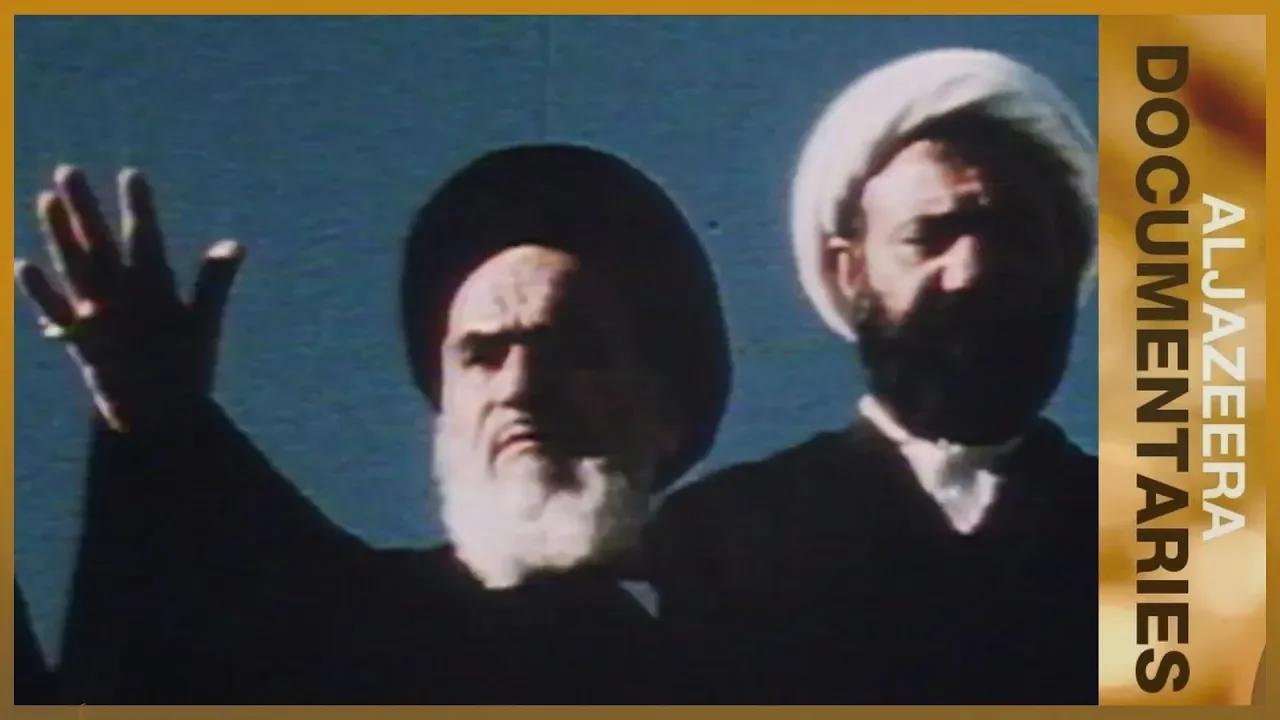
[Music] An old man is praying. This is Ayatollah Humeni.
He is preparing to radically change the history of Iran.
It isn't easy to talk about the greatness of this figure. One of his enemies once remarked that there had been no one like him for 800 years and there would be no one else like him for another thousand years.
Hmeni historically embodied the people's opposition to the Sha, the all powerful monarch who had reigned over Iran for nearly 40 years. In exile for 15 years, the Ayatollah was finally returning home for the final battle alongside his people. A revolution in the name of Shiite Islam.
A new era was about to begin in the Middle East.
[Music] A year before Hmeni's return, an uprising began in Tehran. In early 1978, hundreds of thousands of Iranians took to the streets to challenge their ruler.
Demonstrators had had enough of a ruler who bent on making Iran a great power sought to impose westernstyle modernity on them either willingly or by force.
They viewed it as an unfair and corrupt system that failed to meet the most basic needs of the population.
[Music] Two countries had come to embody the imperialism condemned by the demonstrators. Two countries that supported the Sha's regime, the United States and Israel.
Today, it is difficult to imagine those two countries were the Iranian state's closest allies.
For us, Iran was arguably our most important partner after the United States in terms of economic interests.
We undertook some grand projects with them.
Back in the 1950s, Israel had made overtures to the Sha. Isolated in an Arab world that refused to acknowledge its existence, the Hebrew state was looking for non-Arab partners a little further a field in the Middle East.
Iran, Persian, pro-western, built on a different kind of Islam to the other Arab countries, stood out as a natural ally.
It's hard to imagine now, but it was a very close-knit collaboration.
It has the most advanced technology.
Washington 2 had chosen to make Iran the cornerstone of its influence in the region.
War comes in so fast that it the high degree of military cooperation was designed to keep tan in the western camp.
Also this was the time of the cold war of course and Iran was a major arena of um US Soviet competition.
So yes the job was close to America because he felt that it needed the American support in confronting the USSR and uh maintaining his government in power.
[Music] For both Tel Aviv and Washington, Iran under the Sha was an invaluable partner, the key piece in the great Middle Eastern game.
But neither Israel nor America realized the extent and strength of an opposition that was destined to prevail.
When I spoke with the generals, they would tell me, "Look, it's like measles.
We're seeing demonstrations at the moment. That's the way it is. The Sha has asked us to sort it out because he's the military chief." Well, we're sorting it out.
[Music] [Applause] The blindness and incomprehension of a regime faced with such a powerful and determined uprising was heading for tragedy.
[Music] [Applause] [Music] That day, Black Friday, the Sha's army opened fire in the streets of Tehran.
The official death toll was 87, but according to opposition estimates, it was closer to 4,000.
The monarchy had just revealed its true face.
The revolutionary process was underway and now there was no stopping it.
Regarded as supporters of the Sha, Israeli and American expatriots became targets and began to leave the country.
Protesters attacked cafes, restaurants, banks, and cinemas. Western symbols of modernity associated with the stronghold Israel and the United States had on their country.
tearing down the monarchy, breaking ties with Washington and Tel Aviv, rejecting Western style modernity. All of these objectives combined into a single battle.
Gradually, as the movement began to pick up uh momentum and it it was a movement in need of a leadership, in need of a leader. The person that fit the bill uh seemed to have been [Music] I have to say that not only the different factions of Islamic movement followed and joined him but the other factions of the movement as well were like nationalists like Marxists.
All factions supported as the leader of the revolution.
The time had come for Hmeni to realize his dream, the introduction of a radical doctrine and establishment of an Islamic republic, a theocracy wherein the ultimate power lay with a religious authority, the supreme leader, him.
[Music] [Music] Hmeni set foot on Iranian soil, ready to deliver the fatal blow to the monarchy.
[Music] Nothing and no one could stand in his way.
It was shocking. It was really shocking.
About 10 million people came to streets of terror.
This was the biggest welcoming ceremony ever during the history as long as I remember. 10 million people to come to welcome a leader [Music] and everybody looked at him as the leader of the revolution, a charismatic leader and a man of God at the same time. uh uh that uh he will rescue the country uh and we will have a paradise on the earth.
[Music] Hmani was now the man who embodied the legitimacy of power especially as the sha weakened by ill health had departed the country three weeks earlier.
[Applause] 10 days later, after only 48 hours of fighting in the streets of Tehran, the overthrow of the Iranian monarchy the Sha had ruled over for 37 years was complete.
[Music] The revolution had achieved a total victory. Ayatollahi was the country's new leader.
[Music] The revolutionaries immediately attacked the enemies identified by the new regime with the Israeli diplomatic mission sacked and completely devastated. Its 33 members were the last Israelis still in Iran.
They traveled in small groups to the Hilton Hotel in central Tehran where a bus was waiting to take them to the airport, a distance of some 17 km. 17 km through a hot bed of revolution.
[Music] 17 km. 10 million Iranians on either side of the road, all with tomatoes and eggs. In the bus, there was a driver and two Iranians with Kalashnikovs. Our bus moved on. They thought it was a revolutionary bus. Not a single egg or tomato was thrown.
On reaching the airport, they boarded the aircraft.
But just as the plane was about to take off, they boarded the plane. The engines started and it began to taxi.
Then all of a sudden, it stopped. The doors opened and armed revolutionaries barged in again. I thought to myself, what is it this time? They wanted to carry out one final check. I don't know what for. Then they closed the door and we took off. For as long as we were over Iranian territory, the mood remained tense. Once we crossed the border, the Israelis erupted into cheers.
Meanwhile, the Israelis archeneemy, Yaser Arafat, leader of the PLO, the Palestinian Liberation Organization, was arriving in Tehran, welcomed like a true head of state.
Arafat had become leader of the PLO in 1969. Its stated ambition was to create a Palestinian state independent of its Arab backers.
From his base in Lebanon, Arafat had been leading his Fedí, his fighters into guerilla actions on the northern border with Israel.
Now he had come to seek the support of Hmeni, a man he hoped could help Palestinians achieve their independence.
Definitely it changed completely the whole strategic policy in this area in case of a war upside down completely.
[Music] By inviting Arafat to Tehran Hmeni was sending a powerful message to the entire Muslim world. From now on, Iran would be supporting the Palestinian cause.
[Music] Hmeni then took a provocative initiative. Instead of an Israeli diplomatic presence, there would now be a Palestinian embassy. It was a clear statement.
With this gesture, the Ayatollah was severing all links with Israel, a state whose existence had no legitimacy for him. Any strategic alliance between Israel and Iran was now unquestionably a thing of the past.
[Music] [Applause] The United States recognized the young Islamic Republic, but in Washington, there was concern about what kind of relations would be possible with Iran's new rulers.
Within the American government, there were differing opinions. Some thought that committee was an extreme uh uh force and it would be very difficult for us to to deal with. I think most people still thought of uh Iran as a country that you know we could continue to get along with that even though the sha was gone that uh you know we we would maintain relations. We had our embassy there.
Then on November 4th, 1979, hundreds of Islamist students stormed the American embassy taking 52 diplomats hostage.
Hmeni was hesitant. Would he support these students and risk seriously jeopardizing relations with the United States?
Would he support them to keep control of the movement?
Fore! Foreign! Foreign!
[Music] When the hostage crisis occurred, it made clear, I think, that we were largely unprepared to deal with uh the nature of Iran. on at that point and the fact that u the anger that was there and reflected uh in that hostage crisis uh I think suddenly brought Iran to the top of the concerns that we had about uh our situation in the world.
The last hostages were finally freed after 444 days. By supporting the students, Hmeni made the US embassy hostage taking act two of the revolution. It became one of the founding myths of the new regime. Widely seen as the main reason for the breakdown in US Iranian relations.
A new Middle East was taking shape.
Nothing would ever be the same again.
Thrron's ambitions and interests were on a collision course with Washington and Tel Aviv. A great clash was looming.
[Music] On this day, nearly 90,000 Israeli soldiers, 1300 tanks, and500 personnel carriers invaded Lebanon, a country seemingly unconnected to the emerging confrontation between Iran, Israel, and the United States.
Torn apart by civil war for many years, Lebanon had become a regional battleground. Syria occupied a part of the country to the east. But in the south, especially, the PLO was all powerful. The Palestinian organization had made the area its operational base for instigating deadly raids against Israel.
On June 6th, 1982, Tel Aviv launched Operation Peace for Galilee.
The objective was spelled out loud and clear to seize control of southern Lebanon and thus put an end to the guerilla operations launched by Arafat's Fedin.
[Music] We came here to fight and destroy the terrorist organizations that have been killing and murdering our people for years and years. That is our goal here. Ariel Chiron, recently appointed minister of defense, was leading the offensive. To his fellow countrymen, he was a hero who had been at the forefront of every military victory Israel had won since its inception in 1948. Once we finish it, we'll move immediately back. We don't have any interest whatsoever to stay here, not our country.
We don't need even one square inch of this country.
[Music] Within a week, Shaon had far exceeded the initial objectives as his army made rapid advances.
[Music] Thrron looked on stupified with Israeli troops advancing towards the Lebanese capital. The balance of power in the Middle East was radically shifting. For Hmeni, it was unthinkable. But how should he react?
Engaged in an all-out war against Iraq after the attack launched by Saddam Hussein 2 years previously in September 1980, the young Islamic Republic would be forced to fight for its survival for eight long years in what became known as the Iran Iraq war.
At this stage, the Iranian leader did not have the resources to open another front against Israel in Lebanon. Kmeni issued a statement justifying this decision saying the road to which is Jerusalem goes through Carbala which was uh a religious way of expressing a deeply strategic decision meaning first things first.
The aspiration for Iran to play some role in the liberation of Jerusalem comes after Iran has managed to defeat stones in Beirut. Heavy shelling was now falling on the west of the capital where Arafat and most of his troops had taken refuge.
[Music] [Music] Part of the city was raised to the ground. Thousands were dead, mostly civilians.
On August 21st, 1982, the Israeli siege ended.
[Music] Yaser Arafat paid a final visit to his West Beirut headquarters.
Defeated, Arafat departed Lebanon and went into exile in Tunisia with 10,000 of his.
They were replaced by a multinational force composed mainly of US and French troops tasked with ensuring the safety of the Lebanese capital.
[Music] For Chaon and Prime Minister Manakim Bean, the Palestinian question was settled. They could now proceed with their secret objective of transforming Lebanon.
The multiffaith country would become a Christian state led by the Marinite minority. This new Lebanon would be a powerful state and above all an ally.
[Music] But their plans would unknowingly awaken another Lebanese community, the largest in the country, the Shiite community.
Settled mainly in the east and in the south of Lebanon, the Shiites had suffered directly from the invasion and Israeli occupation.
Some resolved to take up arms and resist.
It was my belief in 1982 that Israel was an enemy and I supported the Palestinian cause.
I considered myself to be on their side.
Naim Kasim was then 29 years old. a chemistry teacher in Beirut. He was leader of the Union of Islamist Educational Associations, a Shiite organization.
For us, the thinking of Imam Hi chimed perfectly with our deep beliefs.
So, we got together with some other Islamist groups and came to an agreement.
We went to Iran to proclaim our willingness to pledge allegiance to Imam Hi, to allow him to be our guide and to respect his authority.
And he gave us his blessing.
[Music] Homini welcomed this alliance.
It would allow him to better fight the Jewish state.
It was an obvious union given his old and deep ties with the Lebanese Shiites.
Many of the leaders of revolution in Iran who became at top positions after victory of revolution.
They had very good background in in Lebanon before revolution. Good connection with Shia people in Lebanon.
You know, Shiism in south of Libnan is older than sheism in Iran.
[Music] In the summer of 1982, Lebanese Shia leaders gathered in the city of Balbeck in the Bea Valley located in the east of the country to set up a new organization to fight Israel with the backing of Hani.
It called itself the Islamic Resistance in Lebanon.
It officially took the name Hezbollah 3 years later in 1985.
[Music] Hezbollah's initial objectives were military.
It was not only about offering armed resistance against the Israelis, rather to end the occupation by any means necessary and drive them out of Lebanon.
[Music] To help the new organization, Iran sent a few hundred revolutionary guards to the Bea Valley in the summer of 1982.
These men were part of the elite body created at the birth of the Islamic Republic and charged with its defense.
It reported directly to the Supreme Leader.
While these elite soldiers did not actually fight, they supplied weapons, money, and knowhow.
[Music] Their presence also implicated another country whose army had a presence in this part of Lebanon, Syria. To reach the Bea Valley, the men benefited from the help of the dictator Hafes al-Assad, another fervent opponent of the state of Israel.
This way, Humeni was establishing what would prove to be a strategic alliance for many decades to come. the partnership with Syria.
They began organizing the Hezbollah.
They began organizing uh an alliance with uh Assad. They began selling uh giving away oil to Assad to buy a relationship with Assad because they began to think about what they call their strategic depth. They wanted to have tools at their disposal to threaten Israel with, which meant threaten the United States with and say, "If you hit us, we can hit you back." And then by creating the Hezbollah, they hit both the Israelis and the United States in Lebanon.
[Music] What took root in the confines of the Bea Valley was a veritable system of alliances.
a system set up by Iran with the help of Syria. A system that created a new political entity, Hezbollah.
A system which would later give rise to the powerful Iran Syria Hezbollah axis in the Middle East.
But for the moment, nobody was aware of the emergence of this system. Least of all the Americans and Israelis.
Dear Canoon, southern Lebanon, about 10 km from the Israeli border.
At around 6:30 a.m., a white pujo stuffed with explosives leaves the village heading towards Ty, the largest town in the region.
At the wheel is a young 18-year-old resistance fighter and member of Hezbollah. His name is Ahmmed Kasir.
Ahmed.
Ahmmed Kasir had always been a quiet person, but he could not keep silent in the face of injustice.
He lived in Saudi Arabia at the time, but returned to Lebanon after the Israeli invasion.
Our uncle tried to hold him back, telling him that a war was raging, but his reply was, "I know what I must do."
[Music] Within a matter of moments, this unknown young man would become a hero in the Shiite struggle against Israel. what is known here as a shahed, a martyr of the resistance. He was about to commit a bold act that had no precedent in Lebanon, one that was both religious and political.
In 1982, we inevitably lost in any direct confrontation with Israel. We had no way of striking back.
We could only get somewhere by taking a new, more effective approach.
Acts of martyrdom.
[Music] 7:00 a.m. November 11th, 1982.
Ahmmed Kasir drives along the main thoroughfare through tire.
Without hesitation, he accelerates and crashes himself and his vehicle into a large residential complex.
The Israeli military headquarters for the whole of southern Lebanon collapsed.
A sevenstory building demolished.
[Music] At the time, we had a grocery store entire.
I was on my way there when the explosion happened. I'll never forget it. There were pieces on fire everywhere.
The whole building was on fire. The Jews had blocked the street. We were proud that something was finally happening, although we didn't know what.
[Music] We were occupied.
We were glad that some of the occupiers died, but we were nervous because we didn't know who was behind it. We didn't know it was my brother Ahmed. I will never forget the moment I found out.
[Music] It was carnage. 91 Israeli soldiers and 15 Lebanese prisoners were killed.
Ariel Chiron was mystified.
How could something like this occur when the only known enemy, the PLO, had been crushed more than 2 months ago?
Amen.
We had no information.
It was very unfortunate in retrospect.
We knew there were some religious activists.
Some we knew, others we didn't.
[Music] The shock worsened when I began to research written records on the Shiites in Lebanon compiled by intelligence and academics.
I was very disappointed.
There was almost no solid research on the subject.
The universities had nothing either.
The multinational force in Lebanon led by the Americans and French was just as unaware as the Israeli military.
On October 23rd, 1983, it was their turn to suffer a similar attack.
The two-tonon bomb devastated the four-story building in which 200 Marines may have been sleeping when the explosion occurred shortly after 6:00 a.m. Beirut time.
The Americans lost 241 soldiers. At the same moment, a suicide bomber blew himself up in a building serving as a barracks for the French forces. 58 were killed.
A double strike claimed by a mysterious Islamic jihad movement thought to be a figurehead for Hezbollah and Iran.
I think there there is much that indicates that the Iranians did have a role if not a very important role in that. Do you have any indication about responsibility?
Yes, we have some but we're not going to point the finger until we're absolutely certain. But I think the thing that does come through loud and clear is the just the insidious nature of terror, international terror. With this new attack, the Hezbollahites could no longer be ignored. They saw themselves as a resistance movement against Israel and its allies.
I recall uh Hisbala seeming to be a domestic factor and then by the mid 1980s it was clear that there was this pipeline um arms material men uh coming from Iran u hostages going uh from Lebanon to Iran uh and political support. Um so this was an emerging phenomenon.
[Music] From the start, the Iranian fighters were smart enough to understand that you cannot create an armed militia without the support of the local population.
[Music] The Iranians constructed what I would call a counter society alongside the ordinary Lebanese state.
It works like this. The child is born.
He goes to a Hezbollah daycare. Then he goes to a Hezbollah school. Then he joins the Hezbollah scouts.
After that, he attends a Hezbollah high school. And then he joins Hezbollah.
[Music] [Applause] [Music] The Israelis were counting. 600 men dead in 2 years. It was a price many were not prepared to pay.
The Israeli army gradually lost control of Lebanon.
On June 6th, 1985, 3 years after the start of the invasion, the Israeli army pulled out, preserving a security zone in the south, an area representing 10% of Lebanese territory. The Israeli army remained there for 15 years until 2000.
It saw this withdrawal as a humiliating defeat.
While for Hezbollah, it marked a first victory.
The Shiite organization chose the moment to claim responsibility for the destruction of the tire headquarters bombing. The name of the Shahid was also revealed, Ahmad Kasir.
November 11th, the day of the attack, became the movement's official martyr's day.
[Music] When Ayatollah Hommeni passed away in June 1989, he left a lasting legacy.
The Shiite theocracy which he had founded 10 years earlier had been firmly established and the fight he initiated against Israel and the United States had with the help of Hezbollah profoundly changed the landscape in the Middle East.
But moving forward, what would his successors do with his legacy?
[Music] Heat.
Up Next
33:29
Sunni vs Shia Islam: Key Differences Explained
@TheVisualDeen
2.3K views•2026-03-28

12:54
Triumph of Orthodoxy Icon: Byzantine Art & History Explained
@BenCallan
2.1K views•2024-08-06
25:55
Climate Change in the Himalayas: Water Conflicts & Melting Glaciers | Documentary Analysis
@DWDocumentary
103.3K views•2022-07-17

1:42
Game of Thrones Opening Credits: A Cinematic Analysis
@gameofthrones
46.3M views•2011-04-18
Related Study Plans & Knowledge Roadmaps
Structured learning paths in General & Interdisciplinary Studies
general-studies
Elevator Engineering: History, Physics & Cities
01From Hoists to Safety Brakes: The Dawn of Vertical Lift
02Hydraulic vs. Traction: The Engineering Physics of Elevators
03Modern Speed, Safety, and Algorithms
+ 2 more learning modules
12h5 modules
Explore Roadmap
general-studies
Rubber: Material Science, History & Geopolitics
01Origins of Natural Rubber & Mesoamerican History
02The Chemistry of Natural Rubber & Vulcanization
03The Geopolitics of the Rubber Boom & Colonization
+ 2 more learning modules
12h5 modules
Explore Roadmap
general-studies
Containerization: Evolution, Logistics & Trade
01Ancient Trade & Bulk Cargo: Amphorae to Barrels
02The Industrial Revolution & Cardboard Packaging
03The Containerization Revolution: Malcom McLean
+ 2 more learning modules
12h5 modules
Explore Roadmap
general-studies
Textile Tech: Evolution, Labor & Global Impact
01Pre-Industrial Textiles: Handloom & Cottage Industry
02Mechanization: The Spinning Jenny to the Power Loom
03The Factory System & Global Labor Transformation
+ 2 more learning modules
10h5 modules
Explore Roadmap