





![Lecture - 21 (2021) - Co-ordinate Geometry and Vector Analysis [Muhaiminul Islam Adnan] UIU](https://i.ytimg.com/vi/jBZ1Qhx7Cf4/maxresdefault.jpg)


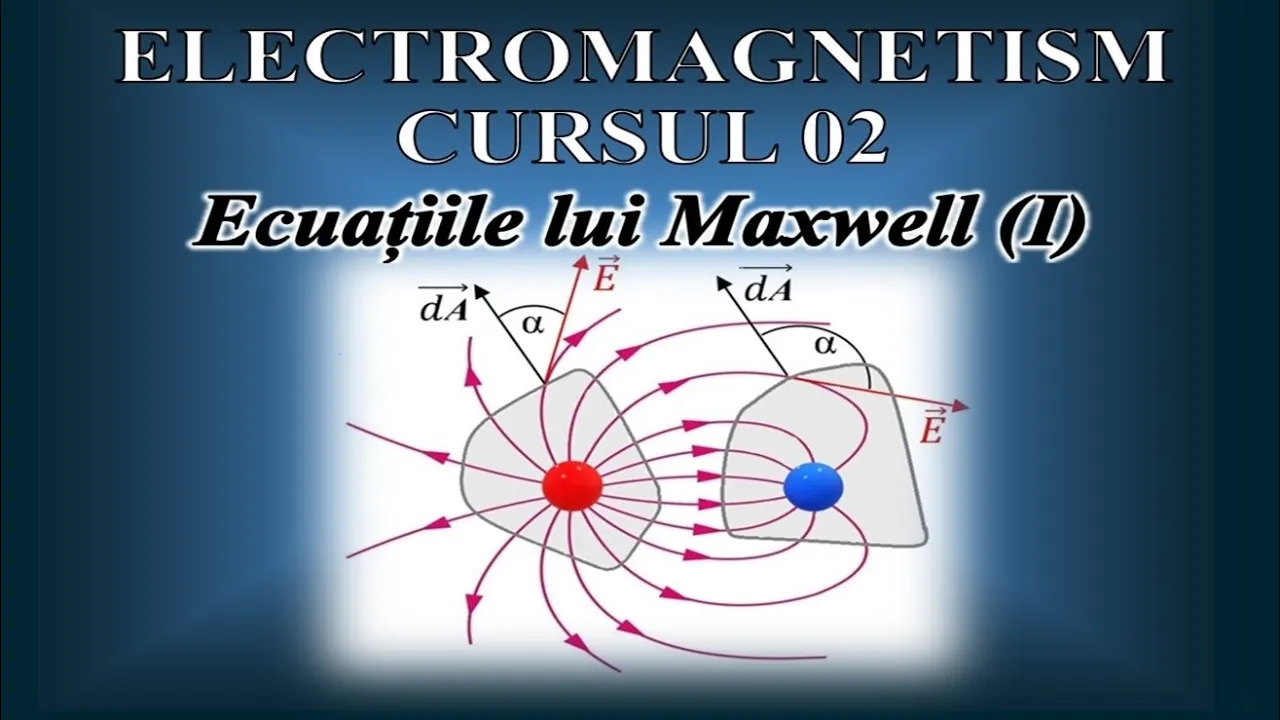

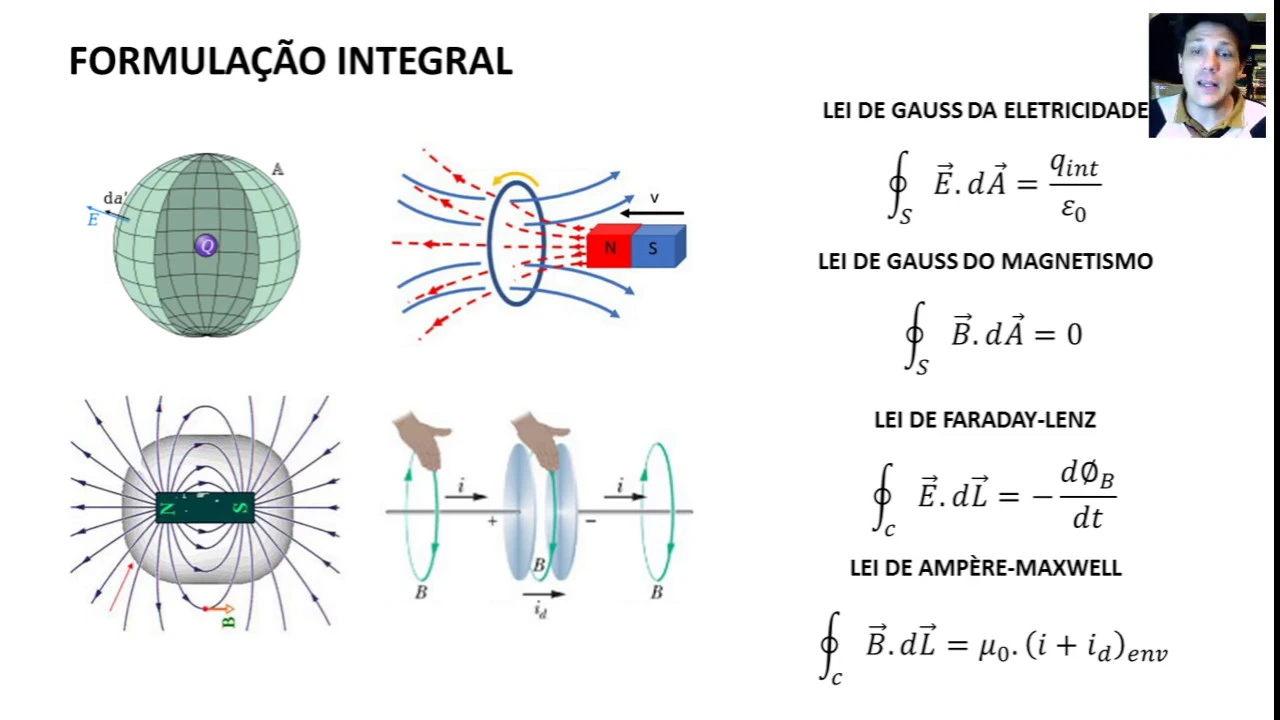






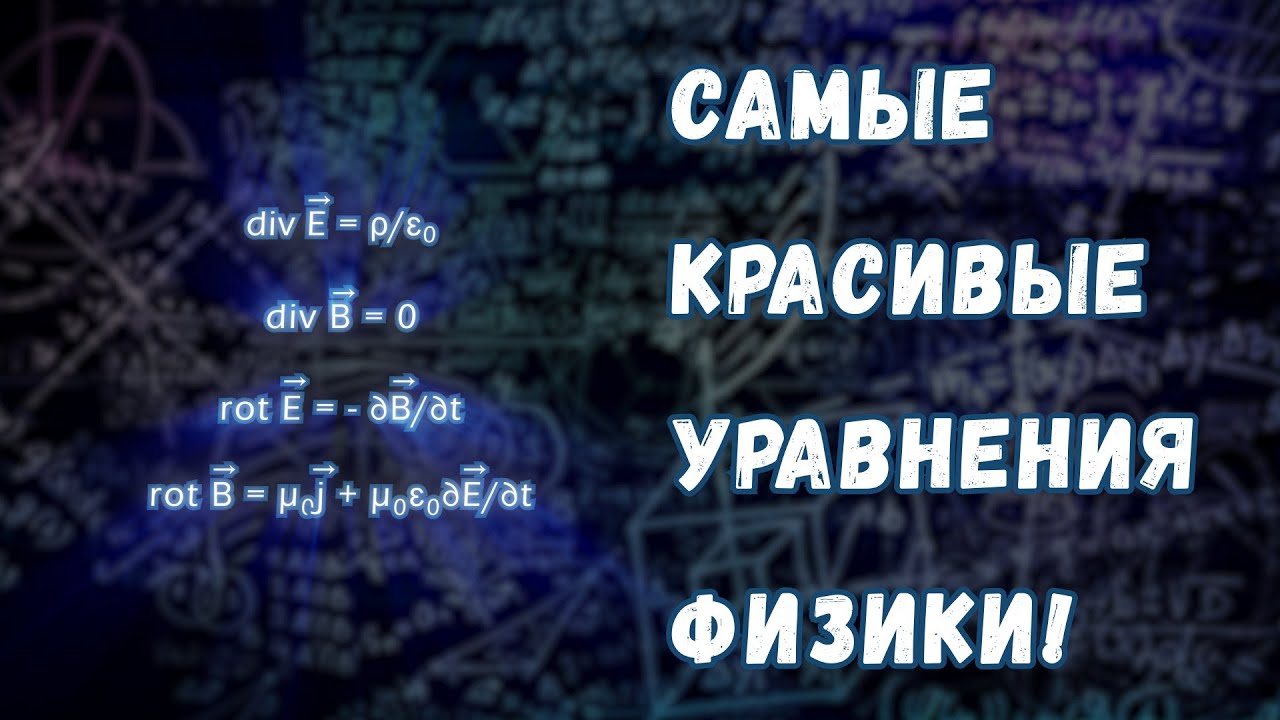





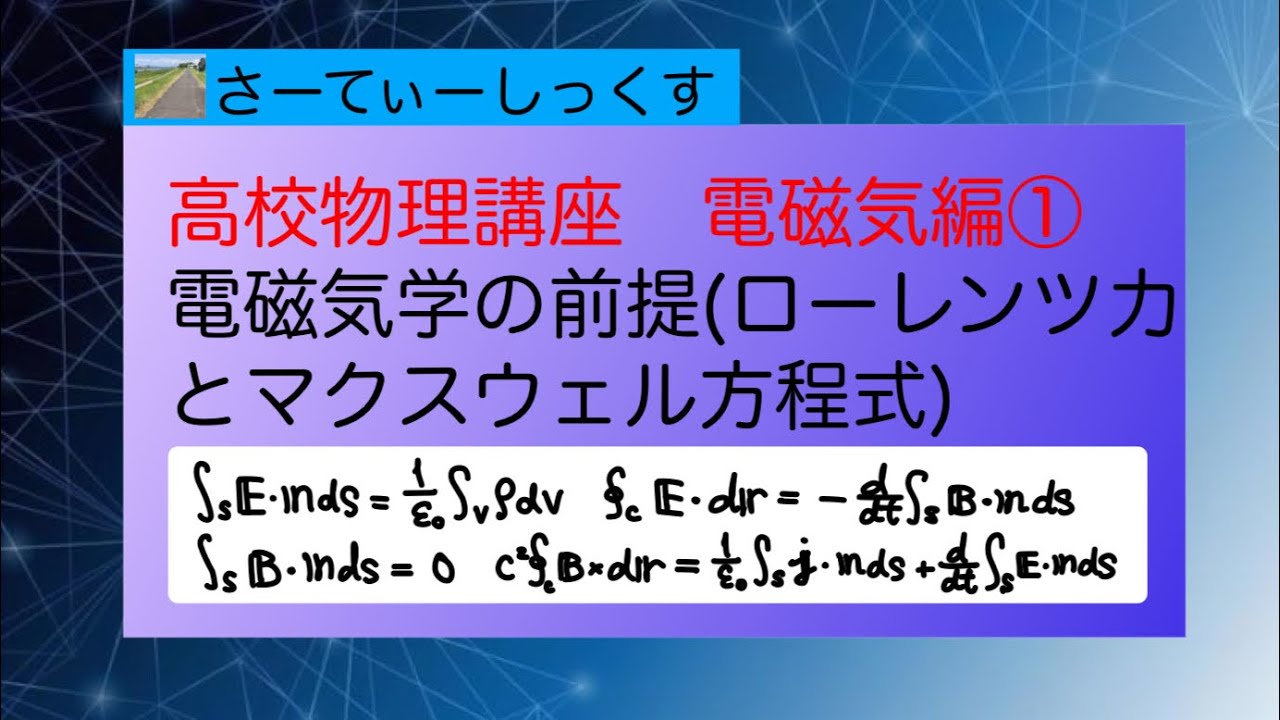
Maxwell's four equations describe how electric and magnetic fields exist and change over time: (1) Gauss's Law for Electric Fields states that electric charge produces electrostatic fields, with flux through any closed surface proportional to enclosed charge; (2) Gauss's Law for Magnetic Fields states that magnetic flux through any closed surface is always zero, meaning magnetic field lines always form closed loops and isolated magnetic poles do not exist; (3) Faraday's Law states that a changing magnetic flux through an open surface induces a circulating electric field and electromotive force around that surface; (4) The Ampère-Maxwell Law states that an electric current or changing electric flux through a surface produces a circulating magnetic field around any path bounding that surface. These equations unify electricity and magnetism and form the foundation for modern physics and engineering technologies.
Maxwell's Equations Explained: A Beginner's Guide
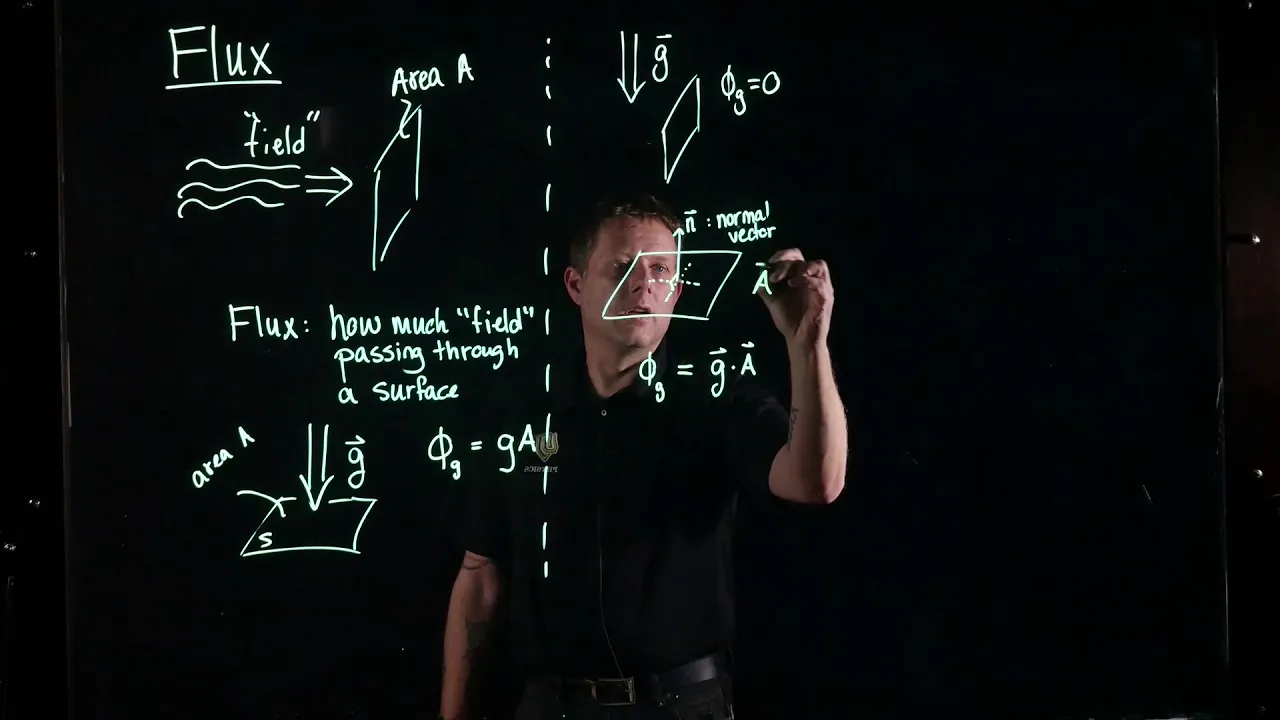
Added:this episode was made possible by brilliant hello today on up and adom we're going to be breaking down Maxwell's equations the fundamental laws that explain how electric and magnetic fields exist and change over time they lay the groundwork for a huge amount of modern physics and Engineering from enabling wireless communication to powering homes the equations are integral to pretty much all of the technologies that Define our everyday lives and have been called the most important equations in the history of science this video will be a bit different to my regular videos I'm aiming to give you a strong and intuitive feel for what the math Behind These equations is communicating without getting overly bugged down in the math itself so by the end you should be able to confidently explain what each of Maxwell's four equations is talking about and what each mathematical symbol in the equation is communicating consider this your One-Stop shop for Max Well's equations as an overview you can think of Maxwell's four equations like this all the equations either concern electric fields or magnetic fields the first two laws are about how electric fields and magnetic fields are produced and the final two laws are about what happens when these fields change over time let's look at the first law written out in words first don't worry if you don't understand all of the terms we're going to build up a good understanding of all of them Maxwell's first law is also known as gaa's law for electric Fields electric charge produces an electrostatic field the flux of that electrostatic field passing through any closed surface is proportional to the total charge contained within that surface this is the mathematical equation for the first of Maxwell's equations each of the terms in this equation means something very specific and the best way to build up an understanding of what the overall equation means is by expl explaining each symbol individually let's start with understanding what an electric field is a field is essentially a region of space where you can feel a force I'm in the earth's gravitational field right now and I can feel the gravitational force acting on my own Mass similarly you're in an electric field if you can feel an electric force acting on charged objects if a charge was in an electric field it would feel a force no matter where it was because the electric field is everywhere but for convenience you'll often see continuous electric Fields represented by these arrows electric field lines the closer the arrows are to each other the stronger the electric field we're looking at and the greater the force a charge would feel in that electric field by convention the arrows are pointing in the direction that a positive charge would move whereas a negative charge would move in the opposite direction in gal's law for electric Fields an electric field is represented by this capital E you might already have spotted that it's a vector indicating that it has a Direction but it's important to clarify that we're not just talking about a vector at one point in space an electric field can come in a load of shapes and sizes and applies to every point in space so it's a whole field of vectors or a vector field at one point the electric field e might be super strong and in One Direction and at another point it might be much weaker and pulling in another Direction the Little n that you can see in the first of Maxwell's equations is also a vector this Vector is called the unit normal vector and it's a lot less complicated than the electric field Vector if you pick any surface the unit normal Vector is just a vector with a length of one that points away from the surface at a 90° angle wher every you are on the surface in this case there's a DOT between the electric field vector and the unit normal Vector this represents the dot product or scalar product you might already be familiar with taking the dot product between two vectors but let's take a moment to understand what it really means the dotproduct between two vectors can be mathematically written out as multiplying together the magnitudes or sizes of each vector and the cosine of the angle Theta between the vectors what's the physical significance of the dot product setting up this right angle triangle will help make things a bit clearer when we multiply the length or magnitude of vector e by cos Theta we end up with the length of the adjacent side of this right angle triangle we then multiply that by the length of the unit normal Vector which by definition is just one so the dot product between vectors e and N just gives the length of the adjacent side of this right angle triangle this can be thought of as the amount of e that is pulling in the direction of n or the component of e in the direction of n so all this stuff simply refers to the amount of the electric field pulling in the direction of the unit normal Vector since the unit normal Vector just points perpendicularly to a surface e.n refers to the amount of an electric field e which is perpendicular to a certain surface vectors and Dot products are essential to pretty much every part of physics but they can be difficult to grasp it took me a while to fully internalize them when I was at Uni and the only way to really understand mathematical Concepts in your bones is by working through problems yourself that's why I'd like to take a moment to introduce today's sponsor brilliant brilliant course on vectors is the perfect place to build an intuition for this extremely useful concept but what makes br and special is how it helps you grasp Concepts across many areas math programming Ai and more by learning through doing each lesson is filled with Hands-On problem solving that let you play with Concepts a method proven to be six times more effective than watching video lectures plus all content on brilliant is crafted by an award-winning team of researchers teachers and professionals from MIT Caltech Juke Microsoft Google and more the interactive Style just makes it so fun and easy that's actually one of the things I really love about brilliant revisiting topics I once struggled with and having them click it's very satisfying I use brilliant to go deeper into my research for videos and I'm always delighted by the new levels of understanding it unlocks for me whether you're a beginner or a working professional brilliant has a course that will help build your critical thinking skills through problem solving not memorizing to try everything brilliant has to offer for free for a full 30 days visit brilliant.org atom or scan the QR code on screen or you can click the link in the description you'll also get 20% of an annual premium subscription that's an entire month to see just how much deeper you can go with Concepts like this totally risk-free okay back to the video in Maxwell's first equation we're not talking about just any surface we're specifically talking about an electric field passing through a closed surface a closed surface is just a surface that completely separates its insides from its outsides so a sphere would be a closed surface a donut or Taurus would also be a closed surface even though it has a hole through it there would be no way for you to get inside the doughnut without passing through its surface by contrast some open surfaces are a bowl a plate or a piece of paper this squiggly thing along with this da is called a surface integral it's worth making sure we fully understand what a surface integral is as it comes up a lot throughout Maxwell's equations and just physics in general a surface integral comes in handy when dealing with functions that vary in two dimensions for example let's say you have just fertilized a very large field unfortunately the fertilizer wasn't distributed uniformly so its concentration the amount of fertilizer per M squ changes in both the X and Y directions if you wanted to go back and find the total amount of fertilizer you placed in the field you would need to use integration as the concentration is continuously changing so we can divide the field into tiny two-dimensional area segments where the fertilizer concentration is pretty constant in each segment each segment has a tiny area da you can find the amount of fertilizer in the whole field by multiplying the size of each area segment da by the concentration of fertilizer in the segment and adding all those values up together that's what a surface integral is adding up the value of a function at each tiny area segment over an entire surface the surface integral that comes up in ga's law for electric Fields is only slightly more complicated because the quantity that's varying isn't a scaler like an amount of fertilizer instead it's a vector field the electric field so instead of a fixed number varying throughout all the tiny area segments it's the electric field both its magnitude and direction that is varying throughout all the tiny area segments the surface integral of a vector field essentially gives you a measure of how much of the field is flowing through your surface that will be different depending on how strong the field is at a certain point and what direction the field is is pointing relative to the surface for example in this uniform electric field there is more electric field flowing through the top of the hemispherical surface than anywhere else as it's facing the field headon as a result a tiny area segment at the tip of the hemisphere would contribute more to the overall surface integral we give a special name to the surface integral of a vector field it's called flux which brings up images of something flowing it's generally really helpful to think about electric and magnetic fields as flowing especially when talking about the amount of field going through a surface however we should remember that comparing fields to flowing fluids is ultimately just an analogy so we call the entire left hand side of the equation the electric flux through a closed surface and remember we should think of that as the amount of electric field that is flowing through our closed surface can flux be negative yes surface penetration is a two-way street so once the direction of our unit normal Vector has been established as outward from your closed surface any flux in that direction coming out of the surface is positive and any flux in the opposite direction going into the surface is negative we can think of flux through a closed surface as the overall amount of field or number of field lines that are passing through a surface any lines of positive and negative flux will cancel each other out this has really important implications see any electric flux that enters a closed surface must eventually come out the only way a closed surface can have any overall positive or negative flux it's for the flux to appear inside the surface or disappear inside the surface without the creation or destruction of any flux all the field lines would just enter the surface Sur and exit the surface resulting in no overall flux so unless there is some mystery thing that can produce electric flux or destroy electric flux the left hand side of Maxwell's first equation will always end up equaling zero it turns out that the mystery thing we're after that can produce or destroy electric flux is electric charge in the equation it's given the symbol q and is called the enclosed charge because it's inside our closed surface positive charge produces electric flux and is called a source of electric flux negative charge absorbs electric flux and is called a sink in order for a closed surface to have any positive or negative overall flux through it it will need to either contain a positive charge or contain a negative charge that's the overall headline of Maxwell's first equation electric charge produces an electrostatic field the right hand side of the equation just pads out the statement with a little more math not only do you need an enclosed electric charge to have any sort of overall flux through a closed surface but the overall flux through a closed surface is actually directly proportional to the amount of charge enclosed within it so if I double the amount of charge enclosed within this surface from 2 kums to 4 kums I can expect the overall amount of positive flux coming from the closed surface to double the constant of proportionality between the enclosed charge inside a surface and the overall amount of electric flux going in or out is a constant called the electric permitivity of free space it's represented by the Greek letter Epsilon with a zero subscript it has the value of 8.85 multiplied by 10 ^ of -12 this constant came up quite a bit for me at Uni and was always difficult to get a grip of the best way to think about electric permit ity in general is how easily a material lets electric field lines propagate and spread out through it this constant is simply a quantification of how easily a vacuum with nothing in it free space lets electric Fields through it that brings us to the end of gaal's law for electric fields and the first of Maxwell's equations let's recap both the visual intuition as well as the math intuitively the equation is communicating that electric flux can only appear at a positive charge and end at a negative charge that's the only way for an electrostatic field to be produced or destroyed mathematically the equation is letting us know that the amount of electric flux through a closed surface around a charge is directly proportional to the value of that charge the second of Maxwell's equations is called gal's law for magnetic fields it's similar to the first equation in that it concerns how Fields can be produced but but it concerns magnetic fields instead of electric Fields it'll be a lot easier to explain now that a good chunk of the math is already familiar to us it can be summarized in words as the flux of a magnetic field passing through any closed surface is zero if I pull up ga's law for electric field so you can see the first two of Maxwell's equations side by side you can see that the left hand side of both equations is practically the same except instead of a capital E for electric field resulting in electric flux we have a capital B for magnetic field resulting in magnetic flux this value for the magnetic field B can also be called magnetic flux density or magnetic field strength and is measured in a unit called Tesla ultimately we should think of a magnetic field in a very similar manner to the way we think about other fields gravitational fields are regions in which masses can experience a force electric fields are regions in which charges can experience a force magnetic fields are regions in which moving charges can experience a force the faster and bigger a moving charge the more of a magnetic force it experiences just like with an electric field a magnetic field can be represented using magnetic field lines with denser magnetic field lines corresponding to a stronger magnetic field similarly to Electric flux through a closed surface we can think about the magnetic flux through a closed surface as the amount of magnetic field lines penetrating that surface or simply as the amount of magnetic field penetrating a surface mathematically the idea of magnetic flux through a closed surface is found by defining a unit normal Vector as pointing at 90° away from the closed surface then taking the dot product between the magnetic field and the unit normal Vector this gives us the component of the magnetic Vector field acting perpendicularly to to the closed surface then taking a surface integral to add up the contribution of the magnetic Vector field at each tiny area segment to give us the magnetic flux we can think about the overall magnetic flux through a closed surface in an identical way to the electric flux if there is more magnetic flux coming out of a surface than going in the overall magnetic flux is positive if there's more magnetic flux going into a surface than going out the over all magnetic flux is negative if there is exactly the same amount of magnetic flux entering and exiting a surface the overall magnetic flux through that surface is zero the only way that the overall flux through a closed surface can be non zero is if you have something inside that closed surface that is either producing or absorbing magnetic flux so looking at this equation as a whole now we can see that it's a declaration that the magnetic flux through any closed surface is always zero the amount of flux going into a closed surface and out of a closed surface no matter what the surface is is always zero there's no way for it to be anything other than zero or in other words there's no way for a magnetic field to be produced without being absorbed at that exact same point magnetic fields always form a closed loop let's compare the first two of Maxwell's equations before moving on G's law for electric Fields tells us that closed surfaces can sometimes have an overall amount of flux going in or out of them if they enclose a charge G's law for magnetic fields tells us that nothing like that can happen for a magnetic field the overall magnetic flux through a closed surface will be zero this means that while electric field lines do not need to form closed Loops magnetic field lines will always form form closed Loops it also means that while we can find isolated positive or negative charges with electric Fields equivalent isolated North Poles or isolated South poles for magnetic fields do not exist they always form a closed loop the last two of Maxwell's equations focus on what happens when magnetic or electric Fields change and how they interact with each other the third equation is called Faraday's law it gets its name from Michael Faraday who demonstrated that a changing magnetic flux could induce an electric current and that's essentially what Faraday's law says we could Define Faraday's law simply as a changing magnetic flux induces an electromotive force in this simplified form the right hand side of Faraday's law essentially corresponds to changing magnetic flux and the left hand side represents electromotive force or potential difference however I think that would be underselling this equation in reality the equation tells us a lot more than the fact that changing magnetic fluxes can cause currents it tells us that a changing magnetic flux through an open surface induces an electromotive force in any boundary path around that surface what this means is if you have a surface and there is a magnetic field going through that surface that's changing you will get a potential difference around the boundary or border of that surface and if there's a conducting material around that border that will manifest as a current a great example of the general concept here is moving a permanent bar magnet towards a coil of wire the surface area inside the coil experiences a change in magnetic flux a changing magnetic field exerts a force on nearby electrons causing them to accelerate let's look at the math a bit more closely now by breaking down each symbol in the equation this part of the equation likely already looks familiar to you from Maxwell's second equation it represents the total magnetic flux going through a surface but hold on a minute didn't we learn in Maxwell's second equation that the magnetic flux through a surface was always zero well have a closer look Maxwell's second equation only applies if the surface is closed which is represented by this closed loop on the integral sign in Faraday's law the surface we're talking about is an open surface so you can easily move from one side of the surface to the other without going through it the total magnetic flux through an open surface doesn't need to be zero because you can have magnetic flux lines that go through the surface but loop back on themselves away from the surface now this symbol d/ DT is a differential with respect to time this means we're not simply looking at the amount of magnetic flux through the surface but at the rate of change of that magnetic flux through the surface over time let's understand what a changing magnetic flux means look at this surface it has magnetic flux going through it now what would need to happen for there to be a changing amount of magnetic flux over time one option would be to increase the strength of the magnetic field resulting in more flux going perpendicular through the surface this would correspond to increasing the value of B in Faraday's law a second option would be to tilt the surface over time this would mean that less of the magnetic field is passing perpendicularly through the surface in Faraday's law this corresponds to the angle between B and N increasing which results in the dot product between B and N decreasing a final option would be to change the surface area of the open surface this would allow more or less field to pass through the surface over time the faster this is all done the lower the DT term and the greater the rate of change of magnetic flux so on the right hand side of Faraday's law we have a rate of change of magnetic flux on the left hand side we have the result of the rate of change of magnetic flux which is a circulating electric field and electromotive force first let's look at the electric field vector remember it from Maxwell's first equation this electric field is slightly different in Maxwell's first equation we were dealing with an electrostatic field that is produced or caused by a charge but this time we're dealing with an induced electric field which is caused by a changing magnetic field the main difference is that while electrostatic fields from Maxwell's first LW can have points of origination and termination the induced electric Fields here loop back on themselves that's why induced electric fields are sometimes called circulating electric Fields electrostatic fields and induced electric Fields have exactly the same effects on positive and negative charges they're only different in this key structural way the induced electric field Vector is being integrated using a path integral shown by this Capital C it tells us we're integrating along a curve or path this is different from the surface integrals we've been talking about so far far a closed path integral of a vector field is a concept that captures how a vector field behaves As you move along a closed loop or path imagine you're in a field of vectors the vector field could represent many things like wind velocity a different positions in Space the flow of water in a river or the gravitational force or electric field at different locations now imagine you're walking along a specific path in this field a closed path means that you start at a certain point follow the path and eventually return to where you started as you walk along the path you can imagine taking note of how much the arrows are pushing or pulling you along your direction of travel at each point sometimes the vector field may be helping you along your path and sometimes it may be resisting or working against you the closed path integral is the sum of all of these contributions from the vector field as you go around the loop mathematically you're adding up all the tiny bits of work done by the vector field as you move along each segment if the vector at a point is pointing in the same direction as your movement along the path it contributes positively to the integral if the vector points opposite to your movement it contributes negatively in our equation we're summing up the contributions of the induced electric field around a closed path Loop the vector DL is facing in the direction of that closed path loop as you move around it by taking the dot product between the general Vector field e and the direction of the path DL we end up with the component of the electric field e that is facing in the direction of the path and then summing up all those individual contributions through integration since our induced electric field is capable of driving charged particles around the circulation of this electric field around our closed path became known as Electro motive Force however what the integral really represents is the amount of energy it would require to move a colum of charge around our closed path through all the pushes and pulls of the electric field the final part of Maxwell's thirdd equation is this minus sign it represents the Insight that currents induced by changing magnetic fields always flow in a direction to oppose the changing flux so if we moved a magnet toward a coil and the changing magnetic field produced an electr motive force and a current inside the coil the current would produce its own magnetic field that would push the magnet away from the coil or slow it down to summarize a changing magnetic field through a surface will result in a circulating electric field and electromotive force around that surface if there's a conducting material around that surface a current will be produced the electromotive force produced will always oppose the changing magnetic field that caus it Maxwell's fourth equation also known as the Amper Maxwell law is about the relationship between magnetic fields electric currents and changing electric Fields it states that an electric current or changing electric flux through a surface produces a circulating magnetic field around any path that bounds that surface the right hand side of the equation refers to the electric current or changing electric flux and the left hand side reprs the circulating magnetic field that's a result of the electric current or changing magnetic flux one thing you'll notice in the wording of this equation that's different from the other three equations is the word or the Amper Maxwell law isn't just saying a causes C like the first three of Maxwell's equations instead it's saying A or B causes C A being the electric current B being the changing electric flux and C being a circulating magnetic field mathematically the or is represented by this plus sign that's why the ampia Maxwell law has the name of two scientists in it it was ampere that related a steady electric current to a circulating magnetic field and it was Maxwell that added the condition that a changing electric flux could also cause a circulating magnetic field let's start with the left hand side the math here is already familiar to us from the third equation we're dealing with a closed path integral around the boundary of a surface but this time instead of walking in a closed path through an electric field it's through a magnetic field we're walking around the closed loop boundary of a two-dimensional surface summing up all of the tiny Vector contributions from the magnetic field in the direction we're walking so what's going on inside our surface that causes a changing magnetic field around its boundary to answer that we need to look at the right hand side let's begin with ampers contribution the enclosed current which is given the symbol I sub ank a current is simply the movement of any charged particles they could be electrons in a wire or ions in a chemical reaction the reason the current is described as enclosed here is that the charged particles are going through the surface we're interested in it's also worth mentioning that we're talking about the net current passing through a surface if a positive current passes through a surface but then a current of equal magnitude passes through it in the opposite direction those two currents will cancel each other out so if you do have an enclosed current passing through a surface according to the ampia Maxwell law that will result in a circulating magnetic field around that surface Maxwell discovered that the other thing that can result in a circulating magnetic field is a changing electric flux this is represented mathematically by all this stuff you'll recognize the surface integral as electric flux when combined with the DDT this represents the rate of change of electric flux just as Faraday's law says that a changing magnetic flux results in a circulating electric field the ampia Maxwell law is saying that a changing electric flux results in a circulating magnetic field so if I suddenly change the amount of electric flux going through my Surface for example by charging a capacitor I would expect a circulating magnetic field around the boundary path to my Surface there are two constants of proportionality that come up in the Amper Maxwell law the first is the permitivity of free space which we've already seen the second is the permeability of free space just as the permitivity of free space tells us about the response of free space to Electric Fields the permeability of free space tells us about the response of free space to magnetic fields so the ampia Maxwell law is telling us that there are two different ways to cause a Sur circulating magnetic field the first is by using a current and the second is by using a changing electric flux if you use a current the amount of enclosed current through an open surface will be proportional to the circulating magnetic field around that surface if you use a changing electric flux the rate of change of electric flux through the open surface will be proportional to the circulating magnetic field around that surface putting Maxwell's four equations next to each other can make them seem daun but hopefully now you have a good idea of what each mathematical symbol is communicating the first equation G's law for electric Fields tells us that to produce an electrostatic field you need a positive or negative charge the second equation gaal's law for magnetic fields tells us that all magnetic fields come in closed Loops the third equation Faraday's law tells us that a magnetic field that changes over time will result in a circulating electric field and the fourth equation the Amper Maxwell law tells us that an electric field that changes over time or a current will result in a circulating magnetic field
Up Next

Maxwell's Equations in Differential Form | Engineering Physics Guide
@PHYSICSMADEEASYDrDivyaGhildyal
257 views•2024-05-12

21cm Hyperfine Transition in Neutral Hydrogen: Radio Astronomy Basics
@AaronRobertParsons
12.4K views•2011-10-13

Muon Paradox: Proof of Einstein's Special Relativity
@upandatom
486.4K views•2021-12-17

Entropy and the Second Law of Thermodynamics Explained
@veritasium
27.5M views•2023-07-01
Related Study Plans & Knowledge Roadmaps
Structured learning paths in Physics