




![What is a Plasma? Is it the 4th State of Matter? - [5]](https://i.ytimg.com/vi_webp/WVYJQucn2yU/maxresdefault.webp)












![Сборник - Открытый космос. Тайны звёзд. [Третий сезон. Эпизод 1]](https://i.ytimg.com/vi/vrVwJ6KbdN4/maxresdefault.jpg)





![La vida privada de las estrellas [8/10] Supernovas de tipo II](https://i.ytimg.com/vi/RThoKZlidLU/maxresdefault.jpg)
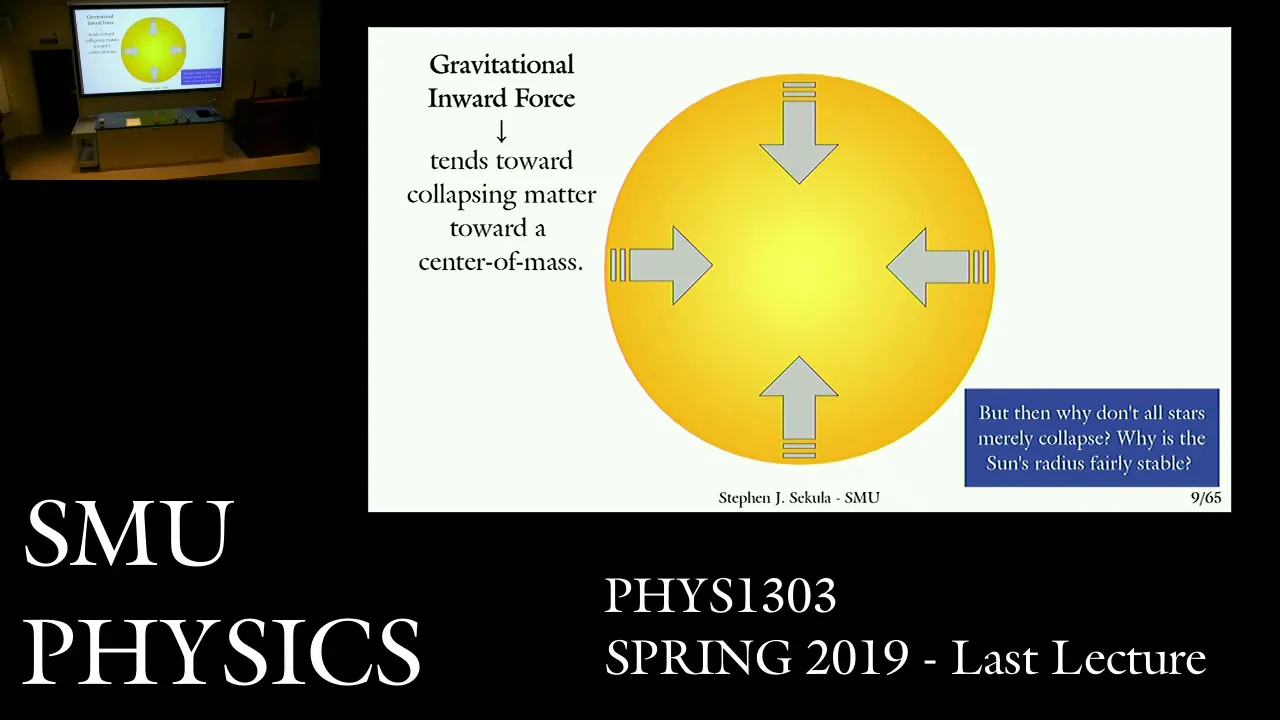
The sun maintains its fixed radius through hydrostatic equilibrium, a balance between inward gravitational pull and outward thermal pressure. The sun generates its enormous luminosity (4 × 10^26 watts) through nuclear fusion in its core, where hydrogen nuclei fuse into helium, converting a small amount of mass into energy according to Einstein's equation E=mc². This process can sustain the sun for approximately 10 billion years, far longer than chemical burning (10,000 years) or gravitational contraction (100 million years) could achieve.
The Sun's Structure, Hydrostatic Equilibrium & Magnetic Fields (AS1010 Lecture 8)
Added:Basic principles of thermodynamics, specifically the relationship between pressure, density, and temperature as described by the Ideal Gas Law.
Fundamental concepts of Newtonian gravity, to understand the inward gravitational force acting on a star's mass.
Introductory electromagnetism, including how the movement of charged particles (plasma) generates magnetic fields.
Basic nuclear physics and atomic structure, particularly the difference between chemical reactions and nuclear fusion.
The life cycle of stars (stellar evolution), exploring how shifts in hydrostatic equilibrium lead to phases like red giants, white dwarfs, or supernovae.
Solar activity and space weather, including sunspots, solar flares, coronal mass ejections (CMEs), and their impact on Earth's technology.
Helioseismology, which uses acoustic waves to probe the internal structure and rotation of the Sun.
Advanced stellar nucleosynthesis, studying how elements heavier than helium are fused in more massive stars.
532 views3likes2:49:27Original Release: 2021-03-25
good morning astronomy 1010 welcome to part two of lecture eight our second part lecture on the sun we are going to delve through the layers of the sun today and if we're lucky get to the heart of our own star where nuclear fusion powers the energy that eventually becomes this wonderful sunlight that is so welcome to us after so many months of winter when we last left off we were talking about the ideal gas law so what's the ideal gas law about tell me what you know i want to ask you some questions to make sure that you're ready to proceed jenna we might need you to hold it down here yep so um the idea of gas law is p equals so pressure equals number density times temperature times boltzmann's constant that's right um watch out for this guys we now have two constants of nature from physics that have the word boltzmann in it there is the stefan boltzmann constant which we use for black body radiation and there is the boltzmann constant which we use for gas particles sorry boltzmann did too much creative cool work and now we have to get confused okay so there's two constants um this constant the boltzmann constant we're going to see a whole bunch of times in our remaining lectures so don't think this is like going away the boltzmann constant shows up any time we deal with gas particles and of course what we're doing right now guys is not only are we learning about the sun which is a giant ball of gas but we're eventually going to want to talk about planets and when we learned about planetary atmospheres obviously gas dynamics are going to come into play okay so um pressure is number density times boltzmann constant times the temperature really it's a relationship between three quantities pressure tells you how hard the gas particles smash into each other number density tells you how many particles there are in the box and the temperature sort of tells you like the speed of the particles i used to have this absolutely wonderful um flash program for the ideal gas law and it's it's no longer working and it's causing me a lot of distress just a moment here uh instead i suppose we'll have to settle for um a less impressive animation that this one here slide 22.
wow uh guys hold on a second i'm just going to pause this recording i have i'm having some uh some technical difficulties here just give me one sec okay let's see if we can do this again i wanted to show you guys a little animation of an ideal gas one that i shared with you before i think it's slide 22 function f5 222 boom okay so these could represent the atoms that make up the gas inside of the sun and you guys know that the sun is a mixture of primarily which two gases jenna i don't know if these guys actually got to watch the the monday lecture yet so i might have to rely on your expertise now um made up of hydrogen and helium hydrogen and helium very good so uh what are the ratios that's something i would test you on i would test you on seven percent hydrogen and 28 helium nice snoring i'm impressed okay that means if we look at this box the blue pellets would be hydrogen atoms the red pellets would be helium atoms okay um the temperature of the gas is related to their kinetic energies and therefore their speeds the pressure is the force of the particles smashing against one another can you guys remind me what the units of pressure are because if you don't know your units it's kind of like you don't know anything you know what are units of pressure in the mks system oh i was going to say pascal pascals very good past okay okay this is just me kind of jogging everyone's memory to kind of where we left off okay i was teaching you guys about the ideal gas law and like i said i used to have this really cool animation with like a bicycle pump and you could pump the particles into a box and it it was just really funny and dorky and cool and i'm i'm really depressed about it so i'm just complaining um in any case it's time for us to think about the sun itself the difference between gas particles in a box in the sun is that in the sun there there is no box the the gas particles are inside a massive and very large sphere you can see it glowing on your sky and there is no bag or boundary that surrounds the sun and yet as you can see with your own eyes the sun maintains a perfectly fixed radius forgive me if i said this last class as well but if you were on a planet around if you lived on a planet around the star polaris polaris is a pulsating variable star and that sun would actually grow and shrink over the course of one month in your sky that would seem very bizarre to us but there are some stars that do not maintain a fixed radius why does our sun maintain a perfectly fixed radius gas particles just want to blow away into space right what do you think makes the sun such a perfectly fixed round ball say that jenna um oh i was gonna guess is it the sun's gravity that's right and if you think about it jenna the gravity must be in such a perfect state of balance with the pressure of the gas particles that the sun maintains a perfectly sharp perfectly fixed radius in our sky and this is an important concept in stellar astronomy it's called hydrostatic equilibrium and it's a key buzz concept in astronomy because it tells us why the sun maintains a fixed radius but it also relates to planets like jupiter and saturn which are essentially giant balls of gas this is a noteworthy topic so let's do it okay introducing a concept called hydrostatic equilibrium oops ium hydrostatic equilibrium is a balance of forces between gravity the sun's gravity pulling shall we say in the sun's gravity is pulling inwards and what we would call thermal pressure pushing out and we use the word thermal pressure to say that it's the pressure related to temperature or in other words it's the pressure expressed in the ideal gas law one of the reasons we have to mention thermal pressure as opposed to just pressure is it's possible for gases to have pressure that depend upon other factors like for instance if you squeeze a gas so hard that the atoms are pressed up against each other and have no more intermolecular space the atoms become degenerate and enter a quantum state the hearts of stars are degenerate and they behave very strangely the gas that makes up the majority of the sun is just like the gas inside some blown-up balloon it's in a state of uh pressure or it has has pressure that's balanced by gravity okay before we go into the layers of the sun i want to have a little quick tidbit on the sun's energy generation methods may i erase okay um do any of you know from life or because you saw it in a tv show how old the earth or the solar system is um i want to say the earth is like 4 billion years old right closer to 5. it's it's actually but good you had it in the several billions of years it's our best measurement to date is 4.6 billion years let's write this down this is a cool tidbit to know so the age of the sun is equal to the age of the earth and it's equal to the age of the moon and it's equal to the age of the solar system and what that means is we believe the entire solar system formed at one time um there's even a name for it uh it used to be called the nebular hypothesis but today it's known as the nebular theory because we have so much evidence that stars and solar systems form in this manner and the current best estimate of the age of the uh sun or any of these one things is 4.6 billion years you might wonder how we could know such a thing in fact i want to kind of shock you uh ian with the amount of precision that we believe we know the age of the solar system watch this guys if i type into google you know what's the age of the solar system according to you know one of these websites that google's has trolled through they're quoting it as 4.571 billion years that blows my mind that means they're extremely confident that it's 4.57 and there are some scientists that are arguing over the fourth decimal place of precision we know the age of the solar system to a one part and a thousand precision one of the ways we know the age of our solar system the classic way is during the apollo moon landing astronauts sampled many different moon rocks and brought them back to earth for analysis as you will learn when we study planetary science the moon is different than earth in that the moon solidified and it formed at the beginning of our solar system but because it's so small and because it lacks any atmosphere or geology the moon is sort of geologically dead and except for the occasional impact crater that smashes into its surface these rocks would have cooled at the start of our solar system and they've been sitting in space preserved in vacuo since the beginning of the the age of our solar system when astronauts sample chunks of moon rock they can measure isotopes of uranium and deduce how long it's been on since the surface of the moon rock cooled and the argument is the age of the moon rocks will be approximately the age of the entire solar system and therefore the age of the sun so i think that's interesting i don't know you do here's another interesting tidbit to think about the sun has been shining with more or less a consistent luminosity for all of this time and there are many different ways to deduce this one way is just to study things like fossil records of ferns let's just type in fern fossil of course the fern from millions of years ago is not going to be completely identical to the fern today but from what i've read and understand ferns really haven't changed too much in their design for millions and millions of years and one of the ways you can go about things like this is a biologist can look at a fossil record of a fern etched into a rock from tens or hundreds of millions of years ago and they can pretty much estimate that if the fern leaves are similar to the size of the fern leaves today the the sun would have to have been shining with the same intensity for this plant organism to maintain the energy supply it needs in other words just like ferns need a certain amount of sunlight today live so did the fern of 10 million years and there are other things you can do more elaborate methods to deduce that the sun has been shining for all of this time the sun has been shining with a luminosity of 4 x 10 to the 26 watts for all of these years so a question that scientists had asked themselves throughout the history of solar solar astronomy is how how does the sun pump out so much light for so many billions of years there are three different concepts that i want to take you through because i think it illuminates uh some some aspects about this class uh i would like to erase this with your permission i'm gonna need some board space okay the first thing i'd like to talk about is fire the sun is not a ball of fire and this is worth mentioning because all throughout history poets and artists and other bamboozlers of the human soul have referred to the sun as helios in his fiery chariot marching across the sky poets can lead us on flights of fancy that are not always truthful right that's sort of how they make their money so i'm having some focus issues here let me see this might knock out the audio for one second but i'm gonna i'm gonna activate that logitech thing so we get our focus under control bear with me guys it takes a very long time for this dum-dum to load okay here we go all right so why is the sun not a ball of fire because fire is a chemical reaction and because at some point today i want to talk to you about nuclear reactions i'd like you to consider the following operation here uh let me grab my slide show okay tiptoe through let's think about what fire is okay so let's imagine we've got a couple of different molecules these little red pellets that you see that's diatomic oxygen it's two oxygen atoms stuck together some of the air that you are breathing in this room contains oxygen only about 21 percent oxygen is a very violent and combustible atom or molecule it's hungry for electrons it'll strip them off of anything that's why you can use it to power your cells if you take two parts diatomic oxygen and you mix it with this molecule of methane a violent chemical reaction takes place and emits light you call that fire and then the atoms swap their dance partners the hydrogens tear themselves away from the carbon they bond to the oxygen making this popular molecule h2o water and then the carbon is left over with the two kicked out oxygen atoms this is a chemical reaction you've exchanged electrons and you've changed the dance partners of your atoms but the atoms themselves did not change hydrogen on the left is still hydrogen on the right oxygen on the left is still oxygen on the right this is the difference between chemistry and nuclear physics in chemistry you swap atoms and molecules in nuclear physics you bust the atoms themselves apart you screw up their nucleis let's say for some reason you could create a massive ball of oxygen and methane in just these ratios imagine you had a huge pile of gas floating in space just like the sun but it actually was a huge ball of fire you can quickly calculate and you will do so in your homeworks with me today that if the sun um had to shine at a luminosity of 4 times 10 to the 26 watts through fire the sun would burn itself out in a time scale of order 10 000 years and early chemists knew this they knew that if you had a huge ball similar to the mass of the sun and it were to pump out this much light that it would use up all the chemical reactions in 10 000 years and that's clearly not even old enough to explain fern fossils stratified layers of geology bones of dinosaurs anything like that the sun could never have been a ball of fire another possibility of how the sun might generate its light is through something called gravitational contraction and this is very closely related to hydrostatic equilibrium gravitational contraction just means that when the sun first forms gravity takes some huge extended nebula it slowly pulls the atoms together and assembles them and as it squeezes the ball of gas so here's gravity squeezing down on a ball of gas and as you do so that ball of gas will become hot and as that ball of gas becomes hot it will act like a black body and it will begin to shine when our sun first formed 4.6 billion years ago it had not quite turned on nuclear fusion in its core but it would have shined and been just as brilliant and bright as the sun today in fact some protostars even have luminosities greater than the eventual star that they become even something like the planet jupiter or the planet saturn neptune uranus when they first formed they would have been glowing bright hot man it would have been cool if we could take a gopro and travel back 4.6 billion years ago into the early solar system not only would you see the sun glowing in our solar system but all the other planets would be shining light as well like all of these brilliant fiery points going around each other gravitational contraction can actually sustain a light output similar to the sun's for a time scale of something like 100 million years now that calculation we will not do in our um homeworks today because this is a little bit over your pay grade but an astronomy student at the junior or senior level frequently has to make this calculation it's not super hard it's just a little too time consuming for us so we can't power the sun as a bald fire and we can't power the sun through gravitational contraction because what will happen is over 100 million years the sun will radiate away all of its light and then it's going to look like jupiter oops excuse me a giant ball of of cass that's not glowing so how can the sun sustain this light output for 4.6 billion years i've already hinted at what the answer is do you guys know how does it do so um i probably wouldn't be able to explain it very well but nuclear fusion right that's right and and this is a sort of a logical thing you have to go through that the sun is continues to power this light output through the method of nuclear fusion and as we go into the heart of the sun i want to take some time to explain this i don't know if i can get through all the layers today because i'm going kind of slow and i'm having fun but i'd like to get there nuclear fusion basically works through einstein's famous e equals m c squared equation you can learn about this equation in the other version of my course astronomy 10 20.
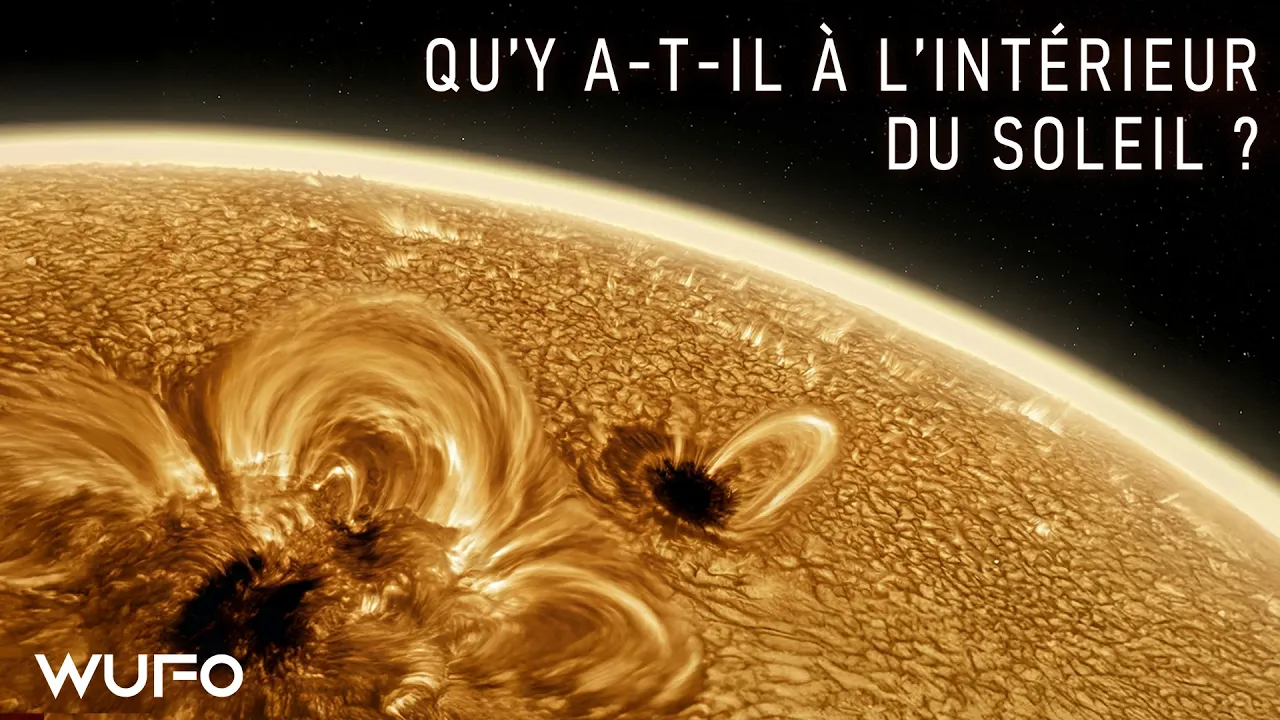
here's a pitch also satisfies a four credit lab science and is available during summer one and i would love to have some of you students come back for more punishment with me also ps the second part of this course is kind of like the first part of this course so you're kind of already trained and that means it's not too hard anyways now that i've made that pitch consider this until albert einstein discovered this equation in 1915 astronomers before they knew that nuclear fusion was possible didn't actually know how the sun continued to shine for so long and they were confused as to whether the earth actually could be billions of years old because they they couldn't comprehend how this would happen now in the sun's core nuclear fusion and i'll explain this later proceeds by taking one two three four hydrogen nuclei that's four protons and essentially smashing them together to create a helium nucleus one two protons and two neutrons so basically you change and transmute four hydrogens into one helium and when you do this you actually have to shave off and and kind of destroy a tiny little bit of mass destroy of course isn't the right word you convert a little bit of the mass of these protons into light in the form of gamma rays so the famous equation that powers the nuclear fusion in the sun the net reaction is four hydrogens collide to make one helium and two gamma rays and this my friends this is what eventually becomes the sunlight that leaks its way through the star fusion cannot proceed in every part of the sun only at its very core where the temperatures are absolutely berserk are the temp are the temperatures high enough for this reaction to proceed in a way once you start generating these gamma rays they then wiggle their way through the star and they help heat it up and support hydrostatic equilibrium so this is actually a secret a secret um component hydrostatic equilibrium by the way today in your homeworks you will calculate how long the sun can sustain its luminosity using nuclear fusion and you will discover that the time scale associated with nuclear fusion is 10 billion years which is totally wild because it suggests that we are halfway through the sun's life and that the sun has enough another five billion years to go i think that deserves a sip of water and life okay so what do we want to do next if we want to learn about the sun we want to learn about how energy transports itself from the core out to the surface and we want to study the sun as kind of like a layered cake in which things are happening differently at different levels in other words i want to take you it by bit 29 through the different layers of the sun and kind of explain to you guys how energy is moving from the core to the outer layers now um people that i did not see on monday kim nori ian did you get to see any of those cool videos that i showed the class on monday of the you know the magnetic fields and the surface of the sun um no like i said i'm gonna do it right after this class okay but normally yeah see them you get to see them how about you kim okay okay so you remember that the layers of the sun that we can directly observe are the corona the chromosphere and the surface layer the photosphere and i'm not sure if you guys remember uh what it looks like right but uh just for i guess for the benefit of ian so he can follow us let's quickly go to slide three oops this is what the surface of the sun looks like e and at visible wavelengths it's a perfectly uniform and boring yellow ball if we change our wavelength of observation to ultraviolet or x-ray wavelengths we suddenly see all these different things we can see the upper atmosphere of the sun we can see these loops of magnetic fields i particularly love this video which i believe is right on the border of x-rays and uh ultraviolet where you can really in fact i want you guys to notice something notice that the surface of the sun in this video is actually black you can see that the ball of the sun underneath it is black because the surface of the sun does not generate x-rays it's the upper atmosphere that generates x-rays so we can see different layers of the sun in different processes processes by studying these different layers okay let's make a six layer cake that is the sun and i've got lots to say about each layer we're going to make a kind of analogy with planets because planets is something that we kind of intuitively understand six layers the sun um the outer two layers which you could think of as the atmosphere of the sun are the corona uh relationship to the coronavirus is that corona means crown and the chromosphere taken together both of these represent a wispy outer layer of the sun and i tend to think of both of these layers as sort of like the atmosphere of the sun it's a loosey-goosey analogy the difference between them mainly lies in their temperatures the corona has a mind-bogglingly hot temperature of 1 million kelvin that is not hot enough for fusion but it's hot enough to make your gas completely ionized the chromosphere is maybe 10 000 kelvin and both of these have the same sort of definition okay what are they they are low density yet extremely high temperature plasmas um that are ultimately being heated by the magnetic field activity at the outer layers of the sun they're heated by magnetic field you might call them storms they're twisting and winding magnetic fields that heat up the plasma um did we talk about a plasma last time jenna i can't remember if i gave you guys that spiel so what did i tell you what did i tell you about plasmas let's remind ian who hasn't seen the video yet um we said that plasma is a charged gas and it is primarily found it's what makes the sun very hot no no no no no sorry plasmas don't make the sun hot hot makes the plasma okay does that make any sense yes that makes sense because nori if you heat up a gas you cause electrons to jump into higher and higher orbits and eventually at some temperature they jump off the atoms right so hot get heating a gas makes it a plasma not the other way around okay um did i tell you that the sun was a mixture of neutral gas and plasma yep yes so which layers what part of the sun would we find the most neutral gas then jenna uh most neutral gas would be at the atmosphere no or at the corona no this is a completely 100 ionized plasma at one million kelvin okay so this is somewhere where i failed so we're going to fix that where you find the majority of the neutral gas is at the next layer down i'm just going to erase this little definition here i'll come back to this stuff later okay i just kind of want to make an overview of the layers and then we'll try to zoom in on them um the next layer is the coolest layer of the sun it's called the photosphere and the photosphere is kind of like the surface of the sun but it's not a physical surface the way earth has a hard surface it's actually just a thin layer of gas but the reason why it looks like the surface is this is where all of the visible light is produced and that's actually how we define the photosphere the photosphere has a key temperature of 5 800 kelvin it's extremely uniform and we define the photosphere as that layer uh from which visible light is emitted and when i say visible light you know i mean roygbiv set 400 to 700 nanometers right the rainbow it's that layer from which the visible light is emitted i got a lot to say about the photosphere i'm i'm debating how much i want to say [Music] let's start by saying this compared to the radius of the sun it's super thin it's only 50 kilometers i'm going to start by writing thick because that's how we usually say it but i'm then going to cross out using strikethrough thick and i'm going to write 50 kilometers thin to remind you that 50 kilometers is a very very small percentage of the radius of the sun let's take a quick look at the photosphere once again this opening picture is a picture of the photosphere this is also an image of the photosphere notice that the illumination is extremely uniform with only blemishes from sunspots i'd like to show you another picture of the photosphere just a couple of different images to give you a sense of it here's a great a great classic picture of the sun's photosphere in slide 37.
oh sorry i hit a funky button okay um this surface is glowing uniformly in this picture it looks yellow probably because it was taken with a filter down on earth with an earth-based telescope if you were actually in outer space and you could handle staring at the sun its surface would appear perfectly white to you or at least yeah actually it would be pure white i mean absolutely pure white what generates this light is the same thing that generates this light the sun is glowing just like the gas in this lighter do you guys know what the spectrum did did we talk about this during our light chapter what is the spectrum of uh of a of a candle flame um i vaguely remember was it a mission or i know someone guessed that and then it wasn't oh no it's um i do know it was a continuous spectrum it's a continuous spectrum so what does that suggest so i just want to see how much you know about this physics stuff here so this is a continuous spectrum a rainbow so according to gustav kirkhoff what what causes a rainbow what causes a continuous spectrum a hot dense solid does this look solid to you no and yet it is still a black body the gas in this room by the way the gas in the photosphere is like a tenth it's like a tenth as dense as the air in this room the photosphere is actually lower density than the air in this room and it's still dense enough to glow as a black body and what does black body mean it means i glow because i'm hot now in a few moments i'm going to try to explain to you that these layers are not black bodies that is not why they glow at their own unique wavelengths and these guys well the truth is complicated i want to say they don't glow at visible wavelengths but they do a little bit the photosphere is powered by thermal black body radiation and what that means is it means that the surface of the sun that you see with your visible with your eyes when the sun's glowing in the sky it's caused because the gas is not do you see how that might be confusing to a student because i just went and told you that the sun's not a ball of fire right and yet the gas at the photosphere glows essentially in the same way that fire does but here the reason why this chemical reaction takes place is because i have some butane or i don't know what's in there probably butane and i light a spark in the oxygen plus the butane basically make a chemical reaction like the one you just saw right but in the sun it's hydrogen and helium gas that's so hot because energy is leaking up from lower layers of the star it glows then like a hot gas or sorry like a hot dense solid that's still a gas um in fact here's something interesting about the photosphere if you go and you take a high resolution telescope and you zoom in on a little patch of photosphere you discover that it's not as uniformly glowing as you at first thought but that at close up close levels the surface of the photosphere is modeled with a little a whole bunch of little bubbles that we call granules and for scale size each one of these granules is approximately the size of the state of texas so these are texas-sized bubbles bubbling up from below this in on lower layers of the sun but the bright bubbles have just recently risen to the top and now the gas is thin enough for the photons to shoot out and escape into space and as the little bubbles shine their light away they become cooler darker bubbles they get a little bit darker and they sink back down this is called granulation and they're like little light bubbles that deliver light to the surface let's write that down in our notes the photosphere contains granules these are texas-sized uh blobs of hot and cool gas if i felt like writing down even more notes i might write that granules deliver light to the surface of the star but i don't feel like writing that down right now maybe you'll accidentally remember it or something um do you guys remember from our monday lecture how big a typical sunspot is about four times the size of earth yeah the very biggest ones but in other words uh jenna granules are texas-sized blobs and we do find sunspots at the photosphere as well sunspots are earth sized blobs also of of cooler gas i think i need to switch markers here i'm burning this one out before i open up expression let me see if any no that's totally dead uh that's totally dead i'll throw those out later wow that's totally dead time for refreshing all right um earth-sized blobs of cooler gas the difference between granules and sunspots is that the sun spots is gas which has been trapped by magnetic fields i'm trying today's lecture a little bit differently than i do my typical sun lecture usually when i give a lecture on the sun i kind of i kind of zoom into each of these layers and i get kind of lost in the sauce and we try some exercises but i know that today we have to do a homework on the sun that's going to cover like a wide variety of topics so i'm kind of bouncing around here and i hope that later i'm going to be able to zoom in and try some exercises with you on these different layers but this will be an experiment um i would like to one talking about this show you an iconic picture of granules versus sunspots and i think this is from the older trace satellite i've seen this picture just popping up in different astronomy textbooks and at some point i realized it was a good useful picture because this picture has been exposed such that you can see sunspots here and you can see blobs and granules there and you can really get a sense of the different scale size right you can see that the sunspots are much darker and much larger now the the granules are just the natural bubbling pattern of the sun hot bubbles rising and sinking this is something totally different basically what's happening and i need to explain magnetic fields a little bit better to you guys but what's happening is the magnetic field lines that poke out of the sun they trap plasma they freeze plasma to the magnetic field lines kind of like flies sticking to fly paper and as the magnetic field lines trap plasma here and here they stop the bubbles from rising up and down and they kind of arrest the gas right up at the upper top of the photosphere and that gas can now shine away its light into space and it keeps shining and shining and shining and shining but it can't sink back down into the sun what's the result eventually after shining for many many hours the gas becomes so much cooler than the surrounding gas that actually starts to look black because it's giving off so much less radiation in fact sunspots are kind of cute because they're formed by magnetic fields sunspots always come in pairs there's usually a north and a south pair for every sunspot they rotate and travel around the sun which we're going to use to measure the sun's rotation in our next lab and the sunspots kind of come and go with the sun's 11-year magnetic cycle the sun has like a period of seven point sorry uh 5.5 years with lots and lots of sunspots and then 5.5 years with no sunspots and you can actually see this if you if you go and look at the solar dynamics observatory website we're currently at a solar minimum sdo uh you know something really strange happened when we looked at the sun last time they did not have a picture posted for that day let's see if they've sensed do you remember that jenna when that happened that actually blew my mind i had no idea what was going on there so today's date is 3 24. you can see it's back jenna okay that was a really weird thing i still have no idea what that was all about but you can see jenna this picture was taken today march 24th at 16 47 universal time um are we in daylight savings time now i think so so ut minus four hours uh would be 12.
these images were taken at 12 46. holy shikes that's pretty recent right that's like 10 minutes ago isn't that wild this is what the sun looks like right now um let's see if we can find one of these images at visible wavelengths these are in uh angstroms so that's 21 nanometers 13 nanometers you'll be able to tell when we get into the visible spectrum because the sun will start to look really really smooth like a ball cool hey how about this we actually have a couple of sunspots today that's i was not even expecting that um it's kind of sad i wish that i could set up my telescope and show you i did try to do this last year in my apartment i tried to set up my telescope it it ended up taking too long and i felt kind of bad about it so i'm not sure that what i got was worth the amount of time i spent setting it up but it is cool to look at with your with your own eye i'm very surprised that we see any sunspots at all let's go back five years ago what is it 2021 let's go back to like 2016 or something let's go to our daily movies um and let's go to 2016 which should have been during a solar maximum i believe and let's just pick a damn day let's see if we can find that uh intensity grand that we just saw um okay do i know what i'm doing do i know what i'm doing here let's try this what is wrong with me well maybe i picked the wrong day but i honestly i was ex but i was expecting to see guys as i was expecting to see a whole damn bunch of sunspots um i don't know if this is just like a mislabeling thing but i noticed on the date next to each of those it says 2018. so maybe something got mixed up there where do you where do you see that am i just miss reading and no that says 18.
that's last modified right that's what i was wondering i wasn't sure if i was so i thought that i clicked on 2016 right let's go to you definitely let's go to 2015 pick a random month pick a random day and let's look at that same okay there we go do you see how many sunspots there are there this was during a solar maximum where you see lots of different sunspots kind of cool looking all right um anyways the solar magnetic cycle is actually kind of like it's a little bit of a mystery of science we know the sun is doing it but we're the the actual calculations of the mechanism are a little bit illusory to us um before i get any more lost in the photosphere let's learn about the interior layers of the sun as well for completeness and then i'll see what i can do with the time i have left okay um if we go below the photosphere we're entering layers of the sun that we cannot directly observe and therefore if you wanted to be a pesky student and ask good questions you could say to me how do you really know what's down there under the photosphere if you haven't seen it and no one else has seen it and the answer to that question is a little complicated but it basically boils down to lots of computer modeling people who are very good at physics very good at mathematics and very good at computers they model using a supercomputer a giant ball of gas they try to recreate the conditions and the forces and the temperatures just the same as they are in the sun and they make a simulation and analyze how a ball of gas would behave now to prevent them from just making stuff up they fact check their models against something called sun quakes eruptions of bubbles and gas that can be seen at the surface another way is through the study of a tiny particle called the neutrino neutrinos are generated in nuclear reactions and they can actually fly all the way through the sun as if it were transparent glass so we can actually observe the interior of the sun by using neutrino telescopes obviously i've got a lot to say about that and i don't want to get sidetracked on it oh i did want to show you now i'm remembering what i wanted to do one of my former students who's was also my tutor um has been they always constantly update me with cool stuff in astronomy that i might have missed um one of the big hotnesses that i might have told you about before is a spacecraft known as the parker solar probe and the parker solar probe is currently on a sort of trajectory it's a spacecraft that's been designed to fly into the outer atmosphere or the corona of the sun and and this is the first time humans have ever tried to do this um i can't i don't know if you guys remember me talking about this but it launched a few years ago and it's basically converted itself into a really highly elliptical orbit that's going to travel out past the orbit of venus or earth and then plunge in really hard five or six or seven times getting closer and closer to the atmosphere of the sun each time um that's one of our latest science missions and i don't think it was the parker solar probe but there was another one that recently produced a super high resolution image of granules on the sun let's see if i can find this new image of granules on the sun it was one of the highest resolution images uh ever ever taken of the surface of the sun and i thought it was yeah this is it guys and what was just so wild about it is just the detail like the the detail just looked so creepy okay first of all this picture i had never seen a picture like this up until like a year ago so you have to understand that to see granules and to see sunspots with this level of resolution for the first time it's like art like this is a beautiful abstract painting to me like there's so much physics and detail going on here with these these cells and bubbles but they just look so cool and i actually forgot to show this to my astronomy that looks like the eye of sauron or something like it's so wild and i actually forgot to show this to my uh astronomy 10 20 students um this wasn't the partner solar uh oh sorry it was the inoye solar telescope um on on hawaii highest resolution images of the solar surface ever can have ever taken before um so i actually need to update my slideshows and get that look at that that's just crazy especially when you look at something like this or you look at that it makes you realize that just a bunch of i mean all it is is hydrogen helium gas magnetic fields and light and yet somehow it looks so beautiful and weird and strange you know it's it's not something you'd be able to predict anyways let's go into the interior of the sun let's see where those bubbles are coming from the inner three layers are known as the convection zone the radiation zone and lastly the inner nuclear core of the sun taken together these three layers can be thought of as the interior layers of sun just like we can't see the interior of earth so well we can't see the interior of the sun the sun doesn't think of itself as having layers the sun is just a ball of gas that gets hotter and squeezier as you get towards the center we humans have identified layers of the sun because we've realized that energy is transported through different mechanisms the physics changes between these layers also the temperature changes um temperatures for the convection zone so we're plunging back down into the sun and temperatures are actually the photosphere is the coolest layer of the sun and then we get higher and higher again the convection zone and the radiation zone are huge absolutely huge layers they constitute like a third of the sun's radius each let's just look at that um that cartoon again of the interior layers of the sun sorry um i don't really like this picture because i don't think it's actually done to scale i like this one so the convection zone goes from the bottom of the photosphere maybe to like just under a third of the sun's radius and you've got to keep in mind that as you plunge deeper and deeper into the sun the temperature is constantly rising the pressure is constantly rising if you've ever taken a dive to the bottom of one of those olympic sized swimming pools like at a ymca if you go to the deep end it's really hard to get all the way down to the bottom you can feel the pressure of that water sitting on top of your head same thing with the sun as you delve deeper and deeper the temperature is constantly going up there's no one temperature that perfectly describes the convection zone but i'd say somewhere in the middle of the thing you'd probably have temperatures as high as 100 000 kelvin that is not high enough for fusion that's not even high enough to completely turn you into a plasma you have to get up to millions of kelvins before you strip all the electrons off that happens in the radiation zone in the radiation zone you've completely removed every single electron from their parent atoms and temperatures get to the berserk level of 10 million kelvin once you hit the nuclear core a key temperature of 15 million kelvin that's the temperature at which hydrogen begins to undergo fusion and fuse into helium let's quickly look at the way energy is by the way um at some point in this class i taught you guys a classic basic science thing the three modes of energy transport do you guys remember that it was a quick little lesson right around the time that we defined temperature how do you transport energy from point a to point b for instance in my glass of delicious ice water energy is currently flowing from the water into the ice ah sure jenna um convection conduction and radiation right today we got to get into those differences okay because energy is transported by convection in the convection zone and by radiation and radiation okay let's think about the three modes we could call it energy transport uh and because heat is a transfer of energy sorry get my screen up there they also call it the three modes of heat transport they are convection conduction and radiation okay before i tell you what they are let's see if you guys already know can anyone describe in simple non-fancy terms the differences between these things it's okay if you can't but i just want to see what you know okay well let's take a peek then convection is what happens when hot air rises in a room say off of one of your household radiators during the winter time one of my former professors described convection as blobology okay the study of blobs basically somewhere down in fact actually you know what the perfect description of convection is a lava lamp in a lava lamp you have two different types of paraffin wax and then you have some kind of a lamp or a heating element down below the paraffin wax becomes heated through probably conduction or radiation from the lamp and as the paraffin wax heats up it expands into a big bubble the bubble becomes buoyant like styrofoam and water because as it expands its density drops and then as it becomes buoyant it rises up to the top of the lamp where it cools off and then the bubbles contract and it sinks back down eventually you set up a convection cell and these are happening all around you all the time a classic example would be as i was about to mention a household radiator why did they design them with these slats like this they designed them with these metal slats so that you can hold little vertical pockets of air the air come in contact with the metal the metal heats the air up through conduction direct contact and this whole bubble becomes something like a hot air balloon it begins to expand as it expands the gas rises it displaces cooler air and cooler air circulates back in and the cycle repeats itself the important idea about convection is it is bulk transport you're transporting big bubbles so let's write that down convection is bulk transport you transport bazillions of molecules at a time and it basically means hot bubbles rise cool bubbles sink and this is not the only time we're going to be talking about convection in our class in the convection zone warm bubbles are heated from below in the radiation zone they're radiated with high energy x-rays and gamma rays and then they expand they float up to the top and once they hit the photosphere guess what they become they would cool off right they become those things that call with a special name granule that's right i wanted you guys to make sure that you had the connection that when you see these beautiful images of granules on the sun let's go back to those really nice pictures you're basically seeing the bubbles that were bubbling up from the convection zone below you can literally see those bubbles percolating up to the top um how would i contrast convection to conduction conduction is adam to let's write it down atom to atom okay adam to adam uh do i know how to spell jiggly let me try this g i g jiggly okay adam to adam jiggling that's how i would describe it in fact let's look at a little crappy animation of conduction together i have one here um if you put a pork chop on a frying pan the molecules of iron in your cast iron skillet have been heated up they're still in a solid phase but they're all violently buzzing and jiggling kind of like bees in a little honeycomb you place your pork chop down on the sizzling frying pan and the jiggling atoms of the pan sear and begin to cook the molecules of meat and this means it's direct contact if you if you pick up a hot spoon that you left in the soup on the stove and that spoon burns your hand you're getting burned through conduction you're touching the hot metal that's different than convection because you're not pushing big blobs of material around you're touching the hot jiggling molecules that jiggle your molecules right of course the third method radiation that's just light and we all know that light can heat things up because if you go outside today and stay into the sun it will feel warmer than when you're standing in the shade this is something you intuitively know so radiation is just heating up by light you know a fun game to play to test your science knowledge is a little game that i call convection conduction or radiation think of something that's being heated up or cooling down in your local life and ask yourself do you know how it's working for instance whiskey on the rocks when you cool down some whiskey with ice cubes is it convection conduction or radiation conduction very good the cubes are in direct contact with the water how about if you cook a pizza like a a trader joe's you know trader joe's has those frozen pizzas i really like the pepperoni one try it sometime it's pretty good um that pepperoni trader joe's pizza when i cook it in the oven convection conduction or radiation um convection right because it's the air it's actually conduction conduction most ovens i think my oven is a conduction oven and that means that i i tried to trick you ian and i successfully tricked you consider yourself tricked okay um there are convection ovens if you ever work in one of those pro pizza shops where they have the big giant ovens you can tell in their convection ovens because they'll have a fan and the fan will be blowing bursts of hot air that's called a convec sorry yeah that's a convection oven but most standard crummy little household ovens are conduction nuts all right i even said to myself i've heard of a convection up and maybe i shouldn't say that well you know the penalty for being wrong unfortunately it's not that i can cut your fingers off or do anything you know they stopped me from doing that years ago so you don't really lose anything by guessing wrong you in fact you learn something you win uh what if you took a uh a baked potato out of the oven and you put it on the window sill and you let it cool off convection conduction or radiation would that one be convection well i mean i'm gonna be honest with you guys i'm not a thousand percent sure which is the dominant mode of energy transport in reality all of those things are actually happening at once the potato is hot and it's touching the air the air is a little bit cooler so there's some direct contact there there's probably also some steam coming off the baked potato and that steam is causing a little bit of bubbles rising and falling i honestly suspect the dominant mode might actually be radiation that hot potato is probably glowing at infrared wavelengths and they're traveling through the air air is actually kind of a sucky heat transporter air is like a good insulator that's why a sweater helps to keep you warm in the winter you're trapping little bubbles of air against your skin that keep you warm it's why a double paned window is uh efficient for keeping your apartment from losing heat to be honest oh yeah i'm sorry um so i don't know uh like i don't really understand like like the point-blank differences between the three like if you could just go over it like real quick and like it's like super brief and i appreciate your honesty about that because i'm not sure i'm doing the best job you know what we should do uh nori is we should draw a little picture of uh convection to go together because i think that will actually help and it is kind of important nori because not only do we need to understand the nuances for the sun but you're going to see these same issues coming back when we study the interiors and the atmospheres of planets let's draw a little model of a convection cell together and i don't know if this is going to help but maybe it will i'm trying it um let's draw some air molecules okay by just taking some black dots and peppering them around the page here okay so let's say these are some air molecules i'm now going to imagine and this could be the convection zone inside the sun i'm going to imagine that somewhere underneath like in the radiation zone the radiation zone is a completely ionized plasma so photons of light probably in the form of x-rays and uv rays probably mostly x-rays honestly and some gamma rays photons are coming up from below and they're heating the gas but here's the thing this is a cooler layer of gas at first so the atoms still have their electrons attached to them and they start blocking the photons and impeding their progress and they start getting heated up let's draw a little pocket and i'm going to use red now and i'm going to i'm going to kind of actually i'm doing this the wrong way i'm going to draw a pocket in which the gas particles have a slightly lower density and what's happening is this pocket of gas is kind of heating up and it can't transport the energy out through mosh pitting mosh a mosh pit is conduction nori okay when atoms are slamming into one another a mosh pit is conduction convection is where you slam into the mosh pit with a i don't know dump truck and you scoop all the people up and push them out the door okay okay so so if suddenly the mosh can't can't release the energy you start to have this temperature gradient where it's cooler here and warmer there and honestly it works just like one of those hot air balloons this thing expands and it begins to rise somewhere higher up you're going to have a cooler pocket of air and this pocket of air has become more dense because it shined away all of its light at the photosphere here the light can escape and this pocket becomes dense and it starts to sink this is what is known as a convection cell big bubble rise big bubble set but meanwhile nori conduction can still happen between these atoms it's just that conduction is not the dominant energy transport mode you're transporting more joules by big bubbles rising and setting than you are by atoms bumping into each other i don't know if that helped it's always hard when you understand something to understand what people don't understand about it all right so i think the key difference i i'm just for myself the key difference to highlight is that convection is larger uh larger scale scale yeah so more is moving at a time versus bulk transport right ian we're transporting large amounts of atoms at once rather than part particles yeah it was just like a little weird for me trying to figure that out in my head because i was like wouldn't it be connections because it's like the air but then it's just like the air is hitting it individually so it was like a weird yeah um but i got it i wonder nori if we typed convection versus conduction if we would see like uh like a pretty cool picture of them here i suspect there are really nice photographs this is a classic science thing it's honestly just like knowing about knowing about life right and that's why these cool 101 level classes are great because you just learned a bunch of basic stuff that teaches you about life here they show you different examples conduction is taking place when the dummy burns his hand on the uh on the handle we see convection in the boiling water as big bubbles are rising and sinking here we see radiation where light is being created in a fire and shining away by the way have you guys ever you never like been around a campfire or a bonfire and you kind of go up towards the fire to roast the marshmallow and suddenly you feel this really intense wall of heat that just comes on you all of a sudden do you know what i'm talking about do you know what that is that's infrared photons you're feeling infrared radiation coming off of the fire and suddenly hitting you and it's cooking your face like a toaster all right so that's an example of radiation so yep from the picture this is what like i got and you can correct me if i'm wrong so like conduction is kind of like almost like contact like between things convection is just like kind of within itself it's like doing its little thing you know i wouldn't say within itself i would say it's it's big bubbles it's literally just bubbles rising and bubbles sinking anytime you see bubbles convection is probably at work okay except for the magic wand blows soap bubbles i don't think that's well radiation is just like emitting it's just it's just like you transport energy by light if i shine a laser beam at this thing those are photons they generate light or they transport light interestingly enough in outer space space is a vacuum there is no convection there is no conduction you can only get energy from the sun to planets through photons or radiation okay um i have a little bit of time left let me see what i can do to help our homework do a little better i've got five minutes left um i want to talk to you about the outer layers of the sun and i want to talk to you about magnetic fields because i think it's going to help our homework and i'm going to try to do this really really quick so let's go once again to the beautiful youtube video called thermonuclear art if you haven't seen this yet ian you're going to see me talk about it uh in monday's lecture and um these guys can tell you that i went absolutely nuts getting really excited about how cool the sun looks at these different wavelengths so this is all from the solar dynamics observatory let me just find a place that i really like here okay what you are seeing right here is the upper atmosphere of the sun you're probably looking at the corona and you can see powerful loops magnetic field lines poking their way out of the sun hot gas is attached to the magnetic field lines and as the magnetic field lines twist and turn plasma charge gas particles become excited you can push gas off the surface of the sun and you can even create these little eruptions called solar flares some of which can be absolutely insane i'd like to show you if i can find it there's this video of a massive solar flare and this this video the first time i saw this it it just blew my damn mind so i'm hoping it'll do that for you guys hold on a sec come on um ah i didn't think to look this up i used to be able to type this in it's just one particular video that that was just really compelling it was an up close image of of gas there's just one in particular that i want to show you or not now we have so many good videos let's i know let's try this maybe i won't find the exact one that i i wanted to find oh get out of here okay i think it was one of these solar flares and it was just a close-up view of the sun just spewing gas and plasma up into the atmosphere and it kind of raining back down it was absolutely so beautiful this of course is another iconic one the so-called fiery loops where you can see magnetic fields just basically pushing a giant waterfall of plasma nori can you tell me what your cat's name is again i like to see kitties and these videos it helps my day go by better her name is willow she just decided to jump up willow kind of looks like a peanut it looks like she's black and brown she's got like a little something on her face yeah she's got like a cross she's like bike that's like viking war paint or something you should have called her odin okay anyways i like willow willow's cute keep keep keep her in the frame if you can okay how does this work it turns out that there's an interaction between magnetic fields and plasma i'm going to try to do this quick bit in five minutes it's not in the book you can only learn this from me if i were you if i were a 1010 student i might be thinking what the is a magnetic field anyways i don't even know what the f that means let's do a little crash course in magnetic fields it'll help our homework go by faster okay call this part of your notes three rules for magnetic fields i of course have had the benefit of taking many different classes in electromagnetism this is a classic branch of physics you've got to take this course like four times at different levels of complexity and i want to condense the important things i've learned about magnetic fields into three rules most of your experience with magnetic fields is playing with refrigerator magnets right and i'm guessing that you know from refrigerator magnets that magnets have a north pole and a south pole right if you if you try to place north against north you feel a magnetic field repulsion if north and south come together you get the attraction right and so that's probably your experience so far but but actually there's a lot of craziness going on underneath the surface here the real way that you generate a magnetic field at its most most basic is you just take a simple wire and conduct a current of electricity through it so let's start with how magnetic fields are generated moving charges create magnetic fields and this is the classic picture that you learn about in your your electromagnetism class now the moving charges do not have to be in a wire but a wire is a convenient sort of example your household wires are probably made up of the elements copper now copper is an atom that has 29 protons 29 electrons and honestly i don't know what the most common isotope is let's just look it up on the damned internet really quick copper m oops copper atom um what makes copper such a good conductor of electricity let's look at it here this is a great picture uh it would be great if it was larger okay let's see if that works all right perfect so in the nucleus you have 29 protons and 35 neutrons and you have 29 electrons so in theory your 29 protons and your 29 electrons should cancel each other out and you have absolutely no net charge and that's kind of true but here's the real real true the real true is that the first 28 electrons are so perfectly filled in their orbiting shells that they actually do a really really really good job in shielding the last electron from the inner nucleus in other words even though this is only 28 electrons they have so effectively blocked the positive charge that your very last electron the so-called valence electron is in a kind of casual non-committal relationship with the atom it's kind of doing it but it doesn't know if it really cares and all it takes is a little bit of pressure all you got to do is just introduce some other electron into the picture and this guy will go boop and it will pop right off and flow to the next atom okay the valence electrons are just dangling at the edge of the atom and they can easily be pushed off this is how you conduct electricity so what we're going to do is we're going to send a little current of electrons flowing through those copper atoms and they're going to flow through this wire and as soon as the charges begin to move magic happens a magnetic field is created that surrounds that wire in a kind of circular loop almost like a like a paper towel tube okay the magnetic field lines circulate around the negative charges that's how you generate a magnetic field and then you can do some kind of fun things with it let's look at my slides real quick slide 5 so i don't have time to get into the horseshoe magnet that's a little more complex but you send a current down a wire you generate a magnetic field now imagine i attached a thin wire to an you know nine volt battery or something and then i took a pair of needle nose pliers and then i bent the wire into a circular loop as the current flowed in a circle the magnetic tube would take the form of a pair of bunny ears and these bunny ears are what are known as a dipole magnetic field dipole magnetic fields are found everywhere we usually associate this side with the north pole and this side with the south pole not only do we see dipole magnetic fields in circuits but actually the earth itself famously generates a dipole magnetic field what does that say to me it says that somewhere down in the belly of earth there is a big layer of liquid hot glowing metal charges have been ripped off of the metal and as earth rotates every 24 hours you're sloshing around that charged liquid metal and boom it's the same thing as putting a current in a circle you know the sun would like to generate a dipole magnetic field as well but here's something weird about the sun the sun is not a solid ball like earth it's a goopy ball of gas and the sun does not have to rotate all at the same rate nor does it famously the sun undergoes differential rotation the equator of the sun rotates faster than the poles and this drags the plasma and the magnetic fields around and around and around until they become super twisted let's take the last two things and then we'll take a little tea break let's take our our last two rules for magnetic fields okay second rule is this other charges stick to or you could say they gyrate around magnetic fields so what happens is if you have a magnetic field line poking out of the sun and you send for instance a high-speed proton towards it when the proton hits the magnetic field it'll sort of oscillate and gyrate around the magnetic fields and the charges become stuck to the magnetic field lines and actually that should make a lot of good sense to you um i don't know about you guys but i can't see i can't see any magnetic fields here can you magnetic fields are invisible and yet jenna when i showed you that video of the sun here you can see the magnetic fields right why is it that you can see the magnetic fields here because plasma is getting stuck to those magnetic field lines and when when the protons stick to the magnetic field lines they emit high energy short wavelength x-rays i'm running out of time for our lecture so normally i have a speech about how the x-rays are generated but when charged particles strike magnetic field lines they the plasma will stick to the magnetic fields and they emit x-rays this is how we can see the magnetic fields in the corona by looking at x-ray wavelengths our third and final rule and then we'll end our lecture is that just as charged particles can stick to magnetic fields magnetic fields can stick to big blobs of charged particles magnetic fields stick to and they get twisted by bulk charges which is basically just another way of saying plasma plasma can bend and twist magnetic fields you can see the dynamic interaction in all of those beautiful videos that i showed you for instance in the fiery loops notice that gravity is pulling a plasma back down to the sun but the plasma is constrained to move along the magnetic field lines like beads that are sliding along a wire right you can also see that in the other videos like in the thermonuclear art videos you can see those magnetic fields winding and twisting as the bubbling gas that's swirling around in the sun is pushing and distorting those magnetic field lines these magnetic storms can be very violent and they can cause huge bursts and eruptions from the surface of the sun sometimes they're called solar flares that's when they erupt and get sucked back down again but during a coronal mass ejection the sun will actually belch did you see that solar flare over there that was did you guys see that that was nuts that actually might have been considered a coronal mass ejection when it actually blows material right off the sun it's called the coronal mass ejection do you know that in 1980 something the sun had an emission of a coronal mass ejection that was so powerful it sent a burst of charged particles that struck some power grid in canada and knocked out half of canada's electricity for a day and a half canada actually had a day and a half blackout because of some really massive burst of charged particles from the sun so this stuff can actually affect earth in extreme circumstances anyways if you get some downtime please watch this whole video if no other reason it's just freaking beautiful and wild and cool and i enjoy showing it to my friends it usually blows their mind okay um we've wasted another hour and a half talking about eruptions of the surface of the sun i don't know why we did that oh i'm sorry i went a little bit over here um let's take a 15-minute break and then we're going to hit that homework does that sound good all right sorry about going over guys i got a little carried away um it's 1 40 at 1 55 or so we'll start the homework deal all right now you're all gonna participate with me right because i do have this pre-recorded but i'm down to do it live if you're down to do it with me you understand what i'm saying all right okay all right so i'll see you guys in 15.
hi painful as it is we have to get back to work you guys ready to do this chapter 14 stuff let's hit it let's see if we can punch it out real fast um today's session is what is it is it homework six we're on now if you guys can call up those questions that will speed this whole thing up a lot so that you're ready no it's somewhere seven oh i'm sorry right um i think i have it up now okay will you um hold on let me do the usual format and set up for you guys okay um i actually have a quick question get me nori um so i watched the pre-recorded monday lecture because i can't make it on mondays um but you gave us it said lecture eight but the homework or like the lab said seven um i just wanted to because i have this problem where i submit it in the wrong thing and i think we're all kind of acquainted with that yeah i wanted to make sure that i'm submitting this next one to eight is it or is it seven so do you mean the homework of the lab the lab and the homework or are they often the homework that we're about to do is right here homework number seven okay um so you should submit today's work to homework number seven uh the lab was lenses and telescopes and uh since i showed you guys the as1020 version since we didn't do it last semester each semester has like little nuances and variations so 1010 your class this year did lenses and telescopes and that was also lab seven okay okay so they're both gonna be submitted under seven today right if i go to that no well han i don't like it when you say it that way two monday's lab was lab seven lenses until yeah today wednesday's homework is homework yeah it's it's also seven okay yeah that's what i meant and remember to watch the lab in case you have not done it yet but it sounds like you have oh i did i did the lab was here at time stamp 130.
all right okay good so let's write down our name and that might have been helpful for other people later on watching this so that's a good question um we have as1010 our class don't forget to put your section whatever the hell that is um this is homework number seven sorry that i was confusing at the beginning uh the problem numbers are from chapter 14 what do we got ian uh 50 55 56 59 and 62. all right ian you're up chapter 14 number 50 what do we got all right uh number 50 says solar energy output observations over the past century show that the sun's visible light output varies by less than one percent but its x-ray output can vary by a factor of 10 or more explain why changes in x-ray output can be so much larger than those in the output of visible light okay to help you understand this question i need to first test your knowledge about the sun class what does the sun put out more of visible light or x-rays i would guess x-rays i would miss visible light why would you guess visible light jenna um because i i guess just purely like simply because it's so visible because we can see it yeah but um just because you can see it doesn't mean oh how do i put this yes it's so visible and we can see it the the real issue uh jenna is is if you look at the spectrum of the sun remember that during our spectroscopy lab i showed you the spectrum of the sun i held up the spectroscope to the window and showed you some white cloud right and the spectrum of the sun i have it here in this this slideshow when i when i showed you the solar spectrum it was actually an absorption line spectrum meaning you saw a rainbow but buried in the rainbow were some faint absorption lines if you make a plot of the intensity of sunlight as a function of wavelength you get this graph here this graph shows us the spectrum of the sun and it compares the actual spectrum of the sun to an idealized black body at 5800 kelvin what you're seeing is that there's super good agreement between the spectrum of the sun and an ideal black body the sun is emitting light at all wavelengths just like any other black body and just like any other black body there's usually one wavelength that it emits more than others the peak wavelength which is described by wean's law okay let's just look at this this is brightness on this axis this is how much light is coming off the sun and this is wavelength first why don't you guys show me where's the visible light portion of the spectrum on this graph um it's around the peak because it's between like 400 and 800 right so we're not 400 to 700 so you can already see ian that the sun's giving off way more visible lights than any other type of light correct correction that's the point is the sun ultimately is a black body where would x-rays be on this graph no no no one knows that question um it's low it's below ultraviolet so it's towards the start like down here right so how would you say the flux invisible light compares to the flux of x-ray light from the sun uh visible light is much higher right right so wait a minute then i'm confused ian what the hell is this question actually asking so let me just read over it again for myself i thought it was saying why do i get 10 times more x-rays from the sun but now i realize it's not actually asking that is it yeah it's just saying it gets multiplied by ten so just because wait what what gets multiplied by ten the um x-ray output yeah it says uh this x-ray output can vary by a factor of 10 or more so in other words well so that's you're saying that's not the the minuscule amount of x-rays that's putting out if not multiplying that by tim this is just about reading comprehension to make sure you understand the question before we attempt to answer it okay what is the question really asking us you might actually already understand it i might be making this pointlessly complicated okay um it's not that the sun's giving off 10 times more x-rays it's that the x-rays that it does give off are 10 times more variable oh okay yeah i was worried that let's let's draw a graph of this okay we need to draw a graph okay we're going to draw a graph of the brightness of the sun as a function of time and this graph will explain what the question is asking i want this as part of your answer so put this on your page on the y-axis we're going to plot the brightness of the sun in say watts per square meter that's the quantity of light and on the x-axis we're here going to plot time in years from the year 1900 to today 2020. i know it's 20 21 but who cares a little over 100 years right i'm gonna plot the visible light using black and what you see is the sun's going to give off a lot of visible light but it's going to stay very steady for the most part so here i am showing the visible light and the visible light only has an up and down fluctuation of one percent at best now i'm going to plot the x-rays in blue notice my symbolic use of colors by the way since we're on the blue end of the spectrum and i'm plotting less x-rays than visible light but they're much more variable or fluctuating so what we see is an oscillation when you get big spikes of x-rays and then quieter periods with less x-rays the idea being that the maximum x-ray output is a factor of 10 times greater than the minimum output by the way i don't like this jazz i don't like comparing a factor of 10 to 1 they should both be in decimal form or they should both be in percent form who knows what the number 10 is expressed as a percent 0.1 the number 10 that you're thinking of 10 i'm talking about a factor of 10 not 10 percent what i mean by a factor is the raw number 10 itself okay let's try a simpler question the raw number one if you express it as a percentage what does one mean one percent pardon is it one one percent jesus christ guys i almost never had a restaurant with you guys trying to figure out the bill we're all hundred a hundred percent right and then the number one is a 100 right so what would a factor of 10 be 1000 1000 this is better because now we're all expressing so you can see that the x-rays compared to visible light fluctuate a thousand times more than the visible light this is what the question is asking ian why are the x-rays so fluctuating when the visible light is so steady what do you think the answer is i am not sure where to start thinking about this kim nori jenna if you had to take a guess could any of you guess why x-rays are why don't we look at a picture of the sun at x-rays and let's look at a picture of the sun at visiblelight and let's see if that gives us any inspiration video three is a video of the sun at visible wavelengths hmm [Music] okay now let's look at a video of the sun at x-ray wavelengths i'm getting the sense that that didn't help too much is it because they're like sort of like bursts of like those waterfalls like they rise and fall because like there's like different like they're they're actually the magnetic fields heat up the plasma and they they cause x-rays to be emitted right the reason why you could see the magnetic fields in those video videos nori is because the the magnetic fields and plasma interacts to release x-rays um in fact i know no one actually reads the book and i know no one is ever going to read the book ever again as long as i teach this course so just this once i'm going to read you a little passage from the book as if we were the sorts of students to do that okay and i'm going over to page 481 and i'm just going to read a single sentence under the heading of solar storms in fact as part of my dramatic reading let's see if i can auto focus this so you guys can read along with me can i read this backwards i've never tried that before solar storms the magnetic fields winding through the sun spots and prominences sometimes undergo dramatic and sudden change producing short-lived but intense storms on the sun the most dramatic of these storms are solar flares which emer which emit bursts of ultraviolet light and x-rays along with charged particles into space moving at nearly the speed of light so according to that passage the origin of these x-ray fluctuations is take it away class magnetic fields the changing and variable magnetic storms exactly so let's see if we can put this into a paragraph form and i'm going to flush out even a little more detail please include this little graph and this paragraph that we're about to write as part of your answer and we're really going to try to get into it here x-ray emission from the sun is so much more variable than visible light emission because the x-rays are produced in different layers sorry i don't know let me try to get a little closer here the x-rays are that's i bet you guys can't read that the x-rays are produced at different layers and by different processes and now we're going to explain those layers and processes for x-rays versus variable light this is the big idea now we want to get into the weeds a little bit x-rays are produced in the sun's okay let's see if you can do this guys what layer of the sun primarily produces x-rays the photosphere false okay and in fact oh would it no oh my gosh go ahead and try again chromosphere no not the chromosphere i didn't quite finish this calculation this is a picture of video of the sun at x-ray wavelengths once again ian notice that the photosphere down below is actually black the photosphere is dark because it doesn't produce any of the x-rays x-rays are all being produced up here this is not the chromosphere this is the corona the outermost and hottest layer okay i kind of didn't fully explain that in today's class there were little bits that i had to omit and that sadly was one of them so oh yeah sorry if you don't mind me asking so what um i wasn't really clear on this i don't know if maybe you covered it on monday and i'm gonna find out later today but like what is the this is there like a what defines the difference between the chromosphere and the corona so i was on the impression that chrome was further out they're both the atmosphere it's just how high up and how hot they are in fact i i actually did a bad job here on this today i was so busy trying to get through all the layers of the sun here's a picture of the corona the corona mostly gives off x-rays but it's so stupid hot at 1 million kelvin that it actually gives off visible light you can actually see the corona during a total solar eclipse when the photosphere of the sun is blocked out notice how far out this extends in maybe one or two solar diameters right um because it's at one million kelvin this is also giving off x-ray light the chromosphere is a little cooler and it sits underneath the difference really is just in the temperature because this is more like 10 000 kelvin it tends to give off more ultraviolet light than x-rays so you look at so when you look at x-rays you see the corona when you look at ultraviolet light you see the chromosphere all right so they're produced at the sun's corona x-rays are produced in the sun's corona when charged particles interact with magnetic field lines their charge particles are interacting with magnetic field lines as the magnetic storms fluctuate with the sun's 11 year and here's an important concept the 11 year solar magnetic cycle as the magnetic field storms fluctuate with the sun's 11-year solar magnetic cycle so does the x-ray emission fluctuate so that kind of explains the variability in the x-rays let's see if we can explain the variability in the visible light now producing the sun's corona i'm just reading this to make sure i've included everything visible light on the other hand is produced at the sun's okay class what layer produces the visible light that's the photosphere yes um guys can i go can i erase some stuff up here all right i need i'm just i'm running out of space visible light on the other hand is produced at the sun's photosphere by what what physical process produces light at the photosphere um thermal black body radiation excellent exactly by thermal black body radiation you guys are starting to get good see now you're actually becoming interesting to talk to because you know things like this by thermal blackbody radiation as the sun's temperature um roommate i've said the sun's temperature but i should say the photosphere's temperature as the photosphere's temperature remains constant at 5800 kelvin so does so does the visible light remain constant with only a one percent fluctuation due to blank class what do you suppose is causing the one percent fluctuation in the visible light output of the sun what could possibly be causing a tiny change sun spots exactly these dip a tiny little bit of the sun's light during the solar magnetic cycle nicely done get all that down and we'll move on um you guys are pretty quick so jenna let me know when you're ready to proceed or if someone's still writing shout outs jenna's good to go i'm gonna erase unless anyone would like to object all right um nori you feel good about reading something for us okay chapter 14 55.
so the question is chemical burning in the sun when an object burns in a fire the amount of energy released through this chemical burning is typically about 10 to the eighth power joules per kilogram of mass burned use this fact to estimate how long this sun would last if it's energy source for a huge fire releasing chemical energy rather than its actual source fusion energy okay so in other words let's imagine that the sun is a big ball of burning logs okay so let's draw a log it's big it's heavy it's wood okay and now we're going to imagine that the sun is a big ball of fire here are some dancing flames the best of my ability okay and these burning logs well we know some things about the sun we know that the light output of the sun has a luminosity of 4 times 10 to the 26 watts and we know that the total mass of the burning logs needs to be the same as that of the sun 2 times 10 to the 30 kilograms so this is one hell of a bonfire this is the energy that is released in the form of light you burn 10 to the power of 8 joules or you release 10 to the power of 8 joules of light for every kilogram of log and the name of the game is to figure out how long can the sun shine we talked about this in our lecture today do you guys have any idea how to start this problem or to go about it given these three quantities i'm going to teach you guys a new skill here today but before i teach you i need to know what you're capable of would any of you have any idea how to go about doing this would you use the ideal gas law no here you wouldn't because here you're just talking about a big stack of burning logs um you know that the energy is we're telling you for each kilogram of log how many joules of energy come out why don't we start this way uh whoever said that i'm sorry i lost track of you what kind of units should our final answer have i want you to think about this in a different way what should our units be would it be years because it's asking how long it could be years it's probably some unit of time so years would be an example um i want to teach you guys another variation on dimensional analysis i like to think of it as dimensional analysis level two for semi-pros okay sometimes you can figure out how to solve a problem by looking at the units of all the numbers that you have to work with and then figuring out what units you want to end up with and then just jiggling them around until the units cancel out correctly for instance we have one two three numbers so i'm gonna make three division bars one two three and at the end i want to end up with some kind of units of time someone suggested years but they don't necessarily have to be years they just have to be a unit of time your job class and i want to see who can do this is to tell me how to place the numbers into the slots in such a way where everything cancels except for some unit of time now right now i don't see any units of time up there or do i where are the units of time hiding ryan in the background says in the watts and you are correct ryan ryan but how are they hiding in the watts what's a what nope it's not one per second squared unfortunately but now that you've got the class on the right track ryan maybe they can help us get there ryan's on the right track he just doesn't know what a watt is is it i have it written down as one tool per second that's right a watt is a joule per second now that i see that i see that of my three numbers only one number involves time and that's the light output and i'm now going to realize that i probably can't get years out at first but i could potentially get a time in seconds okay class someone take it away tell me where to put the numbers actually tell me where to put the units such that i end up only with seconds this is dimensional analysis level two by the way this is also how professional scientists solve problems you can solve many problems this way any thoughts um but i figured i'd give it a try okay give it a try well since we want seconds as the final answer i might put seconds on the top on the right of me and then what and then um put joules on the bottom those two things are connected to each other yes we can worry about the numbers later let's say you've got seconds per joule what else we gotta use we got to get rid of the joules you could put joules on the top of the next one and kilograms on the bottom beautiful i like your smooth dimensional analysis moves we've now killed the jewels but we still have pesky kilograms to manage so i don't there's no other unit with the last one so just kilograms on the top i guess because that number just has a kilogram okay now you've done this just right ian tell me how to put the numbers in to make this cool okay so you would put four times 10 to the 26th on the top of that one the far left with seconds or no on the bottom i'm sorry you have them at the bottom of the 26 joules yeah second right i meant that i just was looking at it as joules over second next the unit yeah it's second upside down so one second emits four times into the 26 joules how about over here um there that would be 10 to the eighth joules on top and then one on the bottom yeah i'm gonna have to ask you guys to be careful here because i've i've seen this thing happen before i don't trust you guys to write 10 to the 8 joules because you all going to do stupid stuff on your calculator like this you're going to type 10 exp8 which is a classic rookie move 10 exp8 means 10 times 10 to the 8th or 10 to the power of 9.
you should probably write out 1 times 10 to the 8. i don't know if you're ready to handle that that kind of thing okay how about this last slot uh just 2 times 10 to the 30th on the top this is exactly how to do it congratulations you've now learned dimensional analysis level 2.
you can solve so many problems this way punch them up give me an answer punching is a you job okay one sig fig is fine i got 5 times 10 to the 11 seconds i love it jenna that's our final answer but someone pointed out earlier that it would be a lot cooler to know how many years the sun could shine as a big pile of burning logs i need us to convert seconds into years do you guys know the number of seconds in one year did i ever give you that conversion factor i'm kind of tempted to just to speed things up hold on just a second guys if you did i definitely don't have it um could you possibly do a calculation on the calculator because i did it and i came like eight to the something's power okay so in the interest of time because there's other things we all want to do today i'm just going to tell you the number of seconds in one year i believe that you guys could work this out if you had to so i'm just gonna i'm gonna do this for you 5 times 10 to the 11 seconds the conversion factor which is really useful for all kinds of things in astronomy is one year is pretty close to pi times 10 to the seven seconds so one year is 3.15 times 10 to the 7 seconds i know that's not exactly pi but that's the joke that we use to remember it okay so punch him up tell me how many years that is hold on okay 16 000 years about 16 000 years and this is why the sun could not be a big pile of burning logs because it would burn itself out in less time than there was between us and brontosaurus right dinosaurs went extinct 65 million years ago presumably the sun was still shining then nicely done by the way the real takeaway of this problem it's not just that the sun is not a ball of fire that's a powerful technique you don't have to just save this for your astronomy class guys you can solve problems in all kinds of other courses that you take with this skill don't forget it two down three to go kim would you like to read us number 56 oh sorry i don't meet myself that's okay hey uh can't ever can i erase this yep all right i'm all set all right so let's get that uh okay it's the lifetime of the sun the sun's chemic the sun's chemical composition was about seventy percent hydrogen when it formed and about 13 percent of this hydrogen was available for eventual fusion in the core the rest remains in layers of the sun where the temperature is currently too low for fusion a is use the data and the sun's mass to calcul calculate the total mass of hydrogen available for fusion over the lifetime of the sun so we're going to use this we're going to use the mass of the sun and we want to find the mass of fusion just for kicks and giggles let's draw a symbolic picture of what's going on so we can visualize the problem this ball represents the sun now i know 70 percent is not exactly three quarters but let's face it 70 is close to three quarters so it's kind of like if i put a bunch of dots that represent hydrogen this quarter of the sun roughly one quarter is represented by helium i'll make bigger dots for the helium because helium is four times as massive as as the hydrogen right and we know that helium cannot fuse we know that in the sun hydrogen fuses into helium so if you're helium you're already used up you already used up fuel you can't you can't uh make any fusion from that so a good 30 or a quarter of the sun is is not available for fusion the rest of the sun is hydrogen but the problem is most of that hydrogen is not hot enough the stuff that is hot enough is whatever fraction that hydrogen is there that's also in the core where temperatures are high enough for you to proceed in other words we're trying to find the mass of them red dots the ones that are not helium that are hydrogen but also in the 13 core so what should i do so we want to find out what the core is the mass of the car the mass of the core available for fusion we want to find the mass of the hydrogen in the core that's how i would put it okay it's actually a pretty simple problem looking at i would say 2 to the 10 to the power 10 or 30 times the 13 percent yep that'll that'll give you this whole circle but we also have to consider only the hydrogen so we multiply it by 13 percent but but we go ahead no go ahead but we when we do the same thing with the hydrogen at 70 percent right so this is like a compound percentage i i you could do it in either direction i would have taken all of the mass multiply it by 70 percent which reduces it to only the hydrogen then i'd multiply by 13 which is only the core it doesn't matter which direction you do it because of the associative law of multiplication so let's just do that so the mass available for fusion is 2 times 10 to the 30 kilograms how do we represent 70 as a decimal ian you said 70 ah that would be 0.7 0.7 good i picked on you because earlier we had that issue yeah yeah and then we're going to multiply by 13 all good all right why don't you guys do that up until what you get i got 1.82 times 10 to the 29th or 2 sorry hey can you guys just give me one sec just one sec a little kerfuffle hi guys sorry about that um did you get a number i'm curious what you guys were talking were you trying to solve the problem no i was just asking about something before um like i like to do the calculation because i got it out i got it wrong for the previous question oh so i just want to like okay let's let's do it together right from the previous question it was one exp8 i'm doing the middle one first [Music] times uh uh two exp30 divide by uh uh 4e26 right no yeah that's right five times since the 11.
is that is that the part you were struggling with yeah because it came out like eight point something so i just didn't want to like i you probably would have gotten messed up your order of operations you could have gone one divided by four e x p 26 times one e x p eight times 2 e x b 30. i'm not sure what you did do but can you do it this way from now on yeah all right cool anyways what did you guys get over here for the mass of fusion uh how many sig figs i got 2 times 10 to the 29 that's fine uh okay uh yeah hold on a second what was it to two 1.8 let's go with that for fun so you get 1.8 times 10 to the 29 kilograms is that what you got all right what's part b ask uh kim b is the sun infuses about 600 billion kilograms of hydrogen each second i'm sorry any result uh that little kerfuffle i just had uh i have a guest who's like trying to uh she's parked in a garage and i'm i just have to can you just give me one more second i'm worried she's gonna get stuck in there because she doesn't know the pro i just realized she was gonna get them into the garage and it's not very obvious how to get out of that thing so i apologize um don't even get trapped in parking garages today okay so i'm sorry kim can we try that again yep the sun abuses about 600 billion kilograms of hydrogen each second based on your result from part a calculate how long the sun's initial supply of hydrogen can last give your answer in both seconds and years okay let's try that same method we did last problem dimensional analysis level two we have a mass available for food we have a fusion rate and we want to know how long can it last uh kim can you tell me how to do this if i have a mass in kilograms yep we're going to time the fusion rate of 600 of 10 to the ninth kilogram seconds times the 1.8 times 10 the 29 kilograms okay let's look at that from the point of view of units your dog's going nothing yeah somebody's in the hall going up the stairs home teaching right we're all distracted sorry kim if i multiply kilograms per second times kilograms what will my final units be would be kilograms kilograms squared per second so that doesn't actually give me a length of time why don't you try again so we're going to do the kilogram second and the other one's going to be the kilograms is going to be on the bottom okay if i do that kim then yes my kilograms will cancel but that final unit is not seconds because it's on the bottom seconds on the bottom is per seconds that is not the same as seconds so try again keep trying until we get it well it says per second that's why it was right i know i know okay the fusion rate is per second but how long is not per second how long is seconds does that make any sense it makes sense but i'm trying to figure out what other way could you flip this stuff around so that you ended up with only seconds and they were on the top instead of the bottom you would have to do seconds on the top and kilograms on the bottom very good and then and then it would be kilograms on the top yes good now help me put in the numbers okay so tell me what to put in uh two to the 10th times 10 to the 30th on the top no we're only working oh i'm sorry yeah one put yep sorry 1.8 times 10 to the 29th where does that go when which dot the bottom hold on this is your kilograms per second this is your kilograms oh sorry one point so that would go on the top over here on the top on the second side 1.8 times 10 to the 28th that's right that would go over here and what would go over here would be 600 times 10 to the ninth on the top that's kilograms per second so that's yeah what let me get rid of eight okay yeah what this means another way to look at it is 600 billion kilograms per one second right okay so one one on the top and it'd be the 600 times 10 to the ninth that's right i needed to make sure that you understood once you it's still kilograms per second but you're flipping it upside down number with it okay okay in other words kim it looks like all you really are supposed to do is take the mass and divide it by the rate and that will give you an answer in seconds so go ahead and do that what do you get three times ten to the sixteenth seconds very good um let's convert that to years what's my conversion factor is um 3.15 times 10 to the seventh seconds is one year right yes so punch that up tell me what you get i got seven hang on no bloody way yeah no seven cannot be zero right divided by three point one five exponent seven well i want kim to do this because kim's nine yep yep we'll see nine what is it three six seven eight nine times ten to the seventh is it just nine what's your second sig fig five so right if you round it let it count better you gotta count better look kim i'm gonna do the same thing that you just did i'm worried that you have the right answer but you're not reading it right and that's something we definitely gotta straighten out okay 3 e 16 divided by 3.15 exp7 this should be pretty simple okay yeah what's your lead digit nine well we're going to keep the point five okay okay but you need to count better nine point five times ten to the one seventh all right kim your decimal place is there will you count with me one two three four five six seven eight eight all right someone up somewhere okay this is not that's not the right answer i know i think it's the three times of this year what happened jenna i'm gonna say that oh sorry my internet's a little first part the second is three times 10 to the 17th not the 16th seconds so i think that makes a difference him did you do that oh it's frozen oh i'm not frozen sorry yeah all right kim you're in the doghouse did you give me the 16 i must have i don't know i don't have i don't have it written down because i was typing it oh what was it supposed to be jenna um 3 times 10 to the 17th seconds all right hey look if that happens again if you see something you don't agree with the reason we're all supposed to punch is to fact check each other ian don't be silent when that happens because i'm not punching so i don't remember if it's 16 or 17 every time okay let's try that again kim kim my friend convert that to years and tell me what you got so 9.5 times 10 to the ninth units uh year good okay kim get all this down because i'm gonna need to erase it up here i'm going to do part c oh shucks tim when you're ready can you read this part c for us yep hang on one second feels like this homework lasts three times 10 to the 17 seconds i know seven point five times ten minutes yes okay okay part c is given that our solar system is now about 4.6 billion years old when we need to worry about the sun running out of hydrogen perfusion so we have a total lifetime of the sun of 9.5 billion years we're gonna subtract the current age of the solar system 4.6 billion years and that's going to tell you how long we have left to live on earth 4.9 billion nice just like we mentioned in lecture today this calculation is the calculation that shows us that the sun has 5 billion years left to live 56 down 59 is pretty simple from what i remember jenna i'm gonna have you read the last two since there's only four of you yeah jenna yep okay um 59 the color of the sun i'm sorry jenna just give me a sec here all right hit us use wien's law and the sun's average surface temperature of about 5800 kelvin to calculate the wavelength of peak thermal emission from the sun wings law tells us that the lambda max that peak remember ian when we looked at the the black body spectrum of the sun and we saw that it peaked right in the visible all right well that peak can be calculated from this formula 3 million nanometer kelvins divided by the temperature this problem is super easy and yet shall we say illuminating let's punch in our three million nanometer kelvins and divide it by the surface temperature of the photosphere 5800 kelvin what do you get 517 let's make it 520.
i still need some units on there jenna nanometers what color or regime of the electromagnetic spectrum is this red false orange false oh is it green yeah let's just look at the visible spectrum really quick so this is a visible light photon uh naham and ahamana see that 5 20 is as green as the day is long okay fine what were the other two parts the question jenna um what color does this wavelength correspond to the visible light spectrum why do you think the sun appears white or yellow to our eyes there are completely different explanations for why the sun appears white versus why the sun appears yellow i bet you guys know know the answer i think you remember it but let's just check when does the sun appear white uh it appears white in space good if i remember correctly and why um if i remember correctly it's because it may be outputting a lot of green light but it's also outputting other colors so when they mix together it creates white light exactly um it's black body light peaks green but emits enough blue and red and thus appears white just like a black body light bulb appears white when does the sun appear yellow that's in the atmosphere and it's because of the tinge of the earth or from the ground and why does it appear yellow again uh because of the color of our atmosphere is our atmosphere scatters the blue wavelengths of light it scatters them sideways and that removes them from the sun's spectrum or from the image of the sun from the ground so um blue wavelengths of light are scattered that's the key term are scattered by the atmosphere leaving the sun yellowish good job ian i like that you did that stuff now you'll be able to tell your kids why the sky is blue it's because of rayleigh scattering okay jenna you're on a roll so i'm going to have you read 62 as well all right um let me just give nori and friends a second to catch up i need some water i hope she made it out of the garage okay all right folks um you good i'm a race all right okay 62 is called pressure of the photosphere the gas pressure of the photosphere changes substantially from its upper levels to its lower level near the top of the photosphere the temperature is about 4500 kelvin and there are about 1.6 times 10 to the 16th gas particles per cubic centimeter um sorry what was the number density 1.6 times 10 to the 16th and what are the units of that number density guess gas particles per cubic centimeter so remember how we can write this um it's possible to write it as centimeters to the minus three do you remember me telling you that on monday yes okay so i'm going to do that for gravity's that's particles per cubic centimeter but particles aren't a real unit so i can write this enemies minus three by the way this is what's called a plane parallel atmosphere we're going to have three layers to the photosphere we're going to subdivide the photosphere into a top photosphere a mid photosphere and a lower photosphere and we're going to have a slightly different temperature and a slightly different density at each stage what's the temperature of the mid photosphere 5800 kelvin and n is equal to 1 times 10 to the 17th particles per cubic centimeter and the bottom temperature is 7000 kelvin and 1.5 times 10 to the 17th particles per cubic centimeter oh the question is to calculate the pressure at all three levels right okay jenna i'm going to work with you a little bit in this problem what formula do you think we want to use here uh i ideal gas law excellent but jenna i'm going to kind of i'm going to explain something that you guys might have missed here and in fact it totally baffles my mind why the book would have given you the number density actually it doesn't really baffle my mind astronomers always like to work in centimeters never in meters and there's a reason for that that has to do with electromagnetism and i don't want to get into it but believe it or not most professional astronomers don't work in mks units they work in a slightly different unit system called cgs centimeters grams and seconds it does make some calculations easier in this case it's not helpful however because this astronomer who's an astronomy person naturally felt like giving you the data in particles per cubic centimeter but check yourself the ideal gas law is actually an mks formula because the units of the boltzmann constant are 1.4 times 10 to the minus 23 joules per kelvin joules [Music] there she is okay joules are kilogram meters squared per second squared so do you see the problem jenna we can't go plug in cubic centimeters into this when you're using mks because a joule is a kilogram meter squared per second squared what are we going to have to do jenna convert the centimeters to to joules or we'll have to do some type of conversion yeah is the uh door is the deadbolt unlocked okay perfect um hold on yes we are gonna have to do some type of conversion but i want you to figure out what it is that matters to me ian um would you just be converting the centimeters into meters yeah but it's not that simple here this is why this is an interesting problem because it's the cube it's yeah the cube matters we're actually compute converting cubic centimeters into cubic meters and since you were sharp enough to see that um let's have you do that guys i should have done like five ten minutes we're almost there all right um okay so let's just focus on the top okay and before we calculate the pressure let's set it up like this we're going to get ian to help us convert number density from particles per cubic your ian's like why did i open my big mouth right never volunteer never raise your voice always stay in the shadows okay anyways number density is 1.6 times 10 to the 16th and we would write particles per cubic centimeter this time i'm gonna do it as one over now i'm curious to see if you can figure out how to do this obviously we need a division bar right you yeah yeah definitely so um well you could probably put the centimeters cubed on the top would it need the negative though since it's on the top no no no um if i had wrote it negative three yeah here then you would put it on the bottom with the negative three okay got it so i intentionally reverted it to one over cubic centimeters so we wouldn't have to get messed up with the negative shift okay so your first instinct is correct we want centimeters cubed and top what do i want in bottom um meters cubed okay now is the tricky part what the hell is the conversion from cubic centimeters to cubic meters would it not still be a hundred since they're both cubed and let me explain why this is about linear area volume in a linear conversion surely there are 100 centimeters in a meter but think about it ian if you multiply a meter times a meter to get a square meter it's no longer 100 square centimeters because you've got all of this if that makes sense what do you think the number of centimeters are per square what do you think the number of square centimeters are per square meter is it a hundred thousand a hundred what 100 000 um sorry uh centimeters cubed per meter cubed oh wait are we doing cubics are we doing squares cube cubed all right so right what would we not okay let me just tell you how you do this because you might you cube the conversion just like you cube yeah so i was that's what i was thinking so if it was squared it would be a thousand centimeters and then you would multiply it by right and one cubed is one a hundred cubed is what look yeah so 100 times 100 is oh i messed that up it would be a million a million okay yeah i dropped a zero i think with that thing if you increase this number by a million what do you get no um you would get uh 1.6 times 10 to the 22nd good and that's now i'm gonna funky my units up again by doing meters to the minus cubed okay now we can calculate the pressure of the photosphere so let's go ahead and do this the pressure at the top of the photosphere is the number density 1.6 times 10 to the 22 meters to the minus cube whatever the crap that is meters to the minus three times the boltzmann constants in mks units 1.4 times 10 to the 23 joules per kelvin guys uh i put a negative up here earlier please get rid of that sorry about that wait actually now i'm confused is it negative or positive i that this is last night's whiskey talking right now because i can't remember what the power of the bolts would be written down is negative but okay boltzmann constant yes it's it is negative sorry i just totally backwards to myself put the negative back in all right i had a moment of confusion but it's gone um uh times the the top of the photosphere which is 4500 kelvin okay go punch it up real quick i got 1008. um yeah and do you know what the units of this pressure are jenna uh pascal very good now jenna do you remember what the atmospheric that's the same as one kilopascal right that's another way to write that do you remember how many uh what the pressure of earth's atmosphere is at sea level does anyone i told you that last time 100 000 pascals or yeah 100 kilopascals yeah 100k so what percentage of earth's atmospheric pressure is this one percent beautiful right the numbers are nice and simple that's why this problem is cute one percent i'm just going to write atm one one percent of our atmosphere just because i want to speed this crapola up as i'm sure you guys do okay the next two we're going to go a little bit smoother because we already have our conversion factor it's a million cubic centimeters per cubic meter so i need to erase okay guys don't you forget those numbers on me okay next up we're going to do the mid photo sphere let's just go right into it the pressure is going to be um first give me the number density in particles per cubic centimeter 1 times 10 to the 17th and we now know watch my maneuverings it's a million per cubic meters per cubic centimeter this is this is some highly offensive ship that we're doing here okay but it's valid it's completely valid times the boltzmann constant 1.4 times 10 to the minus 23 joules per kelvin times the the photosphere's mid average temperature i have memorized is 5800 kelvin you guys see how i put the conversion right into the ideal gas law i'm just feeling lazy and i'm feeling like i want to be done and i want to like do anything else but this i want to take a nap okay so let's go ahead and calculate that up i got 8 100 or 8 000 yeah 8 100 uh pascals or roughly 8 kilopascals and jenna the numbers work out so clean and beautiful because what percentage of earth's atmosphere is that eight percent yeah that's why this problem is cute it's eight percent of the atmosphere at sea level pressure okay and now for our final coup de grace to put this little homework number seven to bed um we're going to do our final calculation at the bottom of the photosphere and the pressure will be um can you remind me what the number density was yep it's 1.5 times 10 to the 17th centimeters we'll multiply that by a million per cubic meters per per cubic listen to that one per cubic meters per per cubic centimeter how you like that maneuver okay per cubic meters per cubic centimeter that's messed up times 1.4 times 10 to the negative 23 joules per kelvin and what was it 7500 kelvin for the bottom seven thousand oh just seven thousand kills okay all right punch me crunch punching crutch the peanut gallery is enjoying my witticisms here in the background what'd you get jenna i got 14 700 which i guess we could do as 15 000. okay sure and you mean pascals i think right yes yeah absolutely 15 kilopascals or 15 of the atmosphere um of sea level at earth you know what blows my mind about this problem the entire photosphere top to bottom ranges from one percent to only 15 of the pressure and presumably the density of atmospheric gas yet it glows just like this bic lighter does truly a gas must be very very thin before it can transition into an emission kind of spectrum right also the so-called surface of the sun is actually pretty ghost-like and tenuous compared to the air we breathe in this room all right well you've done it you've wasted another three hours learning about the sun and please turn in uh your uh your homeworks your labs get them all in if you haven't watched the monday lecture ian you got to do that okay guys next week we start talking solar system stuff be time to look at some pictures of planets it's going to get better and better right up into the end okay all right uh any other issues before i take off then i'll see you later bye
Up Next
4:27
Stellar Nucleosynthesis: Proton-Proton Chain Explained
@GregSalazar
63.8K views•2019-06-30

12:53
21cm Hyperfine Transition in Neutral Hydrogen: Radio Astronomy Basics
@AaronRobertParsons
12.4K views•2011-10-13

32:32
NMR Spin Physics I: Zeeman Effect, Resonance Condition & Larmor Frequency
@nptel-indianinstituteofsci8064
2.3K views•2024-01-17

27:14
Entropy and the Second Law of Thermodynamics Explained
@veritasium
27.5M views•2023-07-01
Related Study Plans & Knowledge Roadmaps
Structured learning paths in Physics
physics
Nuclear Physics (Decay, Fission & Reactors)
01Atomic Structure and the Binding Force
02Radioactive Decay and Half-Life
03Nuclear Fission Mechanics and Chain Reactions
+ 2 more learning modules
12h5 modules
Explore Roadmap
physics
Soft Matter (Polymers, Colloids & Rheology)
01Foundations of Soft Matter & Thermal Forces
02Polymer Physics and Macromolecules
03Colloids, Surfactants, and Self-Assembly
+ 2 more learning modules
38h5 modules
Explore Roadmap
physics
Analytical Mechanics: Lagrangian & Hamiltonian
01Mathematical Foundations: Calculus of Variations
02From Newtonian Mechanics to Constraint Dynamics
03The Principle of Least Action & Lagrangian Mechanics
+ 3 more learning modules
28h6 modules
Explore Roadmap
physics
General Relativity (Spacetime & Cosmology)
01Foundations of Relativity: Special Relativity
02The Geometry of Spacetime: Equivalence Principle & Curvature
03Einstein's Field Equations: The Mathematics of Gravity
+ 2 more learning modules
55h5 modules
Explore Roadmap