In Sherbert v. Verner (1963), the U.S. Supreme Court ruled that a Seventh-day Adventist woman could not be denied unemployment benefits for refusing to work on Saturdays (her Sabbath), establishing that government benefits cannot be conditioned on religious compliance and that such requirements violate the First and Fourteenth Amendments' protection of religious freedom.
Sherbert v. Verner (1963): Religious Freedom & Unemployment Benefits
Added:Deep Dive
The Free Exercise Clause of the First Amendment, which protects citizens' rights to practice their religion without government interference.

First Amendment: Religion (Introductory Level)
2K
The Free Exercise Clause is the second part of the First Amendment's religion clauses, stating that Congress shall make no law prohibiting the free exercise thereof. This clause protects citizens' right to worship God or choose not to worship at all, without government interference with their religious beliefs. Together with the Establishment Clause, these two provisions form the core of religious liberty in America, protecting freedom of conscience—the ability to believe as one wishes or not to believe at all.
Click to watch →

AMERICA'S VOICE LIVE WITH STEVE GRUBER
572
The First Amendment's Free Exercise Clause protects the ability to freely practice religion without government constraint. This constitutional protection applies to all citizens regardless of their position in government, and attempts to limit religious expression in public settings represent an infringement on this fundamental right.
Click to watch →

Civil Liberties part 1
165
The First Amendment's religion clauses prohibit government establishment of religion and prohibit interference with free exercise. The Establishment Clause prevents government from establishing an official religion, giving preferential treatment to any religion, or using tax money to support religious institutions. The Free Exercise Clause protects individuals' rights to practice their religion without government interference. These clauses ensure separation of church and state while protecting individual religious freedom.
Click to watch →

Can a Court Reject You for Your Religious Beliefs?
669K
The First Amendment guarantees the free exercise of religion, protecting citizens' right to practice their faith without government interference. This clause is bolstered by the 14th Amendment's equal protection clause, which ensures that religious freedoms are applied equally to all citizens.
Click to watch →

Free Exercise of Religion: Freedom of Religion, Part 3
447
The Free Exercise Clause of the First Amendment protects citizens' rights to believe in any religion or none at all, and to practice their religious beliefs; however, this right is not absolute and may be limited when it conflicts with other important societal values and interests, requiring courts to balance individual religious freedoms against competing governmental interests.
Click to watch →
Deep Dive
The basic structure of state-administered unemployment compensation programs, specifically the standard requirement that claimants must be 'available for work'.

Labor Committee Meeting 3/19
216
Federal unemployment compensation law requires that claimants be able to work, available for work, and actively seeking work. States must require evidence of work search activity for each week benefits are received. The federal government expects claimants to engage in concerted and effective efforts to find suitable employment. If a state law exempts striking workers from these requirements, it could result in the state losing eligibility to borrow from the federal unemployment trust fund.
Click to watch →

Pro Bono Training: Unemployment Overpayments During COVID-19
1K
Regardless of the unemployment program, claimants must be available to work, meaning physically capable, ready, and willing to accept suitable work at any time. Work search requirements are currently waived by Governor's Executive Order 5. A common source of confusion is that claimants must self-certify they are unavailable to work due to COVID-related reasons to qualify for PUA, but they must still be available to work if they don't meet those specific criteria. Many overpayments involve availability issues where claimants were unavailable due to health issues not related to COVID, or where they refused work based on advice to self-quarantine rather than actual inability to work.
Click to watch →

Alabama Unemployment Compensation Claims for Those Affected by COVID-19 (Coronavirus).
2.6K
The requirement that a laid-off worker must be able and available to work while receiving unemployment compensation benefits has been modified for claimants affected by COVID-19. Additionally, claimants will not have to search for other work provided they take reasonable steps to preserve their ability to come back to their jobs when the quarantine is lifted or the illness subsides.
Click to watch →

Unemployment Compensation for Immigrant and Non-immigrant Workers
179
To receive unemployment compensation, individuals must be available to work. This is a fundamental eligibility requirement that applies to all workers seeking unemployment benefits.
Click to watch →

Take a Green Number and Sit in the Orange Chairs
138
A fundamental requirement for unemployment benefits is that claimants must be ready, willing, and able to work. Question 4 on the claim card addresses this. Claimants must not refuse job offers from anyone. This requirement ensures that benefits are provided only to those actively seeking employment.
Click to watch →
Deep Dive
The concept of judicial review and how the U.S. Supreme Court balances individual constitutional liberties against state regulatory interests.

Landmark Judgments Menka gandhi Vs U.O.I (Article 21 constitution) | Amit Sir | StudyIQ Judiciary
959
This segment addresses the balance between legitimate state interests and individual constitutional rights. The Supreme Court established that administrative authorities exercising discretionary power must operate under judicial oversight. While the state has legitimate concerns about public order and national security, any restriction on individual rights must be justified, proportionate, and subject to judicial review. The Court distinguished between direct and indirect violations of fundamental rights, permitting indirect infringement if it follows fair procedures and serves legitimate state objectives. The judgment established that the state cannot simply invoke general interests without demonstrating specific, legitimate reasons for restricting fundamental rights. This framework ensures that administrative discretion does not become unchecked power violating constitutional guarantees.
Click to watch →

2008 ACS Supreme Court Preview
534
The U.S. Supreme Court serves as the ultimate arbiter in balancing individual constitutional rights against governmental regulatory authority, as demonstrated through cases like Herring v. United States (testing the good faith exception to the exclusionary rule), FCC v. Fox Television Stations (examining administrative law review under the Administrative Procedure Act), Negus v. Holder (interpreting the persecutor bar in immigration law), Wyatt v. LaVine (addressing FDA regulatory preemption of state tort law), and Yura v. Pocatello Education Association (exploring federalism and First Amendment public forum doctrine).
Click to watch →
McCulloch v. Maryland at 200 | LIVE STREAM
563
Marshall's argument that questions of degree are unfit for judges has been borne out in US history. Legal theorists and judges rejected his approach and instituted modern judicial review that focuses on questions of degree. Justice Oliver Wendell Holmes Jr. explicitly rejected Marshall's 'power to tax is the power to destroy' dictum, arguing that most legal distinctions are distinctions of degree. The modern form of judicial review involves balancing constitutional principles (liberty, due process, equality) against state interests, requiring judges to evaluate how much state laws impinge on constitutional principles and the importance of countervailing state interests. This process involves judgments about degree that contemporary legal theorists and judges have come to accept as appropriate for judicial review.
Click to watch →
Attorney Alan Gura addresses the New Jersey Second Amendment Society.
1.6K
The Supreme Court in Heller and McDonald was extremely clear that courts do not use interest-balancing mechanisms to determine the contents of constitutional rights. The Constitution already reflects the people's balancing of interests, and once a right is in the Constitution, it cannot be weighed one way or another to see whether it should be applied. Balancing is only used when history doesn't tell you what to do with a regulation that impinges upon a recognized right. The issue is not whether the right exists but whether the regulation is constitutional.
Click to watch →
WATCH LIVE: Supreme Court Holds Hearing On Tennessee’s Ban On Transgender Care For Minors
11.5K
The Court must balance individual rights against state interests in medical regulation. The Court has held that when laws classify based on suspect characteristics, courts must apply heightened scrutiny regardless of the medical context. This applies even when the underlying medical science is evolving or disputed. The Court's role is to assess whether the state has provided adequate evidence to support its claims and whether the law is properly tailored to its stated objectives, rather than making independent policy determinations about medical risks and benefits.
Click to watch →
Deep Dive
The Fourteenth Amendment's incorporation doctrine, which applies the protections of the First Amendment to state-level actions and laws.
Jim Rickards: A Justice System MOCKERY In Trump Trial
25.7K
The Fourteenth Amendment incorporates the protections of the Bill of Rights (First, Fifth, Sixth Amendments) to apply to state governments, not just the federal government. Originally, the Bill of Rights only applied to the federal government. After the Civil War, the Fourteenth Amendment was adopted to ensure that states could not violate fundamental rights. This means that constitutional protections like free speech, due process, and the right to counsel apply to state criminal proceedings as well as federal ones.
Click to watch →
Engel v. Vitale (1962) AP Gov Required Supreme Court Case
449.2K
The 14th Amendment's Due Process Clause applies the First Amendment to state governments through the doctrine of incorporation. This means that states cannot pass laws that violate First Amendment protections, extending religious freedom guarantees beyond federal actions to state actions.
Click to watch →
Persuasive Writing | Crushing 1L, Ep. 26
125
The incorporation doctrine applies the first ten amendments of the Bill of Rights to the states through the 14th Amendment's Due Process Clause. Originally, constitutional protections only applied to federal actors, limiting state-level constitutional claims. The incorporation doctrine extends these fundamental rights—such as freedom of speech, religion, and due process—to state governments, allowing citizens to bring constitutional violations against state actors. This doctrine is central to federalism, balancing state and national authority.
Click to watch →
Civil Rights and Civil Liberties (AP US Government and Politics)
54.9K
The incorporation doctrine is the Supreme Court's method of applying most provisions of the Bill of Rights to state governments through the Fourteenth Amendment. This doctrine uses selective incorporation, meaning the Supreme Court decides which rights are incorporated and applied to states and which are not. The Fourteenth Amendment states that no state shall make or enforce any law abridging citizens' privileges or immunities, nor deprive any person of life, liberty, or property without due process of law, nor deny equal protection of the laws. This allows federal constitutional protections to constrain state governments.
Click to watch →

Defending Constitutional Rights | Abdi Soltani | Talks at Google
1.3K
The Fourteenth Amendment incorporates the rest of the Bill of Rights and applies them to local and state governments. Before this incorporation, the First Amendment did not directly regulate private conduct, private companies, or private universities. The Fourteenth Amendment's Due Process Clause is what makes the Bill of Rights applicable to all levels of government.
Click to watch →
Prerequisite Knowledge
- Concept 01The Free Exercise Clause of the First Amendment, which protects citizens' rights to practice their religion without government interference.
- Concept 02The basic structure of state-administered unemployment compensation programs, specifically the standard requirement that claimants must be 'available for work'.
- Concept 03The concept of judicial review and how the U.S. Supreme Court balances individual constitutional liberties against state regulatory interests.
- Concept 04The Fourteenth Amendment's incorporation doctrine, which applies the protections of the First Amendment to state-level actions and laws.
Subsequent Learning
- Step 01The 'Sherbert Test' and its specific legal prongs, including the concepts of 'substantial burden', 'compelling state interest', and 'least restrictive means'.
- Step 02Employment Division v. Smith (1990), the landmark Supreme Court decision that dramatically altered and limited the application of the Sherbert Test regarding neutral, generally applicable laws.
- Step 03The Religious Freedom Restoration Act (RFRA) of 1993, legislative action taken by Congress to restore the strict scrutiny standard established by Sherbert v. Verner.
- Step 04Modern First Amendment cases exploring religious exemptions from public health mandates, anti-discrimination laws, and contraceptive mandates (e.g., Burwell v. Hobby Lobby).
Sherbert v. Werner
Sherbert v. Werner
0:00Playing Section
- 1
Woman fired for refusing Saturday work due to religion.
- 2
State denied her unemployment benefits, lower court upheld.
- 3
Supreme Court ruled denial violated First Amendment rights.
The Neutrality Standard and Establishment Clause Concerns
While Sherbert v. Verner established robust protections by requiring a 'compelling state interest' to burden religious practice, this approach faced significant pushback, culminating in Employment Division v. Smith (1990). Critics, including the Smith Court, argue that Sherbert's exemption framework creates an unconstitutional privilege for religious citizens over secular ones. Under this counter-perspective, known as the neutrality standard, the Free Exercise Clause does not excuse individuals from complying with valid, neutral laws of general applicability. Critics contend that carve-outs based on faith undermine the rule of law, making individuals 'a law unto themselves' and raising Establishment Clause issues by favoring religious beliefs over non-religious moral convictions. This viewpoint argues that true equality under the law requires uniform enforcement of democratic legislation without judicial creation of religious exemptions.
Deep Dive
The 'Sherbert Test' and its specific legal prongs, including the concepts of 'substantial burden', 'compelling state interest', and 'least restrictive means'.

ch4 online POS 2041
226
The First Amendment contains Establishment Clause (church-state separation) and Free Exercise Clause (guaranteeing free exercise), neither absolute. When religious practice interferes with public welfare, government can intervene. In Minersville School District v. Gobitis (1940), Jehovah's Witness children were expelled for refusing to salute the flag; the Court ruled against them, citing national unity. In Sherbert v. Verner (1963), a Seventh-day Adventist denied unemployment benefits for refusing Saturday work; the Court ruled in her favor, establishing the Sherbert Test with three prongs: government pressure, state interest justification, and no less restrictive alternatives. In Employment Division v. Smith (1990), the Court ruled that laws burdening all religions equally are not unconstitutional, limiting the Sherbert Test. This sparked RFRA in 1993, which reinstated the Sherbert Test. In Gonzales v. O Centro Espírita (2006), the Court ruled in favor of a Brazilian church when the government failed to prove a compelling interest under RFRA.
Click to watch →

Religious Liberty, Civil Rights, And Public Policy
308
The RFRA test begins by asking about religious liberty: Is the belief sincerely held? Is it burdened (does the government require action or prohibit action, or withhold benefits)? Then it shifts to competing interests: Is there a compelling state interest? Is the government using the least restrictive means? In the contraception cases, the government's requirement that Catholic churches sign forms to receive contraception funding was found to be a substantial burden, triggering RFRA analysis.
Click to watch →

P4: History of Religious Liberty
113
In 1963, the Supreme Court began a new era of free exercise law with the Sherbert v. Verner case. Mrs. Sherbert, a Seventh-Day Adventist, was fired for refusing to work on Saturday (her Sabbath) and was denied unemployment compensation. The Court instituted a new two-part test: (1) if a state passes a secular law that impinges on religious conduct, the state must have a compelling state interest (a really high important interest); (2) even with a high interest, the law can only be approved if it is the least restrictive means of achieving that objective. If not, the religious believer must be given an exemption from the secular law.
Click to watch →

RLUIPA Training
314
RLUIPA prohibits substantial burdens on religious exercise unless governments demonstrate compelling governmental interest and use the least restrictive means. A substantial burden is more than an inconvenience—it significantly impairs religious exercise. Courts evaluate this fact-intensively by examining severity of burden, institutional size and resources, religious needs, space constraints, availability of alternative properties, and history of location efforts. Examples of substantial burdens include denial of construction permits due to parking requirements, conditions requiring religious facilities to operate as commercial establishments, and denial of expansion plans. Compelling interests must be of the highest order; revenue generation, economic development, and congestion reduction are insufficient. Public health and safety may qualify but require demonstration through specific restrictions.
Click to watch →
Sen. Kennedy in Judiciary 10.30.19
544
The Sherbert test is a legal framework used to evaluate whether a government action substantially burdens a person's sincerely held religious beliefs. Courts weigh the substantial burden on religious beliefs against the state's interest in the rule being enforced. This test requires balancing competing interests in a difficult judicial role.
Click to watch →
Deep Dive
Employment Division v. Smith (1990), the landmark Supreme Court decision that dramatically altered and limited the application of the Sherbert Test regarding neutral, generally applicable laws.

Supreme Disappointment | Ep. 1279
267.2K
In Employment Division v. Smith (1990), the Supreme Court established that neutral, generally applicable laws that incidentally burden religious practice do not violate the Free Exercise Clause. This ruling treats religious freedom differently from other constitutional rights, as it allows laws that would otherwise be challenged under other amendments to pass constitutional muster if they apply uniformly without targeting religion specifically.
Click to watch →
ch4 online POS 2041
226
The Sherbert Test (from Sherbert v. Verner, 1963) provides a three-pronged framework for determining whether government action violates free exercise of religion: (1) government pressure to forgo religious practice, (2) state interest justifying infringement, and (3) no less restrictive alternatives available. However, in Employment Division v. Smith (1990), the Court ruled that laws burdening all religions equally are not unconstitutional, limiting the Sherbert Test. This sparked backlash, leading Congress to pass RFRA in 1993, which reinstated the Sherbert Test. In Gonzales v. O Centro Espírita (2006), the Court ruled in favor of a Brazilian church when the government failed to prove a compelling interest under RFRA.
Click to watch →
A Clash of Values: When Law, Religion, the Secular, and the Sacred Collide - Steven T. Collis
135
In 1990, the Supreme Court changed its approach in Employment Division v. Smith, ruling that if a law is neutral and generally applicable, it does not matter if it burdens someone's religious exercise. This caused a massive uproar across the political spectrum. After this ruling, the Supreme Court has interpreted 'neutral and generally applicable' to mean that almost no law government can pass will actually be neutral or generally applicable. Therefore, if a law is not neutral or generally applicable, government must pass the compelling interest test. A law is not neutral if it targets a particular religion. A law is not generally applicable if it has any exception for secular interests—even one exception makes it not generally applicable.
Click to watch →
Employment Division v Smith (Landmark Court Decisions in America)💬🏛️✅
2K
In Employment Division v. Smith (1990), the U.S. Supreme Court ruled that states are not required to accommodate religious practices that violate generally applicable neutral laws, establishing that the Free Exercise Clause does not exempt individuals from complying with laws that apply equally to all citizens regardless of religious motivation.
Click to watch →

Prof. Dr. Steven T.Collis,"ABD’de Din ve Vicdan Özgürlüğü: İlkeler, Emsaller ve Uygulama" Konferansı
130
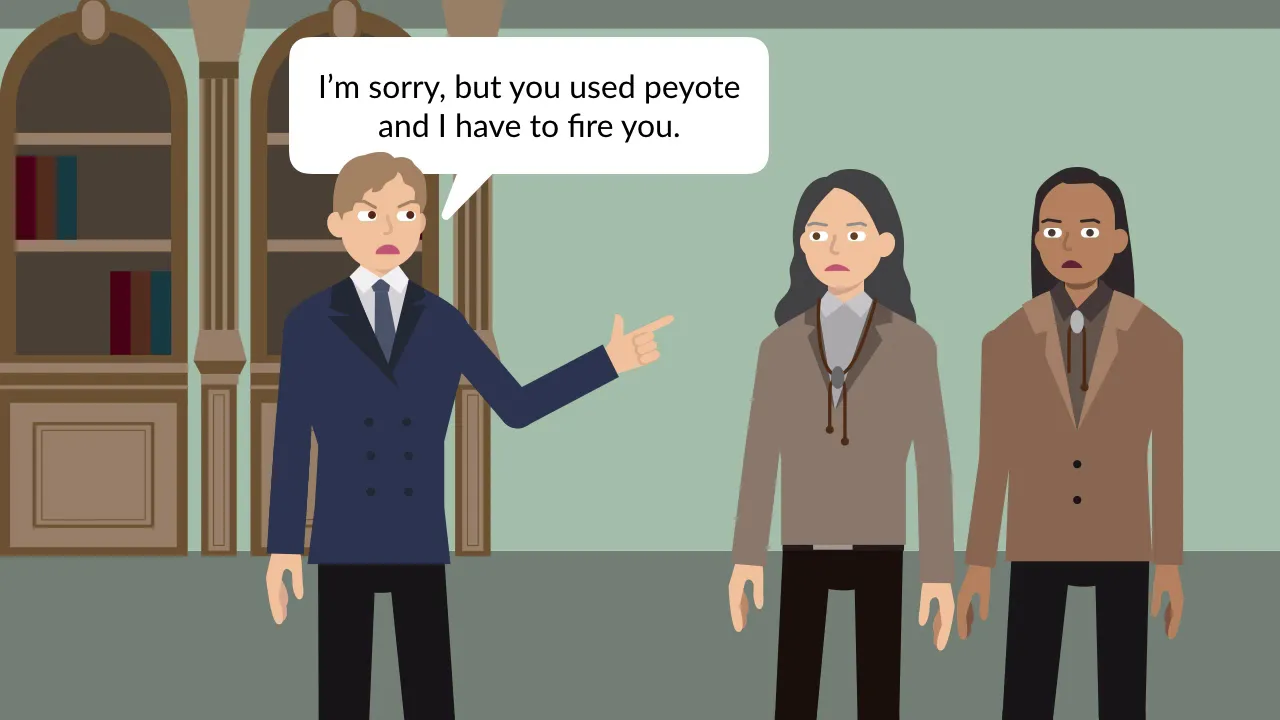
The neutral and generally applicable test requires that laws apply equally to everyone and do not target specific religious groups. In Employment Division v. Smith, the Court ruled that Oregon's peyote ban was neutral and generally applicable because it applied to everyone. However, in Employment Division v. Smith (1990), the Court ruled that Oregon's peyote ban was neutral and generally applicable because it applied to everyone. In Employment Division v. Smith (1990), the Court ruled that Oregon's peyote ban was neutral and generally applicable because it applied to everyone. In Employment Division v. Smith (1990), the Court ruled that Oregon's peyote ban was neutral and generally applicable because it applied to everyone. In Employment Division v. Smith (1990), the Court ruled that Oregon's peyote ban was neutral and generally applicable because it applied to everyone.
Click to watch →
Deep Dive
The Religious Freedom Restoration Act (RFRA) of 1993, legislative action taken by Congress to restore the strict scrutiny standard established by Sherbert v. Verner.

Religious Freedom Restoration Act
541
The Religious Freedom Restoration Act (RFRA) of 1993 is a U.S. federal law that reinstates the Sherbert Test, requiring strict scrutiny when determining whether a law substantially burdens religious exercise; under RFRA, the government must demonstrate both a compelling government interest and that the law is the least restrictive means to achieve that interest, though the Supreme Court later held RFRA unconstitutional as applied to states in City of Boerne v. Flores (1997), while it remains applicable to federal law.
Click to watch →
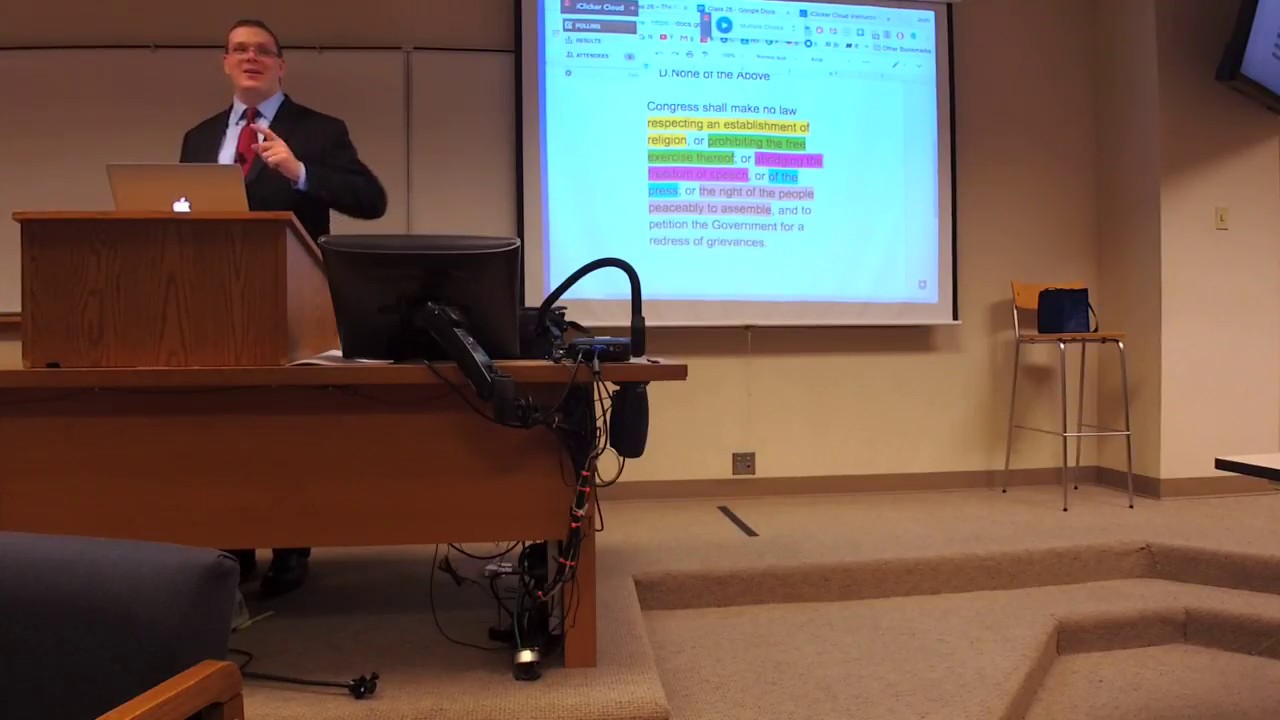
ConLaw Class 26 -The First Amendment
420
The Free Exercise Clause prohibits laws prohibiting the free exercise of religion. In Sherbert v. Verner, the Court established strict scrutiny for neutral, generally applicable laws burdening religious exercise, requiring compelling government interests and least restrictive means. However, in Employment Division v. Smith, the Court replaced this with a general applicability test, holding that neutral, generally applicable laws receive rational basis review regardless of religious burden. Congress passed RFRA to restore the Sherbert standard, but in Boerne v. Flores, the Supreme Court struck down RFRA as applied to the states, holding that only the Supreme Court can interpret the First Amendment, not Congress. RFRA still applies to federal government actions.
Click to watch →

President Clinton Signs the Religious Freedom Restoration Act (RFRA) (1993)
33.4K
The Religious Freedom Restoration Act (RFRA), signed by President Bill Clinton on November 16, 1993, was designed to restore and strengthen religious freedom protections by reversing the Supreme Court's 1990 decision in Employment Division v. Smith, which had limited the free exercise of religion; the Act establishes that the government must demonstrate a compelling interest and use the least restrictive means before interfering with religious practices, reflecting a broad coalition of 68 diverse groups including the National Association of Evangelicals, American Civil Liberties Union, and Traditional Values Coalition working together across ideological lines to protect religious liberty as a fundamental American right.
Click to watch →
Lewis Walton: Changing Times Part 3 #sdasermons #sdachurch #sda
453
In Sherbert v. Verner (1963), the Supreme Court ruled that states cannot deny unemployment benefits to someone fired for refusing to work on their Sabbath, establishing a 'compelling state interest' test. In Employment Division v. Smith (1990), the Court overruled Sherbert, ruling that states can deny benefits if there is any 'colorable' state interest. Congress passed the Religious Freedom Restoration Act (RFRA) to restore the compelling state interest test, but in City of Boerne v. Flores (1997), the Supreme Court ruled that Congress cannot overrule the Supreme Court's constitutional interpretations. This demonstrates that constitutional protections for religious freedom have been significantly weakened.
Click to watch →

The Christo-Fascist Takeover of the Supreme Court
184
The Religious Freedom Restoration Act (RFRA) was passed in 1993 by a Democratic Congress and signed by Democratic President Bill Clinton. The Act was intended to reaffirm people's right to free exercise of religion after the Employment Division v. Smith decision. However, the language of RFRA was so broad that it opened up the floodgates for religious privilege claims. RFRA was passed before the rise of the religious right and before the Supreme Court became conservative, and it has been used to advance religious privilege rather than protect genuine religious freedom.
Click to watch →
Deep Dive
Modern First Amendment cases exploring religious exemptions from public health mandates, anti-discrimination laws, and contraceptive mandates (e.g., Burwell v. Hobby Lobby).
Religious Freedom In Trouble? An Interfaith Discussion (HD)
420
In Hobby Lobby v. Burwell (2014), the Supreme Court ruled 5-4 that closely held corporations have religious freedom rights under RFRA, exempting the Greens from the Affordable Care Act contraceptive mandate. The Court found the government's compelling interest failed because other employers (TRICARE, Medicare, Medicaid, NYC) were exempt. This case sparked intense debate about whether corporations can claim religious objections to anti-discrimination laws. Supporters argue RFRA protects religious liberty, while critics contend it creates a license to discriminate against protected categories. The case illustrates tensions between religious freedom and civil rights protections, particularly regarding LGBTQ+ rights. The outcome raises fundamental questions about whether for-profit businesses can invoke religious objections to anti-discrimination obligations and whether RFRA applies to corporate entities.
Click to watch →
What Elliott-Larsen Amendments Mean for Michigan Employers
472
The Elliott-Larsen amendments create unresolved tensions between neutral anti-discrimination laws and First Amendment protections for religious exercise. Unlike Title VII, Elliott-Larsen contains no explicit religious exemption. The landmark Burwell v. Hobby Lobby (2014) decision established that closely held corporations may claim religious exemptions under RFRA to deny contraceptive coverage, but this ruling was limited to closely held corporations and based on federal RFRA provisions that do not apply to state laws. Justice Ginsburg warned the ruling's logic could extend beyond closely held corporations. Since Michigan has not adopted state-level RFRA provisions, courts must determine how First Amendment protections apply to Elliott-Larsen, creating significant legal uncertainty for employers.
Click to watch →
Religion vs Contraceptives? Supreme Court Says Religion Wins!
112.8K
In 2014, the US Supreme Court ruled in Burwell v. Hobby Lobby and Conestoga Wood v. Burwell that for-profit companies have religious rights to object to providing certain contraceptives to employees under the Affordable Care Act, citing the Religious Freedom Restoration Act; the Court determined that since women can obtain cost-free contraceptives through other systems, companies can seek exemptions from healthcare mandates based on religious objections, though this ruling raised concerns about potential slippery slope implications for other areas like hiring practices and discrimination.
Click to watch →

Hobby Lobby's Insane History
622.8K
In 2012, Hobby Lobby sued the United States government over the Affordable Care Act's contraceptive mandate, which required employers to provide health insurance covering birth control and contraceptive care. The company argued that certain contraceptive methods (Plan B and the week after pill) were 'abortion-causing drugs' that violated their religious beliefs. After a 5-4 Supreme Court decision in 2014, the Court ruled that for-profit employers with religious objections could opt out of providing contraceptive coverage under Obamacare. This was the first time the Supreme Court granted a company the right to hold religious beliefs. The ruling sparked widespread protests and inspired religious groups to request similar exemptions from anti-discrimination laws.
Click to watch →

Debate Goes Bad, Ben Shapiro SILENCED Liberal Professor Right On Stage
476.3K
The Hobby Lobby case involves the Obama administration's attempt to enforce an Affordable Care Act mandate requiring business owners to provide contraception coverage they consider abortifacient. Similarly, the Little Sisters of the Poor, a religious order caring for elderly people, face fines unless they provide employees with coverage for sterilization and contraception they consider objectionable. These cases raise questions about whether the government should compel religious organizations to act in violation of their convictions. The debate centers on whether such mandates constitute government imposition of beliefs on others or legitimate regulatory authority, with implications for the balance between religious freedom and government regulation.
Click to watch →
Sherbert v. Werner
Sherbert v. Werner
0:00- 1
Woman fired for refusing Saturday work due to religion.
- 2
State denied her unemployment benefits, lower court upheld.
- 3
Supreme Court ruled denial violated First Amendment rights.
The Neutrality Standard and Establishment Clause Concerns
While Sherbert v. Verner established robust protections by requiring a 'compelling state interest' to burden religious practice, this approach faced significant pushback, culminating in Employment Division v. Smith (1990). Critics, including the Smith Court, argue that Sherbert's exemption framework creates an unconstitutional privilege for religious citizens over secular ones. Under this counter-perspective, known as the neutrality standard, the Free Exercise Clause does not excuse individuals from complying with valid, neutral laws of general applicability. Critics contend that carve-outs based on faith undermine the rule of law, making individuals 'a law unto themselves' and raising Establishment Clause issues by favoring religious beliefs over non-religious moral convictions. This viewpoint argues that true equality under the law requires uniform enforcement of democratic legislation without judicial creation of religious exemptions.
The Free Exercise Clause of the First Amendment, which protects citizens' rights to practice their religion without government interference.
The basic structure of state-administered unemployment compensation programs, specifically the standard requirement that claimants must be 'available for work'.
The concept of judicial review and how the U.S. Supreme Court balances individual constitutional liberties against state regulatory interests.
The Fourteenth Amendment's incorporation doctrine, which applies the protections of the First Amendment to state-level actions and laws.
The 'Sherbert Test' and its specific legal prongs, including the concepts of 'substantial burden', 'compelling state interest', and 'least restrictive means'.
Employment Division v. Smith (1990), the landmark Supreme Court decision that dramatically altered and limited the application of the Sherbert Test regarding neutral, generally applicable laws.
The Religious Freedom Restoration Act (RFRA) of 1993, legislative action taken by Congress to restore the strict scrutiny standard established by Sherbert v. Verner.
Modern First Amendment cases exploring religious exemptions from public health mandates, anti-discrimination laws, and contraceptive mandates (e.g., Burwell v. Hobby Lobby).
912 views8likes2:14@LSDataOriginal Release: 2023-08-07
[Music] case briefs and so much more LS status got what you're looking for in a landmark 1963 case Sherbert V Werner the Supreme Court of the United States established a precedent for the exercise of religion even if in conflict with certain job requirements a female Seventh-day Adventist Church member was at the heart of the controversy in South Carolina her religious conviction led her to observe the sabbath on Saturdays prohibiting her from participating in work the consequence was her termination from her job seeing a need for financial sustenance in her period of unemployment the woman sought unemployment benefits from the state however her refusal to seek and accept Saturday work on religious grounds created a barrier to her eligibility for these benefits as per the South Carolina statute the South Carolina Supreme Court upheld this denial indicating that this did not compromise her freedom of religion the woman then appealed her case to the Supreme Court of the United States advocating for her religious rights under the First Amendment she earned a favorable ruling the Supreme Court bypassed the lower Court's decision stating that the appellant was unfairly disqualified from receiving compensation Ben benefits an act that infringed upon her constitutional right to freely exercise her religion the Supreme Court declared that the South Carolina statute violated the woman's first and 14th Amendment rights they proclaimed that requiring sabbatarians to work on their day of rest was discriminatory and therefore unlawful they clarified that extending unemployment benefits does not sponsor The Seventh-Day Adventist religion nor does it infringe on anyone else's religious Liberties the Supreme Court's ruling reversed the South Carolina Supreme Court's verdict the case was remanded for further action in line with the Supreme Court's decision reaffirming that citizens cannot be denied Public Welfare benefits due to their religious beliefs or lack thereof the influential decision contributed to the Constitutional dialogue regarding the balance between State interests and religious liberties case briefs and so much more [Music] elevate your mind leave the stress of class behind [Music]
Up Next
1:52
Employment Division v. Smith Case Brief | Free Exercise Clause
@QuimbeeDotCom
15.4K views•2021-01-08

4:27
US Secondary Sanctions Impact on EU Businesses and Blocking Legislation
@Bureauvandijk
1.6K views•2019-03-20

2:09
Missouri v. Seibert (2004): Miranda Warnings and Interrogation
@LSData-CaseBriefs
321 views•2023-07-30

24:42
Police Interrogation Tactics: False Confessions & Legal Reform
@LastWeekTonight
7M views•2022-04-18
Related Study Plans & Knowledge Roadmaps
Structured learning paths in Law
law
Self-Defense Law: Imminence & Castle Doctrine
01Foundations of Self-Defense Law
02Imminent Threat & Reasonable Belief
03The Principle of Proportionality
+ 3 more learning modules
12h6 modules
Explore Roadmap
law
Defamation Law: First Amendment & Actual Malice
01Introduction to civil torts and the First Amendment
02Elements of Defamation: Libel and Slander
03Public Figures vs. Private Individuals
+ 2 more learning modules
8h5 modules
Explore Roadmap
law
Hearsay Rule: Trial Evidence & Exceptions
01Introduction to Trial Evidence & Courtroom Basics
02Demystifying Hearsay: The Core Definition
03Non-Hearsay: Exclusions Under FRE 801(d)
+ 3 more learning modules
14h6 modules
Explore Roadmap
law
Medical Malpractice: Law, Liability & Care
01Foundations of Tort Law and Civil Liability
02The Four Elements of Medical Malpractice
03Defining and Proving the Standard of Care
+ 2 more learning modules
12h5 modules
Explore Roadmap