






























Aerodynamic drag is the force exerted by a fluid on an object moving through it, caused by two main mechanisms: pressure drag (form drag) from pressure differences around the object, particularly significant for blunt bodies, and friction drag from viscous shear stresses along the surface, more significant for streamlined bodies; drag can be reduced by delaying flow separation through turbulence generation (as seen in golf ball dimples and shark skin-inspired coatings), maintaining laminar boundary layers where possible, and optimizing the balance between pressure and friction drag based on the object's geometry and flow conditions.
Aerodynamic Drag Explained: Pressure, Shear & Flow Separation
Added:Basic understanding of fluid properties, specifically fluid density and dynamic viscosity.
Bernoulli's Principle and the physical relationship between fluid velocity and pressure.
Fundamental Newtonian mechanics, particularly how opposing forces act on physical bodies in motion.
The basic concept of a boundary layer, including the distinction between laminar and turbulent fluid flows.
Advanced boundary layer control techniques, such as vortex generators, riblets, and boundary layer suction.
Computational Fluid Dynamics (CFD) methods for simulating and calculating aerodynamic drag on complex geometries.
Aerodynamic vehicle design principles, focusing on minimizing the drag coefficient (Cd) in automotive and aerospace engineering.
The study of aeroacoustics, exploring how flow separation and pressure fluctuations generate aerodynamic noise.
1.1M views28.6Klikes16:43Original Release: 2021-01-12
Thanks to CuriosityStream for sponsoring this video.
Watch thousands of documentaries and get access to Nebula for free when you sign up using the link in the description.
When fluid flows past an object, or an object moves through a stationary fluid, the fluid exerts a force on the object.
We can split the force into two components - one acting in the same direction as the fluid flow, which is called drag, and one acting perpendicular to the flow direction, which is called lift.
If the fluid is a gas, like air, we call these aerodynamic forces, and if it's water or any other liquid we call them hydrodynamic forces.
This video is going to focus on the drag force, and I'll cover lift in a separate video.
Most of the time drag forces are undesirable.
They can have a huge effect on the fuel consumption and performance of vehicles, for example.
And so engineers go to great lengths to minimise them.
We'll explore some interesting ways of reducing drag later on in the video, including how the airline industry could save millions of dollars a year in fuel costs by using a drag-reducing innovation based on artificial shark skin.
But to optimise the design of objects affected by drag forces we first need to understand where these forces come from, so let's start by covering the basics.
Drag forces are caused by two different types of stress which act on the surface of an object.
First we have the wall shear stresses.
These stresses act tangential to the object's surface, and are caused by frictional forces that arise because of a fluid's viscosity.
Then we have the pressure stresses.
They act perpendicular to the object's surface, and are caused by how pressure is distributed around the object.
The drag force is the resultant of these two stresses in the direction of the flow.
So if we know exactly how the stresses are distributed over the surface of our object we can integrate them to obtain the resultant drag force.
The component of drag caused by the shear stresses is called friction drag, and the component caused by the pressure stresses is called pressure drag, or form drag.
Pressure drag is most significant for blunt bodies like this sphere.
It is essentially caused by a difference in pressure between the front and rear of an object.
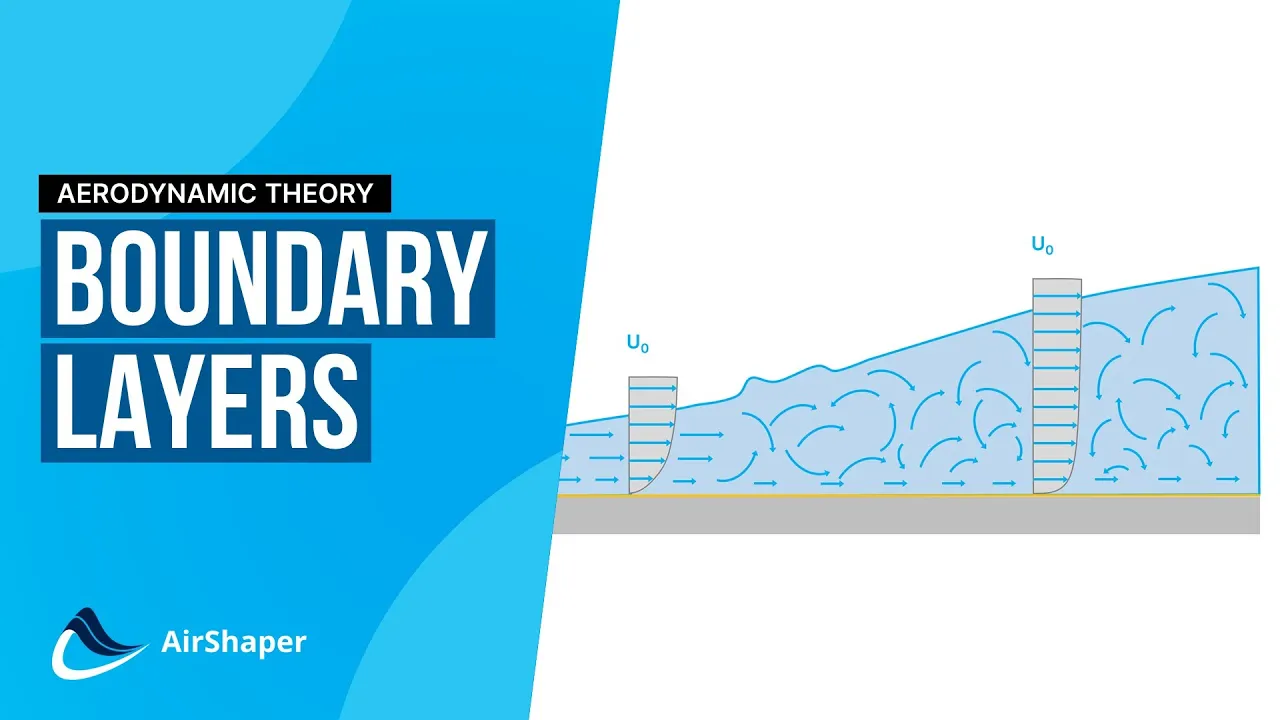
Pressure drag increases significantly if flow separation occurs, which is when the fluid boundary layer detaches from the body, creating a wake of recirculating flow.
This creates an area of low pressure behind the body, called the separation region, and results in a large drag force.
If you're trying to reduce drag forces you'll want to minimise flow separation at all costs.
Flow separation can also cause vortex shedding, which can generate unwanted vibrations and instability.
To understand why flow separation occurs let's look at flow on the upper surface of the sphere.
As the fluid passes over the surface of the sphere it is initially accelerating, and so pressure is decreasing in the direction of the flow.
This is called a favorable pressure gradient.
Beyond a certain point the flow then begins to decelerate, and so pressure in the flow direction is increasing.
This increase in pressure is called the adverse pressure gradient, and it has a significant effect on the flow close to the wall.
If the pressure increase is large enough, the flow will reverse direction, and since it can't travel backwards because of the oncoming fluid it detaches from the surface, resulting in flow separation.
Flow separation occurs at around 80 degrees for a smooth sphere in laminar flow.
If the boundary layer is turbulent instead of laminar, it's better able to remain attached to the surface and flow separation is delayed until around 120 degrees, which reduces the pressure drag significantly.
This is because turbulence introduces a lot of mixing between the different layers of flow, and this momentum transfer means the flow can sustain a larger adverse pressure gradient without separating.
This is why golf balls have dimples instead of being perfectly smooth - the dimples generate turbulence, which delays flow separation, reduces drag, and allows the ball to travel further.
This idea of using turbulence to delay flow separation and reduce pressure drag is also why some airplane wings have small vortex generators protruding from them.
Bodies that travel through fluids, like plane wings or submarines, are usually designed to be streamlined in a teardrop shape to minimise the effect of flow separation.
For very streamlined bodies like this airfoil at a shallow angle of attack, pressure drag is small because flow separation is significantly delayed, or doesn't occur at all.
For bodies like these it's the wall shear stresses which contribute most to the total drag force.
The drag component caused by these stresses is called friction drag.
Friction drag increases with the viscosity of the fluid, and is most significant for bodies which have a large surface area aligned with the direction of flow.
We saw earlier that turbulence delays flow separation, which reduces the pressure drag.
But for friction drag it has the opposite effect.
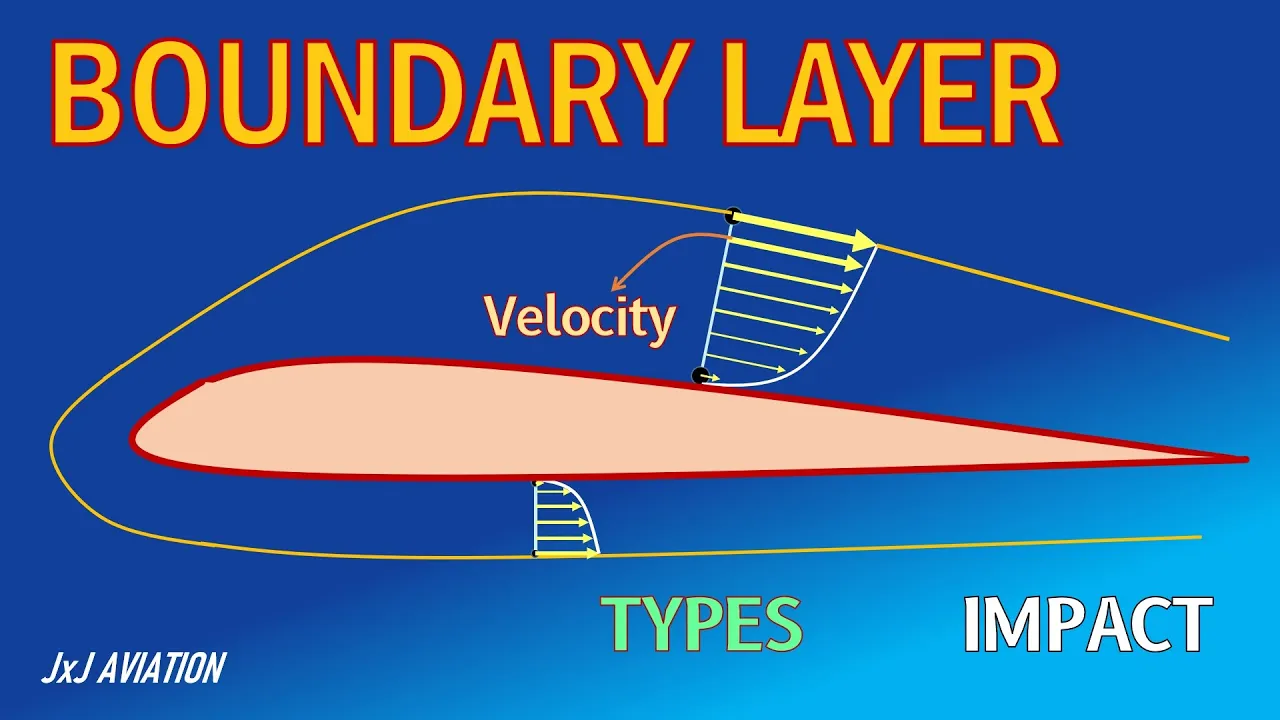
Laminar and turbulent boundary layers have very different velocity profiles.
The velocity gradient at a wall is steeper in turbulent boundary layers than in laminar ones, and so turbulence produces larger shear stresses.
So to reduce friction drag you want to delay the transition to the turbulent regime and maintain laminar flow for the largest possible distance around the object.
It has been estimated that obtaining laminar flow over the wings and fin of commercial aircraft could reduce the total drag force by around 10 to 15 percent, but this is very difficult to achieve.
Techniques like Hybrid Laminar Flow Control have had some success - it involves using suction to pull air through small holes into the wing, which delays the onset of turbulence.
Research has also focused on minimising the friction drag associated with a turbulent boundary layer.
When trying to minimise drag, engineers very often look to nature for inspiration.
Sharks are of particular interest because of the unique microstructure of their skin.
Shark scales contain microscopic ridges which are aligned with the direction of flow.
These ridges modify the turbulent boundary layer in the near-wall area, and this has the effect of reducing friction drag.
Research indicates that coating a commercial airliner with artificial shark skin of similar microstructure could reduce its total drag force by 2%, which would result in massive fuel savings for the industry.
This approach has yet to be widely implemented on commercial aircraft, partly due to challenges associated with manufacturing, but this could change as the technology improves.
We've seen that the magnitude of pressure and friction drag depends on the geometry of a body relative to the direction of flow.
The most obvious example of this is a flat plate.
If we position the plate at 90 degrees to the flow it is a blunt body.
Flow separates easily, creating a separation region, and so the pressure drag is large.
But the friction drag is almost zero, since shear stresses aren't aligned with the drag direction.
If we rotate the plate by 90 degrees we now have a very streamlined body.
The pressure drag is small since there's no separation region behind the body, but the friction drag is now much more significant.
This logic also applies to airfoils, where the angle of attack has a large influence on the drag force.
At high angles of attack separation occurs, which significantly increases the drag force.
When streamlining a body to reduce drag, it's important to remember that the friction drag will increase as the pressure drag reduces, and so these two aspects need to be carefully balanced.
The shape that has the smallest total drag force won't necessarily be the one that is most streamlined.
I mentioned earlier that we can integrate the pressure stresses and the wall shear stresses to obtain the total drag force.
The problem is that in the vast majority of cases it's pretty much impossible to know the detailed distribution of these stresses.
And so we usually represent the total drag force using the drag equation instead.
The C-D term is the drag coefficient.
It captures all of the hard-to-measure parameters, like the effect of the geometry of the object or the effect of the flow regime, and can be determined either experimentally, using a wind tunnel for example, or by running numerical simulations.
The other terms in the equation are the fluid density Rho, the free-stream velocity V, which is usually assumed to be steady and uniform, and A, which is a reference area that will depend on how the drag coefficient was determined.
For airfoils and other streamlined bodies A is usually the planform area.
And for blunt bodies it's usually the projected frontal area.
The drag coefficient can vary quite substantially with Reynolds number.
Let's look at how it varies for a few different two-dimensional shapes.
For a flat plate oriented at 90 degrees to the flow the drag coefficient doesn't vary significantly with Reynold's number, because flow separation will always occur at the edge of the plate and so, although it is a blunt body, it isn't affected by whether flow is laminar or turbulent.
For blunt shapes like this disk we see a large decrease in the drag coefficient at the transition between laminar and turbulent flow, because flow separation is delayed when the boundary becomes turbulent, reducing the drag force.
And for streamlined bodies, the drag coefficient reduces gradually as Reynolds number increases, since viscous forces are less significant at higher Reynolds numbers.
But the drag coefficient begins to increase after the transition to turbulent flow, because as we saw earlier a turbulent boundary layer produces larger shear stresses.
For a sphere, the drag coefficient graph looks like this.
One interesting thing about this graph is that it's a straight line for Reynolds numbers less than 1, and the line is defined as 24 divided by Reynolds number.
At these very low Reynolds numbers flow separation doesn't occur, even for very blunt bodies like the sphere, and so all of the drag comes from friction drag.
Plugging this equation for C-D into the drag force equation gives us an interesting expression.
This is called Stokes' Law, and it is an exact solution for the drag force acting on a sphere for Reynolds numbers less than 1.
It's one of few cases where we have an analytical solution for calculating the drag force, and it has some very useful applications.
We can use it to easily calculate the terminal velocity of a sphere falling in a fluid, so long as Reynolds Number is low enough.
As a sphere falls through a fluid its velocity will increase, and so will its drag force.
Terminal velocity is reached when the weight of the sphere perfectly balances the drag force, so that the sphere stops accelerating.
The drag force is defined by Stokes' Law.
And the weight of the sphere is easy to calculate based on its volume and density.
We just need to remember to subtract the density of the fluid as well, to account for the buoyancy force.
And so based on Stokes' law we can obtain this equation for the terminal velocity of the sphere.
We can apply this equation to create a viscometer, which is used to measure the viscosity of a fluid.
To do this a sphere is dropped into a tube of liquid, which is long enough that the sphere will reach terminal velocity.
The terminal velocity can be measured by timing how long it takes the sphere to pass between two points marked on the tube, and so the viscosity of the fluid can be calculated using the equation we just derived.
We know that pressure stresses and shear stresses are the two fundamental causes of drag.
But in some cases specific components of the drag force are named because of how they're caused, even though they're just different forms of pressure or friction drag.
In aviation for example three important sources of drag are induced drag, wave drag, and interference drag.
If you'd like to learn more about these sources of drag, I've covered them in the extended version of this video, which is available now over on Nebula.
For those who don't know, Nebula is a video streaming service built entirely by educational creators.
It's home to some of the best independent creators out there, including Mustard, Real Engineering and Practical Engineering.
It's a place where creators can experiment with new formats and longer videos.
So in addition to their normal content, which is completely ad-free on Nebula, you can explore exclusive Nebula Originals that you won't be able to watch anywhere else, or dive a little deeper with bonus content, like the extended version of this video where I've replaced this ad with a look at induced drag, wave drag and interference drag.
To make Nebula even better we've partnered up with CuriosityStream.
CuriosityStream is the streaming service for high quality documentaries.
It has thousands of incredible titles for you to explore, covering engineering, aviation, history and more.
Their new Engineering the Future series in particular is excellent.
It investigates how the latest innovations in engineering are likely to shape our future, with hour-long episodes on wind energy, nuclear fusion, and one on aviation, which takes a fascinating look at how electric aircraft and new aircraft designs could revolutionise the industry.
If you sign up to CuriosityStream using this link, you'll get a 26% discount on the annual plan, AND you'll get Nebula for free.
That's CuriosityStream AND Nebula for less than 15 dollars a year.
It really is the best deal in streaming.
So to get the bundle deal and 26% off, head over to curiositystream.com/efficientengineer, or click on the link in the description.
You'll be supporting not only this channel, but a load of other creators in the educational community as well!
And that's it for this review of aerodynamic drag.
Thanks for watching!
Up Next

5:47
Calculating Lift Drag Ratio for Airfoil Efficiency
@stevenshowalter
3.7K views•2014-05-13

12:53
21cm Hyperfine Transition in Neutral Hydrogen: Radio Astronomy Basics
@AaronRobertParsons
12.4K views•2011-10-13

32:32
NMR Spin Physics I: Zeeman Effect, Resonance Condition & Larmor Frequency
@nptel-indianinstituteofsci8064
2.3K views•2024-01-17

27:14
Entropy and the Second Law of Thermodynamics Explained
@veritasium
27.5M views•2023-07-01
Related Study Plans & Knowledge Roadmaps
Structured learning paths in Physics
physics
Nuclear Physics (Decay, Fission & Reactors)
01Atomic Structure and the Binding Force
02Radioactive Decay and Half-Life
03Nuclear Fission Mechanics and Chain Reactions
+ 2 more learning modules
12h5 modules
Explore Roadmap
physics
Soft Matter (Polymers, Colloids & Rheology)
01Foundations of Soft Matter & Thermal Forces
02Polymer Physics and Macromolecules
03Colloids, Surfactants, and Self-Assembly
+ 2 more learning modules
38h5 modules
Explore Roadmap
physics
Analytical Mechanics: Lagrangian & Hamiltonian
01Mathematical Foundations: Calculus of Variations
02From Newtonian Mechanics to Constraint Dynamics
03The Principle of Least Action & Lagrangian Mechanics
+ 3 more learning modules
28h6 modules
Explore Roadmap
physics
General Relativity (Spacetime & Cosmology)
01Foundations of Relativity: Special Relativity
02The Geometry of Spacetime: Equivalence Principle & Curvature
03Einstein's Field Equations: The Mathematics of Gravity
+ 2 more learning modules
55h5 modules
Explore Roadmap