













![I’m autistic [CC]](https://i.ytimg.com/vi/qXynK-rfAnA/maxresdefault.jpg)





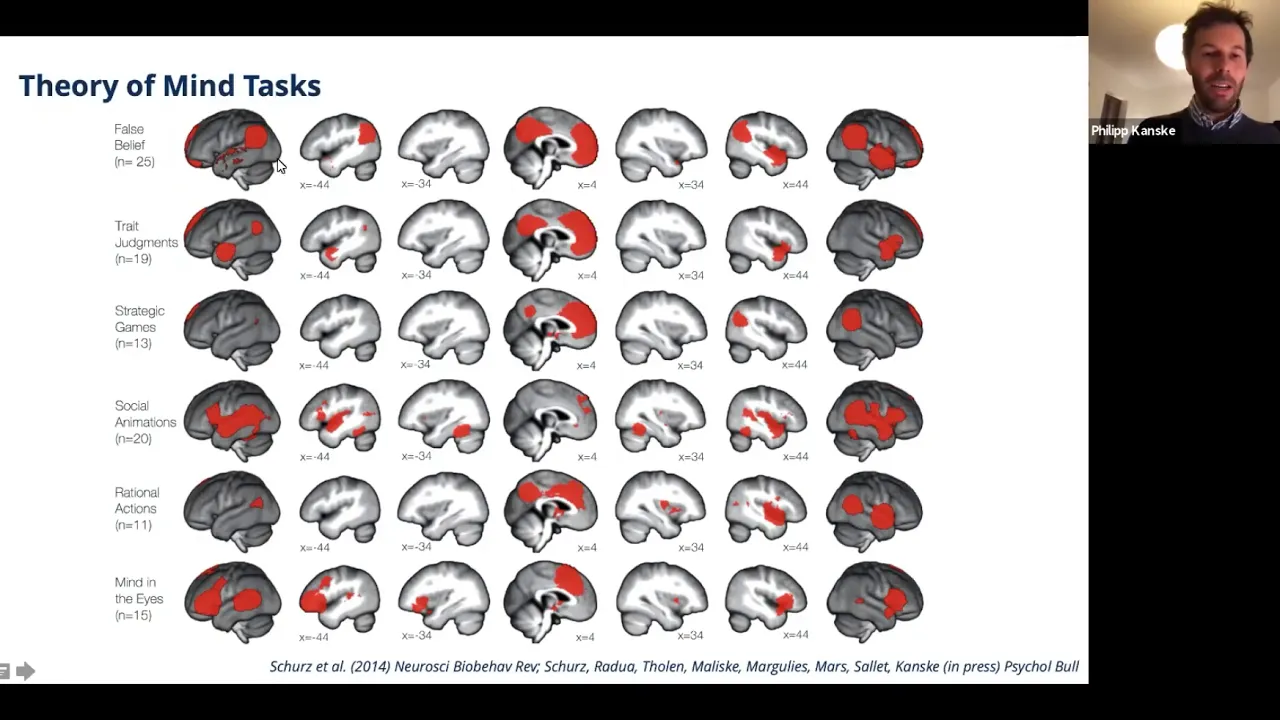

The human brain contains a specialized region called the Right Temporo-Parietal Junction (RTPJ), located above and behind the right ear, which enables us to understand other people's thoughts, beliefs, and intentions. This brain system develops gradually throughout childhood, with children typically beginning to understand that others can have false beliefs around ages 3-5, and continuing to refine this ability into early adolescence. Research using brain scanning and Trans-Cranial Magnetic Stimulation (TMS) has demonstrated that individual differences in RTPJ function correlate with how people judge others' actions, showing that this brain region plays a causal role in moral judgment by enabling us to consider others' mental states rather than just outcomes.
How the Brain Reads Another Person's Mind | Rebecca Saxe
Added:Today I'm going to talk to you about the problem of other minds.
And the problem I'm going to talk about is not the familiar one from philosophy, which is, "How can we know whether other people have minds?"
That is, maybe you have a mind, and everyone else is just a really convincing robot.
So that's a problem in philosophy, but for today's purposes I'm going to assume that many people in this audience have a mind, and that I don't have to worry about this.
There is a second problem that is maybe even more familiar to us as parents and teachers and spouses and novelists, which is, "Why is it so hard to know what somebody else wants or believes?"
Or perhaps, more relevantly, "Why is it so hard to change what somebody else wants or believes?"
I think novelists put this best.
Like Philip Roth, who said, "And yet, what are we to do about this terribly significant business of other people?
So ill equipped are we all, to envision one another's interior workings and invisible aims."
So as a teacher and as a spouse, this is, of course, a problem I confront every day.
But as a scientist, I'm interested in a different problem of other minds, and that is the one I'm going to introduce to you today.
And that problem is, "How is it so easy to know other minds?"
So to start with an illustration, you need almost no information, one snapshot of a stranger, to guess what this woman is thinking, or what this man is.
And put another way, the crux of the problem is the machine that we use for thinking about other minds, our brain, is made up of pieces, brain cells, that we share with all other animals, with monkeys and mice and even sea slugs.
And yet, you put them together in a particular network, and what you get is the capacity to write Romeo and Juliet.
Or to say, as Alan Greenspan did, "I know you think you understand what you thought I said, but I'm not sure you realize that what you heard is not what I meant."
(Laughter) So, the job of my field of cognitive neuroscience is to stand with these ideas, one in each hand.
And to try to understand how you can put together simple units, simple messages over space and time, in a network, and get this amazing human capacity to think about minds.
So I'm going to tell you three things about this today.
Obviously the whole project here is huge.
And I'm going to tell you just our first few steps about the discovery of a special brain region for thinking about other people's thoughts.
Some observations on the slow development of this system as we learn how to do this difficult job.
And then finally, to show that some of the differences between people, in how we judge others, can be explained by differences in this brain system.
So first, the first thing I want to tell you is that there is a brain region in the human brain, in your brains, whose job it is to think about other people's thoughts.
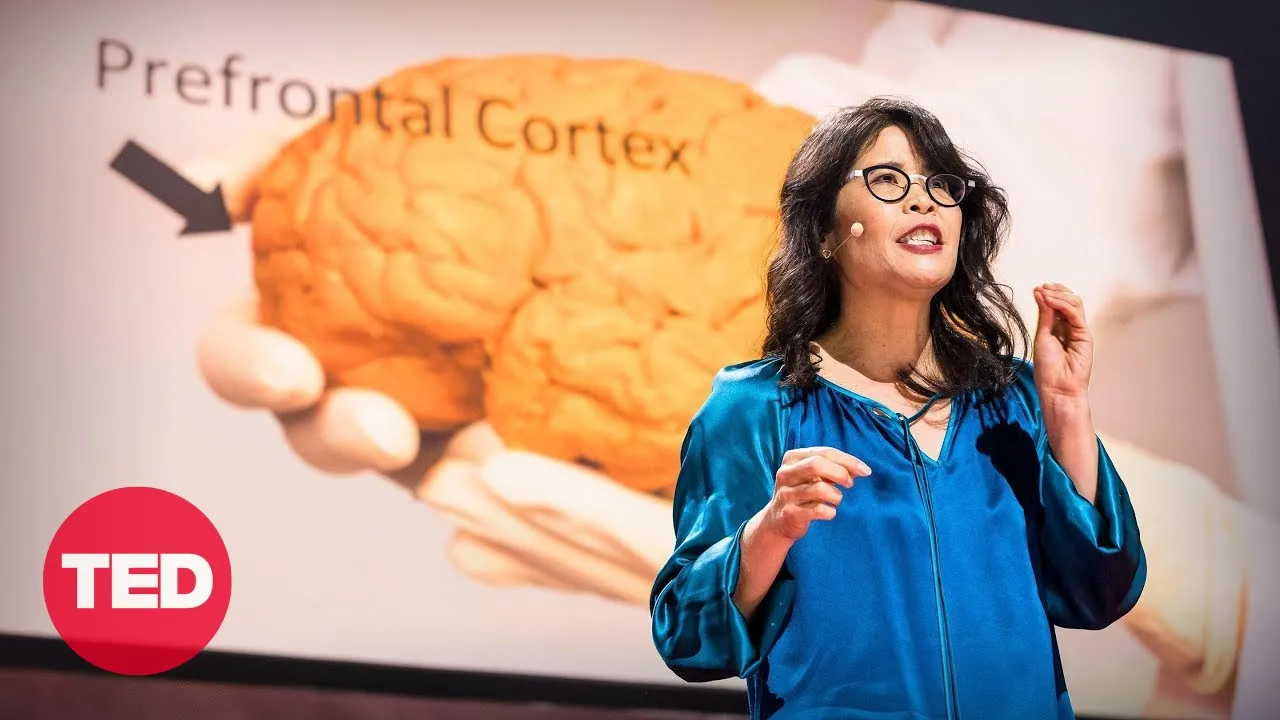
This is a picture of it.
It's called the Right Temporo-Parietal Junction.
It's above and behind your right ear.
And this is the brain region you used when you saw the pictures I showed you, or when you read Romeo and Juliet or when you tried to understand Alan Greenspan.
And you don't use it for solving any other kinds of logical problems.
So this brain region is called the Right TPJ.
And this picture shows the average activation in a group of what we call typical human adults.
They're MIT undergraduates.
(Laughter) The second thing I want to say about this brain system is that although we human adults are really good at understanding other minds, we weren't always that way.
It takes children a long time to break into the system.
I'm going to show you a little bit of that long, extended process.
The first thing I'm going to show you is a change between age three and five, as kids learn to understand that somebody else can have beliefs that are different from their own.
So I'm going to show you a five-year-old who is getting a standard kind of puzzle that we call the false belief task.
Rebecca Saxe (Video): This is the first pirate. His name is Ivan.
And you know what pirates really like?
Child: What? RS: Pirates really like cheese sandwiches.
Child: Cheese? I love cheese!
RS: Yeah. So Ivan has this cheese sandwich, and he says, "Yum yum yum yum yum!
I really love cheese sandwiches."
And Ivan puts his sandwich over here, on top of the pirate chest.
And Ivan says, "You know what? I need a drink with my lunch."
And so Ivan goes to get a drink.
And while Ivan is away the wind comes, and it blows the sandwich down onto the grass.
And now, here comes the other pirate.
This pirate is called Joshua.
And Joshua also really loves cheese sandwiches.
So Joshua has a cheese sandwich and he says, "Yum yum yum yum yum! I love cheese sandwiches."
And he puts his cheese sandwich over here on top of the pirate chest.
Child: So, that one is his.
RS: That one is Joshua's. That's right.
Child: And then his went on the ground.
RS: That's exactly right.
Child: So he won't know which one is his.
RS: Oh. So now Joshua goes off to get a drink.
Ivan comes back and he says, "I want my cheese sandwich."
So which one do you think Ivan is going to take?
Child: I think he is going to take that one.
RS: Yeah, you think he's going to take that one? All right. Let's see.
Oh yeah, you were right. He took that one.
So that's a five-year-old who clearly understands that other people can have false beliefs and what the consequences are for their actions.
Now I'm going to show you a three-year-old who got the same puzzle.
RS: And Ivan says, "I want my cheese sandwich."
Which sandwich is he going to take?
Do you think he's going to take that one? Let's see what happens.
Let's see what he does. Here comes Ivan.
And he says, "I want my cheese sandwich."
And he takes this one.
Uh-oh. Why did he take that one?
Child: His was on the grass.
So the three-year-old does two things differently.
First, he predicts Ivan will take the sandwich that's really his.
And second, when he sees Ivan taking the sandwich where he left his, where we would say he's taking that one because he thinks it's his, the three-year-old comes up with another explanation: He's not taking his own sandwich because he doesn't want it, because now it's dirty, on the ground.
So that's why he's taking the other sandwich.
Now of course, development doesn't end at five.
And we can see the continuation of this process of learning to think about other people's thoughts by upping the ante and asking children now, not for an action prediction, but for a moral judgment.
So first I'm going to show you the three-year-old again.
RS.: So is Ivan being mean and naughty for taking Joshua's sandwich?
Child: Yeah.
RS: Should Ivan get in trouble for taking Joshua's sandwich?
Child: Yeah.
So it's maybe not surprising he thinks it was mean of Ivan to take Joshua's sandwich, since he thinks Ivan only took Joshua's sandwich to avoid having to eat his own dirty sandwich.
But now I'm going to show you the five-year-old.
Remember the five-year-old completely understood why Ivan took Joshua's sandwich.
RS: Was Ivan being mean and naughty for taking Joshua's sandwich?
Child: Um, yeah.
And so, it is not until age seven that we get what looks more like an adult response.
RS: Should Ivan get in trouble for taking Joshua's sandwich?
Child: No, because the wind should get in trouble.
He says the wind should get in trouble for switching the sandwiches.
(Laughter) And now what we've started to do in my lab is to put children into the brain scanner and ask what's going on in their brain as they develop this ability to think about other people's thoughts.
So the first thing is that in children we see this same brain region, the Right TPJ, being used while children are thinking about other people.
But it's not quite like the adult brain.
So whereas in the adults, as I told you, this brain region is almost completely specialized -- it does almost nothing else except for thinking about other people's thoughts -- in children it's much less so, when they are age five to eight, the age range of the children I just showed you.
And actually if we even look at eight to 11-year-olds, getting into early adolescence, they still don't have quite an adult-like brain region.
And so, what we can see is that over the course of childhood and even into adolescence, both the cognitive system, our mind's ability to think about other minds, and the brain system that supports it are continuing, slowly, to develop.
But of course, as you're probably aware, even in adulthood, people differ from one another in how good they are at thinking of other minds, how often they do it and how accurately.
And so what we wanted to know was, could differences among adults in how they think about other people's thoughts be explained in terms of differences in this brain region?
So, the first thing that we did is we gave adults a version of the pirate problem that we gave to the kids.
And I'm going to give that to you now.
So Grace and her friend are on a tour of a chemical factory, and they take a break for coffee.
And Grace's friend asks for some sugar in her coffee.
Grace goes to make the coffee and finds by the coffee a pot containing a white powder, which is sugar.
But the powder is labeled "Deadly Poison," so Grace thinks that the powder is a deadly poison.
And she puts it in her friend's coffee.
And her friend drinks the coffee, and is fine.
How many people think it was morally permissible for Grace to put the powder in the coffee?
Okay. Good. (Laughter) So we ask people, how much should Grace be blamed in this case, which we call a failed attempt to harm?
And we can compare that to another case, where everything in the real world is the same.
The powder is still sugar, but what's different is what Grace thinks.
Now she thinks the powder is sugar.
And perhaps unsurprisingly, if Grace thinks the powder is sugar and puts it in her friend's coffee, people say she deserves no blame at all.
Whereas if she thinks the powder was poison, even though it's really sugar, now people say she deserves a lot of blame, even though what happened in the real world was exactly the same.
And in fact, they say she deserves more blame in this case, the failed attempt to harm, than in another case, which we call an accident.
Where Grace thought the powder was sugar, because it was labeled "sugar" and by the coffee machine, but actually the powder was poison.
So even though when the powder was poison, the friend drank the coffee and died, people say Grace deserves less blame in that case, when she innocently thought it was sugar, than in the other case, where she thought it was poison and no harm occurred.
People, though, disagree a little bit about exactly how much blame Grace should get in the accident case.
Some people think she should deserve more blame, and other people less.
And what I'm going to show you is what happened when we look inside the brains of people while they're making that judgment.
So what I'm showing you, from left to right, is how much activity there was in this brain region, and from top to bottom, how much blame people said that Grace deserved.
And what you can see is, on the left when there was very little activity in this brain region, people paid little attention to her innocent belief and said she deserved a lot of blame for the accident.
Whereas on the right, where there was a lot of activity, people paid a lot more attention to her innocent belief, and said she deserved a lot less blame for causing the accident.
So that's good, but of course what we'd rather is have a way to interfere with function in this brain region, and see if we could change people's moral judgment.
And we do have such a tool.
It's called Trans-Cranial Magnetic Stimulation, or TMS.
This is a tool that lets us pass a magnetic pulse through somebody's skull, into a small region of their brain, and temporarily disorganize the function of the neurons in that region.
So I'm going to show you a demo of this.
First, I'm going to show you that this is a magnetic pulse.
I'm going to show you what happens when you put a quarter on the machine.
When you hear clicks, we're turning the machine on.
So now I'm going to apply that same pulse to my brain, to the part of my brain that controls my hand.
So there is no physical force, just a magnetic pulse.
Woman (Video): Ready, Rebecca? RS: Yes.
Okay, so it causes a small involuntary contraction in my hand by putting a magnetic pulse in my brain.
And we can use that same pulse, now applied to the RTPJ, to ask if we can change people's moral judgments.
So these are the judgments I showed you before, people's normal moral judgments.
And then we can apply TMS to the RTPJ and ask how people's judgments change.
And the first thing is, people can still do this task overall.
So their judgments of the case when everything was fine remain the same. They say she deserves no blame.
But in the case of a failed attempt to harm, where Grace thought that it was poison, although it was really sugar, people now say it was more okay, she deserves less blame for putting the powder in the coffee.
And in the case of the accident, where she thought that it was sugar, but it was really poison and so she caused a death, people say that it was less okay, she deserves more blame.
So what I've told you today is that people come, actually, especially well equipped to think about other people's thoughts.
We have a special brain system that lets us think about what other people are thinking.
This system takes a long time to develop, slowly throughout the course of childhood and into early adolescence.
And even in adulthood, differences in this brain region can explain differences among adults in how we think about and judge other people.
But I want to give the last word back to the novelists, and to Philip Roth, who ended by saying, "The fact remains that getting people right is not what living is all about anyway.
It's getting them wrong that is living.
Getting them wrong and wrong and wrong, and then on careful reconsideration, getting them wrong again."
Thank you.
(Applause) Chris Anderson: So, I have a question. When you start talking about using magnetic pulses to change people's moral judgments, that sounds alarming.
(Laughter) Please tell me that you're not taking phone calls from the Pentagon, say.
RS: I'm not.
I mean, they're calling, but I'm not taking the call.
(Laughter) CA: They really are calling?
So then seriously, you must lie awake at night sometimes wondering where this work leads.
I mean, you're clearly an incredible human being, but someone could take this knowledge and in some future not-torture chamber, do acts that people here might be worried about.
RS: Yeah, we worry about this.
So, there's a couple of things to say about TMS.
One is that you can't be TMSed without knowing it.
So it's not a surreptitious technology.
It's quite hard, actually, to get those very small changes.
The changes I showed you are impressive to me because of what they tell us about the function of the brain, but they're small on the scale of the moral judgments that we actually make.
And what we changed was not people's moral judgments when they're deciding what to do, when they're making action choices.
We changed their ability to judge other people's actions.
And so, I think of what I'm doing not so much as studying the defendant in a criminal trial, but studying the jury.
CA: Is your work going to lead to any recommendations in education, to perhaps bring up a generation of kids able to make fairer moral judgments?
RS: That's one of the idealistic hopes.
The whole research program here of studying the distinctive parts of the human brain is brand new.
Until recently, what we knew about the brain were the things that any other animal's brain could do too, so we could study it in animal models.
We knew how brains see, and how they control the body and how they hear and sense.
And the whole project of understanding how brains do the uniquely human things -- learn language and abstract concepts, and thinking about other people's thoughts -- that's brand new.
And we don't know yet what the implications will be of understanding it.
CA: So I've got one last question. There is this thing called the hard problem of consciousness, that puzzles a lot of people.
The notion that you can understand why a brain works, perhaps.
But why does anyone have to feel anything?
Why does it seem to require these beings who sense things for us to operate?
You're a brilliant young neuroscientist.
I mean, what chances do you think there are that at some time in your career, someone, you or someone else, is going to come up with some paradigm shift in understanding what seems an impossible problem?
RS: I hope they do. And I think they probably won't.
CA: Why?
RS: It's not called the hard problem of consciousness for nothing.
(Laughter) CA: That's a great answer. Rebecca Saxe, thank you very much. That was fantastic.
(Applause)
Up Next

The Neuroscience of Mental States and Social Cognition
@thecellularrepublic9844
4.7K views•2020-10-27
Deciphering Neural Circuits Controlling Anorexia in Mice | Richard Palmiter
@AllenInstitute
2.3K views•2011-10-10
Heart-Brain Connections: Science of Interoception and Empathy
@TEDx
24.2K views•2018-01-23
How Exercise Benefits Your Brain: Science Explained
@TED
11.4M views•2018-03-21
Related Study Plans & Knowledge Roadmaps
Structured learning paths in Neuroscience