







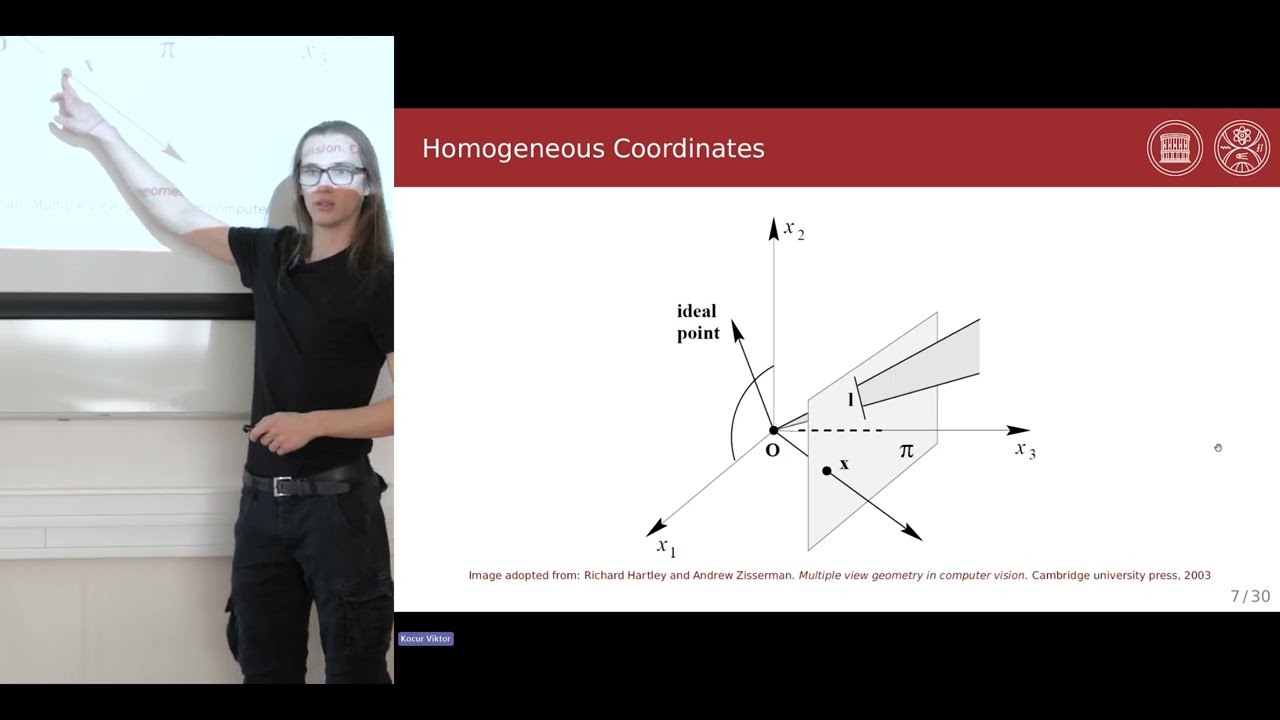





Homogeneous coordinates provide a powerful analytical framework for projective geometry by representing each point in the plane as a ratio of three numbers (X1, X2, X3), where multiplying all coordinates by any nonzero constant yields an equivalent representation of the same point. This system naturally incorporates points at infinity, enabling a unified treatment of both finite and infinite points on the projective plane. Points and lines are symmetrically represented using identical algebraic structures, with the condition that a point lies on a line given by their dot product equaling zero. This symmetry reveals the fundamental duality between points and lines in projective geometry, allowing complex geometric relationships to be expressed algebraically with remarkable simplicity.
Homogeneous Coordinates in Projective Geometry: Intro
Added:so I want to talk about homogeneous coordinates because I think they are one of the most powerful methods of understanding modern geometry so they're not as well known as they should be but as opposed to cartisian coordinates if you use homogeneous coordinates then it helps to understand the sort of plane in its entirety that is with the sort of points at Infinity included this is a lot more appropriate for example in projective geometry and one of the consequences of using homogeneous coordinates is that it's much easier to see the sort of Duality between points and lines it's much easier to prove all the theorems of projective geometry in fact rather than the synthetic approach where one has to uh assume quite a lot of axioms maybe N9 or or 10 axium to do projective geometry on the plane working with homogeneous coordinates we start with some really simple definitions of points and lines and when a point touches a line and from there we pretty much get the whole of projective geometry for free moreover we can think about different kinds of number systems like real uh number systems or complex ones to get lots of different sorts of varieties of geometry and we can study the more simultaneously so I really think it's a fantastic tool for studying geometry it's also pretty easy to be honest it's pretty simple once you get your head around the subtleties um of having different ways to refer to one particular point so what are homogeneous coordinates well nice way to start thinking of them is a homogeneous coordinates homogeneous coordinates are a way to refer to a point in the plane and we do so with three numbers X1 X2 and X3 now the critical thing here is that to describe a specific point the only thing that's important is the ratio between these three numbers X1 X2 and X3 uh and so in homogeneous coordinates we have this special uh property that we can multiply the coordinates of a point by any nonzero constant and we get a new expression but that is equivalent to the old expression it refers to the same point so all that matters is the ratio between X1 X2 and X3 so X1 X2 X3 refers to the same point as 2x1 2x2 2x3 and so on so to be honest we can really start there and very quickly start to build up Geometry just from this idea we don't even have to attach a geometric interpretation to these things yet we just get all of geometry sort of algebraically if we like um however of course you will want to think about some geometric interpretations so let's have a look at one of those well I've picture one of those here I'll talk about that in a moment I just want to say one thing uh it's very important we don't allow X1 X2 and X3 to all simultaneously be zero so we never allow that that doesn't really correspond to a point in the plane in our in the usual sense but anything else is fine and we're free to multiply by any non-zero number now today we can probably um think mostly in terms of X1 X2 and X3 being reals or rationals if you prefer to work over the rational numbers but you should bear in mind that actually we can choose these things to be elements from any commutative field so we could um have these as complex numbers for example and we'll see later that when we do so we get some very interesting insights into the natures of comics which of course are a very nice thing to use projective geometry to study and homogeneous coordinates are a very nice thing to uh use to study projective geometry so it's all matching up quite nicely anyway what's a geometric interpretation of these homogeneous coordinates how can we visualize one of these points well there is a connection with cartisian coordinates which I shall go into in a moment but another way of thinking of things is in sort of um parcentric coordinates so we're going to have these three special points uh with homogeneous coordinates 1 0 0 0 1 0 and 0 0 1 for this moment don't worry too much about where these points are in the plane suffice to say they form a triangle in other words they're not all along the same line okay now we can interpret this point X1 X2 X3 as the center of mass that You' get if you load a mass of X1 onto this vertex here a mass of X2 onto this vertex here and a mass of x3 onto this vertex here and from this interpretation you can hopefully see that all that really matters with regard to what point we're referring to is the ratios of these three numbers so if we load twice as much mass onto each vertex it's not going to affect the position of the center of gravity that we're going to get so this is of course an interpretation that makes a lot of sense if we're considering X1 X2 X3 to be positive real numbers uh and that's the normal way we're going to think about this for this lecture so here's one interpretation it's just to give you a bit of physical insight into what these things mean we're also going to look at some connections with cartisian coordinates but I just want to again emphasize that really we can just think of this thing as a purely algebraic thing starting from here and we'll very quickly see a lot of geometry emerging from this idea okay so as I've already said we can just pick up and run with homogeneous coordinates as an object in their own right but I feel like it might help you if you've not seen these things before to talk about some connections with cartisian coordinates which you probably have seen before so just to recall in carian coordinates we describe points of the plane using two numbers so we have a special Point called the origin 0 0 here and any point on the plane is described by a pair XY where X is the number of units to the right of the origin that point is and Y is the number of units up from the origin that point is so in cartisian coordinates we just need two numbers to describe a point and every point on the plane has a unique description in terms of these coordinates except perhaps the points at Infinity if you want to believe in those or or whatever um so homogeneous coordinates then are a bit different but there is a very natural connection between these two things so uh in particular let's say you have a point XY in the uh in the ukian plane is described by carthesian coordinates well how do you describe what that point is in terms of homogeneous coordinates well it turns out that it's a very simple job actually all you have to do is just a penda one at the end of the description of a point so the point XY in the cartisian coordinate system becomes the point x y1 in the homogeneous coordinate system now these being homogeneous coordinates all that really matters uh is the ratio between these three numbers so we're free to multiply them by any non-zero term and we still get a description of the same points so X y1 is equal to 2x2 Y2 and so on so that's how you go from cartisian coordinates to homogeneous coordinates um so we see the homogeneous coordinates in a way are at least as descriptive as cartisian ones now how do we go back again well by looking at how we go from homogeneous coordinates to cartisian coordinates we start to get a sense of why homogeneous coordinates can be more useful so in particular if X3 is not equal to zero then and we have homogeneous coordinates X1 X2 X3 then what we can do is multiply all of these entries by 1/ X3 and then we'll get X1 / X3 X2 / X3 and one and that operation is just multiplying all of the entries by a non-zero constant so that doesn't affect the point which we're talking about and it converts the coordinates essentially into this form and then we can see by this sort of relationship that we can go from here to here and so X1 X2 X3 that's equivalent to writing it's hard to write at this angle okay so those two things there are equivalent and then we can easily see from this relationship that we can go from here to here and so this is a description of this point here in homogeneous coordinates written in cartisian coordinates so then we can see why homogeneous coordinates are in a sense more powerful because of course we can do this kind of conversion when X3 is not zero but what about when X3 is zero what kind of points are we referring to with homogenous coordinates which have the last entry equal to zero well in that case essentially you might say that we're referring to to points at Infinity on the cartisian plane and to get a sort of um vague sense of what I'm talking about consider these quantities well when X3 is equal to zero we are dividing a number by zero of course I mean we wouldn't technically be able to use this argument because you're not supposed to be able to divide numbers by zero but you can see that when you're dividing a number by an increasingly small number um the result gets larger and larger and so in some sense you can see that there are Infinities appearing in this expression when X3 is zero now the beauty of homogeneous coordinates is that simply by sort of simply by imagining that when X3 is zero we have points at Infinity where we can then talk about these things in a very concrete way and in fact we don't need to worry too much about the interpretation of that because as you shall see the coordinate system works in its own right and in a way we can think of it as a fundamental object so the real power of homogeneous coordinates is that in addition to allowing nonzero third entries here we can also allow zero third entries now of course such points with such Co homogeneous coordinates can't be given exactly the same kind of interpretation via cartisian coordinates because such things would involve division by zero however it turns out that such points can still be interpreted geometrically it's just that they are sort of points which are on the kind of line at Infinity which we can think of in some senses surrounding the standard ukian plane and when we think about projective geometry we can imagine augmenting the ukian plane by this sort of set of points at infinity and um the homogeneous coordinates give us a way to think about include such points and do analytic geometry involving them and in doing so by adding these points we sort of complete the system and then we're able to see more clearly this kind of Duality which happens between points and lines so we can see our sort of point line Duality working algebraically uh by point line Duality I mean this objective geometry idea that points and lines essentially are objects which have kind of equal standing in the geometry of the plane and you can see this very directly uh when you work with homogeneous coordinates which can also be used to describe blinds so um I'll carry on let me explain how that works so one of the reasons I like homogeneous coordinates so much is that you need so little foundation in order to be able to quickly get to a great deal of the results from projective geometry so unlike the sort of standard synthetic approach which I've talked about in previous videos on foundations of projective geometry where you need lots of axioms and assumptions to begin in projective geometry you pretty much just need the idea of the coordinate system the definitions of points and lines and the definition of when a point lies upon a line and from there you can quite quickly go and prove lots of the important results of geometry and so this is the most important sort of picture that I'll talk about in these lectures because it gives you the definition of a point the definition of a line and the condition for when a point lies upon a line or when it's touching it so let's have a look at this a point we typically uh use lowercase letters for points now uh when we're dealing algebraically and surround them by round brackets and a point is just given by a triple X1 X2 X3 blur case letters a line is also specified by homogeneous coordinates three entries we're using capital letters for this Capital X1 Capital X2 Capital X3 are the three different components of a line you'll understand the interpretation of this later on when I go through some examples I hope but the condition for a point to be on a line is when this is zero so when little X1 * big X1 plus little X2 * big X2 plus little X3 * big X3 is equal to zero um and we give a kind of sh hand for this using these triangular brackets and you'll probably recognize this as the dot product uh or sometimes called the inner product of these two vectors and so the import thing here is that both of these point and line are described in very similar ways in terms of three numbers we do not allow each of these entries X1 X2 and X3 to all be zero simultaneously we don't allow these big X1 X2 X3 to all be zero simultaneously those those cases are um they don't have a geometric interpretation essentially but anything else is fine and we're only interested when we talk about a point if we multiply all these three numbers by any non-zero constants such as row um we get a new expression but we think of it as referring to the same Point again uh similarly we can multiply all of these capital x entries by the same non-zero constant and we get a new expression but we take it as referring to the same old line now essentially this means that points and lines are treated equivalently and you can see that they have a completely symmetric role in the way that they interact with each other when we're talking about a point lying upon the line so it might be better perhaps to use some kind of symmetric terminology like when a point touches a line um since really these two objects are on equal footing in our kind of system so I'll just say this again just because it's perhaps the most important part of the lecture the points is described by three numbers use round brackets to denote a point and lowercase letters a line is also described by three numbers we use square brackets to note a line and capital letters and all that matters is the ratio between these three numbers when we're talking about the points similarly with the line and we don't allow all of these three entries to simultaneously be zero and we don't allow this kind of going on here either and this is the condition for when a line and a point meets essentially when the inner product of the vectors equal zero okay so just to say a little something about shorthand I might sometimes write this kind of term like this so sometimes it can be kind of clunky to keep putting these round brackets around the points and the square brackets around the lines so sometimes I might just miss them out and for example Express this product like this because it'll often be clear whether I'm talking about points or lines just by the kind of case of letter which I'm writing what does this way of referring to lines mean I mean here we have a line 3 - 2 2 there are its coordinates so how can we think about this well essentially we can think of what it means in terms of an equation in terms of this equation here which is the equation for when a point is on a l so we can interpret this line 3 2 - 2 we could also say it's the Line 6 4 - 4 or any non zero multiple of these three numbers anyway um we can interpret it as an equation like this specifying all the homogeneous coordinates of points which are on this line so a point Little X is going to be upon this line big X when 3 * X1 + 2 * X2 - 2 * X3 equals z so this is the equation which essentially describes all the points which are on this line now how do we interpret this equation well essentially the equation gives us lots of values X1 X2 X3 which give us a which give us homogeneous coordinates of points upon that line so what we can do we know that when X3 is equal to one uh essentially then X1 and X2 can be interpreted as uh in terms of cartisian coordinates as I was saying at the beginning so I'd just like to just for a minute just Venture back into the realm of cartisian coordinates so we can think about this line in a more familiar way um I don't want to have to keep going back to carthesian coordinates uh hopefully we can move past that but let's just go there for a moment to get some familiarity with this so we can set X3 is equal to one and then we're basically consider considering um all the different points of this line which are sort of finite and um then we're free to think of X1 in terms of a sort of cartisian X I'm using a curly X now uh so we don't get too confused and similarly a curly Y is now represented by X2 and so we can see that this has the cartisian equation equation 3x + 2 y - 2 = 0 we can rewrite this in the usual way so we have y is = to 1 - 3 2X and we can draw this equation so essentially what this is is the sort of equation of the finite of the um of what's going on with this line for all the points except the infinite this is in a sense a more General equation this one with the homogeneous coordinates because we can also think about what happens here when X3 is equal to zero essentially then this is telling us about what the uh about where this line meets the line at infinity and uh what the little x coordinates are for the point where that happens okay then so just as if we're given a line we can interpret that as an equation of points so in an exactly dual way if we're given a point we can interpret that as an equation which gives all the lines which go through that point so for example if we have the point 236 then we get this equation here here in terms of lines capital x the equation 2x1 3x2 3 2x1 + 3x2 + 6 X3 which gives the homogeneous coordinates of all the lines capital x which pass through this point here and um so it's interesting to see this kind of Duality and I think it's also quite revealing about how we tend to think of objects in the world so since we can have an equation I mean it's not it's natural for us I think if we have a line to interpret that as an equation of points upon that line we tend to think better in terms of points whereas if we have a point it's um much less natural for us to then think of an equation of lines through that point and to get a sort of expression for the coordinates of all those lines but we see that kind of logically they're both equivalent ways of looking at things um we can also think for example about all the lines capital x through the points one0 0 that's obviously a special type of Point those are all the lines which have an equation Capital X1 equals z and by sort of um continuing this reasoning we can then think about this sort of reference triangle so we have these three special points 1 0 0 0 1 0 and 0 0 1 um and they're special points in our homogeneous coordinate system now it turns out that essentially when we're doing theorems in projective geometry um [Music] um we can really pick any three non-colinear points to serve as these three points of our reference triangle um because essentially whatever we three points we pick we can always find a sort of projection to transform them um anyway we see fit so I mean we could think of these as having special interpretations in terms of cartisian coordinates which is somewhat elegant and I wother going into them but suffice to say we have these three special points um and then you can see by what I've written so far that this reference triangle also has these three special edges 0 one 0 [Music] Zer joining one z z points one z0 to 001 line one0 0 joining point 0 1 0 to 01 and so on and you can check for yourself that these lines written in blue do indeed join the points drawn in green as I've shown so we can think of a reference triangle in terms of points or dually a reference triangle in terms of lines so this Duality principle is um is going be true for pretty much everything I talk about you can always convert things so that we're talking about points instead of lines and um there's basically an equivalent notion of of everything in uh under this kind of dual flip so for example we could say that three points are collinear that means three points lie on the same line the uh kind of dual statement of that would be that three lines are concurrent that means three lines go through the same point and you can see that basically you can get this kind of dual expression by getting the algebra and replacing the little X's with big x's and the round brackets with square brackets and so on now an interesting question something for you to think about if you have a point with particular coordinate say 236 then what does the line look like that has the same coordinates and how is it related to the point I'm not going to go into this yet um but there's a very nice answer to this question which has to do with polarities well I'll say quickly but I'm not going to go into detail yet essentially to do such a conversion um from a point to a line you find the polar of that point with respect to the unit circle and uh if you don't know what I mean by that uh I give a link to a video uh in the description below that you can find out about that from okay so now we're going to move forward and look at some expressions for important things in particular when three points are in Al line with each other or cinear as we say and so when are three points x y and Zed collinear well just by the definitions they'll be collinear when there exists a line capital x such that these products here all equal zero so the product of little X and capital x is zero as is little Y in capital x as is little Zed in capital X okay so we're really interested in what that condition means and it turns out that you can if you write all these three things as equations in terms of capital X1 Capital X2 capital x 3 the coordinates of the line capital x and then you solve out to eliminate the capital x terms you'll see that this expression is equivalent to this expression here which is that the determinant determinant excuse me with rows X1 X2 X3 y1 Y2 Y3 and Z1 Z2 Z3 is equal to zero and if you don't remember about the terminats then don't worry because you can just think of this expression as being equal to this one here this is a sort of way to write out what this 3x3 determinant is in general in fact it's obtained um via a special trick that you can do with 3x3 determinants which is to expand them out it's this times this times this take away this times this times this so essentially you're um adding on diagonals like that and taking off diagonals like that so then it's plus this times this time this take away this times this times this plus this times this times this take away this time this times this so essentially you're multiplying when you're going uh I've got my hands R around you're multiplying when you go down by diagonals like this and adding and you multiply diagonals like this and subtract them and you imagine that this is sort of wrapped around on a cyinder so when you go off the left hand side you come on the right hand side and so on um okay so that's one fairly useful expression for when three points are cinear now let's have another look at this uh let's just if we use some different notation so rather than calling this point Capital X1 Capital X2 Capital X3 sorry this line rather than calling it Capital X1 Capital X2 Capital X3 in square brackets we can instead call it call its components Lambda mu and newu so those can be new ways to write X1 X2 X3 there's no real advantage to doing this apart from the it's more traditional to think of these Expressions as representing parameters so we can start to think of a parameterization of all of the points on the line and so we basically see that this condition here just by rewriting capital X in terms of these with its uh coordinates given by these three numbers here we find that this condition of collinearity is equivalent to this one that there exists a Lambda mu and a new that are not all zero such that Lambda x i + mu Yi + mu z i = z for each I uh in one in one to three okay so the advantage of this is that we can mess around with the expression to get a sort of General condition for the set of points which line up with a couple of distinct points so let's say we have a pair of points Y and Zed so in this case uh General Point that's in line with these things well provided that Y and Zed are distinct if we take a look at this expression here we can see that essentially that's equivalent of a condition that Lambda is not equal to zero I mean hopefully you can check for yourself that when Lambda is equal to zero um mu and new are proportional to each other and there sorry uh X and Y are proportional to each other and therefore basically describing the same point however when Lambda is not zero um we can essentially get an expression for x is this kind of term here now when you go through the algebra of this which I strongly suggest you do you'll notice that I've done a bit of a trick to get to this in the sense that um I've exploited this fact that you can multiply a a vector by a sort of nonzero constant and it's still referring to the same point so this is done a lot in this kind of setup um so essentially we sort of absorb the Lambda term into the MU and the new term and we find that a general point x which is sorry a general Point Zed which is cinear excuse me I'll start again a general point x I was right the first time a general point x which is collinear with Y and Zed can be written as Mu * y1 mu * Z1 comma mu Y2 plus mu Z2 comma mu Y3 + mu Z3 so we can write that in a more concise way as just being the constant mu * y plus the constant mu time Zed where mu and U are any two elements that are not both equal to zero at the same time so this essentially gives us a parameterization of the line now it might look strange for those of you familiar with sort of the description of um I find combinations of vectors because essentially lines are one-dimensional objects but here we're parameterizing it with two different numbers but that's a conse quence of the fact that in homogeneous coordinates there can be many expressions for a particular point and all that really matters is um is the proportions of the three numbers which go into the coordinates of a point so I strongly urge you to check these results um because I mean this is really fundamental stuff this is the sort of definition of collinearity and so I recommend you check out that this formula works that this is equivalent to this condition above and also that this sort of formula makes sense as the expression of the set of points collinear with distinct points Y and Zed okay so we have these distinct points why Y and Zed and then we have this expression mu y + mu Z which is essentially a parameterization of the set of points on the line through Y and Zed so essentially we have two parameters here me and new but we can basically reduce this um so if you think about it any point on this line of this kind um apart from why itself uh can be written like this because provided we're not talking about the point Y itself we can express the point like this for some value of new which is not zero and then essentially we can just absorb this new into the mu you divide the whole equation by mu and rewrite mu is uh whatever is Mu ided by mu and um we can get this kind of an expression for that point on the line so all the line all the points apart from y can be written in this kind of form which is nice because this is essentially just a one parameter description of set of point point on the line um and how do we get the point Y back I mean it'd be nice to talk about all the points on the line well we can if we like adopt the convention that when mu goes to Infinity uh this expression is describing point Y itself and that sort of makes sense right because when mu's very very large this term here is going to dwarf this term here so we can adopt this convention if we like now I don't think anything I intend to say in these lectures is going to rely on this kind of convention but it is fairly useful to bear in mind now we can actually go further so we started off with this two parameter description of the set of points on the line now we get to here we've got a one parameter description it turns out that we can describe so say we have a couple of points Y and Zed distinct points on the line with homogeneous coordinates Y and Zed well it turns out that we can actually describe any third point on this line without using any parameters at all so excuse me if you take a look at this expression here let's say we have a specific point say x which is of the form mu y + z well we can select the we can sort of because we're free to multiply a a point by any nonzero constant so we can essentially absorb this mu parameter inside the Y parameter um so we can sort of imagine that the coordinates y1 Y2 and Y3 is suitably scaled so as to kind of absorb this me parameter inside and then we can rewrite this um mu y + z simply as y + z and so you can just do this once for any particular point on the line other than this is a mistake here that ought to be a z okay so for any particular point on the line other than y and Zed we can just write that's a mistake as well we can write that third Point as y + z but if we have another point on the line let's say here of course that can't be written in the same way so once we've got more than one point on the line it's uh it's time to introduce the proper parameter so essentially what we're saying here with this bottom bit is that in homogeneous coordinates we have this freedom of being able to express a particular point in lots of different ways and we can essentially take advantage of this um in order to be able to write a third Point uh collinear with y and z as y + z we can suitably uh scale up the three numbers in the coordinates of Y so we can do that okay so now we have the fairly easy job of just dualizing everything that we've just talked about in terms of lines instead of points so the Dual of three points being collinear three points lying upon the same line is that three lines would be concurrent meaning that they all pass through the same point so if we have distinct lines with homogeneous coordinates capital x capital Y and capital zed then they're going to be concurrent if and only if there exists a point x which lies upon them all at the same time so all of these products here they're all equal to zero and the way that this works is exactly like before so we can find that this is equivalent to the condition that this determinant here is equal to zero and just dualizing the argument before we can get this General expression mu y + mu Z which is a parameterization of the sort of pencil of lines um which you're concurrent with Y and Zed okay so we have a couple of a couple of lines Y and Zed they're meeting at a specific point and this is essentially a parameterization of all of these lines and everything I've just talked about also applies uh to this case where we're talking about lines instead of points so um projective geometry has this complete Duality as is evident by the fact that uh points and lines are basically just distinguished by round brackets or square brackets apart from that they're basically algebraically the same thing um and so it's fairly obvious how dualize all these different results and because of that I'm not going to talk about the jewels of every single result you can go through them yourself and think about the jewels of these things
Up Next
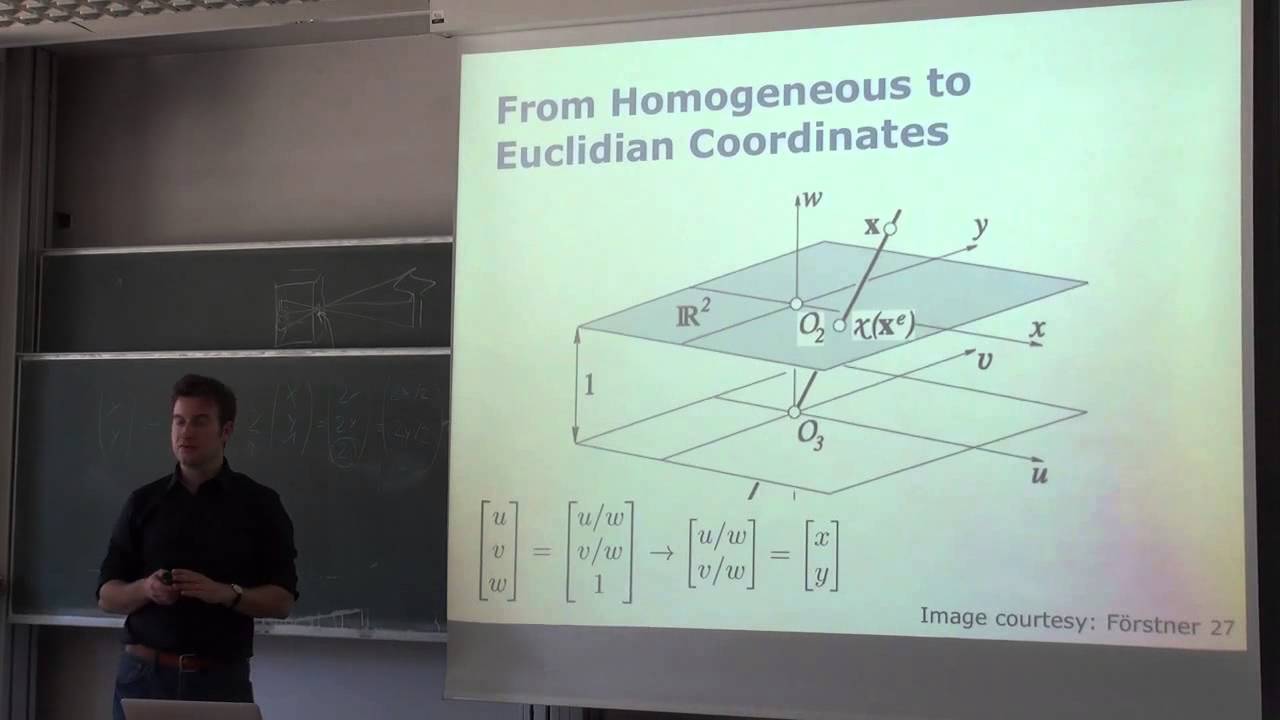
Homogeneous Coordinates in Photogrammetry | Lecture Explanation
@CyrillStachniss
32K views•2015-07-09

JEE Maths | Circles: Pole & Polar Explained with Equations
@TargetPublications
14.4K views•2019-02-23

Foundations of Projective Geometry: An Axiomatic Introduction
@RichardSouthwell
21.6K views•2015-06-13

The Mathematical Impossibility of Accurate World Maps
@Vox
23.3M views•2016-12-02
Related Study Plans & Knowledge Roadmaps
Structured learning paths in Mathematics