Projective geometry is more fundamental than Euclidean geometry because it uses fewer assumptions and focuses on properties of points and lines rather than metrics, distances, or angles; by starting with basic axioms about a two-dimensional projective plane and deriving all subsequent concepts logically, this axiomatic approach makes geometric knowledge applicable across various systems including spherical and hyperbolic geometries, allowing familiar notions like conic sections to emerge naturally from simple foundational principles.
Foundations of Projective Geometry: An Axiomatic Introduction
Added:Deep Dive
Linear Algebra: A solid grasp of vector spaces, bases, dimension, and linear transformations, as these form the algebraic basis for homogeneous coordinates.
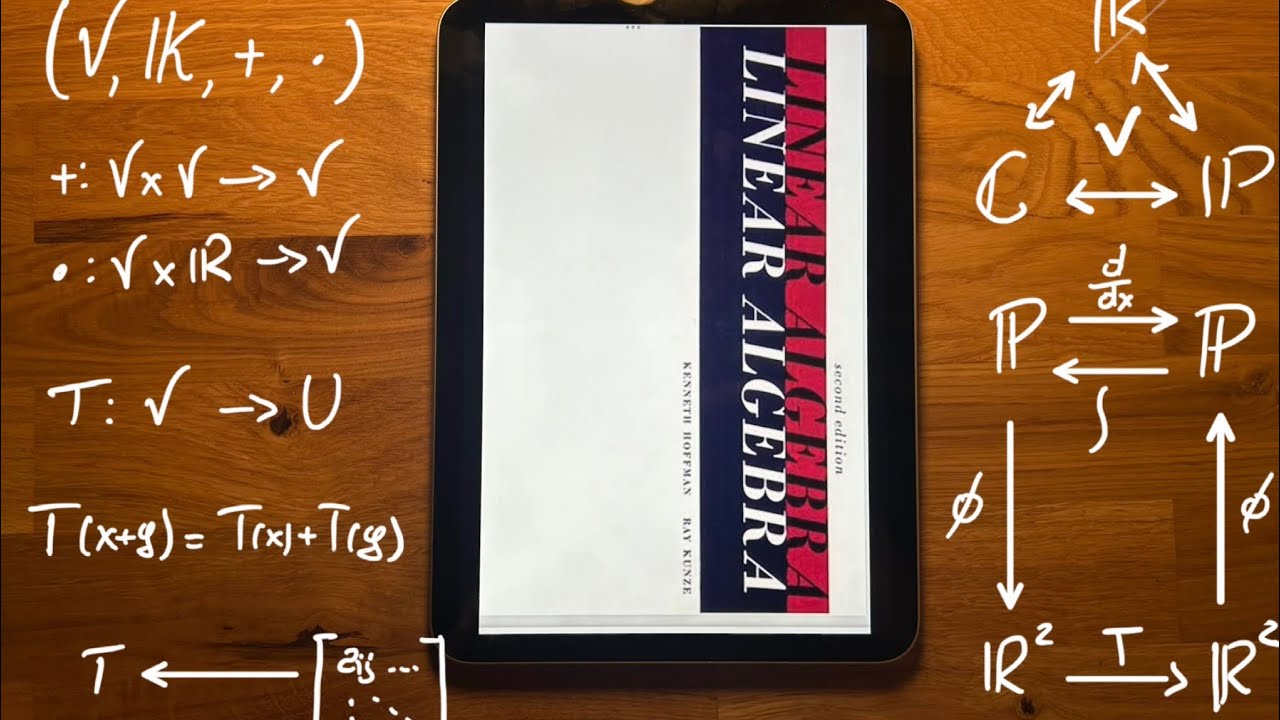
Tudo Que Você Precisa Para Não Reprovar Em Álgebra Linear
31.5K
Linear algebra studies vector spaces—sets with addition and scalar multiplication satisfying specific axioms. Examples include R², R³, Rⁿ, complex numbers C, and polynomials of degree 1. A key insight is that polynomials are vectors because they satisfy vector space properties, demonstrating vectors are more general than geometric arrows. Linear transformations preserve addition and scalar multiplication between spaces. Spaces with the same dimension are isomorphic, meaning they are algebraically identical. The derivative operation on polynomials (Ax + B → A) is a linear transformation representable as a matrix [[0, 1]]. Linear functionals map vector spaces to their associated fields. In finite-dimensional spaces, every linear transformation corresponds to a matrix. Linear algebra is essential for Calculus 2, Calculus 3, and Differential Equations. Key concepts include recognizing vector spaces, linear functionals, dual and bidual spaces, and inner products. Recommended resources include books by Elon Lages, Flávio Ulhoa, Gilbert Strang, and Hoffman.
Click to watch →

Linear Independence, Basis, and Dimension - Linear Algebra
794.2K
In linear algebra, a set of vectors is linearly independent if no non-trivial linear combination of them equals the zero vector; a basis for a vector space is a set of vectors that is both linearly independent and spans the entire space, and the dimension of a vector space is defined as the number of vectors in any basis for that space, which remains constant regardless of which basis is chosen.
Click to watch →

Engineering Mathematics | Linear Algebra (Matrices) | GATE 2023 | For All Branches
294.7K
Linear algebra is a fundamental module in engineering mathematics, particularly important for GATE examinations. It consists of 2-3 marks questions annually. The subject is also known as 'matrices' and involves solving systems of simultaneous equations. Matrices have wide applications in technical subjects including fluid mechanics (stress tensors), finite element analysis (stiffness matrices), and various engineering disciplines. The instructor recommends learning in English as it is the primary language of education worldwide, even at top institutions like IITs and IISc Bangalore.
Click to watch →

Introduction to Linear Algebra: Systems of Linear Equations
547.8K
Linear algebra studies systems of linear equations, which are equations of the form A₁X₁ + A₂X₂ + ... + AnXn = B, where none of the variables are raised to any exponent or involved in products/quotients. These systems model real-world relationships because they strike a balance between simplicity and complexity—simple enough to be solvable yet complex enough to capture many practical scenarios. A solution to a system is a set of values for each variable that satisfies all equations simultaneously. When graphed, the solution corresponds to the intersection point of lines (for two variables) or planes (for three variables). Systems can have a unique solution, no solution (inconsistent), or infinitely many solutions (dependent), depending on whether the equations intersect at a point, are parallel, or describe the same line/plane.
Click to watch →
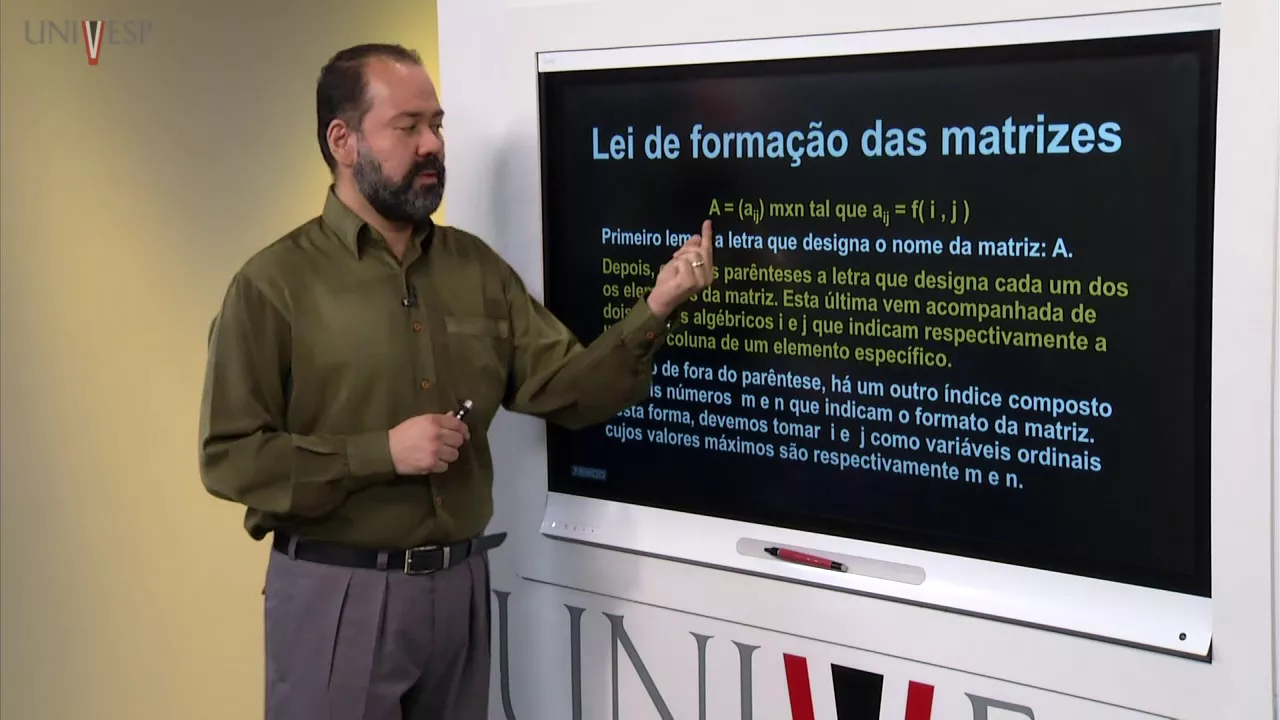
Álgebra Linear - Aula 01 - Matrizes e Determinantes (Parte 1)
80K
A matrix is a rectangular table of numbers organized in rows and columns, classified by dimensions (m×n) and special types including row matrices, column matrices, unitary matrices, rectangular matrices, square matrices (where m=n, called 'ordem'), triangular matrices (lower/upper), diagonal matrices, and identity matrices (where all diagonal elements equal 1); matrices can be defined through formation laws using functions of their indices, and basic operations like equality, addition, and subtraction require matrices to have identical dimensions, with addition/subtraction performed element-wise.
Click to watch →
Deep Dive
Axiomatic Mathematics: Familiarity with modern axiomatic systems, proof structures, and the concept of independence and consistency in mathematical systems.

From One to Many Geometries - Professor Raymond Flood
79.3K
Euclid's Elements, written around 300 BC in Alexandria, established the axiomatic method that shaped mathematics for over two millennia. The work consists of 13 books covering plane geometry, arithmetic, and solid geometry. Euclid began with common notions (logical truths) and five postulates, then proved all subsequent propositions through rigorous deduction. Key results include constructing equilateral triangles, proving triangle angle sums equal 180°, establishing the Pythagorean theorem, developing number theory with the Euclidean algorithm, and proving there are infinitely many prime numbers. The final section presents the five Platonic solids (tetrahedron, cube, octahedron, dodecahedron, icosahedron) and proves they are the only possible regular solids—the first classification theorem in mathematics. Proclus praised Euclid's work for its clarity, precision, and systematic arrangement of foundational propositions.
Click to watch →

(Provably) Unprovable and Undisprovable... How??
48.5K
This segment establishes the framework for understanding mathematical independence. It begins with defining an integral domain through six axioms: existence of zero and one, closure under addition and multiplication, associativity and commutativity, distributivity, and the property that nonzero elements multiply to nonzero results. Using these axioms, natural numbers and negatives can be constructed. The video then demonstrates two approaches to determining provability: direct proof construction (showing (x+y)²=x²+2xy+y² holds via distributivity and commutativity) versus counterexample-based disproof (demonstrating (x+y)²=x²+xy+y² is false by substituting x=1,y=1 and deriving 4=3, which contradicts 0≠1). This establishes that false statements are unprovable, but leaves open the challenge of proving independence for statements whose truth value is genuinely unknown.
Click to watch →

Corre de PhD: Como Desenvolver Intuição Matemática | Lutz Podcast #342
53.4K
Mathematics is built upon axioms - primitive truths accepted without proof. Euclidean geometry starts with five simple axioms, from which complex results like the 180-degree triangle angle sum are derived. Mathematics is not rigid; different axiom sets produce valid but different geometries (Euclidean, spherical, hyperbolic). This flexibility allows mathematicians to explore different mathematical universes. Mathematics is remarkably accessible, requiring only paper, pen, and creativity - no expensive equipment needed. This accessibility enables anyone with curiosity to engage with profound mathematical ideas.
Click to watch →

Prof C.K.Raju on Pythagoras Theorem, Christian/Western Supremacism || Hindu Mathematics || Euclide
14.6K
This segment traces the development of axiomatic mathematics in the 19th century and its philosophical implications. Euclid's Elements contains empirical proofs, particularly in the first proposition where constructing an equilateral triangle requires visual verification of intersection points. This contradicts the claim that Euclid's work contains purely axiomatic proofs without empirical observation. Mathematical points are invisible and cannot be directly observed, yet they are treated as real entities in mathematical reasoning. Dedekind developed the theory of real numbers to address the problem of exact values for irrational numbers like √2, which Indian mathematics accepted as approximate values. Hilbert provided the first purely axiomatic proof of the Pythagorean Theorem in 1899, after it was acknowledged that Euclid's Elements contained empirical proofs. Russell criticized mathematical proofs, stating that all proofs are flawed, leading to axiomatic systems that avoid empirical observation entirely. However, axiomatic systems can prove false statements if the axioms are false.
Click to watch →

Greek Mathematics (Part 1)
58.1K
Euclid's Elements, compiled around 300 BC by Euclid of Alexandria, established the foundational framework of axiomatic mathematics through its systematic presentation of 13 books, beginning with 23 definitions, 5 postulates (including the controversial fifth parallel postulate), and 5 common notions, followed by rigorous logical proofs of geometric propositions such as the construction of equilateral triangles and Pythagoras' theorem; this work represents the culmination of approximately three centuries of Greek mathematical development and has remained one of the most widely studied and reprinted mathematical texts in history.
Click to watch →
Deep Dive
Basic Abstract Algebra: Understanding of fields (such as the real and complex numbers) and groups, which are vital for algebraic formulations of projective coordinates.
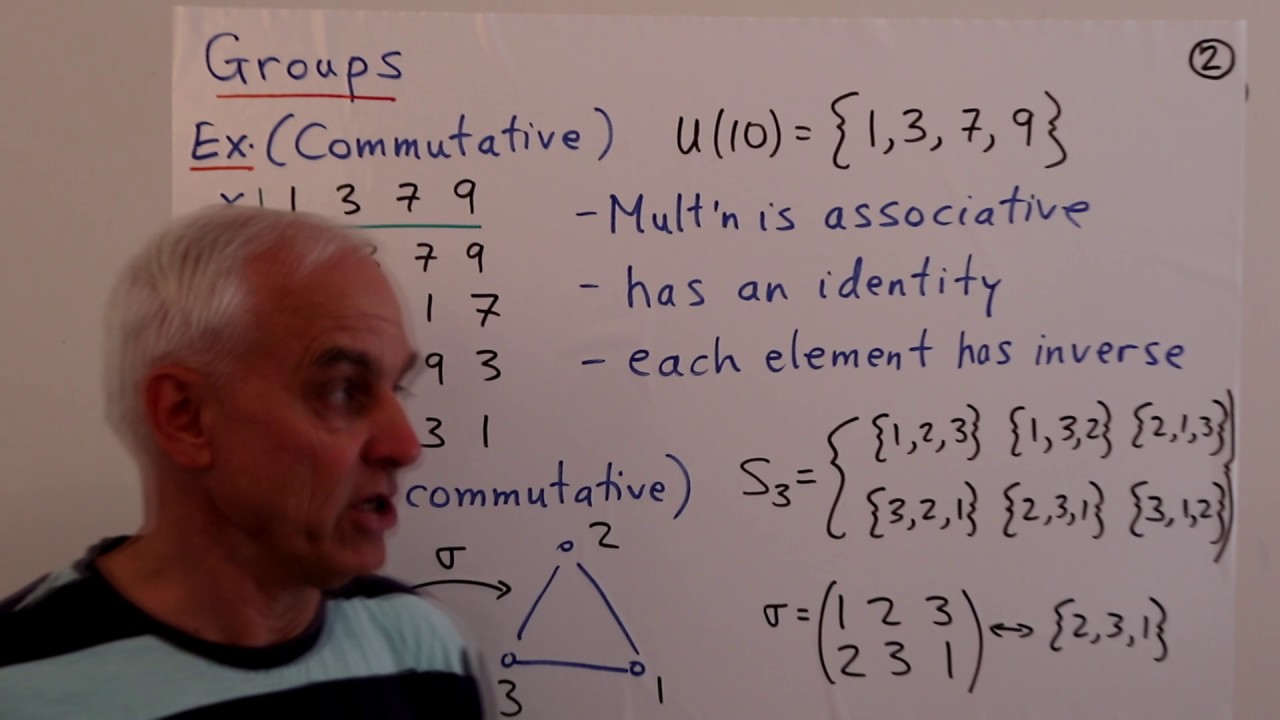
An introduction to abstract algebra | Abstract Algebra Math Foundations 213 | NJ Wildberger
70.5K
Abstract algebra is a branch of mathematics that generalizes familiar arithmetic operations to study fundamental algebraic structures including groups (sets with one operation, either commutative or non-commutative), rings (sets with two operations, addition and multiplication, where addition is always commutative), fields (commutative rings where every nonzero element has a multiplicative inverse), and vector spaces (sets equipped with vector addition and scalar multiplication over a field). These structures share common features: they involve algebraic operations that interact according to specific rules, and mathematicians study their internal substructures, product structures, quotient structures, and relationships between different objects through homomorphisms that preserve algebraic properties.
Click to watch →

Abstract Algebra | Definition of a Group and Basic Examples
30.4K
A group is a set G equipped with a binary operation * that satisfies four axioms: closure (a*b ∈ G for all a,b ∈ G), existence of an identity element e (such that a*e = e*a = a for all a), existence of inverses (for each a ∈ G, there exists a⁻¹ ∈ G with a*a⁻¹ = e), and associativity ((a*b)*c = a*(b*c) for all a,b,c). Basic examples include the integers under addition (Z, +), the nonzero rationals under multiplication (Q\{0}, ×), the general linear group GL(n,R) of invertible n×n matrices, and the integers modulo n under addition (Zn, +). Notably, while Zn with addition always forms a group, Zn with multiplication only forms a group when n is prime (excluding zero).
Click to watch →
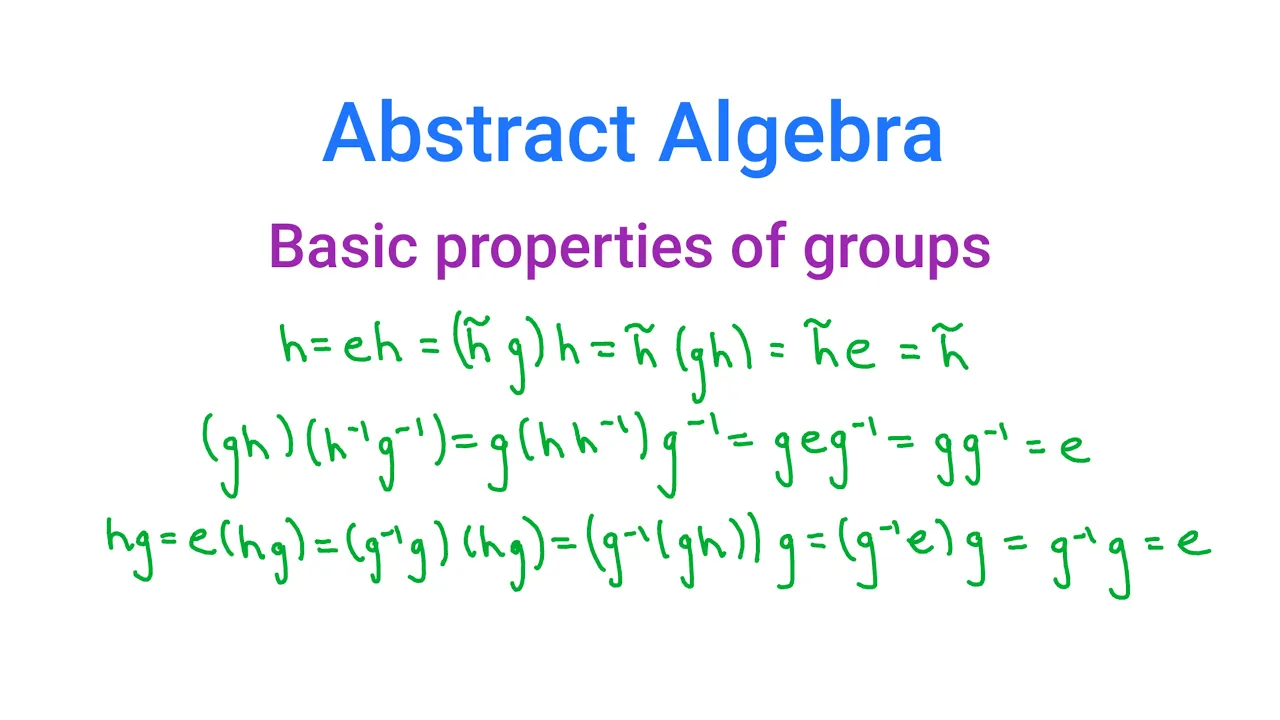
Abstract Algebra: Basic properties of groups
1K
In abstract algebra, groups satisfy fundamental properties including the uniqueness of identity element (only one identity exists), uniqueness of inverses (each element has exactly one inverse), cancellation laws (if ag=ah or ga=ha, then g=h), generalized associativity (parentheses placement doesn't affect n-element products), the property that if gh=e then h=g⁻¹, the inverse of an inverse is the original element (g⁻¹)⁻¹=g, and crucially, the inverse of a product is the product of inverses in reverse order (gh)⁻¹=h⁻¹g⁻¹, which fails in non-abelian groups.
Click to watch →
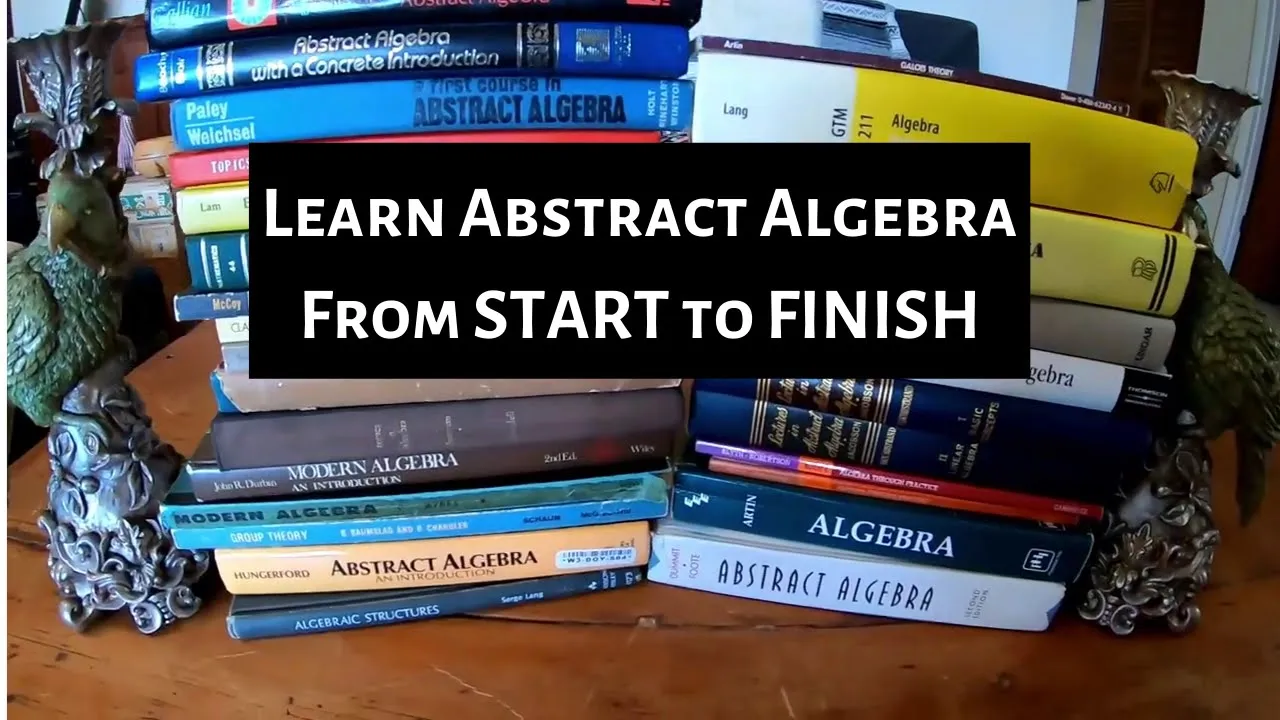
Learn Abstract Algebra from START to FINISH
78.7K
This video provides a comprehensive roadmap for learning abstract algebra from start to finish. For beginners, recommended texts include 'Abstract Algebra: A First Course' by Dan Saracino (comprehensive and affordable), 'Contemporary Abstract Algebra' by Joseph Gallian (excellent examples), 'Modern Algebra' by Durbin (clear writing with specialized topics), and 'A Concrete Approach to Abstract Algebra' by Sawyer (beginner-friendly field theory). Prerequisites include proof writing and linear algebra, though motivated students can jump in directly. Intermediate texts include 'A First Course in Abstract Algebra' by Fraleigh (clear sections), 'Lectures in Abstract Algebra' by Jacobson (rigorous graduate-level), and 'Algebra' by Michael Artin (well-written but challenging exercises). Graduate-level resources include 'Basic Algebra' by Jacobson, 'Abstract Algebra' by Dummit and Foote (essential reference), 'Algebra' by Serge Lang (definitive but challenging), and 'Algebra Through Practice' problem series. Ring theory texts like McCoy's 'The Theory of Rings' require prior abstract algebra knowledge. The journey progresses from binary operations through groups, rings, fields, and modules to advanced topics, with no true 'finish' as the subject continues to research-level depth.
Click to watch →

expanding (x+y)^2 (from no algebra to abstract algebra)
119.8K
The expression (x+y)² expands to x² + 2xy + y², not x² + y², and this identity can be derived through multiple approaches including the FOIL method in algebra, geometric area calculation, calculus using integrals, and abstract algebra where the non-commutative nature of some operations requires writing it as x² + xy + yx + y².
Click to watch →
Deep Dive
Classical Euclidean Geometry: A strong foundation in Euclidean plane geometry, particularly the concepts of parallel lines, projections, and coordinate systems.

यूक्लिड की ज्यामिति का परिचय | यूक्लिड की परिभाषाएँ,अभिगृहीत और अभिधारणाएँ | गणित | Class 9
124.1K
Euclidean Geometry is the foundational chapter of Class 9 Mathematics establishing basic terminology for all subsequent geometry topics. Euclid consolidated existing mathematical definitions into a systematic framework. Fundamental entities include: Point (no dimensions), Line (breadthless length), Surface (boundary with length and width), and Solid (three-dimensional object). Euclid categorized statements into definitions (explainable), axioms (universal truths), and postulates (geometry-specific assumptions). The five axioms are: (1) Things equal to the same thing are equal to each other; (2) If equals are added to equals, wholes are equal; (3) If equals are subtracted from equals, remainders are equal; (4) Things that coincide are equal; (5) Things that are double of the same thing are equal. The five postulates establish geometric construction rules: (1) Draw a line from any point to any point; (2) Extend a line segment indefinitely; (3) Draw a circle with any center and distance; (4) All right angles are equal; (5) If interior angles on one side sum to less than 180°, lines intersect on that side. Playfair's Axiom provides an equivalent formulation of the fifth postulate.
Click to watch →

प्रश्नावली-5 (A to Z पूरी प्रश्नावली) | यूक्लिड की ज्यामिति का परिचय | 9th गणित
93.2K
Euclid, a Greek mathematician from 2000 years ago, compiled all known geometry knowledge into 'Elements' (13 books). The word 'geometry' comes from Greek words meaning 'earth' and 'measurement'. Euclid defined five fundamental concepts: (1) A point has no parts; (2) A line has length but no breadth; (3) The ends of a line are points; (4) A straight line lies flat with all points in the same plane; (5) A plane surface has both length and breadth. These definitions form the foundation of geometric understanding.
Click to watch →

How We Mapped The Infinite Universe With Jim Al-Khalili
801.8K
Euclidean geometry, described by Euclid over 2,000 years ago in 'The Elements,' describes the geometry we see around us every day. In a rectangular room, you see straight lines, right angles, and parallel lines that stay the same distance apart. Any triangle drawn has angles that always add up to 180°. For almost 2,000 years, mathematicians believed these rules were not just mathematically true but also true statements about physical reality itself.
Click to watch →

Thuyết minh: Animation vs Hình học | Animation vs. Geometry| Alan Becker
336.1K
This segment covers the fundamental postulates of Euclidean geometry: points are abstract positions with no size; two points determine a unique line segment; intersecting lines create equal vertical angles; angles around a point sum to 360 degrees; perpendicular lines create four 90-degree right angles; all right angles are equal. It also introduces the golden ratio (φ ≈ 1.618), where a/b = (a+b)/a, and demonstrates how regular polygons approach circles as their number of sides increases.
Click to watch →

Современная научная картина мира: всё страньше и страньше
159.8K
Euclidean geometry, based on ancient Greek mathematician Euclid's postulates, establishes fundamental spatial relationships: parallel lines never intersect, a third line parallel to one is automatically parallel to the other, and a line perpendicular to one of two parallel lines is also perpendicular to the second. The sum of angles in any triangle equals 180 degrees, with one angle being 90 degrees if the triangle is right-angled.
Click to watch →
Prerequisite Knowledge
- Concept 01Linear Algebra: A solid grasp of vector spaces, bases, dimension, and linear transformations, as these form the algebraic basis for homogeneous coordinates.
- Concept 02Axiomatic Mathematics: Familiarity with modern axiomatic systems, proof structures, and the concept of independence and consistency in mathematical systems.
- Concept 03Basic Abstract Algebra: Understanding of fields (such as the real and complex numbers) and groups, which are vital for algebraic formulations of projective coordinates.
- Concept 04Classical Euclidean Geometry: A strong foundation in Euclidean plane geometry, particularly the concepts of parallel lines, projections, and coordinate systems.
Subsequent Learning
- Step 01Non-Euclidean Geometries: Deepening the study of hyperbolic and elliptic geometries through projective models, such as the Klein-Beltrami and Poincaré models.
- Step 02Algebraic Geometry: Advancing to the study of algebraic varieties, coordinate rings, and projective schemes over arbitrary fields.
- Step 03Projective Conics and Quadrics: Investigating the classification, poles, polars, and geometric properties of conic sections under projective transformations.
- Step 04Computer Vision and Graphics: Applying projective geometry to real-world applications like 3D reconstruction, camera calibration, homographies, and image stitching.
Oriented Projective Geometry
While classical projective geometry provides an elegant axiomatic and algebraic framework, it is fundamentally unoriented. In classical projective space, the projective line topologically wraps around, which destroys the concept of 'betweenness' and makes it impossible to define signed directions or distinguish the 'front' and 'back' of a plane. Oriented Projective Geometry, pioneered by Jorge Stolfi, offers a critical alternative. By doubling the projective space to distinguish between antipodal directions, it retains the projective handling of infinity while preserving orientation and inequality. This framework challenges the classical approach, arguing that unoriented projective geometry is insufficient for practical computational geometry, computer graphics, and spatial reasoning where directionality is non-negotiable.
Deep Dive
Non-Euclidean Geometries: Deepening the study of hyperbolic and elliptic geometries through projective models, such as the Klein-Beltrami and Poincaré models.

Неевклидовы геометрии. Чуть-Чуть о Науке #Наука
36.6K
Non-Euclidean geometries, developed by mathematicians like Gauss, Bolyai, and Lobachevsky, emerged from attempts to prove or disprove Euclid's fifth postulate (that through a point not on a given line, exactly one parallel line can be drawn). These geometries describe spaces with constant curvature: Euclidean geometry has zero curvature (flat plane), elliptic geometry has positive curvature (sphere, where all lines intersect), and hyperbolic geometry has negative curvature (hyperboloid, where multiple parallel lines can pass through a point). These geometries have practical applications in navigation (Earth's ellipsoidal shape) and Einstein's theory of relativity, where gravity curves space-time.
Click to watch →

Geometrias não Euclidianas
45.3K
Euclid's fifth postulate (through a point not on a line, exactly one parallel line exists) cannot be proven from the other axioms, as demonstrated by models like spherical geometry (where no parallels exist and triangle angles sum to more than 180°) and hyperbolic geometry (where infinitely many parallels exist and triangle angles sum to less than 180°); this led to the development of non-Euclidean geometries and the concept of mathematical models as interpretations of abstract axioms.
Click to watch →

IPC UBA XXI - Clase de repaso para el PRIMER PARCIAL
106.4K
Gauss discovered the independence of Euclid's fifth postulate and developed hyperbolic geometry (sum of triangle angles < 180°). Riemann developed elliptic geometry (no parallel lines, sum of triangle angles > 180°). These geometries show that different axiomatic systems can be logically consistent.
Click to watch →
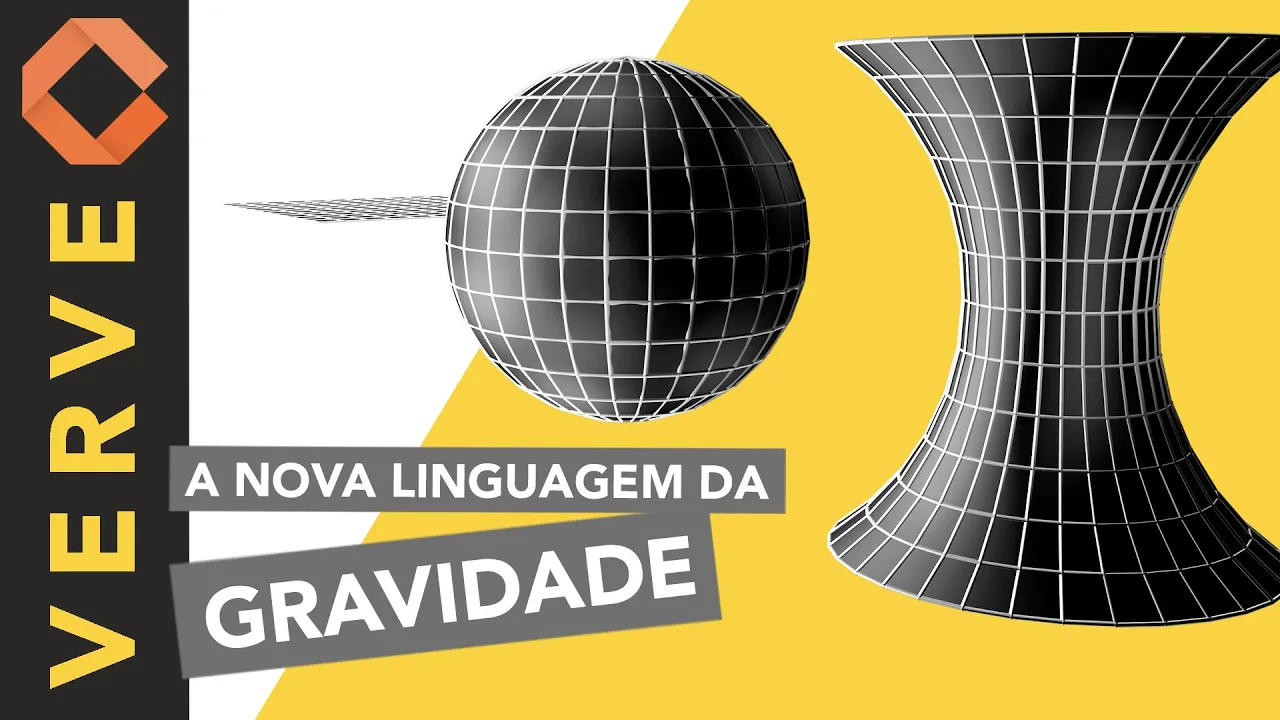
Geometrias Não-Euclidianas: A chave para o espaço-tempo de Einstein
26.7K
Non-Euclidean geometries, which emerged from questioning Euclid's fifth postulate about parallel lines, provide the mathematical foundation for Einstein's theory of general relativity. In elliptic geometry (positive curvature), parallel lines converge and triangle angles sum to more than 180°, while in hyperbolic geometry (negative curvature), parallel lines diverge and triangle angles sum to less than 180°. These geometries describe curved spaces where the shortest path between two points is not a straight line but follows the curvature of the space itself, enabling physicists to model the space-time around massive objects.
Click to watch →

Geometría no Euclidiana
24K
Euclidean geometry, named after Euclid (father of geometry), is presented in his 13-book work 'Elements'. The first four books cover plane geometry with 48 propositions derived from 23 definitions, 5 axioms, and 5 postulates. The five postulates are: (1) draw a line between two points, (2) extend a line indefinitely, (3) draw a circle with any center and radius, (4) all right angles are equal, (5) if a line cuts two lines making interior angles less than two right angles on one side, the lines will meet on that side. The fifth postulate (parallel postulate) caused controversy because it was not self-evident. Mathematicians Gauss, Lobachevsky, and Bolyai discovered consistent geometries without it. Hyperbolic geometry (negative curvature) has infinitely many parallels through a point exterior to a line, with triangle angles summing to less than 180°. Elliptic geometry (positive curvature) has no parallels through such a point, with triangle angles summing to more than 180°. The fundamental difference lies in the curvature of the underlying space.
Click to watch →
Deep Dive
Algebraic Geometry: Advancing to the study of algebraic varieties, coordinate rings, and projective schemes over arbitrary fields.

What is algebraic geometry?
269.8K
Algebraic geometry studies the deep connection between algebra and geometry by examining how geometric objects (like curves defined by polynomial equations) can be understood through their coordinate rings—algebraic structures that encode geometric properties such as irreducibility and singularities (nodes)—and conversely, how abstract rings can be interpreted as geometric spaces called schemes, enabling rigorous mathematical analysis of shapes that cannot be easily visualized.
Click to watch →

Class 9 Maths Chapter 4 Exercise 4.8 | Ex 4.8 Class 9 Maths | 4.8 Math Class 9 | Fazal Academy
230.8K
This comprehensive section covers algebraic geometry problem-solving techniques. Key topics include: (1) Finding dimensions from area expressions by factorization; (2) Calculating perimeter and cost for rectangular and square shapes; (3) Working with cubical tanks using volume and surface area formulas; (4) Circle properties and radius calculations; (5) Using difference of squares formula for dimension finding; (6) Applying distance-speed-time relationship. The section demonstrates completing the square method for perfect square trinomials and cube formulas for perfect cubes. All calculations include appropriate units (meters, square meters, cubic meters, Rs.) in final answers.
Click to watch →

The Shape No One Thought was Possible
318.7K
Algebraic geometry connects polynomial equations to geometric shapes. Polynomial degree counts multiplied variables per term. The sphere equation x²+y²+z²-1=0 demonstrates symmetry through identical treatment of x, y, z. Breaking symmetry by changing signs creates different shapes like the double cone x²+y²-z²=0. Singularities occur where partial derivatives vanish, representing points of mathematical interest. For degree two surfaces, maximum singularities equal one; higher degrees present ongoing research challenges.
Click to watch →

الكورس التأسيسي لمادة الرياضيات🔥المرحله الثانويه🔥محاضرة (2)🔥هاام جداا #كورس_التأسيس
156.6K
The domain of a function is the set of all input values for which the function is defined. For polynomial functions, the domain includes all real numbers. For rational functions, the domain excludes values that make the denominator zero. Algebraic fraction operations include adding fractions with common denominators (keep denominator, add numerators), adding fractions with different denominators (find common denominator, adjust numerators), and multiplying fractions (multiply all numerators and denominators, then simplify). Geometry fundamentals include angle classification (acute 0-90°, right 90°, obtuse 90-180°, straight 180°, reflex 180-360°), complementary angles (sum to 90°), supplementary angles (sum to 180°), vertical angles (equal when lines intersect), and triangle congruence criteria (ASA, SAS, SSS, AAS). For right triangles, HL and LL criteria apply. The sum of interior angles of any polygon with n sides is (n-2)×180°. The sum of exterior angles of any convex polygon is always 360°. For regular polygons, each interior angle equals [(n-2)×180°]/n. A parallelogram has opposite sides parallel and equal, opposite angles equal, and consecutive angles supplementary. Special parallelograms include rectangles (one right angle), rhombuses (adjacent sides equal), and squares (both properties). Diagonals of rectangles are equal and bisect each other; diagonals of rhombuses are perpendicular and bisect vertex angles. The exterior angle of a triangle equals the sum of the two opposite interior angles. The midsegment connecting midpoints of two sides is parallel to the third side and half its length. The Pythagorean Theorem states a² + b² = c² for right triangles. The converse allows determining if a triangle is right-angled by checking if the square of the longest side equals the sum of squares of the other two. Point reflection across axes: (x,y) → (x,-y) for x-axis, (-x,y) for y-axis, (-x,-y) for origin. A median connects a vertex to the midpoint of the opposite side; an altitude is perpendicular from a vertex to the opposite side. In isosceles triangles, the altitude from the vertex angle is also a median. The centroid is where all three medians intersect, dividing each median in a 2:1 ratio. The triangle inequality states that the sum of any two sides must exceed the third side. Area formulas: square (side² or diagonal²/2), rhombus (d1×d2/2), parallelogram (base×height), trapezoid ((base1+base2)×height/2). The midline of a trapezoid equals half the sum of parallel bases. Two triangles are similar if corresponding angles are equal and corresponding sides are proportional. Similar triangles have the same shape but not necessarily the same size. The ratio of corresponding sides is constant (scale factor).
Click to watch →

Army Agniveer Gd Original Paper 2023 | Gwalior Army Gd Original Paper 2023 | Army GD Original Paper
227.3K
This segment covers geometry and algebra: even numbers are divisible by 2, distance-speed-time calculations (3 km/h = 50 m/min, so 7 minutes = 350 meters), the algebraic identity (a+b)² = a² + b² + 2ab, and diagonal counting in polygons (octagon has 20 diagonals using formula n(n-3)/2). These questions test geometric and algebraic knowledge.
Click to watch →
Deep Dive
Projective Conics and Quadrics: Investigating the classification, poles, polars, and geometric properties of conic sections under projective transformations.

Projective view of conics and quadrics | Differential Geometry 9 | NJ Wildberger
30.9K
Projective geometry provides a unified framework for studying conics and quadrics by representing them as homogeneous equations in three-dimensional space, where the projective plane consists of all one-dimensional subspaces (lines through the origin) and points at infinity become concrete elements; this approach reveals that all conic sections (parabolas, ellipses, hyperbolas) are essentially the same object in projective geometry, with their distinguishing features arising only when restricting to the affine plane.
Click to watch →

Линейная алгебра и геометрия. Лекция 42. Шварцман О. В.
176
The isotropic cone consists of all vectors v such that (v,v) = 0. The projective quadric is defined as the projectivization of this isotropic cone. In 2D real vector spaces, non-degenerate symmetric bilinear forms are classified by signature: (+1,+1) yields an empty quadric, while (+1,-1) yields two points in the projective line. In 3D real vector spaces, the signature (+1,+1,+1) yields an empty quadric, while (+1,+1,-1) yields a hyperboloid of one sheet as the isotropic cone. The projective quadric x₁² + x₂² - x₃² = 0 in P² can appear as different conic sections on different affine charts: a circle on the chart x₃ ≠ 0, a hyperbola on the chart x₁ ≠ 0, and a parabola on a transformed chart. Projective geometry treats all conic sections as equivalent objects, as projective transformations can map any conic to any other conic.
Click to watch →

Lección 23 - Clasificación de cuádricas afines y proyectivas | Geometrías Lineales | UNED
2.5K
Quadrics are classified by their rank and index of positivity in projective spaces: in the projective line, there are three types (empty, pair of points, double point); in the projective plane (conics), there are two regular types (empty, non-empty) and several degenerate types; in projective space, there are two regular types (elliptic and hyperbolic quadrics) and various degenerate types. Affine quadrics are classified by their projective completion and the quadric at infinity: in the plane, we have ellipse, hyperbola, and parabola; in 3D space, we have ellipsoid, hyperboloid (elliptic and hyperbolic), and paraboloid (elliptic and hyperbolic).
Click to watch →

Линейная алгебра и геометрия. Лекция 43. Шварцман О. В.
236
A quadric is defined as the set of points in projective space whose representative vectors are isotropic with respect to a non-degenerate symmetric bilinear form. In a chosen basis, the bilinear form is represented by a matrix B, and the quadric equation in homogeneous coordinates is X^T B X = 0. The homogeneity property ensures that scaling all coordinates by the same non-zero scalar does not change the solution set. A quadratic cone is the subset of the vector space consisting of all isotropic vectors (excluding the zero vector), and a quadric is the projectivization of this cone, where each line in the cone maps to a single point in projective space. The general linear group GL(V) acts on bilinear forms through the rule B'(X,Y) = B(G⁻¹X, G⁻¹Y), which is called change of variables. When a bilinear form is transformed by G, its quadratic cone transforms by the same element G. Two quadrics are projectively equivalent if one can be obtained from the other by a projective transformation induced by some G in GL(V). Over the complex numbers, any non-degenerate symmetric bilinear form can be diagonalized to z₀² + z₁² + ... + zₙ², and since every non-zero complex number has a square root, all coefficients can be normalized to 1. Therefore, up to projective equivalence, there is exactly one non-degenerate quadric in complex projective space. For degenerate quadrics, the classification is determined by the rank. Over the real numbers, any non-degenerate symmetric bilinear form can be diagonalized to x₀² + ... + xₚ² - xₚ₊₁² - ... - xₙ², where p is the number of positive terms and n+1-p is the number of negative terms. This pair (p, n+1-p) is called the signature, which is invariant under change of variables. There are exactly ⌊(n+1)/2⌋ + 1 projective equivalence classes of non-degenerate quadrics in projective space of dimension n.
Click to watch →

Кириченко В.А., Геометрия Совбак, 26.05.2021
156
In projective geometry, all non-degenerate conics (such as ellipses, hyperbolas, and parabolas) are projectively equivalent, meaning they can be transformed into each other through projective transformations. The complete classification of real projective conics consists of only three types: (1) non-degenerate conics (represented by the cone equation x₀² + x₁² - x₂² = 0), (2) degenerate conics consisting of two intersecting planes (x₀² - x₁² = 0), and (3) degenerate conics consisting of a double plane (x₀² = 0). This classification is much simpler than the affine classification because projective geometry eliminates the distinction between different types of affine conics by including points at infinity.
Click to watch →
Deep Dive
Computer Vision and Graphics: Applying projective geometry to real-world applications like 3D reconstruction, camera calibration, homographies, and image stitching.

Computer Vision and Graphics | India Science Festival 2024 | #ISF2024
473
Computer graphics is a forward problem where 3D world information is projected to create 2D images using mathematical models like the pinhole camera, while computer vision is an inverse problem where 2D images must be interpreted to reconstruct the 3D world, which is inherently more challenging due to information loss during projection and the lack of unique solutions. Graphics uses techniques like rasterization (fast, suitable for games requiring real-time performance) and ray tracing (computationally intensive but produces photorealistic results suitable for movies), whereas vision relies heavily on machine learning to handle the ambiguity and complexity of interpreting visual data.
Click to watch →

CENG 477 Intro. to Computer Graphics (Section 2, F'21) Week #1 Introduction Part 2
965
Computer graphics is defined as any use of computers to create and manipulate images. The key distinction from computer vision is that computer graphics generates images from a virtual world, while computer vision processes real images to extract 3D information. Computer graphics and computer vision are reverse problems: graphics creates 2D images from 3D virtual scenes, while vision extracts 3D information from 2D real images. Augmented reality combines both fields by augmenting real-world imagery with computer-generated content.
Click to watch →

Relação de Visão Computacional com Computação Gráfica, Processamento de Imagens, etc
4.6K
Computer vision extracts information, models, or mathematical equations from images for decision-making. It reproduces human abilities to rapidly identify visual information like people, colors, or environmental conditions. Computer vision follows an inverse path to computer graphics: starting from images and proceeding to models, while computer graphics starts from models to generate images. Applications span film industry (Avatar, Gladiator), medicine, engineering, and education. Computer vision handles diverse image types including microscopic images of yeast cells, satellite imagery for fire detection, and ultrasound images for medical analysis.
Click to watch →

Ustudy - الجامعة السعودية الالكترونية - شرح مقرر رسومات الحاسب - CS478:Computer Graphics with WebGL
176
Computer vision and computer graphics are related but distinct fields. Computer vision involves analyzing existing images to extract data and information—teaching computers to recognize and understand visual content like objects, faces, or scenes. Computer graphics, in contrast, involves creating visual content from data—transforming real-world objects or abstract data into visual representations within the computer. While both deal with images, computer vision extracts information from images, while computer graphics generates images from information. This distinction is fundamental to understanding how computers process and create visual content.
Click to watch →

DIGITAL IMAGE PROCESSING LECTURE 1 IGNOU MCS 230 #ignou #ignoumca #ignousolvedassignment #MCS230
2.5K
This section distinguishes three related but distinct fields. Image Processing involves transforming images to images through recovery, reconstruction, filtering, compression, and visualization, requiring significant mathematics. Computer Vision takes images as input but produces interpretation as output (identifying objects like people, animals, or non-living things), involving scene understanding and relating to AI, machine learning, and cognitive science. Computer Graphics reverses this process, generating images from scene representations. The instructor notes these are separate papers in the curriculum, with Image Processing and Computer Vision being the first two blocks, followed by Computer Graphics in the third block.
Click to watch →
Oriented Projective Geometry
While classical projective geometry provides an elegant axiomatic and algebraic framework, it is fundamentally unoriented. In classical projective space, the projective line topologically wraps around, which destroys the concept of 'betweenness' and makes it impossible to define signed directions or distinguish the 'front' and 'back' of a plane. Oriented Projective Geometry, pioneered by Jorge Stolfi, offers a critical alternative. By doubling the projective space to distinguish between antipodal directions, it retains the projective handling of infinity while preserving orientation and inequality. This framework challenges the classical approach, arguing that unoriented projective geometry is insufficient for practical computational geometry, computer graphics, and spatial reasoning where directionality is non-negotiable.
Linear Algebra: A solid grasp of vector spaces, bases, dimension, and linear transformations, as these form the algebraic basis for homogeneous coordinates.
Axiomatic Mathematics: Familiarity with modern axiomatic systems, proof structures, and the concept of independence and consistency in mathematical systems.
Basic Abstract Algebra: Understanding of fields (such as the real and complex numbers) and groups, which are vital for algebraic formulations of projective coordinates.
Classical Euclidean Geometry: A strong foundation in Euclidean plane geometry, particularly the concepts of parallel lines, projections, and coordinate systems.
Non-Euclidean Geometries: Deepening the study of hyperbolic and elliptic geometries through projective models, such as the Klein-Beltrami and Poincaré models.
Algebraic Geometry: Advancing to the study of algebraic varieties, coordinate rings, and projective schemes over arbitrary fields.
Projective Conics and Quadrics: Investigating the classification, poles, polars, and geometric properties of conic sections under projective transformations.
Computer Vision and Graphics: Applying projective geometry to real-world applications like 3D reconstruction, camera calibration, homographies, and image stitching.
21.6K views263likes4:47@RichardSouthwellOriginal Release: 2015-06-13
okay hello everybody I'm Dr Richard southwell and this is the beginning of a course of lectures on the foundations of projective geometry an absolutely beautiful subject I've done quite a few videos trying to introduce projective geometry to the Layman um using kind of visual and intuitive ideas but what I'd like to do now with this course on the foundations of projective geometry is to take in axiomatic more sort of rigorous approach using some algebra proper proofs and such and essentially to make a Learning Resource that people can use just by watching these videos and learn projective geometry to a relatively decent level projective geometry relates to ideas of Optics and ideas of perspective drawing but it also relates to some much much deeper and more kind of exciting fields in my opinion like non-euclidean geometry hyperbolic geometry curved space things like this the reason is because essentially projective geometry is more fundamental than euclidean geometry standard high school geometry and even better than that the approach I want to take it's a predictive geometry is essentially following coexisters book on the subject which takes an axiomatic approach so rather than defining everything in terms of numbers and Cartesian coordinates and things like is done so much in Geometry you know if the x coordinate and the y coordinate and so forth we don't need to talk about numbers hardly at all we don't need to talk about met well we don't need to talk about metrics and distances and angles instead we're just going to make some assumptions at the beginning about what our two-dimensional projective play in our Arena which we're going to be doing geometry on is like and then all of the things which um follow are just logical consequences of those original axioms now the reason why that's a great thing is because what it means is that the knowledge which we accrue is applicable to any system which satisfies those axioms so it could be applicable to a geometry on a sphere or it could be applicable to more exotic situations like hyperbolic geometry I'm not going to get into those Notions which are quite complicated and um involve a lot of metrics and I don't have to because projective geometry is more fundamental it's it's below the idea of measurements it's below the idea of curvature essentially all we're really talking about is properties of points and lines and I think one of the most fascinating things from jet projective geometry is to see all of these ideas of conic sections that's like um ellipses and hyperbola and such and to see ideas like um metrics and sequences of rational numbers and things all kind of emerge from some much more basic axioms it's almost um it's almost like a kind of Genesis story of geometry where we can start with some logical ideas that a blind man could understand and just see all of The Familiar Notions of geometry emerge from these
Up Next
28:31
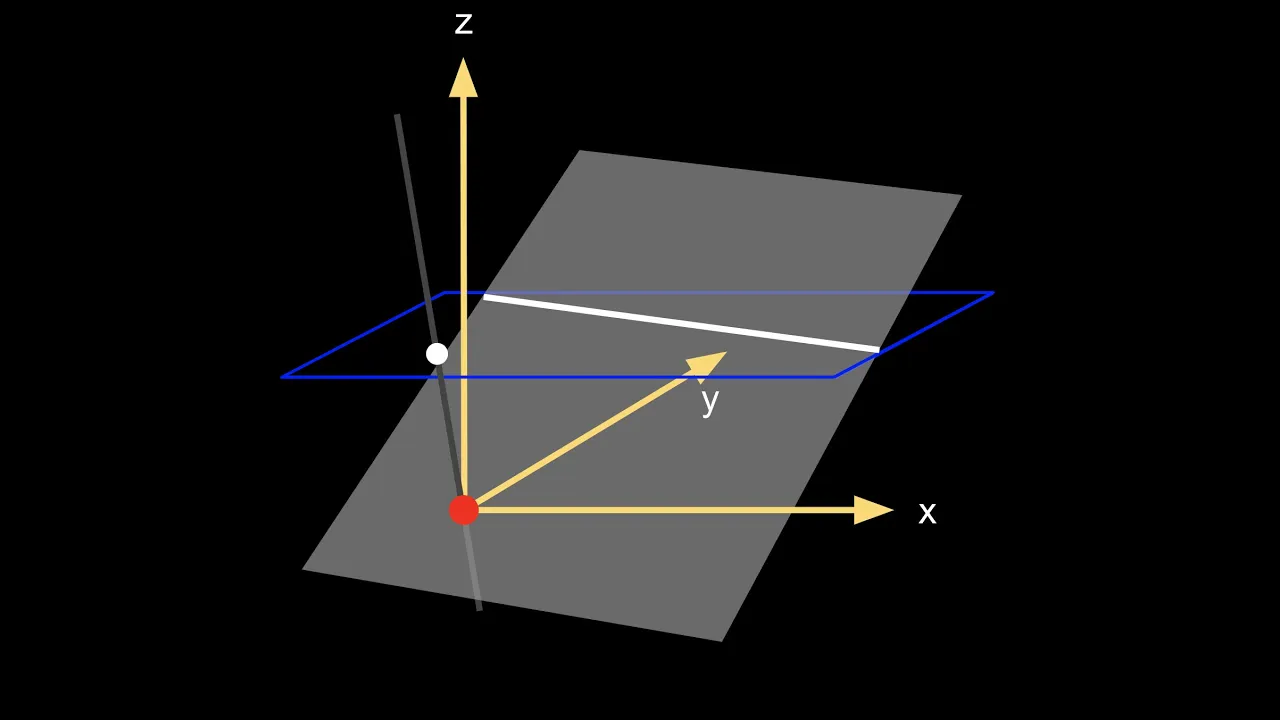
Projective Geometry via Linear Algebra Explained Intuitively
@coolcomputery
46.2K views•2022-07-23

8:17
JEE Maths | Circles: Pole & Polar Explained with Equations
@TargetPublications
14.4K views•2019-02-23

46:41
Homogeneous Coordinates in Projective Geometry: Intro
@RichardSouthwell
26.2K views•2016-07-14
6:00
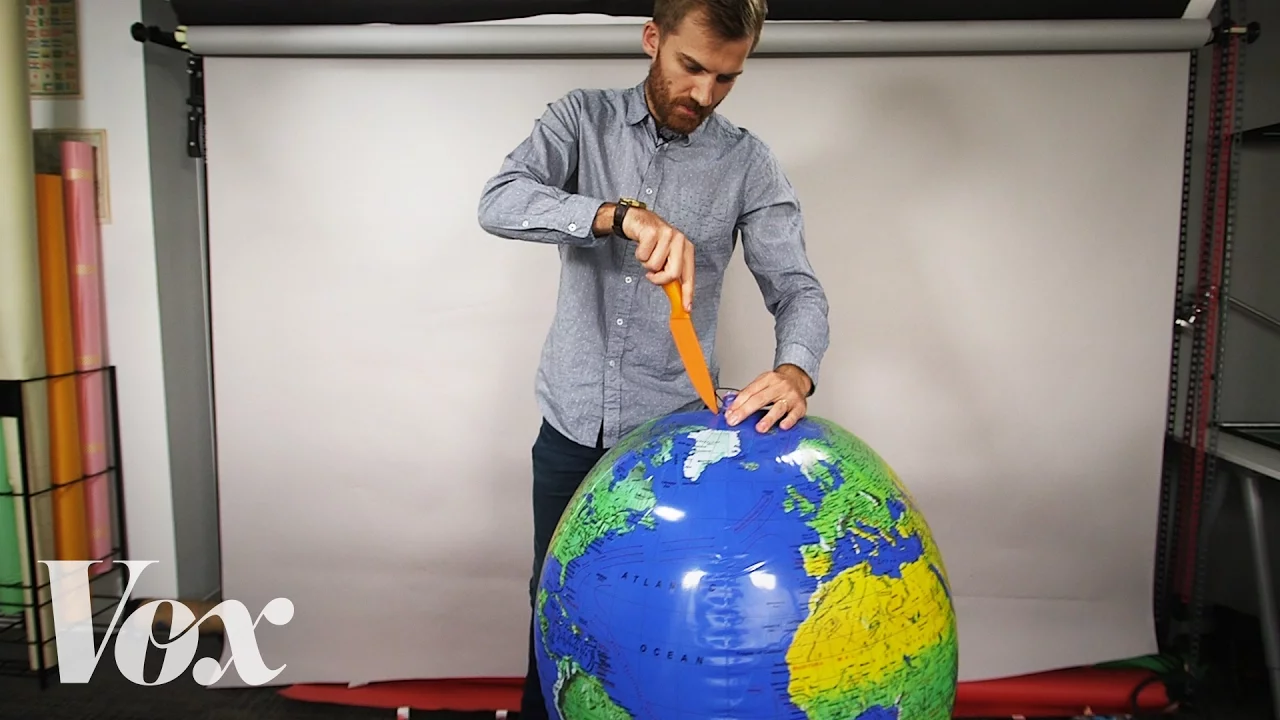
The Mathematical Impossibility of Accurate World Maps
@Vox
23.3M views•2016-12-02
Related Study Plans & Knowledge Roadmaps
Structured learning paths in Mathematics
mathematics
Projective Geometry: Coordinates & Conics
01From Euclidean to Projective Space
02Homogeneous Coordinates
03Duality and Projective Transformations
+ 2 more learning modules
14h5 modules
Explore Roadmap
mathematics
Tensor Calculus: Vectors to Riemann Curvature
01Mathematical Foundations: Linear Algebra & Calculus
02Covectors, Dual Spaces, and Tensor Basics
03The Metric Tensor and Index Gymnastics
+ 2 more learning modules
40h5 modules
Explore Roadmap
mathematics
Gödel's Incompleteness: Logic, Proofs & Limits
01Introduction to Formal Systems & Hilbert's Dream
02Set Theory, Cardinality, and Cantor's Diagonal Argument
03Arithmetization and Gödel Numbering
+ 2 more learning modules
14h5 modules
Explore Roadmap
mathematics
Galois Theory: Fields, Groups & Solvability
01Foundations of Abstract Algebra: Groups & Fields
02Polynomials & Field Extensions
03Splitting Fields & Symmetries
+ 2 more learning modules
24h5 modules
Explore Roadmap