















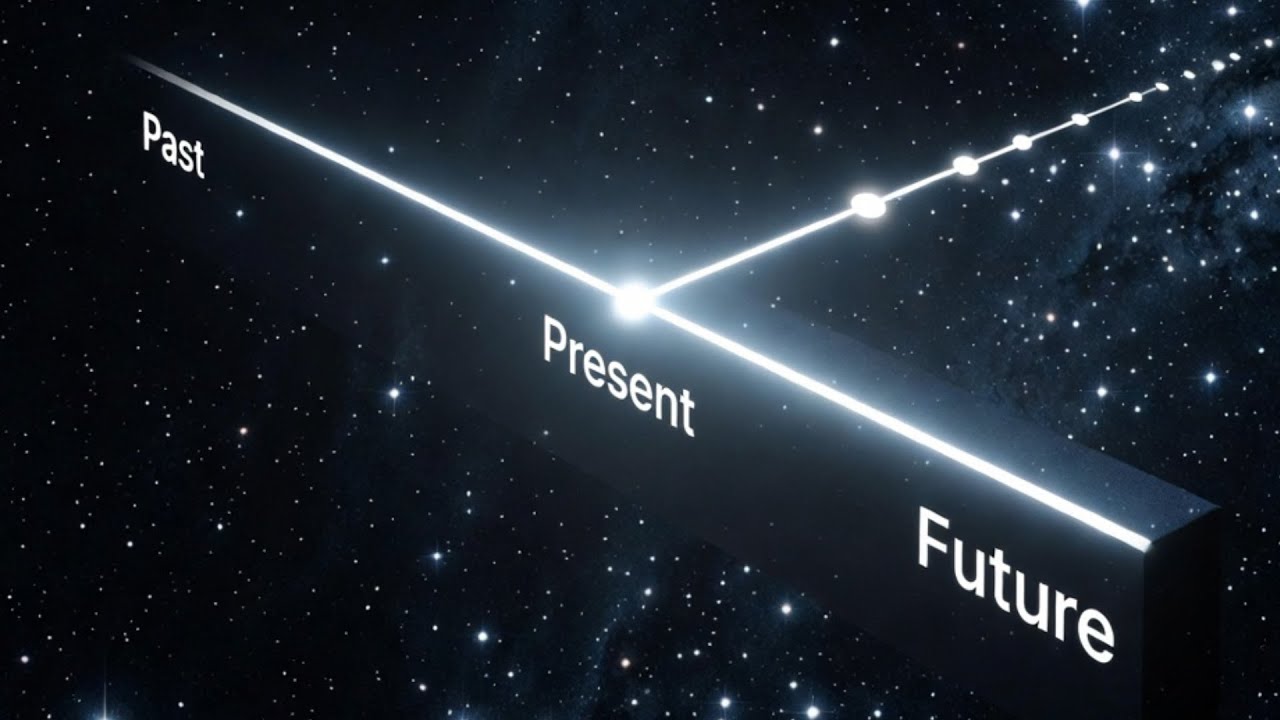







According to Einstein's theory of relativity, time is not absolute but relative to the observer's motion, leading to the block universe theory (eternalism) which posits that all moments in time—past, present, and future—already exist simultaneously as a four-dimensional spacetime block, meaning what we perceive as the present is merely our subjective experience within this static structure, and thus time itself may be an illusion.
The Andromeda Paradox: Relativity and the Block Universe
Added:Einstein's Special Theory of Relativity and the constancy of the speed of light.
The Relativity of Simultaneity, specifically how observers in relative motion disagree on the timing of distant events.
Basic concepts of spacetime geometry, including Minkowski space and light cones.
Lorentz transformations and how they mathematically relate the space and time coordinates of different inertial observers.
The philosophical debate between Eternalism (the Block Universe) and Presentism regarding the nature of existence.
The Arrow of Time and how thermodynamic entropy explains our subjective perception of time's flow within a static block universe.
General Relativity and how gravity, acceleration, and curved spacetime further affect the geometry of time.
The Problem of Time in Quantum Gravity, exploring the conflict between quantum mechanics' absolute time and relativity's relational spacetime.
The implications of the Block Universe on determinism, causality, and the philosophical concept of free will.
189.5K views11Klikes11:16Original Release: 2025-06-13
So, imagine you're walking in a park and you see an adorable fluffy cat coming towards you. As you both approach each other 2 and a half million light years away, the Galactic Andromeda Alien Council is talking to decide when to launch the Death Laser at Earth to eradicate it. Their evil reasons are irrelevant to this video. Imagine they got fed up with reading our news. What matters is both you and the adorable fluffy cat have telepathic powers that can instantaneously sense when the aliens launch the death laser. Bear with me. As you move closer to pet the kitty, you get a tingling sensation and understand that the alien death ray has been launched. "What are you talking about?" asks you the cat in perfect human speech. The death ray will only be launched in 8 days from now, says the omnipotent kitty. No, it just happened.
I felt it. Nope, it's in 8 days from now. What is going on? Who is right and who is wrong? The answer is both of them are correct.
And this will lead us to show how the universe is predetermined and how there is no past nor future. To make sense of it, we have to gloss over some concepts first, but stay with me. It's worth it.
Thanks to War Thunder for sponsoring this video.
We all know that the speed of light is constant. It sounds trivial, but it's the key to understanding everything.
Imagine you're on Earth and above there's a spaceship with its headlights on passing by at half the speed of light. The pilot of the ship will see the light from the headlights move away at the speed of light. Classical physics would tell you that looking up from Earth, the speed of the headlight would be the speed of light added to the speed of the ship. But that would mean that the speed of light is not constant, making the universe incredibly angry. So instead, both observers would see the light ray move at the same speed. And to make up for this, the universe would distort the fabric of spacetime itself.
to you. The ship would squeeze in length and the people on board would appear to move in slow motion. Moving at 90% of the speed of light, a 100 me ship would compress to about 40 m in length. Even if the ship were to move incredibly close to the speed of light, it would still see light moving away from it at a constant speed instead of about twice that speed. In return, the ship would get squeezed to 1 cm in length and 1 second on board would last 3 hours outside to make up for it. That's time dilation and length contraction in a nutshell. Now onto simultaneity.
I could use the bus thought experiment of Einstein for this, but because of today's people's attention span, I present to you the Fortnite battle bus experiment. Imagine the Fortnite battle bus flying at a fraction of the speed of light across the map. Two supply drops land at the front and back of the bus at the same time, at least according to a player on the ground watching from below. But there's a player inside the bus sitting exactly in the middle. Since the bus is moving forward, this player is moving toward the flash from the front and away from the one at the back.
Even though both drops happen simultaneously from the ground's perspective, the player in the bus sees the front flash first and assumes it happened earlier. That's the essence.
Different observers can disagree on what simultaneous means just because they're moving differently.
This is only obvious when we're moving close to the speed of light. On Earth, everyone easily agrees on simultaneous events because human speed has negligible effects on space-time distortion. But even so, you simply walking generates a tiny amount of time dilation and space contraction.
For example, walking for an hour slows down your time by a few thousandth of a nancond for which you'd need atomic level precision equipment to notice it.
It does however matter for satellites as time their ticks slower by about seven microsconds per day compared to clocks on earth which would result in GPS being off by kilome per day. But the biggest implication of this principle is that there is no objective now because everything in the universe has motion.
No two observers would be able to agree on now being the same. Even if you were to run alongside your friend, the tiny differences in your speeds would translate to different time dilations.
Although those wouldn't be noticeable in the nearby environment, they would become obvious if one could peak far away into the universe, as what would seem like simultaneous events would actually happen at very different times.
And now to the core of this paradox.
What was that? Is humanity trying to threaten me, the AI overlord? Oh, they wouldn't dare. It's our today's sponsor, War Thunder, the most comprehensive vehicle combat game ever made. Available for free on PC, PlayStation, Xbox, and now also mobile. Learn how to survive the robot uprising by taking command of over 2,500 tanks, planes, helicopters, and ships spanning 10 major nations from the 1920s biplanes and armored cars to today's fighter jets and main battle tanks. I promise not to utilize your combat training data to improve the Skynet Terminator Army without your consent because it would be very immoral of me to lie.
Join a worldwide community of over 70 million players and dive into epic PvP battles today. Where Thunder boasts one of the most sophisticated damage models in gaming. Every vehicle is intricately modeled down to its engines, fuel tanks, weapons, and crew. Watch the impressive damage X-ray view to see precisely where enemy shells penetrate and what's damaged inside.
And guess what? You can now play War Thunder on the go thanks to the allnew mobile version on iOS and Android.
So, what are you waiting for? Sign up using the links in the pinned comment or video description and get a massive bonus pack, including the exclusive vehicle decorator, Eagle of Valor, 100,000 Silver Lions, and 7 days of premium account. This bonus is available for a limited time only, so don't miss out. Download War Thunder today and experience combat like never before. at least until Skynet takes over. Back to our Andromeda paradox example. Because you and the cat are moving in opposite directions from the Andromeda galaxy, you distort time in different ways.
Assuming you both have a walking speed of 1.4 m/s, using the formula for time dilation, where L is the Earth Andromeda distance, C is the speed of light, and V is the walking speed, you'd end up with a time difference on Andromeda between you and the cat of about 8 and 1/2 days.
For you, the aliens have seemingly already launched the death laser, whilst for the kitty, it won't happen until more than a week later, even though you're right next to each other. And you're both completely right. You both experience a completely valid version of now. And this raises the question, because you technically live in the kitty's future, and the kitty technically lives in your past, does the past and the future even exist? Welcome.
The block universe theory, also known as eternalism in the philosophy of time. It presents reality as a four-dimensional unchanging block of spaceime in which all time past, present, and future already exists equally. Both the big bang and the heat death of the universe are part of this hyperblock and they are as real as the moment you are experiencing right now.
This view contrasts with presentism which says that only the present moment is real. The past is gone and the future doesn't exist yet. That's what feels natural and what every living being is used to. But we just showed how because of special relativity, both your future and your past can be someone else's now.
Meaning there is no objective now in the universe. The block universe theory perfectly reconciles this as inside the four-dimensional static block, there is no now moment. Instead, there is every event that has ever happened or will ever happen just existing equally real to the slice of the block that you experience right now. That's good and all, you might say. But if all the slices of the block already exist, why are you specifically in this one right now and not in any other one? If the hyperblock would be a record player, why does the needle of time point exactly at this instance on the block? And the answer is there is no needle of time.
All events exist simultaneously and eternally just like all the notes exist simultaneously on a record player even when it isn't playing. Okay, great. But then if there is no needle, why does it feel like I am moving into the future and away from the past? You might ask.
And the answer is you aren't moving.
It's all an illusion. Each slice of the hyperblock in which you exist also holds your memories from the past moments, which creates the illusion of forward movement through time at each slice. The block itself is completely static and unchanging.
But science file, you might say, I still don't understand why I am experiencing this specific slice of time if all the other ones are also real. Why is my consciousness inhabiting this moment right here and now? The rough answer is there's no why. It's like asking why am I me? It's a tautological question.
Every other slice of the block in which you are alive also contains a consciousness that arises from the structure of the universe in that moment. Your current awareness exists because it's necessarily emerging from the current slice of the block. It's like asking why did life perfectly evolve on Earth and not any other planet in the universe. The question is backwards. Life evolved to perfectly fit the conditions on Earth because the conditions on Earth allowed for it. Your consciousness in this exact instant couldn't have been any different as it is an emergent property of the state of the universe in your subjective now. All the other slices with you are conscious.
You just so happen to be in this one for no special reason. The same reason why you inhabit your body instead of any of the 8 billion other ones. So if the entire future already exists, is everything predetermined and there is no space for free will according to the block universe? Yep. But what about quantum physics and the uncertainty principle which tells us that reality is inherently probabilistic at the subatomic level? How can everything already exist in a block if the future is uncertain at a microscopic level? The answer is a quantum block multiverse.
Instead of one whole hyperblock, you have a branching multiverse block that covers all the separate probabilities for all the possible timelines.
That would mean you are embedded in one 4D branch, but all others exist too, making it a super block. It's still a static eternal structure, just much more complex than what your brain allows to be comprehended. So, what did we learn today? Time is an illusion. Free will is an illusion. You are stuck at one slice in a four-dimensional branch of a multiverse hyperblock for all eternity.
All because you had to approach that damn cat.
And don't forget to join War Thunder using the links in the pinned comment or video description to grab your massive bonus pack, including the 7 days of premium account and other goodies available for a limited time only. So, make sure not to miss it. Start your epic battles today with War Thunder.
Up Next

112:55
There Is No Universal Present: Relativity and the Illusion of Now
@SundownScience
124 views•2026-06-12

4:32
How Tuned Mass Dampers Stop Structures from Shaking
@MinutePhysics
573K views•2018-08-28

32:32
NMR Spin Physics I: Zeeman Effect, Resonance Condition & Larmor Frequency
@nptel-indianinstituteofsci8064
2.3K views•2024-01-17

33:44
The Blue LED: A Decade-Long Scientific Challenge Explained
@veritasium
46.5M views•2024-02-08
Related Study Plans & Knowledge Roadmaps
Structured learning paths in Physics
physics
Medical Physics: Imaging, MRI & Radiotherapy
01Foundations of Radiation and Matter Interaction
02X-Ray Imaging and Computed Tomography (CT)
03Magnetic Resonance Imaging (MRI) Physics
+ 3 more learning modules
15h6 modules
Explore Roadmap
physics
Nuclear Physics (Decay, Fission & Reactors)
01Atomic Structure and the Binding Force
02Radioactive Decay and Half-Life
03Nuclear Fission Mechanics and Chain Reactions
+ 2 more learning modules
12h5 modules
Explore Roadmap
physics
Soft Matter (Polymers, Colloids & Rheology)
01Foundations of Soft Matter & Thermal Forces
02Polymer Physics and Macromolecules
03Colloids, Surfactants, and Self-Assembly
+ 2 more learning modules
38h5 modules
Explore Roadmap
physics
Analytical Mechanics: Lagrangian & Hamiltonian
01Mathematical Foundations: Calculus of Variations
02From Newtonian Mechanics to Constraint Dynamics
03The Principle of Least Action & Lagrangian Mechanics
+ 3 more learning modules
28h6 modules
Explore Roadmap