













![SACANI RESPONDE [TUDO SOBRE COSMOLOGIA] - Ciência Sem Fim #273](https://i.ytimg.com/vi/CoDF65uzm88/maxresdefault.jpg)



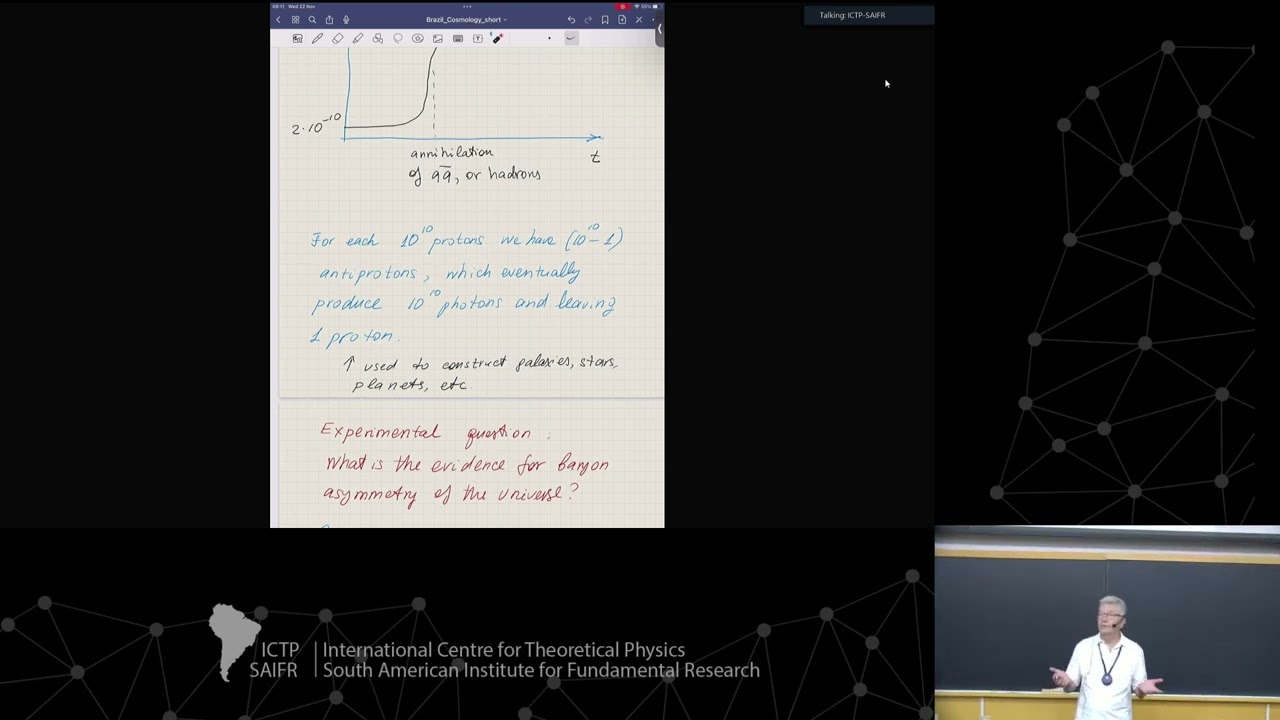
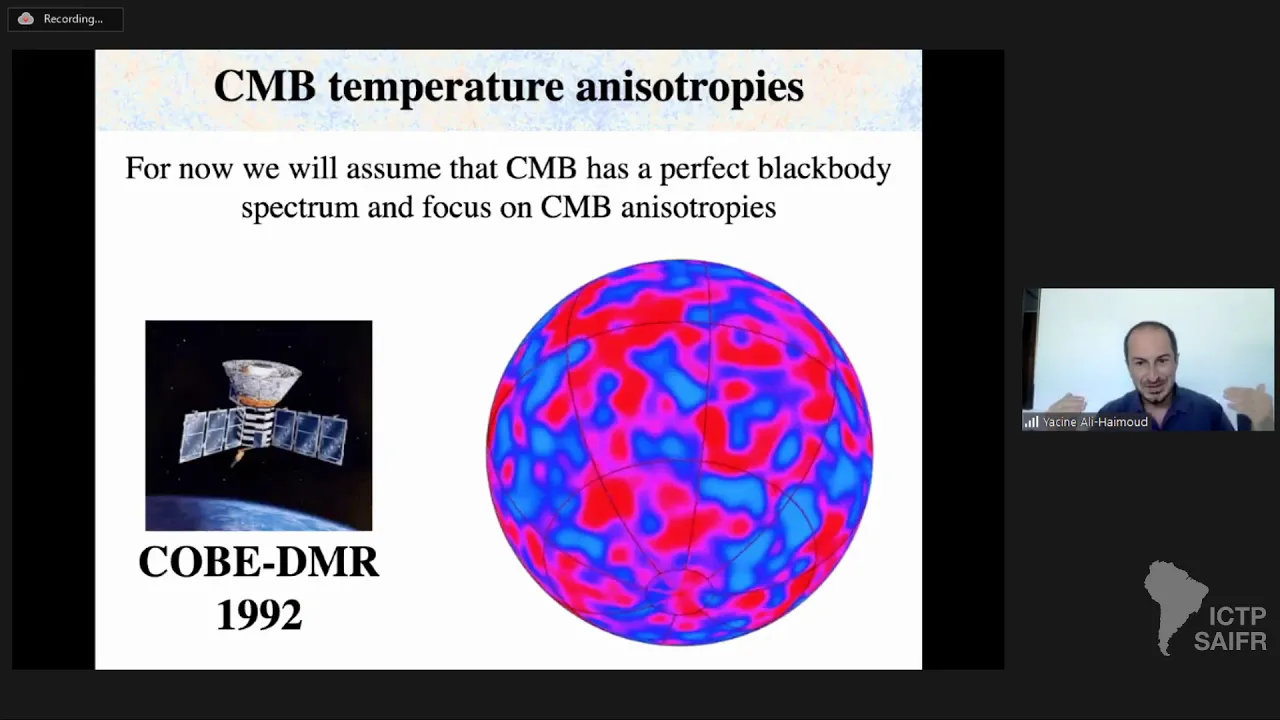
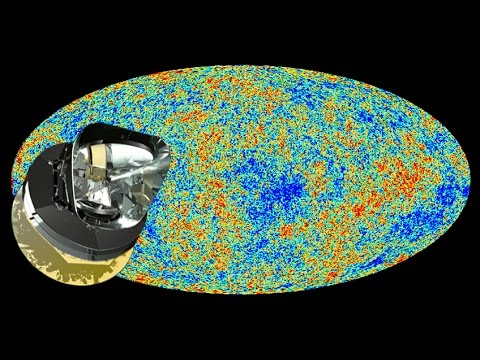

The cosmic microwave background radiation provides evidence that the universe underwent a period of thermal equilibrium at high temperatures, where photons, electrons, and protons existed in thermal equilibrium until recombination occurred when the universe cooled to approximately 4,000 Kelvin, causing electrons and protons to combine into neutral hydrogen atoms and decoupling from the radiation field; this remnant radiation has been stretched by the universe's expansion to appear today as a black body spectrum at approximately 3 Kelvin, representing a 'fossil' of the early thermal state of the universe.
Cosmology Lecture: Baryogenesis & Early Universe
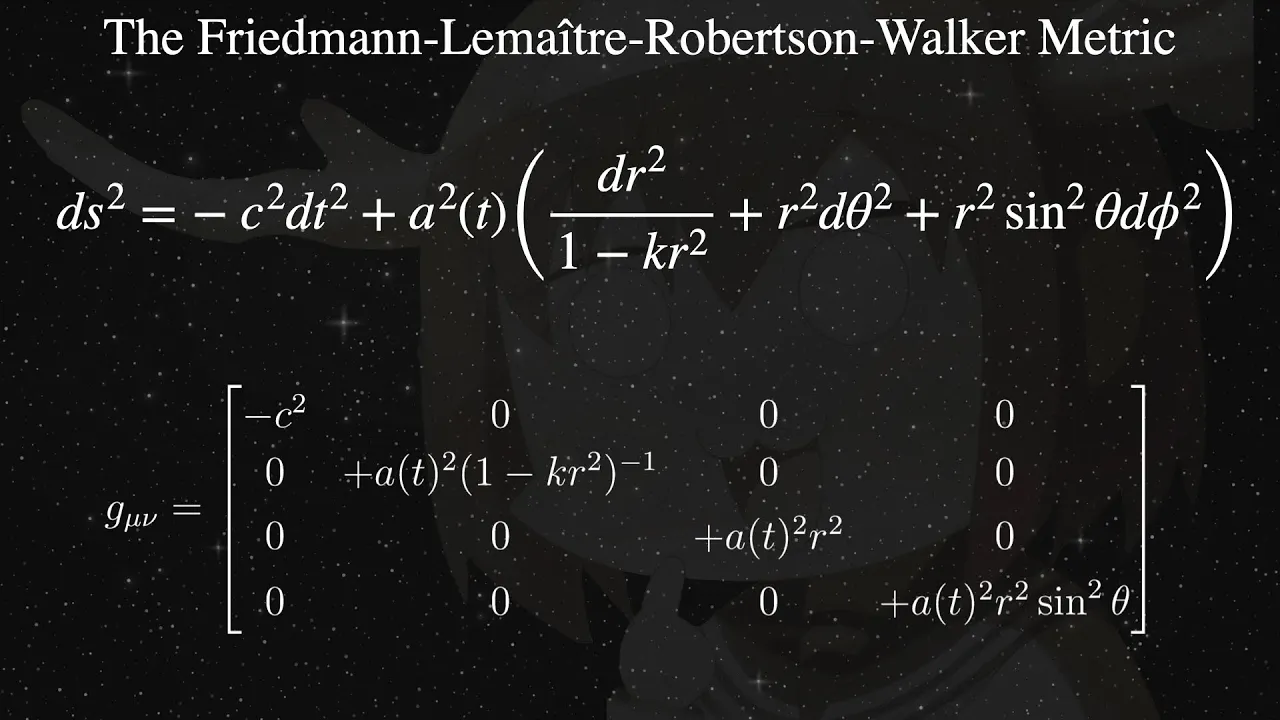
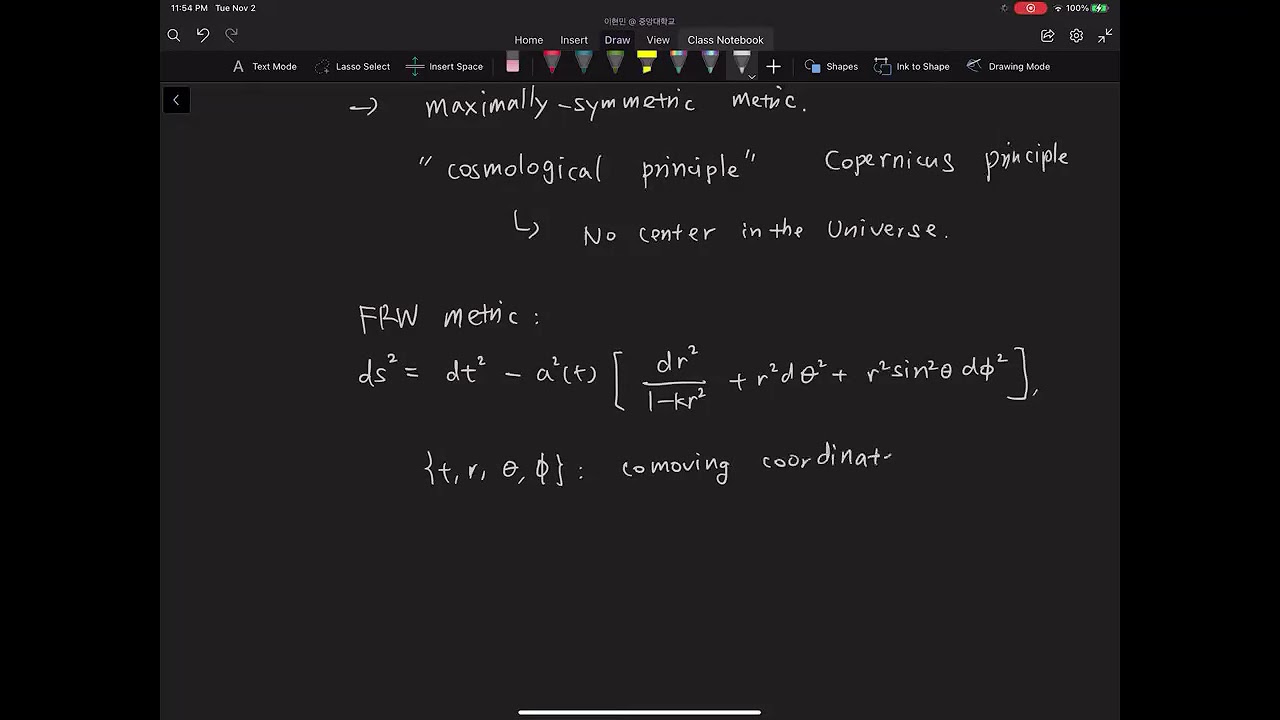
Added:Fundamental concepts of General Relativity, specifically the expansion of space and the Friedmann-Lemaître-Robertson-Walker (FLRW) metric.
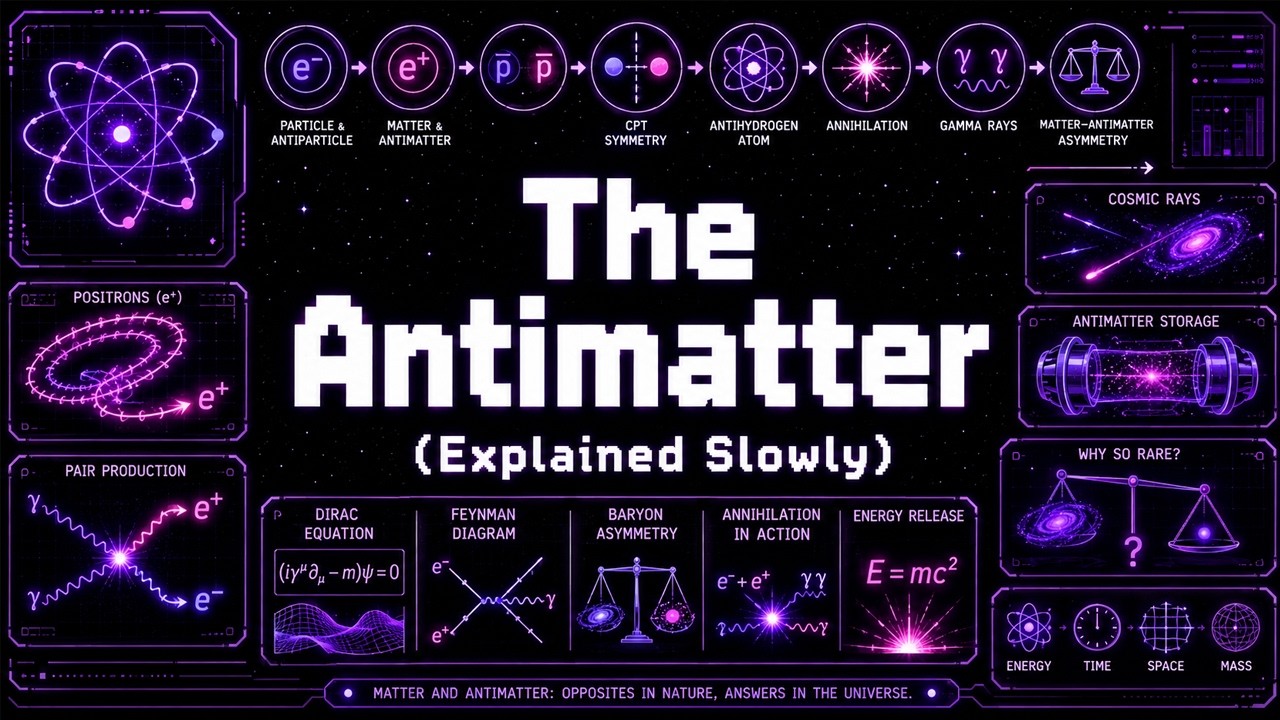
Basic principles of the Standard Model of Particle Physics, including the classification of matter (quarks, leptons) and antimatter.
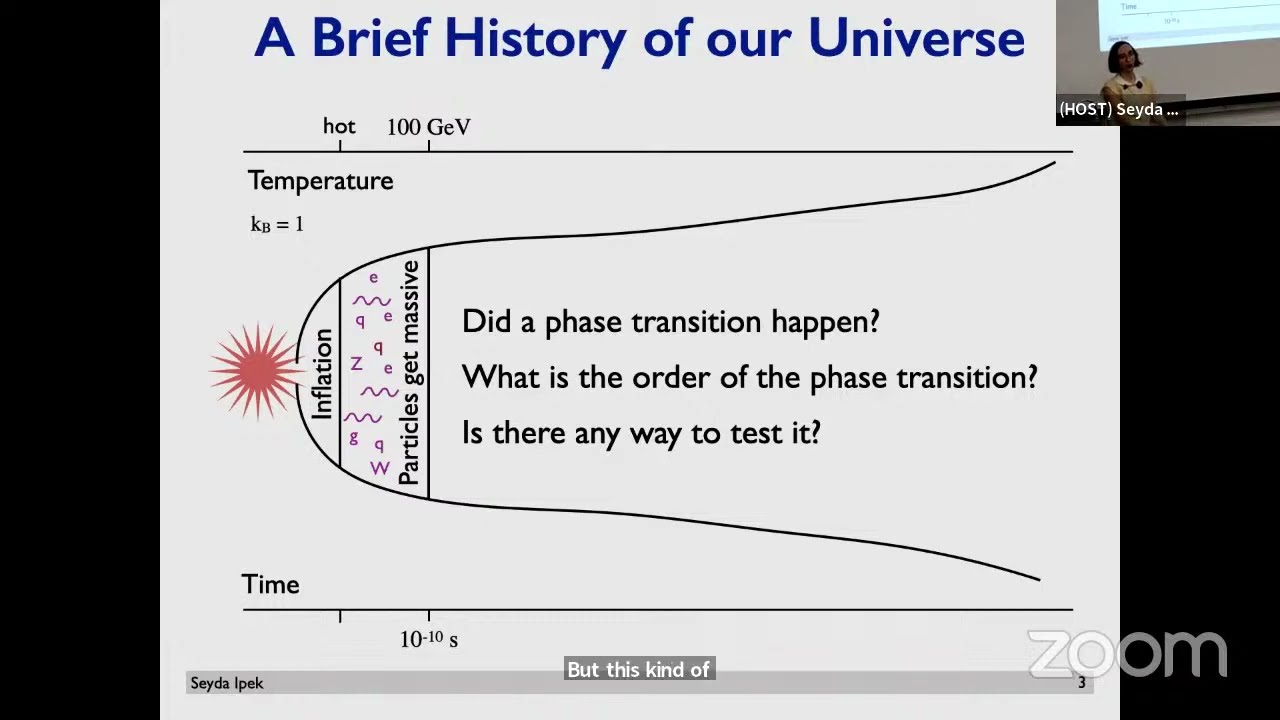
Classical thermodynamics and statistical mechanics, particularly thermal equilibrium and phase transitions in the early universe.
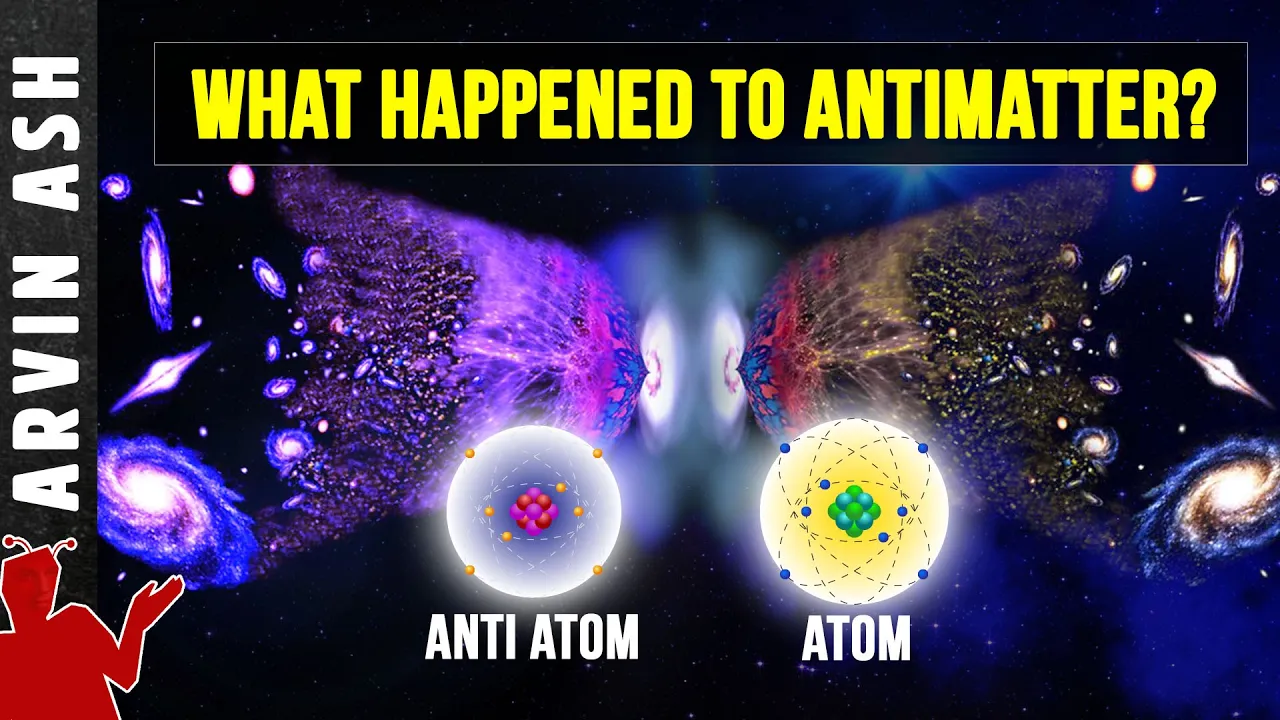
The concept of Baryon Number conservation and the fundamental physical distinction between matter and antimatter.
The Sakharov Conditions: A deep dive into the three necessary conditions for baryogenesis (baryon number violation, C and CP violation, and out-of-equilibrium interactions).
Big Bang Nucleosynthesis (BBN): Analyzing the creation of light atomic nuclei in the minutes following baryogenesis.
Cosmological Inflation: Understanding the mechanism behind the rapid, exponential expansion of space in the fraction of a second after the Big Bang.
Advanced baryogenesis models, such as Leptogenesis and Electroweak Baryogenesis.
Cosmic Microwave Background (CMB) Physics: Studying how early universe density perturbations left thermal fluctuations in the oldest light in the universe.
84.1K views557likes2:01:10Original Release: 2013-03-17
[Music] Stanford University all right let's uh should we begin um just to uh just to go back very briefly over what we said last week um what I said was that the best way to go about trying to estimate the rough parameters of the expanding universe is to begin with a model and then calculate its consequences for what I'll tell you in a moment and if that doesn't work so well adjust the parameters of the model and keep adjusting until you uh until you hit pay dirt and you agree with the data um you can do it the other way you can take the data and try to run it backwards using the same equation but it's often harder to do that all right the uh the data not the data the model that we put in basically consists of two things it consists of a Time history for the scale factor a of T and A specification of whether we're talking about a negatively curved positively curved or zero curved Universe um for the until we get to the properties of the cosmic microwave background and some of the detail that's contained in the cosmic microwave background which we're coming to today but until we get to those details um we really typically don't really see deep enough and far enough that the constant K the positive curvature negative curvature or zero curvature is really very critical to the analysis um that's like saying if you're on the surface of the Earth and you look out the th miles well a curvature counts but it really doesn't uh it really is not that strong in effect and if your everything else that you're doing is not too precise it's hard to tell whether the curve at the Earth is curved on a scale of a th000 miles of course if you have High Precision than you can tell but uh you know all you're doing is looking uh looking out relatively nearby relatively nearby the curvature doesn't matter too much the same is true of negative curvature and so counting Counting galaxies counting uh Supernova and things like that which at not such large red shifts red shifts that never get bigger than four five 6 seven or something like that that you don't really have you're not really terribly sensitive to the curvature that's both good and bad it's bad because it doesn't allow you to deduce from the uh counting of supernova and so forth with good Precision what the curvature is whether it's zero plus or minus on the other hand since it doesn't matter too much it means that uh that you don't have to know too well what the curvature is to uh to make conclusions about the other thing and the other thing that counts is the curvature history or the or the history of the scale factor how it varies with time um so you start with a model which is which is scale factor is a function of time and what you calculate is two things you can try to calculate you can try to calculate the red shift as um the uh sorry the intensity as a function of the red shift in other words what is the brightness of standard sources standard can candles as a function of their red shift that's roughly speaking uh calculating the Hubble law relation between distance and velocity um and you can C and you can calculate from your model the number of objects that you see in the sky of a given Red shift in other words the density of things out there is a function of red shift and those are the two things which you can calculate from a model compare with a model and pin down your parameters as best you can the the uh just from the counting you do not as well as if you knew the curvature with great Precision which you which takes CMB data to to get at but still the tendency is toward a fairly flat universe fairly flat uh with no indication of either positive or negative curvature consistent with zero curvature and a expansion history which is consistent with the existence of a cosmological constant which contains about 70% or dark energy which contains about 70% of the energy in the in in space so that's what you learn from uh the counting of supernova of standard candles it takes the other end of things looking very very deep much deeper than where there are galaxies or much deeper than where there are Supernova or anything other other recognizable standard candles looking deep into the microwave background to do better and we're going so today we start to talk about the microwave background um or more generally what we want to talk about is the temperature history of the universe the temperature history of the universe temperature first of all what is temperature temperature you all know what temperature is you put your hand on a hot uh flame and you know what what heat is it feels bad it feel feels good whatever whatever your tastes are but um strictly speaking temperature is a feature of thermal equilibrium thermal equilibrium is a condition for a system uh that is established after a period of time basically by scattering the kinds of systems we're thinking about are things made up out of particles what particles well what particles are present in the universe there are photons there are electrons there are protons and nuclei to get neutrons they Decay very quickly but there are nuclei and for our simple purposes let's just say there are electrons protons and and photons those are the particles that make up the universe today at present times and thermal equilibrium is what happens after you put particles together allow them to collide with each other for a relatively long period of Time how long long by comparison with the time scales uh that it takes for actual collisions to take place partic collide with each other in microscopic amounts of time they Collide there are mean-free paths between particles so there are various time scales the time scales are not associated typically with uh with the grand cosmological features of the universe they're just associated with the nature of the gas or the um gas or fluid or whatever it is we're talking about the fluid might as will be here in the laboratory and the various time scales have to do with the microscopic uh aspects of the fluid and when the fluid sits around well I say fluid I I mean whatever it happens to be I just use the term fluid because it can flow uh the fluid if left to itself for a period of time will establish thermal equilibrium it will establish thermal equilibrium as long as the expansion whatever expansion might exist as long as the expansion is much slower than these time scales uh for which uh these collisions taking place then it will establish thermal equilibrium but you got to be careful about that what causes things to become thermalized or to become the thermal equilibrium if I have a box let's take as our model our again our mythical box let's take our mythical box and let's give it perfectly reflecting walls as usual so that we don't have to worry about heating the walls energy being absorbed by the walls and so forth perfectly reflecting walls and put photons into it and let's put photons into it in by shining a laser into the box so we shine a laser into the box through a little hole the radiation is in the box and then we close up the hole and the radiation bounces off the walls of the box and if this is just pure photons with no interaction between them and the interactions between photons is extremely weak photons do not readily scatter off each other ordinarily uh then the Box will not come to their thermal equilibrium all that will happen is the pulse of radiation will bounce back and forth and back and forth and back and forth and back and forth forever and ever almost forever and ever without uh anything interesting happening well maybe you consider that interesting but without it um without the energy being spread through the system without the energy be becoming uh thermal what it takes is some scattering it takes some form form of collisions to scatter the photons uh and cause the system to come to thermal equilibrium photons do scatter a little bit there is some cross-section for the interaction of photons but for photons of wavelength comparable to what we have in the universe today the cross-section for scattering or the probability for two photons to scattering is so negligible that uh that these photons would not equilibrate they would not come to thermal equilibrium what it takes to make things come to thermal equilibrium to make photons come to thermal equil equilibrium is some charged particles charged particles scatter very very efficiently off radiation an electron a photon or an electromagnetic wave an electromagnetic wave goes past it the electric field causes the electron to vibrate the vibrating electric field the vibrating electron then sends off more radiation and scattering is very efficient if this box contained some density of electrons let's call them e minus minus for the fact that electrons have negative charge uh if the Box had some population of electrons in it then scattering would be efficient and the box would very quickly come to thermal equilibrium of course it depends on what the distance between the electrons are but you know if we if we put a reasonable density of electrons in there then photons scatter electrons scatter the electrons and the photons all come and form eventually a thermal soup and under those circumstances we would say that the box has a temperature now the universe appear there's good reason for this but we're not going to get to it tonight there's good reason for it but the universe appears to be electrically neutral uh there are not large lumps of positive charge and large lumps of negative charge in the universe and certainly on the average the universe appears to be electrically neutral so it's not just electrons in addition to electrons there are protons and other uh other Atomic nuclei with positive charge let's simplify it and just say there are photons in the Box we'll call them gamma gamma for gamma ray but they're not necessarily gamma rays just gamma for Photon and there are protons P that's what's in the box gamma electrons and protons the number of electrons the number of electrons let's call it NE e minus is the same as the number of protons and that's why it's electrically neutral well that's not why it's electrically neutral the why of why it's electrically neutral is more complicated it simply states that the box is electrically neutral of course use the fact that the the charge of the electron is equal and opposite to the charge of a proton another experimental fact that we're not trying to explain tonight if the electrons and protons are freely moving in the Box in other words if they're not bound two situations one situation that you could imagine is that the electrons and the protons are tied together into hydrogen nuclei hydrogen nuclei are electrically neutral electrically neutral objects are not efficient scatterers okay it is true that they do scatter radiation a little bit but on the whole they're such weak scatterers that um the very very small dilute density of hydrogen in the universe today has so little effect on the photons moving through it that would take forever and I never even tried to calculate but a very very long time much longer than the age of the universe to cause the uh the photons to come to thermal equilibrium and so today the universe is not in thermal equilibrium it's not in thermal equilibrium it doesn't have a proper temperature or another way of saying it is that the very ious kinds of particles are not in equilibrium with each other the atomic nuclei that are out there if you were to characterize them by a temperature how do you characterize them by a temperature roughly speaking the temperature is the kinetic energy of a of a particle if you were to calculate them as uh if you were to describe them as by having a temperature the temperature would be much much lower than the temperature that c characterizes the photons out there so the ordinary particles electrons and protons are not in equilibrium with the photons there's simply not enough scattering for that to happen on the other hand if the electrons and protons were freely moving and not bound into atoms then they would be efficient scatterers and they would come to equilibrium together with the photons and you'd expect it to be characterized by a single temperature the temperature of the electrons the temperature of the protons the temperature the photons all the same temperature and in that circumstance there's a well- defined notion of temperature what does it take to make sure that the electrons don't fall into the protons and form atoms well it takes a high enough temperature when the temperature is high enough the energies of the photons and the energies of the electrons and the energies of protons and so forth are large enough that enough collisions take place that they keep busting up the uh the hydrogen atoms there are some hydrogen atoms when the temperature is high but there are also plenty of free electrons and free protons to scatter the radiation and that maintains the thermal equilibrium so if we're in the regime of temperatures where temperature is really meaningful in other words where things are thermal equilibrium then the box of gas is described by a number of electrons and protons or better yet a density of electrons and protons with a dens of electrons and protons being equal and a temperature T capital T okay now the radiation in the Box every component of the radiation every Photon if you like or every uh every bit of the radiation is also characterized by a wavelength Lambda there are many many different wavelengths in the Box the Box does not have a single wavelength once it's in thermal equilibrium and the distribution of wavelengths is determined by the thermal properties of the Box uh we could also characterize radiation not just by by not by wavelength but equivalently by frequency and the relationship between frequency and wavelength is that the product of the frequency and the wavelength is equal to the speed of light okay so either wavelength length or frequency and as I said there are many many different frequencies there's a whole spectrum of frequencies inside the box and it's characterized by a function it's characterized by a function called the intensity intensity I and the intensity I is basically an energy density it's basically an energy density but it's a function of both the temperature and either the wavelength or the frequency the wavelength or the frequency and it's defined in such a way that if you multiply it by the volume of the box or just a small little differential volume in the Box DV and you multiply it by a small differential of frequency d new that tells you how much energy is stored in the volume v in a band of frequencies between frequency new and new plus d new that's the meaning of the intensity in other words the energy density per unit frequency and it's a function of the temperature the higher the temperature the higher the intensity now we're not going to work through the theory of this int intensity function but um we can actually work out the behavior of the intensity function as it would have been worked out before 1900 before 1900 the only parameter the only constant of nature which appeared in the theory of light and in the theory of radiation was the speed of light C so that's all there was was C and now you can use Simple um dimensional analysis to ask what must be the formula for the intensity as a function of T and new and you get an answer everybody know how to do dimensional analysis you just say all right let me tell you how you do dimensional analysis the first question is what is the dimension of intensity well it's energy per unit volume per unit frequency what is the units of frequency incidentally inverse time right so whatever intensity is it has units its units are energy uh per unit time sorry energy per unit frequency energy per unit frequency which means energy time time per unit volume now you can ask what kind of quantity can you make what kind of quantity can you make out of the temperature oh the other question is sorry there's one other element what about the temperature what are the units of temperature this is the units of intensity energy times time over volume what are the units of temperature the units of temperature are basically units of energy there's a historical glitch in the definition of temperature temperature was not originally defined it wasn't even known that it was an an energy it was just defined in terms of boiling water and freezing water and dividing the Gap into a 100 little segments and they were called degrees uh uh Cade but modern theories of what temperature is is that temperature is just basically the energy of a molecule the average energy of a molecule or a particle in a gas energy is temperature sorry temperature is energy the conversion factor just the numerical conversion factor between energy units and conventional temperature units like centigrade is a certain constant called boltzman's constant so you'll often see formulas in which some energy or another whatever it happens to be is written as being proportional to some temperature times a constant K boltzman the boltzman constant is as I said just a conver verion Factor I'll keep it around but for our real purposes temperature is an energy and it has units of energy okay and K boltzman is just some historical Relic uh that we could easily set equal to one and not lose anything I'll keep it around just because uh it's traditional to keep it around okay so apart from this K boltzman temperature has units of energy and so we can ask what kind of dependence can I have which has certain units on temperature and frequency frequency has units of one over time temperature has units of energy and I has to have units of energy times time over volume it'll take you a few minutes just work it out I'll tell you what the general formula has to be it's of the form I equals temperature time frequency squared over the speed of light squared if we keep the speed of light in that's the only thing around that we have is the temperature the frequency and the speed of light and this is the only formula which has the right units of course it's not the only formula that has the right units there can be other formulas like for example twice that two has no units and in fact that's basically the right answer twice uh the temperature times the frequency squared over the speed of light squared that's as oh not quite I said I would keep K boltzman around but the rule is always the same whenever you see a temperature in the formula multiply it by K boltzman and think of temperature time K boltzman is a single thing a single thing with units of energy all right so that's uh that that's the formula for the energy per unit volume per unit frequency now this formula is a disaster this formula was a disaster it was known to people in the 1890s or early parts of the or late parts of the 19th century that this was a disaster if we plot this as a function of new we see that it grows parabolically and therefore the total amount of energy contained in this box is going to be infinite there's just more and more and more energy per unit volume in higher and higher frequencies all right so you know the story of course the story was that a new constant was necessary oh experimentally experimentally and for the life of me I have never been able to figure out how the experiments were really done to discover that um any detail to this curve I I don't know how they were done because I don't know how physicists at that time could have measured the intensity as a function of wavelength and I've looked it up I've tried to find I cannot I don't know I'm not even sure that they did do it or were just guessing about it but this is the formula from classical physics and of course experimentally the formula was quite different it turned over and went back down to zero so that the total energy contained in the box is finite this fact or the uh the the fiction that the energy in the box is infinite because of this formula was called the ultraviolet cat catastrophe and in order to have it turn over like that it was necessary that this formula have another constant in it this was the only formula that you could make that only involved the constant C necessary to have another constant and that constant was of course Plank's constant adding plunk constant into the formula you can uh you can uh or adding con plun constant you can make up many formulas but let me give you the right one I'll give you the precise formula for I and we'll see some interesting things about it I is equal this is the black body formula this is the famous black body formula or the plunk formula twice Plank's constant anybody know what the units of Plank's constant are energy times time energy times time okay of course what are the units of energy uh you want to reduce everything to length distance distance time and mass mv^ s Mass MV is length over time mv^ 2 m mass time length squ over time squ yeah and then to get H you multiply by time so it's m length squared over over time but whatever definite uh definite units times new cubed divided c^2 times a crazy function and the crazy function was 1 / e the plunks constant times the frequency divided KT again that's K boltzman goes together with a temperature as always minus one all right just to look at it just for fun what is it question okay what does this formula have to do with this formula well what this the formulas are the point is the formulas are the same for low energy for low frequency for low frequency the exponential is an exponential of a small quantity here when the frequency is very small if the frequency is close to zero you can expand out this exponential and you use the fact that an exponential e to the X for small X is just 1 + x and then subtract off the one e to X - 1 is just X so what's in the denominator here is just one over H new divided by KT but that means the KT can go in the numerator that's what the complicated function is for small new and then if I multiply it by this let's do it tce h new cubed over c^2 notice first of all Plank's constant disappears so in first approximation for small new Plank's constant has cancelled one power of the frequency cancels and if I didn't make a mistake in writing these things down twice T KB twice T KB New 2 over c^2 I think I got it right I think they agree okay so now the um the point of course is that this becomes important when new gets large for small new the formula as written by the classical physicists of the 19th century reallyy Jane jeans and other people that was correct but as new starts getting large what happens to the exponential here the exponential starts to get very big so as new becomes large in particular when H new over KT starts to become bigger than one this exponential starts to get large in fact it becomes so large that the one isn't even important here and this whole Factor just becomes exponentially small so there's a crossover Point there's a crossover point when H new over KT is about equal to 1 instead of this curve continuing up and up and up like a parabola it rather suddenly turns over and goes exponentially to zero thus solving the ultraviolet problem the ultraviolet catastrophe now this provides another interesting connection it says that for every temperature taking this formula KT KT not I don't want to confuse time and temperature uh this can be written in another way incidentally let's let's write it another way instead of new let's remember that new is equal to C over Lambda new equal C over Lambda we could plug that in here and this says h C over Lambda is bigger than one did I get that right or that Lambda is less than HC over KT so high frequencies or small wavelengths are strongly affected by quantum mechanics and the spectrum is driven very quickly to zero there's a crossover point the crossover point is exactly at Lambda equals HC over KT that's the crossover point and more than that that's where most of the power is most of the power most of the um energy density or at least the the largest part of it is contained in in wavelengths that are proportional to one over the temperature that allows us to establish a connection if you like between Lambda and temperature now we can we can sort of use that connection between Lambda and temperature even when a system is not in strict thermal equilibrium just to get a rough uh sense sometimes if we know that we have a bunch of photons whose average wavelength is some particular wavelength and we want to know how potent they are at doing various things to a system we can roughly speaking replace it by the question of how potent would be radiation at a corresponding temperature uh and so we could look at the photons that we see today and from the bulk of the photons that we see in the universe the overwhelming majority of them have a particular wavelength the wavelength is about a millimeter okay and that allows us to associate it with it a temperature that temperature is about 3° we'll come back to that but that does not say and it's not interpret we should not interpret that in itself as saying anything is in thermal equilibrium that's just a rough correspondence it turns out to be much better than that but for reasons we'll come to yeah no no no no no no no no no no no um uh plunk was doing a combination of two things he was doing a combination of uh curve fitting um okay so various things were known the fact that the wavelength that the central wavelength here shifts with temperature that was known it was called it's called V's displacement law it's the displacement of the central Peak as a function of temperature the was a physicist of the 19th century and uh plun knew that very well and he was able to read off that this placement law he was able to read off a constant H uh K was nothing no everybody knew that K and temperature Go Together by that time speed of light was known and so the displacement law which said that Lambda goes as one over the temperature was parameterized by a new constant called H so the the most important part of what plank did was just to identify this constant to identify the constant and uh and this was it's much deeper than it sounds um he also recognized that it had something to do with harmonic oscillators he recognized but he had the wrong idea he didn't realize that it had to do with the radiation being described by oscillators he thought that it had to do with the walls of the Box containing harmonic oscillators of some sort oscillating systems it was before atoms were known for sure molecules were not really understood but he had the idea there's something vibrating in the walls of the box and the walls of the Box are emitting and and he had some right ideas some wrong ideas it was Einstein of course who uh who derived this uh who derived this formula in detail from a set of principles but we're not that that's not where we're going today okay so um yeah okay uh you really want to go through it or you want to do it at home T * K boltzman is energy yeah well I don't know if if you want me to work it out we can do it thank you I think he's looking at the I and the units of I yeah the units of the units of I so the units of I let's see the units of I are energy per unit volume per unit frequency or at least that's what they better be uh do I have it wrong K times T is energy all right let's let's try it let's see what we get okay I say I has units of energy divided by frequency energy per unit frequency per unit volume all right and that is energy what's what's the units of energy what did we say energy was mass times length Square mass time velocity squared right mass time length squar over time squared that's energy what about frequency frequency is one over time so that would put a Time upstairs and volume downstairs would be length cubed all right so let's see what we get that's Mass / length time time Mass divid div by length time time now we have to go over to the right hand side I probably made a mistake in substituting for the energy there since the energy already appears on this side but let's do it anyway on that's the that's the units of intensity the units on the right hand side are again energy this is the right hand side right hand side uh energy which is again Mass * length squar over time squared frequency squared is 1 over time squared this doesn't look like it's working out does it oh does it um divided by c^ 2 c^ 2 is length squ over time squar so that's time squar over l squ this doesn't look good does it what's going on um how much are we off by yeah it looks like we're off by a uh by a factor of c l s cancels yeah we're off by a factor of C somewhere um length time time is length over time squared time time over length which means a c we're off by a factor of C so is it upstairs or downstairs I don't know what happened [Music] um C Cubed on the bottom yeah uh my guess is that the definition of intensity has an extra factor of of C in it that I didn't know about because I remember this well I may have remembered the formula wrong I may have may remembered the uh the speed of light Factor wrong the speed of light of course is yeah okay so we what is the right formula see Cube downstairs see Cube downstairs looks like and now you can also ask about this exponential here is that dimensionless it should be dimensionless because it has to be compared with one and that I'm sure is dimensionless uh H new that's an energy E equals H new everybody knows that formula right energy equals H new and KT is also an energy so we're in good shape apart for that apart from that speed of light cubed which I blew all right so anyway that has no effect on this relationship between frequencies or wavelengths and temperatures uh given a temperature this wavelength is called the thermal wavelength the thermal wavelength associated with that temperature now there's something else helpful or simplifying about this formula Let's uh let's just take the formula and get rid of everything that's uh Irrelevant for my purposes right now 2 H and C are constants so let me take them out of here and just say this is a proportionality this is a proportionality I is proportional to new cubed times this thing over here notice that what's in over here is a function of new divided by temperature what's in here it contains constants K and H bar but its dependence on new the frequency is through the ratio of new to temperature well let's uh let's divide this by temperature cubed and now multiply it by temperature cubed what I'm interested in is the shape of the curve the shape of the curve here and for the moment not the height of the curve I'm interested for the moment only in the shape of this particular curve and the shape of the curve as a function of new is not influenced by whether I do or don't multiply by T cubed here multiplying by T cubed simply changes the overall normalization height of the curve but it doesn't change its shape there here is the thing which determines its Universal shape and notice that it's only a function of the ratio of new to temperature in other words the shape of the curve dropping the factor T cubed is just a function of the ratio of new to temperature that means that if I change the temperature all that happens is the curve rescales the frequency rescales for example supposing I change the temperature by a factor of two what happens to this curve it simply rescales by a factor of two along the new axis here all right so I just stretch it by a factor of two if I want to change the temperature by a factor of two if I want to change the temperature by a factor of 100 I just stretch the curve by a factor of 100 in terms of wavelengths I do the same thing remember that new is proportional to one over the wavelength we could write it this way if we wanted one over the wavelength if I change the temperature then as a function of wavelength I just squeeze the curve all right so there's a universal Behavior to the shape of the black body Spectrum and if you know it at one temperature and you want to get it at another temperature you simply rescale it you rescale the frequency proportional to the change to the rescaling of the temperature and that's an important point this is going to come up as a very important uh fact and it's a simplifying fact okay as I said neutral atoms and in fact today most of the electrons and protons in the universe are bound up into atoms and F furthermore they're very dilute there aren't very many of them per unit volume many more photons than there are uh protons and neutron scatterers and the scatterers aren't really available for scattering they're bound up into these nuclei and so the universe today is not in thermal equilibrium uh the fact that there is a temperature associated with the black body radiation is a kind of accident and we we'll come to what that accident is okay so when the when the temperature is too low in the Box the the uh radiation couples the right term is that decouples from the charged particles when the temperature is too low the charged particles form atoms the atoms are poor scatterers and for the most part the photons in the Box the radiation in the Box doesn't even see the charged particles it just goes right past them and decouples from them that's the right term now let's imagine starting with this box and for whatever reason let's suppose it starts at a high temperature let's suppose that it starts at a high temperature so high that the electrons and protons in it are ionized that uh that they're not bound into atoms or at least that not all of them are bound into atoms and so it does have a temperature it does have a thermal equilibrium and the radiation Spectrum looks like the black body radiation Spectrum now let's start to expand the box as we expand the Box just expand it physically as we expand the box it cools it cools because the various particles do work on the box and the work uh depletes the energy in inside the Box the Box cools the temperature goes down of course and eventually it gets so cold in the box that the electrons and protons combine into atoms and there just aren't enough sources of scattering there aren't enough high energy photons there aren't enough oomph in there to uh to ionize to reionize the atoms okay so what happens the radiation decouples from the atoms the atoms go their own way who knows what happens to them their temperature may also go down down the temperature of the radiation goes down but it doesn't really stay in thermal equilibrium to say it's in thermal equilibrium means the temperature of every part of the system is the same so the system falls out of thermal equilibrium at some point it falls out of thermal equilibrium but nevertheless as we continue to expand it the shape of the black body Spectrum here is sort of Frozen in it's frozen in for the simple reason that when you expand the size of the box every single Photon in it just has its wavelength stretched by the same factor every photon is stretched by the same factor and as we saw stretching the wavelengths by a factor of two for example in this formula in this formula here is equivalent to just changing the temperature by a factor of two so as the Box expands every wavelength gets doubled let's say it mimics it mimics the effect of just lowering the temperature by a factor of two but only for the radiation what happens to the other particles well they do whatever they do but they don't couple very much to the radiation so in general what will happen is the um is the molecules not the molecules the atoms in there will have a different temperature than the radiation they won't come to thermal equilibrium because they're not efficient scatterers but the radiation will have exactly the same form the black body Spectrum will not change except in so far as it rescales according to the change in volume or the change in linear dimension of the box if the linear dimension of the Box doubles the effective temperature goes down by a factor of two if it quadruples the effective temperature goes down by a factor of four and so forth that's why today when the universe is far too cold for it to be in thermal equilibrium radiation with matter nevertheless the spectrum of radiation in the universe has the black body form again I emphasize it's not because the radiation is in equilibrium with anything it's just because it had the shape Frozen in at some very early time and maintain that shape now how do we know that it had that shape at a very early time we know because we measure the shape of the black body Spectrum or we measure the shape shape of the photon Spectrum in the universe with there's of course lots of different kinds of photons there's gamma rays in the universe there's um ordinary light star light and all that kind of stuff but the overwhelming majority of photons are in the wavelength range of about a millimeter everything else is just more or less incidental carries very little energy and is fully accounted for by mechanisms that we understand right the dominant form of radiation and I say that both by energy and by counting number of photons the dominant form by a long shot is the black body microwave cosmic background radiation that was discovered in the 1960s uh that radiation has been studied to death and of course it does have the shape of a black body Spectrum to very high precision uh the Arab Bars by now are very very tiny I'm not sure exactly how big they are but they're so small uh that uh that the deviations from the black body are much much smaller than the Arab bars well how can we know that they're smaller than the Arab bars well because we have many many different frequencies we study it at and statistically the curve fits the black body Spectrum to very high Precision so what we see today is a universe filled with radiation that appears for all practical purposes to be the remnant of a thermal distribution that must have become thermalized at a much higher temperature when the electrons and protons were ionized that's of course our best guess as to what the history the thermal history of the universe was but let's uh let's expand on it a little bit what can we say or first of all what are the facts what are the facts and what do we know question yeah a photon that travels in in vacuum supposing what a photon traveling under how much space does occupy how much space does a photon occupy that is a um a loaded question uh in some sense the photon has no size at all but it does have a quantum mechanical spread in its uh in its uh let's call it its probability distribution um let's say it occupies a size roughly equal to its uh to its wavelength to the inverse temperature yeah I think that's that's the the photons that are floating around not only have a wavelength of about this big but the wave packets that describe them are also roughly about that big you so a millimeter a millimeter characteristic size scale of uh of the photons the wave packets the wavelengths all the same about a millimeter in today's uh say it again yeah yeah yeah but the peak the peak here today the peak here today is about 1 mm yeah there's no well there's no Universal well-defined notion of how big uh a particle is there's several different several different uh things that you could call the size of it so I'm going to I'm not going to try to answer that okay yeah there's there's another formula that I want to write down which we'll come back to soon let's call this phenomenon where you go through the situation where you start with ionized gas lower the temperature and come out at the other side with lower temperature with uh with atoms okay that's the phenomena of uh combination we it's called recombination but it's just combination where the electrons and protons combine into atoms that's the point at which the uh the scattering stops that's called decoupling and it's characterized by a certain temperature it's characterized by a temperature and it's characterized by a wavelength through the connection between wavelengths and temperature okay what about the wavelength of the radiation today the wavelength of the radiation today let's write a formula it's a sort of trivial formula the wavelength of the radiation that we see today the remnant radiation from this black body Spectrum let's call it today and now we mean the average wavelength we mean the the wavelength at the top of the peak the wavelength today divided by the wavelength at decoupling is this bigger than one or smaller than one first question is it a big number or a small number it's a big number the Wes got stretched okay what did they get stretched by they got stretched by the expansion of the universe so we can write that this is just the ratio of the scale factor today divided by the scale factor at the time that decoupling took place the time that decoupling took place is not an absolutely rigorously sharply defined time it happened over some period of time but the characteristic time that it happened over is relatively short and so we can talk about the ratio of the scale factor in other words this ratio is the ratio by which the universe expanded over that period of time between the decoupling phenomenon and today so it's interesting to ask what do we know about it okay it is also equal since the wavelengths are in ively proportional to the characteristic temperature it's also equal to the ratio of the temperature at decoupling to the temperature today T today Lambda today over Lambda decoupling is T decoupling over T today okay whose temperature not the temperature in this room not the temperature even in the outer space if you are out there floating around that would be mostly the temperature you would actually feel would probably have a lot more to do with the temperature of the uh the molecules and atoms out there no we're talking about the temperature of the microwave radiation the microwave background radiation uh and this is the ratio of the temperature today the temperature of uh this today is about 3° 3° Cen uh 3° Kelvin no the temperature today is about 3° and it's an interesting question what can we say about the temperature at decoupling what was the temperature at which hydrogen recombined or better yet if you went in the other direction what would be the temperature at which hydrogen would um uh would ionize there's a one simple answer to it when the temperature is such that the photons have enough energy to ionize the atom okay that's when the photon anybody know what the energy of ionization of a hydrogen atom is 13 13 electron volts so if the photons if the characteristic photons had an energy of 13 electron volts then they would have plenty of energy to kick the hell out of the hydrogen atom and and ionize it that's a temperature of let's see that uh that's a much bigger temperature than the decoupling temperature and I'll tell you why in a moment okay but that is one simple theory of the temperature of decoupling it's the temperature at which the average Photon has an energy comparable to the 13 Point whatever it is electron volts that that'll ionize an atom okay but there's another element and the other element is that there's a lot of photons out there the number of the ratio of the number of photons to the number of protons is very large in fact the number of photons to the number of protons or the number of atoms or the number of electrons they're the same thing let's say the number of electrons the ratio is about 10 to e now where did that number come from how did so many photons get there this is something we're going to try to talk about how did it get to be this is this this is an observable fact this is a fact that we know by looking at the matter in the universe we know how many protons there are or how many El there are and we measure how many photons there are from the black body spectrum and we know that the ratio of the number of photons to the number of electrons is about 10 to 8th now let's suppose that the temperature was just called T let's take the temperature T what is the probability that a photon have a given energy and the answer is at a temperature T the probability for photons to have different energies is of the form e to the minus let's write it correctly the energy of the photon let's call it Epsilon for the energy of the photon energy of photon divided by KT this is a standard formula this is the boltzman distribution e to the minus energy over KT this is the probability that the photon have an energy Epsilon um good that's where we are so now I can ask the question what's the probability that a photon have the ionization energy the ionization energy being 13.5 electron volts let's just substitute that in epsilon ionization Epsilon stands for energy Epsilon ionization is just good old 13.5 electron volts that's the probability that a given Photon have an energy which is big enough to ionize the hydrogen atom if Epsilon is very much smaller than KT then this is a small small number exponentially small on the other hand there are a lot of photons so instead of asking the question what is the probability that any given Photon have a uh an energy big enough to ionize the atom we could ask how many photons are there that can ionize the atom to answer that we have to multiply this in other words per per atom how many photons are there that can do the job and the answer is this number times 10 e so in other words we're actually operating in the taals of the distribution here we have to multiply this by 10 to 8 and if this combination of numbers is order one is roughly one or bigger then there are simply enough photons to ionize the electrons there will be one Photon if this is a one that says there will be roughly one Photon per atom with enough juice to ionize it all right 10 e is approximately e to the 20 or something like that that that energy or at and above at an at and above yeah but don't forget the Spectrum falls off quickly so it's mostly going to be pretty much in the vicinity of that energy but yes that energy or energy above well question question would would that 10 to the E be true way back when when wouldn't that be a different number no no no as far as far as the ratio of these numbers go that was frozen in there was no no mechanism within this box for changing either the number of photons or the number of electrons or the number of protons at least not until the temperatures are very very much higher than talking about the uh the history back to decoupling is a history of um of pretty much conserved number of particles conserved number of photons conserved number of electrons conserved number of protons and to you know to calculate that you requires some calculation but that's that's uh that's the bottom line that the number of particles of Any Given species really didn't change very much okay back to the and probably well back before that all right so we have e to 20 * e to minus ionization energy over KT should be of water one and uh we can write that then that the ionization e ionization over KT should be [Music] um biggest than or equal to about what 20 20 or in other words we can write this turn it over let's turn it over it says that KT is about 12th of the ionization energy in other words let me just spell out what this means it means there are so many photons around that you don't actually have to heat the system up to the ionization temperature before there's a significant population of photons that uh that can ionize the atoms at a temperature 12th of the ionization temperature there are enough photons around because of a large population of photons is 10 to e uh there are enough high energy photons high energy photons now means above 13.5 volts there are enough of them around to make sure that a significant population of the atoms are ionized that happens when the temperature when the characteristic temperature is only 12th of the ionization uh uh temperature how many degrees would that be the number of phons is Conant what's that the number of photons coming out of a solar system is negligable or it's not enough iation energy photons coming out no no no no the the the population of photons is very very the photons that came out of stars they weren't even around at that time uh so we don't care about them at all and uh even if we did the population of them is a tiny tiny fraction of the population of overall photons no we're only counting the photons that are in the microwave background in other words the remnants or the relics of that early thermal equilibrium those are the ones that count as far as we're concerned okay so we know now question yeah so at at the time of decoupling you got all these electrons and protons that combined with the hydrogen atoms and emit a 13.6 EV Photon say it again at the time of Rec combination there the electrons and positrons combin into hydrogen atoms and emit 13.6 CV photons you mean when they Rec combine yes yes they do so shouldn't there be a line in the spectrum of the back black body radiation at 20 times the average well as long as the process is happening slowly enough it will stay in thermal equilibrium and um the uh if it stays in thermal equilibrium the Curve will be the right curve if the expansion takes place a little faster yeah then there will be a kind of bump at the uh at 13.5 electron volts but as long as it happens slowly um the balance will maintain itself and the population the population will conform to the uh to the thermal equilibrium so technically if the expansion is slow enough that the process is adiabatic it will remain in thermal equilibrium at all times uh until until the point where there simply aren't enough uh charged particles to keep it in equilibrium so what is that okay that temperature is about 5,000 4,000 deges 120th the you can plug in the ionization energy corresponds to a certain wavelength uh the wavelength is some angstrom or whatever it is uh you plug that in you get an energy out and the temperature is the temperature at which the ionization happens or the recombination happens is about a 20th of that because of the large population and that brings it down to about 4,000 de 4,000 degrees is much lower than the ionization temperature by what two orders of magnitude um no by Factor 20 uh right right one and a half one and a one and a quarter magnitudes or whatever um right W from alpha says that 13.6 20 is about 7, 7,891 okay so it's 25 where'd you get that number say it again yeah wol from alpha alpha what is Alpha oh okay M and it gives you twice that essentially almost 8,000 de so it should sounds like it needs to be a factor of 40 it could be a factor of 40 yeah I mean this is this is very rough this is very rough this is very rough yeah uh yeah a detailed calculation has to be done detailed calculation detailed calculations have been done I haven't done them uh but this is the basic physics the important thing is that it's a good deal lower than the ionization temperature by if not a factor of 20 maybe a factor of 40 uh and um yeah right so recombination happens or decoupling happens at a temperature of 4,000 de the temperature of the current radiation is 3° 4,000 de over 3° is about a th000 it's 1,200 or something like 4000 1,300 something like that yeah okay so that tells us then that the temperature at decoupling provided by the temperature today putting everything together that we know is about a factor of a thousand but that's also the ratio of the scale factor remember the temperature scales inversely with the scale factor and so this is also equal to the scale factor today divided by the scale factor at decoupling that uh that's kind of an amazing piece of information to know that the Universe expanded by a factor of a thousand from the time that it was opaque opaque means that it was ionized and therefore light could not readily travel through it all right so that's one Landmark so to speak that's one Landmark going backward in time time of course there were a lot of landmarks going backward in time that I've overlooked in thinking about the history of the universe going backward uh I haven't talked about Galaxy formation I haven't talked about uh black holes forming all sorts of things um and we'll come back to those things we don't have enough information yet to think about what it was that led the galaxies to form and so forth but uh jumping back and ignoring that we come to the first Landmark which is the decoupling Landmark now the second landmark in going backwards the second important thing that happened in the sense of going backward is the universe went from being matter dominated to being radiation dominated or to put it correctly the universe went from being radiation dominated to being matter dominated remember what radiation dominated and matter dominated means the equation of State for radiation and the equation of State for matter led to two different formulas for the energy density in the two kinds of uh energies the energy density in [Music] matter scaled like some constant let's call it row not divided by the scale factor cubed that's just a dilute ution of particles as the universe expand whereas row radiation went like some other row uh some other Row one I guess we could call this row matter row radiation it's just a number divided by A4 as we go forward in time radiation becomes less important well of course it's less important today it's much less important today but as we go backward in time we come to a time where this becomes bigger than that today and for almost the entire observable period of the universe the universe was matter dominated meaning that the matter contribution was much bigger than the radiation dominated part that affected the way the universe expanded exp expanded like T to the 2/3 instead of t to the 1/2 or whatever but if we go back early enough where the scale factor is small enough we come to the point where there's a crossover between here and here let's see if we can estimate where that crossover happened what the scale factors were when that happened all right first let's see what we know about the ratio today let's take the ratio today of let's erase this formula I don't want to confuse too many things here let's take the ratio today of the energy density in radiation for the energy density in matter okay that's today how do you do it well first of all you know from the black body Spectrum you know how much energy density is present in the form of photons basically you can use the following facts that for every for every proton or for every hydrogen atom there's 10 to the E photons 10 to the E photons per proton second of all we know the energy of each Photon the energy of each photon is about 10-4 electron volts that's the uh 3° that's that's what corresponds to 3° right and what about the energy of a proton the energy of a proton is a billion electron volts one gev 1 billion electron volts so there's a factor of 10 to the 8th 10 the uh 10 the minus 8 times I guess 10 13th 10 the 10 Theus 8 is the ratio of the number of protons to the number of photons and then 10 to the 13th is the ratio of the energy per photon or proton to the energy per photon anyway it's straightforward to work out and the answer is about 10 5 100,000 the ratio of matter to radiation today is about 10 5 okay now how did it behave in the past in the past as we extrapolate backward row matter scales with three powers of the scale factor whereas row radiation scales with four factors of the scale factor that means the ratio here in time scaled like one factor of the scale factor how far back oh oh this is incorrect why is this incorrect I made a mistake I forgot about dark matter right I forgot about Dark Matter dark matter has about 10 times as much mass as uh the ordinary luminous matter protons so this actually becomes 10 6 10 the 6 ratio of row matter to row radiation all right now the way that they scale as you go backward in time differs by one factor of the scale factor and what that tells you what that tells you is that in the past at the time when the scale factor was a million times smaller than it is today that the energy density in matter and the energy density in radiation were the same so as you go backward when the scale factor is a million times smaller than it is today in other words when the temperature is a million times larger than the 3° that's well well above that's uh what is it roughly a thousand times that's a thousand times the temperature of the decoupling period when the temperature was another factor of a th000 larger universe another factor of thousand smaller then there was a crossover and the universe became dominated by radiation the radiation energy became larger than the uh than the matter energy and as you go even further and further back the universe becomes more and more and more radiation dominated all right so that tells us that if you go to the very very early universe that matter matter meaning massive particles protons electrons but basically protons nuclei were very unimportant in the energy balance and the fredman equation was basically just the equation coming from radiation right of course that was very early and we don't easily see directly back to that time so in fact we don't easily see back to a time when the universe was uh was radiation dominated nevertheless Theory tells us that it must have been radiation dominated wouldn't there be a temperature where even protons can exist yes yes yes yes yes that would change the equation oh yes oh yes oh yes yes I'm still confused you said earlier that the number we have a number of electrons protons and protons and to ignore all the Stellar output today you're talking about only the CMB or you talking about period the whole universe no the CNB okay CMB is where the constant supp we get yeah yeah yeah no obviously obviously we talk about Starlight The Starlight is there today it wasn't there these very early times incidentally all of these things are happening long before there were stars and the temperature was uh was uh way up there long before there were stars galaxies and so forth yeah I have a slightly different way to answer the question was asked earlier which is if you take all of the three electrons okay and just ionize deionize them all at the same time you just add NE to n gamma and it will change by one part in 100 million so it's sort of negligible uh sorry I if you just if you just take n gamma over NE and change it to n gamma plus NE Over N well we're going to come to that yes yes yes yes yes yeah we're going to come to that ratio that's an important ratio we're going to come to it hopefully tonight okay so we found two landmarks decoupling sorry when we were talking earlier you said that the university expanded a thousand times since the universe became transparent did that happen about 280,000 years after the big bang I can't remember if it's that's the order of magnitude for sure I can't remember it's a what's that 380 yeah it's it's order of magnitude um a couple hundred thousand years yeah in 13 Point whatever it is building is yeah the time the time until the decoupling is negligible it's a tiny tiny time in in cosmological scales and then that's right it expanded from what you normally think of as the Big Bang it expanded by a factor of a thousand the volume expanded by a factor of um a th000 time a th000 is a million time a thousand is a billion yeah yes that that that's correct that's the lesson that over the period that we usually associate with after the big bang the universe that depends on what you define to be the big bang if you define the Big Bang to be the decoupling era when the universe became transparent then it expanded by a factor of a thousand now before that it presumably expanded by a much bigger factor and uh uh in fact if we go back if we go back to the point where this crossover took place between radiation and matter that's a factor of a million we can go back before that we can go back earlier than that the next important landmark in fact the next one that I can think of is a landmark where the temperature was hot enough um to create positrons question yes um do we know what Z what a what is a at time Z was 0. no we don't know what a Time Z was uh and so if it was if it wasn't zero remember yeah remember I I I've warned about this before space is pretty close to being flat okay when space is flat only ratios of A's have meaning if you take a flat plane and you ask what the radius of curvature of it is it doesn't mean anything it's radius of curvature is infinite but if the plane stretches by a factor of two so that the grid that's embedded in the plane stretches by a factor of two that's well defined so to the extent that the universe is and was close to being flat a doesn't really measure the radius of anything it's ratios of a that measure the expansion Factor what I was going to get to is so that at the time of the Big Bang at that moment the universe could have been impacted we don't know we don't know but right there's nothing I mean I in my way when I think of the big bang I think of like this tiny universe but I I think that's probably incorrect way to think about it uh I think that's an incorrect way to think about it yeah look it depends on whether K is plus one minus one or zero if K is plus one that means a closed and bounded universe and a has some meaning now still the only thing we know is that is ratios of a we don't know know what the primordial size of the universe was when it first formed if it was a sphere if it is negatively curved then it started out infinite started out as this infinite hyperbolic uh EST drawing so yes so the we're we're operating now at the level of what observational cosmologists can say and what they can say is about ratios of AES right good let's keep going back in time yeah so when we get to the point of decoupling is that where our observations end yes all right let's good good all right let's uh let's draw a picture and another yeah that's that that is correct that's that's not necessarily where any observations can end it's where our observations do end today so let's uh and let's disc let's discuss that a little bit all right so last time I drew a picture on the board time versus Space time goes upward space goes horizontal let's imagine us sitting at the origin here here we are here's us now later later later and in fact here's today this line or this surface here represents today and we look backward we look backward along light rays and we we we see uh various things now you asked me uh repeat your question again now my question is um at the era of recombination yeah that's kind of where our cosmological observations that's that's correct that's correct all right so in looking back to different time periods we see different distances we can plot that by saying we said at the center and we look out and we see a thousand years ago we see things a thousand light years away a shell a million years ago or or rather um even further out we see things as they were a million years ago we further and further out and eventually we see back in looking out we see back to the time at which this recombination took place all right that's actually looking at some time but from our perspective it's shells corresponding to different times now we see light coming in from different places and uh that's the subject of astronomy of course but before decoupling took place the universe was ionized light does not that's the whole point light scatters a great deal from ionized material in fact the light simply didn't make it way very readily through the ionized material that was there before decoupling that basically means roughly speaking that it was opaque that the Universe was optically opaque before decoupling so that means we look out to distance out here that distance is what we're looking at when we're looking at the microwave background basically telescopes that that are looking at the microwave background or effectively looking back to there and beyond that they can't see because it's opaque all right now you might have a chance of seeing other kinds of things coming through that are less affected by whatever it is that's creating the opacity for example neutrinos neutrinos can pass through a lot more stuff low energy neutrinos can pass through a lot more stuff than uh than photons and so in principle you can see neutrinos from further out gravitons even more so so what you the distances to which you can see in principle may not be constrained to the same degree as the things that you can see by Optical uh Optical I I mean in the general sense radiation electromagnetic radiation electromagnetic radiation the earliest that we can see to is the decoupling period right anything else beyond that um is uh is circumstantial evidence should we call it but some of it we understand very well okay let's let's keep going back in time going out past here well somewhere out here was the transition from radiation dominated to radiation dominated on this side matter dominated here so radiation dominated here matter dominated here here is decoupling decoupling and then galaxies formed somewhere in here and here we are today so that's the uh that's the picture of the universe in a nutshell but more things can be traced back we understand the laws of physics well enough to go to yet higher temperatures it's an issue of going to higher and higher temperatures scale factors is getting despite the fact that it looks like things are getting bigger as we go out here the scale factor itself is getting smaller which means the temperature is increasing and something new happens when the temperature gets to be about 10 to the 10th 10 to the 10th Kelvin that corresponds that corresponds to a t a today over a of T of about 10 to the 14 in other words at the point where the universe was 10 14 times smaller or where the scale factor was 10 the 14th times smaller than it is today the temperature would be 10 to the 14th times larger and the characteristic Photon wavelength or the characteristic Photon energy would be about a million electron volts at this point the characteristic energy of a photon is one meev so the what I called Epsilon earlier the energy of a photon here is about 1 me 1 million electron volts now that happens to be about twice the mass of an electron the MC s of an electron I'm sorry it's about five then it would correspond to the mass of an electron correspond to the mass of an electron once the temperature gets up to that high temperature there are lots of photons around whose energy is high enough that if they Collide that when they Collide two photons have enough energy that when they Collide that they can make a transition to an electron e minus and a positively charged electron a positron in other words pair production becomes possible that whether it does or doesn't happen is a matter of quantum electrodynamics and computation but it could not happen when the energies were much lower than this uh than the energy of the mass of an electron so once you get up above this threshold here the photons have enough energy that they can make electron positron Pairs and they do and they do Quantum electrod Dynamics says that photons of such energy when they Collide have a significant probability of creating an electron positron pair it's also true that electron positron pairs will collide together and make pairs of photons what happens is the electrons positrons and photons come into thermal equilibrium the electrons and positrons the number of electrons and positrons is no longer determined by memory of the future memory of the future meaning today when we go backward in time we come to a point where new particles can legitimately be created by simply the energy of collision of photons and the equilibrium the number of such uh electrons and positrons is determined not by history but just by the temperature and in fact thermal equilibrium at that temperature when you're at thermal equilibrium at that temperature the number of electrons is equal to the number of positrons not quite we'll see in a moment but close number of electrons is equal to the number of positrons is about equal to the number of photons in other words it's a soup consisting of electrons if the what what happens if the number of electrons and positrons gets too low well it's they're replenished by collisions right they're replenished by collisions and the collisions will tend to Simply resupply them what happens if the number of electrons and positrons get too high they will collide and make photons so there's a balance and the balance is not determined by anything except the temperature and above that temperature the three species of electrons positrons and photons are all about equally abundant question yeah so you said that the universe is electrically neutral right so you're talking here approxim yes it is elect no as far as we know it's exactly electrically neutral so here you're talking about the creation of electrons and positrons that are beyond the actual electrons that are part of the universe now well of course you can't tell which ones are the which ones are which this just about these are the additional these are the additional ones right and remember that this number is about 10 to the E times larger than the uh than the uh number of electrons today yeah the implication of that is something like this the number of electrons minus the number of positrons that's the excess of electrons to positrons that doesn't change that doesn't change then the excess of electrons over positrons doesn't change as the universe calls what does change is the sum of electrons and positrons when a collision takes place it creates an electron and a positron okay so the electrons plus positrons increase but the electrons minus positrons in other words the excess of electrons over over positrons does not change so the number of electrons minus the number of positrons that's basically today the number of electrons whatever the number of electrons today is it was originally the number of electrons minus the number of positrons and if you divide that by the number of electrons plus the number of positrons well the number of electrons plus the number of positrons is basically of the same order of magnitude as the number of photons but the number of electrons today in ratio to the number of photons is 10 Theus 8 so this number is believed at the time when the universe was hot enough to create lots of electrons and positrons this number is believed to have been about 10 Theus 8 another other words if we forget about today and we just ask what was life like in the very very early times when electrons and positrons were as abundant as photons then basically for every 10 to the E electron positron pairs there was one excess electron now that's an extremely odd fact that's an extremely odd OD fact and it it Turns Upside Down the old question of why there are so many photons uh the question is not why there are so many photons as it is why there are so few um why the excess of electrons minus why this difference is so much smaller than the total number of electrons positrons the question is not how did the number of photons get to be large it's why is the excess of M minus charges over plus charges so terribly tiny but the question can even be turned around again by asking what is it that led to any difference between the number of of electrons and the number of positrons if the universe really started neutral and for the moment supposed there were no protons let's start with a world with no protons right start with a world with no protons there's lots of photons lots of electrons and lots of positrons and if you believe in symmetry in particular symmetry between particles and antiparticles you might guess that the way the world started was with an equal number of an equal abundance of electrons and positrons if it had no electrons and positrons to begin with it would very quickly the photons would collide with each other make electrons and positrons but in equal numbers so a natural explan a natural expectation based on symmetry would be that the number of electrons and the number of positrons were equal plenty of and that this would be zero that turns the question around again given that the number of electrons and positrons are not equal which is odd in itself the question then becomes why is it so small but on the other hand you could say well 10 the minus8 is a lot bigger than zero so why is it so big why is it so big why is it so small what is a theory which tells us why um why there's an electron positron imbalance all right before we address that let's go back let's go even a little we'll address that next time that's the theory of um of particle anti-particle excess excess of particles over antiparticles let's just go a little bit further back another factor of 100 or 200 or 300 in temperature and something else begins to happen if we go back another factor of let's say certainly by a factor of a thousand certainly by a factor of a thousand then um probably a good deal less than that then the photon collisions can make quarks and antiquarks by the time it's a thousand times uh hotter the collisions can make protons and antiprotons so if we go back another factor of a thousand the universe should be filled with protons and antiprotons again in equal abundance the trouble is it's too hot for protons and antiprotons to exist they simply the same way that hydrogen um dissociates into electrons and protons the protons and neutrons or the protons in particular will dissociate into quirks so above what would it be uh I lost track of the temperature but another factor of 10 the two or 10 the 3 and the world is a hot soup of electrons positrons photons quarks and antiquarks and am I missing anything Dark Matter yep dark matter which we don't know exactly what it is gluons all sorts of things and the population uh gets more and more complicated but this little energy how does that fit into the that's that's that is not important at the early universe that's not very important in the early Universe it's not part of the story at this stage [Music] um but what is true is that there are some relics some relics you know like dinosaur hunting what are the things which didn't change since the very earliest times and it's expected or thought that the excess of matter to antimatter in particular electrons to positrons goes way way back same with the number of quarks to antiquarks number of quarks there are more quarks today than there are anti- quarks that's because there are protons and no antiprotons or not many antiprotons out there and so the there's an excess of quarks over antiquarks there's an excess of electron over positrons and the question is what is the origin of that excess and why is it so small what is the theory that accounts for it are those similar numbers what's they those two differences oh they're the same they are the factor of three because three quarks to a uh to a proton but um yeah the excess of barion matter to anti barion which means quarks to anti- quarks is the same as the excess of electrons to positrons that's to keep electrical neutrality yeah and uh so that's about the same number roughly the same number and um you know we can ask what in our experience with physics would account could could account for that imbalance and we do have a theory of it not a detailed theory of it that number 10 the minus8 has never been calculated as a hard number but um there is a rough theory of it and we more or less understand why it's small yeah the forces start coming together well I'm not sure what that means for a combination of forces when you get back to high enough temperat forces and all the other forces kind of combin oh that's way back that's that's way back that's that's much much hotter than this yeah yeah but let let's just let's just let's start let's just think about for a moment starting with this condition where there's lots of electrons and positrons lots of photons it makes this hot soup it's almost completely balanced between electrons and positrons with a tiny excess and let's follow it forward in time as we follow it forward in time and it starts to cool down the electrons and positrons will annihilate into photons but typically the photons will not will not have enough energy uh to uh to collide and make electrons and positrons again so as you cool it down Annihilation becomes the dominant thing that happens annihilation of electrons and positrons and the electrons and positrons just annihilate they just uh they just uh disappear and turn into photons the photons scatter when they scatter they thermalize and their temperature comes below the temperature needed to make electrons in POS itron and so if the number of electrons and positrons were equal what would simply happen is essentially all the electrons and positrons would annihilate and there would be none left or almost none left okay what we see is the leftover because it wasn't exactly balanced what we see is the imbalance and uh far as we can tell electrons dominate over positrons everywhere in the universe it's not as if we were just a local a local pocket where there's more electrons than positrons a statistical fluctuation uh no matter how far out we look what we see appears to be due to electrons and not to positrons we see cosmic rays coming in cosmic rays appear to be made and they the cosmic rays the highest energy ones are cosmic in origin very very far away nobody has ever seen an anti- nucleus come in in uh in cosmic rays there are a few antiprotons that come in but that's easy to explain if a high energy particle comes in and hits the atmosphere it will make some antiprotons but the chances of it making an anti- nucleus you know whole helium nucleus that's extremely small on the other hand if there were galaxies out there that were anti- galaxies then we should see coming from them anti- nuclei which would be of the same kind or just the opposite kind the opposite charge of the nuclei that we see uh coming from ordinary matter galaxies so the complete absence of anti-uc in cosmic rays are pretty strong indication that everywhere throughout the Universe this sign difference here or this excess of electrons over positrons is the same and of the same order of magnitude in fact it is of the same order of magnitude uh so there's something to explain thereus is also equal to MH MH today yeah well at this time the protons are still the same protons they uh proton pair creation has not happened yet so at this time NE this this difference here is the same as the number of protons right at this time the protons was pretty much just protons they were knocking around the temperature was high enough to kicked them around a lot but it wasn't high enough to destroy them and it wasn't high enough to create new proton anti-proton pairs so there was a period when the protons were just plain old protons and there was a tiny population of them compared to the photons 10 the minus8 and the proton number was about the same as the difference between electrons and positrons yeah presumably exactly the same okay you mentioned a couple times that what we see is probably a very small fraction of what there is very likely so doesn't that make us our results about the excess of matter an and are there I me so what do you do you can't see in not much you can do are there any alternative that perhaps make different assumptions that thatal that perhaps are not imbalance but that we can't see far enough to tell what I can tell you is the imbalance is much too large to be a local statistical fluctuation a local statistical fluctuation over a volume of let's say 10 to the 10th Lighty years Cube all of which had this same sign of imbalance same order of magnitude such a random statistical fluctuation of uh matter over antimatter would be ex violently unlikely so the fact that the the 10 billion light years or 20 billion light years or so that we see is all of the same sign certainly needs an explanation and an explanation cannot be a random statistical fluctuation but your point is correct we simply can't see out Beyond a certain distance and uh if there's some kind of reason why there might be a transition to another region where everything is backward with respect to electrons and positrons we wouldn't know it easily uh so the answer is we don't have much information about what's out there Beyond 15 20 billion light years the microwave radiation which is let's call it by its current name the CMB CMB okay CMB is older even than the galaxies is that correct oh it's older than the galaxies and since we're receiving it that means we're actually getting radiation from far enough back before the galaxies does that suggest G formed in here somewhere does that suggest that while May able to see the enti universe it's unlikely that there's any galaxies that are so far away that theying from us fast enough we can't see them because because they couldn't be further away from the source of the cnv and we're still getting cnv signals this is decoupling this is the time of decoupling over here here's today we see back to here that tells us absolutely nothing about whether there are galaxies up here or not today just doesn't tell us anything right we could not see them because we can't get light from them from this great distance we can't get light all together but certainly we can't get light from comparable times so no we we we this tells us nothing about whether there are galaxies out beyond the what we do know is that by looking out as far as we can look we see galaxies homogeneously distributed no reason to think that there's a sharp edge of any kind in the Galaxy population they just look uniform so most people would bet that that uniformity extends out being beond the distance that we can see through C2 I would yeah okay for more please visit us at stanford.edu
Up Next
95:18
Big Bang Ripples Confirmed? Cosmology's New Frontier | WSF
@WorldScienceFestival
650.9K views•2014-06-26
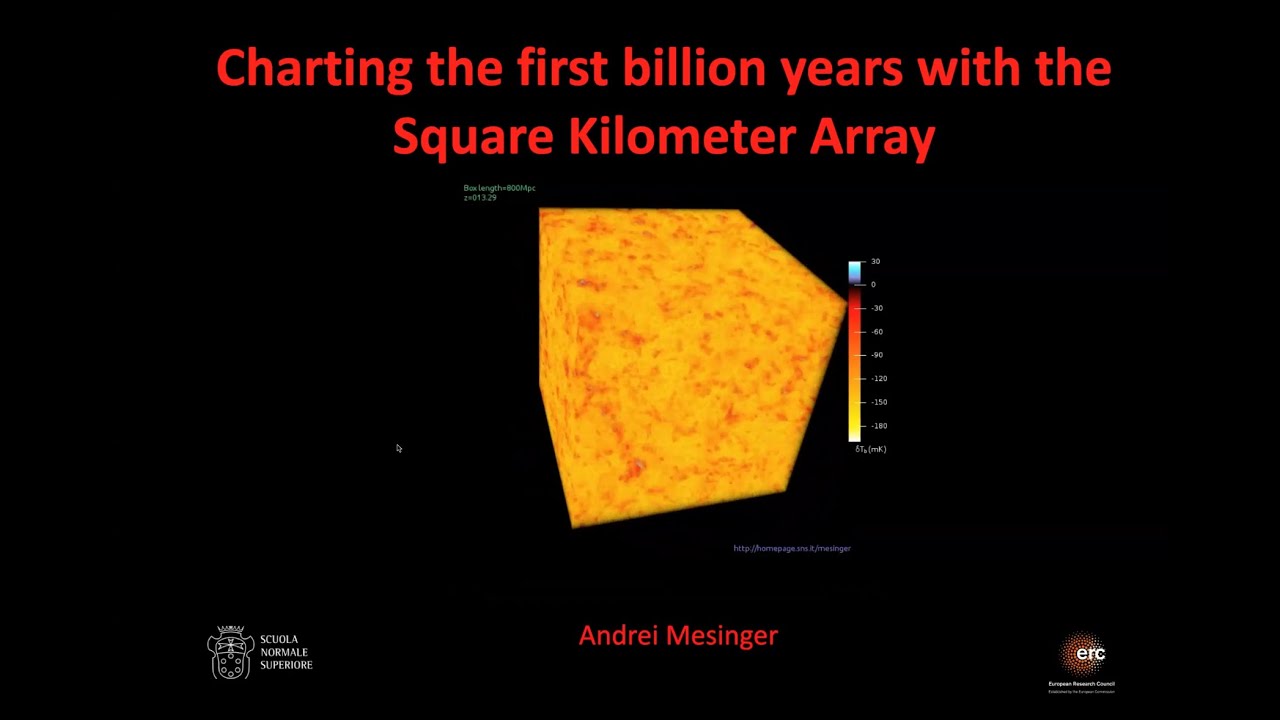
61:17
First Billion Years of the Universe with the Square Kilometre Array
@iaaudc
121 views•2022-05-26
128:32
Cosmology Lecture 9: Inflation and the Early Universe (Stanford) 2013
@stanford
227.2K views•2013-03-19

6:10
Gamma-Ray Bursts: Cosmic Snipers Explained | Astronomy
@kurzgesagt
15M views•2016-07-31
Related Study Plans & Knowledge Roadmaps
Structured learning paths in Astronomy
astronomy
Reionization: Pop III Stars, IGM & 21cm Line
01Foundations of Cosmology & the Early Universe
02Population III Stars & Cosmic Dawn
03Physical Mechanisms of Reionization
+ 2 more learning modules
17h5 modules
Explore Roadmap
astronomy
Planetary Rings: Dynamics, Roche & Resonances
01Foundations of Gravity and Orbital Mechanics
02Tidal Forces and the Roche Limit
03Structure, Composition, and Collisions
+ 2 more learning modules
10h5 modules
Explore Roadmap
astronomy
Asteroseismology: Stellar Waves, Ages & Cores
01Foundations of Stellar Astrophysics & Wave Mechanics
02Stellar Oscillation Modes: P-modes and G-modes
03Mathematical Framework of Asteroseismology
+ 2 more learning modules
35h5 modules
Explore Roadmap
astronomy
Adaptive Optics: Physics, Engineering & Control
01Foundations of Wave Optics and Wavefronts
02Atmospheric Turbulence & Optical Distortion
03Wavefront Sensing Technologies
+ 3 more learning modules
35h6 modules
Explore Roadmap