











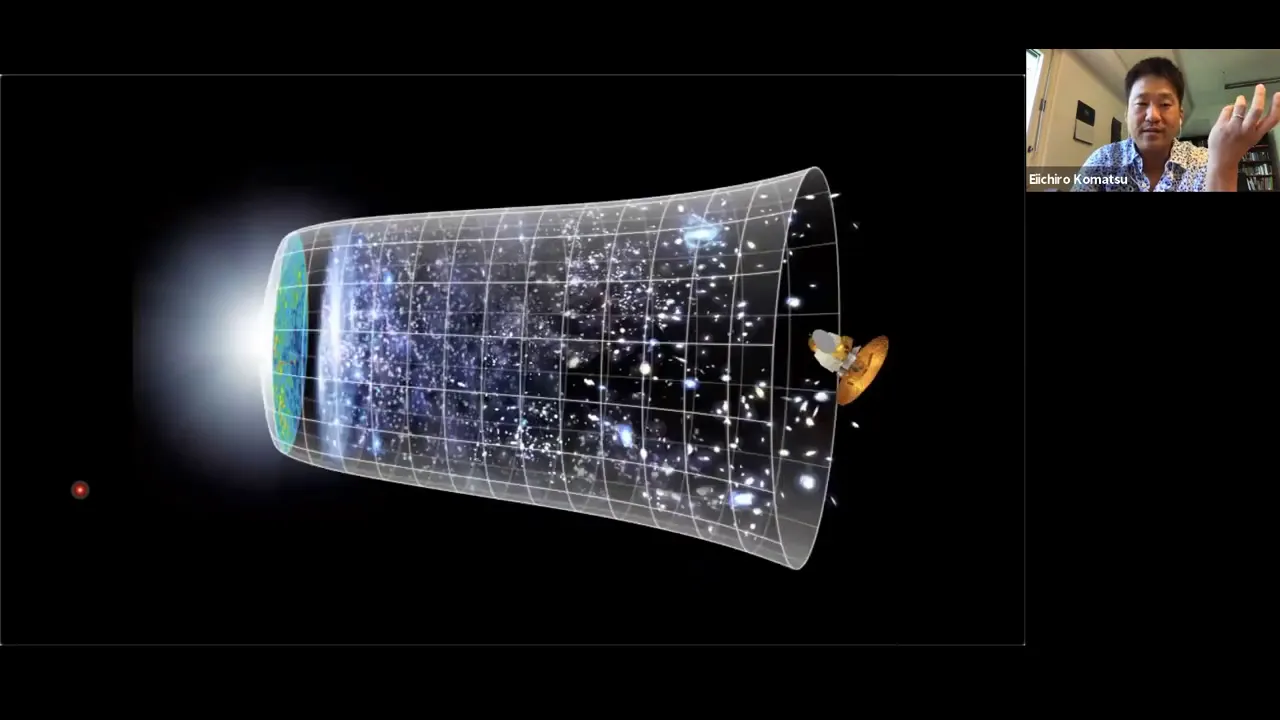


Scientists use observations of the cosmic microwave background radiation and gravitational waves to probe the physics of the very early universe, specifically studying how inflation seeded the first structures and testing theories about dark matter, dark energy, and the fundamental nature of gravity.
Astronomy & Astrophysics: Early Universe, Gravitational Waves | Harvard Radcliffe Institute
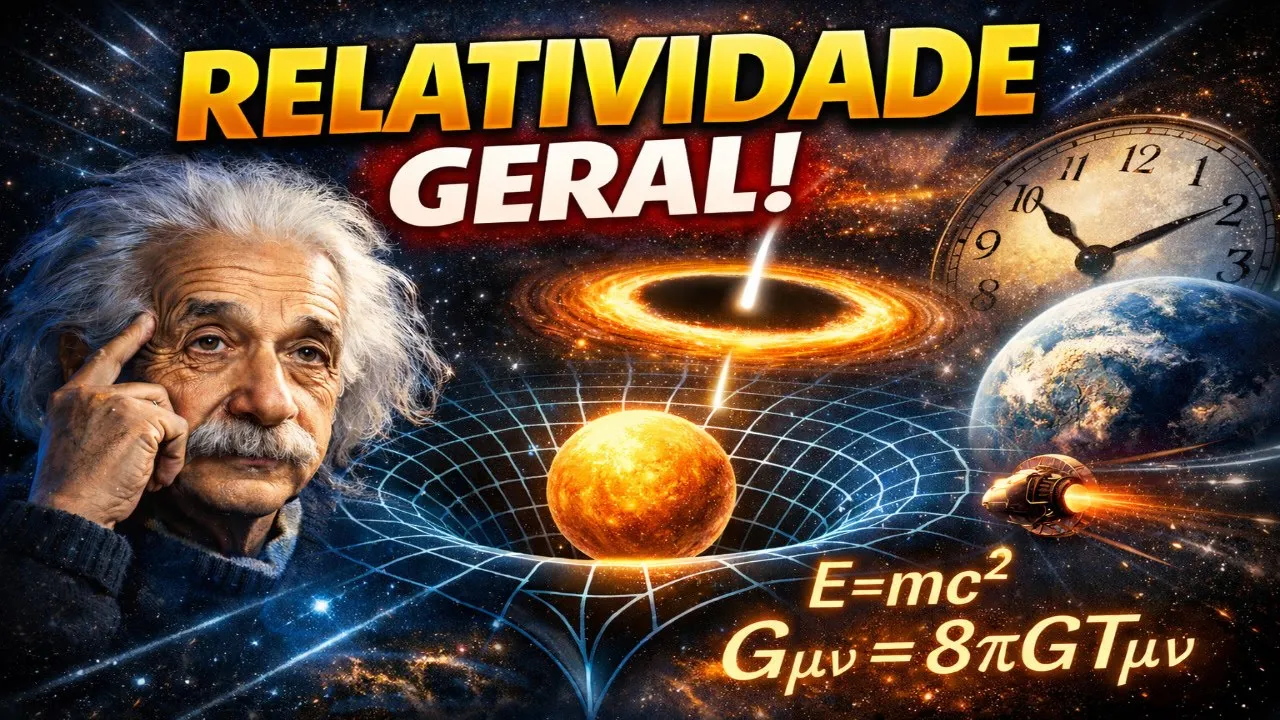
Added:Understanding of Einstein's General Theory of Relativity, specifically how mass and energy curve spacetime to describe gravity.
Basic concepts of the Big Bang model, including the expansion of the universe and the cosmic timeline.
Familiarity with the electromagnetic spectrum and the origin of the Cosmic Microwave Background (CMB) as relic radiation from the early universe.
Fundamental physics of black holes, including how they form from collapsing massive stars and their basic properties.
Advanced study of gravitational wave detection technologies, such as laser interferometry used by LIGO, Virgo, and the planned space-based LISA mission.
Exploration of Cosmic Inflation theory, which explains the extreme uniformity and initial fluctuations of the extremely early universe.
Investigation into primordial gravitational waves and the ongoing search for B-mode polarization patterns in the CMB.
The emerging field of Multi-Messenger Astronomy, which combines gravitational wave data with electromagnetic and neutrino observations to study cosmic events.
68.8K views888likes1:23:14Original Release: 2016-11-07
[MUSIC PLAYING] - Hi.
Welcome everybody to our second installation of Next In Science.
The idea here is to bring together early career scientists who are working in somewhat allied, but not too closely allied fields, to present their work.
The idea being that a lot of times the most exciting science is being done by early career scientists, who are in a sense-- I wouldn't say putting their chips on the roulette wheel, but finding interesting new fields that look like they're going to be promising.
And so as a result, you get treated to things that are more interdisciplinary, and you can expect them to grow in the future.
So it's very much a frontier set of talks that we have today.
My name's John Huth, and I'm a Physics professor in the university here, and I'm also a Venture Faculty member with the Radcliffe Institute-- which means that I get to do programming.
I'm hosting a science symposium on October 28th, which some of you may be interested in attending.
It's on oceans-- we're going to talk about life in the very early oceans here on the planet, then talk about the role of the ocean in driving climate and the feedbacks between climate and the ocean, and then finally, marine life in the ocean with a particular emphasis on and New England.
Prior to that, on October 24th, we have a talk by Kerry Emanuel who is a climate researcher at MIT.
And his particular field of interest is extreme climate events, in particular, driven by rising sea temperatures.
And he is the author of a paper describing the emergence of something called a hypercane, which is a super hurricane that forms.
So the idea of being with rising sea surface temperatures, we'll have fewer hurricanes, but the ones we do are more severe, as a result.
So you may want to tune in for that.
All of these are open to the public.
So today's Next In Science, we're bringing together four scientists who are going to talk about their work broadly based in astrophysics and astronomy.
And I've chosen speakers in part because they will talk about astrophysics and astronomy on different scales.
And so we're going to start with the largest scale-- the universe as a whole, and work our way into smaller territory.
I always bring a little bit of my own interests into this.
I'm interested in astrophysics, because I'm a particle physicist I do work at CERN at the Large Hadron Collider.
And one of the intersections there is, we're looking for forms of matter that might explain the structure of the universe, and in particular, some of the work that Cora is doing informs us on what kind of particles may be out there.
So that's one reason that I'm interested, but I have a more immediate and somewhat parochial interest.
I'm teaching a freshman seminar and we're talking about early models of the universe and then we'll get into modern cosmology at the end of the seminar.
And one of the things that we're reading in two weeks is the Divine Comedy by Dante Alighieri.
And one thing that struck me in the Divine Comedy was that hell is a lot more interesting than paradise.
If you read it, you know there's all these details and you can really get your teeth into it, but then you get paradise and it's all this ethereal kind of floaty stuff that says, oh you can't understand it because there are mysteries out here, and you know about 25 cantos of mysteries that you can't understand.
It's a little tedious, right?
So I thought about it a bit.
And wondered, why was this?
Why was this?
And when we had this panel together, I suddenly realized that in Dante's era, he knew a lot about geography.
He walks all around Tuscany and sees all the waterfalls and all sorts of things, but the knowledge of paradise is very limited.
You just have this Aristotelian model and these ideas which are kind of vague and ill-formed.
But seven centuries later, we have these amazing instruments that allow us to give us windows deep into the universe and back in time.
And you can put flesh on the bones now.
I mean, you can imagine a trip to Jupiter or you can imagine a trip to Mars or you can imagine what it's like in the very early universe and even the sound of the cosmic microwave background radiation.
So you could almost imagine that if Dante was born now, and he went to write the Divine Comedy, Paradiso would be this amazingly-detailed and would be every bit as good as the inferno.
So this is one of the lessons that I hope to impart to my freshman in my seminar.
So having said that, let me introduce our first speaker Cora Dvorkin.
She is-- let's see if I can do this without looking at my notes-- she is from Argentina.
She got her doctorate at the University of Chicago in 2011.
And she recently joined the faculty in the Harvard Physics Department last year.
Prior to that, she was a Hubble Fellow in the Institute for Theory and Computation at the Center for Astrophysics.
Did I get it?
- Yes.
- Great.
So Cora's work is in the universe, the structure of the universe, at large, drawing on a number of different data sets and windows.
And it's proving to be a remarkable picture we're able to understand a lot of details of the structure and how this reflects on the matter content of the universe.
So without further ado, let me introduce-- well, I am introducing her.
Oh, she's also the Shutzer Assistant Professor at Radcliffe.
Sorry about that.
And the title over talk is Deciphering the Early Universe, Connecting Theory with Observations.
Let me also tell you that talks are back-to-back-- Cora and then Salvatore And then at the end of those to two talks, we'll take questions up front.
So keep your questions.
Write them down, hold them, and then we'll take them and then we'll have a break.
OK?
[APPLAUSE] - Thank you very much for the introduction and thank you very much for the invitation.
It's really a pleasure to be here.
So today, As John said, I will try to make heaven more interesting.
I completely agree with your opinion of the Divine Comedy.
So hopefully we can make it all better.
So I will talk about deciphering the early universe-- connecting theory with observations.
So for this talk I chose one sort of direction in which my research has been going, which is, trying to understand the physics that seeded the first structures in the universe-- trying to understand what gave rise to the structures that we can observe today.
And for this, I will be talking today about how we can probe the physics of the very early universe by using observations of something known as the cosmic microwave background.
And I will go in detail into what this is, and the large scale structure of the universe.
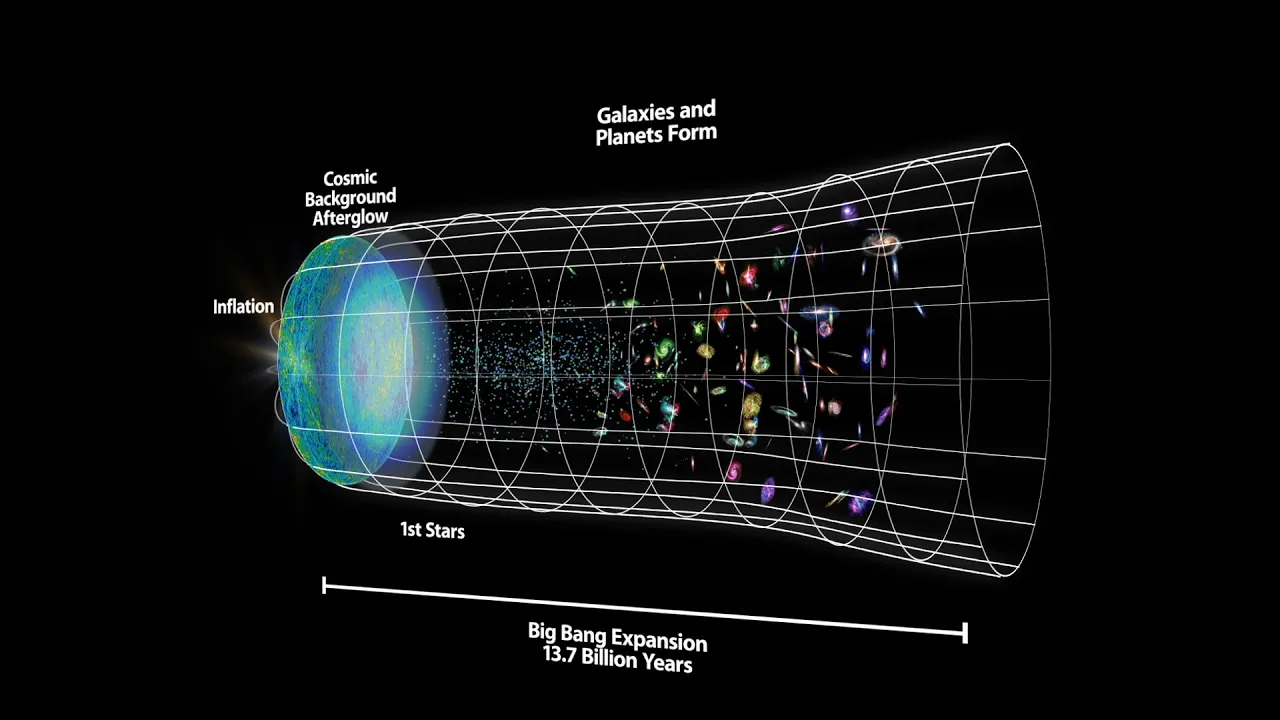
So let me start by showing this picture here.
This picture here represents a very thin-- this line of time represent 13.8 billion years of the universe.
So the universe began as a hot, condensed plasma of particles in thermal equilibrium at very high energies.
The universe expanded and cooled and many physical processes happened along the way.
Some physical processes we know very well.
Some of them we don't know what's the physics that gave rise to this process and some of us are interested in trying to shed light on these physics.
So interesting processes that happened along the way are recombination-- about 0.4 mega years after the Big Bang.
Protons and electrons combine into hydrogen. These periods known as recombination.
And since then, the universe became mainly transparent to cosmic micro background or CMB photons.
So since then, photons-- mainly freestream toward us, until the time in which the radiation from the first stars and quasars reionizes the universe-- about 500 megayears after the Big Bang.
And about 6% these photons we scatter-- 6% comes from the latest data set coming from the Planck satellite.
OK?
So mainly they freestream toward us, until this period in which a very small fraction of them rescattered.
And so today, we observe these photons at microwave frequencies, and at a temperature of about 2.7 Kelvin.
So I thought they would give to the general audience a little history, just this slide of history of how the cosmic microwave background was actually found.
So in 1964, two astronomers-- Arnold Penzias Bob Wilson-- they were radio astronomers looking for sources of radio waves, and they were looking at radio waves with their antenna in New Jersey.
And they were finding an excess isotropic noise in this antenna built at Bell Labs if this story they meet says actually this is true because I've heard Bob Wilson telling the same story that they even thought he was dropping from germs in their telescope Klein the telescope that cleaned the telescope and the excess noise would not go away.
At the same time, in parallel, Peebles, who was here yesterday giving historical lecture at the CFA, Jim Peebles, Dicke, Wilkinson, the and Roll, they were doing theoretical calculations and they predicted that there should be a signal of about 3 Kelvin being coming from the Big Bang.
There were two disconnected groups.
One of them had no idea about the CMB expectations.
And an astrophysicist from MIT, Burke, talked to Penzias and Wilson.
Penzias and Wilson repeatedly were trying to find people to tell them about their source of noise that couldn't go away.
They talked to him.
They talked to Burke.
Burke told them about their work from Peebles, et al., and they told them that they were very likely finding something very big-- something that was very sought for.
And so the story ended with them announcing the discovery of the cosmic microwave background.
And years later, they won the Nobel Prize for this.
So this is a neat story of a discovery that came accidentally, in some sense, because they were not looking exactly for it OK, so in 1992, fluctuations around the temperature of the CMB were found.
So in 1992, a satellite known as COBE, the Cosmic Background Explorer, found that the CMB mainly follows a blackbody distribution, with a temperature of about 2.7 Kelvin and fluctuations around these temperature of 1 part in 10 to the 5.
And this is a map of how COBE sees these temperature fluctuations.
This part over here is the galaxy that has to be masked because it's so bright that if we don't mask it, we would not be able to see these temperature fluctuations.
And because of this discovery, this team also won the Nobel Prize.
OK, so this is a more current picture coming from data taken by the Planck satellite.
The Planck satellite was launched in 2009.
It took data until very recently.
Papers are still coming out from the analysis of these data.
This is a snapshot of the very early universe.
And in this talk, I will explain why I make this claim.
So what is observed here is that temperature fluctuations have different positions in the sky.
And the idea is that by measuring the statistical properties of these temperature fluctuations we can infer the physics from the very early universe.
These temperature fluctuations have been measured to have a [INAUDIBLE] temperature of about 100 microKelvin and their distribution is Gaussian at first order.
So the CMB power spectrum, these temperature fluctuations, when I say power spectrum, I mean the square amplitude of these temperature fluctuations.
The CMB power spectrum has been predicted, as I already told you, and measured with great precision over the last few decades.
And I'm showing you hear a plot of the temperature power spectrum of the CMB as a function of angular scale in the sky.
So scales here correspond to smaller angular scales and scales here correspond to larger angular scales.
OK?
In red, I'm showing you the data that has been taken by the Planck satellite.
Notice the arrow bars in these data sets.
This is a really remarkable measurement.
In green and shining is the best fit model for these data.
This best fit model works very well.
I will be talking about, in the next slides, about the standard model that we have in cosmology today.
And this structure of these acoustic peaks carry a lot of physics inside.
The structure of these acoustic peaks carry the information of acoustic oscillations in the photon-baryon plasma at the time of recombination.
OK?
So the photons were strongly scattering with the electrons, via Thomson scattering.
The electrons were interacting with the protons, via Coulomb scattering.
And all of this was going together-- baryons were trying to fall into gravitational potentials, coming from the dark matter.
And they were going out due to the pressure of the photons.
So they were oscillating inside and outside this potential wells, and this is why we see acoustic peaks.
The first peek is the baryons and the photons going in with gravitation potential.
The second peak actually corresponds to a trough, but because I'm squaring it, it's seen as a peak-- corresponds to the photons going out.
And this is what we observe.
That's why we see the peaks in the temperature power spectrum of the CMB.
OK so here is where we stand in cosmology today.
We have a standard model of cosmology known as Lamda-CDM.
We have a homogeneous background, and we measure the parameters of this background very well.
We know by CMB and large constructual observations that we have approximately 5% of baryonic matter.
When I say baryonic matter I mean the matter that we can observe-- you, me, the stars the planets, this building-- the matter that we are used to and that is visible to us.
We have 27% of color earth matter, and it's matter that only interacts gravitationally but it's not visible.
And we have approximately-- we know from observations that we have approximately 68% of dark energy, which is a source of energy that we attribute to-- that we attribute the expansion, the accelerated expansion of the universe that is observed in recent times.
On top of this homogeneous background, we have perturbations that are seeded in their very early universe.
We measure these perturbations to be nearly scale-invariant.
They almost do not depend on the scales see considered.
And as I said before, they are approximately Gaussian.
So we made a lot of progress in measuring all of these parameters with very high precision.
However, big questions remain.
What is the Lamda of our Lamda-CDM standard model of cosmology?
What is dark energy?
We don't know.
What if the CDM of our Lamda-CDM-- standard model of cosmology-- what is this cold dark matter that is observed?
And what gave rise to the first structures in the universe?
So I do researching in these different lines, but today, I thought, given that I have 30 minutes, I will focus my talk on some questions we are currently trying to answer as a community related to the physics that seeded the first structures in the universe.
So this is what I will base my talk today in this question-- what is the physics that seeded the first structures in the universe?
OK So inflation was a theory for the very early universe proposed by Alan Guth and others In 1981.
Alan Guth is a professor at MIT.
And this theory, that goes under the name by inflation, is the main paradigm that explains the observed inhomogeneities in the universe today.
Inflation is a period and of accelerated expansion in the first fraction of the second after the Big Bang.
And it explains why the universe is approximately homogeneous and spatially flat.
We had several problems before the theory of Inflation was proposed.
The problems were related to why the universe is observed to be so flat, why the universe is observed to be so homogeneous at very different scales so this theory came into place.
It was proposed as a solution for these problems.
So in the simplest model of inflation, there is a single scaler field-- and by scaler field I mean a field that takes different values in different positions-- and more common-- and more common scaler field that we are very used to it this, for example, the temperature.
OK?
That's a scalar field.
So the field takes different values at different positions.
So in that simplest models of inflation, there is single scaler field slowly rolling down a potential This scaler field is known as the inflect on field.
So while it rolls down the potential-- while it rolls of down the potential-- different modes, different perturbations in this field stop being in constant contact.
When they stop being in constant contact, and by this I mean that they cannot exchange information with each other-- a perturbation-- an initial seed is frozen.
OK?
And this initial seed is what then gives rise to CMB fluctuations that we observe today.
OK so the square amplitude of this initial seed, I will call it the primordial power spectrum-- which is the square amplitude of this initial seed that gives rise to the observed CMB fluctuations and the observed large-scale structure of the universe.
So the idea is that the field during inflation takes different values, and these different values are associated with the CMB fluctuations at different angular scales in the sky.
So the idea is that by looking at different angular scales in this guy the CMB power spectrum may be able to different regions of inflationary potential during inflation.
So this is the link-- this is an inverse problem that we have here.
We have the observations of the CMB power spectrum, either temperature polarization.
And we want to understand the physics of the very early universe a fraction of a second after the Big Bang.
So our goal as a community, and my goal in one of my line of research, is to shed light on the physics of inflation by using CMB observations.
This is just an example of work that I have been doing on reconstruction on this inverse problem, on taking data measured by the Planck satellite of the temperature of the photos that come from the Big Bang.
These temperature data has been measured by Planck satellite.
I'm trying to reconstruct this primordial power spectrum that is this seed for these fluctuations that we observe today.
So this is a reconstruction that wed did using-- with Vinıcius Miranda and Wayne Hu using temperature fluctuations and an ongoing work with a graduate student at Harvard, [INAUDIBLE], is to make a full reconstruction of the primordial power spectrum by using not only that temperature fluctuations of these photons, but another property of these photons known as the polarization.
And I will talk about these in a few slides.
We can also infer the shape of the inflationary potential.
And here, I'm showing you here-- we can put constrains using data from the Planck satellite or the WMAP satellite or many other telescopes that are all over the world, we can try to put constraints on the shape of the inflationary potential to see how all these [? inflect?] on field is moving along the potential-- if it's moving slowly, if it has abrupt in the way.
So this is another example.
And we can make predictions.
I talked to you about the temperature fluctuations of the CMB photons, but the CMB photons are also polarized.
They oscillate in particular directions-- this is what is the polarization of the CMB fluctuations.
And so with temperature measurements of the temperature fluctuations.
We can make predictions as to what we should observe for the CMB polarization.
And we can learn about the physics of inflation looking at these predictions.
Now another question that we can ask is-- I talked to you about one field or a particle, if you want, during inflation-- can we probe other primordial particles during inflation?
Can we probe physical properties of these particles?
And so I am just showing you this slide just for you to get an idea of what you can do with the large-scale structure of the universe.
Primordial particles affect the large-scale structure of the universe in very distinctive ways.
So for example, work that I have been doing over the past few years is related to probing primordial particles spin 2.
When I say "spin," I mean a quantum mechanical inherent angular momentum of the particle.
So we can program primordial particles of spin 2 by looking at the statistics of the ellipticities of the galaxies-- and this is another talk per se, but I just want to give you a feeling of some work that I have been doing and it's being done in this field.
You can also look at the galaxy velocity field and try to probe primordial particles with spin 1-- this is a work in progress with my post-doc Azadeh Moradinezhad.
And in principle, higher spin particles which are studied-- which have been studied for a long time by string theories and predicted, in principle, they should also leave an imprint on the large construction of the universe.
And this is more subtle and it's part of work in progress.
OK let me tell you in my last 10 minutes about the polarization that I already mentioned of the CMB and how you can hope to learn about the energy scale at which inflation happen using the polarization of the CMB fluctuations.
So the CMB polarization is linearly polarized.
And by this, I mean that it oscillates in distinctive planes.
OK?
The polarization is generated by a process known as Thomson scattering-- scattering of photons off free electrons.
So the photons scatter off free electrons, and each electron, along the line of sight, sees a local temperature quadruple-- a local temperature distribution-- that is the source of the polarization that we observe today.
We can decompose the CMB polarization.
When you show the composition-- this is just the basics-- but when you show the composition is to decomposition to E and B modes in the same way electromagnetism is decomposing to E and B modes.
Here, just to give you a picture of how the E and B modes of the CMB polarization look like.
So that E-modes have their direction either radially-- they are oriented radially around cold spots or tangentially around hot spots.
And the B-mode has the same orientation as the E-modes, rotated by 45 degrees OK so that's how that how we decompose the polarization of the CMB.
So different processes give rise to different types of polarization.
Density and velocity fluctuations plus linear evolution-- just nothing happened to these photons-- this gets rise to E-modes.
Now in order to have B-modes, you can either have B-modes by a process known as gravitational lensing.
Gravitational lensing is the bend-- it's how the photons bend their path when they are traveling toward Earth because of massive structures in the universe.
Massive structures in the universe curve the space time and the photons bend their back toward us, and this is known as gravitational lensing and this affect gives rise to B-modes.
And another source of B-modes comes from primordial gravitational waves.
I believe Salvatore will talk about gravitational waves, but perhaps not primordial gravitational waves.
So bear in mind that these will be two types of gravitational waves.
So gravitational waves arise from inflation, because we expect to have quantum fluctuations in the space-time fabric of the universe that get expand in this accelerated-- in this period of accelerated expansion-- a fraction of a second after the Big Bang.
OK?
Those are the gravitational waves.
And that's why they're exciting, because a measure-- well, that's one part of why they're exciting, but a measurement of these gravitational waves would provide us with information about the quantum properties of the metric.
So it will tell us something about quantum gravity.
So gravitational waves-- also, so as I told you, the stored space time.
And this creates a quadruple that each electron sees as well, along the line of sight.
And this source is polarization.
And they leave an imprint into their B-mode polarization.
Here I'm showing you just so that you have a picture of what these B-modes look like as a function.
When I say multiple moment, I mean angular scale in the sky.
So remember that these are large angular scales and these are small angular scales.
This is the B-mode on power spectrum.
In black, I'm showing the B-mode power spectrum coming from gravitational lensing, from the way the photos bend their path due to massive structure in the universe when they're coming toward us.
And in blue, I'm showing you a signature of gravitational waves for a certain amplitude.
I just picked an arbitrary amplitude here.
These two peaks correspond to scattering of photos off free electrons happening either at the period of reionization at these very large scales, or at the period of recombination at these much shorter scales-- smaller scales, sorry.
And the goal here of this line of research is to try to find out if these gravitational waves are present or not.
And so this line of research puts limits into the possible amplitude that these gradation waves can have.
So they're interesting because we can learn this amplitude of these gravitational waves, we will be able, or we could, potentially-- we don't know if we will ever measure them, but hopefully we will.
We could potentially learn about the energy scale of inflation.
So a measurement of gravitational waves would not only provide a direct measurement of the expansion rate of the universe during inflation, during the extent of the minus 35 seconds after the Big Bang, but also, it would provide a measurement of the energy scale of inflation.
OK?
So this quantity r over here is a measure of the amplitude of the gravitational waves.
So is this quantity is greater than 0.1 this would imply-- or if it's the order of 0.1, this would imply that the energy scale of the inflation is about 10 to the 16GV.
Think that the LHC goes up to perhaps 14 TV so this is a TV's 10 to the 3GV.
This is orders of magnitude larger than what any possible accelerator ever built-- not only now, but ever built in Earth can ever reach.
So this is a window to the highest energy scales in the universe.
These energy scales are way larger than any energy scale that could be probed that was proven-- that was probed in the past and that could be ever probed in earth by an accelerator.
These are current limits on primordial gravitational waves.
The take out message from this plot is that we are making progress in putting limits on these amplitude of the primordial irritation waves, but they have not been detected yet.
This is work that I did on collaboration with the BICEP team and their Planck satellite in which we combined their data with other data sets coming from the Planck satellite that could be a source of confusion with their data sets.
And these sorts of confusion comes from something that we cosmologies call foregrounds-- because they are a source of noise for us.
Some other people study these-- they're not foregrounds for other people, but for us, they are foregrounds.
These other sources of confusion come from emissions from polarized dust particles in the galaxy that could be confused with primordial B-modes.
So the quotes for primordial gravitational waves is continuing and will continue.
I'm showing you here an approximate raw sensitivity as a plot that's a function of years.
WMAP was the satellite in the early 2000s.
Planck, I talked about Planck, it was launched in 2009, and it was another satellite.
And now as a community, as a big community effort, we have recently proposed an experiment that we call CMB Stage 4.
Its stage-- the different stages really grow from Stage 1 to Stage 2, 3, and 4, they grow in order of magnitude of the number of detectors that we need.
The CMB Stage 4 experiment proposes building different telescopes all over the world to map the sky and to be able to map these temperature and polarization fluctuations of the CMB.
This is my final slide.
This is what we expect to have as a constraint on these quantity r that was measuring the amplitude of these primordial gravitational waves.
So here, we around this number-- 0.3.
With CMB Stage 4 in the fourth year of CMB Stage 4, this is just a projection that we made as a community, we expect to reduce the [INAUDIBLE] by about a factor between 10 to 100.
This came out very recently, actually.
This came out this week in a science paper that we wrote.
And in this book, we not only talk about possible science that you can do with the CMB Stage 4 proposed experiment to learn about the physics of the very early universe, but for example, I was leading a dark matter chapter in which we also proposed different physics that you will be able to learn with the CMB Stage 4 experiment about dark matter.
There were other-- you can also learn about neutrinos, dark energy, et cetera, et cetera, et cetera.
OK so I will end here with my conclusions.
So I show you that we can probe the shape of the inflationary potential by using CMB observations, so by mapping observations that we make today with the very, very early period of the universe.
We talked about how large-scale structure of the universe offers a unique way of probing physical properties of other possible primordial particles.
And I showed you the current state of the art for constraints, at that moment.
We are constraining, we didn't measure anything, at the moment.
But here are the constraints on gravitational wave amplitudes.
And you should really stay tuned, because in the next decade, we will expect to tighten these limits and on the amplitude of primordial gravitational waves by a lot, and perhaps, even measure.
There are many experiments that are built.
That are currently proposed, that are currently taking data-- such as BICEP3 and Keck, different frequencies, EBEX, POLARBEAR, SPIDER, Advanced ActPol, SPTP3G, Simons Observatory, CMB-S4, LiteBIRD, PIXIE, CORE, et cetera, et cetera, et cetera.
In blue, I just put the ones that I been involved in writing proposals.
But these are lots of experiments that are being proposed and this is really a golden era, hopefully, that will come for primordial gravitational waves.
OK, thank you.
[APPLAUSE] No questions, right?
- Yeah, we're going to hold our own questions.
So Salvatore is originally from Italy.
He did his undergraduate work at the University of Bologna.
And he did his doctoral work at the Pierre and Marie Curie University in Paris, got his doctorate in 2012.
And then he joined MIT as a postdoctoral fellow and then became a research scientist.
And he is now just about to become a member of the faculty at MIT.
- Yeah.
- And he has been working on gravitational waves, direct observation of gravitational waves-- not produced primordially, as Cora was talking about, but produced in very violent collisions in the universe, at large.
And in fact, most of you, many of you, probably saw the news of the discovery of gravitational waves.
- No spoilers.
- What?
- No spoilers.
- No spoilers.
OK, sorry about that.
Even hear the sound of it?
Are you going to play us the sound of it?
- No, I can make the sound but-- - Well, that would be even better.
OK, so the talk is, everything you want to know about gravitational waves but were afraid to ask, by Salvatore Vitale.
[APPLAUSE] - Thank you.
And I hope you can hear me well.
And so the way this talk is made, it basically anticipates the Q&A.
And it's a long series of Q&A. I've been asked to talk about what I do for a living and this is gravitational waves, basically.
You can see here two black holes rotating and emitting gravitational waves.
Well, you cannot see them, they're black, but OK.
OK, if you have questions, we have the Q&A later or I have coffee break.
So let me with the very first basic question that you may ask if you don't spend your whole day thinking about this thing is, what are gravitational waves?
If you open a physics textbook-- a good one-- you'll find typical sentences like this.
They say the gravitational waves are ripples in the space-time continuum, emitted by any system with a non-constant quadrupole moment.
OK which is not particularly enlightening.
You can look at the Einstein equation, OK.
And that is [INAUDIBLE] you start from the Einstein equation, you put [? out your?] your metric, crank the machinery, and you obtain gravitational waves.
Now, I could spend the next 25 minutes talking about this, but I care about you, so I'd rather use images, OK?
So this will give the idea, well, at the direct order, if you take a small stone and you throw it out in a pond which is at rest, you will create a perturbation at the center where something happened and this perturbation will propagate outward.
OK?
So in this example, the waves are just a perturbation on the water and the continuum is the pond.
In our case, the continuum is just the space-time, and is a very stiff material.
It's very hard to [? de-form?] this is why our stones needs to be much, much bigger.
And in particular, in what I do, I focus on compact objects, which is a fancy way of calling neutron stars and black holes.
If you take two of these objects and you make them spiraling around each other, they lose energy and this energy goes into gravitational waves.
And the image is very similar to what you've seen before.
OK, so you may think, oh, this is pretty similar to electromagnetic waves.
You have charges that move and they make electromagnetic wave.
And there are points in common, there are similarities.
There are also important differences.
The one that I like to think about is that in Cora's talk you have seen that the electron and all the photon interact and they interact with everything.
The gravitational field this very different.
It's much more shy.
It doesn't interact with anything, basically, OK?
This means that while light that you receive from star pulsars, quasars, whatever-- can be easily absorbed, obscured, bent, deflected, reflected whatever-- gravitational waves do not have this issue.
They basically can go from one side to the other of the universe without being disturbed by anyone.
And I hope some of you at least will have recognized my quote from Neil Young.
But if not, it's OK.
And I should have used Bob Dillon, but I didn't have time to change the slides.
OK so how do we detect these gravitational waves?
To answer this question, we should first look at what they do when they go through something.
And what they do is that they-- well, they basically change this space-time itself.
And the way it is it gets manifest is in the fact that if you have an observer, a free-floating observer which means, [INAUDIBLE] for example, the distance between these objects will change with time.
So that if you start, for example, with 4 particles within a ring, four masses, and the gravitational wave passes by, the ring will become an ellipse.
So the space-- the distance will increase in one direction and decrease in the other, and so on and so forth. [INAUDIBLE] So you may think, OK, it's easy.
The only thing I need to do to check if there are gravitational waves is put a few things around, monitor their distance.
If I see that the distances is varying with a characteristic pattern-- there you go-- gravitational waves.
It's not that easy, though.
So don't believe the smiley face because if you do the numbers, you will find out that the typical gravitation wave will introduce a relative distance which is a variation, which we constrain of roughly one part on 10 to the 21.
And this is a very, very large number.
So you have to be able to measure very small variation.
When we give talk around with my colleague, we typically use the example of an atom.
This is a hydrogen atom.
You go inside the nucleus which is a proton and go on [? inside,?] [? inside,?] [? inside.?] And this is the proton and the [? radiational?] way to be able to measure is the one you would see here.
It's pretty small.
Now not many of us have seen protons on their life, so I found another image, which I like best.
It's not about length, it's more visual.
If you go to the seaside and count the grain of sand, you'll get a very large number.
If you do the same as the size everywhere in the coastline of the whole planet, if you believe the questionable web page I found where they do this calculation, they found there is a few 10 to the 21.
So the measurement we need to do, it's comparable to being able to remove one grain of sand from the whole planet and see the difference, OK?
This is what we are doing.
And for us, desperate and crazy as it may be, luckily for us, there were people in the past who were not scared by this task.
In particular, I have a picture of Ray Vice who was a professor here at MIT who in the 70s, got pen and paper and showed that you can actually build an apparatus that can measure this kind of variation in length.
And this original idea was developed.
And several or tens of years later, it became what we call LIGO, which stands for a Laser Interferometer Gravitational-Wave Observatory.
Now we are not going through the math or the data, but I want to give you an idea about the works.
LIGO is basically-- you can two pictures, there two of them.
It's an interferometer, for those of you who know what I mean, of arms four kilometers along.
The way it works is the following.
You have laser light-- like this one just a bit better-- entering an apparatus, hits a mirror.
Half of the light goes up, half of the lights continue.
And there are mirrors at the ends, so the light bounces back.
Now this is not a typical interferometer, the light bounces back and forth a few hundred times.
Then it goes out and is recombined here.
Now light has a nice property that if you combine it in the right way, it can interfere in a way that cancels out, basically.
So you have darkness.
And this is the condition in which we keep our instruments normally.
Now if a gravitational wave passes through, because of what I told you before, this length will change in a way, and this direction will change in another way.
So the interference condition at the end is not met anymore and we see some light coming out.
And so this is the basic idea of how we use laser interferometry to measure a very tiny variation in distance.
We have two of these instruments in the US.
One is in Louisiana, the other is in Washington state.
And there are a few others which are either being built or planned around the world, and all together they work as a network, OK, to increase our sensitivity.
So what I do for a living is more about learning something about the sources of these gravitational waves.
So what can we learn?
Well.
If we go back to our pond, you can imagine pretty easily, I think, that if you are sitting on the side, you don't see what has been thrown to the pond, you only receive these waves coming to you.
If you're very good at physics or mathematics, you can think of using the shape and maybe the relative distance between this wave front and so on and so forth to learn something about what happened in the middle that caused this perturbation to start with.
And this is exactly what we-- what I do, at least.
And so my objects of interest, as I mentioned before, are compact objects.
And these are leftovers of very massive stars after they end their nuclear fuel and they supernovae and explode.
What is left in the middle, it's either a neutron star which is somewhere in this [INAUDIBLE] nebula or a black hole which you're seeing here, hitting its companion.
Now both of these categories of objects come with pretty many open questions, and they're very interesting objects, otherwise, we wouldn't be here.
So the first one-- neutron star.
And neutron star-- you probably know these.
We're talking of the objects which are roughly 1.5 times the mass of our own star, but packed together in a radius of 10 kilometers.
Now these conditions are so extreme that, in fact, pretty much like in Cora's CMB example, we can only produce this condition in the lab so to be frank, we have no idea how matter behaves in this condition, because we cannot make them at earth.
So one of the things I want to do is study these neutron stars is learn something about their composition and their [INAUDIBLE] state.
Another interesting thing is verify whether are many astronomers seem to think, neutron stars mashing one and the other are responsible for what we call a GRBs, which are very bright and energetic flashes of light that we sometimes see, or if they produce most of the metal in the universe.
"Metal" means everything-- [INAUDIBLE] an idiom, in this case.
And another related question is, what is the maximum mass of neutron star?
We don't really know and [? there are?] consequences nuclear physics.
Things get even weirder when you move to a black hole because you have even more mass, and even more compact.
And now these objects-- and then we'll come back to this in a minute-- produce extreme gravitational field.
Now a priori, there is no reason why Einstein General relativity should work for those skies.
So this is the first probably question comes to mind, Einstein, inventor, discovered GR to explain what was happening in the solar system, which is a very quiet place, as compared to black holes.
It's several order magnitude extrapolation.
Of course, Einstein was Einstein, so it seems to be working, which is very annoying.
Come back to this later.
Anyway, so there are several other questions which we want to answer, like how fast can this black hole rotate around their axis?
We don't know.
There are conjectures, for example, by Hawking, that says that there is a limit on how fast these black holes can spin.
But we would like to verify whether that's the case.
We don't know how big they can get, or rather, we know that they can be either a few times our sun or millions of times as massive.
We don't know if they can have any value in the middle.
And we don't know when they first formed is of the universe.
Some people may even think, suggest that may be dark matter, or whatever.
For us crazy-- something nice about physics, and for us crazy, as crazy as your theory is, there is someone who's already thought about it.
OK, to tell you what I mean by extreme with any image, Let me use Saturn, which I think all of you have seen once in your life here.
It has this beautiful ring, and so on and so forth.
Now if Saturn were a black hole, you would see something like this which you know, if you're seen Interstellar, the movie Interstellar.
This is a black hole with a ring.
But you see a pretty striking difference between Saturn and the black hole is that the ring in the black hole also goes up and down, which seems very weird.
What is going on is not that the ring is going up and down, it's that the black holes are pretty aggressive objects.
So if my eye here on the right and looking at the black hole this way, what happens is that the photons emitted by the side of the disk, which normally I should not be able to see it because it's on the other side, try to escape-- for example, vertically or with some angle but they get attracted by the black hole, by the gravitational pull of the black hole, so they are deformed and they go this way.
Which means that I can see basically, facing the black hole, I can see the rare of the ring-- both the upper side and the other side.
So this is something which is pretty far from what we typically think and imagine or experience in our life.
OK so this is about the sources.
How do the waves look like?
And for my work, I focus, as I said, on binary compact objects, so I have two objects like two black holes in this cartoon.
They started life what?
The part of their lives which interesting for me, around each other.
They are orbiting faster and faster, emitting gravitational waves.
When they are thought about, we talk of this spiral and these gravitational waves that they emit.
So these are the variation on the space-time, basically.
And it's not the same [INAUDIBLE], it just gets slightly louder and louder and the frequency gets higher.
Then the two black holes, or the two neutron stars start touching each other.
We talk of merger, they merge.
And then what is left is a single black hole, because you have to measure two of them together.
Since it was born in a violent way, it's not spherical.
It's out of equilibrium.
So it has to release the excess of energy and we talk of ringdown in this phase.
And this is the very last bit of the wave from it.
So here's right after the merger, when the mess is happening.
And then basically it goes down to zero, because it's releasing all the gravitational waves energy left over.
I guess you're all asking this question.
And now, this is all very nice, but does it work?
We have these [? multi-denses?] and black holes are very weird objects.
Maybe you made it all up.
Yes, it does.
And unless you have been living in a different planet, you have heard that in the last year, LIGO and Virgo collaboration detected two such binary black holes.
So the gravitational wave is coming from two of these mergers.
And it was nice, it was everywhere [INAUDIBLE].
And here you can find-- we actually added a third objects which we cannot claim with certainty that it was a black hole-- I'm a personal believer, OK, so we claimed detection of two of them.
And you can also see these are the waveforms.
They look a lot like the one I just showed you.
Now I should also say that pretty much in the same way if a Cora looks at the CMB spectrum from each of the feature-- like the peak, [? the throat,?]
whatever, she can learn something about the universe-- if I look at one of these waveform, from each of these features like their duration or the amplitude or whatever, I can say something about the source.
OK so this was everywhere in the news.
We got the congratulation from Obama, which is nice.
I put this because two things are particularly funny to me.
The first one is that in the Washington Post, although we were pretty high in importance, we we're still below Meryl Streep, Beyonce, Bloody Mess, whatever that is, and Trumpism.
And the other thing which I like is that the Economist, given its orientation, took our merger and put us in the Merger and Acquisition section of their paper, which I think is hilarious.
OK, moving forward.
So what do we learn?
We got these two objects, I promise you we would learn something about black holes.
Did we?
Yes.
So we learned a few things.
First of all, we learned that black holes can be significantly more massive than what was previously found and discovered with electromagnetic [? emission.?]
So in this plot in this cartoon, you see on the x-axis the total mass of the black hole.
This is 20, 40, 60, if you're going to read it from there.
Now the blue objects are the black holes that they were previously known through electromagnetic observations, OK?
And you can see they all live somewhere in between 5 and 20 star masses, maybe.
The red points where there are bars are the two and maybe three black holes that we discover with LIGO.
And you can see like in some cases, like this guy here, they are significantly more massive and scary than what's found before.
You know, these are 35, and these are 60 star masses.
Now in the next few years, it's going to be funny to discover why we see this.
Are we targeting a different population?
Or do the electromagnetic metals have some selection bias or a combination of both?
We don't know yet.
It's going to be interesting.
We also learned something about the stars that this black hole came from.
The fact that they could get so massive has implications on metallicity of their progenital star, in particular, it puts an upper limit.
And we can talk about this if you want at the coffee break.
But basically, if you have too much metal, you cool early so you cannot become that big.
We also discovered, and got to show that black holes can, indeed, spin around their axis.
Now so for one of them, we could say with pretty eye certainty that it was spinning.
And for all of them, we could say, basically, that they are not maximally spinning.
So they are far from this theoretical limit that some people think-- that most people think should be there.
Now this may seem pretty vague.
I'm not telling you that the spin was 0.3 plus minus something.
However, the important thing is that these are the first direct measurement of spins of black hole ever made by humankind.
And let me tell you what I mean here.
We already measured masses and spins of black holes, OK?
But the way we have done it, it's indirect measurement.
So first of all, what you need is a black hold in a binary system.
We call it x-ray binary.
So if you want to measure, for example, the spin of black hole in this way, what you're measuring is not the spin of the black hole.
You're measuring properties of the disk of gas around the black hole.
OK?
I show above just to impress you, [INAUDIBLE].
So you are measuring something about the disk, and from that you infer the spin.
The same thing about the mass.
When you're measuring, if you want to know the mass of the black hole, is the mass of this guy and his velocity.
So it's this different.
What we're seeing instead here is the direct imprint of black hole mass and spin on the space-time.
So it's a much cleaner measurement.
OK, moving forward, you may have read this.
And thank you for the congratulation.
However, I showed this before.
This is wrong, OK?
We have not shown that Einstein was right.
If I were the editor of CNN, this CNN, I would have titled this-- "It's not as sketchy, but Einstein was not wrong."
That's what we have shown.
And actually, even better, the gravitational waves signal invented by lab are compatible with what predicted by Einstein, and by the way, you cannot prove the theory is right, only that it's wrong.
OK?
You can see also I have a future in journalism if physics doesn't work.
So I'll give you one example of what I mean with this.
There we go.
I'll give you one example of something called massive graviton.
Now if you believe in Einstein and GR, the gravitational wave force-- forced [? and hence,?]
gravitational waves, are carried by-- well, the speed of light, first of all.
So if you like to think in a quantum point of view, this means that they are mediated by a particle called graviton which is massless, like the photon.
And now if general relativity is wrong, you may think that the graviton may have non-zero mass-- very small but non-zero.
So one of the things we have done with our discoveries is trying to put an upper limit on the mass of this graviton.
Now don't look at the plot, we can focus just on the question here.
We put an upper limit on the mass of this hypothetical graviton to be something incredibly small.
It's 1.2 10 ti minus 22 in the span units which is electron volt over c square.
Now John, you are-- a particle physicist will tell you that the neutranoids much, much, much, much bigger.
And so it's a very small number, but it's non-zero.
This is the point.
If we had decided that this was zero, we could have maybe said that Einstein was right, it's zero.
By putting an upper limit, we said that 0 is compatible with what we found-- which is a very different thing, OK?
So what I mean here is that in the next few months and years, we can either prove that GR is wrong, if we find a violation of it, or we can just say that it keeps being confirmed by the data.
Now in the next few minutes, actually, I'm early, which is good for a coffee break, I want to say something about what happens next.
Let me start with what I do, in particular, which is, as I said, the neutron star, black holes.
Now LIGO will restart collecting data later in October for another six months.
And then just a small pause and we continue for the next three years.
Anyway, so in the next month and years we expect to detect way more of this binary black holes.
And hopefully, since we know they are out there, we should also start detecting binary neutron stars.
So part of my job in the next few years is going to be to try to characterize these objects-- the underlying population, its properties.
And also, keep performing tests of general [? activity.?]
And the nice thing about most of what we do is that we can start stack detection.
So from 10 we learn more than what we learned with the first one.
So our tests will get better and better with time And now although my talk only focused on compact binaries, there are other potential sources of gravitational waves, for example supernovae explosions, OK?
And so hopefully soon we'll start to detect some of these other interesting objects, or what I personally would prefer, see something which we have no idea why it is.
In science, typically it is the most exciting thing that can happen.
And something that I also involve with people that are on my team, it's thinking about what happens next.
Now if you remember the first or second slide of Cora's talk, she had this 1.3 billion on the history of the universe in one slide.
And now we with LIGO are targeting sources and black holes which are in our backyard.
They are a redshift of 0.5 maybe.
So they are pretty nearby.
And most-- well, a lot of interesting stuff happens earlier-- or farther away, depends how you want to think about distance.
So we are with people we're working on conceiving and thinking about the next generation of ground-based gravitational wave observatories.
We even have names.
We have names before we have money, which is nice, personally.
And these guys, once they get online-- we're talking 15 years to be optimistic-- they would be sensitive to black holes, basically, as far as you have stars in the universe.
So a redshift of 6 of 10, and actually even more.
We can see black holes up to redshifts of 20 with these objects.
OK in the last one or two minutes, I would like to even expand a bit more the horizon here and stress the fact that there are several astrophysical phenomena which are-- will be producing detectable gravitational waves.
Now in my talk, I focused here on terrestrial interferometers and using the LIGO observatory in Washington state.
Now as I said, this kind of detector target supernovae, compact binary, and something like this.
And they are sensitive to frequencies on the order under their [INAUDIBLE] to [INAUDIBLE].
This is not all of it, OK?
C mentioned, BICEP, and the other experiments, which on the other side of the spectrum, very early on in the age of the universe is zero-- whatever that means-- and they are targeting gravitational waves from the very Big Bang.
Which we know will happen as she said, in the next few years.
In the middle there is a lot of other things happening.
For example, we are already now taking data, something called the Pulsar Timing Array.
They target they call a gravitational waves emitted by supermassive black holes, like the one in the centers of the galaxies.
And the way it works is pretty nice.
So around us, there are all these pulsars which emit flashes of light in a very stable periodic way.
So you can use them as clocks, basically.
So if a gravitational wave, a train, passes in the universe, it will change by a tiny amount of the distance between us and each of these pulsars, in a different way.
So by timing it very precisely, the arrival time of these pulses, we can measure gravitational waves.
And hopefully,they will get something, a positive results soon.
Something as that will happen in the next five to 10 years awfully it's something called LISA.
LISA is basically another interferometer.
So it is kind of like LIGO, but it's in space.
OK?
So it's arms, instead of being four kilometers will be a few millions or billions or billions kilometers-- I don't remember now.
And so because they're not on the ground, they're not limited by seismic noise-- so by the earth shaking.
So they can go to lower frequencies-- fraction of the earth's [INAUDIBLE].
And if you are sensing to these frequencies, what you can look for, it's again, well, A, they are compact binaries, and also extreme [? mass?] ratios.
This is a very big black hole with a very small one going around it.
Or again, a supermassive black hole in the center of the galaxy.
So I think we can say that in the next 10 years or so, we'll have a pretty good idea and we'll have detected gravitational waves from everywhere in the spectrum.
So this is my last slide.
I updated my slides at the end, in the spirit of Dante, and I put this quote from the Divine Comedy which is "E quindi uscimmo a riveder le stelle," which means, "And then we went out to see the stars again."
Now my stars are dead and black-- thank you.
[APPLAUSE] - So I was curious-- what is, can you explain to me, and perhaps the audience, what the Hawking limit is, how it arises for a spinning black hole?
- Yeah, OK, so the idea is the following.
As you may have heard, black holes are singularities in the fabric of space-time, OK?
Now I think it was Hawking came out with something which is called the cosmic censorship conjecture, which says that you cannot have naked singularities in the space-time.
There are a few reasons-- if the black hole is spinning, you can violate causality and other funny things.
So the way we protect ourselves from this weird things happening is that we put the singularity around the black hole-- where lights cannot come out, as you know.
Well, [? direct?] order.
So even if something very weird happens inside, we cannot see it, it's all OK.
Now it turns out that if the spin of the black hole is larger than some value, the horizons disappear.
So you would be left with a free, visible, naked singularity.
And again, so this is a conjecture-- if you don't want naked singularity, you need to have horizon then the spin as a limit.
OK?
We want to prove that.
- OK.
First question.
- You said that the upper limit of black holes as a mess remains to be defined, what about the lower limit of mass of black hole in order for it to have gravitational-- observable gravitational affect.
And secondly, how abundant are the binary black holes as opposed to single black holes?
- Can you repeat the second question?
- How abundant are binary black holes?
- Oh I see.
- --as opposed to single back holes?
- So the first question is-- if I was on the high side of the mass of black holes, what about the low side?
Which is a great question.
right now, there seem to be a gap between the mass of neutron stars and the mass of black holes.
I said that neutron stars have masses which are around 1.4, 1.5 solar masses.
Black holes, instead, seem to start from 5 or 6 solar masses.
And the priori-- there is no reason why it should be so.
OK, you may spectacles are 2, 3, 4-- whatever.
Now this may be due to observational bias, or just we have been unlucky.
OK, it happens.
The samples of black holes I show is 20, maybe.
We don't know that many black holes yet.
And so that is one of the things we want to verify, in the next few months and years-- whether we will detect black holes which are in the gap, basically, which are masses lower than a 6 or 5.
And the second question is-- how many more binary black holes there are as opposed to individual black holes?
Now, if you had asked me this question a year ago, a year and a and a couple of months ago, I would tell you maybe 0, because one of the nice thing about our discovery is that it showed that you can have binary black holes.
Because there were astrophysical models which said-- not very many of them, but there were astrophysical models which said you cannot form a binary black hole, basically.
OK?
And now we found one, so they are out there.
More frequent-- well, I guess we need some more time to decide.
We know that a lot of the stars in the universe-- and actually, my colleague astronomers maybe there is a number which I don't-- maybe 60%, 70% are in binaries?
OK, a lot of stars in the universe are in binaries, OK?
So since our black holes were stars to start with, you can think that there is a significant fraction of them.
The problem is that to become black hole, you need to become a supernova, and supernova is a pretty extreme and violent phenomenon.
So some people think that when both objects-- one at a time-- go supernova, they can destroy the binary system.
They can basically shoot the two objects in different directions.
So all of these are things that if you invite me to stay, I will-- no, I don't know.
We'll see.
We have calculated already a rate of how often this happens in the universe.
And the rate is such that in with our detectors, we should see on the order of already now, a few of these objects per month.
OK?
So they're pretty common.
And if you talk with me at the coffee break, I'd remember the number, I can tell you how many of these you have-- each megaparsecs cube each year, which is what astronomers like to quote.
And remember, it's like 30 or 40.
So they're not so uncommon.
Thank you.
- OK.
are there some other questions?
I have-- oh, over here.
OK.
I have one for Cora.
- I just wonder-- I get the impression that by a microwave background and by pulsar arrays and by LIGO, almost simultaneously gravitational wave or the effects of gravitational wave seem to come into reach of measurement.
And I wonder whether this is a chance incidence, or is it an intrinsic reason since we're talking about really, really different orders of magnitude?
And you could imagine that one effect is detectable and the other is many, many orders of magnitude far from being measured.
- Do you want to?
- Please.
[INAUDIBLE] - So your question, is why we can measure-- let me rephrase your question.
Your question is, why we seem to be able to measure?
- We detect gravitational waves simultaneously on very different orders of magnitude.
- Yes.
So well, so first of all, the gravitational waves that, for example, we would be able to measure with the CMB come from a different source, right?
So they come from the quantum fluctuations of the metric that get stretched out in the period of 10 to the minus 35 seconds or so after the Big Bang.
So these are primordial gravitational waves.
Now the gravitational waves that he was talking about, that Salvatore was talking about, come from a different source.
These are coming from emerging black holes.
So different effects-- different physical effects produce gravitational waves at different scales.
That's why we are looking at different scales.
- No, I think the question-- and let me see if I can rephrase it, is you find it surprising that we have sensitivity across different scales now-- of the instrumentation seems to be giving us all at the same time the sensitivity.
And why is the instrumentation at this level?
- So I think physicists tend to be optimistic in general.
So we may not-- the fact that I'm-- we're putting limits and they're putting limits-- I don't know if these-- I think it's-- well, they already have a detection.
we don't have a detection yet.
I think this is completely coincidental that we're still looking for gravitational waves.
- Maybe I can add.
We don't-- shh-- there is no [INAUDIBLE] in common or anything.
There has not been a breakthrough that worked for both of us or for the pulsar.
It's just accident.
- I think I can offer maybe one thought, but I don't know.
- Please.
One issue is that quantum mechanics was sort of a playground to understand physics for a long time, but now, quantum mechanics is being applied to devices and instrumentation and it's starting to blossom.
And so you're starting to see very sensitive low-temperature technologies that are being brought to bear that give us these windows.
So I mean, I can't go into too much more detail, but if you look at the detectors for CMB polarization, they've been evolving over quite some time, and the detector technologies for LIGO, as well.
And they rely on an understanding of quantum mechanics and kind of engineering of quantum mechanics, if you like.
And I think that what that has done is it's gotten to a certain level of maturity that gives us new windows.
Now that doesn't explain why you're able to get gravitational waves sensitives in both cases, but it is the advent of these super sensitive measurement techniques that have been evolving out of quantum mechanical technology, I guess.
Does that work for you?
- Yeah.
Let me add something.
So the limits-- I talked about the limits put by BICEP, because of things that we know-- because BICEP became very visible.
But the limits on gravitational, on primordial gravitational waves were there way before.
So BICEP maybe made an order of magnitude improvement, but they have been there for years and years before.
So nothing is particular special, I would say, this period.
We are making progress, but this progress has been in a continuous going on for years and years.
- Salvatore?
- I just want to add that Einstein came out with GR in 1916 and we made this discovery in 2016.
We just waited for it.
Now, I'm joking.
It was accidental.
It was very nice, but accidental.
- OK, other question?
- So my question is, one of the things Salvatore touched on is the way in which science is reported, and you know, I'm very interested in the sort of popular conception of how things are and the occasional headlines that you read.
So a couple of headlines I've seen very recently, were one of them was-- "Cosmic radiation may feed forms of life they were we're discovering"-- that in fact, you don't need the sort of standard formula that we're using now to create life.
And the other one was just over the last day or so that there maybe something like 10 times more galaxies that some of the things that have been coming back from Hubble are you know indicating that we're under shooting by an order of magnitude.
So I'm interested in hearing a little bit more about how you feel science is reported, and what you would like to see in science reporting that maybe you're not getting?
- Do you want to go first?
- OK, yeah, I think I already expressed my opinion.
I understand that if you had written, "Einstein was not wrong," you would not have sold the copies.
But I suggest you always try to read the source.
Most often, if you read CNN, the New York Times, or whatever, they love their flashy title, but then there's also a link to the actual article-- scientific article-- where things are discussed.
So I always try to go this extra step even for information which is not pertinent to my own field.
And, yeah, I guess that's my take.
- OK Yeah I saw I have two things to say.
The first one is that in general, in the news we read things that are very showy-- there is a tendency to make a big title and to put lots of lights into certain breakthroughs or to put those headlines.
But really, it is the continuous progress that is being done in science, that should be per se something really exciting.
And so I think that that tendency to say-- in his case, "Einstein was right," or well, in the case of gravitational waves-- it's a different story.
But we all know the story of BICEP.
People are willing to see some breakthrough, some big titles, and really the excitement-- of course, that is very excitement, but sometimes the excitement doesn't have to be like in a Hollywood movie in which everything is so dramatic.
The excitement is actually to make these steps of progress that we are continuously making.
And the second thing is something curious that happened after-- I don't know if it's so much related to your question, but I just wanted to share my opinion.
Something curious that happened after the BICEP announcement was that-- well the paper came out the same day of the announcement, and because the announcement in the newspapers was so big, the community served as sort of a peer review.
So the peer review done by different parts of the community was happening at the same time that these news were appearing in the newspaper.
So I think sometimes it should happen in the opposite way, right It should appear in the news after the peer review.
So this was a little bit of chaos that happened then was due to everything coming out together because there was such an urge for showing such a big title, when it was really impressive what happened in any case, they made that improvement-- the BICEP team made an improvement of an order of magnitude, compared to the constraints that existed before.
And that's already for us, who work in the field, something incredible and worth a title in the newspaper.
- And I can just very quickly mention that obviously I agree with Cora and I can share maybe the experience from our side.
What happened is that the press conference and release was after the paper had been accepted by PRL, so it had already been peer reviewed by-- I cannot remember or name our reviewers-- a lot.
And indeed, the reason why was that the field of gravitational waves has a bumpy past.
There have been claims in the 70s, maybe?
Something like this?
- 60s.
- 60s.
Of detection and they have not being replicated, so they're probably not true.
And obviously there's been you know-- the BICEP papers.
So we wanted to be extremely careful.
And you know, so over the last-- we made the discovery in September, and we announced it in February, which means that for five months, we have become very good at lying to people like family friends.
[LAUGHTER] - Like a CIA agent who comes home.
OK, so why don't we take a break.
We'll resume at 3:00.
[APPLAUSE]
Up Next

83:52
From Lambda CDM to Early Dark Energy: Cosmology Training
@cosmoverseseminars2112
590 views•2024-11-29
61:17
First Billion Years of the Universe with the Square Kilometre Array
@iaaudc
121 views•2022-05-26

6:25
Kepler's Laws of Planetary Motion Explained (Educational Astronomy Video)
@Peekaboo_Kidz
404.9K views•2023-02-17
6:10
Gamma-Ray Bursts: Cosmic Snipers Explained | Astronomy
@kurzgesagt
15M views•2016-07-31
Related Study Plans & Knowledge Roadmaps
Structured learning paths in Astronomy
astronomy
Reionization: Pop III Stars, IGM & 21cm Line
01Foundations of Cosmology & the Early Universe
02Population III Stars & Cosmic Dawn
03Physical Mechanisms of Reionization
+ 2 more learning modules
17h5 modules
Explore Roadmap
astronomy
Planetary Rings: Dynamics, Roche & Resonances
01Foundations of Gravity and Orbital Mechanics
02Tidal Forces and the Roche Limit
03Structure, Composition, and Collisions
+ 2 more learning modules
10h5 modules
Explore Roadmap
astronomy
Asteroseismology: Stellar Waves, Ages & Cores
01Foundations of Stellar Astrophysics & Wave Mechanics
02Stellar Oscillation Modes: P-modes and G-modes
03Mathematical Framework of Asteroseismology
+ 2 more learning modules
35h5 modules
Explore Roadmap
astronomy
Adaptive Optics: Physics, Engineering & Control
01Foundations of Wave Optics and Wavefronts
02Atmospheric Turbulence & Optical Distortion
03Wavefront Sensing Technologies
+ 3 more learning modules
35h6 modules
Explore Roadmap