



















![prof. P. Kulhánek: Obecná teorie relativity (Velmi nestandardní přednáška) – 11, [2.5.2024, LS23/24]](https://i.ytimg.com/vi/e9xnLc6UOfQ/maxresdefault.jpg)




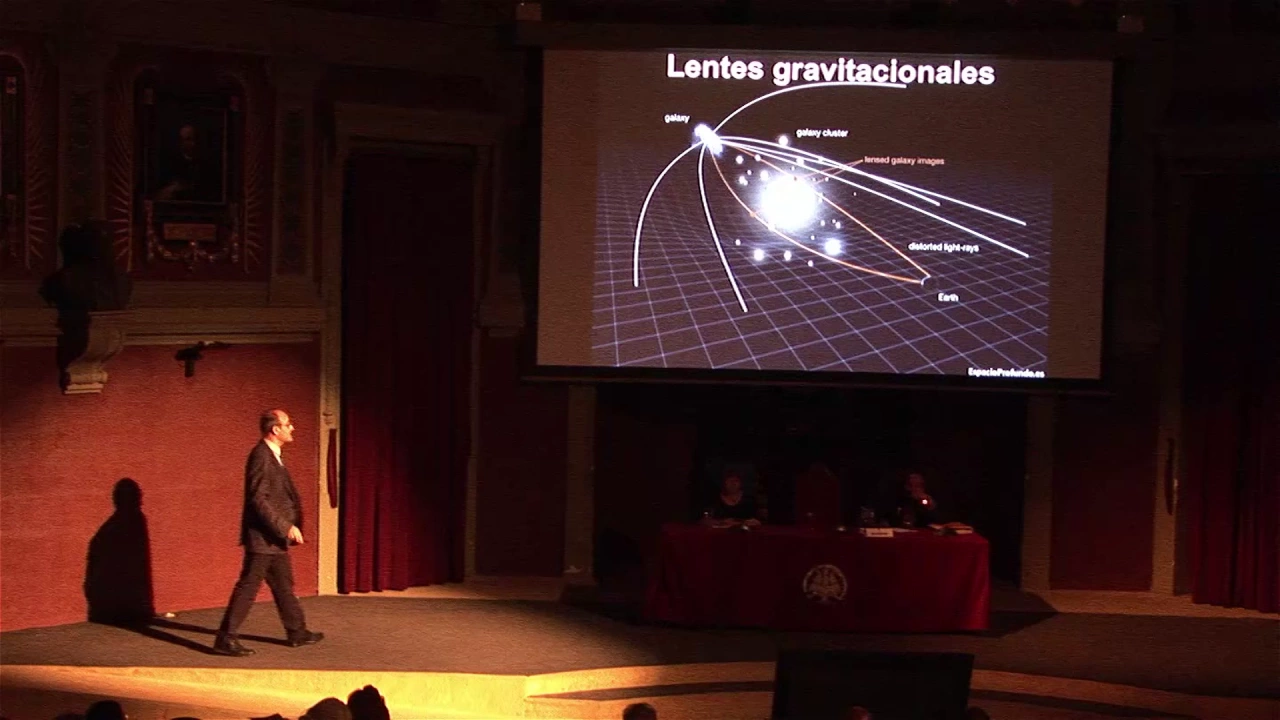
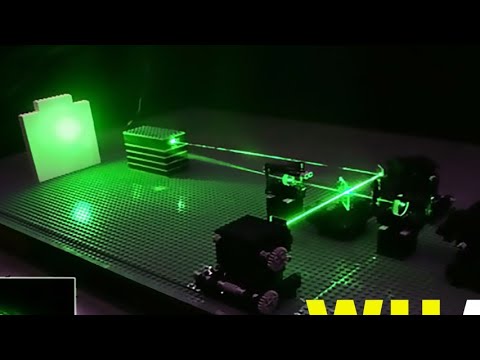
The Laser Interferometer Gravitational-Wave Observatory (LIGO) uses laser interferometry to detect gravitational waves—ripples in space-time predicted by Einstein's theory of general relativity that stretch and squeeze space itself. Each LIGO detector consists of two 4-kilometer-long concrete tubes containing vacuum-sealed metal pipes with mirrors at each end. A powerful infrared laser beam is split and sent down both tubes, bouncing between the mirrors multiple times before recombining at a detector. When gravitational waves pass through, they cause minuscule changes in the length of the tubes (on the order of 10^-22 meters), which alter the interference pattern of the recombined laser beams and produce a detectable signal. This technology, developed by hundreds of scientists over decades, enabled the first direct detection of gravitational waves in September 2015, confirming Einstein's century-old prediction and opening a new era of astronomy that allows scientists to 'hear' cosmic events like black hole mergers that were previously invisible.
The Most Precise Experiment Ever Built: LIGO Explained
Added:Ready? Right here, out in the middle of the desert, miles from any city, are huge concrete tubes, that are part of a giant machine running the most precise experiment humans have ever built. This experiment is happening inside two tubes, each 4 km long. And inside each tube, there's a big metal pipe. And at the end of each pipe, scientists place some of the smoothest mirrors ever made. And then they fire a powerful laser that gets split down each tube, bouncing back and forth and back and forth, building up power until they bring those beams back together to detect something that just a hundred years ago scientists said was impossible to find. Finding it took hundreds of scientists and over a billion dollars. But what exactly did we find? And what's the cutting edge we're finding now... that makes those same scientists want to build an even bigger one?! Let's go!
Right now, I'm here in the control room of this giant machine. "Hey everyone." Hi everyone, how are ya?
"I've seen you on the internet..." Yeah, I'm Cleo, great to meet you! This machine is known as the Laser Interferometer Gravitational Wave Observatory or just LIGO. And that is Mike, the head of LIGO. The reason this machine is such a big deal is that up until now, for all of human history, everything that we know about the cosmos has been from waves of light and particles that just happen to come our way. But it turns out there are other ways to sense our Universe. Think about it this way......imagine that you're in a jungle and you can only see. Think about what you know about what's around you. Now...with this machine, it's like all of a sudden we can suddenly "hear". Think about what you know now about what's around you. That's why LIGO was built, to create a way to "hear" our Universe. And with this machine, our "hearing" is getting better, fast. It's as though a few years ago, we could only "hear" the Universe "yelling"... and now we can "hear" it "murmuring". But, when scientists started building this machine back in the '90s, it was thought of as high risk, high reward because it was all based on a prediction made by Albert Einstein 75 years before. Imagine for a second that two enormous stars 100 light years away from us... collide! What happens here on Earth? Well, at first...nothing. We don't see it. We don't feel it. But Einstein predicted that massive things, warp space and time around them and THAT'S what we call gravity. So when these two massive stars collide, Einstein said that not only do they produce an explosion of light, but they make ripples that stretch and squeeze space and time. And those ripples move outward... like a wave... a gravity wave, a gravitational wave. And Einstein predicted that these gravitational waves travel at the same speed as light. So after 100 years, that light from that collision hits us and so do these waves. But think about what that means! It implies that everything we know, you, me, the space between us, all of reality as we know it, is getting stretched and squeezed and we never feel it. But 100 years ago, this was all just a theory. Gravitational waves?! Most physicists believe that even if Einstein were right, it would be too hard to actually prove. That's because based on Einstein's predictions, this stretch or squeeze would be 10,000 times smaller than the size of a proton. To put that into perspective, trying to measure that is like trying to measure the distance from here to the nearest star four light years away and watching that distance change by the width of a human hair. Yeah... that's why we had to build this insane machine. It's a giant measuring stick. But if everything is getting stretched and squeezed, including your measuring stick, how would you get an accurate result? No, seriously, how would you do it? Turns out the measuring stick and this are the key ... because what if you used something that we know has a constant speed, right? Like light, and you shoot it down your measuring stick, and you could calculate how long it takes the light to go down and bounce back. So if the distance changes, the time the light would take would change too. That would work in principle, but actually doing this is insanely hard. So this is what they built. I'm walking around next to LIGO's measuring sticks right now. That's what these concrete arms are. The way this works is laser light is sent out here and then splits into two, speeding down these identical arms, then hits mirrors at the end and gets reflected back. Now, normally the arms are perfectly aligned so that the waves of light cancel each other out resulting in no light hitting the detectors.
But if that mysterious, stretchy, squeezy, wave comes through... it would change the length of the arms...... shift the laser beams ever so slightly... and on the detector, you should see... a flicker.
The longer the measuring stick, the easier to measure the change, except... the harder to build it in the first place. LIGO's measuring sticks are 4 km long. So long they need to correct for the curve of the Earth. "The curvature of the Earth is such that, you know, if we launch the light from the corner station at the ends the fall off of the curvature of the Earth is about 4 feet." Now... time to go inside. The suspense is building... oh cool! This was a big deal... very few people get to go inside here.
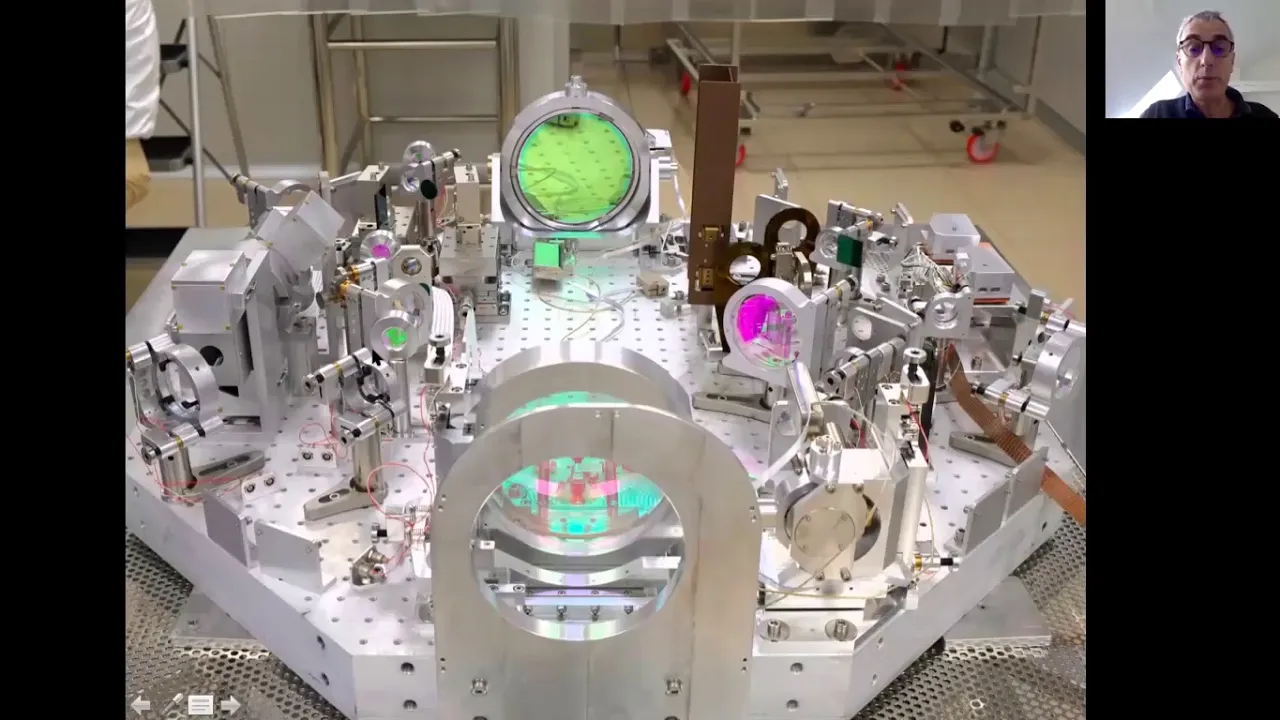
I was so excited...except there were a lot of spiders. "Yeah, widows. That's the main thing I'm worried about..." less excited about that. Now, we are inside the concrete tube. This is the beam pipe. And inside the beam pipe is 10,000 cubic meters of... nothing. And when I say nothing, I mean there are fewer particles in there than the International Space Station flies through because they sucked them all out. And the reason they did that is to make sure the only thing in there is the laser. "We're going off to this clean room space so we have several different layers to protect ourselves." I think I look great! "Busted down." Wow, you look cool! "That's uh the good thing about $700 glasses, right?" Why do we have to wear these glasses? "Because the laser that we use is invisible...and if it hits you in the eye, you're not... you won't blink. It will blind you and you can start hearing popping first, which is your blood vessels popping before your field of vision goes cloudy." Okay... I'm going to wear the glasses just in case. Inside this is the laser where the whole experiment starts. But if I were to open up this pipe, you wouldn't see it because it's an infrared laser. Its wavelength lies just outside the spectrum that you can see. We sense this as heat. Right now at the beginning here, only 60 watts of power goes into the experiment. That's actually a lot. My little laser pointer here is probably 0.005 watts. So this is already 12,000 times more powerful. And it's not even close to its max power. Once the laser travels down the arms, it hits the mirrors at the ends, and on its way back, it hits more mirrors, bouncing back and forth within the arms 300 times on average before hitting the detector, building up the laser power to 400 kW. That's 80 million times more powerful than my little laser pointer! But this extreme power has a purpose. More light equals more sensitivity. And more bouncing means a longer distance the light travels... a longer measuring stick! Increasing the total travel distance to 1,200 km. Which makes any little change easier to measure. But pulling this off is even harder than you think. They have to line this laser up with incredible accuracy. That's what they're doing here at this crazy looking table. But to look any closer, I need to put on some special gear... Why do we look like this? Why are we gowned up? "It's definitely not to protect us. It's because we're just dirty, right? Like our skin, our eyelashes, our sneezing or coughing." I touched my glasses after wiping my hands, so now I need to wipe my hands again. This is serious business!
Even the tiniest speck of dust on these optics could ruin the whole experiment. So to limit that chance, they only open up these chambers about once a year to make sure that everything is perfectly aligned. It's extremely rare to get to go inside. And once it's all aligned, the laser exits here and enters the arms. Oh my god! Do you see it? That's the coolest thing. And while I was here, I learned the most fun way to explain what they're doing with this machine. "Has anyone else shown you the LIGO dance yet?" No! "Okay, uh, one hand up in the air, one hand out to the side. Gravitational waves coming towards us. This one goes down. This one goes big. This one goes big. This one goes up.
And it goes faster and faster and faster... And that is what's happening... but it's doing it 10 to the minus 22 meters" So they set up this incredible experiment. But if anything jostles it, it messes the whole thing up.
My favorite story about this is how scientists at LIGO found a very weird source of noise. Hey, Mico, why did ravens cause an issue at LIGO in 2018? "Here's the deal... back in 2018, frost formed on these pipes that were part of the cooling system at the end of one of the detector 4 km arms. The ravens, clever as they are, found the icy pipes and started pecking at them. That tapping created little vibrations that interfered with the laser readings underneath causing those glitches in the Gabamus data." This is Mico, it's like Clippy but way smarter. Actually, hold on... let me show you. There's a secret way to turn it into There we go! Clippy! I like talking to it because it helps me figure out what's most interesting about a story. Like I can have a conversation and then I can go into the transcript and find sources and figure out what I thought was most cool. Mico, how did they solve the raven problem? "Well, the team got a little creative. They insulated those pipes so that condensation couldn't form and freeze anymore, which means no more frosty treats for the ravens and no more data glitches caused by their tapping." If you want to chat with Mico, you can scan this QR code or use the link in my description. And make sure to ask how they deal with airplane noise at LIGO. It's a whole thing. Thanks, Mico! Back to the story. So, now that the laser is lined up, it's flying down the arms and it's hitting these mirrors. But remember, we're trying to measure something smaller than a proton. So, these can't just be any mirrors......these are some of the smoothest, most reflective mirrors in the world. These things are HUGE. The main mirrors at the ends of the arms weigh 40 kg, and making them takes work on four continents over multiple years. Wait...but that doesn't look like a mirror...you can see right through it! That's cuz these mirrors need to be coated with dozens of layers of different materials to optimize their reflectiveness. But now, they definitely don't look like regular mirrors. And that's because they're not made for visible light. They're made to reflect the infrared light of the laser. And on top of that, they're polished to be unbelievably smooth. "Normal people think that their fridge surface is flat stainless, but it turns out that if you were to take your fingernail or something and rub across it, it has a peak to valley shape, right? All flat surfaces do." But those peaks and valleys won't work for the laser... "Those peaks and valleys will distort our detector laser waveform."
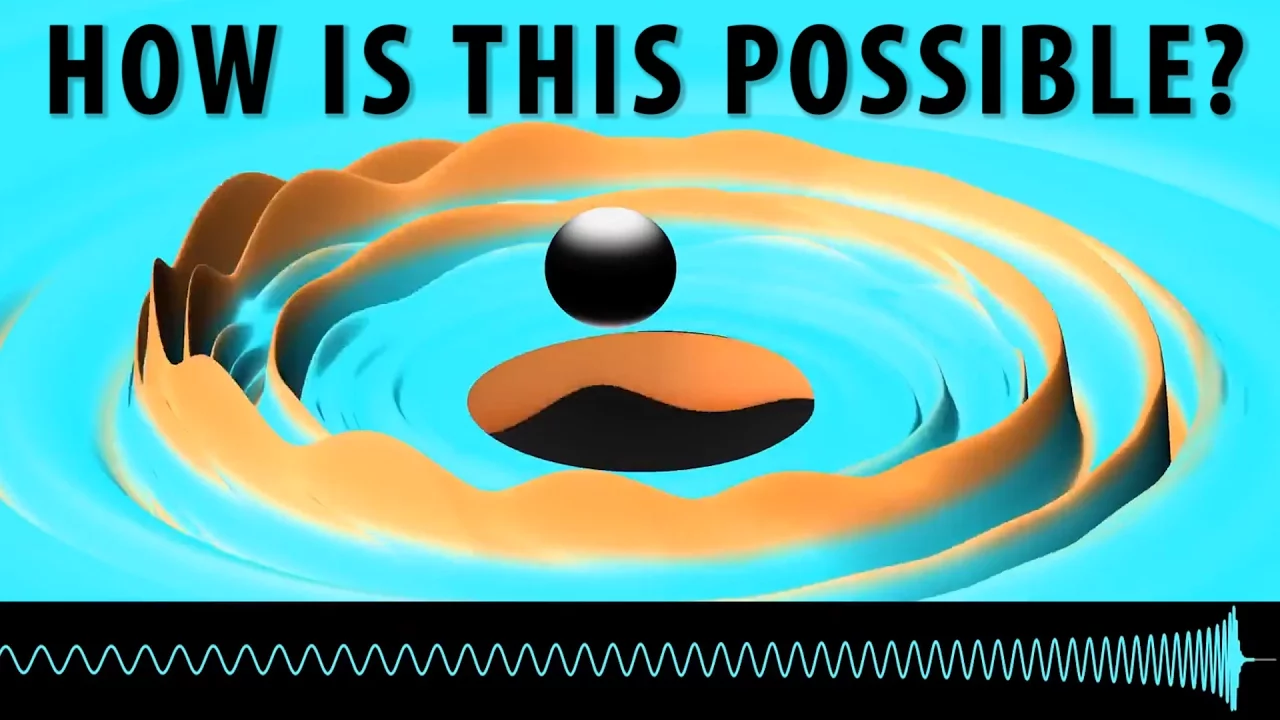
A typical mirror in your bathroom is about 90 to 95% reflective. But these mirrors reflect 99.9999% of the infrared light that hits them. That means that practically all of this powerful laser light can keep on bouncing back and forth along these tubes, measuring their length for any changes. So now we've got our powerful laser, our insanely long arms, our super smooth mirrors all aligned. But there's one more thing that could ruin everything. What if you do all of this incredibly delicate work and then a truck drives by? The whole thing could get ruined if the ground that it's on doesn't stay still. And by still, I mean a kind of stillness that you and I have never known... "So the natural movement of the ground that we're standing on is about a nanometer. You know, a billionth of a meter. That means our mirrors have to be made 10 billion times more still than the ground we're standing on." This machine is 10 billion times more still than the normal still ground. What does that even mean?!?! They did it by creating an insanely complex suspension system that isolates those mirrors and counteracts any vibrations, even hanging them by strands of glass about four times thicker than a human hair and yet stronger than steel. The details of the engineering here are incredible. And what really blows my mind is that they did ALL of this work on basically a bet that Einstein was right. So they build this crazy machine and then... they turn it on... and... nothing. For 10 years. No flicker. The detector stays silent. They don't see a single gravitational wave. Brutal. "We didn't see anything in those first science runs. We didn't see any gravitational waves at all..." But they kept going, making the machine better and better, more and more sensitive until in September 2015, they turn on the newer, better advanced LIGO. And almost immediately, 3 days later, they finally see... And that flicker... it actually looked like this. Yep, it's a bump on a chart. They call it a chirp. But how did they know that that chirp was actually a gravitational wave? Maybe it was just a truck going by. That's why 3,000 km away in a totally different place with none of the same trucks, they'd built a whole another one. That's right.
There are two of these enormous crazy machines working together to check each other's work.
And that second machine saw the chirp, too. After ALL this work and ALL this building and ALL this genius human effort... a hundred years almost to the day after Einstein predicted it, we saw our FIRST gravitational wave. For those scientists, it meant that they just won the Nobel Prize.
And for all the rest of us, it meant a totally new era. Eventually, they figured out that those first waves they detected were caused by two black holes merging 1.3 billion lightyears away. It was a huge impact causing massive waves, a cosmic "yell", basically.
And it turns out that the Universe "yells" a lot. "We've made 294 detections to date. And right now, we get them about once every 3 days or so." We've now "heard" more black holes colliding, creating even bigger ones. stars smashing and exploding, telling us where many of the elements on Earth come from. These "sounds" let us officially measure the speed of gravity and the expansion of the Universe. We first understood light and then we manipulated it. We're now right at the beginning of understanding gravity. Just imagine what we could do if we could manipulate THAT! When LIGO first started "listening" to the Universe, they could only "hear" this far, and they didn't detect anything. Then here's how far they could "hear" in 2015, making their first detection. And today, LIGO can reach more than a thousand times more space than it originally could. And the best part is... we're only just getting started. They're working on new, bigger machines, like this one in Europe. It's a triangle with three 10 km long arms buried underground. And in the US, there's another plan for one called Cosmic Explorer, an L-shape, but instead of 4km arms, they want 40.
Those observatories would expand our "hearing" to close to the edge of the observable universe.
Humans are astonishing. We gave ourselves and every person after us a "new sense". We might be the first living species ever to "sense" the Universe in this way. The Universe has been "talking" to us this whole time and we can finally "hear" it. So now the question is... what will we "hear" next?
If you believe that there should be more optimistic science and tech stories...subscribe.
Up Next
Gravitational Waves: The Impossible Detection Physics
@veritasium
7.8M views•2017-01-05

21cm Hyperfine Transition in Neutral Hydrogen: Radio Astronomy Basics
@AaronRobertParsons
12.4K views•2011-10-13

NMR Spin Physics I: Zeeman Effect, Resonance Condition & Larmor Frequency
@nptel-indianinstituteofsci8064
2.3K views•2024-01-17

Entropy and the Second Law of Thermodynamics Explained
@veritasium
27.5M views•2023-07-01
Related Study Plans & Knowledge Roadmaps
Structured learning paths in Physics