


![John Denver in Alaska / The American Child [09/03/1978] (Full) Rare!!](https://i.ytimg.com/vi/W2HSBPgK9vg/hqdefault.jpg?sqp=-oaymwEmCOADEOgC8quKqQMa8AEB-AG-AoAC8AGKAgwIABABGGUgXihRMA8=&rs=AOn4CLDYxyiNPN8emZgB1-ePnYQTYOPsdA)











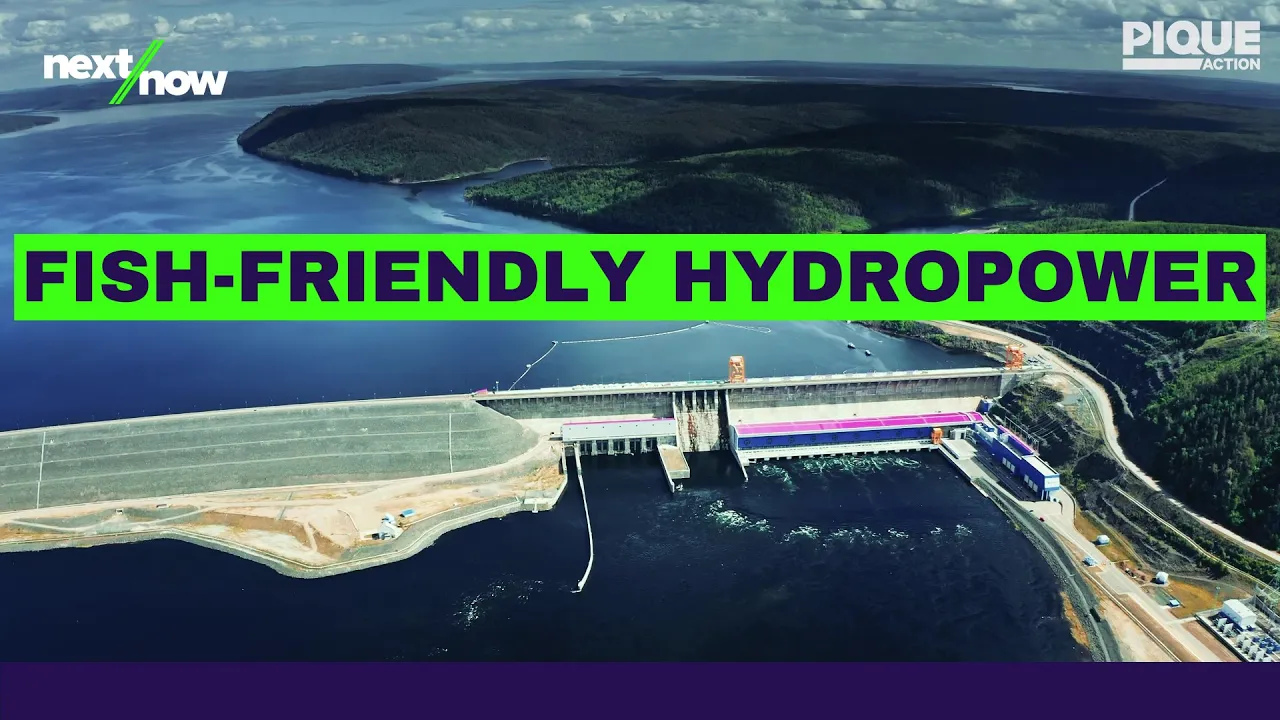
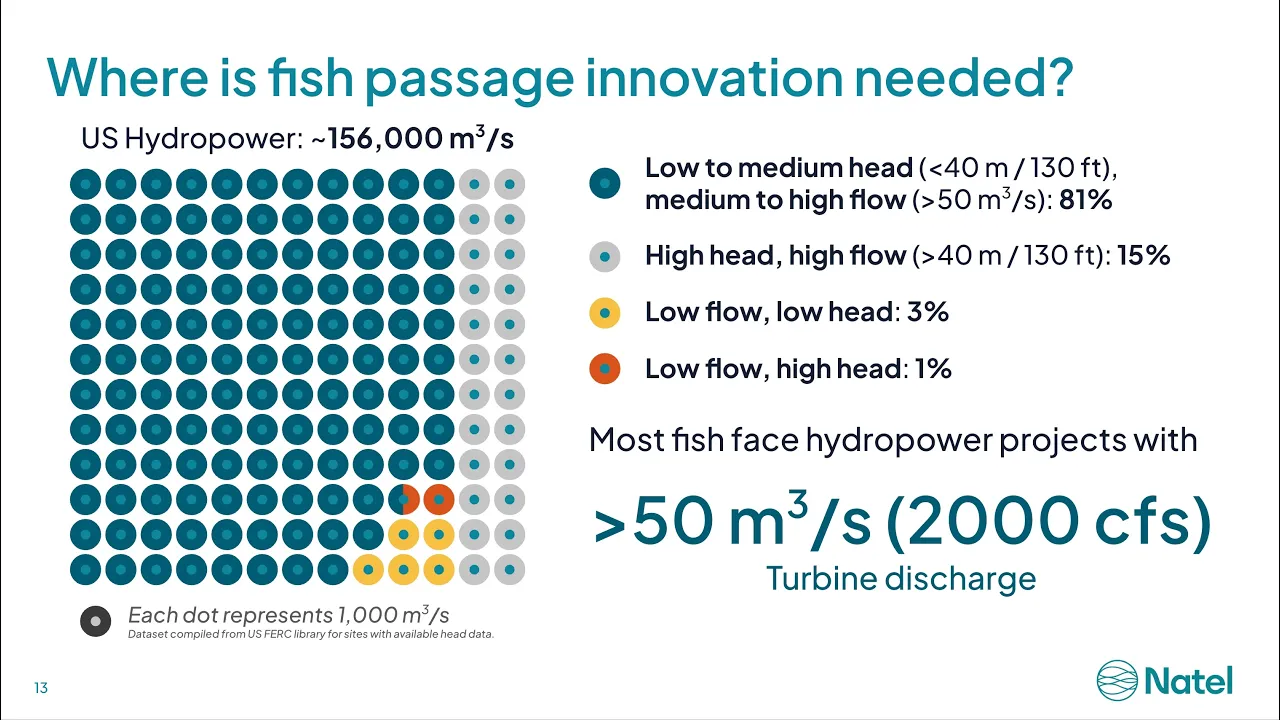








Modern hydroelectric dams employ sophisticated engineering solutions to help fish migrate safely, including fish ladders with attraction water and baffles, submersible screens to divert juvenile fish from turbines, and bypass systems that release fish downstream; these technologies continuously evolve through research, such as PNNL's sensor fish studies and acoustic tagging, to improve fish survival rates and balance energy production with ecosystem protection.
How Fish Survive Hydro Turbines: Fish Passage at McNary Dam
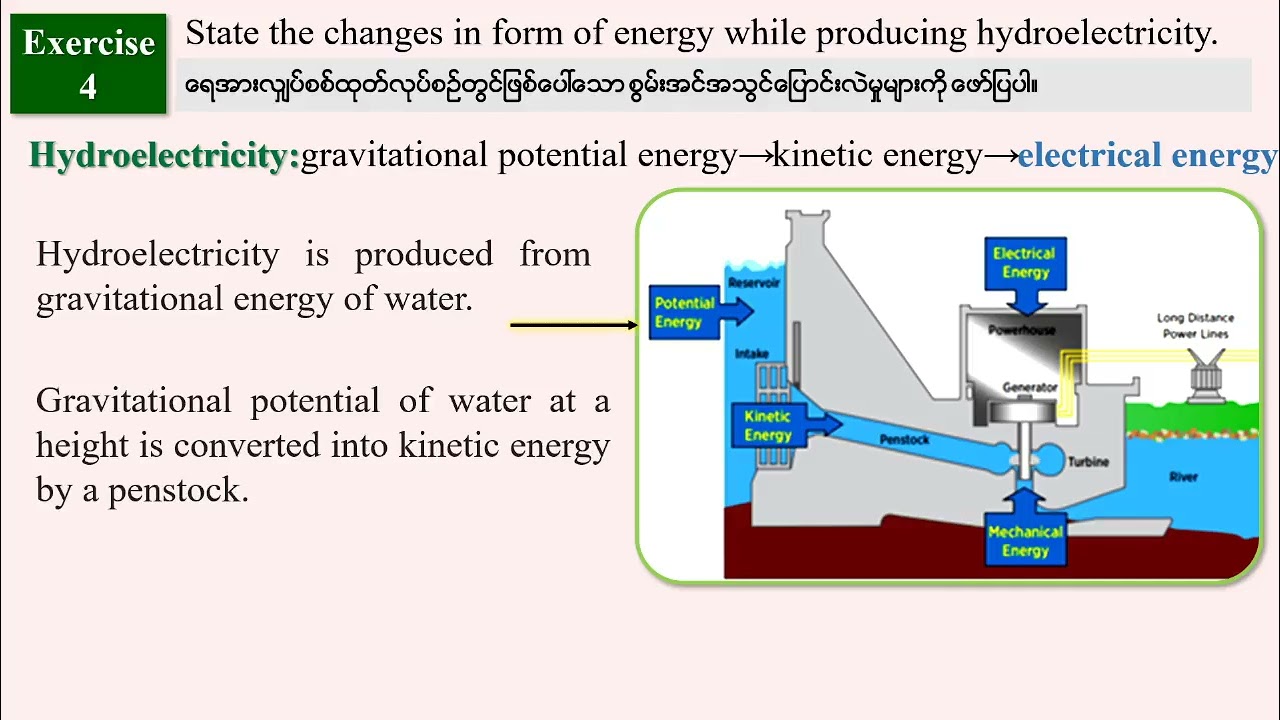
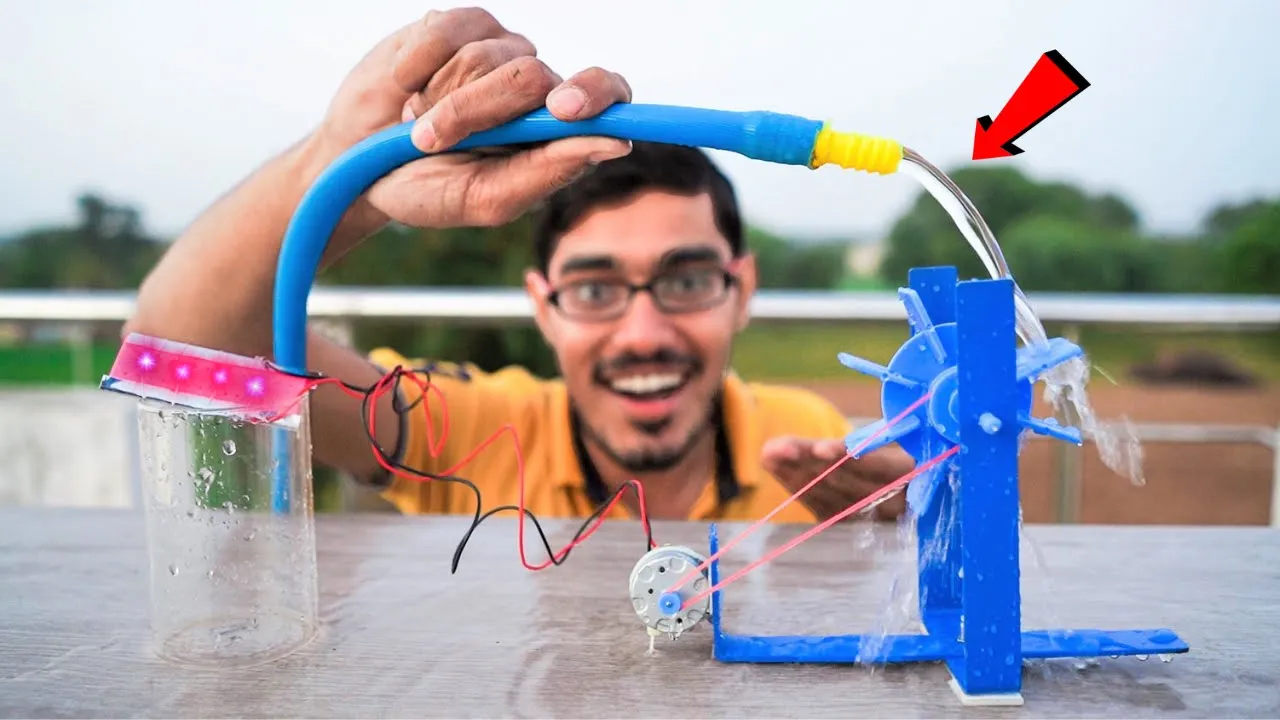
Added:Fundamentals of hydroelectric power generation, including how dams harness gravitational potential energy and convert it to electricity using water turbines.
The biological life cycle of anadromous fish species, particularly salmon, and their behavioral impulse to migrate between freshwater spawning grounds and the ocean.
Basic principles of fluid dynamics, specifically how velocity, pressure differentials, and shear stress behave in moving water.
The concept of ecological fragmentation, representing how artificial barriers like dams disrupt river ecosystems and native aquatic pathways.
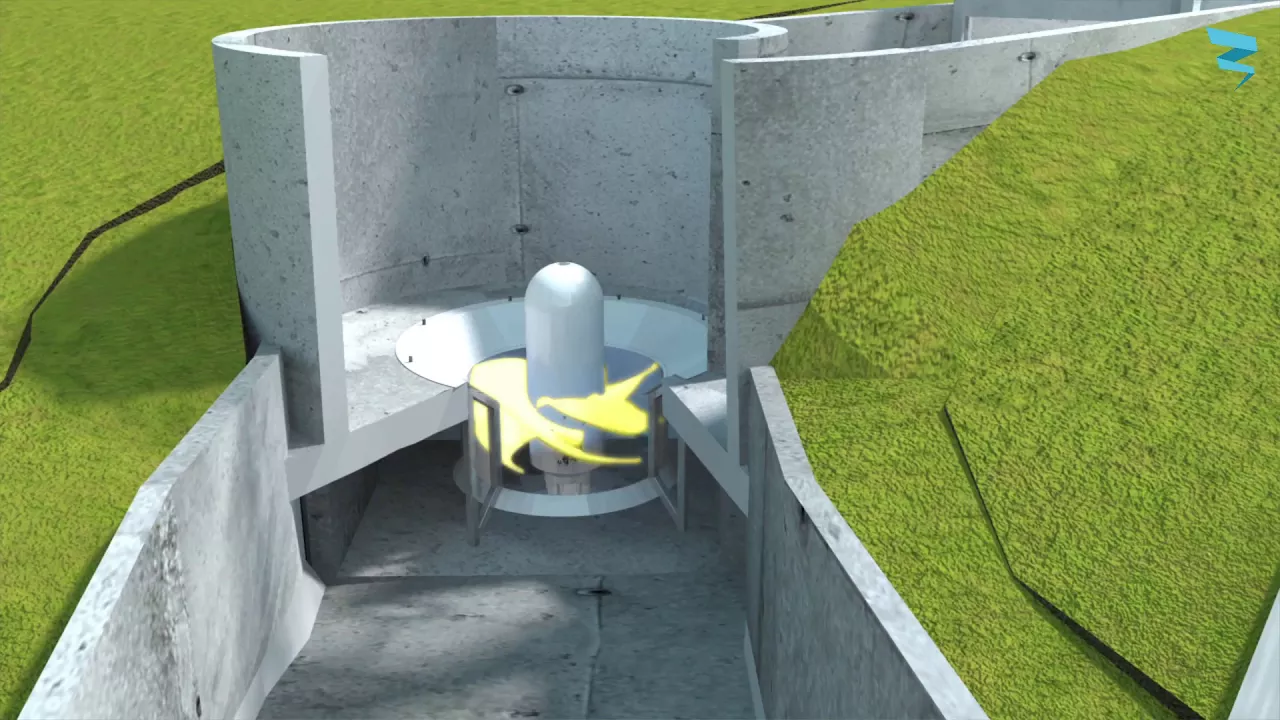
Advanced engineering designs for 'fish-friendly' turbines, such as the Minimum Gap Runner (MGR) and Alden turbine technologies.
Methods for monitoring and quantifying fish passage success, including PIT (Passive Integrated Transponder) tagging, acoustic telemetry, and statistical survival modeling.
The economic and operational trade-offs of balancing grid energy demands with ecological bypass spilling protocols.
The study of dam decommissioning and river restoration projects as alternative solutions to structural fish-passage mitigation.
2.6M views70Klikes22:21Original Release: 2024-03-05
Most of the largest dams in the US were built before we really understood the impacts they would have on river ecosystems. Or at least they were built before we were conscientious enough to weigh those impacts against the benefits of a dam. And, to be fair, it’s hard to overstate those benefits: flood control, agriculture, water supply for cities, and hydroelectric power. All of our lives benefit in some way from this enormous control over Earth’s freshwater resources.
But those benefits come at a cost, and the price isn’t just the dollars we’ve spent on the infrastructure but also the impacts dams have on the environment. So you have these two vastly important resources: the control of water to the benefit of humanity and aquatic ecosystems that we rely on, and in many ways these two are in direct competition with each other. But even though most of these big dams were built decades ago, the ways we manage that struggle are constantly evolving as the science and engineering improve. This is a controversial issue with perspectives that run the gamut. And I don’t think there’s one right answer, but I do know that an informed opinion is better than an oblivious one. So, I wanted to see for myself how we strike a balance between a dam’s benefits and environmental impacts, and how that’s changing over time. So, I partnered up with the folks at the Pacific Northwest National Laboratory (or PNNL) in Washington state to learn more. Just to be clear, they didn’t sponsor this video and had no control over its contents.They showed me so much, not just the incredible technology and research that goes on in their lab, but also how it is put into practice in real infrastructure in the field, all so I could share it with you.
This is McNary Dam, a nearly 1.5-mile-long hydroelectric dam across the Columbia River between Oregon and Washington state, just shy of 300 miles (or 470 km) upriver from the Pacific Ocean. And this is Tim Roberts, the dam’s Operations Project Manager and the best dam tour guide I’ve ever met.
But this was not just a little walkthrough. We went deep into every part of this facility to really understand how it works. McNary is one of the hydropower workhorses in the Columbia River system, a network of dams that provide electricity, irrigation water, flood control, and navigation to the region. It’s equipped with fourteen power-generating turbines, and these behemoths can generate nearly a gigawatt of power combined! That means this single facility can, very generally, power more than half-a-million homes. The powerhouse where those turbines live is nearly a quarter mile long (more than 350 meters)! It’s pretty hard to convey the scale of these units in a video, but Tim was gracious enough to take us down inside one to see and hear the enormous steel shaft spinning as it generates megawatts of electrical power.
All that electricity flows out to the grid on these transmission lines to power the surrounding area.
McNary is a run-of-the-river dam, meaning it doesn’t maintain a large reservoir. It stores some water in the forebay to create the height needed to run the turbines, but water flows more or less at the rate it would without the dam. So, any extra water flowing into the forebay that can’t be used for hydro generation has to be passed downstream through one or more of these 22 enormous lift gates in the spillway beside the powerhouse.
As you can imagine, all this infrastructure is a lot to operate and maintain. But it’s not just hydrologic conditions like floods and droughts or human needs like hydropower demands and irrigation dictating how and when those gates open or when those turbines run; it’s biological criteria too. The Columbia and its tributaries are home to a huge population of migratory fish, including chinook, coho, sockeye, pink salmon, and lampreys, and over the years, through research, legislation, lawsuits, advocacy, and just plain good sense by the powers at be, we’ve steadily been improving the balance between impacts to that wildlife and the benefits of the infrastructure. In fact, just about every aspect of the operation of McNary Dam is driven by the Fish Passage Plan. This 500-page document, prepared each year in collaboration with a litany of partners, governs the operation of McNary and several other dams in the Columbia River system to improve the survival of fish along the river.
This fish bible includes prescriptive details and schedules for just about every aspect of the dam, including the fish passage structures too. Usually, when we build infrastructure, the people who are going to use it are actual people. But in a very real sense, huge aspects of McNary and other similar dams are infrastructure for non-humans.
On top of the hydropower plant and the spillway, McNary is equipped with a host of facilities meant to help wildlife get from one side to the other with as little stress or injury as possible.
Let’s look at the fish ladders first. McNary has two of them, one on each side.
A big contingent of the fish needing past McNary dam are adult salmon and other species from the ocean trying to get upstream to reproduce in freshwater streams. They are biologically motivated to swim against the current, so a fish ladder is designed to encourage and allow them to do just that, and it starts with attraction water. Dams often slow down the flow of water, both upstream and downstream, which can be disorienting to fish trying to swim against a current. Also, dams are large, and fish generally don’t read signs, so we need an alternative way to show them how to get around. Luckily, in addition to a strong current, salmon are sensitive to the sound and motion of splashing water, so that’s just what we do. At McNary, huge electric pumps lift water from the tailrace below the dam and discharge it into a channel that runs along the powerhouse. As the water splashes back down, it draws fish toward the entrances so they can orient with the flow through the ladder. Some of this was a little tough to understand even seeing it in person, so I had a couple of the engineers at the dam explain it to me.
All these entrances provide options for the fish to come in, increasing the opportunity and likelihood that they will find their way.
Once they’re in, they make their way upstream into the ladder itself. Concrete baffles break up the insurmountable height of the dam into manageable sections that fish can swim up at their own pace. Most of the fish go through holes in the baffles, but some jump over the weirs. There’s even a window near the top of the ladder where an expert counts the fish and identifies their species.
This data is important to a wide variety of organizations, and it’s even posted online if you want to have a look. Once at the top, the fish pass through a trash rack that keeps debris out of the ladder and continue their journey to their spawning grounds. The goal is that they never even know they left the river at all, and it works. Every year hundreds of thousands of chinook, coho, steelhead, and sockeye make their way past McNary Dam. If you include the non-native shad, that number is in the millions.
And it’s not just bony fish that find their way through. Some of the latest updates are to help lamprey passage. These are really interesting creatures!
I’m working on another video that will take a much deeper look at how this and other fish ladders work, so stay tuned for that one, but it’s not the only fish passage facility here. Because what goes up, must come down, or at least their offspring do (most adult salmon die after reproducing). So, McNary Dam needs a way to get those juvenile fish through as well. That might sound simple; thanks to gravity, it’s much simpler to go down than up. But at a dam, it’s anything but.
I definitely wouldn’t want to pass through one of these, but juvenile fish can make it through the spillway mostly just fine. In fact, specialized structures are often installed during peak migration times to encourage fish to swim through the spillway. McNary Dam has lift gates where the water flows from lower in the water column. But salmon like to stay relatively close to the surface and they’re sensitive to the currents in the flow. Many dams on the Columbia system have some way to spill water over the top, called a weir, that is more conducive to getting the juveniles through the dam.
The other path for juveniles to take is to be drawn toward the turbines. But McNary and a lot of other dams are equipped with a sophisticated bypass system to divert the fish before they make it that far. and that all starts with the submersible screens.
These enormous structures are specially designed with lots of narrow slots to let as much water through to the turbines while excluding juvenile fish. They are lowered into place with the huge gantry crane that rides along the top of the power house. Each submersible screen is installed in front of a turbine to redirect fish upwards while the water flows continues on. Brushes keep them clean of debris to make sure they fish don’t get trapped against the screen. They might look simple, but even a basic screen like this requires a huge investment of resources and maintenance, because they are absolutely critical to the operation of the dam.
Once the fish have been diverted by the screens, they flow with some of the water upward into a massive collection channel. This was originally designed as a way to divert ice and debris, but now it’s basically a fish cathedral along the upstream face of the dam.
The juveniles come out in these conduits from below. Then they flow along the channel, while grates along the bottom concentrate them upward. Next they flow into a huge pipe that pops out on the downstream face of the dam. Along the way, the juveniles pass through electronic readers that scan any of the fish that have been equipped with tags and then into this maze of pipes and valves and pumps and flumes. In the past, this facility was used to store juveniles so they could be loaded up in barges and transported downstream. But over time, the science showed it was better to just release them downstream from the dam. Every once in a while, some of the juveniles are separated for counting so scientists can track them just like the adults in the ladder.
Then the juveniles continue their journey in the pipe out to the middle of the river downstream.
Avian predation is a serious problem for juveniles. Pelicans, seagulls, and cormorants love salmon just like the rest of us. In many cases, most of the fish mortality caused by dams isn’t the stress of getting them through the various structures, but simply that birds and other predatory fish take advantage of the fact that dams can slow down and concentrate migrating fish. This juvenile bypass pipe runs right out into the center of the downstream channel where flows are fastest to give the fish a fighting chance, and McNary is equipped with a lot of deterrents to try and keep the birds away.
All this infrastructure at McNary Dam to help fish get upstream and downstream has changed and evolved over time, and in fact, a lot of it wasn’t even conceived of when the dam was first built. And that’s one of the most important things I learned touring McNary Dam and the Pacific Northwest National Lab: the science is constantly improving. A ton of that science happens here at the PNNL Aquatics Research Laboratory.
I spent an entire day just chatting with all the scientists and researchers here who are advancing the state of the art.
For example, not all the juvenile salmon get diverted away from those turbines.
Some inevitably end up going right through. You might think that being hit by a spinning turbine is the worst thing that could happen to a fish, but actually the change in pressure is the main concern. A hydropower turbine’s job is to extract as much energy as possible from the flowing water.
In practice, that means the pressure coming into each unit is much higher than going out, and that pressure drop happens rapidly. It doesn’t bother the lamprey at all, but that sudden change in pressure can affect the swim bladder that most fish use for buoyancy. So how do we know what that does to a fish and how newer designs can be safer? PNNL has developed sensor fish, electronic analogues to the real thing that they can send through turbines and get data out on the other side. Compare that data to what we already know about the limits fish can withstand (another area of research at PNNL), and you can quickly and safely evaluate the impacts a turbine can have.
What’s awesome is seeing how that research translates into actual investments in infrastructure that have a huge effect on survivability. New turbines recently installed at Ice Harbor Dam upstream were designed in collaboration with PNNL with fish passage in mind to reduce injury for any juveniles that find their way in. One study found that more than 98% of fish survived passing through the new turbines, and nearly all the large hydropower dams in the Columbia river system are slated to have them installed in the future. And it’s not just the turbines that are seeing improvements. I talked to researchers who study live fish, how they navigate different kinds of structures, and what they can withstand. Just the engineering in the water system to keep these fish happy is a feat in itself. I talked to a coatings expert about innovative ways to reduce biological buildup on nets and screens. I talked to an energy researcher about new ways to operate turbines to decrease impacts to fish from ramping them up and down in response to fluctuating grid demands.
And I spent a lot of time learning about how we track and study the movement of fish as they interact with human made structures. Researchers at PNNL have developed a suite of sensors that can be implanted into fish for a variety of purposes. Some use acoustic signals picked up by nearby receivers that can precisely locate each fish like underwater GPS. Of course, if you want to study fish behavior accurately, you need the fish to behave like they would naturally, so those sensors have to be tiny. PNNL has developed miniscule devices, so small I could barely make out the details. You also want to make sure that inserting the tags doesn’t injure the fish, so researchers showed me how you do that and make sure they heal quickly. And of course, those acoustic tags require power, and tiny batteries (while extremely impressive in their own right) sometimes aren’t enough for long-term studies. So they’ve even come up with fish-powered generators that can keep the tags running for much longer periods of time. A piezoelectric device creates power as the fish swims… and they had some fun ways to test them out too.
Of course, migratory fish aren’t the only part of the environment impacted by hydropower, and with all the competing interests, I don’t think we’ll ever feel like the issue is fully solved. These are messy, muddy questions that take time, energy, and big investments in resources to get even the simplest answers.
The salmon pink and blue paint in the powerhouse at McNary really sums it up well, with the blue symbolizing the water that drives the station, and the pink symbolizing the life within the water, and its environmental, economic, and cultural significance. This kind of balancing act is really at the heart of what a lot of engineering is all about. I’m so grateful for the opportunity to see and learn more about how energy researchers, biologists, ecologists, policy experts, regulators, activists, and engineers collaborate to make sure we’re being good stewards of the resources we depend on. I think Alison Colotelo, the Hydropower Program Lead at PNNL put it best: My crew and I spent two full days in Washington talking to scientists and engineers about these complicated issues. And I probably learned more about biology in those two days than anything I happened to absorb in college, especially about how dams can isolate populations of fish if they aren’t equipped with well-designed passage systems like those at McNary. And there’s a human equivalent to that too, that’s really interesting I think, because we’ve found ways of living in super remote places, and the ways people and fish adapt to those situations have a lot of similarities. My friend, Sam, of the Wendover Productions channel has a video series called Extremities that is all about the most remote places on Earth and how and why people choose to settle them. I’ve watched all 15 episodes. They’re so good, and if you want to check them out, they’re available only on Nebula.
You’ve probably heard of Nebula before. It’s a streaming service built by a group of creators, including me, as a way to boost the resources and capabilities of independent creators. It’s totally ad-free, full of originals like Extremities, and there are no industry executives or big production houses deciding what projects live or die. That means people like Brian from Real Engineering, Scotty from Strange Parts, Integza, and a lot of others get to make the stuff they’re passionate about without having to be so careful to please the YouTube algorithm or so shallow to capture a wider audience.
You can think of it like an employee-owned co-op. A place to experiment with bigger projects, different formats, and extra content and perks from your favorite creators. My videos go live there early, before they come out here, and my Practical Construction series wouldn’t have been possible to make if not for the dedicated people watching on Nebula. I know there are a lot of streaming platforms out there right now, and no one wants another monthly cost to keep track of, but I also know that if you’re watching a show like this to end, there is a ton of other stuff on Nebula that you’re going to enjoy as well. So I’ve made it dead simple: click the link below and you’ll get 40% off an annual plan. That means you pay just one time, 30 dollars, for an entire year’s access at nebula.tv/practical-engineering. That’s less than 3 dollars a month. If you’re with me that independent creators are the future of great video, I hope you’ll consider subscribing. Thank you for watching, and let me know what you think!
Up Next

2:34
Understanding Correlated Color Temperature (CCT) in LED Lighting | Explained
@BorderStates
35.4K views•2015-03-10

30:32
Ultrasonic Transducers: Resonant Frequency Measurement and Horn Design
@imajeenyus42
229.9K views•2017-02-22
54:16
Polymer Environmental Degradation: Mechanisms & Stabilization
@iit
1.8K views•2012-07-10

33:39
How a Student's Question Saved a NYC Skyscraper from Collapse
@veritasium
22.8M views•2025-04-26
Related Study Plans & Knowledge Roadmaps
Structured learning paths in Engineering
engineering
Building Acoustic Levitators: Physics & Arduino
01The Physics of Sound and Standing Waves
02Piezoelectric Transducers and H-Bridge Drivers
03Arduino Programming: Generating 40 kHz Signals
+ 2 more learning modules
14h5 modules
Explore Roadmap
engineering
Building Peltier Cloud Chambers: Particle Tracks
01Cosmic Rays & Cloud Chamber Physics
02Thermoelectric Cooling (TEC) Fundamentals
03Custom Liquid-Cooling Loop Design
+ 2 more learning modules
18h5 modules
Explore Roadmap
engineering
Yagi-Uda Antennas: Modeling, Build & VNA Test
01Introduction to RF and Antenna Fundamentals
02Yagi-Uda Antenna Design Principles
03Antenna Modeling and Simulation in 4NEC2
+ 2 more learning modules
18h5 modules
Explore Roadmap
engineering
ECG Monitor Design: Op-Amps, Filters & Noise
01Electronics & Breadboard Basics
02Op-Amps and Instrumentation Amplifiers
03Bioelectricity and ECG Fundamentals
+ 2 more learning modules
18h5 modules
Explore Roadmap