Color Correlated Temperature (CCT), measured in Kelvin (K), describes the color tone of white light emitted by artificial light sources like LEDs; lower CCT values (2000-3000K) produce warm, orange-yellow light ideal for cozy atmospheres such as restaurants, while higher CCT values (4000-5000K and above) produce cooler, bluish-white light resembling daylight, which is preferred in commercial and industrial settings for creating productive, alert environments.
Understanding Correlated Color Temperature (CCT) in LED Lighting | Explained
Added:Deep Dive
The concept of the visible light spectrum and how different wavelengths correspond to different colors.

Introduction to light & E M W-7.01-IGCSE Physics
10.8K
The visible light spectrum ranges from approximately 400 nanometers (violet) to 700 nanometers (red). Different colors correspond to different wavelengths: violet has the shortest wavelength (~400nm) while red has the longest (~700nm). All colors are made of the same electromagnetic wave structure with electric and magnetic fields, but they differ only in their wavelength. Human eyes detect these different wavelengths and the brain interprets them as different colors.
Click to watch →

Electromagnetic waves
104
Visible light is the only part of the electromagnetic spectrum detectable by human eyes. The visible spectrum consists of seven colors arranged by wavelength: Red (longest wavelength, ~700 nm), Orange, Yellow, Green, Blue, Indigo, and Violet (shortest wavelength, ~400 nm). Red light has the longest wavelength and lowest energy among visible colors, while violet has the shortest wavelength and highest energy. The visible region spans approximately 400-700 nanometers. This spectrum demonstrates how different wavelengths correspond to different colors that our eyes can perceive.
Click to watch →

भूगोल | MPSC Geography Basic Concepts | रोहिणी गुट्टे - नायब तहसीलदार | Chanakya Mandal Pariwar
123.9K
This section details the visible light spectrum. Visible light spans approximately 300-700 nanometers in wavelength. Within this range, different colors correspond to different wavelengths: violet (shortest wavelength, around 300-400 nm), blue, green, yellow, orange, and red (longest wavelength, around 600-700 nm). The instructor explains that shorter wavelengths (like violet) have higher energy, while longer wavelengths (like red) have lower energy. This is why we see different colors in rainbows and prisms, and why different colors of light behave differently when interacting with matter.
Click to watch →

Physical Science with Zachary Kwong
394
Visible light consists of different colors corresponding to different wavelengths within the electromagnetic spectrum. The colors appear in the order: red, orange, yellow, green, blue, indigo, and violet. Red light has the longest wavelength, while violet light has the shortest wavelength among visible colors. This variation in wavelength is what causes us to perceive different colors. The relationship between color and wavelength is fundamental to understanding how we see and how light interacts with matter.
Click to watch →

درس الاشعاع وحيد اللون و طول الموجة لسنة الأولى ثانوي شعبة آداب 🌹🌺
1.2K
The visible light spectrum is composed of an infinite number of monochromatic light rays, each called monochromatic light. The human eye can only detect light rays with wavelengths between 400 and 800 nanometers. The visible light spectrum is defined as the range of wavelengths visible to the naked eye. The maximum wavelength (800 nm) corresponds to red light, while the minimum wavelength (400 nm) corresponds to violet light. Different colors correspond to specific wavelength ranges: red (650-800 nm), orange (580-600 nm), yellow (550-570 nm), green (490-540 nm), blue (440-480 nm), and violet (400-420 nm).
Click to watch →
Deep Dive
The Kelvin temperature scale and its relationship to thermodynamic temperature.

JEE Main Heat, Thermodynamics, Ktg, Fluid | One-Shot | Physics Mega Revision #2
147.6K
The Kelvin temperature scale is the absolute temperature scale used in thermodynamics. The Kelvin scale starts at absolute zero (0K), where molecular motion ceases. The relationship between Kelvin and Celsius is T(K) = T(°C) + 273.15. All thermodynamic equations involving temperature require the use of absolute temperature in Kelvin. The Kelvin scale is essential for calculating thermodynamic quantities like entropy and internal energy.
Click to watch →

XI-11-01 Thermal properties of matter (2015) Pradeep Kshetrapal Physics
143K
The Kelvin scale starts at absolute zero (0 K) and uses the same degree size as Celsius. Water freezes at 273.16 K and boils at 373.16 K. Converting between scales requires adding/subtracting 273.16. As a fundamental quantity, temperature cannot be derived from mass, length, or time. The Kelvin scale is the SI standard and thermodynamic scale, representing the most fundamental approach to temperature measurement in physics.
Click to watch →

10. States of Matter || 1M || | Concept + PYQs + Short Tricks || Class11th #cet2024 #mhtcet2024
49.1K
The Kelvin temperature scale is used in gas laws. The relationship between Kelvin and Celsius is: T(K) = T(°C) + 273.15. This scale is necessary because gas laws require absolute temperature.
Click to watch →

JEE 2022: Heat & Temperature L1 | Unacademy JEE | JEE Physics | Jayant Nagda
81.2K
The Kelvin scale is absolute, starting from absolute zero (0 K) where gas molecules have zero kinetic energy and are at absolute rest. The relationship between Kelvin (K) and Celsius (C) is: K = C + 273.15. This means 0°C = 273.15 K and 100°C = 373.15 K. The Kelvin scale is preferred in scientific calculations.
Click to watch →

¿Cómo sabemos que un kelvin es un kelvin? 3. El Kelvin
94.8K
The Kelvin is the SI unit of temperature, defined through the Boltzmann constant as the temperature change that produces a thermal energy change of 1.380649 × 10^-23 joules, representing the average molecular energy in a system; it was established by Lord Kelvin to provide an absolute temperature scale starting from absolute zero, unlike the Celsius scale which uses water's phase transitions as reference points.
Click to watch →
Deep Dive
The physical principle of black-body radiation and how heating an object changes its glowing color.

Structure Of Atom Class 11 NEET | L 2 | Baazigar Series Part 5
11.6K
Black body radiation is the thermal radiation emitted by an ideal black body (an object that absorbs all incident radiation). When heated, a black body (like heated iron) first glows dull red, then bright red, orange, yellow, and finally blue as temperature increases. This color change corresponds to decreasing wavelength (increasing frequency) of emitted radiation.
Click to watch →

Planck's Constant and BlackBody Radiation
172.6K
Any object with a temperature above absolute zero (0 Kelvin) emits electromagnetic radiation. As the temperature of an object increases, the energy of its emitted radiation also increases. This principle explains why heated objects change color - metals glow red at lower temperatures, then yellow, and eventually white as temperature rises. The increased molecular vibration at higher temperatures causes oscillations of electric charges that emit electromagnetic radiation.
Click to watch →
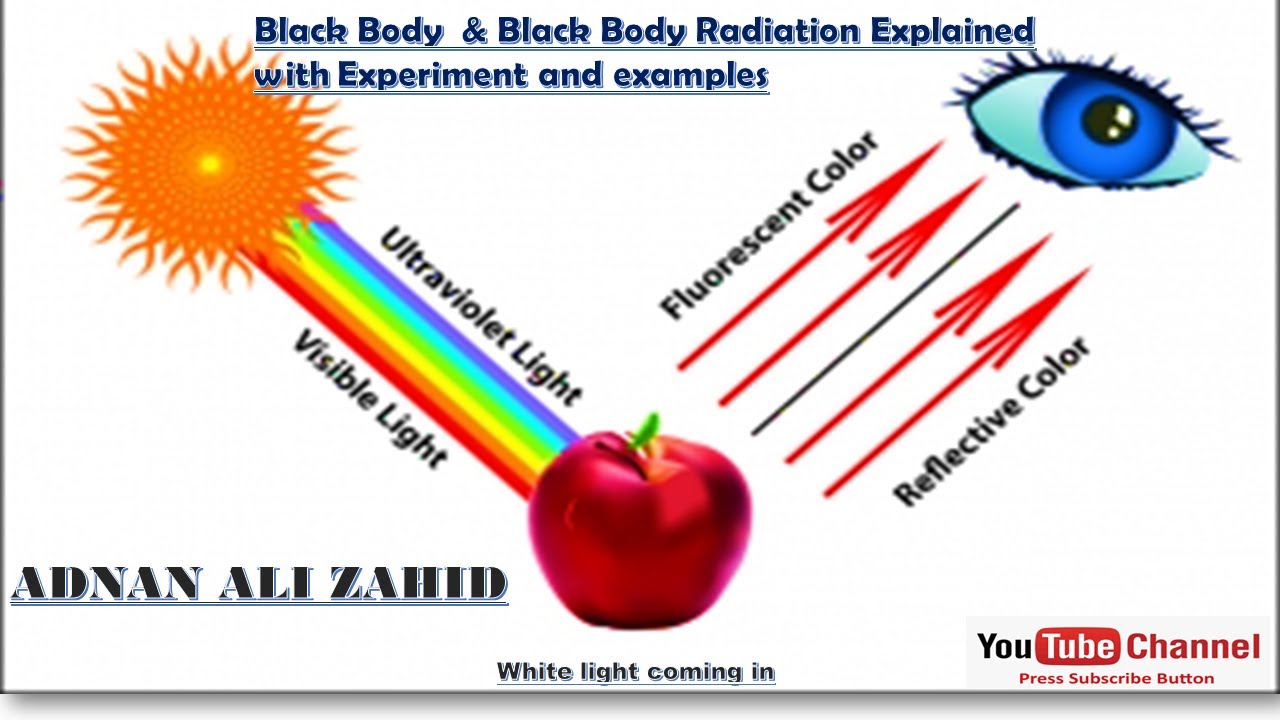
Blackbody Radiation | Quantum mechanics|Explained experimentally with examples in hindi -Urdu.
268
A black body is an idealized object that absorbs all incident electromagnetic radiation and emits radiation based solely on its temperature. When heated, objects emit thermal radiation whose characteristics depend on temperature. As temperature increases, the total power radiated increases dramatically (Stefan-Boltzmann Law: P ∝ T⁴), and the peak wavelength shifts toward shorter wavelengths (Wien's Displacement Law: λ_max ∝ 1/T). This explains why heated objects change color from red to orange to yellow to white as temperature rises, and why all objects emit thermal radiation based on their temperature.
Click to watch →

Black body radiation
116
Black body radiation is the light emitted by objects that absorb all incident radiation (appear black) when heated to sufficient temperatures. A black body emitter absorbs all radiation falling upon it. The black body radiation spectrum plots intensity versus wavelength, showing that hot objects emit light across many wavelengths simultaneously because different atoms in slightly different thermal states release energy as light at various wavelengths. As temperature increases, the peak emission shifts to shorter wavelengths (left on the graph) and increases in intensity. At 1000K, objects emit primarily infrared (invisible to eyes); at 2000K, they appear red hot with mostly red light; at 6000K (sun's temperature), they appear white hot with equal red, green, and blue emission; at 15,000K, they appear blue hot with more blue than red. This explains why stars have different colors based on their temperatures and why hotter objects appear brighter.
Click to watch →

Solved Problems /MCQs on Black Body Radiation & Photoelectric Effect
10.3K
When a black body (such as a platinum wire) is heated, its color changes from red to yellow to white as temperature increases. This phenomenon can be explained by Wien's Displacement Law. As temperature rises, the peak wavelength of emitted radiation shifts toward shorter wavelengths (blue end of the spectrum). Red light has longer wavelengths (~700 nm), while white light contains all visible wavelengths. The color change demonstrates that the body emits radiation across a range of wavelengths, with the peak shifting as temperature changes.
Click to watch →
Deep Dive
Basic understanding of LED (Light Emitting Diode) technology versus traditional incandescent light sources.

ITI Electrician Practical Hindi Channel Basic से Advanced Electrical काम पूरी तरह सिखाया जाता है
103
LED (Light Emitting Diode) bulbs and traditional incandescent bulbs operate on fundamentally different principles. LED bulbs use semiconductor technology with a driver circuit that reduces voltage from 220V to 4.5-24V, consuming significantly less electricity (30-40W equivalent to 100W traditional bulb). Traditional bulbs use tungsten filament that heats up to produce light, containing argon gas inside. LED bulbs have longer lifespan and are more energy-efficient, making them the preferred choice for modern lighting applications.
Click to watch →

Nima uchun Moviy LEDni yaratish deyarli mumkin emas edi? @veritasium
84.2K
Traditional incandescent light bulbs use a tungsten filament that heats up to produce light, emitting most energy as heat rather than visible light. LEDs (Light Emitting Diodes) produce light through electroluminescence, where electrons recombine with holes in a semiconductor material, releasing energy as photons. This fundamental difference makes LEDs much more energy-efficient, as they convert electrical energy directly into light with minimal heat loss.
Click to watch →

Intro to LED Light Bulbs: Part 1: What is LED and why is it different?
38.8K
LED (Light Emitting Diode) is a semiconductor technology that generates light through electron movement, unlike incandescent bulbs which produce light by heating a tungsten filament (converting only about 10% of electricity to light with the rest as heat) or CFLs which use electricity to excite mercury gas that produces ultraviolet light converted to visible light by phosphor coating. High-power LEDs have recently become powerful enough and affordable enough to replace traditional lighting technologies, making them a more efficient alternative for home and office lighting applications.
Click to watch →

Matt Got Into A Car Accident Yesterday.. - UNFILTERED #193
748.5K
LED (Light Emitting Diode) technology has largely replaced incandescent light bulbs due to energy efficiency and longevity. Incandescent bulbs contain filaments that produce light through heat, consuming more energy and having shorter lifespans. LED bulbs produce light through semiconductor technology, using significantly less energy and lasting much longer. The transition to LED lighting represents a major advancement in energy-efficient illumination.
Click to watch →

LEDs ERZEUGEN STROM!
55.5K
LEDs (Light Emitting Diodes) are highly efficient light sources that differ fundamentally from traditional incandescent bulbs. Unlike filament bulbs requiring extreme heat to emit visible light, LEDs produce illumination without significant thermal energy. The core structure consists of a semiconductor crystal with two layers—one positive with excess positive charge carriers and one negative with excess negative charge carriers—typically made from gallium compounds. When forward voltage and current flow correctly, the barrier layer between these layers breaks down, allowing charge carriers to move freely. When positive and negative layers meet, energy is released through recombination, producing light. This semiconductor-based mechanism enables LEDs to achieve much higher efficiency and longer lifespans compared to traditional lighting technologies.
Click to watch →
Prerequisite Knowledge
- Concept 01The concept of the visible light spectrum and how different wavelengths correspond to different colors.
- Concept 02The Kelvin temperature scale and its relationship to thermodynamic temperature.
- Concept 03The physical principle of black-body radiation and how heating an object changes its glowing color.
- Concept 04Basic understanding of LED (Light Emitting Diode) technology versus traditional incandescent light sources.
Subsequent Learning
- Step 01Color Rendering Index (CRI) and TM-30-18 metrics, and how they differ from CCT in measuring light quality.
- Step 02The physiological effects of light on humans, specifically how blue-enriched (high CCT) light affects circadian rhythms and melatonin production.
- Step 03Principles of architectural lighting design, including how to select and layer different CCTs for residential, commercial, and outdoor spaces.
- Step 04Tunable white LED technology and smart lighting control systems that allow dynamic adjustment of CCT throughout the day.
CCT Basics
Choosing CCT
CCT Basics
0:07Playing Section
- 1
CCT measures white light tone in Kelvin.
- 2
Higher values shift from warm orange to cool blue.
- 3
Labels vary among manufacturers, causing confusion.
The Inadequacy of CCT: Why Kelvin Alone Fails to Predict Color Quality and Biological Impact
While Correlated Color Temperature (CCT) is a standard metric for LED lighting, relying solely on Kelvin ratings presents an oversimplified view of light quality. CCT is a one-dimensional scale that measures light along the blackbody curve, completely ignoring the green-to-magenta axis (quantified as Duv). Consequently, two LEDs with the exact same CCT can look dramatically different—one cast in an appealing pink hue and the other in an unpleasant greenish tint. Furthermore, CCT fails to indicate color rendering capability or the light's biological impact. Because LEDs can be engineered with vastly different Spectral Power Distributions (SPDs) to achieve the same CCT, Kelvin ratings cannot accurately predict how a light source affects human circadian rhythms or sleep. To truly understand lighting ambiance and health impacts, researchers and lighting designers argue that we must look beyond CCT to multi-dimensional metrics like TM-30-18, Duv, and melanopic lux.
Deep Dive
Color Rendering Index (CRI) and TM-30-18 metrics, and how they differ from CCT in measuring light quality.

TM 30 Color Metric
1.1K
IES TM-30 is a new color rendering metric that addresses two key limitations of the traditional CRI: it provides a more accurate measure of color fidelity and introduces a gamut index to measure color saturation, which is particularly important for structured light sources like LEDs and fluorescent lamps that have peaks and valleys in their spectrum. Unlike CRI, which can be gamed by optimizing for specific test colors, TM-30 uses 99 color samples to provide a more comprehensive assessment of how light sources render colors, with the RF (fidelity) and RG (gamut) indices working together to give specifiers a complete picture of color rendering performance.
Click to watch →

Correlated Color Temperature (CCT) And Color Rendering Index (CRI) Mean Very Different Things
613
Correlated Color Temperature (CCT) measures the color appearance of light (e.g., warm white at 2700K vs cool white at 6500K), while Color Rendering Index (CRI) measures how accurately a light source reproduces colors compared to natural sunlight; these are independent properties where higher CRI generally indicates better quality light for both visual appeal and plant health, though the common belief that 6500K is best for vegetative growth and 2700K for flowering is an oversimplified rule of thumb that doesn't account for the full spectrum of light plants actually need.
Click to watch →

Color Rendering of Light Sources - Current Development
469
The CIE Color Rendering Index (CRI) has significant limitations: it uses only 8 samples, fails for narrowband sources like LEDs, and has discontinuity at 5000K boundary. Two sources can have identical CRI but produce dramatically different color appearances. The CIE xy diagram suffers from color non-uniformity where equal differences are represented by different distances. IES TM-30 (accepted 2015, version 2020) represents significant advancement over traditional CRI by providing comprehensive color quality information including: Color Fidelity Index (Rf) measuring color match accuracy, Gamut Index (Rg) measuring average saturation shift, and Color Vector Graphic showing hue/saturation shifts. Key improvements include: 99 samples instead of 8, CAM02-UCS uniform color space with advanced chromatic adaptation, and continuous reference transitions across all CCT values. Color differences are calculated using three components: hue shift, chroma/saturation shift, and lightness shift, combined using Pythagorean law in color space. Alternative approaches include metamerism testing (where samples appear identical under one light but different under another) and color preference-based indices measuring shifts in appearance of products like chips, butter, tea, meat, skin, and hands.
Click to watch →

Gaffer & Gear 93 - Aputure 300X
24.6K
Warm white range (2700K-4000K): CCT accuracy ±40K, TLCI 97.9, TM-30 93.9. Mid white range (4000K-5000K): CCT accuracy ±20K (exceptional), TLCI 98.2, TM-30 93. Cool white range (5000K-6000K): CCT accuracy ±27K, TLCI 98, TM-30 93.5. At 3200K: actual 3176K, TLCI 98, CRI 98, delta UV 0.0000 (Plankin curve). At 4400K: actual 4399K, TLCI 98, CRI 96.2, delta UV -0.0047 (slight pinkness). At 5600K: actual 5599K, TLCI 98, CRI 96.2, delta UV -0.0012 (slight pinkness). Only R12 falls below 90 in all tested Kelvin values.
Click to watch →

Conférence 2022 : Caractérisation de la qualité de la lumière LED
284
Color temperature alone does not define light quality—two projectors with identical color temperatures can appear different due to Delta UV (position relative to black body curve). CRI (Color Rendering Index) uses only 8 reference colors and calculates average reflection differences, but can show high values (above 90) while having catastrophic red rendering. TM30, based on 99 colors, provides a more representative assessment with three coefficients: RF (fidelity, ideally 100), RG (saturation, 60-140), and position relative to black body. The circular diagram shows how colors will appear, revealing whether red appears magenta or orange appears yellow. This allows quick assessment of spectral quality beyond simple numerical ratings.
Click to watch →
Deep Dive
The physiological effects of light on humans, specifically how blue-enriched (high CCT) light affects circadian rhythms and melatonin production.

Light Pollution Impacts on Human Health and Wildlife | Alyn Wallace | TEDxTalks
38.7K
Humans have evolved circadian rhythms based on natural day-night cycles, controlled by hormones including melatonin which promotes sleep. Blue light from LEDs strongly affects circadian rhythms because human sensitivity peaks in the blue spectrum. Exposure to blue-rich light suppresses melatonin production, making it difficult to sleep and disrupting the body's natural clock. This disruption is linked to serious health issues including heart disease, depression, and increased risk of breast cancer.
Click to watch →
Dr Martin Moore-Ede | Why Your Health Hinges on the Light You See
436.4K
Research comparing identical brightness levels (measured in lux) shows dramatic differences in melatonin production based on light spectrum. Standard blue-rich LED lights produce six to seven times less melatonin at night compared to specially engineered zero-blue lights. Additionally, blue light is approximately 20 times more effective than white light at shifting circadian clocks, meaning very dim blue light can produce the same circadian effects as bright white light.
Click to watch →

The importance of sleep | A Hunter‑Gatherer's Guide to the 21st Century (from Livestream #89)
26K
Societal blue light restriction is important—outdoor blue spectrum light should be limited, particularly lights shining upward and outward at night. Nighttime darkness is healthy, while 24-hour light is implicated in higher disease rates. Illuminance measures brightness (foot candles or Lux), while CCT measures light temperature (higher CCT = bluer/cooler, lower CCT = warmer/yellow). At night, high luminance and high CCT light suppress melatonin and induce delayed phase shifts, disrupting sleep. During daytime, blue light stimulates positive mood and alertness. A 2013 study found the lunar cycle affects human sleep: during full moon, deep sleep decreases by 30%, time to fall asleep increases by 5 minutes, and total sleep duration reduces by 20 minutes, even in sleep lab conditions. There is a distinction between biological time and laboratory time—aligning human behavior with mechanical clocks is not how human physiology works. When you break your cycle (like when backpacking), you find yourself not eager to stay up late. Humans tend to get up easily without alarm clocks because natural light cycles reset circadian rhythms quickly. The farther from the equator, the more variation there is in daylight hours across seasons, making fixed schedules less physiologically aligned with natural cycles.
Click to watch →

VALIENTEMENTE C65 T1 | activa tus MITOCONDRIAS con Antonio Valenzuela
154.4K
Different colors of light have different effects on circadian rhythms. Blue light (emitted by screens and LED lights) signals to the body that it is daytime, suppressing melatonin production and alerting the body. Red and orange light (like firelight or sunset) signals to the body that it is evening, promoting melatonin production and relaxation. This is why exposure to blue light in the evening can disrupt sleep, while red light has minimal impact on circadian rhythms.
Click to watch →

Le Dernier Qui S'Endort Gagne 1000 ?
1.6M
This segment explains the relationship between melatonin, blue light, and sleep-wake cycles. The participant describes how melatonin is a hormone produced by the body that regulates sleep, naturally released when it gets dark. They demonstrate using blue lights and watching blue light on a computer to suppress melatonin production and prevent sleepiness. The segment also shows using chewing gum and pistachios to keep the brain active, demonstrating how environmental light exposure and physical activity can counteract the natural circadian rhythm that promotes sleep.
Click to watch →
Deep Dive
Principles of architectural lighting design, including how to select and layer different CCTs for residential, commercial, and outdoor spaces.

Ánh sáng và các lưu ý khi thiết kế chiếu sáng trong kiến trúc | Quách Minh Tiến
28K
Architectural lighting design involves understanding three types of lighting (general, task, and decorative), selecting appropriate color temperatures (warm 2000-3000K for relaxation, cool 5000-6000K for alertness) based on circadian rhythms, and creating effective contrast between light and shadow to enhance spatial experience.
Click to watch →

Architectural Lighting Training Video
3.1K
Effective architectural lighting design relies on three core principles: hierarchy of visual importance (using higher intensity light to establish focal points), contrast ratios (perceiving brightness relative to surrounding areas), and layered lighting (combining ambient, task, and accent lighting to create depth and dimension). Quality architectural lighting products like adjustable recessed accent lights with precise beam spreads (25-40 degrees) and appropriate color temperatures (2700K-3000K) enable designers to create sophisticated lighting effects such as wall washing and quiet ceilings, transforming spaces from commodity-lit environments to visually compelling environments.
Click to watch →

Cómo iluminar ambientes INTERIORES y EXTERIORES de una vivienda | VeroMilla ARQ
571
Effective residential lighting requires applying three layers—general, task, and accent lighting—to each room based on its function: living rooms use layered lighting with recessed spots, pendant lamps, and decorative accents; dining rooms require focused pendant lights at 75-80cm height to avoid harsh shadows; kitchens need under-cabinet lighting and island fixtures; bedrooms benefit from dimmers and bedside table lamps; bathrooms require mirror lighting positioned beside rather than above; studies and libraries need warm, adjustable lighting; outdoor spaces emphasize circulation, architectural highlighting, and decorative elements like landscape lighting and solar-powered fixtures.
Click to watch →

Laboratorio 9: Iluminación como herramienta de proyecto
186
Lighting is an integral architectural tool that defines atmospheres, structures pathways, and enhances spatial experience. Three basic types exist: general lighting (structural framework), functional/punctual lighting (accompanies specific tasks), and ambient/emotional lighting (creates sensations). Each space requires different lighting based on its function—offices need cool neutral light (3500K-5000K) for concentration, while bedrooms need warm light (2700K-3000K) for relaxation. Light temperature, measured in Kelvin, determines space perception: warm (2700K-3000K), neutral (3500K-4000K), and cool (5000K-6500K). Natural light is the primary design consideration, defined by orientation, opening size, and filtering elements. Natural and artificial light must complement each other.
Click to watch →

Review
320
Architectural lighting design is built upon three fundamental types of light—ambient (providing base illumination), task (dedicated to specific visual performance), and accent (adding depth and interest)—which are organized through the Flynn modes framework focusing on psychological impressions like preference, relaxation, privacy, spaciousness, and visual acuity. Effective lighting design requires understanding human vision including the three visual ranges (photopic, mesopic, scotopic), the five photometric quantities (luminous flux, intensity, illuminance, luminance, exitance), and the inverse square law. Key design considerations include glare prevention (veiling and direct glare), appropriate color temperature selection, and adherence to IES design guides for illuminance criteria based on space type, task requirements, and occupant age. Modern LED technology offers superior efficacy over 100 lumens per watt, extended lifespan up to 50,000+ hours, and enhanced controllability, though designers must balance initial costs against lifetime savings and address potential issues like glare and light pollution.
Click to watch →
Deep Dive
Tunable white LED technology and smart lighting control systems that allow dynamic adjustment of CCT throughout the day.

LightFlex™ LED nLight® Controls: Start-Up and Programming Made Simple
15.3K
The LightFlex LED is the industry's first tunable-white lighting control system that combines daylighting and electric light in a single luminaire, featuring automatic 24-hour operation based on sunlight levels where louvers open and LEDs dim during daylight hours, with manual control options via wall switches for louver position and fixture intensity (1-100%) and correlated color temperature (2700-6500K), all managed through the nLight network control system.
Click to watch →

Was sind Tunable white LED Leuchten Zukunft dynamische Lichtfarben
827
Tunable white LED technology uses two LEDs (warm and cool) to create adjustable light color temperatures ranging from 2500K to 6000K, enabling dynamic lighting that mimics natural daylight cycles throughout the day. This circadian lighting system supports human health by promoting alertness with cool, blue-rich light in the morning and evening, enhancing concentration during work hours, and facilitating relaxation and melatonin production with warm light in the evening. When combined with daylight sensors and amber bands, tunable white LEDs can automatically adjust to the time of day, creating optimal lighting conditions that align with the body's natural circadian rhythm.
Click to watch →

Lutron HomeWorks Tunable White Lighting Schedule
2.2K
Tunable white lighting enables dynamic adjustment of both intensity and color temperature (CCT) throughout the day. The system requires dual 0-10V control using two Lutron LMJ-5T-DV-B wireless modules, one for intensity and one for CCT. Each module communicates via Clear Connect Type A technology and can switch line voltage while providing control signals. This architecture allows independent control of lighting parameters, enabling applications like aquarium lighting that require specific spectral characteristics for coral growth. The system integrates seamlessly with Ketra or similar tunable white solutions, programming like any standard load in the Homeworks system.
Click to watch →

Tunable White Lighting
1.2K
Tunable white lighting enables dynamic adjustment of white light color temperature (CCT) from warm (around 3000K) to cool (above 4000K) by combining separately dimmable warm and cool phosphor-coated LEDs, allowing lighting designers to match light appearance to specific applications such as circadian rhythm support, mood setting, or seasonal interior design changes, though this technology typically involves higher costs, more complex wiring, and lower efficacy compared to fixed-color LED sources.
Click to watch →

Introduction to Tunable-White Lighting Webinar
3K
Tunable-white lighting is an LED-based technology that allows dynamic adjustment of white light color temperature (measured in Kelvin) from warm (around 2700K) to cool (around 5000K or higher) through the combination of separately dimmable warm and cool LED arrays, enabling applications such as circadian rhythm support, mood setting, seasonal finish matching, and behavioral control in spaces like classrooms, offices, and retail environments, though it typically involves trade-offs including higher costs, more complex wiring, and lower efficacy compared to fixed-color LED sources.
Click to watch →
CCT Basics
Choosing CCT
CCT Basics
0:07- 1
CCT measures white light tone in Kelvin.
- 2
Higher values shift from warm orange to cool blue.
- 3
Labels vary among manufacturers, causing confusion.
The Inadequacy of CCT: Why Kelvin Alone Fails to Predict Color Quality and Biological Impact
While Correlated Color Temperature (CCT) is a standard metric for LED lighting, relying solely on Kelvin ratings presents an oversimplified view of light quality. CCT is a one-dimensional scale that measures light along the blackbody curve, completely ignoring the green-to-magenta axis (quantified as Duv). Consequently, two LEDs with the exact same CCT can look dramatically different—one cast in an appealing pink hue and the other in an unpleasant greenish tint. Furthermore, CCT fails to indicate color rendering capability or the light's biological impact. Because LEDs can be engineered with vastly different Spectral Power Distributions (SPDs) to achieve the same CCT, Kelvin ratings cannot accurately predict how a light source affects human circadian rhythms or sleep. To truly understand lighting ambiance and health impacts, researchers and lighting designers argue that we must look beyond CCT to multi-dimensional metrics like TM-30-18, Duv, and melanopic lux.
The concept of the visible light spectrum and how different wavelengths correspond to different colors.
The Kelvin temperature scale and its relationship to thermodynamic temperature.
The physical principle of black-body radiation and how heating an object changes its glowing color.
Basic understanding of LED (Light Emitting Diode) technology versus traditional incandescent light sources.
Color Rendering Index (CRI) and TM-30-18 metrics, and how they differ from CCT in measuring light quality.
The physiological effects of light on humans, specifically how blue-enriched (high CCT) light affects circadian rhythms and melatonin production.
Principles of architectural lighting design, including how to select and layer different CCTs for residential, commercial, and outdoor spaces.
Tunable white LED technology and smart lighting control systems that allow dynamic adjustment of CCT throughout the day.
35.4K views170likes2:34@BorderStatesOriginal Release: 2015-03-10
in order to differentiate the various use of white artificial light sources like LED light bulbs are labeled with a correlated color temperature or c CT c CT is measured in degrees Kelvin and this temperature rating indicates what tone of white light will be emitted from the light fixture when you hear people talking about warm white light they're talking about a light source with a 2000 to 3000 K rating at a temperature of 2000 K the light will look very orange yellow in color as the temperature increases the color shifts to yellow yellowish white white and then to a bluish or cool white before LEDs were widely available fluorescent lights with a cc T of 2700 K or 3000 K where no one has warm white fluorescents with a cc T of 3500 K were called neutral and anything with a cc T of 4100 K and above were considered cool white some LED manufacturers have become more liberal in their interpretation of the traditional CCT scale when LEDs first became commercially available in white they were most affordable in the bluer or cooler spectrum so nearly all of the early white LED sources lean toward a CCT of 6000 K and above because of that we are now seeing manufacturers calling 5,000 K neutral and you might even see some 4000 K LEDs labeled as warm white as a homeowner or a facilities manager you need to understand what CCT means because it impacts the way the light makes your space feel for example at 1500 to 2000 K candle light makes a space feel cozy that feeling works well for restaurants seeking to create a romantic atmosphere but it wouldn't be right for an industrial warehouse at the other end of the spectrum commercial facilities often use cooler 4,000 to 5,000 K lighting because it is closer to the color of daylight and is often perceived to make the space feel more productive and businesslike the needs of your environment is key to picking the right color temperature or CCT for a more detailed look at what CCT means in the world of LED lighting click the link on your screen now
Up Next

5:03
Arduino MyoWare EMG: Muscle Biomechanics With Arduino Tutorial
@MarcdeVinck
20.6K views•2019-09-05

30:32
Ultrasonic Transducers: Resonant Frequency Measurement and Horn Design
@imajeenyus42
229.9K views•2017-02-22

54:16
Polymer Environmental Degradation: Mechanisms & Stabilization
@iit
1.8K views•2012-07-10

33:39
How a Student's Question Saved a NYC Skyscraper from Collapse
@veritasium
22.8M views•2025-04-26
Related Study Plans & Knowledge Roadmaps
Structured learning paths in Engineering
engineering
Building Acoustic Levitators: Physics & Arduino
01The Physics of Sound and Standing Waves
02Piezoelectric Transducers and H-Bridge Drivers
03Arduino Programming: Generating 40 kHz Signals
+ 2 more learning modules
14h5 modules
Explore Roadmap
engineering
Building Peltier Cloud Chambers: Particle Tracks
01Cosmic Rays & Cloud Chamber Physics
02Thermoelectric Cooling (TEC) Fundamentals
03Custom Liquid-Cooling Loop Design
+ 2 more learning modules
18h5 modules
Explore Roadmap
engineering
Yagi-Uda Antennas: Modeling, Build & VNA Test
01Introduction to RF and Antenna Fundamentals
02Yagi-Uda Antenna Design Principles
03Antenna Modeling and Simulation in 4NEC2
+ 2 more learning modules
18h5 modules
Explore Roadmap
engineering
ECG Monitor Design: Op-Amps, Filters & Noise
01Electronics & Breadboard Basics
02Op-Amps and Instrumentation Amplifiers
03Bioelectricity and ECG Fundamentals
+ 2 more learning modules
18h5 modules
Explore Roadmap