


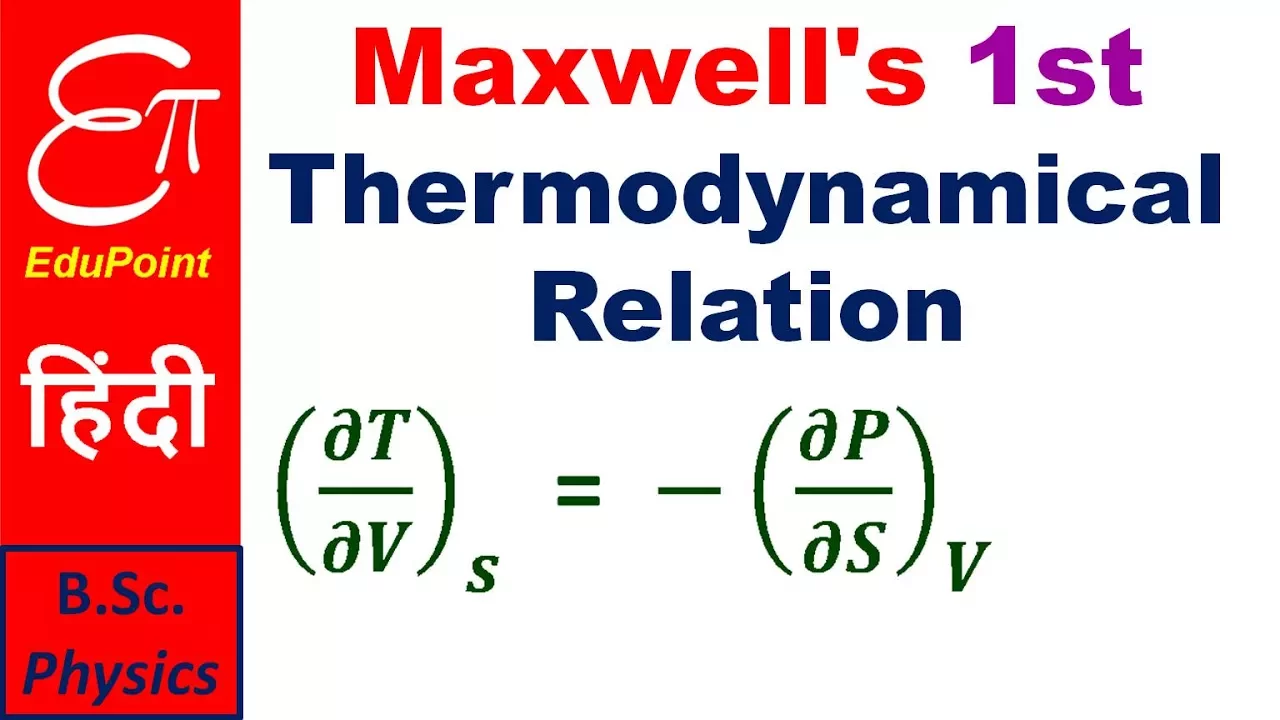











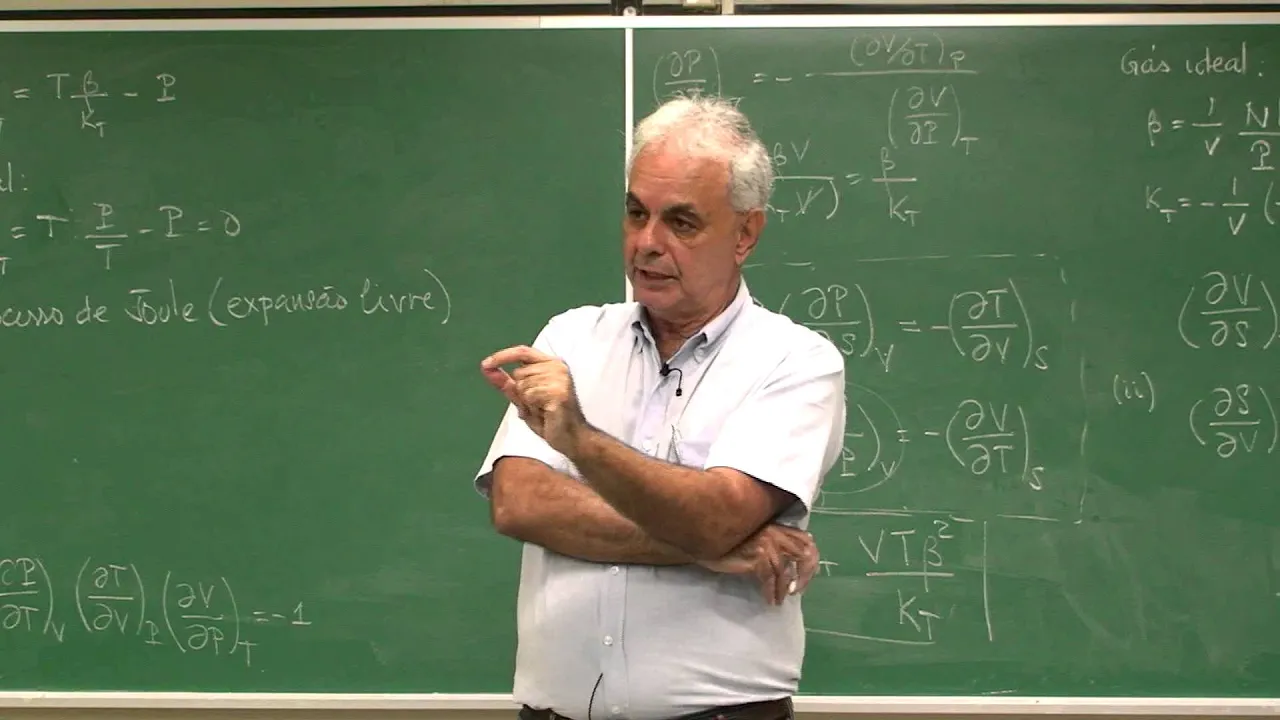





Maxwell's relations in thermodynamics can be easily derived using a modified thermodynamic square method based on the mnemonic 'Good Professors Have Studied Under Very Fine Teachers,' where thermodynamic variables (T, P, S, V) and functions (G, H, U, F) are arranged clockwise in a square; the relations are obtained by drawing parallel arrows between diagonally opposite points and applying a negative sign rule when both entropy (S) and pressure (P) appear together on one side of the equation.
Maxwell's Relations: Thermodynamic Square Shortcut Method
Added:Understanding of the four primary thermodynamic potentials: Internal Energy (U), Enthalpy (H), Helmholtz Free Energy (A/F), and Gibbs Free Energy (G).
Familiarity with the fundamental equations of thermodynamics in their differential forms (e.g., dU = TdS - PdV).
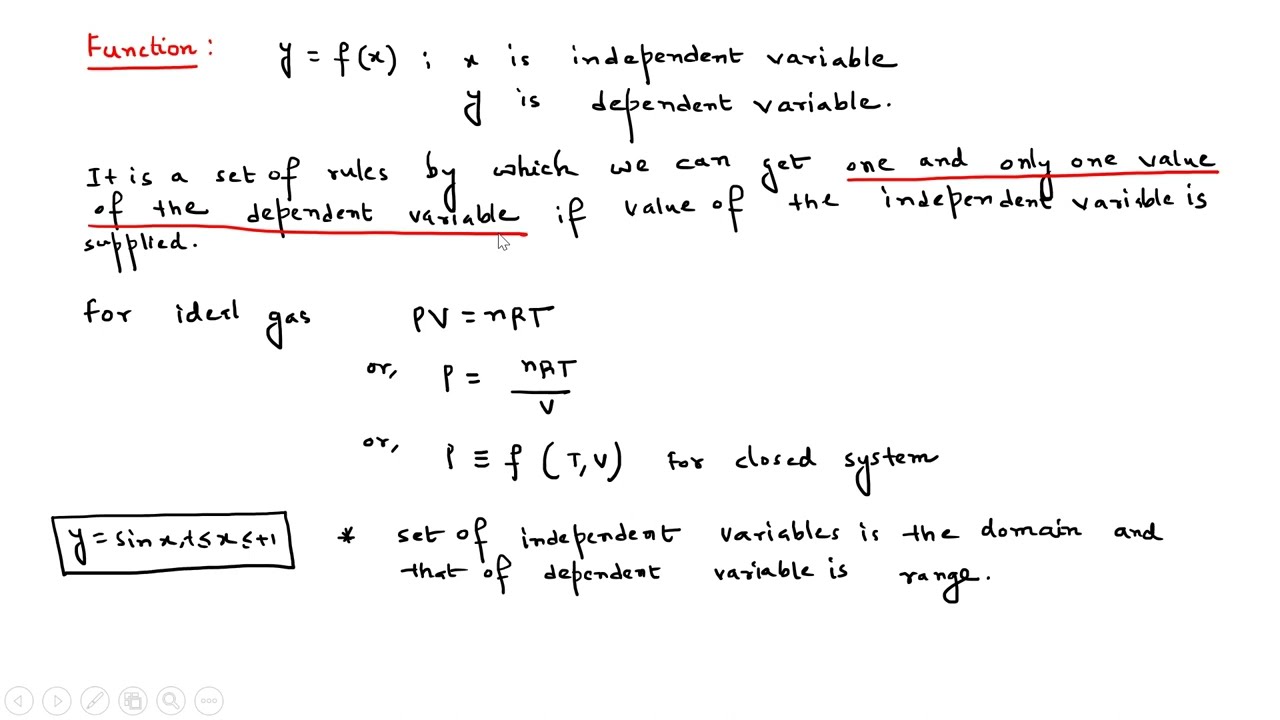
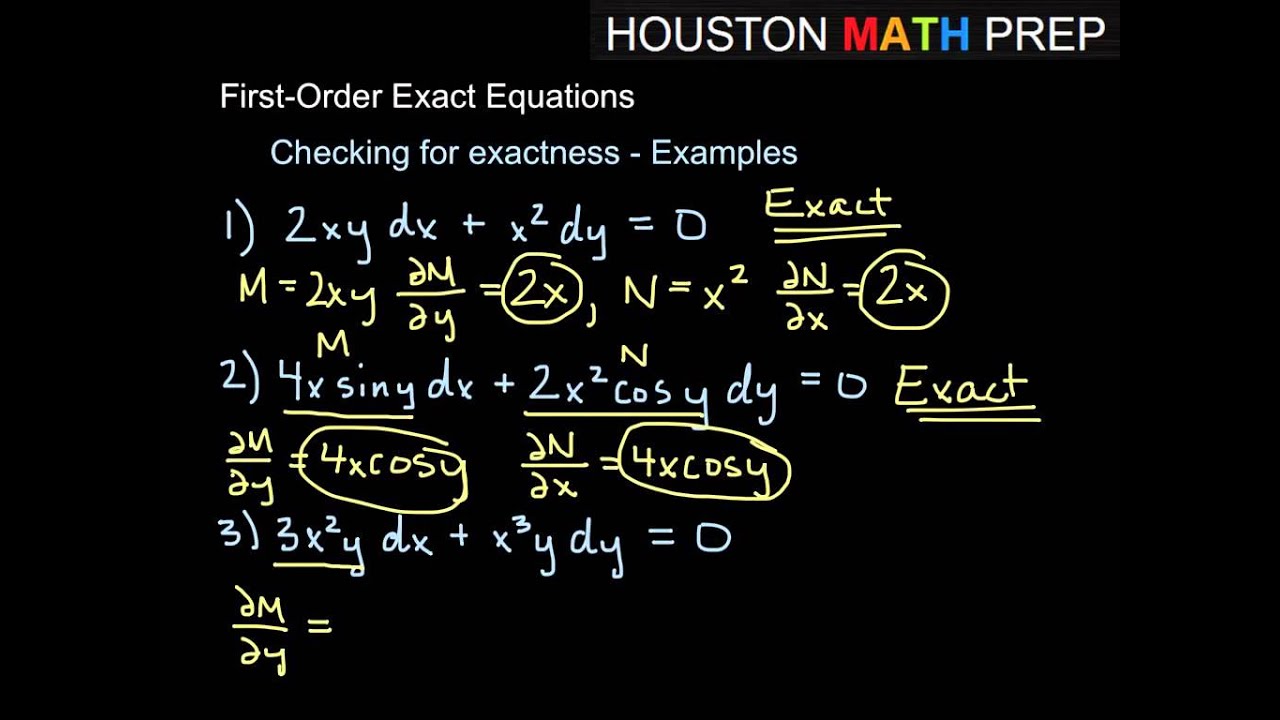
Basic knowledge of multivariable calculus, specifically partial differentiation and Euler's reciprocity relation for exact differentials.
Deriving the first and second thermodynamic equations of state for ideal and real (van der Waals) gases.
Evaluating mathematical relationships between heat capacities, such as deriving the expression for Cp - Cv.
Applying Maxwell's relations to analyze physical processes like the Joule-Thomson expansion and gas liquefaction.
Extending thermodynamic relations to open systems by incorporating chemical potential and partial molar properties.
233.7K views5Klikes13:04Original Release: 2018-05-01
hello students welcome again I am Aditi ever done from our the chemistry calm in this presentation you are going to learn a very easy shortcut method to derive Maxwell's relations it is for csironet gate set iit jam and other university level exams I am going to use a modified thermodynamic square method to derive Maxwell's relations let us start with the construction of modified thermodynamic square it is based on the following mnemonic good professors have studied under very fine teachers here the first letter of each word represents either a thermodynamic function or a variable for example G represents Gibbs function P represents pressure H represents enthalpy s foreign rupee you for internal energy V for volume ever Helmholtz free energy T for temperature I am going to arrange these terms along a square in the clockwise direction starting a twelve o'clock position first of all G's place where the 12 o'clock position of the square then moving to the right side P is written on the top right corner H on the middle of right side then s on the bottom right corner you and the middle of bottom side then V then F and finally T this makes our thermodynamic square once again read the mnemonic good professors have studied under very fine teachers so the terms are arranged in the clockwise manner here in this square the variables are placed at the corner like T P s and V whereas the other terms G H U and F are the thermodynamic functions by using this square it is possible to derive Maxwell's equations very easily we will learn how to do this now watch carefully how are we going to derive Maxwell's first relation first of all draw an arrow on the left hand side of the square from top to bottom that is from T to V and write the partial derivative accordingly that is dou T by dou V now we have to find the variable that is maintained constant here to find this draw another arrow from the first variable that is T to another variable that is diagonally opposite here s is diagonally opposite to the first variable hence right s here that means the derivative now becomes dou T by dou V at constant s now draw another line exactly parallel to the first one but on the right hand side of the square from P to s now write the partial derivative accordingly that is dou P by dou s and you know V is diagonally opposite to the first variable that is P hence here we are maintaining the constant for this derivative so dou P by dou s at constant V now the question is where to put the negative sign to know this we have to follow a simple trick that is whenever both s and P come together right negative sign on that side for example in the above equation the right side has both s and P terms together hence we can put negative sign on the right side this is Maxwell's first relation to make our understanding very clear now I am jumping to fourth relation skipping second and third to derive this fourth relation we had to draw an arrow on the left hand side of the square but now from bottom to the top that is from V to t and write the partial derivative accordingly that is dou V by dou T here V is in the numerator because it is at the starting point of the arrow now since P is diagonally opposite to V we have to write P here now we can read this partial derivative as dou V by dou T at constant P now draw another arrow from bottom to the top that is from s to P in the same direction as that of the first arrow now write the partial derivative dou X by dou P and since T is diagonally opposite to the first variable that is yes we have to write here T now the partial derivative can be read as Doh s by Doh P at constant T now the question is way to put the negative sign we know the trick already whenever both s and P come together right the negative sign on that side again on the right side of the equation we find both s and P hence we can write negative sign and the right side of the equation this is Maxwell's fourth relation now the third relation previously we have seen already the arrows are written on the left-hand side as well as right-hand side from top to bottom as well as bottom to the top now it is also possible to write the arrow from left to right or right to the left that is on the top as well as bottom of the square so to get the third relation we had to draw the arrow from left to right from that is from T to P and the partial derivative is dou T by dou P since s is diagonally opposite right s then another arrow exactly parallel to the first one in the same direction from left to right from that is from V to s so write dou V by dou s and we know that P is diagonally opposite to V so we write P that is dou V by dou s at constant P now the question is where to put the negative sign again our trick whenever both s and P come together write negative sign on that side watch carefully both the left side term as well as the right side both terms are having P and s together hence we had to write negative signs on both sides of the equation but negative negative are going to be cancelled out so we write dou T by dou P at constant s that is equal to dou V by dou s at constant P this is Maxwell's third relation finally the Maxwell's second relation you can guess what is going to happen to derive this relation we have to draw an arrow the top side of the square from a right side to the left side that is from P to t and write the partial derivative accordingly that is dou P by dou T since V is diagonally opposite to P we have to write V here then draw another arrow up on the opposite side parallel to the first one in the same direction there is from s to V now write the partial derivative dou s by Doh V since T is diagonally opposite to the first variable that is s we had to write T now we can read the Maxwell's second relation as dou P by dou T at constant V that is equal to dou s by Dow V at constant T here I am NOT writing any negative sign on any side of the equation it is because we know that s and P terms are not coming together so no need of negative signs this is Maxwell's second relation okay that song this is the end of the presentation thanks for watching visit following pages to find more information on this topic along with previous here questions from csironet gate and set exams don't forget to subscribe to this channel
Up Next

60:07
Second Law and Available Energy - I | NPTEL Thermodynamics Lecture 10
@iit
153.7K views•2010-03-23

12:53
21cm Hyperfine Transition in Neutral Hydrogen: Radio Astronomy Basics
@AaronRobertParsons
12.4K views•2011-10-13

32:32
NMR Spin Physics I: Zeeman Effect, Resonance Condition & Larmor Frequency
@nptel-indianinstituteofsci8064
2.3K views•2024-01-17

27:14
Entropy and the Second Law of Thermodynamics Explained
@veritasium
27.5M views•2023-07-01
Related Study Plans & Knowledge Roadmaps
Structured learning paths in Physics
physics
Nuclear Physics (Decay, Fission & Reactors)
01Atomic Structure and the Binding Force
02Radioactive Decay and Half-Life
03Nuclear Fission Mechanics and Chain Reactions
+ 2 more learning modules
12h5 modules
Explore Roadmap
physics
Soft Matter (Polymers, Colloids & Rheology)
01Foundations of Soft Matter & Thermal Forces
02Polymer Physics and Macromolecules
03Colloids, Surfactants, and Self-Assembly
+ 2 more learning modules
38h5 modules
Explore Roadmap
physics
Analytical Mechanics: Lagrangian & Hamiltonian
01Mathematical Foundations: Calculus of Variations
02From Newtonian Mechanics to Constraint Dynamics
03The Principle of Least Action & Lagrangian Mechanics
+ 3 more learning modules
28h6 modules
Explore Roadmap
physics
General Relativity (Spacetime & Cosmology)
01Foundations of Relativity: Special Relativity
02The Geometry of Spacetime: Equivalence Principle & Curvature
03Einstein's Field Equations: The Mathematics of Gravity
+ 2 more learning modules
55h5 modules
Explore Roadmap