




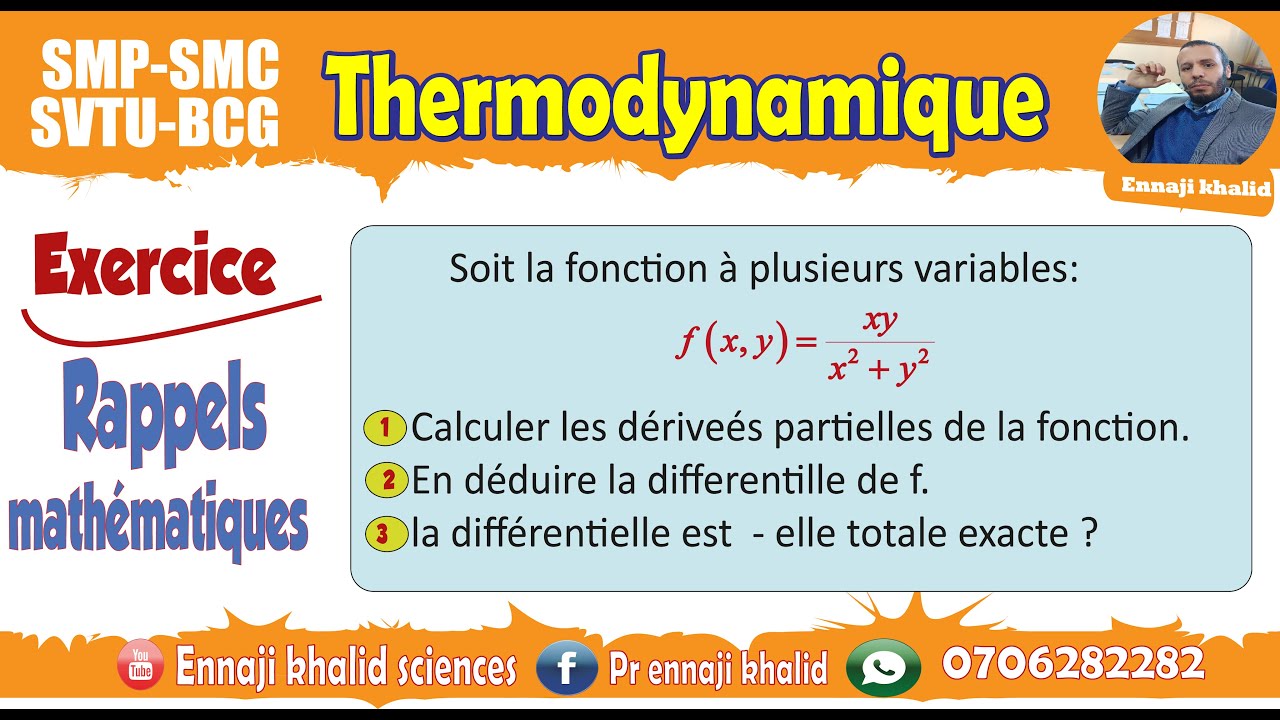
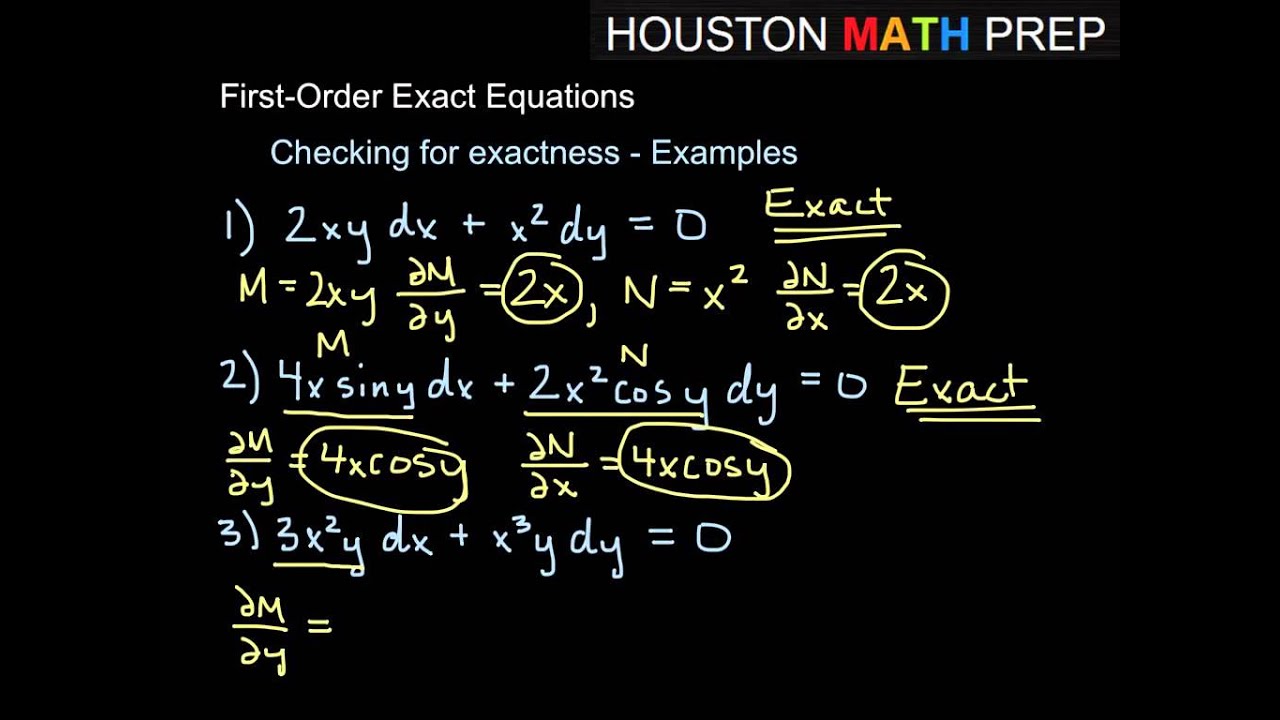





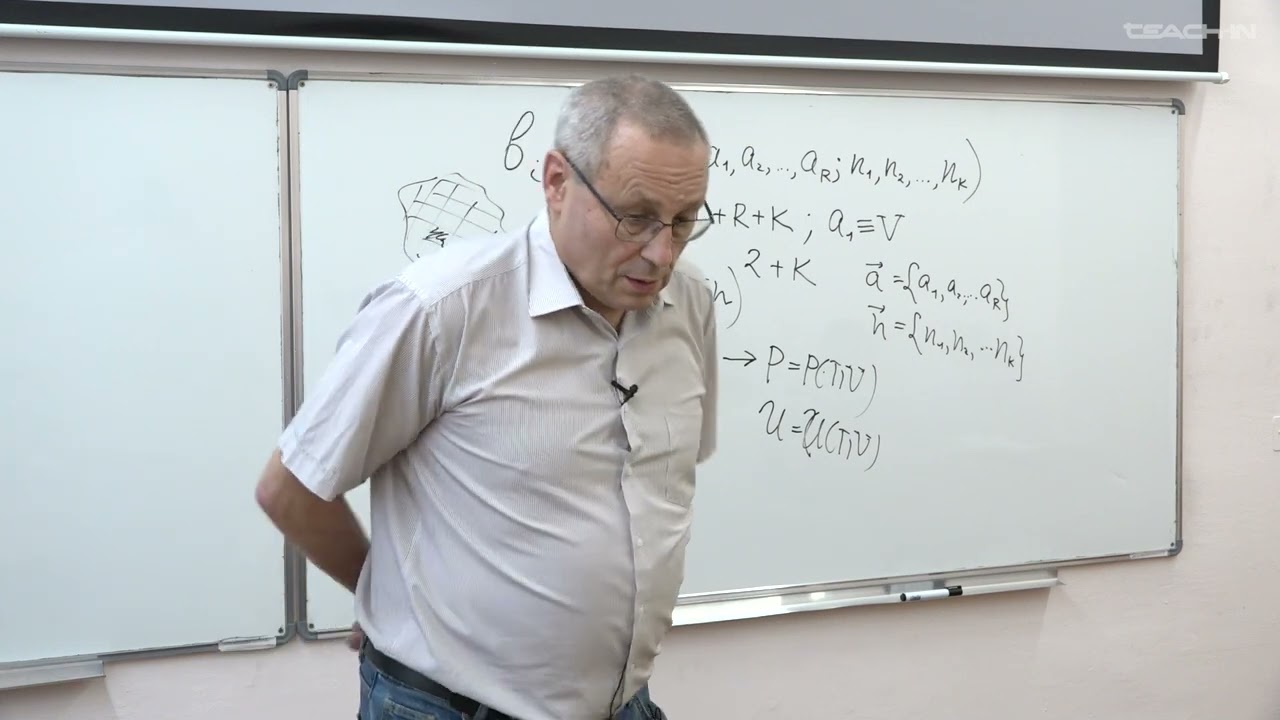












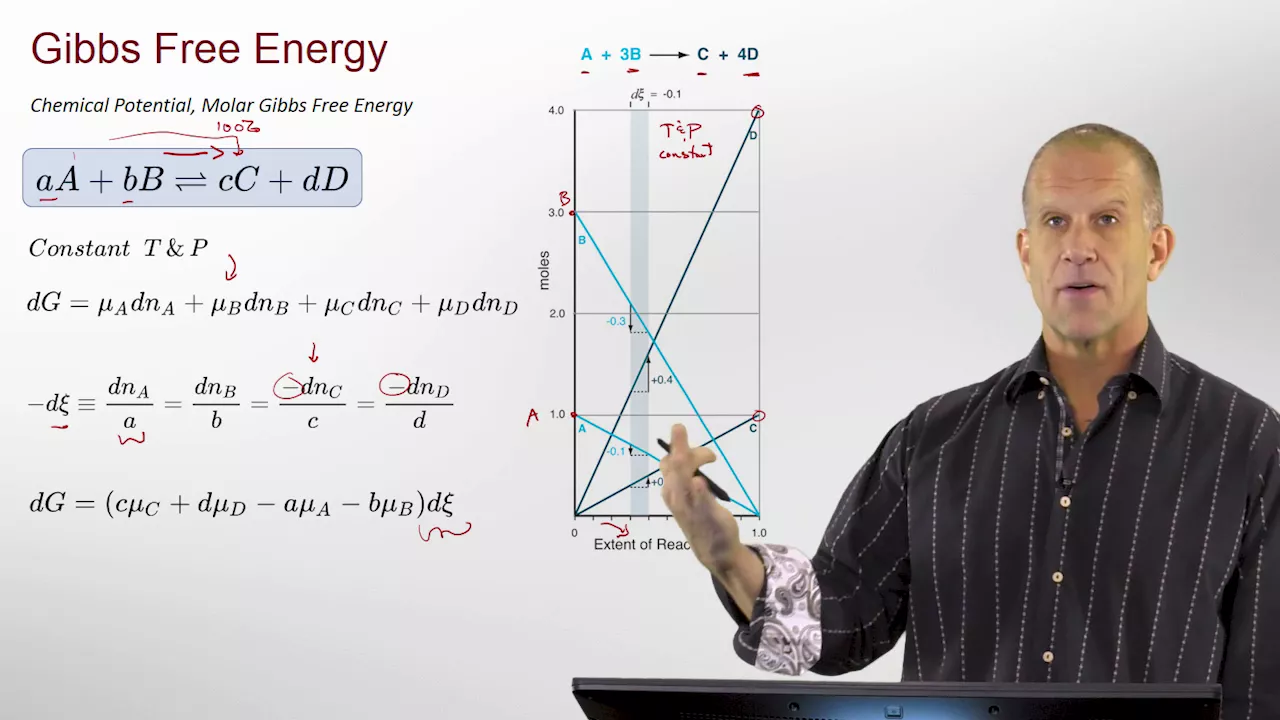



Partial molar quantities describe how thermodynamic properties change when one mole of a component is added to a mixture, with the partial molar Gibbs free energy specifically called 'chemical potential' (μᵢ). For open systems, the differential form of Gibbs free energy is dG = -SdT + VdP + Σ(μᵢ dnᵢ), and the Gibbs-Duhem equation Σ(nᵢ dμᵢ) = 0 shows that chemical potentials cannot change independently but are related to each other through the system's composition, meaning if one component's chemical potential increases, another's must decrease proportionally.
Partial Molar Quantities & Gibbs-Duhem Equation | Thermodynamics
Added:Fundamental understanding of state functions, specifically Gibbs Free Energy (G), Enthalpy (H), and Entropy (S).
Proficiency in multivariable calculus, particularly partial derivatives and exact differentials.
Clear distinction between intensive and extensive thermodynamic properties.
The concept of open versus closed systems and how variable composition affects thermodynamic state functions.
Thermodynamics of non-ideal mixtures, including the concepts of fugacity, activity, and activity coefficients.
Phase equilibria in multicomponent systems, such as vapor-liquid equilibrium (VLE) and the application of Raoult's and Henry's laws.
Chemical reaction equilibria, utilizing chemical potential to derive the equilibrium constant (K) for reacting mixtures.
Application of the Gibbs-Duhem equation to validate experimental thermodynamic data for binary and multicomponent mixtures.
86.5K views1.8Klikes26:42Original Release: 2020-06-25
hello everyone and welcome to the channel now in this particular video we will discuss partial molar quantities now it's going to be the seventh part of our chemical thermodynamics series so let's get straight into the topic [Music] [Applause] [Music] [Applause] all right so up till now whatever thermodynamic relations we have studied uh that is applicable on the closed system okay whatever we have studied that is applicable on closed system and it is a particular system where the matter was not exchanging up till now okay so whatever we have studied like the first law second law the equation of states and all those things were about the closed system where the matter the exchange of the matter was not happening what we are going to do is we are going to take a particular kind of system where the exchange of matter also happens okay so what we are going to do now we are going to study this partial molar quantities uh will correspond to the quantities for the system where matter also exchange okay matter also exchanges now for those kind of system where matter exchanges we have to express it through partial molar quantities for example we have gibbs free energy let's say gibbs free energy denoted by g is actually function of whatever we have studied till now ah we were considering it to be function of temperature and pressure but apart from temperature and pressure for the system in which matter also exchanges it is going to be the function of number of moles okay so n1 n2 m3 and so on to nk these are the number of moles of different constituents in that particular system all right so this is uh going to be your gibbs free energy for a system where matter exchanges so it's going to be function of temperature pressure as well as all these number of moles of different constituent of that system so what is going to be your dg so you will be getting it in this way that is del g by del t okay because it's a function of temperature so we'll do that and keeping rest of the thing constant so pressure n one and two and n k these all will remain constant for this plus it will be like del g by del p and keeping rest of the things like temperature uh n1 n2 and nk these things will remain constant similarly you will have del g by del n1 and here your rest of the things like temperature pressure n2 n3 and so on goes for n k remains constant and so on okay it will go so on and it will be like del g by del n k and rest of the things remain constant you get temperature pressure and rest of the n values so n 1 and 2 these remains constant now in this particular equation this term and this term these are called as your partial molar free energy of component this is called as partial this is partial molar free energy for first comp first component because it is for del n right so first component similarly this particular thing will be called as partial molar free energy for nth component or for kth component because we are representing it as k for kth component okay so that's how these are called as your partial molar quantities now generally what is going to be the definition of this so in general if you want to understand the definition of this partial molar quantity so it goes like that partial derivative of a thermodynamic function y with respect to the amount of component i of the mixture when the temperature pressure and other constituents are kept constant is called as your partial molar quantity of that it component okay and mathematically it is given like y bar is equals to it's like del y by uh del n i and where rest of the things will be constant temperature pressure and other constituents will be kept constant okay so that is how we express our partial molar quantity now there are various partial molar quantities in your system okay and remember that it is this particular thing this partial molar quantity is what it's the change in y when one mole of component i is added in the system okay so that's the that's the significance of it that means that partial molar quantity actually tells us that what is the what is going to be the change in the y y can be any thermodynamic function it can be gibbs free energy it can be internal energy or anything so what is the change in that when one mole of ni is being added okay so it can be if you are expressing it against n1 so when one mole of n1 is added if you are expressing it against n2 so then one mole of n2 is added so this goes like that okay i hope this is much clearer to you all right so in your thermodynamics we have different partial molar quantities let me just tell you about them so these are your different partial molar quantities in thermodynamics this particular one is partial molar internal energy this one is partial molar enthalpy uh this is partial molar gibbs free energy which we have already done and this is also called as partial molal uh work function okay so that's what we have so these are one of the most important partial molar quantities now among all these four the most important one okay the most important one is your partial molar free energy that means this particular one okay so this is the most important one and it has a specific name what we call it we call it chemical potential actually okay we call it chemical potential and we represent it by mu i so that is how we represent it there are other chemical potential also and which are expressed in the other forms like there are different chemical potentials corresponding to internal energy enthalpy and and your work function but over there remember that whatever that particular thermodynamic function will be a function of that means let's talk about internal energy so we know that internal energy is a function of like entropy and volume so if i express it like this that is del uh u by del n i and if i keep constant entropy and constant volume apart from that if i keep other constituents also constant then this will also be called as chemical potential okay uh because it's a function of entropy and volume same goes for your enthalpy you know that enthalpy is a function of your entropy and pressure so if i express del h by del n i at constant entropy and at constant pressure with n1 n2 and so on so this will be also called as chemical potential so if you just express it in this form this is the most important one this is chemical potential whereas there are other chemical potentials also in thermodynamics this is also one of that this is also one of them okay so these all are actually chemical potentials uh because you are keeping the other things constant which the function is actually depending upon okay so that's how it goes uh let's talk about partial molar free energy first of all now we'll come back to the equation which we have used for expressing gibbs free energy we have written the equation in this form in the form of partial derivatives uh now you know like you can just interpret this equation in this way that this particular part will be equal to minus s and dt will be already here plus this particular part that is del g by del p at constant t is actually equal to volume so it will be v dp if you compare with this this is nothing but your chemical potential with respect to n1 so we will call it as mu n1 okay and dn1 will remain as it is then we have this particular term as mu and 2 and then we have d and it goes like that okay so it will be like this only okay it will keep on increasing so what i can write down it's this that is dg is equals to minus sdt plus vdp and plus in the place of this because it is increasing it's a series kind of thing so i can express this in the form of a series i can write down this like sigma mu i d and i and your i goes from 1 to k okay so i will start from 1 and it will go up till k so that is how we can write down and it is a very important equation in the form of your chemical potential okay so gibbs free energy in the terms of your chemical potential can be written as in this particular equation the other thermodynamic system is also written like this okay now remember this particular equation is valid for open system okay it's not valid for closed system for closed system the equation will remain up till here itself now other equations which we can express in the terms of uh like for the open system will be like in the form of d h so d h will be equal to t d s plus v d p and along with that i just have to add this term that is mu i and d n i and rest of the term will go like this i is equals to 1 to k then again i can express internal energy also as tds plus pdv and plus this particular term that is mu i and dni similarly the next one which is work function can also be written in this term and it will be d a is equals to minus p d v minus s d t and plus it will be equal to uh sum of your or sigma mu y d and i so this is how i can express the other thermodynamic functions in for the open system these all equations are valid for open system understand this okay now let's understand that what is the dependence of chemical potential or temperature and pressure so how does your chemical potential depends upon your temperature and on your pressure now if you want to express this the dependence of chemical potential on temperature and pressure we have to take differential of chemical potential with respect to temperature let's say first of all okay so we are first of all understanding the dependence on temperature okay so we can write the ti as temperature dependence so it goes something like this del mu i upon del t and let's keep the other things constant so pressure and ni will be kept constant so what you are going to get you can write it down like this del by del t of let us put the value of mu i mu i is nothing but del g by del and i and it goes like temperature pressure and your other n terms will be remaining constant here okay and this whole particular thing is actually at constant pressure and n i now let's put the value of g now we already know that your dg is actually equal to vdp minus dt and plus sigma mu i and dni right this is what we have just derived from the previous equation so if you put that over here remember that what are the things which are kept constant in this so if you take over all this particular term you are having constant pressure okay the overall thing okay so if you differentiate this if you just differentiate this that is del g by del t if you do that so what i am going to get and if i keep the other things constant del g by del t and if i keep the other things constant what are those things constant uh those are like pressure is constant and ni is constant if i keep that so if pressure is constant this particular term will vanish so i'll just get 0 over here this differential with respect to t is going to be equal to minus s okay and then i'll be having this particular part that is going to be this is again since ni is constant so differential of this particular part will also be zero so i'm applying actually euler's theorem what does that euler's theorem tells me that if i have d by dx into d by d y of a let's say so this can be written as d by d y of d a by d x understood so differentiation can be altered so if what i am going to do i am going to differentiate this del g with respect to t and i am going to keep del ni outside okay so that's what i am i have applied here so this particular term can be written as del by del n i and it can become del g by del t okay and rest of the things will remain constant so i'm not writing them so this particular value of this p and n i the value of this particular thing is minus s so you will get del by del n i of minus s so this after putting the value of this over here as minus s what i got that del minus s by del n i now this i can write down in this way that is minus del s by del and i uh at constant p and rest of the things okay the rest of the things are constant now this is again uh it is also expressed in the terms of partial molar quantity right anything any thermodynamic function if you differentiate it with respect to n i that is with respect to the component that becomes partial molar quantity so here again it became partial molar entropy basically so what i can write down um i can just express it as minus s bar where s bar is the partial molar entropy so i have this that is del mu i by del t at constant p and n i is actually equal to minus s bar okay so that's what i got as my final dependence of my chemical potential on temperature so chemical potential depends upon temperature with this particular term let's check the dependence with respect to pressure as well so when you are talking about pressure dependence again you have the same thing that is mu i is equals to del g by del n i at constant temperature pressure and the rest of the things okay and i so you have this already and what we are going to evaluate is del mu i by del p at constant temperature and at constant ni okay i am not keeping pressure constant because that is what we are going to actually find out so this can be written as del by del t of del g by del um n i okay and rest of the things will be like this so in the same way you have to do okay you have to do it in the very same way that's just the way we did for the temperature dependence applying euler equation and all so what you are going to do now because you know that dg is actually equal to vdp minus sdt and plus sigma mu i and d and i so if you have constant if you have constant temperature so this particular term will become 0 that means if i calculate dg by sorry here should be p right because we were doing it at constant pressure okay so if you calculate dg by dp at constant temperature and ni so this particular term will only give you b this particular part will vanish this particular part will also vanish so what you will get at the end in the same way okay i'm not going to derive it again every each and every step i'm just going to tell you that at the end you will get this that is del mu i by del p at constant t and n i will be actually equal to v bar okay v bar will be your partial molar volume okay this will be your partial molar volume so that's how these things depends upon each other and this is how you can derive the equation to calculate it now we can go a little farther also in this particular step we can solve it a little further for your ideal gas so let's try to do that as well so what we actually calculated till now that del mu i by del p at constant t and n i was actually equal to partial molar volume and we know that for ideal gas we know this thing that pv is equals to rt you're not specifying the number of moles because all these quantities are molar quantities so we are talking about one moles each so don't we know we don't need to specify n over here so v will be equal to rt upon p will put it over here right now and what we will get is d mu i by dp this is going to be equal to rt upon p okay now you can just integrate this by uh like by taking out this differential part to the other side so we'll get d mu i is equals to r t d p upon p and just integrate this equation okay now if you integrate it um this is this will go from initial pressure p naught to some final pressure p at this initial pressure you have some standard chemical potential which will be mu i naught and up till the final uh chemical potential that will be mu i all right so you can integrate that on the left hand side this is just as a differential sorry just as an integral of d x so this is going to give you mu y and on the right hand side if you do this so you are going to get rt and this is going to be lon p okay now putting the limits because we have mu i naught to mu i and here it will go from p naught to p okay upper limit minus lower limit is what we have to apply so this will be mu i minus mu i naught on the other side it will be rt and lon p minus lon p naught okay now lon a minus long b can be written as lon a upon b so that's what you can write down so i'll be just doing it here on the screen so this part will go like mu i is equals to mu naught i plus i have just taken it to the other side rt lon p upon p naught okay so this goes as your dependence of your chemical potential on the pressure so you can see that mu i is your mu i naught is the mu i naught is your standard chemical potential when the pressure of gas is 1 degree bar okay and mu i you can see over here that it depends upon both temperature and pressure but mu i not just it depends upon temperature it does not depends upon pressure why because uh for the standard one you have to keep this particular term is equals to p naught lon one you will get over here and that will vanish so this is not going to be the function of temperature okay so that is something very important that mu i depends on pressure and temperature both whereas mu i naught depends only on temperature okay so it depends only on temperature it does not depends upon your pressure all right so this was all about your partial molar quantities one more topic which is very small and is related to this particular thing is your gibbs to ham equation so let me just finish that and that will be just compiled in this video right now since from the chemical potential uh formula we have understood that mu i bar is nothing but is equals to g i uh divided by your ni right that means if you keep on adding all the gibbs free energy divided by the corresponding number of constituent of that and if you keep on adding that you are actually going to get the total chemical potential all right so or you can write down this thing that gi is actually equal to n i and mu i right you this thing you can just write it down from there or what you can say that gi okay you can say that your gi is actually equal to sigma and i and mu i all right so that's what you can tell for now if you take uh the the sum of it so just like you differential this particular summation when you have both these quantities changing so it can be written in this way that is dg is going to be equal to sigma okay you have to keep it like n i d mu i and plus sigma mu i d and i okay this is called as additivity rule okay so this is called as your additivity rule so that's what you will get it's the it's the property of your summation okay that's how you write down so that's one of the equation which is very important now you know for the open system what we have that for open system we have the value of dg is equals to vdp and minus sdt and plus sigma mu i and dni this is what we have for the open system right now at constant at constant temperature we have dt is equals to zero and at constant volume sorry at constant pressure we have dp is equals to zero right so that's what it means that if you keep both these things constant your dg is going to be equal to sigma mu i and dni okay this is happening at constant temperature and pressure both now let it be equation number one let it be equation number two if these both these equations are expressing the same quantity so that means what that you can just relate these two equations right so once you relate these two equations what you will get that sigma mu i and d and i is equals to sigma n i d mu i plus sigma mu i d n i now you can see this particular part is written twice you can just cancel out this thing and at the end what you will get is sigma and i d mu i is equals to zero so this particular equation is called as your gibbs to ham equation now remember this thing that this is your equation number three and it is not only valid for dg which we have derived it but it is also valid for your work function da also valid for your enthalpy dh and also for your internal energy that is d u okay so that means what you can write down these terms like this okay you can just express it like this that is sigma n i d a i is equals to 0 you can also have sigma m i d h i that is also going to be equal to 0 and similarly sigma and i d u i will also be equal to 0 where these bars are expressing that these are actually you um these are actually your partial molar quantities okay okay so what does this particular gives to him equation means okay so what is the physical interpretation of this so we know that we have just derived that sigma and i d mu i is equals to 0 what is tells you it shows that the chemical potential do not change independently but it is related uh to the composition of like related to the composition of the system okay so if the composition changes your chemical potential also changes okay so that's what your gibbs to ham equation tells you it means that let's say for let's take two component system okay two component system and remember we are already doing everything in the open system okay so we are doing for two component system n1 and n2 so in that case we will have n one d mu one okay plus n two d mu 2 this is going to be equal to 0 or you can say that n 1 d mu 1 will be equal to n 2 and d mu 2 right that's what you will have or you can write down in this way that is sorry with a negative sign here yeah so what we'll have it should be 2 right so now that means what that d mu 2 will be equal to n 1 upon n 2 with a negative sign and d mu 1 this is going to what we are like what we are going to get so what does that mean it means that if d mu 2 is positive then d mu 1 has to be negative ok thus if the chemical potential of the second component increases the chemical potential of the first component decreases so that means chemical potential cannot be changed independently it is going to change in a relation with the number of components okay in the component form understood so that means what that if mu 2 increases then mu 1 decreases this is very important for the gibbs to hand like this is very important interpretation which we have got to know from the gibbs duhem equation it means that for open system you cannot vary the chemical potential independently these all chemical potentials are actually dependent upon each other well that's it for this video guys i hope that whatever we have studied in this particular class we have covered partial molar quantities okay partial molar quantities we have also covered gibbs to hem equation so i guess whatever is being taught is clear to you all and you have understood all the all these things okay so i'll see you guys in the next video with a new topic in this particular series i'll try to finish this up as soon as possible so that's all from my side guys thank you so much for watching if you like this video give it a like if you're new to this channel subscribe to the channel and share this video with your friends thank you so much and have a great day bye
Up Next

26:55
Ternary Phase Diagram Example: Basaltic Crystallization
@kennethbefus
40.6K views•2021-03-12

83:56
Biocatalysis and Catalysis in Islatravir Synthesis | Merck Webinar
@SCIwheresciencemeetsbusiness
675 views•2020-10-08
28:21
Orgel Diagrams: Complete Guide for d1-d9 Complexes & Transitions
@AllBoutChemistry
180.7K views•2018-07-17

17:31
Edible Water Bottles: A DIY Guide to Sodium Alginate Spherification
@ryan
10.5M views•2019-06-21
Related Study Plans & Knowledge Roadmaps
Structured learning paths in Chemistry
chemistry
Nuclear Chemistry: Decay, Meds & Fuel Cycle
01Introduction to Nuclear Structure and Radioactivity
02Decay Dynamics and Kinetics
03Radiation Interaction and Detection
+ 2 more learning modules
24h5 modules
Explore Roadmap
chemistry
Supramolecular Chemistry: Forces & Machines
01Foundations of Chemical Bonding and Intermolecular Forces
02Introduction to Host-Guest Chemistry
03Thermodynamics and Dynamics of Self-Assembly
+ 2 more learning modules
16h5 modules
Explore Roadmap
chemistry
Photochemistry: Excited States & Reactions
01Foundations of Light-Matter Interactions
02Molecular Orbitals and Electronic States
03Photophysical Processes and Jablonski Diagrams
+ 2 more learning modules
18h5 modules
Explore Roadmap
chemistry
Coordination Chemistry: Bonding & Properties
01Introduction to Transition Metals and Ligands
02Crystal Field Theory (CFT) and Geometry
03Magnetic Behavior and Spin States
+ 2 more learning modules
14h5 modules
Explore Roadmap