






















A ternary phase diagram extends binary phase diagrams by combining three binary systems (diopside-anorthite, anorthite-forsterite, and diopside-forsterite) into a triangular surface viewed from above, where temperature contours (cotectics) indicate where two phases crystallize simultaneously; as magma cools, it follows a cooling pathway that drives composition away from the crystallizing phase toward cotectics, eventually reaching the ternary eutectic where all three phases crystallize together, with the lever rule applied to calculate liquid-solid proportions at each stage.
Ternary Phase Diagram Example: Basaltic Crystallization
Added:Understanding of binary phase diagrams, including eutectic points, liquidus, and solidus lines.
Familiarity with the Gibbs Phase Rule and how degrees of freedom change with phases and components.
Basic knowledge of the lever rule as applied to binary systems to calculate phase proportions.
Fundamental concepts of igneous petrology, specifically how magma cools and the order in which minerals crystallize.
Exploring the differences between equilibrium crystallization and fractional crystallization (crystal settling) in ternary systems.
Studying ternary systems that feature solid solutions, such as the Diopside-Anorthite-Albite system.
Learning to use thermodynamic modeling software like MELTS to simulate crystallization in complex, multi-component natural magmas.
Applying ternary phase relationships to interpret the petrogenesis and tectonic settings of real-world basaltic rock suites (e.g., MORB vs. OIB).
40.6K views610likes26:55Original Release: 2021-03-12
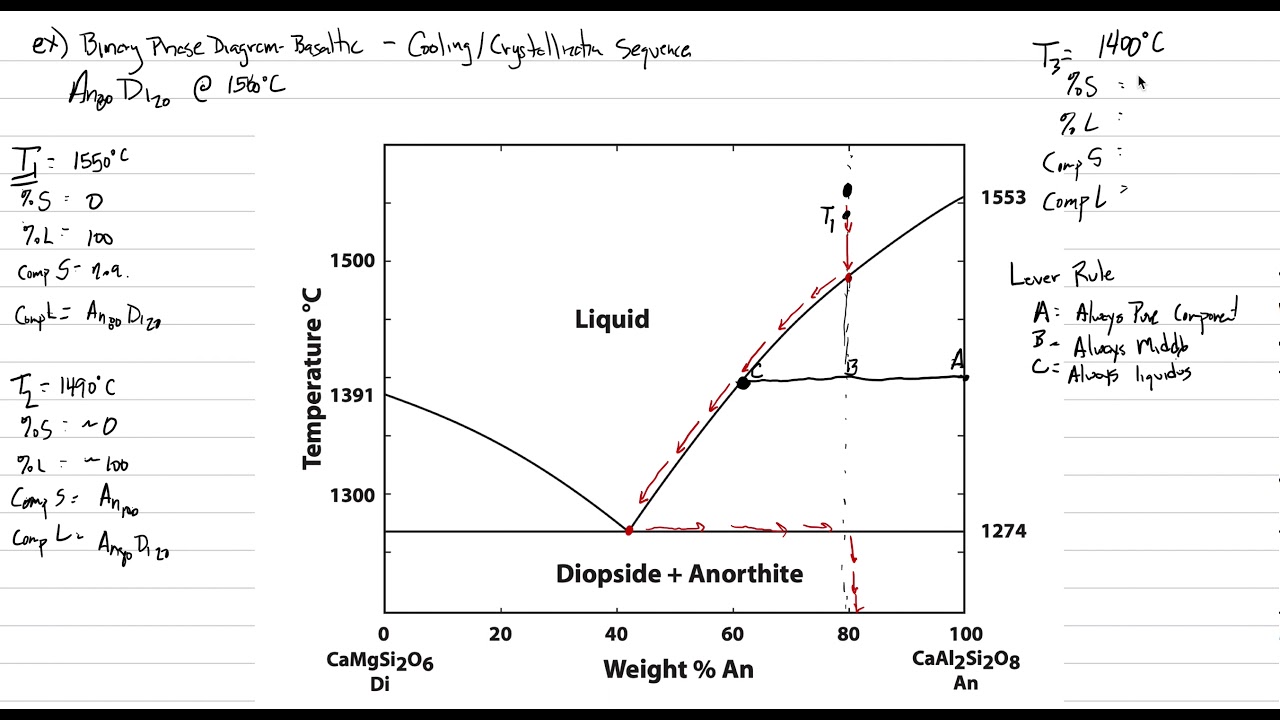
is the last lecture in phase diagrams one thing we know about nature is that nature can be complex and a binary explanation of a system might not be appropriate now we could add a third dimension if we move to ternary diagrams instead of using binary and so that's what the purpose of this lecture is is to describe for you and give you an example of how to use a ternary phase diagram to explain a basaltic melt here in our binary system we went from diopside to anorthite with a what did we have we had we had a phase diagram right that looked like oh that was a little sloppy but it went from diopside to anarthite and there was a solidus and then there was two liquidus surfaces and a eutectic point now this diagram is how i want you to visualize this limb of this ternary diagram going from diopside to anarthite with at 1274 a eutectic point right here but what we've done to complicate this diagram is we've actually added another binary phase diagram on this axis that goes from anarthite to forster right and down here at the bottom we've added a whole nother phase diagram binary phase diagram that goes from diopside to four stripe and by combining these three binary systems we can actually interpolate between them to create a full ternary diagram we look at the binaries on the side view whereas we look at the ternary from the bird's eye view looking down on a surface each of these dashed dotted lines here these are temperature contours and we read them just like we'd use elevation contours so for example this is our 1600 degrees c and we're going to go down in temperature to 1500 degrees c heading towards a thermal valley so here it's hot here it's 1400 here it's 1400 between them there's a cold point and this colder line which we're going to label a thermal valley that thermal valley is known as a cotectic and a cotectic is a temperature or is a place where two phases are crystallizing the cotectic is where two phases crystallize here is another cotectic this dark line here this is a thermal valley and here's another cotectic and where the three thermal valleys all go together to that point right here that is the ternary eutectic ternary eutectic and at the ternary eutectic three phases are crystallizing anarthite diopside and four strand and so we have just added by adding three together we can describe how three different mineral phases can all crystallize together this is much more powerful than the binary and it's a little more complicated my students struggle with a couple ideas the first is going to be how we're in bird's eye view we're looking down on a surface and we need to be able to visualize that surface in three dimensions and if you can just you know see that here's 1400 line and that is like 1400 here and then we go down towards the thermal valley we're going down towards the thermal valley as we're headed towards the cotectic and then we continue to roll downhill so let's just say for example we had a magma and the magma is right here and it's at 1 500 degrees c well we're above here's the 1500 contour and so if we're at 1500 degrees c here the actual temperature of crystallization the liquidus surface here is above is between 1500 and 1400 so it won't crystallize anything until maybe 1420 but as soon as we hit 1420 on a cooling pathway we're going to crystallize something and we're going to crystallize whichever end of the triangle we're closest to not separated by a valley so in this case we would crystallize anarthite and we would drive away from the composition of melt would drive away from n-member anarthite down topography until we get to the cotectic we would start to crystallize forced right at that point and by doing that we would then continue to cool going down the thermal valley of the kotectic until we reach the eutectic point where the remainder of the magma will crystallize until the last drastic gasp of melt goes away and then we would disappear down into the screen below the solidus as we turn as the rock continues to cool that would be a descriptive path for how the composition changes we need to do that now actually in practice again read the textbook if this is like really causing you to stumble because i guarantee you it is complicated and there are students that struggle with this a lot hopefully this example will will help you we're going to do a basaltic composition let's do a basaltic melt composition and we're going to do cooling again i've purposely done cooling every single time hint to my students i'll probably do melting on an exam and our composition is going to be diopside 20 anarthite 30 forced to write 50. first step is finding where that bulk rock composition or bulk magma composition is and you do that on a ternary diagram diopside 20. well here's diopside 100 we need to go down down down here's diopside 30. here's diopside 20 this line right here and we're forced to at 50 i think that here's the 50 line for forced right right because here's the 100 point for force right so we're gonna go at where the 50 meets the 20.
that's our bulk magma composition our t1 will be at 16 50 degrees c what is the temperature where the first crystal will form at this point well it's at 1600 because that's where the dot sits on the temperature contour so at t1 1650 we actually have a percent liquid of 100 we have a percent solid of zero we have a uh oops let's see comp right we're going to do our compositions we got our composition liquid well it's the same as what we started with di20 a and 30 forced to write 50 and the composition of the solid is not applicable so we have just started we are well on our way the very first crystal that forms is going to form at 1600 so let's actually go ahead and talk about that as our t2 and so our t2 is when we're going to first hit the liquidus so i'll say that here first hit liquidus which means our very first crystal forms and that is going to be where it hits the contour at 1600 degrees c percent liquid solid composition liquid composition solid well it's our very first crystal so we're still at just about a hundred we're at just about zero compositional liquid hasn't changed much because we've just pulled that one crystal so it's di20 a and third 30 fo 50 but the composition of solid is our first actual real unknown we are on the big limb of this ternary that is closest to the force to right apex we are on the thermal hill the thermal mountain of forsterite we have not yet hit a cotectic that can precipitate anything else and so since we're on this slice of the pie the pizza pie then we will be crystallizing forced to write 100. if we pull four straight 100 out of the melt we have to then push the melt away from this apex and so what we're going to end up doing is draw in our tie lines and the tie lines have to be we're going to draw a straight line that goes from this force to right oh it's hard to draw a straight line here use a ruler that's going to be the most important line that you draw on this diagram have it be perfectly straight connecting from this apex going through our composition point and hitting the cotectic but at this point we're still sitting at that dot we haven't moved at all in this direction which is the direction we're going to be headed so nothing complicated has yet happened let's make something happen let's have now the magma is going to cool from 1600 to 1500. so here what this is t2 and here it's also t1 and now we have cooled to 1500 and so we have actually moved to this spot right here which is a dot along the tie line between the four stride apex and our bulk rock composition this is t3 t3 we'll do it up here t3 is at 1500 degrees man don't be sloppy t3 is at 1500 degrees celsius we need to know liquid solid composition liquid composition solid and we're going to need to use the lever rule here for the very first time the lever rule is not any more complex in this system than it was in the binary what i want you to do is put in uh a at the forced right apex we're going to put a b in at our tipping point that's a little hard to see isn't it let's put it i'll put it right here and we're going to put a c we're going to label that little c3 and with our lever rule we're going to be able to figure out the percent liquid and percent solid at each point and so the percent liquid is this big line here and so the percent liquid is a the length of a b over ac and the length of c to b we're still hot it should be a shorter line and it is b c over ac is our percent solid so i've measured this in millimeters on my sheet of paper and our percent liquid is 82 over 104 which gives a percent liquid of what is that going to be that's about 80 right and the other one is 22 over 104 and that equals about 20 so that's our percent liquid and our percent solid the composition of our liquid is the point on this graph relative to our three n members and so this is going to be diopside 10 downside 20 diopside 24.
it's going to be forced to write let's see that's 190 80 70 60 50 40.
let's see 10 20. 30. 38.
yeah that's pretty good forced to write and it's also anarchite 38. the composition of the solid well we're still in the domain of four stripes so it has to be forced to write 100. again take a look at the textbook if this stumped you but i hope it was making sense to you let's do another composition before we do anything fancy let's have a t4 b at 1400.
see t4 at 1500 if you want to pause the video right here and go ahead and do it on your own and then check your answer um with me because i'm just going to keep working along right here we have our a we have our b now there's more crystallization that's occurred by the time you get to 1400 so we're actually going to label c4 right here so our percent liquid is a b over ac our percent solid is now b to c4 over ac and that number should have increased on my sheet of paper i have that length as 43 over 126. like a knucklehead i did not actually calculate that out why did i not do that i can't do that during my video well you could you could double check what is that's like um like 66 percent and that's like 33 doing that in my head right now instead of with a calculator that makes me feel pretty bad what is our composition liquid and our composition solid composition solid i hope you got it right it's still fo 100 that's going to change once we hit the cotectic but for now we're still in the forest right domain our composition liquid should become more poor and forced to write and at this point right here we are going to be at around diopside here's 90 80 70 60 50 40 diopside 28 we're gonna be at forced to write 10 24. you sum the two that's going to have to be anarthite 90 80 70 60 50.
about 48 does that sum yeah it does and 48. okay so you're i think you're getting the idea how we're going to do these little the c's are going to be progressively getting closer to the eutectic now now let's do the actual complication of the ternary and the complication of the turn area is we're going to hit the gotectic we're going to change the composition of the melt so t 5 is right here 1390. we have just reached the cotectic t3 is at 1300 degrees c we have reached the cotectic and we have just reached the cotectic we have just crystallized the very first crystal of anorthite we're going to need to put in our percent liquid percent solid composition liquid composition solid because we've only crystallized like one crystal of anatothyte actually our process is identical to what we've done right now why did i put that as a three that's obviously t5 we're going to put a dot in here and label that t5 we're going to label c5 and our process will be the same as what we have done our percent liquid is a b over ac i have that as 83 over 143 which is 58 8 our percent solid is b uh to c5 over ac which is equal to 60 over 143 on my sheet of paper which is about 42 percent and then the composition of the solid is still forced to write 100 but it's almost not anymore it's like forced to write 99.9999 and orthite 0.0001 because we've just added the very first crystal of anarchite to the melt the compositional walk of the melt is where we're sitting right here and so that is going to be diopside 30 and orthite 54 and forced to write 16.
okay so now let's do the fun stuff what ends up happening now is we're going to drive away in this direction down the cotectic thermal valley and we're going to change the amount of crystallization that occurs so we're going to go we're going to start crystallizing and we're going to drop to 1280 degrees here we go this is t 6. so t6 is at what did i just say 1280 1280 degrees c we are crystallizing two phases two phases forming and we have to draw a new line in here's the new line we're going to draw a new line at t6 that connects t6 through our bulk composition and it's going to strike this limb of our triangle about here so again this is a little harder for me to do on my tablet but i'm gonna put a line in like so oh good that actually turned out pretty good and we're gonna label some points on this we're gonna label we have a new um we're going to go a 6. b is the same and we're going to go c 6.
this is how we set up the lever rule now it's a different line and that's important percent liquid solid composition of composition of the solid we are going to measure the length of that line for our lever rule and and it's the same it's the same way okay it's a b over ac so i have this as 56 over 1 122 that is this length right here from here to here is 56 and the whole length on my sheet of paper is 122 millimeters that gives me a percent of liquid of 46 whereas the percent solid is from c6 to b and that is 66 over 122 which is about 54 the composition of the liquid is the dot right here and i have the comp that that's going to be a composition of liquid of d i so here's so let's see okay i here's 90 80 70 60 50. we'll say 41 and it's anorthite 49 and that's going to make it be forced to write 10. it's about right and the composition of the solid this is the new bit it's the intersection right here so that is our this this intersection point right here is the comp solid t6 and i have it as force to write 87 anarthite thirteen right so anarthita hundred and orthotite 13 is here forced to write a hundred four straight 87s right here so it's the intersection of our new tie line with that axis okay i know this is taking a little while but it's better to be thorough and make sure you understand it than to rush too much let's now explain and so what will end up happening is as we get progressively closer to our ternary eutectic we have to draw in new lines like that so that could be like a t uh seven and we could do another one t8 but now let's go ahead and do what happens at the ternary so what what t um i guess we'll go that too light of a color let's go darker green so t 7 is going to be at 12 70 degrees c we have just arrived to our thermal minimum and our invariant point our ternary eutectic at the ternary eutectic we are going to start crystallizing a third phase so all three we'll say this all three minerals are crystallizing the magma wants to disappear and have the whole rock i mean it's super cold it's 1270. so at this ternary tactic we've just reached it we need to do everything we percent liquid percent solid composition liquid composition solid we're going to have to draw a new line that goes from this point through this point it's going to intersect our limb over here so put that in boom put it this is our actual okay that's not t7 that was just a demonstration i was doing here is our actual t7 uh composition that's forming right when we reach the eutectic our percent liquid is going to be c7 b a7 and it's just the lengths i have we measured this out our percent liquid on my sheet of paper is 48 millimeters divided by 123 millimeters giving me 39 percent liquid just when we reached the eutectic the amount of solid is millimeters divided by 123 millimeters 123 millimeters is the length of the green line i've just put in and that is going to be 61 solid the composition of the liquid is this point right here which is di50 it is a n 44 and it is fo six or seven and this has to add to a hundred so we'll put it in a six and then the composition of the solid that's forming just when we reach the ternary is right here and what is that that spot right there is going to be anorthite 28 forced to write 72.
did i say enterthing28 and it's actually also going to have diopside 0.0001 the very first diopside crystal is going to form when we just arrive to that ternary eutectic and as we continue to crystallize we could do another color uh should we do bright pink that might be too much let's go purple t8 t8 is going to be also at 1270 degrees c and we are going to depart eutectic departing eutectic we're going to be right here that is c 8 with the same we'd have to have the same tie line but we don't need the same tie line anymore because we've just sat here for thousands of years and that 39 liquid is now gone away so our percent liquid when we are just departing from the eutectic is essentially zero the last drop is disappearing our percent solid is about 100 and the composition of that liquid is still the composition of that exact dot so we could go to what we did before di50 and 44 fo 6 the composition of the solid is our composition of our starting material which is right there at b oh this is starting to get messy right i hope you kept yours clean it's going to be our starting material right here d i 20 a and 30 f o 50. at all colder temperatures than 1270 it's just a solid rock disappearing down into the page from our bird's eye view to colder and colder temperatures below the solidus well i hope that helped if you need more practice on your own use that textbook
Up Next
11:28
Tropospheric Chemistry: Hydroxyl Radical Reactions Intro
@dr.ianmackenzie869
627 views•2021-09-20
83:56
Biocatalysis and Catalysis in Islatravir Synthesis | Merck Webinar
@SCIwheresciencemeetsbusiness
675 views•2020-10-08
10:06
1H NMR: Determining Number of Peaks from Structure
@MSJChem
59.2K views•2017-04-06

17:31
Edible Water Bottles: A DIY Guide to Sodium Alginate Spherification
@ryan
10.5M views•2019-06-21
Related Study Plans & Knowledge Roadmaps
Structured learning paths in Chemistry
chemistry
Nuclear Chemistry: Decay, Meds & Fuel Cycle
01Introduction to Nuclear Structure and Radioactivity
02Decay Dynamics and Kinetics
03Radiation Interaction and Detection
+ 2 more learning modules
24h5 modules
Explore Roadmap
chemistry
Supramolecular Chemistry: Forces & Machines
01Foundations of Chemical Bonding and Intermolecular Forces
02Introduction to Host-Guest Chemistry
03Thermodynamics and Dynamics of Self-Assembly
+ 2 more learning modules
16h5 modules
Explore Roadmap
chemistry
Photochemistry: Excited States & Reactions
01Foundations of Light-Matter Interactions
02Molecular Orbitals and Electronic States
03Photophysical Processes and Jablonski Diagrams
+ 2 more learning modules
18h5 modules
Explore Roadmap
chemistry
Coordination Chemistry: Bonding & Properties
01Introduction to Transition Metals and Ligands
02Crystal Field Theory (CFT) and Geometry
03Magnetic Behavior and Spin States
+ 2 more learning modules
14h5 modules
Explore Roadmap