







![[ゆっくり芸術家解説]~サルバドール・ダリ~[ぐにゃぐにゃ時計]](https://i.ytimg.com/vi/XOKEIHSL8rw/maxresdefault.jpg)







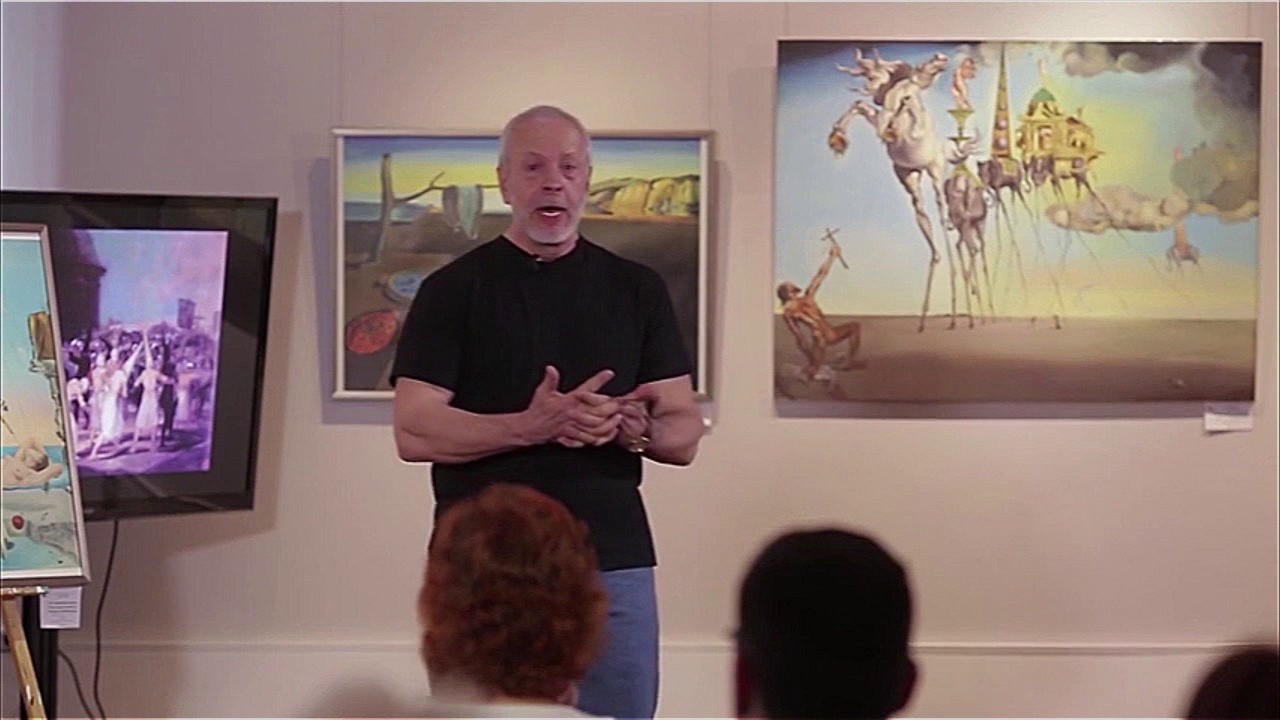






Salvador Dalí's 1937 painting 'The Metamorphosis of Narcissus' exemplifies his paranoiac-critical method, a surrealist technique where forms simultaneously represent multiple objects (such as hands, eggs, and bodies) to access the unconscious mind; unlike other surrealists who used automatic methods to let the unconscious emerge freely, Dalí combined this psychological approach with classical artistic precision, creating works where forms exist as both one thing and another simultaneously.
Dali's Metamorphosis of Narcissus: Surrealism & Paranoia
Added:The Greek myth of Narcissus and its classical themes of vanity, self-reflection, and transformation.
The core tenets of the Surrealist movement, particularly its focus on releasing the creative potential of the unconscious mind.
Basic principles of Freudian psychoanalysis, especially the concepts of the unconscious, dream symbolism, and repression.
An introduction to Salvador Dalí's life, artistic career, and his unique style of highly detailed, dream-like painting.
In-depth study of Dalí's self-developed 'Paranoiac-Critical Method' and its application across his other major works from the late 1930s.
The historical intersection and direct correspondence between Salvador Dalí and Sigmund Freud, including their 1938 meeting in London.
Analysis of double imagery, optical illusions, and cognitive perception in modern and contemporary visual arts.
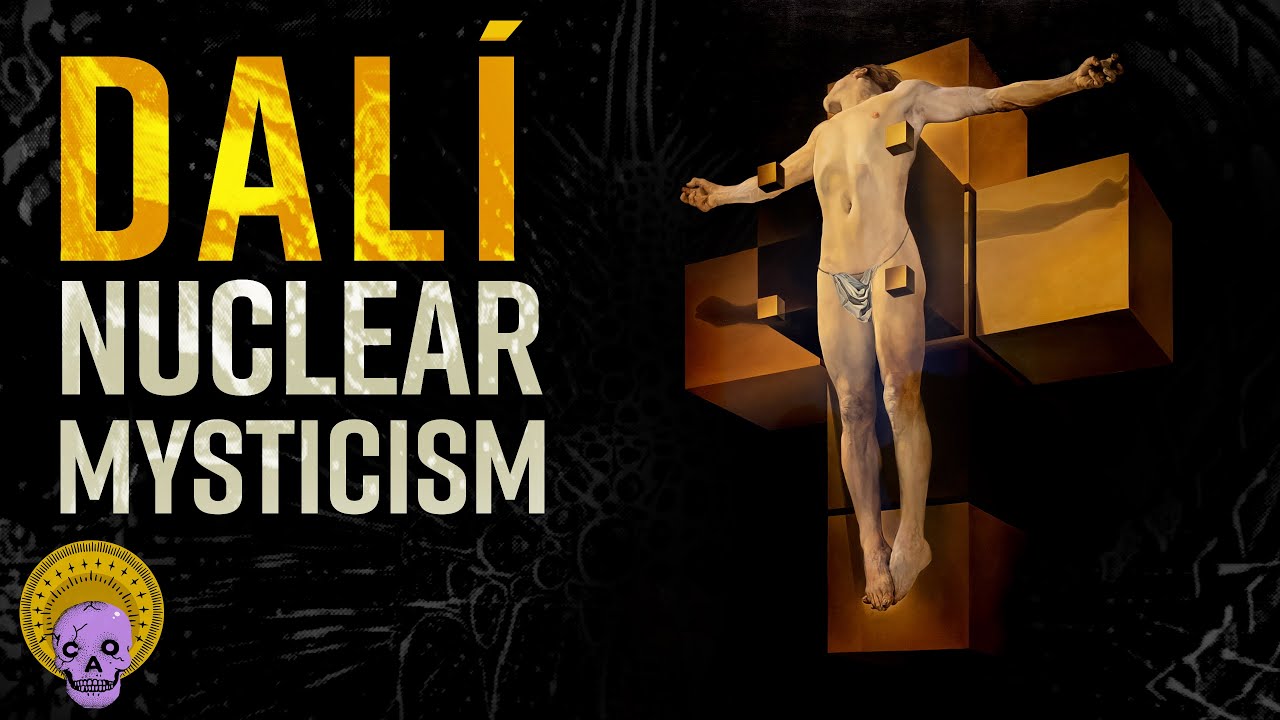
Dalí's transition from traditional Surrealism to his later 'Nuclear Mysticism' phase, influenced by science and religion.
81.2K views377likes4:08Original Release: 2011-10-18
SPEAKER 1: We're looking at a painting by Salvador Dali in the Tate Modern.
It's The Metamorphosis of Narcissus, and it dates to 1937.
It's a pretty wild painting.
SPEAKER 2: So what I see that relates to that is this hand that seems to be emerging from the earth, that holds an egg from which seems to be hatching Narcissus.
SPEAKER 1: Except that so many of Dali's paintings, and rendering in Dali's paintings, which are painted in that kind of classical manner in terms of it's sort of-- SPEAKER 2: It's very realistic.
SPEAKER 1: --it's precision, It's careful rendering of space, even if that space is distorted, of shadow, of line.
If you look at the egg from which the flower is emerging, it seems to be emerging from a crack that is also the shadow of the flower at the same moment.
And so it's both those things sort of simultaneously.
And, in fact, the whole painting seems to be about forms being one thing, and, at the same moment, another.
SPEAKER 2: Because there is, behind that hand, another hand that seems to be emerging from a pool of water.
This time not rock, but something-- because it's brown, maybe it seems more earth-like.
And holding also an egg-like shape, but actually it looks a little bit more like a walnut.
But it also has a crack.
And from that seems to emerge a hair that looks like a flame.
SPEAKER 1: Because the hand is, in that second iteration, not so much a hand, as actually a crouching body-- the body of Narcissus.
SPEAKER 2: You can see knees and arms.
SPEAKER 1: But what's wonderful is that whereas the figure that's yellow on the left, slightly further back, is a body where the head is a walnut.
On the right, it's more clearly a close-up of a hand holding an egg.
And yet, they're precisely the same forms.
It's that doubling.
It's that mirror that's so incredibly disconcerting.
All of this needs to be contextualized.
What in the world is Dali doing?
Well, what he said he was doing, and what Andre Breton lauded him for-- he was a writer often seen as one of the leaders of the surrealist movement-- SPEAKER 2: And he wrote The Surrealist Manifesto.
SPEAKER 1: Right.
All of the surrealist manifestos, or at least a number of them, yes.
They called the ability of Dali to do this, to see things simultaneously as more than one thing, as a result of a psychological state which they called paranoiac-critical activity.
SPEAKER 2: Sounds scary and dangerous.
SPEAKER 1: [LAUGHS] Well, I think they loved the fact that it was scary and dangerous.
And it was based on the kind of willful misreading of Freud.
You know, Freud talked about the filters that kept the unconscious and the conscious mind apart.
But Dali claimed that in a state of paranoid critical activity, he could actually embrace both the conscious and unconscious simultaneously so that his conscious mind could actually do the painting.
The brilliance of understanding that form as both a hand and a body, as flesh and stone, simultaneously, that, Dali, would have claimed was absolutely the result not of the rational mind-- impossible in the rational.
But it was the result of the irrational, of a conversation between those two states in this state of paranoid critical activity.
[LAUGHS] SPEAKER 2: OK.
It was incredibly important to the surrealists to access that unconscious, to access something that was more authentic, that lacked the control of the conscious mind.
SPEAKER 1: For them, that was the engine of creativity, absolutely, was this motherload of the creative.
I mean, when we think back to the 19th century and we think back to artists like Gauguin, wanted to get back to nature, like Courbet wanted to get back to nature.
The unconscious, for the surrealists, that was the great goal.
That was it.
SPEAKER 2: Right.
SPEAKER 1: So what's so interesting is the surrealists go at this from a number of different points of view.
SPEAKER 2: Right.
SPEAKER 1: People like Miro will try to, in a sense, allow for the unconscious to emerge, and paint using an automatic method that is not allowing the conscious mind to interpret.
Whereas Dali is sort of wanting both.
He wants the perfection of the academic style to render the inspiration of the unconscious.
Up Next

8:00
Richard Hamilton's 'Just What Is It' | Pop Art Analysis
@miniartdocs_art1037
12.2K views•2018-08-21

114:18
Christian Iconography: History, Theology, and Meaning | Fr. Panayiotis Papageorgiou
@Trisagionfilms
58.8K views•2020-02-21

10:26
Redgrave's The Sempstress: Victorian Social Realism, 1846
@smarthistory-art-history
3.2K views•2011-10-22

16:34
Earliest Depictions of Jesus in Art: 10 Ancient Images Explained
@UsefulCharts
5.9M views•2022-06-03
Related Study Plans & Knowledge Roadmaps
Structured learning paths in Art History
art-history
Gothic Cathedrals: Engineering, Light & Society
01The Birth of the Gothic: Romanesque to Suger's Vision
02The Structural Triad: Pointed Arches, Ribbed Vaults, and Flying Buttresses
03Theology of Light: Lux Nova and Sacred Geometry
+ 2 more learning modules
14h5 modules
Explore Roadmap
art-history
Pre-Raphaelites: Realism, Symbolism & Critique
01The Victorian Art Establishment and Academic Formula
02The Founding of the PRB and Radical Realism
03Medieval Revivalism and Literary Symbolism
+ 1 more learning modules
8h4 modules
Explore Roadmap
art-history
Street Art: From Subways to Art Market
01Subcultural Origins in Philadelphia and New York (1970s)
02The Subway Era and Style Wars (Late 1970s - 1980s)
03The East Village Scene and Early Gallery Crossover
+ 2 more learning modules
10h5 modules
Explore Roadmap
art-history
Classic Maya Art: Iconography, Glyphs & Ritual
01Foundations of Classic Maya Visual Culture
02Deciphering Maya Hieroglyphs & Text-Image Integration
03Sacred Geography and Cosmological Architecture
+ 2 more learning modules
14h5 modules
Explore Roadmap