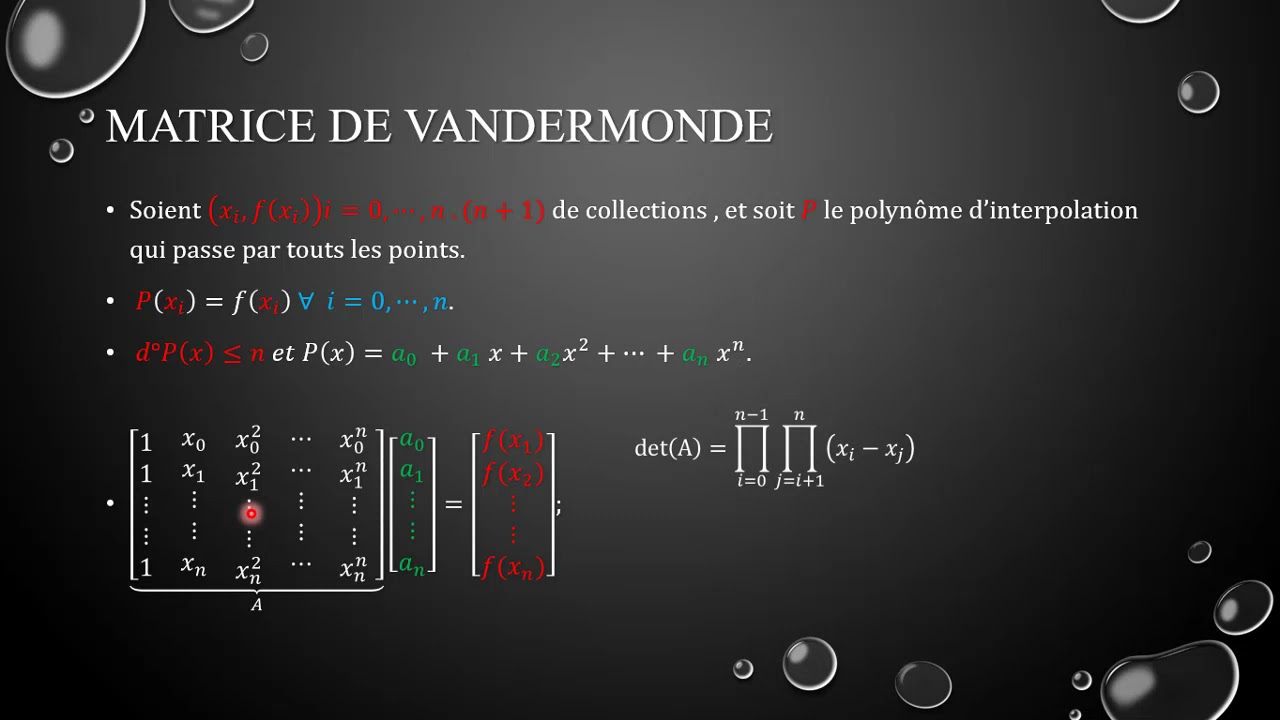




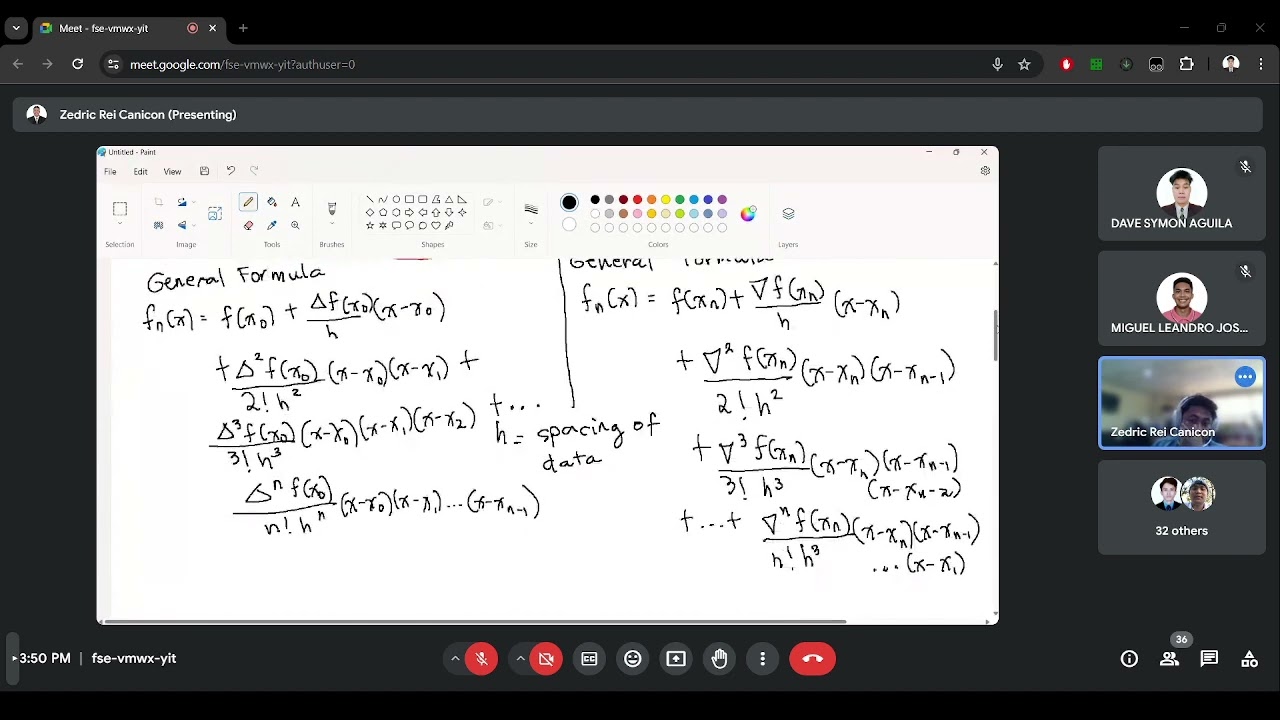








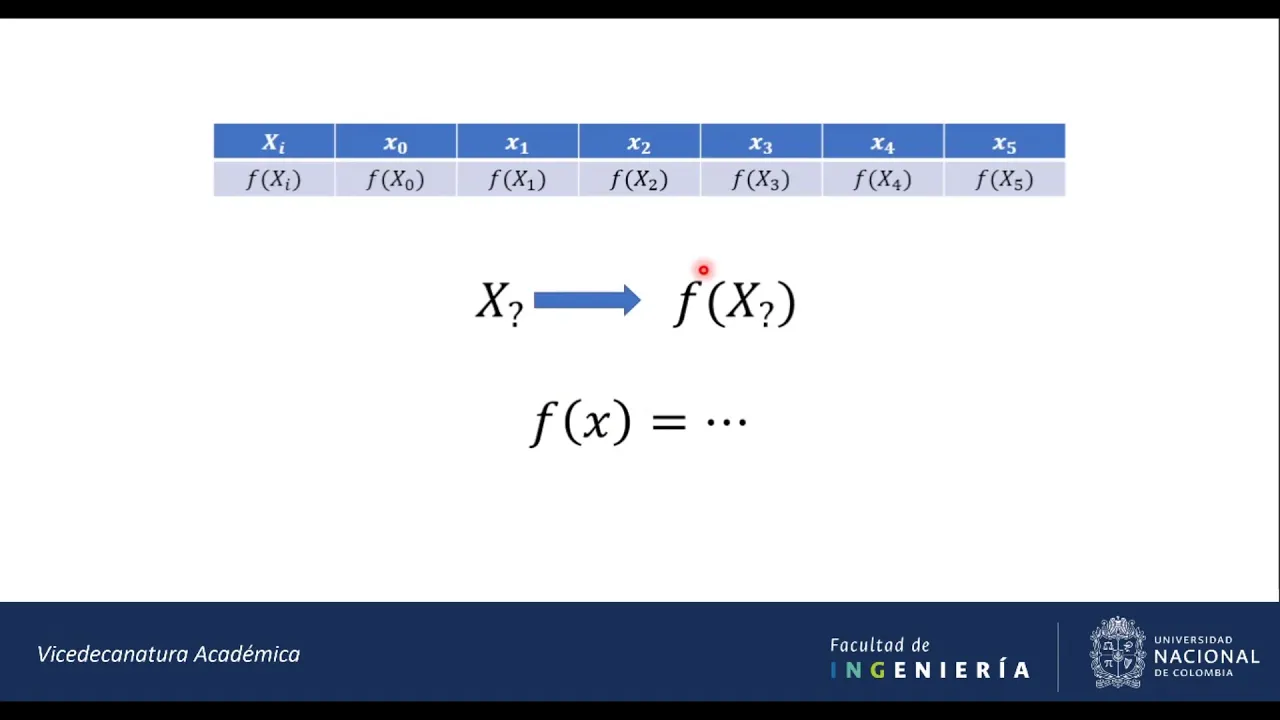




Newton's Divided Difference Formula is an interpolation method used when x-values are not evenly spaced, unlike Newton's forward/backward interpolation which require even differences. The formula constructs a divided difference table by computing successive differences between y-values divided by differences in x-values, then applies the formula: y = f(x₀) + (x-x₀)f[x₀,x₁] + (x-x₀)(x-x₁)f[x₀,x₁,x₂] + ... + (x-x₀)...(x-xₙ₋₁)f[x₀,...,xₙ]. This method, along with Lagrange interpolation, can solve interpolation problems for uneven sequences of numbers.
Newton Divided Difference Formula | Numerical Methods Full Tutorial
Added:Fundamental concepts of polynomial interpolation, specifically what it means to fit a unique polynomial of degree $n$ through $n+1$ data points.
Basic coordinate geometry and understanding of discrete datasets with unequal spacing ($x_i, y_i$).
Intermediate algebra, particularly polynomial expansion, simplification, and evaluation.
The general concept of finite differences as used in numerical analysis to approximate derivatives.
Error analysis of interpolating polynomials, including the calculation of the remainder term and understanding Runge's phenomenon.
Lagrange Interpolation Formula, comparing its construction, computational complexity, and limitations with Newton's method.
Cubic Spline Interpolation, which uses piecewise low-degree polynomials to avoid the runaway oscillations of high-degree polynomial interpolation.
Algorithm design and programming implementation of the Divided Difference Table using dynamic programming in Python, MATLAB, or C++.
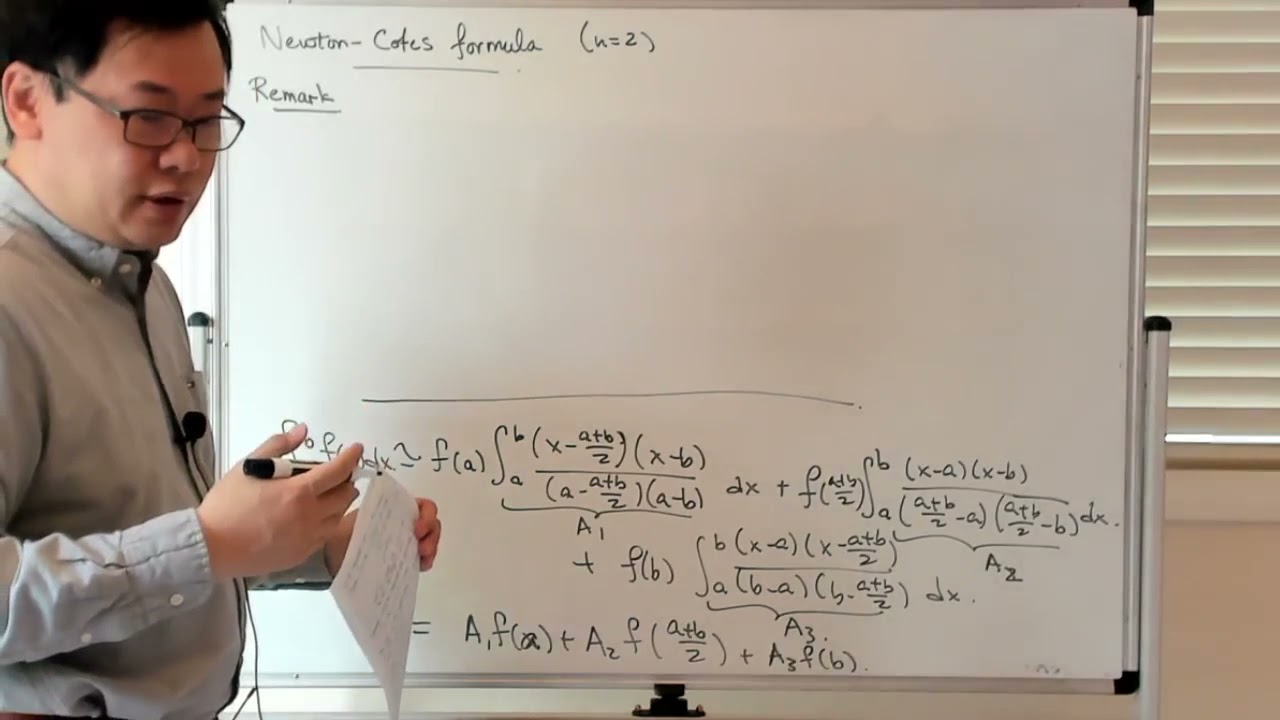
Derivation of numerical differentiation and integration formulas (such as Newton-Cotes formulas) based on interpolating polynomials.
191.2K views2.9Klikes9:14Original Release: 2017-05-19
[Music] hello everyone today in this video we are going to learn about what is newon divide and difference formula okay so it's one of the formula used in interpolation method okay so uh my first question arises is where and why will I use this formula okay so you have Newton's uh forward interpolation backward interpolation uh legrangian interpolation why will you use this formula okay why I will use this formula because there is not an even difference between these values like in Newton's forward interpolation and Newton's backward interpolation what was there there was an even differences like 5 - 0 10 - 5 15 - 10 there was a difference of five okay but over here if you check 3 - 2 which is 1 6 - 3 which is 3 7 - 6 is 1 9 - 7 is 2 so the difference is just not even okay so here we will use this Newton's dividing difference formula okay and why will we use it we will use it with our convenience okay you can use lres too over here but we are using Newton divide and difference formula okay so lrange and Newton divide and difference formula both compute or both can solve sums on on this uneven breakage like uneven uh sequence of numbers if there are unequal sequence of number unequal then Newton dividing difference formula and lrange interpolation formula both can solve the that sums okay so uh I'm clear with that now now I'm moving to the sum this portion you have been provided in your examination paper that this question will not be provided you will be provided with this type of question and what will I do with this table is I will construct a new table from this table okay so uh first I'll write my x value over here as I was doing in my newon forward and Newton's backward you are quite familiar like it is just simple with new it is just like Newton's forward and Newton's backward interpolation method but no after this these columns are basically quite different from Newton's forward and Newton's backward that's why it is different from both of the uh Newton's forward and backward interpolation method okay so how will I compute X not and X1 okay so I'll compute like this 39 - 15 okay I'm writing over here 39 - 15 ided 3 - 2 which which will give me uh 24 and 24 is my answer so 243 - 39 / 6 - 3 243 - 39 / 6 - 3 what will I get 43 - 39 is uh 204 uh and 6 - 3 is 3 if I divide it I'll get 68 okay so I'll get 68 and 68 is the required answer similarly If I subtract this from this and divide it by 7 - 6 I'll get 132 and if I subtract this this from this and divide it by this I'll get 190 so this is quite clear okay now moving to X X1 X2 how will I find that it is basically simple and as we were doing in this portion we will be doing a same over here but not with this value we will do this this computation value using this and this okay so how will we do that 68 - 24 divided by I'm Computing this part what is X X1 X2 divided by X2 - x what is X2 over here I have written this thing X is 2 X1 is 3 X2 is 6 X3 is 7 and X4 is 9 okay so what is my X2 X2 is 6 X2 - x what is x 2 6 - 2 so these are my first values this minus this divided by this minus this okay I'll get 44 / 4 which is 11 okay so 11 is my answer now what I do I'll subtract this from this same I'll subtract 68 from 132 divided by just shift this one bit uh just shift it to one place previously it was on six now it will be come coming on seven and previously it was on two now it will come on three 7 - 3 what is 7 - 3 which is 4 my answer will be 16 again 198 - 132 and I'll shift this by 1 9 6 so I'll get 22 okay now I'll have to compute and I'll compute this table till I get a single digit over here or a single number over here or I'll get a zero over here okay so now I'll compute X not X1 X2 and X3 okay so what is this s same If I subtract this from this if I subtract this from this which is 16 - 11 okay and then divided by x3 - X1 what is X3 X3 is 7 and X not is 2 now my pointer is on this and this okay so 7 - 2 which is 5 this will be 5 by 5 one one now same if I subtract 16 from 22 I'll get six okay and I'll just shift this one place like 9 - 3 okay so uh this is 22 - 16 by 9 - 3 which is = 6 by 6 which is = to 1 I've got one now if I subtract this from this it will be zero but I'm just showing you off to clear yourself clear it yourself 1 - 1 by what is the X4 - x what is X4 X4 is 9 9 - 2 so what will I get 9 - 2 is 1 - 1 by 9 - 2 is 7 which will obviously be zero as because 1 - 1 is there if it was seven if it if it can be if it can be if it was 7 and it was 6 then my value will be 7 - 6 by 9 - 2 okay but it won't be like that it will be similar to this thing only but I'm showing you as an example how will I do that one okay so I have just constructed my table okay so from my table I'm just moving to the formula part okay so what is my formula y = FX + x in x - x into this plus x - x X - X1 into this plus x - x X - X1 x - X2 X - X3 dot dot dot do dot x - xn into that portion okay so what is my FX this thing we have to take and my FX will be 15 okay what is x - x x is 5 and what is my X knot X notot is uh 1 second X is [Music] 2 okay so 5 - 2 and x - X1 uh X X1 24 okay now 5 - 2 5 - 3 into 11 + 5 - 2 5 - 3 5 - 6 into 1 + 5 - 2 5 - 3 5 - 6 5 - 9 into 0 so I'll get this and my answer will be this thank you friends for liking our videos do subscribe it and for any queries just comment down below
Up Next
21:55
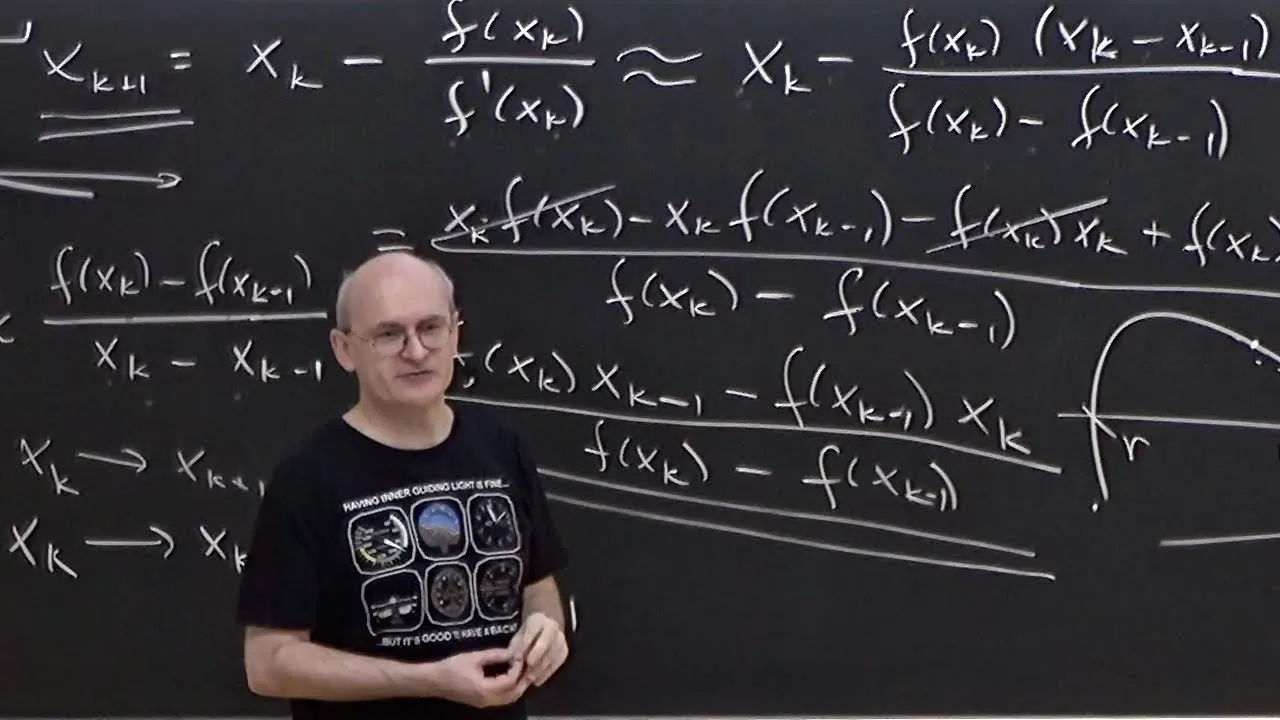
The Secant Method for Root Finding Explained
@CVUTFEL
118 views•2024-04-29

8:17
JEE Maths | Circles: Pole & Polar Explained with Equations
@TargetPublications
14.4K views•2019-02-23
10:44
Fourier Series Introduction: The Big Idea Explained
@DrTrefor
387K views•2021-05-03

6:00
The Mathematical Impossibility of Accurate World Maps
@Vox
23.3M views•2016-12-02
Related Study Plans & Knowledge Roadmaps
Structured learning paths in Mathematics
mathematics
Projective Geometry: Coordinates & Conics
01From Euclidean to Projective Space
02Homogeneous Coordinates
03Duality and Projective Transformations
+ 2 more learning modules
14h5 modules
Explore Roadmap
mathematics
Tensor Calculus: Vectors to Riemann Curvature
01Mathematical Foundations: Linear Algebra & Calculus
02Covectors, Dual Spaces, and Tensor Basics
03The Metric Tensor and Index Gymnastics
+ 2 more learning modules
40h5 modules
Explore Roadmap
mathematics
Gödel's Incompleteness: Logic, Proofs & Limits
01Introduction to Formal Systems & Hilbert's Dream
02Set Theory, Cardinality, and Cantor's Diagonal Argument
03Arithmetization and Gödel Numbering
+ 2 more learning modules
14h5 modules
Explore Roadmap
mathematics
Galois Theory: Fields, Groups & Solvability
01Foundations of Abstract Algebra: Groups & Fields
02Polynomials & Field Extensions
03Splitting Fields & Symmetries
+ 2 more learning modules
24h5 modules
Explore Roadmap