












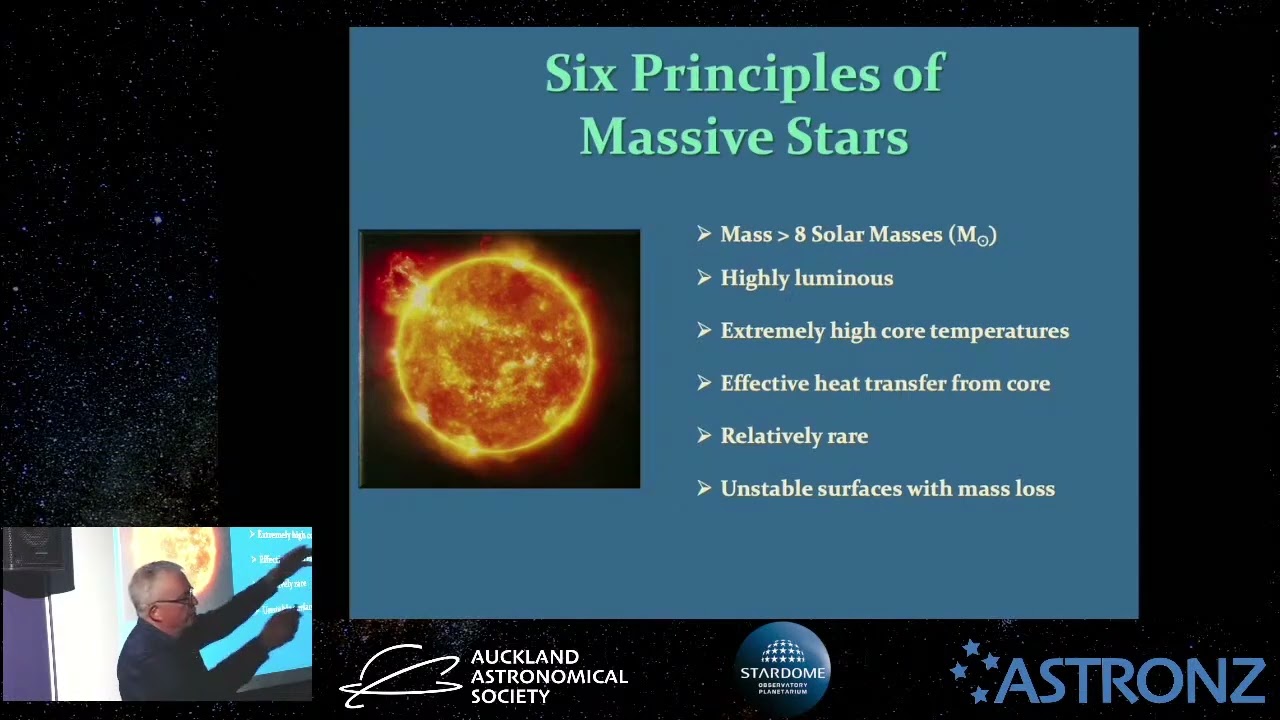













Massive stars (greater than 8 solar masses) end their lives in supernovae because they progress through multiple fusion stages (hydrogen, helium, carbon, neon, oxygen, and silicon fusion), with each successive stage occurring faster and at higher temperatures; when silicon fusion reaches nickel-56 (the most stable nucleus at atomic mass 56), the fusion process becomes endothermic and cannot sustain the star's weight, causing catastrophic core collapse that triggers the supernova explosion.
Supernova Explained: The Final Moments of a Massive Star
Added:The concept of hydrostatic equilibrium, which is the balance between gravitational collapse and outward thermal pressure in a star.
Basic stellar nucleosynthesis, specifically how stars fuse hydrogen into helium and progressively heavier elements in their cores.
The concept of nuclear binding energy, particularly why iron has the most tightly bound nucleus and cannot support further exothermic fusion.
An understanding of stellar classification, specifically what distinguishes 'massive stars' (typically above 8 solar masses) from low-mass stars like our Sun.
The formation and physical properties of stellar remnants, specifically neutron stars, pulsars, and black holes.
The r-process (rapid neutron capture) nucleosynthesis, which explains how elements heavier than iron are forged during the explosion.
The classification of supernovas (such as Type Ia vs. Type II) and how astronomers use them as 'standard candles' to measure cosmic distances.
The role of supernova remnants in dispersing heavy elements throughout the interstellar medium to seed new star and planet formation.
158.8K views10.8Klikes10:16Original Release: 2024-03-07
Massive stars end their existence in a blaze of glory called a supernova.
You've probably heard of them before.
What you might not know is that a lot is happening in the core right before that explosion.
The life of one of these stars is measured in millions of years, but there are several phases near the end that occur at normal human timescales.
What are those moments like and why does this end in a supernova?
[Intro Music] Hey Crazies.
Contrary to what you might have heard, not all stars end in a supernova.
Anything less than about eight times the mass of our sun and the star will just kind of fizzle out gradually.
There's no sudden catastrophic explosion.
Today is about stars with masses greater than eight suns. Why, though?
I was trying to give you the day off, but come on.
Why does it take eight solar masses?
Because of the way fusion works.
See, the star’s own mass is trying to make it collapse.
It's called self gravity.
The only thing holding it back is the energy released from the fusion in the core.
The star finds a balance pretty quickly that we call hydrostatic equilibrium.
So after that, the star is stable?
Well, for a while.
Stars do have a lot of particles in them, but that fuel supply is finite.
After millions of years of fusing hydrogen into helium, the core will run low on hydrogen.
Not so much that hydrogen fusion stops, but the supply will get low enough that the fusion can't support the star's weight anymore.
Can it find a new equilibrium? Yeah, but only so many times.
How many times? That depends on the mass of the star.
Red dwarfs can only turn hydrogen into helium, so they only have one equilibrium available.
But stars like our sun will eventually be able to turn helium into carbon.
So they have a second equilibrium they can use later in life.
The largest stars have six different equilibriums and go supernova when the sixth one fails.
Feel free to holler if you have any more questions.
[Transition Music] To be clear, it's not like all these processes are happening at the same time, at least not at first.
For the main bulk of a star's life, hydrogen fusion is all that's happening.
As a massive star runs low on hydrogen, it has to switch to helium.
But hydrogen fusion doesn't just stop.
The core now has two regions: Helium fusion in the inner core and hydrogen fusion in the outer core.
Helium will eventually run low as well, and in about a 10th of the time.
So the star will have to switch again to maintain equilibrium.
Each successive transition increases the temperature of the inner core and occurs at a faster rate.
(Off Camera) Is it faster because it's hotter?
Yes, mostly, but it's not the only reason.
When you fuse nuclei, you often end up with less of the new thing.
For example, it takes four hydrogens to make one helium, and it takes three heliums to make one carbon.
That means you have less fuel for the next stage.
But later there are stages where it's just about adding helium, so it's not always a factor.
And temperature is definitely the bigger factor.
If it were just the fuel, you'd expect helium fusion to be only four times faster, when it's actually ten times faster.
It's complicated, is what I'm saying.
The point is you can see these last few stages happen at normal human timescales.
This is the blink of an eye, astronomically speaking.
These are the last few moments of a massive star's life immediately before it supernovas.
By that time, the core looks like an onion.
There are so many layers of fusion.
But the process happening in the center is the most important.
It's the hottest and releases the most energy.
If that inner core fails, it's all over.
[Transition Music] The whole reason these fusion reactions can support the star's weight is because they release energy.
And the only reason they release energy is because successive nuclei are more tightly bound.
(Off Camera) How does binding them together release energy?
Oh, great question!
Binding is a type of negative energy.
You can think of it like an energy deficit.
A nucleus being lower on this graph means it's more tightly bound and has a bigger deficit.
That deficit is paid for by a release of energy equal to the difference.
Conservation of energy shall not be violated!
Imagine two basketballs are being rolled toward either side of a hill with a ditch in the middle.
If they're moving slowly, they'll just roll back down.
In a sense, they repel each other.
If they're moving fast enough though, they'll make it all the way into the ditch and get stuck.
We could say those balls are bound to each other.
This is basically what fusion is.
What matters is the depth of these ditches in our analogy.
You can see the middle of this one is deeper than the ground outside.
There's a gravitational energy difference that got released as heat or something.
The process is said to be exothermic.
A similar thing happens with the atomic nuclei in a star.
In the outer layers, they're not moving fast enough and they repel each other.
Like the slower basketballs, it's as if they can't quite make it up a hill.
But stellar cores are hot.
[Spring Noises] The nuclei are moving so fast that they essentially don't have time to repel each other.
Fast fast!
They make it up their hill, so to speak, and they get bound to each other.
The energy difference is released, but in a more of subatomicy way.
You know, like with a super energetic photon or a positron or neutrino or something.
Every nucleus exists in a tiny ditch on a giant cliff face.
Connecting all the ditches gives us the binding energy curve, which we saw for a brief moment earlier.
And as larger nuclei are built, there's a downward trend.
Energy continues to be released.
The process continues to be exothermic... up to a point.
After an atomic mass of 62, the energy trends back upward again.
Any further change to the right doesn't release energy anymore.
It absorbs it.
The process is said to be endothermic.
Endothermic fusion is catastrophically bad news for a star.
The last and shortest stage of a massive star's life is silicon fusion, which is when it makes a whole list of larger nuclei until it hits that upper limit.
(Off Camera) That happens when the star makes iron, right?
Actually, that's a common misconception.
Surprise, surprise!
[Transition Music] Full disclosure, this was recently a huge surprise for me too.
I had to unlearn some things.
This silicon fusion stage isn't all that fancy.
It's just adding helium over and over again.
Helium happens to have two protons and two neutrons.
So, any time that gets added to another nucleus: the total atomic number will go up by two, but the total atomic mass will go up by four.
It's Periodic Table time!
Starting at Silicon-28, these are the elements that get made in that final stage.
But the star’s not making the typical isotopes of these elements, at least not in large quantities.
While each step is two boxes at a time, the masses don't always match.
Normal, everyday stable iron is actually iron-56.
We're four neutrons short.
(Off Camera) Iron-52 is still iron though, isn’t it? Kind of, but it's not stable.
Besides, the star doesn't stop at iron anyway.
Silicon fusion can go all the way up to nickel-56.
Nickel is the end of the line, not iron.
Yes, Nickel-56 is unstable and will decay into iron-56 if left alone.
Except it is not left alone.
There are high energy photons zipping around, breaking nuclei apart in a process called photodisintegration.
Which would be a cool band name.
Anyway, remember how the tipping point for binding energy occurred at an atomic mass of 62?
Well, stars never make it that far.
Thanks to photodisintegration, the stellar fusion limit is a little lower at 56, and it certainly doesn't make isotopes this stable.
The stellar fusion chain is actually up here at less stable binding energies.
All those high energy photons that were supposed to be supporting the star’s weight, they're breaking nuclei apart instead.
There isn't a mass large enough to overcome this problem.
Catastrophic failure is imminent.
[Transition Music] These massive stars begin their life calm but end in a panic.
First, there's hydrogen fusion, which lasts millions of years.
Then there's helium fusion, which lasts hundreds of thousands of years.
Next, there's carbon fusion, which only lasts thousands of years.
After that, the panic sets in.
Neon fusion only lasts for years, like regular Earth years.
Oxygen fusion only lasts for weeks.
And finally, silicon fusion only lasts for days.
The star is frantically looking for heliums to smash into its bigger nuclei.
But it's running out.
To make matters worse, the high energy photons that were supposed to be helping are now working against the star.
Without sufficient energy released from the core, the star collapses on itself.
When that core reaches a critical density, which happens quickly, it becomes a neutron star.
An outward shockwave is created, powered by a rush of neutrinos from the formation of the neutron star.
So much energy is released in that instant that the star explodes in a supernova, which temporarily outshines its entire galaxy.
It's the most spectacular event in the whole universe.
And all it took was eight suns worth of mass and waiting millions of years.
So until the next one, remember, it's okay to be a little crazy.
Thanks to everyone who supports the channel.
I'm overwhelmed with your generosity.
A special thanks goes out to our new Asylum Counselor: Joe K. Kim and our new Einsteinium crazies: Dan Sullivan and William Hutchison.
If you'd like to support the channel, there are links down in the doobly-do.
Imaginary numbers are just as real as real numbers.
While it is true that imaginary numbers can have real world consequences, like with alternating current in quantum wave functions, they do that through a phase angle.
There's no way to put a phase angle on mass and have it make any sense.
Anyway, thanks for watching!
Surprise, surprise!!
Up Next
41:42
High-Mass Star Evolution: From Birth to Iron Core Collapse
@JasonKendallAstronomer
37.6K views•2018-08-29
61:17
First Billion Years of the Universe with the Square Kilometre Array
@iaaudc
121 views•2022-05-26

10:01
Why Earth Has No Rings: The Roche Limit Explained
@ScienceAsylum
97.3K views•2023-06-12
6:10
Gamma-Ray Bursts: Cosmic Snipers Explained | Astronomy
@kurzgesagt
15M views•2016-07-31
Related Study Plans & Knowledge Roadmaps
Structured learning paths in Astronomy
astronomy
Reionization: Pop III Stars, IGM & 21cm Line
01Foundations of Cosmology & the Early Universe
02Population III Stars & Cosmic Dawn
03Physical Mechanisms of Reionization
+ 2 more learning modules
17h5 modules
Explore Roadmap
astronomy
Planetary Rings: Dynamics, Roche & Resonances
01Foundations of Gravity and Orbital Mechanics
02Tidal Forces and the Roche Limit
03Structure, Composition, and Collisions
+ 2 more learning modules
10h5 modules
Explore Roadmap
astronomy
Asteroseismology: Stellar Waves, Ages & Cores
01Foundations of Stellar Astrophysics & Wave Mechanics
02Stellar Oscillation Modes: P-modes and G-modes
03Mathematical Framework of Asteroseismology
+ 2 more learning modules
35h5 modules
Explore Roadmap
astronomy
Adaptive Optics: Physics, Engineering & Control
01Foundations of Wave Optics and Wavefronts
02Atmospheric Turbulence & Optical Distortion
03Wavefront Sensing Technologies
+ 3 more learning modules
35h6 modules
Explore Roadmap