














Maurice Merleau-Ponty's phenomenology emphasizes that perception and the lived body are foundational to understanding human experience, arguing that consciousness is fundamentally embodied and that we must distinguish between objective space (allocentric, third-person) and oriented space (egocentric, first-person), where the body serves as an orientation toward space rather than merely an object within it.
Merleau-Ponty: Phenomenology of Perception Explained
Added:Descartes' Mind-Body Dualism: Understanding the traditional philosophical split between mind (res cogitans) and body (res extensa) that Merleau-Ponty seeks to overcome.
Husserlian Phenomenology: Familiarity with Edmund Husserl's concepts of intentionality, the life-world (Lebenswelt), and the phenomenological reduction.
Empiricism vs. Rationalism/Intellectualism: Basic understanding of how traditional epistemology explains perception, either as passive sensory reception or purely intellectual construction.
Embodied Cognition and Enactivism: Exploring how Merleau-Ponty's 'lived body' influenced modern cognitive science, neuroscience, and theories of situated mind.
Feminist Phenomenology: Studying how thinkers like Simone de Beauvoir and Iris Marion Young applied the concept of the lived body to gender, oppression, and physical existence.
Phenomenology of Space and Architecture: Investigating how the concept of 'oriented space' is applied to architectural design, environmental psychology, and human geography.
Technology and Postphenomenology: Analyzing how tools, interfaces, and digital technologies mediate our bodily perception and extension into the world (e.g., Don Ihde's philosophy of technology).
204.2K views7.9Klikes12:38Original Release: 2022-06-10
Hi everyone.
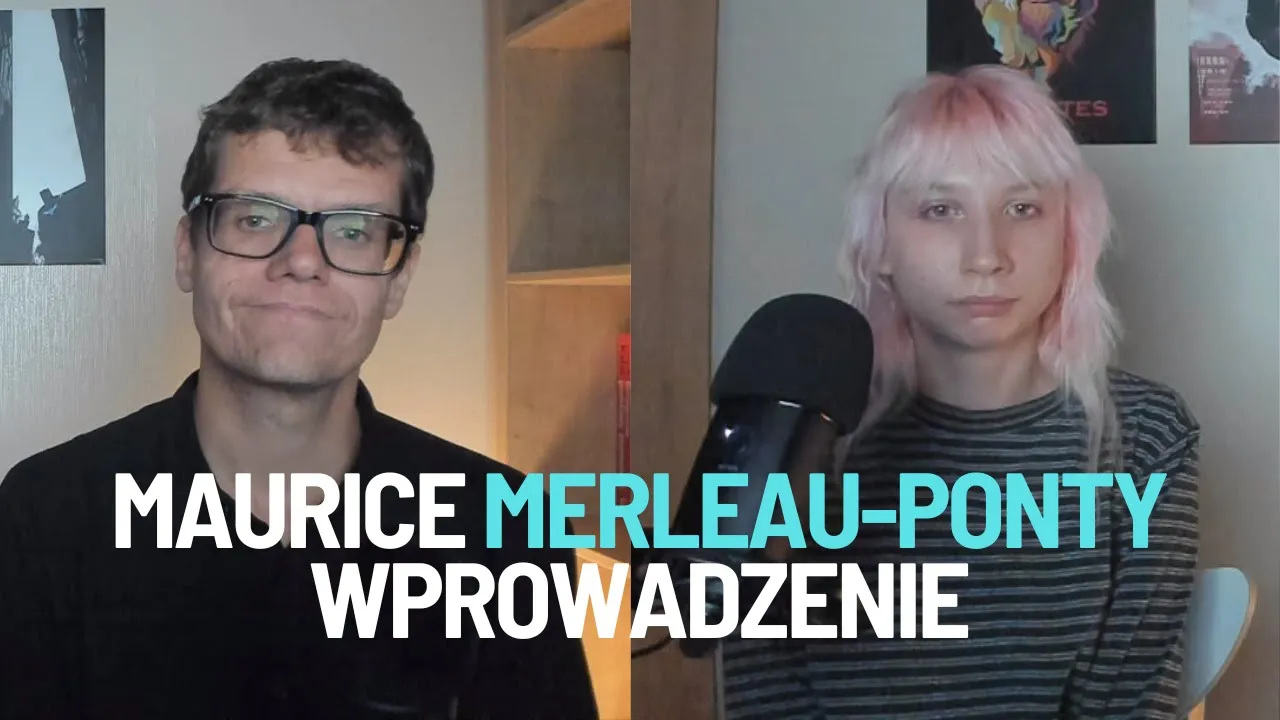
Today, I'll be introducing some ideas from Maurice Merleau-Ponty's very important book, the phenomenology of perception from 1945.
Merleau-Ponty is best known for his contention that phenomenology, and philosophy in general, need to emphasize the living body in order to get away from the problems of mind- body dualism, which to his mind are pseudo problems, and in order to ground philosophy in our lived experience.
For Merleau-Ponty, a lot of philosophy is just a bunch of pseudo problems.
We imagine that we can remove ourselves from the world and be these disembodied minds.
And then we come up with all of these ideas about how disconnected we are and wonder what the connection is between us in the world.
Wonder how do I know that there are other people, how do I know that I'm not a brain in a vat somewhere?
And he says that actually, if we start from the facticity of the world, and if we start from our lived experience within that, the world is there.
And all of our ideas are possible only on the background of perception.
So there's so much that we don't actually need to worry about once we really start from the experience of the body in space.
He says the world and reason are not problematical.
And so this might lead you to think that because Merleau-Ponty thinks that a lot of problems in philosophy are just unnecessary pseudo problems, that he wants us to return to good, common sense.
But that's not his claim either.
He actually thinks that common sense can be wildly misleading.
This is why for him, we need the method of phenomenology, which is a method of philosophy that begins with our experience in the rich complex spectrum in which it is lived, on the horizon in which we experience it through our bodies, and do our best to find key or essential features of that experience even as we recognize that we can never remove ourselves and have a view from nowhere.
Phenomenology, according to Merleau-Ponty, is the study of essences.
We want to find the essence of perception or the essence of consciousness, for example, but the way to find those essences is not to imagine that they are removed from existence, but to investigate existence on its own terms and uncover the structures that we find within it.
He says that our philosophical efforts should be concentrated on re-achieving a direct and primitive contact with the world and giving that contact a philosophical status.
So the goal is really to give a direct description of experience as it really is.
Phenomenology as a method in general is focused on description.
And Merleau-Ponty, you can see this in his work as well.
He really wants us to describe experience as it is.
When we're describing experience, as it is, we have a tendency to fall into two ways of viewing the world that he finds insufficient.
The first is intellectualism, which is often associated with abstraction or idealism in philosophy.
He thinks that intellectualism tends to remove us from the world and imagine that we can understand things in a vacuum and that that's for him wrong.
But then the other side of it is that we often tend to see the world through the lens of empiricism, where we are reducing what exists to what we can directly perceive and not really investigating the structures that make that perception possible and that, uh, make it historically contingent.
In order to really be able to describe essences for Merleau-Ponty.
We have to undertake what he calls, following Edmund Husserl, the founder of phenomenology, and other people in this tradition, the phenomenological reduction.
The phenomenological reduction is an act of bracketing our natural attitude, which presumes that we are seeing the world as it is in reality, by putting the natural attitude out of play.
We step back to watch the world, but we do not withdraw from it and imagine that we are abstracted from it.
Right?
And so there's this tension in Merleau-Ponty between wanting to stick with things as they appear, and also recognizing that we can best understand things as they appear, if we have an attempt at some detachment.
But that detachment is always relative to our embeddedness within the world.
We can't fully accomplish a detachment from the world.
But we can pass from the fact of existence to the nature of existence in order to understand the fact of our existence more clearly.
Merleau-Ponty thinks that, in this way, phenomenology unites extreme subjectivism with extreme objectivism and ultimately helps us get out of the binary between subject and object altogether.
I've mentioned that Merleau-Ponty emphasizes the living body in his philosophy.
And so you might wonder.
Okay, well, what exactly does that mean?
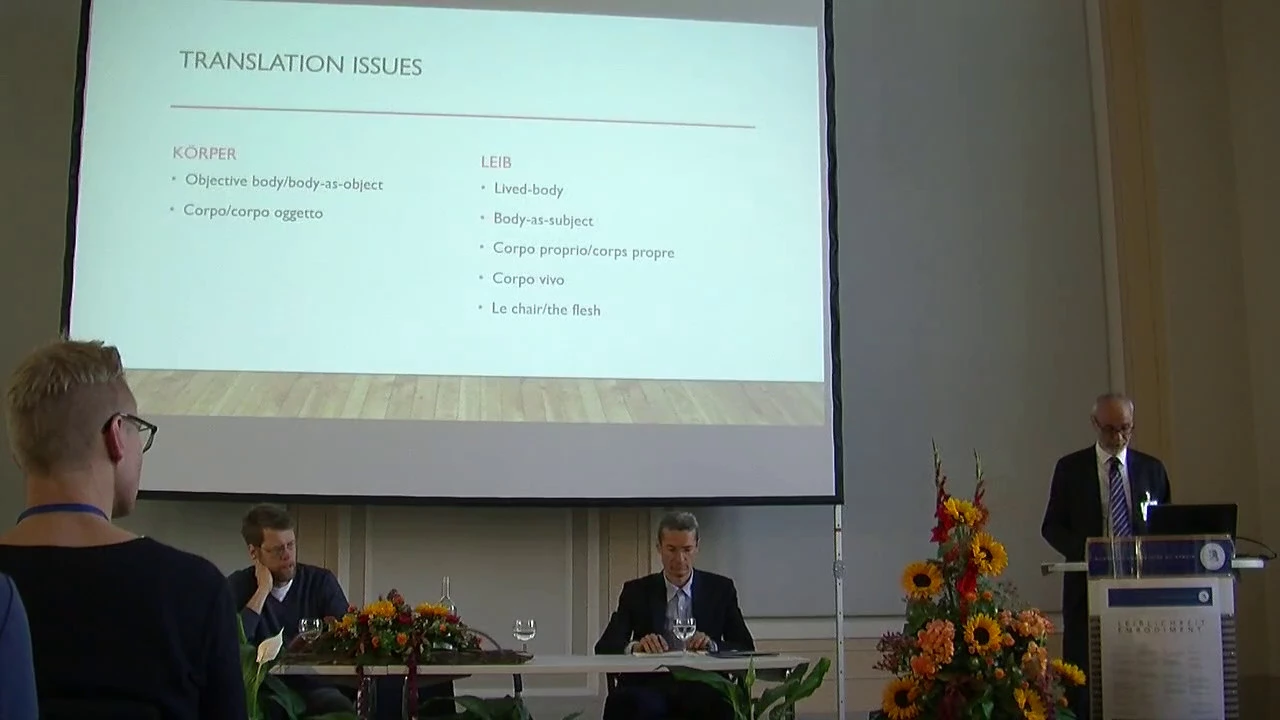
Merleau-Ponty begins by drawing on the work of Edmund Husserl, who articulates the key distinction for phenomenology between the body as considered as a third person, objective inert entity, or what in German is the Körper, and the second way of thinking about the body, which is as living subjective, first-person German Leib.
Merleau-Ponty thinks that I cannot understand myself as a subject apart from my body.
And when I think about my body, it's not the body as a kind of object.
It's the living body.
It's my body as a means of expression.
So Merleau-Ponty thinks that one of the main problems with philosophy is its tendency towards mind, body dualism.
He thinks that we go as stray when we imagine ourselves as disembodied minds or as inert bodies, or as a combination of the two, which you find a lot in, in dualistic philosophies.
When we're talking about the body, we're talking about something that is in between pure subject and object.
There is no inner self for Merleau-Ponty.
We know ourselves only in and through the world.
So I actually am the exterior that I present to others, but there are sedimenting layer dimensions of this.
One of the things that Merleau-Ponty is known for is emphasizing the historical nature of the person.
And that also means the historical nature of the body.
We as humans are in a constant state of becoming, and this means that we don't have a fixed essence, but rather that we are in this process of becoming over time through personal and collective history.
The body has lived as a here and now for Merleau-Ponty.
It's not a thing that exists in space, but rather an orientation towards space.
There would actually be no such thing as space for Merleau-Ponty without a body.
We have to think space from the body rather than thinking the body from space.
And so this doesn't mean that he's against, uh, some modicum of scientific objectivity.
It's just that he thinks we have to start with phenomenology.
We go astray when we try and apply abstract scientific categories onto lived experience, we need to have the opposite approach.
This has actually been pretty influential in recent decades within scientific studies of consciousness, where Merleau-Ponty is known as one of the main people to articulate the enactivist view of consciousness.
For Merleau-Ponty, movement is crucial to understanding how we live in the world.
Motility is the spatiality of the body brought about in action.
Consciousness and original intentionality actually take place in motility, he thinks, where the body is engaged with the possibilities that its surroundings present it with.
He moves away from the view that we get and people like Descartes that I am an I think, and he says that I am an I can, my body is an I can, each of us has what Merleau-Ponty calls of body schema, which is a tacit knowledge of the body's situation in space.
It's a pre reflective bodily awareness that is dynamic and directed towards possibilities.
So when I reach out for the doorknob, I have an intuitive sense of where my hand is relative to the doorknob, of how far I need to reach.
I might be wrong in some cases, probably not.
If it's a doorknob, I've touched many times before, but perhaps if it's the first time.
Um, but either way I am pre- reflectively oriented towards reaching for the doorknob and that orientation involves the tacit sense of my body in space.
It also means that my primary way of engaging with both my body and things in the world is as possibilities for me.
Merleau-Ponty is influenced in this respect by Heidegger's conception of the distinction between something being present at hand or something being ready to hand.
The ready to hand nature of existence is really key for Merleau-Ponty.
So let's think about this back in terms of space.
Merleau-Ponty suggests that there are two primary ways that we might conceive of space, objective space and oriented space.
Objective space is an external or homogenous way of thinking about it almost as if it's a grid, right.
Um, something is four feet away from something else.
This is how we often think about the body as being in space, right?
An entity in space.
This is a positional way of thinking about it that is third person, and also is often described as allocentric space.
A view from outside of a given situation, perhaps a view from above.
So if you think about the way that when you look up directions, what you first see is a flat surface where the place that you're going to is in one spot and the place where you are is another spot.
And they're sort of seen as if from above.
That is allocentric space or what Merleau-Ponty calls objective space.
There's a second way of thinking about space that he finds really important for phenomenology, which actually grounds in his view objective space.
And that is oriented space or bodily space.
Here, the body inhabits space.
This form of space is characterized by motricity or motility.
And it is fundamentally situational and first person rather than being allocentric.
It's egocentric.
So when you click start on your Google map, And you go from seeing the place where you are and the place where you're going as points on a two dimensional surface to now having the two dimensional surface shift where you are here and where you're going is projected as a place that is in front of you, that is egocentric space.
Or the best analog that Google maps can give us because it's still two dimensional, right?
And for Merleau-Ponty, science goes wrong a lot of times, by thinking about objective space as fundamental, and oriented space as derivative.
Again, he wants to invert the way that science usually thinks about things and say, no, we have to think of objective space from oriented space because oriented space is how space shows up for all of us, including the scientists.
Ultimately for Merleau-Ponty, perception is the background from which all acts stand out.
And so our philosophy needs to begin with perception, but perception is not thought of in the traditional empirical way as a sort of receiving of percepts into some inner space, but as our active engagement with the world around us, because our conscious is fundamentally embodied.
Hope you enjoyed this video.
If you want more about phenomenology, we often talk about it on my podcast, Overthink, and you can also find some related videos in our channel here.
Up Next

11:40
St Theodore the Studite: Christ's Flesh Is Circumscribed
@jonathanhill2737
342 views•2026-03-13

164:01
John of Damascus on Holy Images: A Theological Defense
@BannedBooks
139 views•2026-04-25

8:18
Horkheimer and Adorno on Enlightenment and Its Contradictions
@OverthinkPodcastPhilosophy
56.9K views•2021-12-20
4:57
The Myth of Sisyphus: A Greek Legend of Eternal Punishment
@TEDEd
8.6M views•2018-11-13
Related Study Plans & Knowledge Roadmaps
Structured learning paths in Philosophy
philosophy
Frankfurt School: Critical Theory & Culture
01Foundations of the Frankfurt School and Critical Theory
02Horkheimer & Adorno: The Critique of Instrumental Reason
03The Culture Industry and Mass Deception
+ 2 more learning modules
12h5 modules
Explore Roadmap
philosophy
Philosophy of Language: From Frege to Austin
01The Linguistic Turn: An Introduction to Language in Philosophy
02Gottlob Frege: Sense and Reference
03Early Wittgenstein: The Picture Theory of Meaning
+ 3 more learning modules
15h6 modules
Explore Roadmap
philosophy
Feminist Epistemology: Standpoint & Injustice
01Introduction to Epistemology and Feminist Critiques
02Sandra Harding and Standpoint Theory
03Donna Haraway and Situated Knowledges
+ 2 more learning modules
12h5 modules
Explore Roadmap
philosophy
Environmental Philosophy: Ethics & Deep Ecology
01Foundations of Environmental Ethics & Anthropocentrism
02Biocentric Individualism and Animal Liberation
03Ecocentric Holism and Deep Ecology
+ 1 more learning modules
10h4 modules
Explore Roadmap