








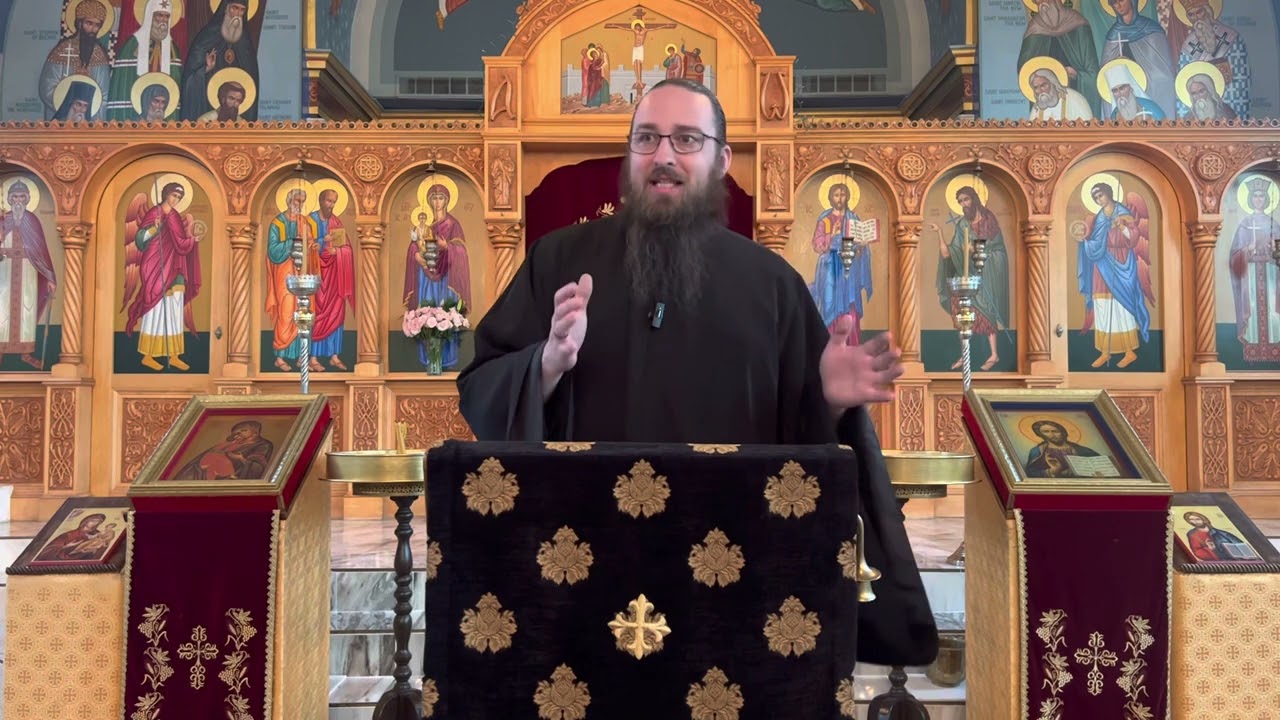






St. Theodore the Studite argues that Christ's humanity is circumscribable (measurable and depictable) even after the resurrection, because Christ retained all properties of human nature including flesh, bones, and physical appearance; since the icon depicts only Christ's humanity (not his divine nature), it can be venerated without worshipping the divine, as the icon is merely a shadow while Christ is the truth.
St Theodore the Studite: Christ's Flesh Is Circumscribed
Added:The historical context of the Byzantine Iconoclastic Controversy (8th and 9th centuries), including the conflict between the iconoclasts and the iconodules.
The Christological definitions established at the Council of Chalcedon (451 AD), specifically the doctrine of the hypostatic union (Christ as fully God and fully man).
The philosophical and theological definition of 'circumscription' (perigraphe) as it relates to physical limits, boundaries, and depictability in Patristic thought.
St. John of Damascus's foundational defense of icons, particularly his distinction between worship (latreia) reserved for God, and veneration (proskynesis) shown to images.
The theological resolutions of the Seventh Ecumenical Council (Nicaea II, 787 AD) and the ultimate 'Triumph of Orthodoxy' in 843 AD.
The implications of St. Theodore's arguments on Christian anthropology, specifically how the incarnation sanctifies physical matter and human embodiment.
A comparative study of Byzantine Iconoclasm versus the iconoclasm of the Protestant Reformation, analyzing the similarities and differences in their theological objections to images.
The development of Eastern Orthodox liturgical aesthetics and the theological rules governing Byzantine iconography following the iconoclastic crisis.
342 views17likes11:40Original Release: 2026-03-13
And we're back.
What if I told you that saying Christ's flesh is infinite was the argument of the iconoclast and was the argument against icon veneration?
And what if I told you that St. Theodore went to great lengths to argue against Christ's flesh being infinite and uncircumscribable in order to defend the veneration of the icon?
That's what we'll be taking a look at here today.
St. Theodore is the go-to source for the defense of the holy icons. And we celebrated the holy icons just a few weeks ago on the Sunday of Orthodoxy.
Let's read what he has to say here.
This is the Orthodox position.
If your opposition were aiming to prevent the erection of the icon of our Lord Jesus Christ, you could bring forth such texts.
But, since you have accepted the depiction and deny only the veneration, why do you again totter and stumble from one position to another as liars are want to do?
So, already here, he's saying something that I greatly appreciate. When engaging someone who has made a claim, provide me the texts. Show me the primary texts, the primary sources. This is what St. Theodore is asking for.
This is now the heretic's response. This is the iconoclast's idea.
Admittedly, it is agreed that our Lord Jesus Christ is circum- is circumscribed, but only up to his passion and by no means after his resurrection.
Where have we heard this before?
Keep in mind, this is the heretical position.
For the Apostle says, "Even though we once knew Christ according to the flesh, yet now we know him thus no longer." And likewise, Gregory the Theologian, "He is perfect not only by his divinity than which nothing is more perfect, but also by his assumed flesh, which is anointed with divinity and has become that which anoints it and even, if I may be so bold, the same as God."
"If the assumed flesh is the same as God, how could it be circumscribed while being united with the imperishable divinity?"
And the response.
"Nevertheless, you have conceded that Christ is circumscribed before his passion and is venerated in the circumscription of such an icon."
The iconoclast, "Even if I should concede as much and not object, where does your argument lead?"
So, so far, we haven't really gotten to St. Theodore explaining why Christ is circumscribed after the resurrection, but he does so here.
St. Theodore.
"The authorities which you have previously introduced do not show that it was possible for Christ to be circumscribed either before his passion or after his resurrection.
In particular, they do not say that although he is circumscribed, his image remains high up and is not venerated.
Why do you bring in as your supporters those who oppose you in half of your position?
It is time for you to look for other authorities who agree completely with your argument.
But in fact, Christ is circumscribed even after his resurrection."
Let me say that again.
"Christ is circumscribed even after his resurrection. Listen to him speaking to his own disciples when after the resurrection they thought they saw him as a spirit, 'See my hands and my feet that it is I myself.'
If then he said that he whom they saw after the resurrection was that same one who was with them before the passion, obviously just as he was circumscribed before the passion, after the resurrection also, he was contained by circumscription because he had not lost the properties of his human nature. Let me say that again.
He had not lost the properties of his human nature.
What kind of hands and feet did he show them, sir?
And what did he bid them to touch as a man with flesh and bones?
What kind of food did he taste? Must not one of the Must not one who has these properties either be circumscribed or, if he is not circumscribed, be a ghost as he seemed to be to the Apostles?"
Let's talk about circumscription. Here's St. Theodore.
"If the verse, 'The Lord created me at the beginning of his work, the first of his works of old' refers to humanity, but the later verse, 'Before the hills I was brought forth' refers to divinity, then the speaker must be subject to circumscription in so far as he is created."
Here St. Theodore is emphatic. Explicit.
Christ is created.
"But in so far as he is uncreated, according to his divinity, he must be uncircumscribable. But if, because he is circumscribed in one nature, the created, the other nature, the uncreated, should also be circumscribed, then the one must change from uncircumscribable to circumscribed and the other from circumscribed to uncircumscribable.
Each nature must exchange with the other its own character and lose the natural and in- inalienable property which belongs to it.
And in sum, neither remains truly itself because of vain alteration, which is absurd."
So, here St. Gregory, I mean sorry, St. Theodore is saying that if the natures are exchanging properties, they no longer remain what they are, which is absurd.
Let's go on.
"If by saying, 'The Lord created me at the beginning of his work,' we understand not that the word has been changed into flesh because of the combination of divinity and humanity in him, but that the word has become flesh while remaining on the height of his divinity.
In the same manner, when we say that he is also circumscribed, we do not believe that he is changed into a circumscription in so far as he is God, but that in so far as he became man, he appears like us.
But if in being circumscribed the uncircumscribability is changed, then also in becoming flesh the nature of divinity is changed, which is absurd."
That's easy.
Let's go on.
"Saying, 'The Lord created me' is equivalent to saying, 'The Lord circumscribed me.' For if it is not possible to say, merely because it is not written, 'The Lord made me' or 'The Lord embodied me' that these things did not happen to him, so because it is written, 'The Lord created me,' it is possible for those who wish to think correctly to understand equally, 'He is also He also circumscribed me.'
For creation is a property of circumscription as those who as those know who have even a little intelligence."
I love St. Theodore's rhetoric. That's absurd. Even those with little intelligence know this to be true.
Let's go on.
"If Christ is uncircumscribable as you say, not only in respect to his [clears throat] divinity, but also in respect to his humanity, then his humanity is also divinity.
For things which have the same properties also have one nature.
But if he is of two natures, he is therefore also of two properties.
Otherwise, by the removal of circumscription, the nature of humanity would also be removed."
And it goes on and on like this, but you understand.
You understand the idea here.
Let's come back over here.
This is St. Theodore, first treatise, section 12.
"In what sense can you say that the divinity of Christ is in the icon? By nature, since they are venerated together or not?
If his divinity is in the icon, there is circumscription.
But if not, the veneration is impious, for one worships what the icon is not rather than what it is called.
Christ's flesh is always venerated together with his divinity because they are united inseparably. But the icon is not united inseparably with him.
So, here's a here's an argument we hear.
Because the flesh is united to the divinity, it's infinite because the divinity is infinite.
Or it's uncircumscribed because the divinity is uncircumscribed.
Let's hear what how St. Theodore responds.
"You are still taking the same talking the same absurdities.
Since the archetype and the image are not the same, because the one is truth, but the other is a shadow, why do you image that your attack is so clever?
In the case of the Lord's body, because of the conjunction of natures, his divinity is conjointly both venerated and glorified, although it is subject although it is subject to the circumscription of the flesh.
How else could it be since the flesh is tangible, graspable, and visible and in no way takes the alien properties of the uncircumscribable nature because of the union?"
Let me say this again. The flesh in no way takes the properties of the divine nature because of the union.
Accordingly, as it is said, the flesh even suffered without the impassible essence sharing the suffering.
Because the case of the icon is entirely different.
For where there is present not even the nature of the flesh which is portrayed, but only the relationship, much less could you say that there is present the uncircumscribable divinity which is located in the icon and is venerated there only in so far as it is located in the shadow of the flesh united with it.
What place is there where divinity is not present in in beings with or without reason, with or without life?
But it is present to a greater or lesser degree according to the capacity of the nature which receives it.
Thus, if one says divinity is in the icon, he would not be wrong since it is also in the representation of the cross and the other sacred objects. That last part is a little beyond what we're talking about here.
But we see accordingly, as it is said, the flesh even suffered without the impassible essence sharing the suffering.
It's because the natures are not communicating their properties to each other.
The tangible, graspable, and visible flesh in no way takes on the alien properties, the properties of the divine nature.
I wish you to continue to have a blessed Lent and a glorious Pascha.
Up Next

164:01
John of Damascus on Holy Images: A Theological Defense
@BannedBooks
139 views•2026-04-25

12:38
Merleau-Ponty: Phenomenology of Perception Explained
@OverthinkPodcastPhilosophy
204.2K views•2022-06-10

68:32
Should We Destroy the Machines? Big Tech Surveillance Critique
@TheStoriesWeTell303
167.9K views•2025-11-30
4:57
The Myth of Sisyphus: A Greek Legend of Eternal Punishment
@TEDEd
8.6M views•2018-11-13
Related Study Plans & Knowledge Roadmaps
Structured learning paths in Philosophy
philosophy
Frankfurt School: Critical Theory & Culture
01Foundations of the Frankfurt School and Critical Theory
02Horkheimer & Adorno: The Critique of Instrumental Reason
03The Culture Industry and Mass Deception
+ 2 more learning modules
12h5 modules
Explore Roadmap
philosophy
Philosophy of Language: From Frege to Austin
01The Linguistic Turn: An Introduction to Language in Philosophy
02Gottlob Frege: Sense and Reference
03Early Wittgenstein: The Picture Theory of Meaning
+ 3 more learning modules
15h6 modules
Explore Roadmap
philosophy
Feminist Epistemology: Standpoint & Injustice
01Introduction to Epistemology and Feminist Critiques
02Sandra Harding and Standpoint Theory
03Donna Haraway and Situated Knowledges
+ 2 more learning modules
12h5 modules
Explore Roadmap
philosophy
Environmental Philosophy: Ethics & Deep Ecology
01Foundations of Environmental Ethics & Anthropocentrism
02Biocentric Individualism and Animal Liberation
03Ecocentric Holism and Deep Ecology
+ 1 more learning modules
10h4 modules
Explore Roadmap