









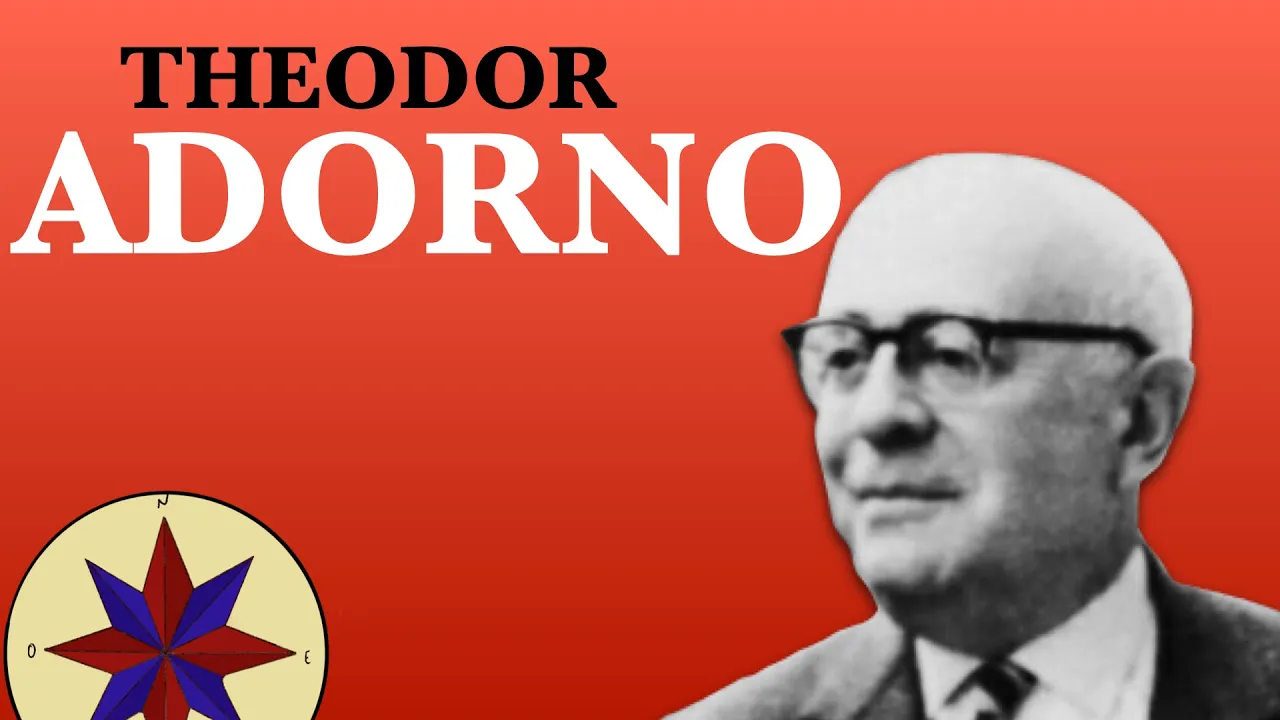
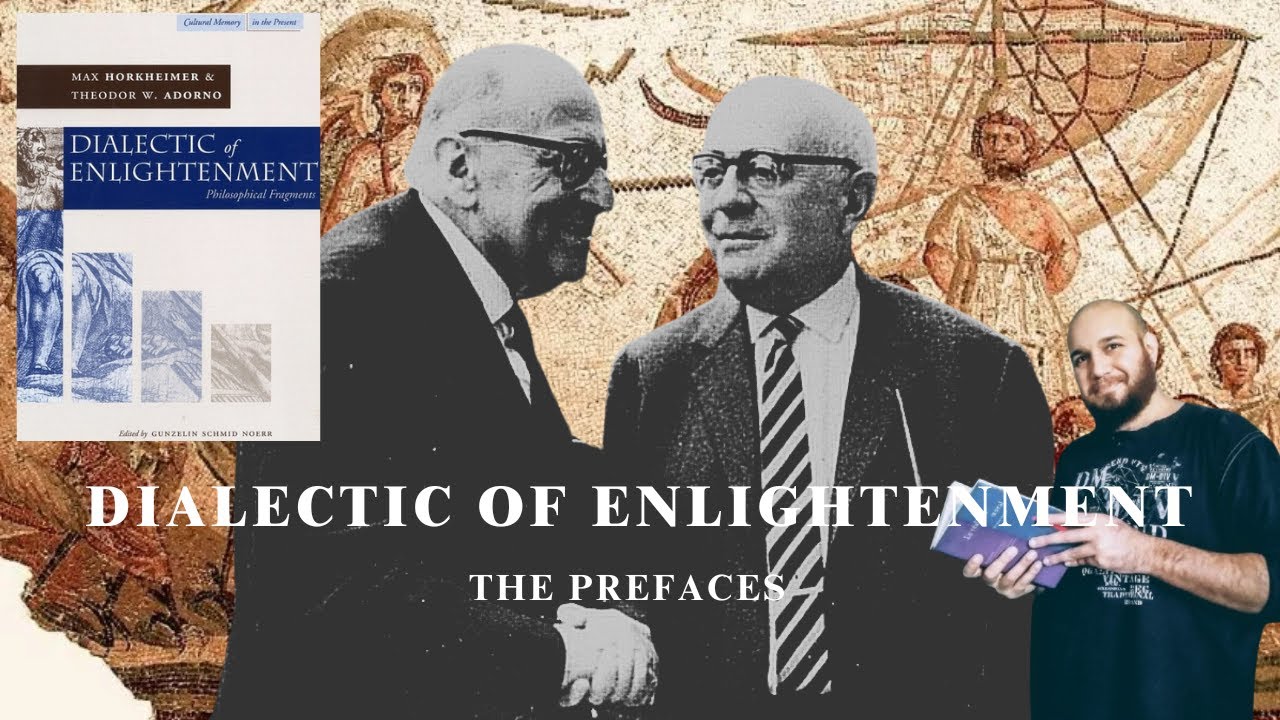


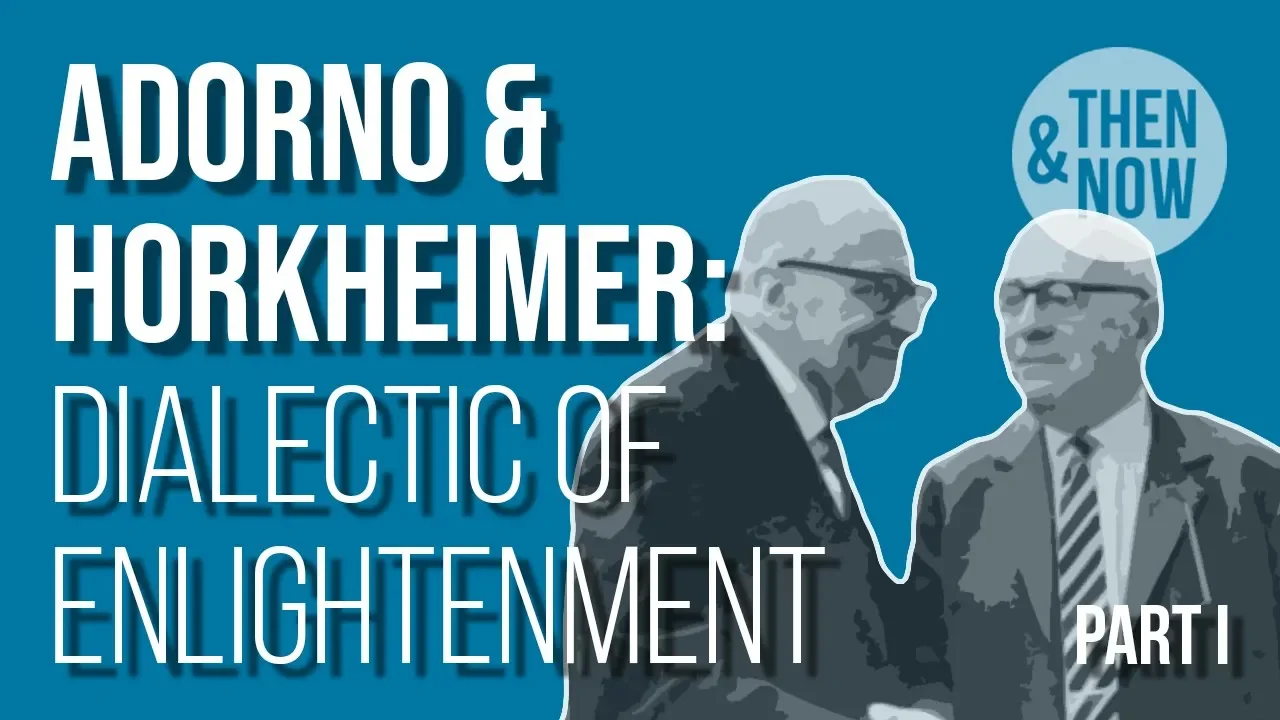





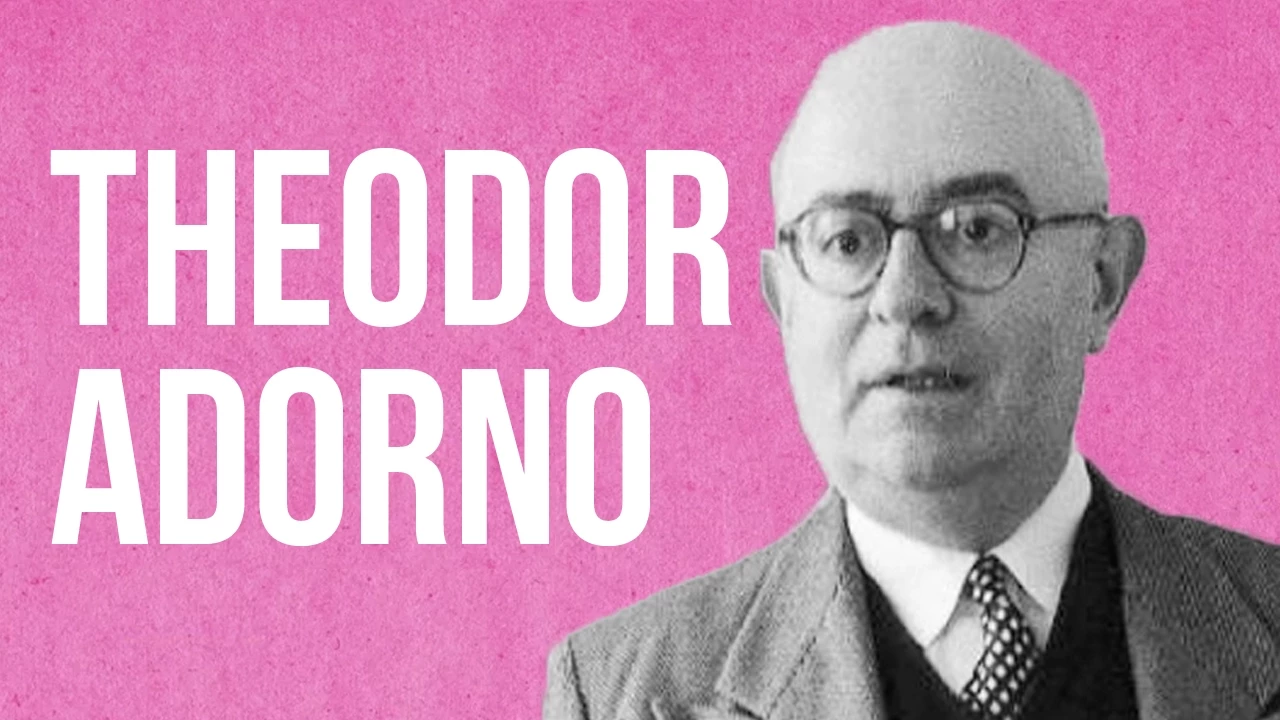







Max Horkheimer and Theodor Adorno argue that Enlightenment, despite its promise of reason and progress, is inherently totalitarian because it pursues mastery over nature and humanity, reducing everything to calculable systems that eliminate subjectivity and lead to barbarism; they contend that both Enlightenment and mythical thinking share a common logic of projecting human understanding onto the world and fearing the unknown, ultimately resulting in the domination of the thinking subject over itself and the elimination of genuine critical thought.
Horkheimer and Adorno on Enlightenment and Its Contradictions
Added:The core tenets of the 18th-century Enlightenment, particularly the emphasis on human reason, scientific inquiry, and liberation from dogmatic belief.
Fundamental concepts of Marxist theory, especially how economic base structures influence societal ideology and class domination.
An introduction to the Frankfurt School and the origins of Critical Theory as a method of analyzing society and culture.
The historical context of the mid-20th century, particularly the rise of fascism and the devastation of World War II, which catalyzed Horkheimer and Adorno's pessimism.
A close reading of Horkheimer and Adorno's key text, 'Dialectic of Enlightenment', focusing on the transition from myth to rationalism and back to myth.
The concept of 'Instrumental Reason' (Zweckrationalität) and how modern society prioritizes efficiency and control over ethical values.
The 'Culture Industry' thesis, which critiques modern mass media and entertainment as tools for stabilizing capitalist domination.
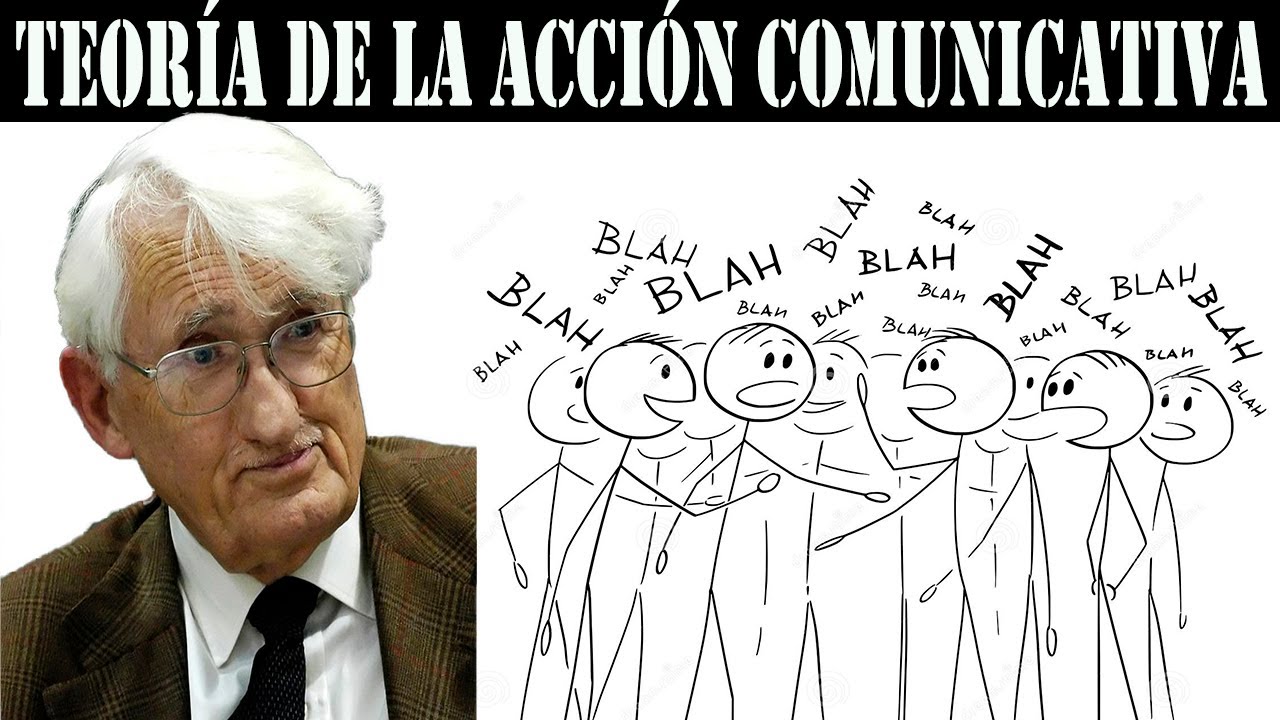
Jürgen Habermas's critique and reconstruction of the Enlightenment project through his theory of communicative action.
Applying the critique of technological rationality to contemporary issues like algorithmic bias, data surveillance, and digital capitalism.
56.9K views0likes8:18Original Release: 2021-12-20
Why isn't enlightenment all it's cracked up to be?
Well, Horkheimer and Adorno have ideas. They say that enlightenment is totalitarian.
Enlightenment aims for mastery and encourages a total disenchantment with the world.
An enlightenment picture of the world encourages us to learn from nature only in order to dominate it and to dominate other people.
So you might recall that the Age of Enlightenment, in a philosophical sense, coincides with the rise of colonialism and the rise of capitalism.
For Horkheimer and Adorno, this is no coincidence.
Actually, endemic to the philosophy of enlightenment, is barbarism.
Enlightenment encourages the domination of nature and this domination of nature eventually turns into the domination of the thinking subject over itself.
So enlightenment encourages control and mastery over nature and over people, including ourselves.
For enlightenment thinking, knowledge is power and power is knowledge.
And this is not a benign association.
It's actually quite dangerous.
Now, one of the things that Horkheimer and Adorno focus on in this text is the idea that enlightenment thinking likes to imagine itself opposed to myth.
So think about a common narrative here.
Actually, we might return to Kant.
For Kant, enlightenment is the human exit from immaturity.
The human race was immature throughout much of its history.
It believed in myth, it accepted the dogmas and doctrines of religion.
And now it's finally in a position to start to be guided by the light of reason.
This is enlightenment.
Well, Horkheimer and Adorno suggest that, actually, enlightenment thinking partakes of the very same logic as myth.
So what is mythical thinking based on?
From the perspective of the enlightenment, mythical thinking is based on unreason and part of its unreason is its anthropomorphism.
Mythical thinking projects the subjective, the human, onto nature.
Through, for instance, animism, this idea that plants and natural resources, for instance, have souls.
The enlightenment comes along and is like, Ooh, you imagine that plants and rocks have souls.
How unenlightened of you.
Well, Horkheimer and Adorno counter that, actually, mythical thinking is not that different in relevant ways from enlightenment thinking itself.
Because what happens in enlightenment thinking is a dream of unity.
This idea that we can have a total explanation of everything possible.
Formal logic is the paragon of this enlightenment thinking, they describe on page 200.
The idea that we can sort of reduce everything to numerical values, to soundness and validity, and say whether something is true or false.
When we do that, we are anthropomorphizing the world by reducing it to the faculties of our own understanding.
Abstraction, Horkheimer and Adorno suggest, is the tool of enlightenment.
Nature here is taken as what is to be studied mathematically.
But why should we say that nature is any more mathematical than it is animistic?
Isn't our mathematical conception of nature itself a projection of human ways of understanding things?
Horkheimer and Adorno suggest on page 201 that enlightenment is mythic fear turned radical.
In both the mythical mindset and the enlightenment mindset, we have, as humans, a fear of the unknown and we seek to master the unknown.
It's just that we seek to master it in different ways in mythical thinking and enlightenment thinking.
For enlightenment thinking, nothing can remain outside.
The outside is what we fear.
And so we have to explain everything, to subsume everything, in order to counter that fear.
This is one of the ways in which the Frankfurt school, which is the school that Horkheimer and Adorno, as well as Marcuse are coming from, draw on psychoanalysis.
So to sort of speak broadly for a moment, the Frankfurt school is a group of thinkers based in Frankfurt, Germany, who combined Marxism-- so, dialectical materialism-- with psychoanalysis, the work of Freud.
And brought those together into a kind of hybrid in order to assess political, social, and various other philosophical issues of their day.
Now, I would love to also talk to you about the fascinating and, in some cases, tragic history of the Frankfurt school.
I would encourage you to read about that yourself, but I'll just say that Frankfurt school ends up being kind of a misnomer because many of the members of the school had to flee Germany with the rise of National Socialism, because the majority of them were Jews.
Going back to the text for a moment here, enlightenment thinking in Horkheimer and Adorno's sense, involves a dream of thinking about being as automatic, as machine-like.
Reason here is a mere instrument.
And usually it's an instrument for economic interests, interests of capitalism.
Capitalism, and the reigning ideology of it, which gets called positivism here, want to make subjectivity as small as possible because subjectivity cannot be calculated.
They want to eliminate it completely if possible, right?
Like let's study an fMRI scan and talk about dreams.
We're not going to ask people about what their dreams are because we have no way of actually assessing the truth of those from their subjective perspective.
But for Horkheimer and Adorno, this is an extremely reductive way of thinking about subjectivity and thinking.
The task of thinking is not merely recording, according to them.
If anything, thought becomes deceptive when it tries to imagine itself as a mere recording, they describe thought as a process of determinate negation.
This is the dialectical component of Horkheimer and Adorno's thought.
They draw on the conception of negation that we find in Hegel, as well as in Marx, which is basically this idea that advancement only comes about through the tension of opposites.
You may recall that that's a definition of dialectic.
So in thinking, we experience this tension of opposites, and then that gets resolved through a determinate negation.
Thinking, they describe on page 209, has a divisive function.
But the enlightenment reduces this divisive function of thinking and recognizes it only insofar as thinking is able to dominate what is around it in order to then return to the dream of unity, allaying our fears of the unknown.
A final thing to note here is that for Horkheimer and Adorno, there's no linear march of progress.
Progress always entails regress.
Progression involves regression.
This is what leads them to suggest that the enlightenment leads to barbarism.
Society advances by dominating those that it excludes, page 207.
Think about the way that working conditions which enable a maximum of productivity end up compelling conformism and reducing freedom.
Paradoxically, misery grows even as our capacity to remove misery grows.
Horkheimer and Adorno are thus deeply distrustful, not only of enlightenment, not only of capitalism, not only of scientific modes of knowing, but also of the very concept of progress as a linear forward march.
Up Next

45:22
Marcuse's One-Dimensional Man | Philosophy Lecture 4
@ThePartiallyExaminedLife
245.5K views•2012-01-26

164:01
John of Damascus on Holy Images: A Theological Defense
@BannedBooks
139 views•2026-04-25

12:38
Merleau-Ponty: Phenomenology of Perception Explained
@OverthinkPodcastPhilosophy
204.2K views•2022-06-10
4:57
The Myth of Sisyphus: A Greek Legend of Eternal Punishment
@TEDEd
8.6M views•2018-11-13
Related Study Plans & Knowledge Roadmaps
Structured learning paths in Philosophy
philosophy
Frankfurt School: Critical Theory & Culture
01Foundations of the Frankfurt School and Critical Theory
02Horkheimer & Adorno: The Critique of Instrumental Reason
03The Culture Industry and Mass Deception
+ 2 more learning modules
12h5 modules
Explore Roadmap
philosophy
Philosophy of Language: From Frege to Austin
01The Linguistic Turn: An Introduction to Language in Philosophy
02Gottlob Frege: Sense and Reference
03Early Wittgenstein: The Picture Theory of Meaning
+ 3 more learning modules
15h6 modules
Explore Roadmap
philosophy
Feminist Epistemology: Standpoint & Injustice
01Introduction to Epistemology and Feminist Critiques
02Sandra Harding and Standpoint Theory
03Donna Haraway and Situated Knowledges
+ 2 more learning modules
12h5 modules
Explore Roadmap
philosophy
Environmental Philosophy: Ethics & Deep Ecology
01Foundations of Environmental Ethics & Anthropocentrism
02Biocentric Individualism and Animal Liberation
03Ecocentric Holism and Deep Ecology
+ 1 more learning modules
10h4 modules
Explore Roadmap