






















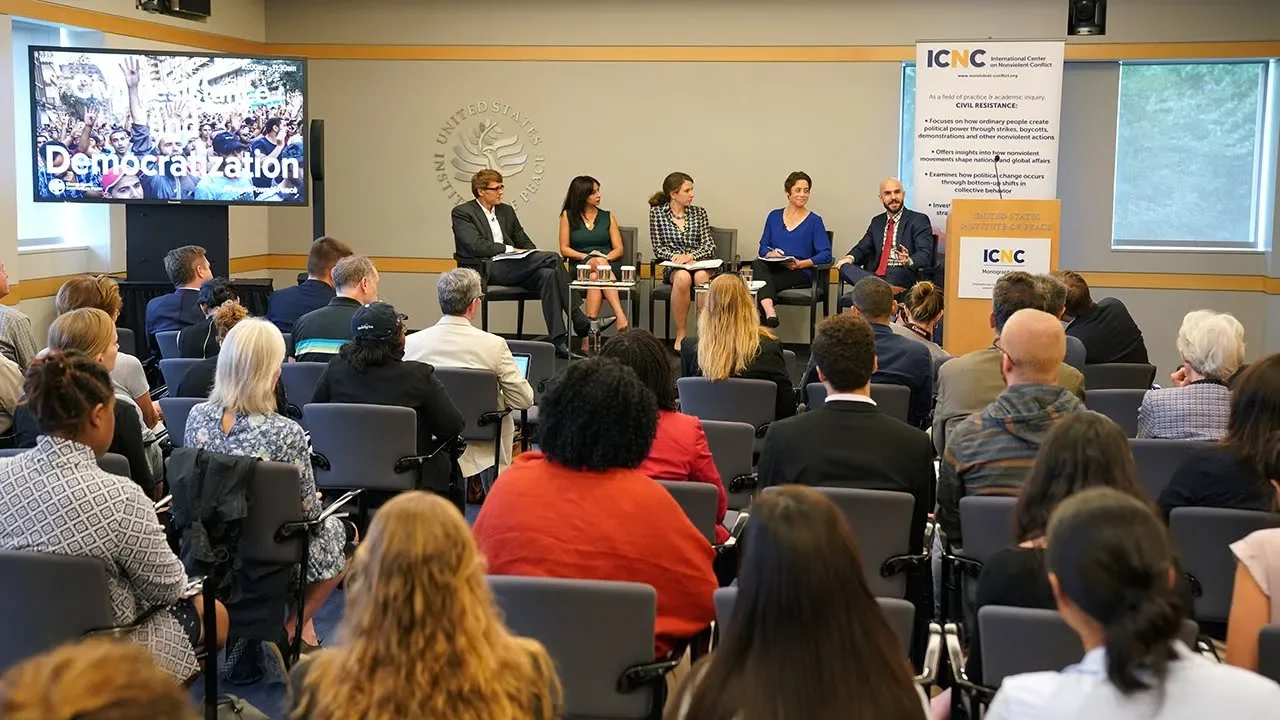


Civil resistance—where ordinary citizens work together through coordinated non-violent action to defend, demand, and improve democracy—is the most effective strategy for challenging authoritarian regimes. Research shows that successful movements share four key characteristics: they attract growing participation from diverse populations, focus on winning over key institutional pillars (civil service, business, labor, religious authorities, military), build organizational resilience against violence, and innovate new tactics. Historical examples from the civil rights movement, anti-aparttheid struggle, and recent movements in South Korea and Chile demonstrate that when people organize strategically and sustainably, they can successfully challenge even seemingly powerful authoritarian governments.
Defending Democracy: Civil Resistance Strategies with Erica Chenoweth
Added:Everyone hushed so quickly. Erica, did you notice? I think everybody's so ready. So ready. Thank you all for being here. Good evening, friends. We are truly grateful that you have come together for this evening's McKenzie lecture with Dr. Erica Chennowith.
Yeah, I want to go ahead and applaud right now, too.
[applause] >> [applause] >> My name is Chris Broadway Bowman and I have the joy of serving as the senior minister here at First Congregational United Church of Christ of Boulder. On behalf of our whole congregation, we welcome all of you. It is so good to be together.
We're blessed with a full house tonight, both here in the sanctuary and well beyond these walls. A warm welcome to all who are joining us by liveream. You can all wave into the cameras. They will see you. We know of at least four watch parties. a young adult gathering in Longmont, a party in Lafayette, and two here in Boulder, including a full auditorium at Frasier Meadows Retirement Center.
[applause] In whatever way you are joining us, we're glad to be connected in this shared moment of learning and reflection.
For folks who are online, if you go to the homepage of our website, firstong.net, net. You will find there both a program which everyone else has on paper here and a discussion guide for your watch party that you can download.
Let me say a word to you about the McKenzie lecturesship itself. It was established in 2000 in honor of Reverend Bruce McKenzie and his wife Janette upon Bruce's retirement as senior minister.
This lecturesship gives thanks for their ministry and their deep love for this congregation and for the wider Boulder community. Bruce served here for 27 years from 1970 to 1997 and continued as minister ammeritus until his death in 2017.
The lecturesship stands as an enduring expression of Bruce's conviction that faith invites rigorous thought, honest questioning, and courageous engagement with the world. This event is made possible by the McKenzie Fund of First Congregational Church's endowment. If you would like to help sustain this work for the years to come, you'll find giving information on your program and offering plates will be available by the doors as you leave this evening.
Following Dr. Chennowith's lecture, we will take a brief pause and then move into conversation. The index cards that you received are for your questions.
Please write them down and we'll collect them promptly at the end of the lecture.
so that they can be shared with former Congressman David Skaggs, who will facilitate our dialogue with Dr. Chennowith.
After our time of conversation, you are warmly invited to linger for even longer. You'll find refreshments down the hallway. Dr. Chennowith will remain here in the sanctuary to greet you personally and to sign books. and we're grateful to the Boulder bookstore for making those available this evening.
And now, as we turn toward the heart of our gathering, it's my pleasure to invite Sarah Schulty, our church's moderator, to introduce Dr. Erica Chennowith and to express our appreciation for the ways Dr. Chennowith's scholarship and public witness help us imagine and participate in a more courageous and hopeful civic life.
Sarah, thank you. [clears throat] Still a little strange for me to be here on a Friday night instead of a Sunday morning. I keep kind of looking around going, "This is kind of weird."
[clears throat] Okay.
Um, we like to we like to do everything we can here at First Congregational Church to make our social justice work more effective. and we like to partner with people in the community in order to learn more about social justice work and do more social justice work. And last year we did a series of conversations with our friends at Nuropa University.
And one of the things that I took away from that partnership was something um that I'd like to share with you tonight, which is that gratitude is a form of resistance.
So in that spirit, I'd like to share as a way of welcoming Dr. Chennowith. Three things that I'm grateful for. Some of them have already been mentioned by Chris, so I'll try to keep them short.
[snorts] The first is that I'm very grateful for each and every one of you who is here tonight. Whether you're here in the congregation or you're joining us online, whether you're a member of our church or whether you're a visitor, I am so grateful for your presence and your choice to be here tonight. And so we can all share together in hearing the words of Dr. Chennowith.
>> [applause] >> I'd like to thank, as Chris alluded to, the McKenzie lecturesship. The reason we are all sitting here to sitting or standing here today, myself, Dr. Chennowith, all of you, is because people in the past have wanted to keep this event alive. They've given their money, they've given their time, and they've given their care to nurture this. And so, we are all here, and we are all here because of them. the people who are here today and the people who have been with us in the past. So, I'd like to give a little moment to think that the people who helped us in the past are with us in this moment sharing in this wonderful event.
The last thing I'd like to mention that I'm grateful for is for Dr. Erica Chennowith.
Um, you can see their bio in your program and in the in the hopes of brevity, I'm going to say that they are a professor of political science at Harvard University and they have asked me to make clear that they are here in their personal capacity and not as a representative of Harvard University.
[applause and cheering] >> [applause] >> I don't know why we don't.
So, in the bi in their bio, you'll see their accomplishments in research and writing and their awards for their groundbreaking contribution to the work of understanding non-violent civil resistance.
What I am grateful for is the beacon that Dr. Chennowith is giving to us.
We feel like we are surrounded by injustice. We feel sometimes that we are living in the dark. And we ask ourselves, "What can I do? What should I do?
How can I do it? Who will do it with me?
Will I be okay?"
And we are so permeated, pierced with doubt in maybe ourselves or our society that we decide it might be easier to stay home with our anger and our fear.
Dr. Chennowith and their work has shown us that although there are no guarantees, we have a very recent human history that shows us that people, citizens who work together, who commit to a cause and commit to each other can change society.
And I am very grateful for that.
[applause] >> [applause] >> So, I'd like to say that I happen to know another thing and that is that Dr. Erica Chennowith when they were a student here at University of Colorado attended this church.
And so, I it was my great honor on behalf of myself, our church, and our Boulder community to welcome back Dr. Erica Chennowith.
>> [applause] [applause] >> Good evening everyone. How you all doing? [cheering] >> It is such a pleasure and a privilege to be here at First Congregational Church in Boulder where, as Sarah just said, during my graduate studies, I spent some time exploring my own faith. And I want to thank those who so lovingly welcomed me here in those days when I was a little bit grumpy about it.
I also want to thank Reverend Chris and the committee for the generous invitation to join you tonight. The McKenzie family for investing in opportunities for their congregation to continue its ministry through this lecture series and everyone who made this event possible tonight. And I also want to thank those in the audience here in the sanctuary and those watching online for joining in the essential conversations that we need to have in our communities, in our neighborhoods, in our families to determine the future of our country and our world. As I understand it, the folks who are gathered here this evening are coming with some big questions. I've gotten a little bit of a foreshadow of some of the questions um from Reverend Chris.
Among us, as I understand it, are federal workers who've been unceremoniously laid off after faithfully working as civil servants serving their country. ENCAR staff wondering about their future. Students, scholars, and academics who felt pressure to conform to new ideological projects or risk being targeted instead.
Immigrants and families of immigrants and friends of immigrants who fear for their lives and their livelihoods.
parents who've been worrying about what kind of political culture, what kind of climate, what kind of economy their children will inherit, and retirees who cannot believe that they're spending their golden years at church meetings about countering authoritarianism in America.
We have all watched with horror the events that have unfolded in Minneapolis and St. Paul over the past few months and we have held the awe of the community's collective response and we have held feelings of fear about whether our communities, whether our neighbors, whether our families will be next. So, I want to acknowledge all that people are bringing and all that people are holding in this room tonight.
And although we may not get to all the big questions and we certainly won't get to many uh concrete answers, I also want to acknowledge how powerful it is that we are in this room asking these questions that this church has provided the sacred space for this community to come together to bear witness to learn to question to strategize and to ask how we can help. It is rooms like this in the US and around the world where people over history have come together to organize the most iconic mass movements that have changed the world. So I know some of your questions. Where are we right now as a country? Like what's the score?
Where are we headed? What can we do?
What should we do? How can we take care of ourselves, our families, our neighbors, our communities, our children, our grandchildren?
Now I'm a social scientist. I approach these questions usually from a standpoint of trying to use social science tools to better understand patterns across many different times and places that might help us to get some insight as to how to better know and prepare for what might be required to affect change. I'll share some of those general lessons with you tonight and a few stories about them and we're going to dive into discussion and we can really talk about anything you want at that point. But this is not going to be one of my more nerdy talks up front. The talk is going to have three parts.
First, the bad news, then the more encouraging news, and finally a pep talk. Okay.
Okay.
[applause] So, let's dive in. First, the bad news.
In my view, we are indeed at a crossroads in US history. We're at a moment in which civil society and civic institutions are either going to figure out how to collectively push back and defend democracy in the United States or the United States is going to slide deep into authoritarianism.
Democracy is a process. It's not a destination. No democracy is perfect.
Ours certainly never has been. But there are some basic minimal standards in terms of rule of law, separation of powers, checks and balances, voters choosing their leaders rather than leaders choosing their voters, and respect for basic rights like free expression, assembly, conscience, due process. These are the foundational elements of any free society, the essential building blocks that allow for the pursuit of many different possibilities and collective futures.
Now, at the current moment, the US is in the midst of acute challenges on every one of those dimensions and more. Key government institutions meant to check presidential overreach have largely collapsed in response. The executive branch has been effectively purged of meaningful opposition and oversight.
Congress is fully acquiescent and is an effective implementation arm of the executive branch. The federal government openly attacks the autonomy of blue states and cities while aligning its brutal policies with red state trifectas. We see the executive branch suing federal judges in entire districts over their immigration rulings in which they merely uphold the constitutional principle of due process. We see justice undone through pardons to the president's supporters, including those who have committed violent crimes on his behalf and retaliatory investigations of his critics. Now, even within the judiciary, we see unsettling trends of deep fissure. The political scientist Adam Bonica has argued that whereas Trump has lost 94% of court cases in federal courts, so far he has won 94% of Supreme Court rulings, including some incredibly consequential rulings. though a judiciary at war with itself cannot constrain a tyrant and that the high court seems prepared to reinterpret the constitution in Trump's image means there are few if any effective institutional checks on his power.
Meanwhile, lawless assaults on our communities have been escalating and the clock is ticking on mounting an effective response. Once an autocratic click has successfully seized control of key institutions, consolidation becomes easier over time. If it feels like it's getting worse more quickly, that's because it is getting worse more quickly. As institutional checks and balances are dismantled inside the government, there is less friction. When the government begins directly bullying corporations, unions, educational institutions, mayors, religious figures, opposition politicians, immigrants, and ordinary people in our society. And there are fewer obvious ways to seek redress for injustice.
So that leaves us, civil society, as the beach head for democracy in the United States. And this is where there is some good news. Each of us can do a great deal. And it matters what we do. It matters what we do individually. It matters what we do collectively. It matters what we do today. It will matter what we do tomorrow, next week, and the week after that. And it matters what people in positions of power and influence will do as a result.
So that's a lot of pressure.
President John F. Kennedy on his desk had a plaque that was given to him by the commander of his naval unit during World War II in which uh JFK served in the Pacific War and was wounded there.
And the inscription on the plaque said, quote, "Oh God, thy sea is so great and my boat is so small." End quote. It is easy to feel overwhelmed by the call to stand up against tyranny. But what we learn from countries that have come back from the brink is very important and in many ways reassuring. In almost every major historical example of the past 125 years in which societies have faced democratic backsliding or organized against autocratic rule movements, civil society is what made the key difference across history and across geography.
Democracy movements have won through civil resistance, which is where ordinary people decide to work together in a coordinated strategic way to defend, demand, and improve democracy through non-violent action. Whether we're talking about how the civil rights movement in the United States mobilized against the autocratic and racist Jim Crow South uh system of segregation or how the anti-aparttheid movement in South Africa created a democratic breakthrough against a white supremacist regime. How the solidarity movement organized and mobilized against authoritarianism in Poland. How Chileans broke through the fear and terror of Pinocha's far-right regime to peacefully force his ouster. or how South Koreans mobilized against a coup just a year ago. The most important factor in determining whether those movements succeed is a strong and sustained defense of freedom, justice, and accountability from the grassroots to the grass tops. And this is because no government, no matter how tyrannical, is monolithic. Every tyrant or aspiring tyrant is totally dependent on the cooperation, obedience, and help of thousands of people in different pillars of support. Aspiring autocrats like to project strength, permanence, and absolute loyalty and feelalty. And they're doing that to make people feel powerless, alone, demoralized, and demobilized.
But we're not powerless. We're not alone. Actually, people who oppose oligarchy, autocracy, and dehumanization of other human beings are in the vast majority in this country. And autocratic power is not permanent. It's super fragile. That's why they're trying to project that it's permanent. Over history, successful civil resistance movements have a few things in common.
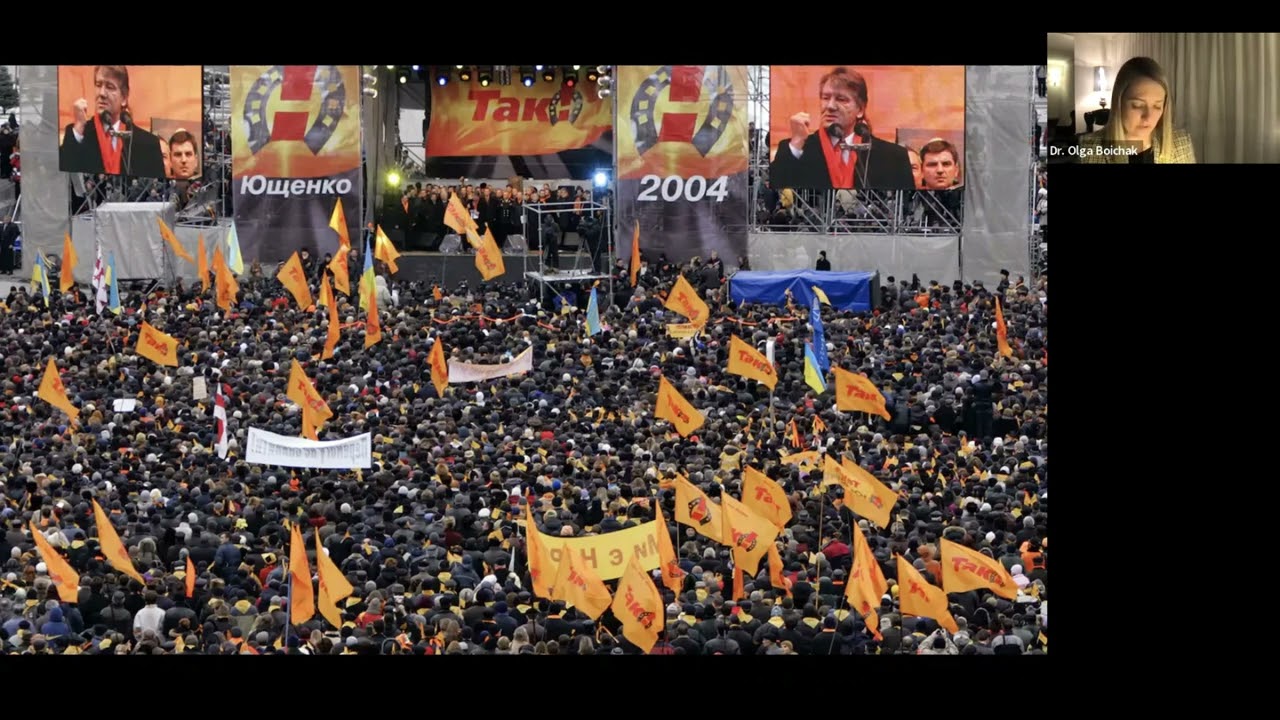
First, they attract an ever growing number of participants from all walks of life who ultimately seize the momentum and build a center of gravity that can be a counterveilling force against the tyrannical power. And they focus that popular energy on making sure that key pillars, the civil service, the business sector, political leaders, local leaders, organized labor, religious and cultural authorities, police and military forces, and the like, ultimately align with the democracy rather than the autocracy. Successful movements build resilience and maintain organizational discipline even as violence or the threat of violence against the movement escalates. And finally, they innovate new tactics, building methods of non-violent protests and persuasion, non-ooperation, and alternative institutions through which they experiment with building the beloved community that they wish to see.
So, how are we doing? Here's some more good news. I believe we're witnessing the emergence of a powerful movement of movements that has the capacity not only to disrupt the consolidation of Trumpist authoritarianism, but also to envision an irresistible future for America's next chapter. There are perilous waters ahead, but we have everything we need to build the country um and bring it to a better place. So, first let's talk about numbers, the first of those four factors of successful movements. My team at the crowd counting consortium has tallied tens of thousands of protests in the past 13 months. That's over four times as many as had happened by this time in 2018. The volume of protests is growing by the month. January 2026, just last month, featured the third largest number of protest in US history.
>> [applause] >> They were surpassed only by the historic uprisings after the killings of George Floyd, Briana Taylor, and Ahmad Arbory in June 2020 and the student walkouts and marches of March 2018 after a school shooting in Parkland, Florida, which at the time were the largest single day demonstrations in US history.
Two of the largest mass demonstrations in our country have then since taken place in June and October of 2025 during which millions of Americans from all walks of life came onto thousands of town squares, thoroughares and bridges to register their opposition to autocratic consolidation.
At the same time, we can witness a growing realization that protests are both deeply necessary and deeply inadequate on their own to prevent the consolidation of autocratic power. And so in cities and towns across the country, communities are getting together and they're organizing to raise the alarm about ICE abuses with hundreds of thousands of whistle kits distributed to people from all walks of life who have been radicalized basically by watching what ICE has done to their neighbors. And sometimes for the first time in their lives, they have watched their neighbors, their friends, their children's school teachers hauled out of their lives and separated by their from their families by masked government agents and come out on the street and said no. I'm sure you are all thinking of the killings of Renee Good and Alex Prey, which we know about only because of the people in their community who had volunteered as observers and prepared to film and distribute the footage to thwart the inevitable attempt at a coverup. Those types of things don't become known unless communities are prepared to record and share what they are experiencing. I hear daily stories and outreach from people as diverse as high school students starting new chapters of concerned citizens in their rural town to understand how they can push back effectively against the indignities that they are witnessing in their communities. It is impossible to overstate just how important these visible signs of resistance are and will continue to be as the consolidation effort continues because authoritarianism absolutely cannot fully consolidate when people are willing to take risks to demonstrate their commitment to democracy through non-violent action.
And people aren't just protesting in blue areas. Just so you know, we are seeing much more protest in red counties, too. In November, my team published a study showing that during Trump's first term, protests were actually largely concentrated in counties where Kala Harris ultimately won the election in 2024. But in 2025, over the past year, we saw a totally different picture. Since April of 2025, the median protest county in the United States cast more ballots for Trump than for Harris.
>> [applause] >> The increase in protest participation is also greater in those counties and in counties where he won by at least five percentage points where protests tend to be small but mighty and in those counties the average protest participation has increased by 250%.
So that's participation and diversity of participation. How about tactical innovation? So remember that movements that win are the ones that translate protest participation into powerful forms of leverage. Whether at the ballot box or in alternative institutions in mutual aid networks or through economic non-ooperation such as campaigns of consumer boycots or withholding labor to impose costs on pillars that are helping the regime to consolidate power. People saying no individually and collectively, especially when it's costly to do so, is what puts the brakes on consolidation.
And we are also seeing this appetite for non-ooperation through boycots, boycots, and blackouts. There have been campaigns to sell back Teslas, boycott Target, corporate shareholder votes rejecting proposals to eliminate DEI in places like John Deere.
We've seen attempts to unsubscribe to Disney um have a magical effect on reinstating Jimmy Kimmel. We've seen boycots of Spotify um making them end running ads for recruiting ICE agents.
We've seen economic pressure campaigns on Aello airlines making them come to a different decision about whether they wanted to be involved in deportation efforts. So these have been largely successful economic campaigns, very interesting experiments from which there's much to learn. And ultimately moving to the ability to withhold labor through strikes, perhaps the most effective method of non-violent resistance that has ever been developed by people are things that people are now talking seriously about. Then there's the flourishing of alternative institutions, building beloved community, building a vision for a future that appeals, that is irresistible. We're seeing it through the development of mutual aid networks, organizations of workers who've been laid off, and a new civic solidarity, new media, new ways of solving local problems that make the autocrats vision old news and irrelevant. A new culture, new stories, new ideas can help to build the vision for a bigger Wii. And what about the impacts on these pillars of support? Well, in the US today, the response of key civic institutions has been pretty mixed, right? So far, as with many autocratic contexts, some institutions are more naturally positioned to resist autocratic intrusions, and others don't really move on their own.
Trump's early moves to purge the civil service in the military represented in many ways an attempt to inoculate himself against non-ooperation from within those entities. Instead, people sort of have to push those pillars into action. And today, we see some movement among key pillars um against authoritarianism. Today's gathering is like one tiny micro example of a faith community working to organize itself.
Many of our friends in the labor movement have been working to push back from the beginning. The Catholic Church decided to throw its mighty power behind those resisting the administration's cruel ad uh immigration policies.
University faculties across the country are organizing themselves to push back on violations of their first amendment rights and the committee for the first amendment is organizing actors, writers, and other creatives in Hollywood to leverage what power they have to protect free expression for everyone.
So among pillars who have been mo more overtly aligned with the administration, the manga movement of the Republican party, big business, big tech, some segments of the evangelical church, Trump's most ardent base of supporters.
Let's just keep in mind that the critical task of shifting people in their loyalties is not necessarily about converting the most hardcore opponents of the democracy movement. Instead, it's about constraining their power and cutting them off from the sources of support that allow them to dominate others without a popular majority.
Although there are no guarantees and there is no way to predict the future, our own country's history tells the story of how an engaged and mobilized civil society has shaped every promising step forward in our nation's progress.
For every progressive change we have seen to improve the democratic experiment in the United States, a mass movement was behind it. Whether it was the abolition of slavery, the expansion of the vote, labor rights, women's rights, civil rights, the rights of children, reproductive rights, gay rights, the protection of the environment, black lives matter, and many others. So now it's our turn. And so here comes the pep talk.
And with apologies, I'm going to moralize a little bit because even though that's not my usual practice, how often do social scientists get to stand at a pulpit?
>> [applause] >> And there might be some important things that I say here um especially as we consider the role that faith communities might have in addressing the crisis that faith that faces us and these times I think it's okay to bear one's soul a little bit too. So the first thing I want to say and this is like really important to me to say this is that this too shall pass.
We need to think with a clear eye about the kind of country we are creating with our words and deeds and through the way we struggle when we arrive on the other side of this current emergency which we will. The goal if the goal is democracy we need to remember that in the House of Democracy there are no enemies.
There are only adversaries at worst. Barbara Deming who is a feminist activist described the two hands of non-violence. One hand that stops the injustice and one hand that offers an open invitation into vision of beloved community. To stand against authoritarian consolidation, we will need both hands. Now, faith communities are absolutely crucial in strengthening both hands. Consider the end of apartheid in South Africa. It wasn't just a clerk and Mandela who shephered South Africa out of a white supremacist system, out of tyranny, and out of the acute possibility of civil war. That effort required all of society, a united democratic front of which the church played a key role. There is no free South Africa in 1994 without black townships mobilizing marches, strikes, and boycots and Archbishop Desmond Tutu and the church he brought behind him.
People often ask me whether what we need right now is a broad anti- athoritarianism movement or whether we need a new democracy movement that articulates a compelling alternative. My answer is yes.
We are in a both and moment. These two fundamental lines of effort and many others can happen at the same time and indeed must happen at the same time. And what faith communities can bring to a moment like ours is a prophetic vision of love that can inspire, sustain, comfort, heal, and reassure. We will need a new vision in this country, a vision of love, a love of ourselves, knowing that an inconceivably powerful source of perfect love is available to us, always and never separate from us.
We will need a new vision of love for our neighbors, all of them, and especially those who are afraid, who are alone, and who are in harm's way. We will need a new vision of leadership for our communities in all of their diversity and complexity. And we will need a new vision of leadership for our nation. A new sense of a nation that has not yet come into being. As Reverend Vincent Hering used to say, "I am a citizen of a country that doesn't yet exist." So to my friends in faith who are standing out, I see you and I thank you for sewing the seeds of the new nation of our time.
I want to tell you about one of my mentors, Reverend James Lawson, who was a titan of the civil rights movement.
Though, as he told me, he and his contemporaries called it the American freedom movement. The term civil rights movement came later, and once he said, I don't even know where that term came from.
Reverend Lawson had served time in federal prison for refusing to serve in the Korean War as a conscientious objector. And in prison, he read Gandhi's autobiography to learn the technique of non-violent struggle. Now, he had spent his early career after prison, then teaching and training students and parishioners, including a young John Lewis, about how to wave non-violent struggle in church basement in Nashville. His movement put into action what they learned, and they desegregated downtown Nashville in one of the most stunningly successful campaigns of the civil rights movement.
That was in the late 1950s into 1960.
And I first met Reverend Reverend Lawson over 50 years later at a talk I was giving in Europe back in 2011. We were both there because it was the peak of the Arab awakenings. And uh I was brought in as an expert to talk about the like statistical analysis of the likelihood of success of non-violent versus violent cases in the Arab awakenings and what might be needed to support democracy movements that were emerging in that context. It was a really nerdy talk with PowerPoint slides, charts, graphs, statistical tables, discussions of statistical significance. So after the talk, Reverend Lawson approached me afterward and he had some encouragement and a little bit of a nudge. I'll never forget it. He said, "Erica, this work is for the whole world. These numbers are so important and I want you to keep talking about them, but I also want you to remember you got to have a little faith."
And so this brings me to my second point. We know what works. We have everything we need. all the ingredients, all of the knowledge, all of the historical examples. Actually, Reverend Lawson once said to me, "I am so jealous of everything you have at your fingertips." When we were trying to figure out what to do um to desegregate the South, we had Gandhi's autobiography in the Bible, and that's what we used.
He said, "You've got training manuals, you've got statistics, there's no excuse."
So, we have everything we need to build a movement that can take the country to a better place. But no one can predict the future. And we've never been where we are right now. There are no guarantees. As we build the type of formation, our own United Democratic front, the movement of movements that will change the course of history once again, we're going to have to act on faith.
Not too far from my home in Massachusetts, in a farming town called Heath, there stands a tiny church, the Heath Union Church. You've probably never heard of it, but in the early 20th century, it had a regular visitor, the theologian in exile, Reynold Neber, who spent his summers in a stone cottage down the road from the church, raising ducks and chickens with his family and serving as a guest preacher from time to time. His daughter recalled that Neber hosted a rotating set of illustrious guests in the radical intellectual and spiritual community that he tried to build there each summer. All of whom were deeply concerned with the rise of fascism, the rise of wealth inequality and labor conditions that were totally intolerable. They were concerned with attacks on immigrants, the sustained segregation, discrimination, and injustice experienced by black Americans, not just in the Jim Crow South, but also in the North.
These friends included people like the Supreme Court Justice Felix Frankfurter, who so loved the area and the community that was being built there that he bought the mill down the road to spend time there when the Supreme Court was in recess. And the guest list also included another well-known dissident theologian Dietrich Bonhaofer who was with Neber in Heath at the church when he made the fateful decision to return to his native Germany in what he knew would be a suicide mission to join the resistance against the Nazis.
It was with the knowledge of Bonhaofer's impending departure to confront fascism headon that brought pain and worry to the Heath community when Neber penned a prayer that some of you might be familiar with. It goes like this.
God grant me the serenity to accept the things I cannot change, courage to change the things I can, and wisdom to know the difference. living one day at a time, enjoying one moment at a time, accepting hardships as the pathway to peace, taking as he did this sinful world as it is, not as I would have it, trusting that he will make all things right if I surrender to his will, so that I may be reasonably happy in this life and supremely happy with him forever and ever in the next. Amen.
Now, some of you might recognize that prayer from its first part, which is now used around the world today on memes, in recovery rooms, in ecumenical study groups and worship services, and even in boardrooms. But in its original context, the prayer was in fact a call to action, a call to courage, a call for people of all faiths and all walks of life to face the facts of what might be required of them to defeat the forces of tyranny in their time. It was a prayer written with pain and anguish, a plea to a more powerful source to give strength, wisdom, and courage to those who needed to walk through their fear and stand with those who were standing up for what's right.
Now, Neber wasn't a pacifist. Neither was John F. Kennedy. They along with many other liberal uh theologians and neber took issue with pacifists when he felt their commitment to pacifism equated to appeasement. Gandhi and Neber were contemporaries, but Neber did not live to see the tools that Gandhi shared with the world being honed and improved. In South Africa, where civil resistance proved essential in toppling apartheid. In Chile, where Austo Pinocha was finally toppled by effective civil resistance. In South Korea, where in the 80s and again last December, South Koreans rose up to confront military dictatorship and break through to freedom. These examples from the past and the present provide inspiration for us today. The technique of civil resistance is our inheritance and these lessons teach us that yes, the ark of history is long. It is long and it does not bend toward justice on its own.
Last year I had breakfast with a longtime benefactor of the field of civil resistance who also herself worked internationally in the field of conflict resolution and we were sort of touching base and I was sharing with her some of my despair about the crackdowns against peaceful protesters in Myanmar in Venezuela people we know the rising bloodshed around the world and my concerns for the future of our country in a period of such uncertainty and change. And she said to me at the end of the conversation, "Do you know why light will always overcome darkness in the end? It's because light has a source, a powerful source. Darkness has no source.
Darkness is just the absence of light.
It cannot sustain itself against the arrival of light.
So let's not give the autocrats what they want. Instead of succumbing to the isolation, the fear, and the demoralization that they so desperately need us to feel, know now and always that you're not alone, organize your own community, your own sphere of influence, to wield your resources even more powerfully. Be unrelenting about it.
Throw your support behind those who have raised their hand to lead in these times. Our country is full of folks who are doing the hard work on the ground already to organize their communities, build new containers for people seeking a political home, mobilizing against injustice, litigating against unlawful acts, providing providing direct services for those who've been harmed by the government, supporting the families of people deported, disappeared, or detained, and doing the hard and necessary work of envisioning what comes next. You are among them. So you deserve support and you can support others. This is the great struggle of our time. So most importantly, don't believe the lie that our current situation is beyond repair. This too shall pass. Take courage. Stay the course knowing that those who choose to stand and lead for a more perfect union today are the ones who are going to shape the country and the world to come. Thank you.
>> [applause] [applause] [applause] [applause] [applause] >> Friends, we're going to take a very short break, rearrange the furniture and the microphones and get ready for a conversation um facilitated by David Skaggs with Dr. Chennowith. So you can stand up, turn around, chat, step out, step in. We'll be right back.
Friends, as soon as you take your seats, we can start the conversation.
>> I'm sure that a few folks will continue to wander in, but we are as soon as uh a few more folks are seated, we are going to go ahead and get started so that we can have as much time as possible with Dr. Chennowith.
Okay.
>> All right. Well, it's my pleasure not only to introduce Dr. Chennowith, but to also introduce David Skaggs. Oh, he hates this.
He hates this, but it has to be done.
Uh, David Skaggs served three terms in the US House of Representatives and seven terms in the Colorado House of Representatives. He's a Marine veteran who served in the Vietnam War. He is known for promoting civility in politics and he's known for his strong environmental record. The National um I'm just going to say Noah, the Noah David E. Skaggs Research Center here in Boulder is named in his honor.
I'm sorry, there's a little more. He was appointed the first chair of the office of congressional ethics in 2008.
He was a trustee of the National Endowment for Democracy and the American University of Iraq. In 2017, he received the Distinguished Service Award from the US Association of Former Members of Congress.
He wants you to know that he has been active in the resistance to the Trump administration.
>> [applause] >> And uh probably closer to our heart, he is a longtime member of the First Congregational Church and has sung baritone in our chancel choir for more than 50 years. Please welcome Doc David Skaggs.
[applause] >> I told Chris not to put all of that in the in the program, but I'm I'm stuck with Thank you very much. What a privilege to be here with you, Erica.
And uh uh my first softball question as a recovering politician is and inspired by your talk, when are you going to run for office?
>> Oh god, [cheering] [applause] >> I don't think that's in my future. But um you know, there's a good thing about division of labor here, right? People who run for office, their job is to win elections. People who study and participate in social movements are there to create the environment in which we can have elections. That's my that's what I'm in.
[applause] >> Point taken. Anyway, welcome back to Boulder. Um and uh you got your PhD here at the university in political science, but looking at your work, it seems to me to be an amalgam of political science, sociology, mass psych, I mean a number of disciplines. So, how do you what do you call yourself at this point? A a social scientist.
>> Yeah, that that's a good catch-all term, but I think political science is still my my main home.
>> Well, I will uh spare you from my normal commentary about the lack of science and political science because [cheering] but I think you've you've already disproven that in your work with all the data. Um, we talked a little bit before we sat down about the higher education and given your position in a distinguished faculty at the Kennedy School, I'm sure you were observing not only what was going on in Cambridge, but the higher ed community around the country and it uh it pained me as u someone that has dabbled in the higher education world a bit since Congress not to see that community stand up for itself with greater B unity and coherence.
Any any thoughts about what went wrong or did anything go wrong?
>> Yeah, I mean I guess I have a couple things to say again just in my personal capacity and from my perch. The first is that um Harvard uh remains the only institution in the country that has sued the administration.
Um we did it twice. We won both suits.
Um, and you know that you're in a democracy when when you sue and you win a lawsuit, you win.
When you sue and you win a lawsuit and you still lose, that's evidence that you're not in a democracy. Um, and so just from uh being on the inside there, um, I can tell you that there's a price to pay for standing up and that helps us understand why so few others have done it. Now, that's true at the institutional level. At the faculty level though there has been much more going on. Uh so clearly faculties have also themselves launched independent lawsuits through the AAP and the AFT and a variety of other kind of formations and they also have been winning their suits and huge numbers right um but the thing is that you know authoritarian consolidation works when it's kind of a surprise like when nobody really sees coming the extent to which a tyrant will try to dominate um educational ational and cultural institutions so early in order to you know seize the ability to determine what type of ideas are even allowed to be discussed.
But um if you know about all of the recent cases of backsliding you know that universities and media are kind of the first place they go right is to try to consolidate. what nobody really has appreciated until this our own instance is how quickly that can happen and that universities just really aren't u positioned to be like vanguards of the resistance in a normal functioning democracy. They're just not built that way. And so um if they're kind of taken off guard and by surprise and they can't shore up the resources to mount a defense even individually, they're not going to have a very good time doing it collectively. and and so you know I have plenty I could say about it but perhaps I've already said enough.
>> You are a tenure.
[laughter] >> Yeah, I'm not worried about my job. I'm worried about the institution.
>> Just kidding a little bit. Um one of the things I am aware of that goes on at the Kennedy School is the work that your colleague John Devopi does with uh especially young voter questions. uh and some of that data I believe has indicated a real erosion in the belief in democracy among our young people which raises the question given that young people are often sort of the shock troops of civil resistance. How do you reconcile that? Well, so I think there's a huge difference between public opinion polls that tell us that young people are feeling completely disenchanted and disgusted by the political system and the observation that they still remain like the vital engines of civil resistance movements. Those two things can happen at the same time and often do happen at the same time. My colleague Matthew Seel and I just published a piece a couple of weeks ago in the Journal of Democracy about this like new wave of Gen Z protests happening all over the world. The only successful civil resistance movements we've seen in the last year have been youth movements in Bulgaria, in Sri Lanka, in Bangladesh, um in Korea to some extent. Um and it has been like youth power that has driven those campaigns against authoritarianism. And so, you know, they we there these two things can coexist at the same time. And I don't actually think um you know people filling out a survey saying that they think that political violence is you know sometimes necessary or something is the same thing as them being willing to do it. Right?
So but we we see what we can see is that people are showing up in large numbers in these movements. You know there were a lot of observations early on in the protests that were happening around the country here um that people were saying oh you know it looks like it's mostly like elderly folks at the no kings.
First of all, I didn't actually notice that in the in the ones that I was watching up close. Uh but the second piece is that if you've seen what's happened over the course of protest in the US in the last year, um the people who are out like doing the anti-ICE protests everywhere are largely like millennials and young people. So, so it's it's just sort of like you can you can sort of reconcile public opinion polls with behavior um uh by just looking at what people are doing rather than what they're checking a box saying.
>> Well, you you mentioned the no kings u demonstrations and uh the work of Indivisible.
uh and I'm and we've had a fair number of demonstrations here in Boulder, both organized by them and and also organized around what's happening to science and the environmental institutions in Boulder. Uh I was heartened that in your structure of what needs to be happening that demonstrations do matter because there's a sense when you're out there on the street, is anybody listening? Is anybody going to pay attention?
Yeah. And sometimes I even think that's too high a bar for me. The question is what would have happened if nobody was out there, right? So like you know the bar is did we uh prevent something even worse from taking place, right? And and I think uh having very large shows of popular participation is part of what shows that there are going to be costs even if that symbolically they're just being you know kind of put on display in in symbolic terms in in largecale protests but they also demonstrate a capacity a capacity to impose political costs economic costs social costs you know and and so um I think it's really important that people have stood up and I don't think they should um be discouraged encouraged by not seeing immediate impacts of that action.
>> Well, and and in your um analysis of the major ingredients in successful resistance, you talk about creating um what's the word I'm looking for now?
Yeah. Um defections. So, what do we know about what goes into the minds of the power elites that some of whom will ultimately need to defect?
>> Yeah. So, you know, this is kind of an interesting area because for a long time, um, most of the research, including mine, really focused on the question of, you know, whether and how security forces would defect. Um, and so, you know, there weren't too many theories of it, but the theory kind of went like this, which is if you get enough people from enough walks of life engaged in a civil resistance movement, invisible opposition, somebody's going to know somebody who's in the security forces. and those and you're going to start to have these social connections that make it very difficult um for the security forces not to eventually begin to weaken in their loyalty to the regime. And so that was kind of the theory and we've seen this play out in many cases in the 20th century. Like you can think of the iconic examples of you know protesters putting carnations and the end of gun barrels and the in the in the carnation revolution in Portugal or in Serbia there was this very um kind of iconic example of um the Serbian police refusing to fire on demonstrators in Belgrade um because they recognized their own family members in the crowd.
And um those are like the iconic examples that built a lot of theory and that we you know showed uh through a lot of data um were a a lynch pin in the sort of success of these movements.
There's been something important that's happened though um over the last 25 years which is that autocratic governments have learned about that.
And so what they have done is learned how to adapt to knowing that they need to keep their security forces aligned with them. and that's [clears throat] the most important thing they need to do. So there have been fewer and fewer defections over time in many civil resistance campaigns around the world.
And um I think what this means is really three things. The first is that we need a better theory for what makes people defect in different pillars, not just kind of an idea that if you send in a bunch of people, somebody's going to know somebody and it'll like magically have an impact politically. So that's number one. Number two is that we need to think about different pillars. So if the security forces are unavailable for defection like say they were in South Africa um what they did was they focused on the business and economic community as the key pillar that needed to defect in order to bring down apartheid and that is how it happened. The security forces never defected. The third thing we need to do is build strategies then that um kind of recognize that defections in the key pillars of support are how these movements win. Not just huge numbers of people but numbers of people that translate their power into those pillars defecting. So we did a study Zoe Marks uh Andrew Hawking and I a couple of years ago that we published about can you like what what we were trying to do is build a computational model that could test three strategies.
The first strategy is like the magical mobilization strategy that I described where if you just take as many people as you possibly can and get them in the streets as quickly as possible like how long does it take to win basically. And then the second strategy is what we called a a naive pillar strategy. And the strategy in that model was basically to just get as um to to go to the nearest pillar of one's community like influential person in one's community that's closest to you and just start like trying to get them to defect.
That's the naive pillar analysis. And then the third strategy is what we called an informed pillar strategy. The informed pillar strategy is when the the protesters as agents had some information about which of the pillars in their community were feeling kind of ambivalent and they went to them first and it creates a cascade of defections because if you go for the lowhanging fruit and they defect it can create other defections. So then we ran this computational model and it turned out that that third one the informed pillar strategy is by far the most successful.
puts in the like 80 90% range of success even with smaller numbers. Whereas the mass mobilization strategy um like worked if it worked which is to say if you really could get like 10% of the population in the street very quickly that would work but it almost never happens.
>> So I I hope in in line with your occasional reference to boycots that um you've assured that none of your books get sold to the Department of Homeland Security.
But more seriously, uh I would guess that uh the people in the administration are pretty sophisticated about the sorts of things that you've written about and that that might inform, for instance, the u reliance on security forces from outside of the communities that they're trying to control.
you know, um, there was a a figure that I talked about in a TED talk I gave in Boulder in 2013 called the three and a half% rule. And the three and a half% rule was just the historical observation that at least at that time in the data set that we had on non-violent movements. Um, none of them had failed after mobilizing three and a half% of the population. Um, and so that sounds like a small threshold, but it's actually a large number of people abs in absolute terms.
The first country that broke the rule after that was Bahrain which by 2014 had had an unsuccessful movement um to that was part of the Arab awakenings. started in 2011, ended for sure by 2014. And by all accounts probably mobilized about six to 7% of the population.
And um when we looked into that case um what became clear is that the security forces were kept in the barracks. The Saudis came in and that was on purpose to make sure that there weren't defections.
So now when you see National Guard from X country being sent to Y or X state being sent to Y state that's a learned example.
I was afraid of that. Yeah.
Um, you also write about the role of technology both on the organizing level and I'm concerned about the role of technology on the uh in behalf of the repressive powers and and in particular where we're going to go with facial recognition and those tools that a repressive state can bring to bear against all of us.
>> Yes, I Dave, this is something I don't like to think about. Um uh but I but I would just say um this has been part of of why uh so many movements I think have um struggled to adapt to the new sort of challenging terrain that we're in is because there's a huge kind of technology gap between what movements are doing and what uh is being waged against them on the tech side. Um and it's not just surveillance, it's like much more sophisticated. um uses of technology to spread, you know, uh terrorizing images of like what ICE is doing to scare people to make them feel, you know, demoralized and everything. Um and to spread misinformation and and things like that. So, it's it's it's unbelievably complicated and overwhelming. I don't know that I have any really good ideas other than I'm really into like in-person conversations and and action right now in part uh because I think um you know a little more analog action is not a bad idea.
>> Yeah. Um we we are here in the wake of all of the events of the last few months in Minneapolis um including the outofstate police force that was brought in there. But I'm just wondering, I I'm sure you have already started to derive lessons learned and mistakes to be avoided that come out of the Minneapolis experience. So, can you share some of that with us, please?
>> I think we're going to be studying Minneapolis for decades. Um, you know, I I don't know of any mistakes. What I would say is the only mistake we could learn from Minneapolis is if we didn't get information after watching what happened there. Um, but I I don't think uh I don't think I'm not going to like criticize anything that was done there. I think um it's a remarkable remarkable example from which we'll be learning lessons for for a generation.
>> Absolutely.
>> [applause] >> You also write and and have lectured about sort of the the dynamics not just of civil resistance but civil disobedience and the costs and benefits that come from the disobedience tactic.
Um I I had the good fortune of being a classmate in my first election to Congress with John Lewis. So you know was inspired by John and all that he had been through in his remarkable life.
But there's a good deal of pain there.
>> Yeah, there's no doubt about it. I mean, civil disobedience is something um you know, for those that don't aren't aware of the difference between civil resistance and civil disobedience. So, civil resistance is a broad technique of struggle that includes all kinds of different methods of non-violent action, including sometimes civil disobedience.
Civil disobedience is a particular method where the idea is basically to deliberately break a law um that one views as unjust in order to then publicly suffer the sacrifice of breaking it. And so John Lewis um engaged in civil disobedience and went to prison for it. Was actually he wasn't even beaten for civil resistance. He was just beaten for protesting. Right. Um um but you know people who live a life of non-violent struggle the way that John Lewis did, they make a lot of sacrifices and they understand too that there's a purpose to the sacrifice that the sacrifice can be useful to them and to the movement in trying to dramatize uh the injustice that they are facing and um that was like a key part of the strategy of the civil rights movement of the quit India movement of the non-ooperation campaign in India and many other kind of Gandhian inspired examples.
>> Yeah. At least my memory uh growing up uh as a young man with the civil rights movement in full full force was that the uh the willingness to submit to the consequences of civil disobedience was a critical factor in getting defections from the authorities.
>> Yeah. I mean, that's the theory. And I think sometimes it worked, right? And sometimes it didn't. And so, I think the main thing to know about civil disobedience or any act of being deliberately arrested or put in harm's way is that um you know, it's pretty unpredictable what happens from there.
And so, the most important thing people need to do is prepare themselves for any kind of um uh anything that might come to pass um and their families and their communities in order to be resilient to what might happen.
And have have you or any of your colleagues sort of studied what went on in the minds of the repressive forces in the south in those days that ultimately changed where they ended up. We you know there's some dramatic examples. George Wallace in his later years deciding uh to be a different human being.
>> Yeah. You know I think there's there's sort of two uh views on this. One view is is that view that part of the power of non-violent action is it opens up the possibility of a kind of a spiritual awakening right among the the opponents of the movement. Um and then there's another point of view which is that it's quite dangerous to rely entirely on hoping for conversion that in fact defections are not about changing minds.
It's about changing interests and uh and putting constraints on people's actions so that they can't continue doing the harm and that movements that either overvalue or build their strategy on kind of a hope of being able to melt the hearts of their opponents are on dangerous ground. So I think that's the you can sort of understand the one of one of those perspectives has more spiritual roots and the other has much more kind of utilitarian strategic approach. Um, and I think that it's hard to get at which is actually happening in the data.
>> Well, you alluded in your remarks to the particular role and one would hope leverage that communities of faith have to play in these days and in this effort. Um, and I' I'd love to have you expand on that a little bit, especially given where we are.
>> Yeah. So, I was thinking of of Jim Lawson because [clears throat] he was himself a man of faith. Um, but he also uh like used the church space very well, right, [laughter] to help uh build the Nashville campaign. And for anybody who's not familiar with the Nashville campaign, there's a very good like short documentary on it. Um, in this uh documentary series called A Force More Powerful. Um, and you should watch it.
You should actually watch the whole documentary. Um, but the the the piece on Jim Lawson in Nashville is really important for us in this country today.
So he used the church well in a number of respects. Uh the first thing is that he used the church basement as gathering places for teaching, learning and training. Um you might remember seeing some footage. um if you've had any kind of encounters with history on the civil rights movement of uh like black and white footage of activists white and black in church basement undergoing training where they were being beaten by their peers and th those were Jim's trainings and what they were doing was they were trying to build resilience and honestly like emotional regulation to be able to sit in their seat at the lunch counter um knowing that um the Ku Klux Clan was going to come in and try to drag them off their stools or the police were going to come and they were going to harass them and were going to try to make them turn around and punch them in the face, right? And so he was teaching them to take all kinds of insults and beatings and people putting cigarette ashes in their hair and burning them and just sitting there with dignity in their power. Um and he in order to uh create a community of activists that was prepared for the abuse that they were about to experience, they needed a spiritual basis of comfort, you know, and so he was also able to offer theological tools. um he was able to offer a strategy that was based in Gandhi's strategy and he was encouraging people to ask questions about it and challenge you know the group about it but they would use that space well and then you know he told me once that um there was a really important moment um in the kind of climax of the Nashville campaign where a bunch of the students had been arrested for sitting on um you know lunch counter stools, which was not illegal, but they'd been arrested in huge numbers and they just filled the jails, right? And there was this black lawyer in town named Alexander Lubie who agreed to represent these students and like for free. And um Alexander Luby's home was bombed by the Ku Klux Clan for doing this. And uh the immediate response to it was Lawson and the other leaders of the movement calling a silent march from Luby's home to the steps of city hall.
And so they gathered at Luby's home and they started doing this silent walk through the city. And people started to gather and they they thought brilliantly. I think that if they did a silent march, there were a couple of things that were powerful about it. The first is it was very accessible. anybody could know and participate who wanted to. But it was also going to be clear who was there to provoke because in a silent march you're either being quiet or you aren't. And so you can manage the provocators. And then the third reason it's powerful is because it's powerful.
It's powerful to see 5,000 people walking down the street in silence from the site of an atrocity to city hall.
And so when they got to city hall, they had their cameras on um rolling and they'd invited the press to come and Mayor West came out of his office and met them on the city hall steps and Diane Nash, a black student from Fisk University, walked up to the mayor and said, "Mayor West, do you believe that it is right to deny somebody service on the basis of the color of their skin?"
And he said, "I don't think it is right." and they got him saying it on camera and from that moment forward there were negotiations to desegregate the downtown. So, you know, you can't have that kind of discipline without some powerful resilience, trust in one another, strategy, and being able to really put up with a lot of nonsense in order to get to a point where you can fully express your power. s such a powerful story and and example and it worked because the press was there. So uh thoughts about the current media environment and uh you know we are delued daily with you know so much nonsense coming out of Washington and the administration. Is there any room for the necessary media attention to be paid to what we're talking about doing?
So we have a trashed information environment is how I would describe that's a technical term. Um and so uh we don't actually know and and it's very hard to predict what breaks through and that's just why it's so important for everybody to be paying attention and watching. And you know, after Alex Prey was uh killed, the Monday after it happened, there was an online training for uh that I think it was I think it was the ACLU and and Indivisible or somebody like that in collaboration that put on an online training, a webinar for how to be an observer and take video.
Um it has been viewed by 200,000 people.
Like that is historical levels of people in this country wanting to become like citizen reporters and documentarians.
And um the reality is we don't know what's going to break through. But uh if nobody is paying attention and taking the video, we know it nothing will break through, right? So so it's just better to have um power in numbers when it comes to documenting what's going on.
and uh and then we need to figure out things like earned media strategy and building independent media and all kinds of other things to make sure that the word gets out when it needs to.
I talked a minute ago about the role of communities of faith. Um and as I recall in your book, you talk specifically sometimes about the unique role that women can play in the resistance movement and I wanted you wanted to invite you to elaborate on that a bit.
>> Yeah. Yeah. Yeah, I mean, I'll share my story about the the Irish Ladies Land League, um, which is one of my favorites. So, in the late 19th century, um, as you might recall, Ireland was a colony of Britain, um, and there was, you know, understandably after the the Great Famine, um, when Irish people were starving in huge numbers and the British were still exporting their food or importing their food, um, there was a lot of like anger about that. And so, um, things really started to get serious and kind of a an independence movement toward the end of the 19th century and there was a lot of agitation that was going on among the land league. Um, and so the uh the British government shut it down and they banned the Irish land league entirely, but they totally underestimated the ladies land league.
They just thought of, you know, bunch of bourgeoa women probably sitting around having tea. We don't know. They weren't.
They they were pretty serious. And um they came up with this idea that you know if they could prevent uh the wealthy British land owners from coming to the country and extracting rents which they would do um then they could make they could make it so they couldn't come and take their food and their land away from them because they would kick them off their you know tenencies and everything all the time. So they organized um an ostrichization campaign with their initial target being this one wealthy British land owner um who came to county Mayo [clears throat] to collect his rents. His name was Captain Charles Boycott and [clears throat] um and uh they organized a campaign where they knew if we don't buy if we don't let him buy groceries in our town, we don't we don't cook for him. We don't uh tailor his clothes. We don't launder his clothes.
We don't look at him. we don't pay any attention to him, he's never gonna come back here. And so they organized that campaign. And you know what? He never went back there. And uh and that's where we get the term boycott.
>> Had no idea.
>> So the the reason I I share this story is because um why is it important that the first boycott was figured out by the Ladies Land League? Well, they had the social knowledge of like what it takes to live in comfort, you know, and we, you know, they are they're the ones who like figured out like what a person needs to sustain a happy life and are sort of like we don't need to give that.
Um, and so that's social knowledge. They just they, you know, and it it's not because they're innately that way. It's just because that's when they've been socialized that way. And so um you know Zoe Marks and I are writing a book right now um that is where where we added data to a global data set of mass revolutionary movements that looks at the demographic composition of the movements by gender by youth and and a few other measures. And what we found is that a major underappreciated like omitted variable in a lot of previous studies, not just about how mass non-violent action works, but how democracy even spread in the 20th century was the huge numbers of women who are participating in the front lines of those movements. And [clears throat] we found that when more women are participating um when they're like basically at gender parody in terms of the representation of women on the front lines, those are the movements that were the most likely to create the defections of security forces. And those were the movements that were the most um likely not to have then huge fatalities. They were also the movements where they were most likely to see a transition to democracy afterward.
And you know when I look at the smile revolution in Algeria in 2019, one of the activists that I interacted with um uh uh in recent years was from uh Algeria. And there's this famous photo of this woman who um who is looking at these riot police on International Women's Day, March 8th of 2019. And she's just kind of looking at them and talking to them. And they're all standing there with these looks on their faces like, "Oh my god, I'm this is so awkward." And I asked one one of my Algerian students like, you know, "What is this picture actually about?"
He said, "Oh, that's a really famous teacher." He said, "She's really she's really well known in her town and she was walking up and down that line of riot police and she was saying, "Shame on you. I had you in class. You shouldn't be out here, Blood." And and then and then she was and then she was going up and down and she was like, "You know what? You're frowning because you're hungry and I'm going to, you know, make you a you know, whatever.
It's something to eat." And and so she just kept going up and down and like talking to them that way. That was the first day in which there wasn't a fatality associated with that movement.
>> [clears throat] >> And from that moment forward um you know it was only a matter of of of weeks before Buddhaflea fell because the military collapsed around him.
>> Yeah. You you touch on the Arab Spring or how did you the Arab what are you awake? Yeah. uh in the book. Uh and sadly those democratic movements and awakenings um died on the vine ultimately with repressive forces coming back into control of those countries. Um tough challenge they were facing because the the absence of any democratic tradition of any depth must have made it very difficult. But what what did we learn from the way those revolutions met their end or have they met their end?
>> Yeah, I mean that that your last question is a good one because [clears throat] there's always the question of like how do you count when something is actually over, right? Um but but here's what I'll say about uh the key kind of observations maybe in the field about this. So, the first is um there's been a lot of conversation in the field about a growing trend of kind of counter-revolutionary um backlash against pro-democracy revolutions. Actually, some people even describe kind of what the United States has been through as an example of that, right? Um and that that's just like something we're seeing more commonly around the world, not just in countries that don't have, you know, a long uh standing history of democracy. Um and the lesson to learn of that is really two things. The first is the the sort of two hands of non-violence thing I mentioned where there need to be both the anti- athoritarian uh challenges and a pro-democracy center of gravity that can actually serve as an alternative.
And what has been missing in a lot of movements, including, I would argue, the one in the United States in 2020, is that it was very good at being anti- athoritarian, um, but not very good at building an effective center of gravity that could sort of hold and improve democracy, um, and p and build people along and build a broader positive coalition like the yes coalition. Um and then the other thing that's just true is um there's there down the road um being able to block the adverse coalition is also a skill and a strategy that a lot of movements don't develop. And part of this is because of the sort of reification of leaderless movements, right? The idea that it's better to just kind of be disorganized or or whatever.
Um I don't think that's right. I think the the cultivation of like a very deep bench of leadership is necessary in order to have that power then to block a counterrevolution. So anyway, those are some of the things that the field is talking about right now, but more will be revealed. Well, forgive me the discourtesy that I showed at looking at my watch a second ago because I, you know, you had kindly said we could go on forever and I suspect that might meet with approval, but uh we also suggested maybe a half hour and it's already 45 minutes. So, and Chris is getting the hook. So, anyway, uh this has been a delight for me to be able to have a conversation with you. who you are uh compelling in your insights and and your um equinimity about the future and we are inspired and I thank you so so much.
>> Thank you.
[applause] >> [applause] >> Erica, this has been such a tremendous gift to us. And friends, there um are refreshments down the hallway. Erica will linger here in the sanctuary and sign books and have conversations. We also have a gift for you.
We know that it's very cold and snowy in Massachusetts. I think you should take it out, at least the first part of it.
So, we got you some, you know, as an as a CU alum, we got you some Buffs paraphernalia there.
There's some hoodies in there for your whole family and also some peace and love chocolate from Boulder. So, thank you, Erica.
[applause] Dear friends, as we go uh from this evening, may we hold all the questions that have come this night, may we continue to hold them. May they shape us. May the courage that is so much a part of what we need to do um keep going and may we find our feet in the midst of it. And may we also understand that hope is not just a wish, it's a discipline.
That's what we know you write about.
what you share with us. So may we indeed be disciplined as we move forward and may the one who calls us to justice and to mercy and compassion and to love um guide us every step of the way. Thank you Erica.
[applause] >> [applause] [applause]
Up Next

Why Civil Resistance Works: Chenoweth & Stephan Analysis
@KnittingCultLady
1.8K views•2026-02-06

BRICS Pay and de-dollarization: A New Financial Order Emerges? | 55 chars
@DannyHaiphongYT
164.6K views•2024-10-22

Government Surveillance Methods: 10 Ways You May Be Watched
@BeAmazed
1.6M views•2017-04-09
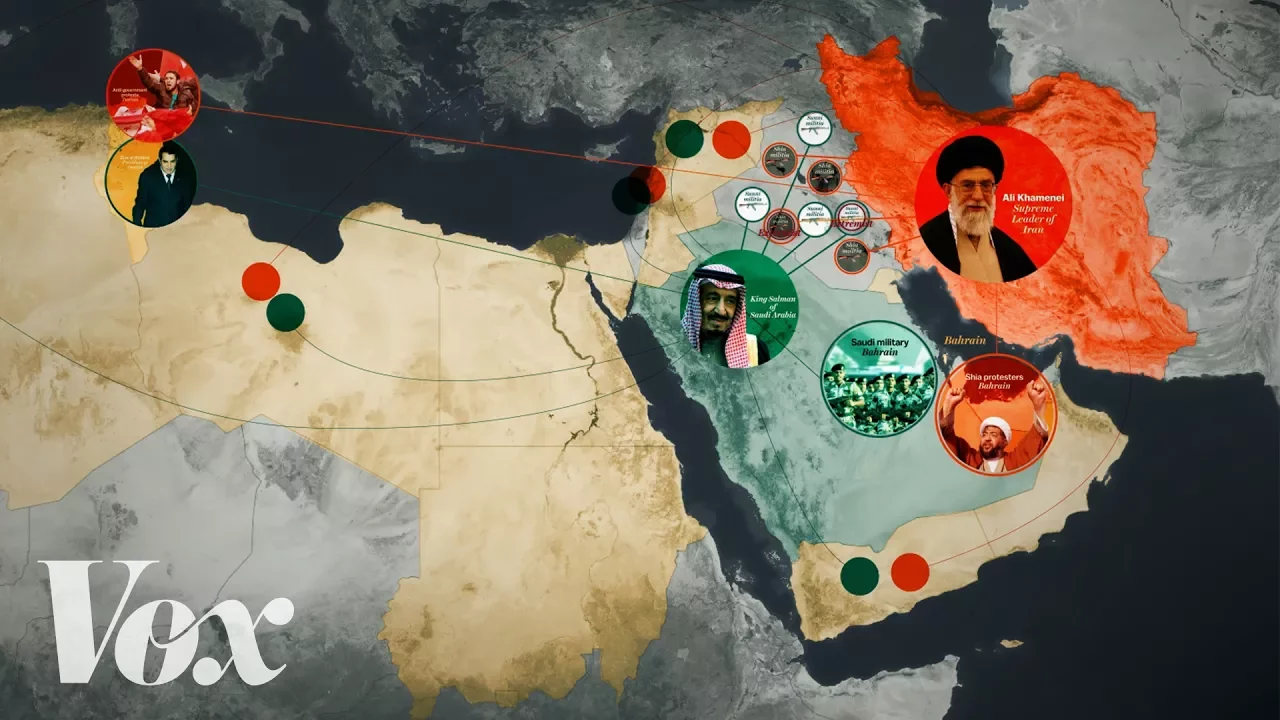
Explaining the Saudi-Iranian Proxy Conflict in the Middle East
@Vox
18.2M views•2017-07-17
Related Study Plans & Knowledge Roadmaps
Structured learning paths in Political Science