




















The wave function is a fundamental concept in quantum mechanics that describes the probability distribution of a particle's position in space, replacing the classical notion of particles having definite locations; unlike classical objects, quantum particles exist as spread-out probability waves until measured, at which point the wave function collapses to a definite state, explaining phenomena like the double-slit experiment where particles can interfere with themselves while passing through two slits simultaneously.
Understanding the Wave Function in Quantum Mechanics
Added:Basic probability theory, specifically the concepts of probability distributions and probability density.
Fundamental wave mechanics, including amplitude, interference, and the principle of superposition.
The de Broglie hypothesis of wave-particle duality, which posits that matter exhibits wave-like properties.
The core differences between classical determinism (e.g., Newton's laws) and quantum indeterminacy.
The Schrödinger Equation, which mathematically governs how the wave function evolves over time.
The Born Rule and the measurement problem, exploring what happens when a quantum system is observed.
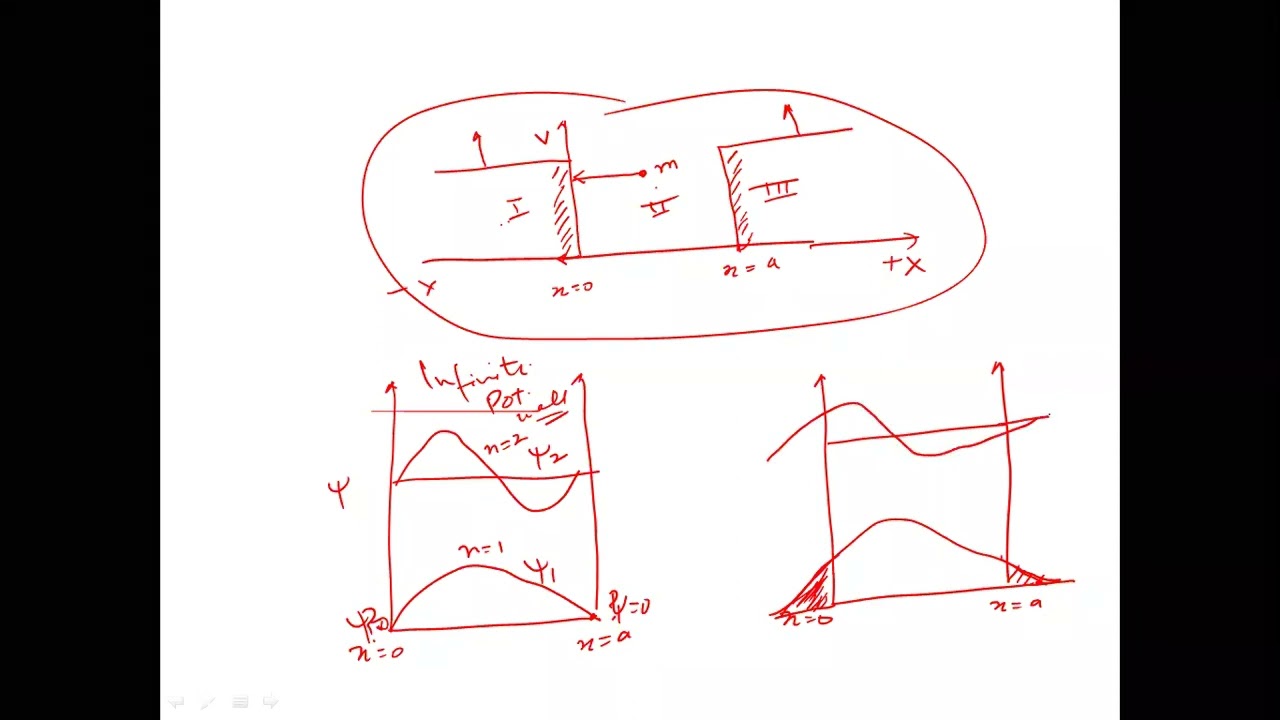
Applying the wave function to idealized physical systems, such as the 'Particle in a Box' (infinite square well).
The phenomenon of quantum tunneling, where the wave function allows a particle to pass through a classically impassable barrier.
Heisenberg's Uncertainty Principle, understanding how conjugate variables like position and momentum are fundamentally constrained.
576K views8.3Klikes9:37Original Release: 2009-08-08
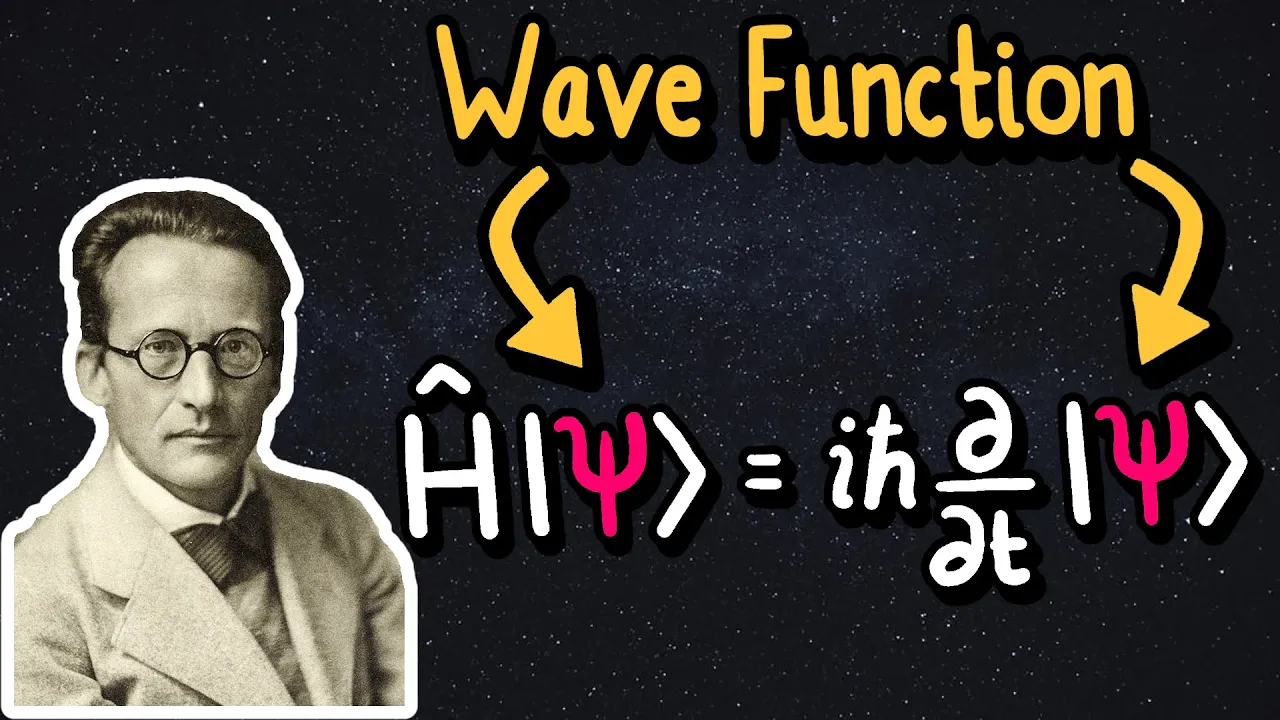
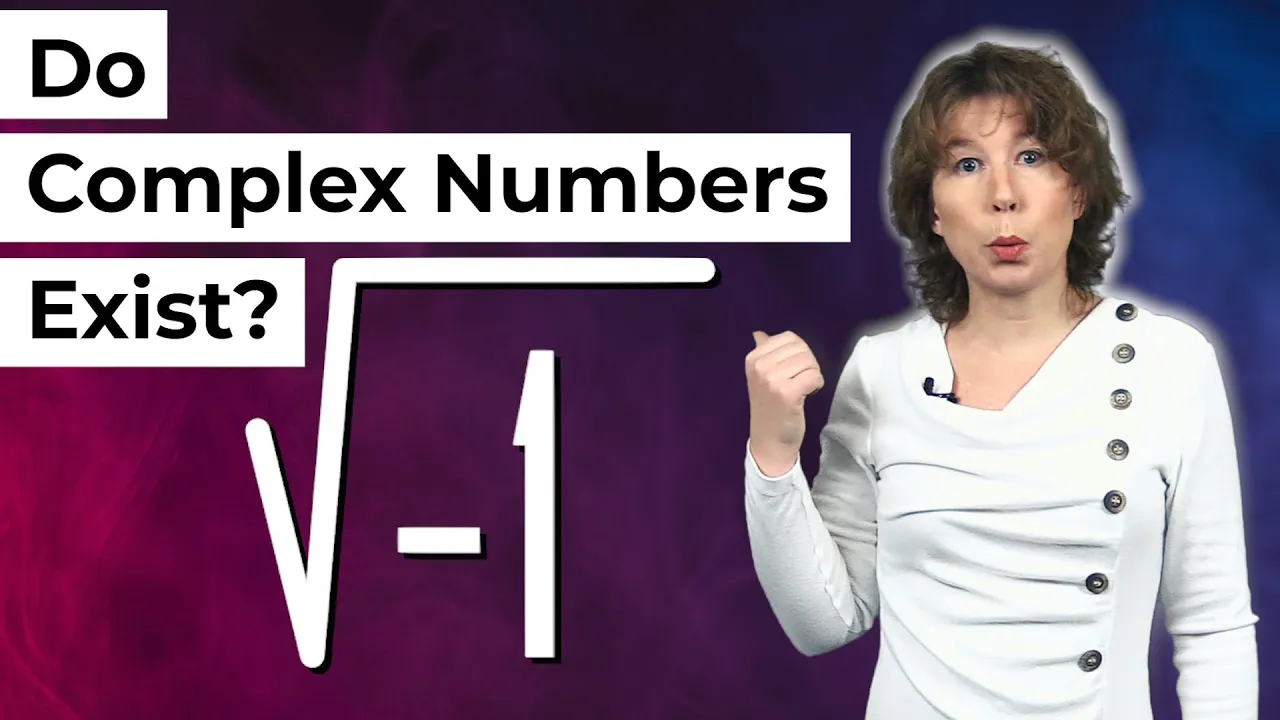
it is remarkably an incredibly important concept that is at the heart of our theories of how the universe and how matter behaves and yet we don't understand it you know I actually teach this to the first year undergraduates and what I tell them is that if they think they've understood it then they probably haven't we can't measure it we can't observe it and that's not because our instruments aren't good enough it's just fundamentally built into the theory we cannot see a wave function that's a cool symbol it is a cool symbol indeed so it looks like a looks like a pitchfork at the very microscopic scale the world becomes very fuzzy um and so particles that you know that we like to think of electrons and protons that we sort of like to think of as little billiard balls don't behave that way at all they don't they no longer have a welldefined position in space for example they kind of spread out a bit and you can't say in a very fundamental way exactly where a particle is it could be here it could be here it could be here and so the only way you can actually Express um that you know physically what's going on is to associate a probability you say well you know it's a high probability that it's here and there a low probability that it's here but you can't say for definite exactly where a particle is and the wave function is just really the mathematical way of expressing that probability of where the particle actually is in space Oh the wave function is the version of quantum mechanics invented by Owen shinger and it's uh a complex quantity which I don't want to go into but actually the wave function is related to the probability of finding a particle somewhere but the more complicated thing was shing's life in 1938 I think he was invited to Oxford by lindaman and traveled there with his wife and his girlfriend and set up a men men two women and him living together in the same household and when Linderman and others found out about it in Oxford he uh was invited to leave and and found himself uh just before the outbreak of the second world war in Germany he was rescued there by the Irish who spirited him out to Dublin and he spent the war there uh with his wife and he managed to get another mistress an Irish girl pregnant and he his wife and this Irish girl brought out the baby themselves so he had a very very complicated life which was probably typical of quite a lot of German scientists from Berlin at the time Berlin in the 30s being quite a racy place it's our quantum theory has at its core and wave function has at its core the idea of an imaginary number the idea of the Square < TK of minus1 and so we are using it seems absolutely mad to somebody who isn't a mathematician or a physicist it seems bizarre and it is mad in some respects when you think about it that we're using imaginary numbers square root of minus one something that cannot exist in the real world to describe reality and that's that that's absolutely remarkable and so we can certainly on a computer plot out we can take molecules and we can look maybe if you want to come over here we can plot out and this is actually some work from collaborators in in Cork in something called the Tindle Institute and I have to thank somebody called Jakob Baron for this but what you can see here is is a molecule in this case it's C60 C60 is a wonderfully symmetric molecule it's like a um basically a molecular football and we can take that map and we can convert that mathematically into a map that then tells us what the probability of finding an electron is what do those blobs represent there and so those BL blobs represent the wave function itself represent well here the wave function positive here the wave functions negative here's how the the wave function spreads out across the molecule and so for example there's a classic experiment in physics called the the the young slit experiment the double slit experiment which you can do with particles you can do with particles like electrons and basically you have a beam of electrons firing along and a pair of little slits and the electrons go through and very fundamentally because the electron position is not defined you can't say which slit it goes through it goes through both this is one particle going through two holes at the same time particles aren't supposed to behave that way or at least in the microscopic scale or things we're used to dealing with and that's why the concepts are so incredibly difficult to explain because you have to accept that at some very fundamental level that that's the way the universe works one thing you might do if you were doing this double slit experiment with a particle going through is say okay so why don't I just set up some very clever little Gizmo which will actually measure whether or not a particle goes through one slit or the other and then I can actually say which slit the particle goes through and the amazing thing is whatever thing you set up to to detect which slit the particle actually gone through you can detect it but then suddenly all the quantum mechanical effects go away that suddenly the particle yes you can detect it and it only ever when you actually make the measurement it only ever goes through one slit but suddenly all the quantum mechanical effects go away and that's this thing of collapsing the wave function when you make a measurement you go from a probabilistic thing well either the particle here or the particle here to saying on this occasion the particle is definitely here doesn't that mean you just solve the puzzle what other quantum mechanical effects have gone away so let's go back to this twin slit thing again if you don't make that measurement of actually saying which slit did the electron go through because the electron then goes through first and because it's behaving like a wave when it comes out the other side the two waves interfere with one another and so you actually see interference effects between the two waves you see basically you see fringes if you ever do if you have a a tank of water and you just make ripples in it and you'll see that the waves travel through each other but as they're traveling through each other they interfere and in some places you get big waves and in other places you get no waves at all and you can do exactly the same thing with this double slit experiment you can get the the electrons to interfere with each other and produce these wave patterns that you you see as you see in in in tanks of water um but the amazing thing is that you can do it one electron at a time so one electron can interfere with itself as long as you don't do this thing of collapsing the wave function so if you leave it as a wave function you can actually get one electron to interfere with itself and so that really is a fundamentally associated with the wave function um and that gives you a really in sense that the wave function in some sense is the real particle that's what's really going on I think quantum mechanics is so totally counterintuitive but it seems stupid to everybody it looks at first sight as though it can't be right the problem with it is okay so that's fine I can explain it and they'll nod and as you've been nodding and they all you know they're happy with the explanation but then the way physics works is so you have Pro you know you have to solve some problems we set them an exam question or they've got some physics experiment they're doing they're trying to understand or whatever and you get to the end of an experiment or you get to the end of an exam question the first thing you should do is look at the answer and think does that make sense because almost always physics if you've got an answer that sort of makes no sense at all to you you've probably done something wrong and you need to look back up the calculation or play with your apparatus some more to try and find out where you might have made a mistake the terrible thing about quantum mechanics is it because it predicts such completely counterintuitive things you know you can have particles in two places at once you can actually have particles tunneling through solid walls and so on you end up with a result at the end that you think that can't be right and bizarrely in quantum mechanics if you get to an answer at the end that says that can't be right then you probably have got it right but that makes it very hard for to really grasp it to really understand the subject because you always end up with these completely counterintuitive answers at the end why should you introduce this wave function when in the world we live in the world where everything is uh large scale and Cricket balls especially for Australia that swing around the place or uh classical objects such as a book that can fall on your foot it it doesn't really matter whether you're using uh any other language you're always going to think of these as material objects but when you get down to the tiny the very small such as an electron or neutrino you have to describe in terms of a wave function because it is not P um it's obeying a completely different set of laws of motion and it's when you go from the very small and you aggregate these particles together that out of that emerges the classical World in which we live so it's hidden from us because we only see things on a large scale I've certainly got be to see those huge paintings by Monet enormous things that cover a wall and as you go close to it you can see it's all blurry and fuzzy and in that sense when you go back from the picture you see the Garden or the water lies and and if you're up close you magnify it closely it hasn't got the behavior of being a a classical picture it has the impression of being broken up into little dorbs here and there and and the genius of money was to be able to have a huge picture on the wall enormous much bigger than the size of one of these walls and to stand back from it and see how he could go forwards and paint a little DB there and it would add to part of the picture I can't imagine how I can do that well in quantum mechanics is a bit like that you have to stand back from it look at the whole picture and then imagine that you can put a little dorb somewhere the quantum mechanical wave function such that when you go back to the realistic world you the world we live in I mean the world we live in not the realistic world the world we live in that then this little quantum mechanical wave function could add up to an atom inside a cricket ball or an electron inside a Cricut ball and become the microscopic object we normally see everyone loves quantum mechanics it's the probably in the first year in the core physics that they do so I teach two things in the core physics for the first year which are special relativity and quantum mechanics and I have to say I have the best job in the first year because it's the physics everyone wants to learn about and everyone goes uh about so you know it's really fun to teach the students really enjoy it and it's one of those things you know people have this idea that students are kind of lazy you and want to do the easy stuff actually what they really like is this stuff and it's hard
Up Next

6:40
Double Slit Experiment Explained: Quantum Physics & Wave-Particle Duality
@joescott
461K views•2015-10-05

12:53
21cm Hyperfine Transition in Neutral Hydrogen: Radio Astronomy Basics
@AaronRobertParsons
12.4K views•2011-10-13

8:31
Quarks Explained: Evidence, History & Types | Physics
@sixtysymbols
389.7K views•2010-05-28

27:14
Entropy and the Second Law of Thermodynamics Explained
@veritasium
27.5M views•2023-07-01
Related Study Plans & Knowledge Roadmaps
Structured learning paths in Physics
physics
Nuclear Physics (Decay, Fission & Reactors)
01Atomic Structure and the Binding Force
02Radioactive Decay and Half-Life
03Nuclear Fission Mechanics and Chain Reactions
+ 2 more learning modules
12h5 modules
Explore Roadmap
physics
Soft Matter (Polymers, Colloids & Rheology)
01Foundations of Soft Matter & Thermal Forces
02Polymer Physics and Macromolecules
03Colloids, Surfactants, and Self-Assembly
+ 2 more learning modules
38h5 modules
Explore Roadmap
physics
Analytical Mechanics: Lagrangian & Hamiltonian
01Mathematical Foundations: Calculus of Variations
02From Newtonian Mechanics to Constraint Dynamics
03The Principle of Least Action & Lagrangian Mechanics
+ 3 more learning modules
28h6 modules
Explore Roadmap
physics
General Relativity (Spacetime & Cosmology)
01Foundations of Relativity: Special Relativity
02The Geometry of Spacetime: Equivalence Principle & Curvature
03Einstein's Field Equations: The Mathematics of Gravity
+ 2 more learning modules
55h5 modules
Explore Roadmap