









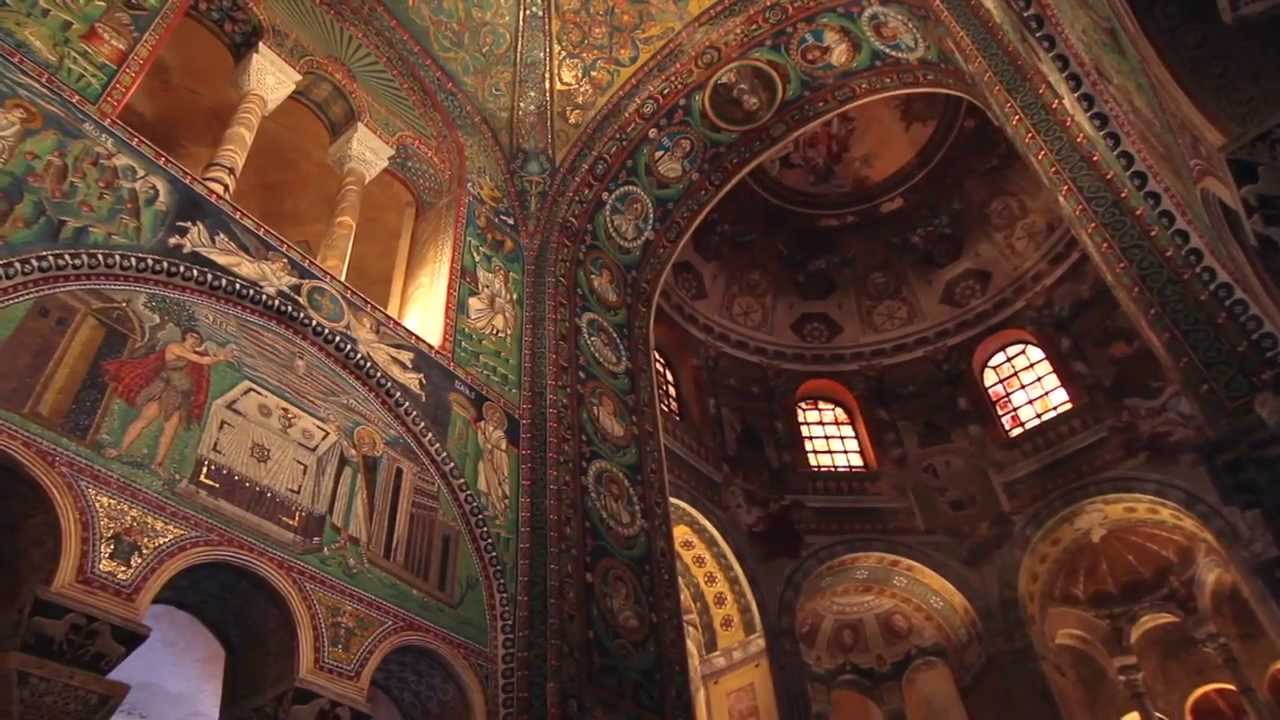





San Vitale in Ravenna (Italy), begun c. 526-27 and consecrated 547, exemplifies Byzantine architecture through its centrally planned octagonal design with an ambulatory, featuring some of the most magnificent early medieval mosaics that convey Christian theological themes of sacrifice, redemption, and eternal life, while also serving as political propaganda asserting Eastern imperial control over the city after its reconquest from Gothic rule.
San Vitale, Ravenna: Early Christian Mosaics and Byzantine Art
Added:The division of the Roman Empire and the emergence of the Byzantine Empire, including the strategic role of Ravenna as a Western capital.
The political reign and ideological goals of Emperor Justinian I and Empress Theodora, specifically their efforts to reconquer Italy.
Fundamental concepts of Early Christian iconography and how Christian artists adapted pagan Roman imperial imagery for religious purposes.
The basic transition of mosaic techniques from Roman floor designs to the shimmering, light-reflective glass tesserae used on Byzantine walls and vaults.
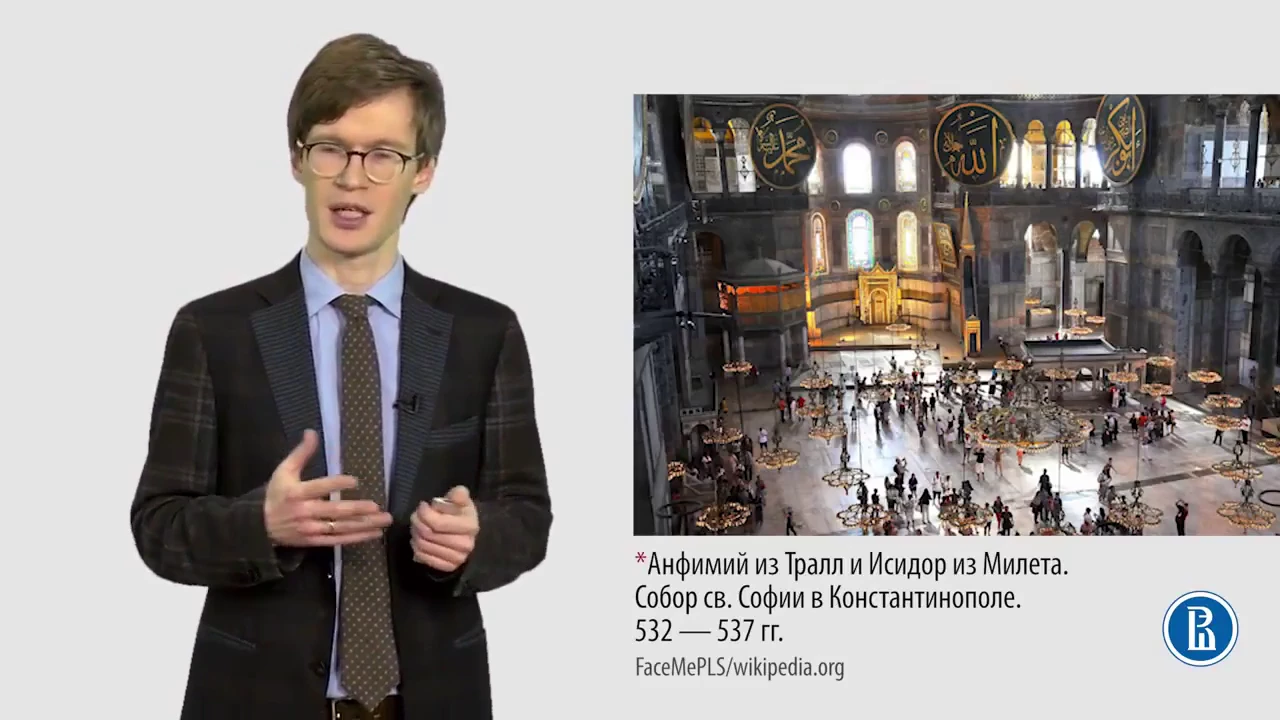
An analysis of the Hagia Sophia in Constantinople to compare San Vitale's central plan with Justinian's grandest architectural achievement.
The historical impact of the Byzantine Iconoclastic Controversy (8th-9th centuries) on the preservation and evolution of religious art.
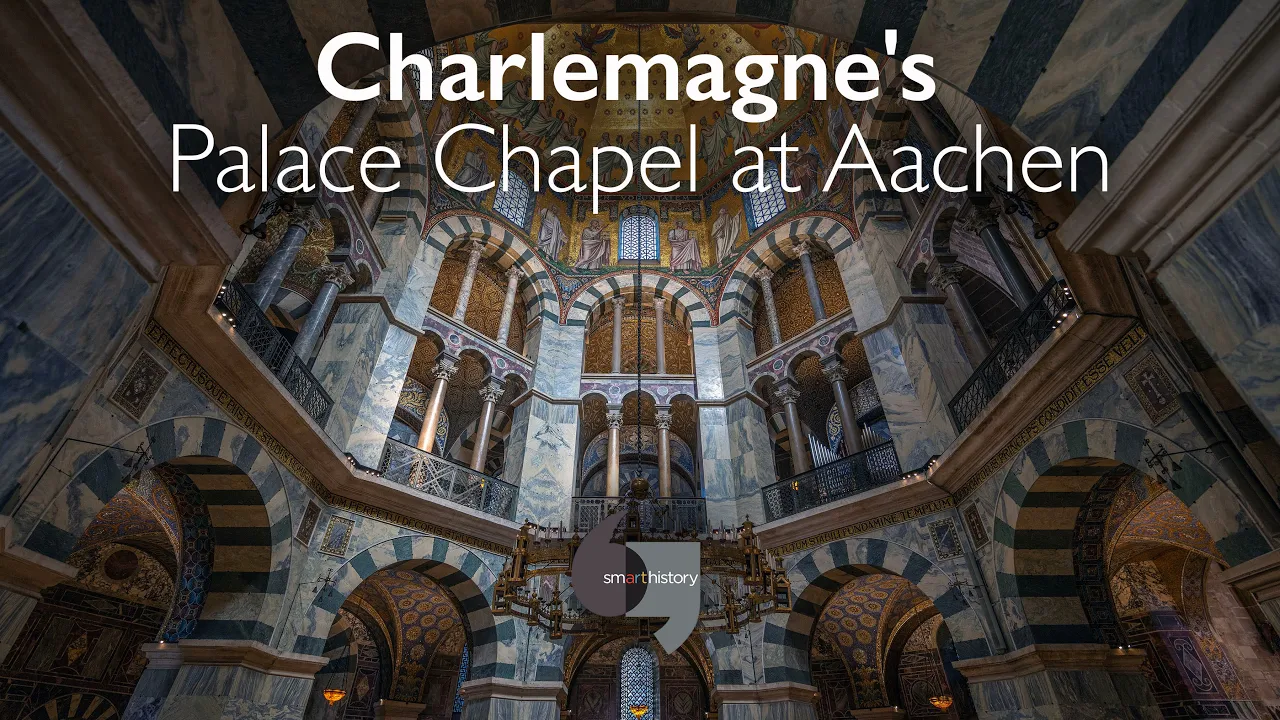
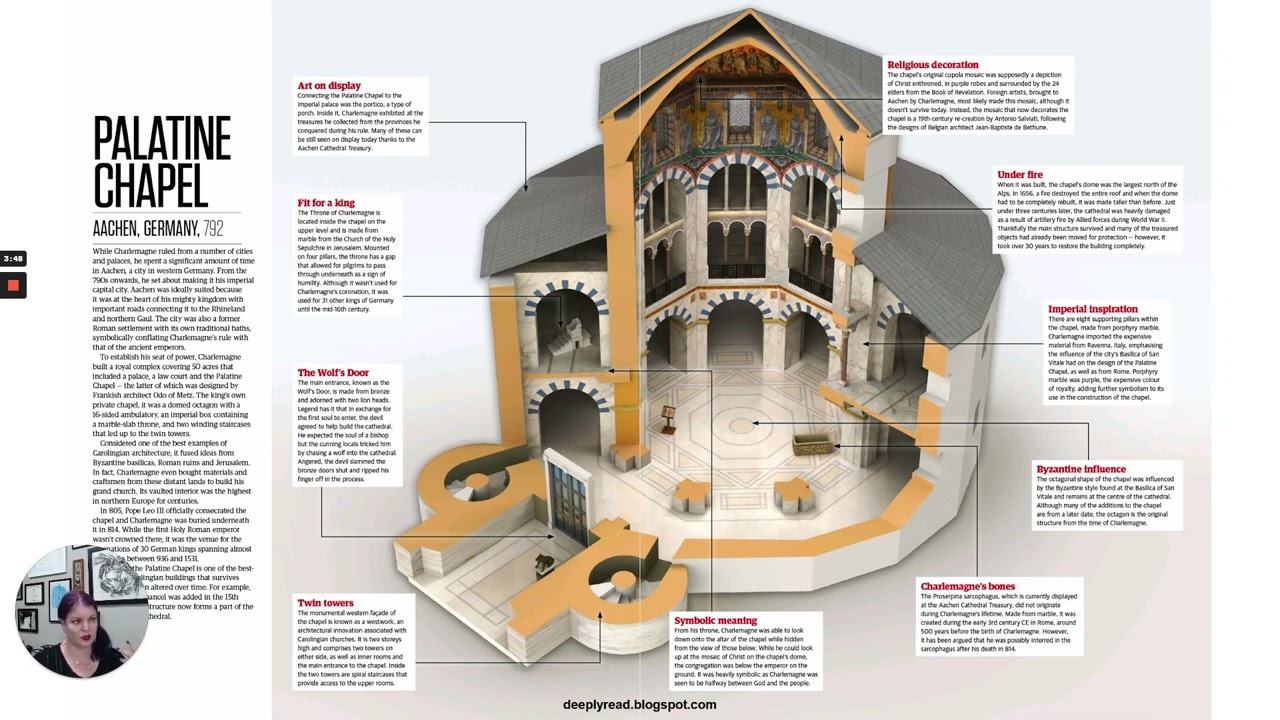
The direct architectural influence of San Vitale on Western medieval structures, notably Charlemagne’s Palatine Chapel at Aachen.
A deeper exploration of 'caesaropapism'—the dual role of the emperor as absolute political ruler and supreme head of the church—as depicted in state art.
104.8K views1.6Klikes11:44Original Release: 2022-08-21
(jazzy piano music) - [Narrator] We're in the Italian city of Ravenna, standing outside of the Church of San Vitale.
This is a really important sixth century church.
- [Narrator] And it's unusual in that it's a centrally planned church.
- [Narrator] When we think about a church, we generally think about a building that's shaped like a cross, and it has that long hallway, the nave.
This doesn't have that.
Instead, it's got an ambulatory, or an aisle that surrounds the central space.
In this particular case, on the east side of the church, there's also an extension with an apse at the end.
- [Narrator] We see that it has eight sides, so it's an octagon.
And within that octagon is a smaller octagon that rises higher.
- [Narrator] The walls are pierced with lots of windows, and that's especially important, because the interior is covered with some of the most magnificent mosaics from the early medieval period.
- [Narrator] Let's go inside and have a look.
- [Narrator] We've walked into the church, and the center towers over us.
There are massive piers that help support the building, but there's also real delicacy.
Look, for instance, at the way that the columns are doubled, that is, stacking of one set of columns above the next.
- [Narrator] And they moved in and out back into the space of the ambulatory on the ground floor, and then up into the gallery above.
- [Narrator] The eastern end of San Vitale is completely covered in dense mosaic, and they might at first seem disconnected, but in fact, there is a unifying theme.
- [Narrator] Art historians have talked about the theme of offering of sacrifice.
We see that in the scenes of Abel and Melchizedek, who make an offering to God.
We see God's hand above accepting that offering.
- [Narrator] And in the opposite lunette, we see Abraham sacrificing Isaac, or almost sacrificing Isaac.
- [Narrator] And on the other side of the lunette, Abraham offers bread three strangers who come to his door who are understood as God.
And all of this relates to the offering made by the priest at the altar of the Eucharist, the bread and wine that are the body and blood of Christ, the idea of God's sacrifice so that mankind can be redeemed, and can have eternal life in heaven.
So much of the mosaic is about what eternal life in heaven is like.
- [Narrator] These glittering gold tesserae must have felt miraculous.
You can so clearly see the uneven surfaces in the way that they pick up light.
- [Narrator] Most of the tesserae right are colored glass or gold sandwiched between glass, but we also have silver and mother of pearl.
- [Narrator] And in some areas, stone that is less reflective, and creates a dynamic contrast with the glistening quality of the metallic and glass tesserae.
And if you look really closely, you start to get a sense of the art of the mosaics.
They had to, up close, represent what would resolve into an image at a distance.
- [Narrator] We can see that at times, the mosaicist uses bright orange tesserae to make highlights.
And from far away, you don't see that bright orange.
It resolves in our eye to form faces that appear quite naturalistic.
- [Narrator] This is truly painting with stone.
- [Narrator] The individual tesserae curve around a face, for example, or around a halo.
Everywhere we look, we see life, and that speaks to the idea of the afterlife.
We see so many different kinds of birds, and flowers, and animals, and vines, and fruits, and cornucopia that we see unexpected forms.
For example, we see dolphins with their tails entwined in one another.
Though art historians often disagree about the specific meaning of the dolphins and the shells, they're clearly referred to Christ, to the apostles who they surround.
- [Narrator] There are so many things to see, and just in terms of the natural world, if we look all the way up at the top, I love the three doves that surround these urns, joined by this amazing arcing vine.
- [Narrator] And the vine yields fruit.
It yields grapes which refer to the wine of the Eucharist, the blood of Christ.
We see birds wading in the water, and in the water, we see reeds and rocks.
We also see apples and pears, and other kinds of fruit.
- [Narrator] And flowers are everywhere.
And this really is paradise.
There are three large windows, and just above that, a large apse mosaic.
- [Narrator] And in the center, we see Christ dressed royally in purple, sitting on an orb, the orb of the Earth of the universe, below the flow of the four rivers of paradise, and on either side of him, an angel.
- [Narrator] Christ is holding the book of the apocalypse with the seven seals visible.
In his right hand, he's handing a crown to Saint Vitalis, who was adopted as the primary martyr of this city.
- [Narrator] And on the other side, we see Ecclesius, who founded and sponsored the building of this church, and we see him handing the church to the angel beside Christ.
Every surface was covered with imagery, with figures, with decorative patterning.
Right above the altar, we see an image of the Lamb of God, and the Lamb of God refers to Christ.
He's wearing a halo, this idea of Christ as the sacrificial Lamb, sacrificed for the redemption of mankind.
- [Narrator] The lamb is surrounded by a wreath of victory, and in this case, the idea of the triumph of Christianity itself.
And that wreath is held in place by four angels, who stand on globes that refer to the globe upon which Christ in the apse sits.
- [Narrator] We see Christ again, but this time, bearded, older, in the archway.
- [Narrator] The triumphal arch has Christ in the center, and his body is surrounded by a mandorla, a kind of a rainbow-colored halo.
Moving down the arch on either side are 14 figures, including the apostles.
There are also fabulously decorative columns, made out of a high quality marble that was brought from the East.
What's most remarkable about these columns is that we've really left behind the classical orders.
These are not Doric, they're not Ionic, they're not Corinthian.
They are early Christians trying to invent a new iconography for their architecture.
- [Narrator] And on top of the capitals, we see impost blocks that help make the transition up to the arches.
- [Narrator] The two most important mosaics in San Vitale flank the apps.
- [Narrator] And those show the Emperor Justinian and his empress, Theodora.
Now, Justinian and Theodora never came to Ravenna.
- [Narrator] And they're in the mosaics, we think, to reassert their control over the city.
- [Narrator] For much of the 400s, Ravenna was under the control of a goth, Theodoric, and Theodoric was an Arian, that is, he didn't follow the orthodox doctrines of the church.
And so Justinian, the emperor in Constantinople, sends his general to re-conquer Ravenna, and reestablish Orthodox Christian belief.
- [Narrator] And so what we're seeing here is the reassertion of Eastern imperial control, that is, Justinian is in Constantinople, and he is saying, I'm in charge, even here in Ravenna, in Italy.
We see Justinian in the center wearing purple, the color that is associated with the throne, and he's surrounded by his court.
But there are also religious figures representing the church, and there are soldiers, three centers of power, the church, the emperor, and the military.
- So we can see that some of the figures are treated more individualistically than others.
Justinian and Maximian are more individualized, but the figures from the army are much more anonymous.
- [Narrator] Justinian the emperor, his authority is divine.
You can see a halo around his head, and he holds a bowl associated with the Eucharist, which is handing in the direction of Christ in the apse.
- [Narrator] This is a bowl that would've contained the bread for the sacrament of the Eucharist.
He's in the center of the composition.
He's frontal, but really all of the figures are frontal.
- [Narrator] They are schematic, abstracted.
This is the medieval.
We've left the classical tradition of naturalism behind.
- [Narrator] And so if we look closely at the figures, we can see that there's no real concern for accurate proportions.
Their feet don't really seem to carry the weight of their bodies.
They seem to float in a eternal space, and not in an earthly space.
Next to Justinian, we see the Bishop, Maximian, with his name above him, although that was added later, and beside him, other clergymen.
- [Narrator] Maximian holds a beautiful jeweled cross.
- [Narrator] The figures next to him hold a jeweled book of the gospels, and the figure at the far right holds an incense burner.
- [Narrator] To the right of the apse windows, we see the panel of Theodora, the empress, and it mirrors the panel with Justinian.
- [Narrator] So we have an idea that Theodora ruled as co-equal to Justinian.
- [Narrator] She's wearing incredibly elaborate clothing and jewelry with rubies, with emeralds, with sapphires, and very large pearls.
And in back of her head, just like Justinian, is a halo.
- [Narrator] Like Justinian, who's carrying a bowl that held the bread for the Eucharist, Theodora is carrying the chalice for the wine for the Eucharist, and she's surrounded by attendance to symbolize the Imperial court.
A curtain is raised as though she is about to take part in a ceremony.
- [Narrator] I'm really taken by the elaborate Byzantine costume.
- [Narrator] While there's a sense of trying to bring the richness of the Imperial Court in Constantinople here to Ravenna.
- [Narrator] There is an expression of hierarchy.
We know even from the feet who the emperor is.
Look at those incredible shoes.
But as extraordinary, as brilliant as the mosaic is, it's not the only showpiece in this church.
For the medieval viewer, the dynamic abstractions that we see in the stone revetment or stone panels have been opened up so as to produce these extraordinary patterns.
And this tradition of elaborate stone revetment goes back to Imperial Rome, and even before that, to Hellenistic Greece.
So it was rooted in this great ancient tradition.
- [Narrator] So much of what we see here comes from that pagan tradition.
This idea of the abundance of life in the waters comes from images of the Nile River.
- [Narrator] And Mosaic itself was a Roman art that the Romans used primarily on their floors.
- [Narrator] So we have the mosaics, these panels of marble that have been cut open.
We have these beautiful monolithic marble columns, and we also have carved marble in the capitols, where we see vines and tendrils.
So that idea of growing, of abundance.
And we also see in the impost blocks, lambs on either side of a cross, the idea of Christ as the Lamb of God, the Lamb which is sacrificed for the redemption of mankind.
- [Narrator] So the individual elements in the mosaic are so dynamic.
The vines are curling, the animals are moving, people are enacting.
But the same is true for the architectural space.
The patterns in the revetment seem as if they are alive.
And then the very architecture has a series of apse bays that rise up to the dome.
This entire space is dynamic.
It is this lush, glorious space here in this city that's distant from the capital of the empire, but that speaks to its importance.
(jazzy piano music)
Up Next

15:15
Unraveling the 5000-Year History of Mosaic Art: A Global Odyssey
@RTaylorDen
80.6K views•2015-10-17

114:18
Christian Iconography: History, Theology, and Meaning | Fr. Panayiotis Papageorgiou
@Trisagionfilms
58.8K views•2020-02-21

10:26
Redgrave's The Sempstress: Victorian Social Realism, 1846
@smarthistory-art-history
3.2K views•2011-10-22

16:34
Earliest Depictions of Jesus in Art: 10 Ancient Images Explained
@UsefulCharts
5.9M views•2022-06-03
Related Study Plans & Knowledge Roadmaps
Structured learning paths in Art History
art-history
Gothic Cathedrals: Engineering, Light & Society
01The Birth of the Gothic: Romanesque to Suger's Vision
02The Structural Triad: Pointed Arches, Ribbed Vaults, and Flying Buttresses
03Theology of Light: Lux Nova and Sacred Geometry
+ 2 more learning modules
14h5 modules
Explore Roadmap
art-history
Pre-Raphaelites: Realism, Symbolism & Critique
01The Victorian Art Establishment and Academic Formula
02The Founding of the PRB and Radical Realism
03Medieval Revivalism and Literary Symbolism
+ 1 more learning modules
8h4 modules
Explore Roadmap
art-history
Street Art: From Subways to Art Market
01Subcultural Origins in Philadelphia and New York (1970s)
02The Subway Era and Style Wars (Late 1970s - 1980s)
03The East Village Scene and Early Gallery Crossover
+ 2 more learning modules
10h5 modules
Explore Roadmap
art-history
Classic Maya Art: Iconography, Glyphs & Ritual
01Foundations of Classic Maya Visual Culture
02Deciphering Maya Hieroglyphs & Text-Image Integration
03Sacred Geography and Cosmological Architecture
+ 2 more learning modules
14h5 modules
Explore Roadmap