The tragedy of the commons describes a situation where individuals acting in their own self-interest deplete shared limited resources, even when they understand that overuse will eventually cause harm to everyone; this occurs because each person believes their individual contribution to resource consumption is negligible, leading to collective overexploitation of common-pool resources like pastures, fisheries, aquifers, and public infrastructure.
The Tragedy of the Commons Explained | Shared Resource Dilemma
Added:Deep Dive
The economic classification of goods, specifically the difference between private, public, and common-pool resources based on the concepts of rivalry and excludability.

EC465: ปัญหาทรัพยากรร่วม (common-pool resources)
157
Goods are classified by two characteristics: excludability (whether people can be prevented from using without paying) and rivalry (whether consumption reduces availability for others). Private goods are both excludable and rival, while public goods are non-excludable and non-rival. Common Pool Resources are hybrid goods that are difficult to exclude but rival, such as fish in oceans, river water, and forests. Unlike private goods like oil (which can be excluded), common pool resources allow unrestricted access but consumption reduces availability for others.
Click to watch →
![[Mankiw principles of economics 11] 11. 공공재와 공유자(공짜의 경제학)](https://i.ytimg.com/vi/tFS4Wa6QRU4/maxresdefault.jpg)
[Mankiw principles of economics 11] 11. 공공재와 공유자(공짜의 경제학)
165
Economic goods are classified into four types based on two criteria: excludability (whether non-payers can be prevented from accessing) and rivalry (whether one person's consumption reduces availability for others). Private goods (pizza, tacos) are both excludable and rivalrous. Public goods (national defense, parks) are non-excludable and non-rivalrous. Common resources (fish, shared roads) are non-excludable but rivalrous. Club goods (cable TV, toll roads) are excludable but non-rivalrous. The same good can shift between categories depending on circumstances, such as a free road becoming a club good with tolls or a common resource when congested.
Click to watch →

7.3 Classificação dos Bens (Públicos e Recursos Comuns) (Mankiw) #economia
468
Goods are classified into four types based on two fundamental characteristics: excludability (whether people can be prevented from using the good) and rivalry (whether one person's consumption reduces availability for others). Private goods (ice cream, clothing, congested toll roads) are both rival and excludable. Artificially scarce goods (television, fire protection) are non-rival but excludable. Common resources (fish in oceans, uncongested roads) are rival but non-excludable. Public goods (tornado sirens, national defense) are both non-rival and non-excludable. The classification boundaries are not always clear, as a single good like a road can change its type depending on conditions such as tolls and congestion levels.
Click to watch →
![[9급공무원행정학] 김중규 선생님의 정치와 행정 1/2편](https://i.ytimg.com/vi/mrCNB7mTMdo/maxresdefault.jpg)
[9급공무원행정학] 김중규 선생님의 정치와 행정 1/2편
1.5K
Goods are classified into four categories based on two characteristics: rivalry (경합성) and excludability (배제성). Rivalry means one person's consumption reduces availability for others. Excludability means people can be prevented from using the good if they don't pay. These two characteristics determine whether a good is public, private, club, or common. Private goods are both rivalrous and excludable (bread, toll roads). Club goods are excludable but not rivalrous (cable TV, paid lectures). Public goods are neither rivalrous nor excludable (national defense, lighthouses). Common goods are rivalrous but not excludable (fisheries, forests).
Click to watch →

Bienes públicos
901
Goods are classified into four categories based on rivalry and excludability. Private goods are rival and excludable (food, electronics). Common resources are rival but non-excludable (fish in oceans, forests). Club goods are non-rival but excludable (private parks, cable TV). Public goods are non-rival and non-excludable (national defense, street lighting). This classification determines how goods are produced, priced, and allocated in markets.
Click to watch →
Deep Dive
The concept of individual self-interest and rational choice theory, where actors make decisions to maximize their own personal utility.

Theoretical Approaches to Political Analysis: Rational Choice Theory
110
Rational Choice Theory presupposes that human beings are not just rational maximizers but also self-interested creatures. The notion of self-interest plays a vital role in how decisions are made. When making choices, individuals are rational because they want to preserve themselves and serve their own self-interest. This assumption is considered normal to human beings and is the main assumption of rational choice theories. From these assumptions, the theory can predict outcomes given certain constraints and explain causal mechanisms between independent and dependent variables.
Click to watch →

Unit - 1 Complete Revision Education शिक्षाशास्त्र II By Dr Mukesh Goyal
1.1K
Rational Choice Theory posits that individuals use their self-interest to make choices that will provide them with the greatest benefit. Individuals with more options will make choices that maximize their advantage. This theory assumes that individuals are rational actors who calculate costs and benefits before making decisions. It is frequently tested in UGC NET examinations.
Click to watch →

Lesson 1 Introductory concepts, definitions, branches, economic thoughts, assumptions, economic art
1.9K
Economic agents (individuals, households, firms, governments, international actors) are assumed to be rational beings who make decisions to maximize their self-interest. Consumers maximize utility (satisfaction from goods/services), while producers maximize profits. This rationality assumption is fundamental to economic analysis, enabling mathematical modeling of decision-making processes.
Click to watch →
Ep. 3.2: Effect of Altruism on the Prisoner's Dilemma
256
Self-interest in rational choice theory means acting on one's own preferences without interpersonal utility comparison. Altruistic actors remain self-interested—they simply evaluate outcomes based on values including others' welfare. The parent example demonstrates this: the parent acts on altruistic preferences but still follows rational choice principles. This distinction matters for understanding how different value systems can produce different strategic behaviors within the same game-theoretic framework.
Click to watch →

POLS 299 Podcast 2 1
307
Rational Choice Theory develops a rationale for why people behave the way they do. The key assumption is that actors make choices that allow them to obtain the best possible outcome for themselves - to obtain their preferences. To develop this rationale, researchers need to understand individual preferences and build models to predict actors' choices.
Click to watch →
Deep Dive
An understanding of negative externalities, which occur when an individual's consumption or production imposes a cost on a third party without their consent.
What is The Negative Externality of Consumption Diagram | IB Microeconomics | IB Economics Exam
266
A negative externality of consumption occurs when an individual's consumption imposes uncompensated costs on third parties. Using cigarettes as an example, when a smoker consumes cigarettes, they impose lung damage costs on bystanders through secondhand smoke exposure. The smoker pays only $5 for cigarettes but does not compensate those affected by the smoke. This creates a market inefficiency because the private cost ($5) is less than the social cost (private cost plus external damage costs), leading to overconsumption of the good.
Click to watch →

EFF Chapter 2 | Full Revision | Public Finance | Mohnish Vora | CA Intermediate Group 2
129.3K
Negative consumption externalities occur when consumption activities impose costs on third parties. For example, smoking in public places affects non-smokers through second-hand smoke. The smoker does not account for these external costs in their consumption decisions, leading to overconsumption of goods that impose negative externalities.
Click to watch →

Market Failure and Causes | Economics | NTA UGC NET | Simranjit Kaur | Unacademy UGC NET
33.7K
Negative externalities occur when production or consumption imposes costs on third parties. In production, examples include factory emissions causing air pollution, waste disposal affecting water quality, and noise pollution affecting nearby residents. In consumption, examples include smoking (secondhand smoke affects others) and alcohol consumption. In both cases, society pays more costs while receiving fewer benefits than the private transaction suggests. The key characteristic is that Marginal Social Cost exceeds Marginal Private Cost, leading to overproduction of goods with negative externalities.
Click to watch →
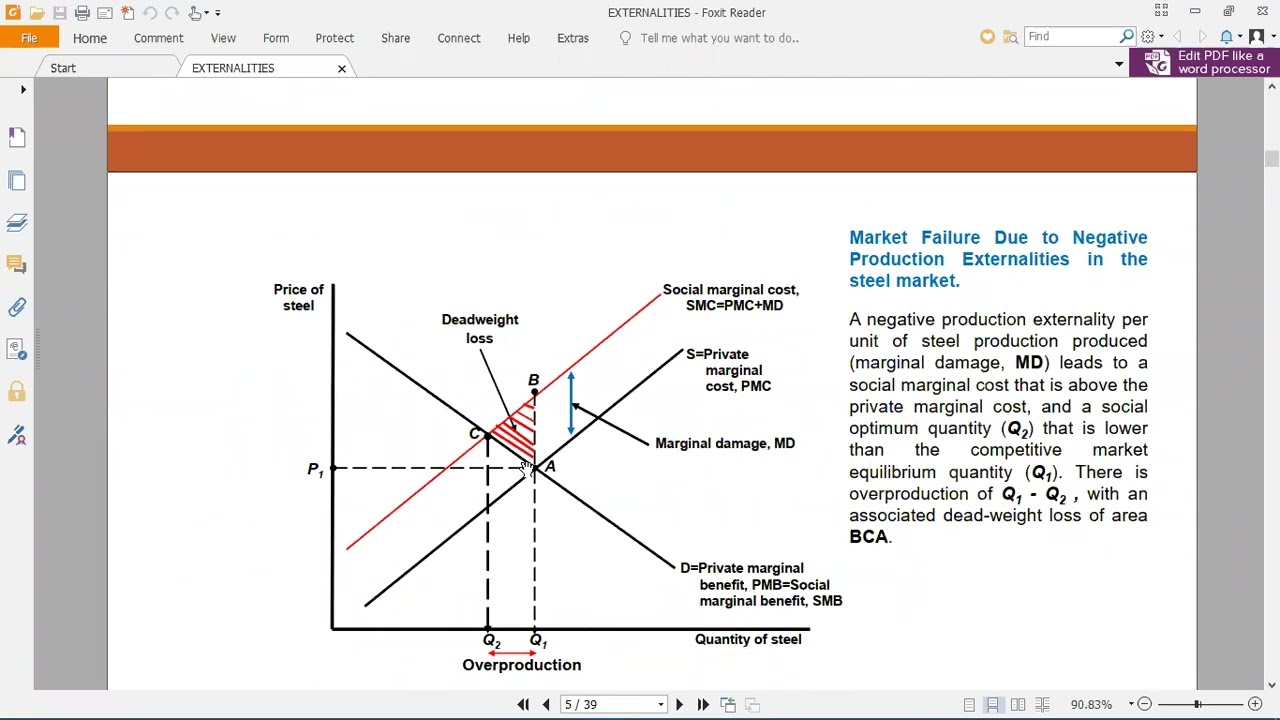
VIDEO 6 EXTERNALITIES
262
A negative consumption externality occurs when one person's consumption reduces third-party welfare without compensation. For example, smoking in shared spaces harms others through secondhand smoke. The private marginal benefit (PMB) is what the consumer receives, while the social marginal benefit (SMB) equals PMB minus the marginal damage imposed on others. In competitive markets, consumers equate PMB to private marginal cost, but society requires SMB to equal social marginal cost. The market equilibrium produces quantity Q1, while the socially optimal quantity is Q2, which is lower. The market overconsumes because consumers don't account for the harm they impose on others.
Click to watch →

Y1/IB 22) Negative Externalities in Production and Consumption
263.7K
Negative externalities are detrimental third-party effects that result from the actions of economic agents (consumers or producers) who engage in economic transactions. These effects harm parties not directly involved in the transaction, creating an impact on societal welfare.
Click to watch →
Prerequisite Knowledge
- Concept 01The economic classification of goods, specifically the difference between private, public, and common-pool resources based on the concepts of rivalry and excludability.
- Concept 02The concept of individual self-interest and rational choice theory, where actors make decisions to maximize their own personal utility.
- Concept 03An understanding of negative externalities, which occur when an individual's consumption or production imposes a cost on a third party without their consent.
Subsequent Learning
- Step 01Elinor Ostrom's Nobel-winning work on 'Governing the Commons', which examines how local communities can successfully manage shared resources without government intervention or privatization.
- Step 02Policy instruments and market-based solutions used to mitigate resource depletion, such as cap-and-trade systems, quotas, Pigouvian taxes, and the establishment of property rights.
- Step 03Real-world global applications of the dilemma, including climate change, international overfishing, space debris accumulation, and cyber-security vulnerabilities.
- Step 04Game Theory frameworks, particularly the Prisoner's Dilemma and Collective Action Problems, to mathematically model cooperation versus defection.
Tragedy Defined
Tragedy Defined
0:06Playing Section
- 1
Explains shared resource depletion through farmer pasture example.
- 2
Highlights individual gain leading to collective loss dilemma.
- 3
Applies concept to overfishing, water use, and traffic.
Elinor Ostrom's Common-Pool Resource Management
Nobel laureate Elinor Ostrom challenged the inevitability of the 'Tragedy of the Commons' by demonstrating that communities can successfully manage shared resources without state control or privatization. Ostrom argued that Garrett Hardin's model was flawed because it confused unregulated, 'open-access' resources with a true 'commons'—which historically featured community-enforced rules. Through extensive empirical research of real-world fisheries, pastures, and forests, she showed that local users often develop self-governing institutions, communication networks, and mutual monitoring systems. These community-led rules effectively prevent resource depletion, proving that collective cooperation and local governance are highly viable alternatives to government regulation or privatization.
Deep Dive
Elinor Ostrom's Nobel-winning work on 'Governing the Commons', which examines how local communities can successfully manage shared resources without government intervention or privatization.

Video 1 - Elinor Ostrom - Governing the Commons
1.9K
Elinor Ostrom's Nobel Prize-winning work 'Governing the Commons' challenges the traditional 'tragedy of the commons' theory by demonstrating that communities can successfully manage shared resources through self-governance institutions rather than relying solely on state control or privatization; her innovative institutional framework identifies three levels of analysis (constitutions, collective choice rules, and operational rules) and reveals that successful resource management depends on multiple contextual variables including communication, trust, and locally-adapted rules, as evidenced by her empirical studies of diverse communities worldwide.
Click to watch →

Elinor Ostrom: Governing the Commons Theory Explained
47K
Elinor Ostrom, the first and only woman to win the Nobel Prize in Economics (2009), challenged the traditional view that state control or privatization are the only solutions to the Tragedy of the Commons; through her field research across diverse communities worldwide, she demonstrated that local communities can successfully self-govern common-pool resources like fisheries, forests, and irrigation systems by developing context-appropriate rules governing access, usage limits, monitoring, enforcement, and dispute resolution, thereby proving that sustainable resource management is achievable through collective action rather than external intervention.
Click to watch →

Ending The Tragedy of The Commons | Elinor Ostrom | Big Think
111.7K
Elinor Ostrom's research demonstrates that contrary to Garrett Hardin's 'tragedy of the commons' theory, communities can successfully manage shared resources through self-governance and polycentric systems—complex nested arrangements involving multiple scales of market, government, and community organization—rather than relying solely on top-down government regulation or free-market approaches.
Click to watch →
The REAL Tragedy of the Commons
79.2K
Nobel laureate Elinor Ostrom identified eight principles for successfully managing common-pool resources: clearly defined boundaries, rules compatible with local conditions, collective decision-making power, monitoring of CPR conditions and behavior, graduated sanctions for infractions, conflict-resolution mechanisms, freedom to organize, and nested enterprises for multi-level coordination. These principles explain why some commons endure for over a thousand years while others fail. Successful commons require communities to develop extensive norms of honesty and reliability, maintain renewability through balanced withdrawal and replenishment, and coordinate through bottom-up organisation that preserves local autonomy while enabling regional cooperation.
Click to watch →

КОМФОРТНЫЙ РУССКИЙ ГОРОД: САМОЕ ВАЖНОЕ ВИДЕО ПРО УРБАНИЗМ | FURYDROPS
69.9K
Elinor Ostrom challenged the traditional dichotomy between private and public goods by identifying four classes: private goods (excludable and subtractable), public goods (non-excludable and non-subtractable), club goods (excludable but non-subtractable), and common-pool resources (non-excludable but subtractable). Her research demonstrated that communities can successfully manage common-pool resources for centuries without depletion, contradicting the 'tragedy of the commons' theory. She found that local self-governance works better than external government intervention, and there is no universal solution for managing shared resources.
Click to watch →
Deep Dive
Policy instruments and market-based solutions used to mitigate resource depletion, such as cap-and-trade systems, quotas, Pigouvian taxes, and the establishment of property rights.

Market-based environmental policy instruments | Wikipedia audio article
777
Market-based environmental policy instruments are economic tools that use markets, prices, and property rights to incentivize polluters to reduce negative environmental externalities, primarily through two mechanisms: transferable permits (cap-and-trade systems) which set pollution limits and allow trading between entities, and pollution taxes which establish maximum control costs; these instruments differ from command-and-control regulations by providing flexibility in how firms achieve environmental goals while still requiring some regulatory oversight for implementation.
Click to watch →

ESPA4317 Ekonomi Sumber Daya Alam dan Lingkungan - Karakteristik SDAL
5.9K
Three primary instruments address externality problems in natural resource management. Command and control uses prohibitions and regulations, but faces enforcement challenges with public goods. The Pigovian tax imposes fees on pollution based on quantity released, incentivizing reduced emissions. Cap and trade establishes total allowable limits (caps) with tradable permits, exemplified by fishing quota systems in Canada and Norway. These market-based approaches create scarcity value and align private incentives with social welfare, offering more sustainable solutions than purely regulatory approaches.
Click to watch →
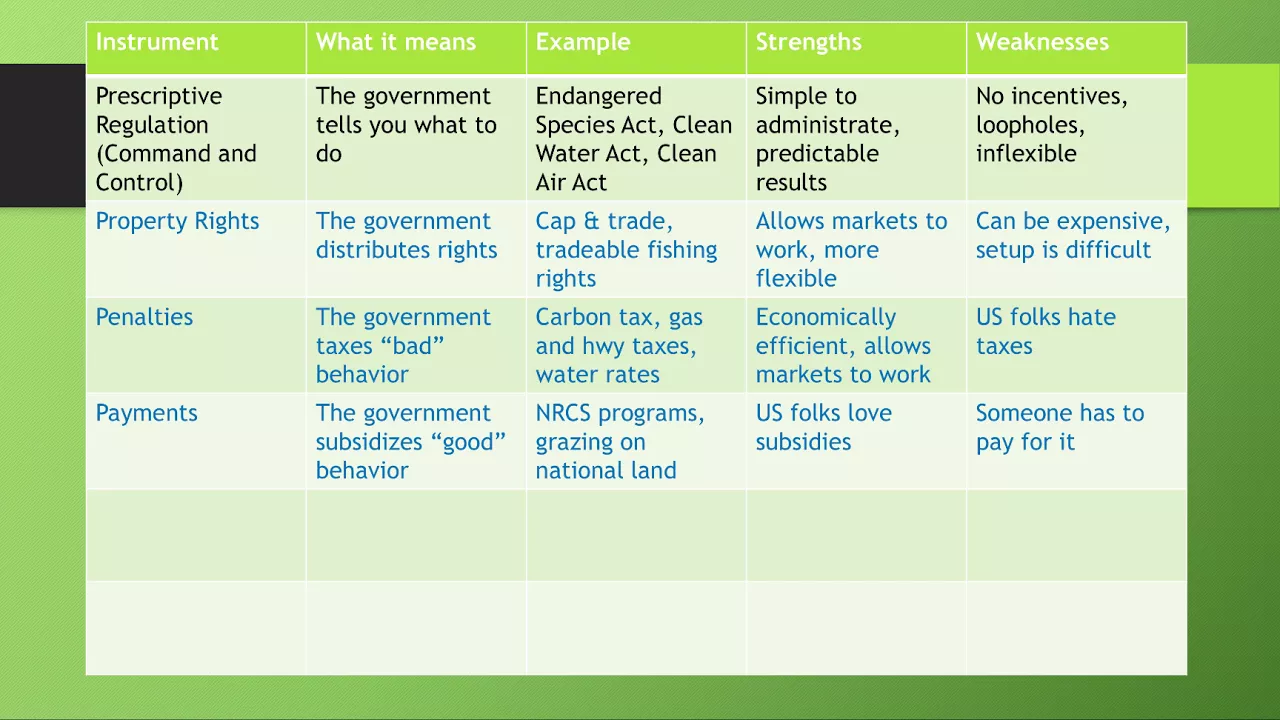
The 6 Ps of Environmental Policy Instruments
17.2K
Market-based environmental policy instruments include property rights (cap-and-trade, tradable fishing rights), penalties (carbon taxes, gas taxes, water rates), and subsidies (NRCS conservation programs). These instruments allow markets to work, are more flexible, and can be less expensive than command and control approaches. However, they face challenges including high setup costs, political resistance to taxes, and potential subsidization of bad behavior. The video emphasizes that penalties and cap-and-trade programs can have similar economic impacts, and creative messaging may be needed to overcome public resistance to taxation.
Click to watch →

Public Finance Unit - 2 - Detailed ONE SHOT - CA Foundation Economics | Roopa Trivedi | Jan 26 |
258
Market-based policies for environmental protection include: (1) Pigouvian Taxes - taxes on pollution equal to external cost; (2) Cap-and-Trade Systems - tradable emission permits with pollution caps; (3) Subsidies for positive externalities. India uses GST compensation cess instead of direct pollution taxes. The US has implemented cap-and-trade successfully since 1994.
Click to watch →

2022 공공경제론 제8장 1
110
Market-based solutions use market mechanisms to address external effects. Cap and trade systems create tradable permits for pollution or other external effects, allowing market participants to find the most cost-effective ways to reduce negative external effects. Pigouvian taxes impose charges on activities that generate negative external effects, with the tax amount equal to the external cost per unit. This tax increases the private cost of harmful activities, reducing production to the socially optimal level. The goal is to internalize external costs through market mechanisms rather than direct government regulation.
Click to watch →
Deep Dive
Real-world global applications of the dilemma, including climate change, international overfishing, space debris accumulation, and cyber-security vulnerabilities.

La morale, dans TON intérêt ?
204
The climate change scenario illustrates the Prisoner's Dilemma in international relations. Two major industrial powers (Gilead and Nation of Fire) face the choice of cooperating to reduce emissions (both suffer costs but achieve collective benefit) or defecting by maintaining emissions (one gains competitive advantage while the other suffers). Without coordination, each power has an incentive to defect regardless of what the other does, leading to the equilibrium where both emit freely and climate change accelerates. This demonstrates how the Prisoner's Dilemma applies to real-world issues like nuclear disarmament, overfishing, cybersecurity, and public goods provision.
Click to watch →

우주쓰레기 때문에 인류는 영원히 지구에만 갇혀 살게 될 운명입니다.
214.1K
The space debris problem mirrors the climate change dilemma: individual entities (countries, companies) benefit from activities (emissions, satellite launches) while the costs (debris, climate damage) are shared globally. This creates a situation where each actor waits for others to act first, resulting in collective inaction despite knowing the consequences are severe.
Click to watch →

「我慢する人」が食い物にされる不条理な世界の仕組み(コモンズの悲劇) をWiki解説【聴くpedia / 作業用BGM】
176
The Tragedy of the Commons operates at global scales. For climate change, each country's rational decision to use fossil fuels for economic growth contributes to global warming, which ultimately harms all humanity. Similarly, in overfishing, each nation's rational decision to maximize catches from shared ocean waters leads to depletion. The principle that 'individual micro-justice leads to macro-disaster' applies universally, where small individual gains accumulate into large collective losses.
Click to watch →

ゲーム理論のパラドックス(囚人のジレンマ)#科学の雑学 #拡散 #一分でわかる #雑学
4.5K
The Prisoner's Dilemma structure appears in many real-world scenarios. In business, companies competing on price reduce industry profits. In international relations, nations increasing military spending destabilize global security. During pandemics, individuals hoarding masks prevents those who need them from obtaining supplies. In corporate culture, employees working overtime to gain recognition reduces overall efficiency and increases costs.
Click to watch →

Ocean Documentary Channel - Global warming & overfishing SEA THE TRUTH
529
Earth is 71% water, yet oceans are becoming emptier. Scientists predict oceans will be empty of edible fish in 30 years. 90% of predatory fish and 80% of commercial fish species have been eliminated. The North Atlantic fish stocks declined from 10 tons per square kilometer in 1900 to one-tenth by 2000. Industrial fishing began centuries ago, with the Netherlands playing a major role in herring fishing. The first international whaling quota was set in 1946. From the 1970s, EU limits were imposed, but these proved insufficient. Despite catch quotas, fleets expanded and technology like sonar made fish have no place to hide. The EU sets quotas 48% higher than scientists recommend. Since the 1950s, global fish catches have quadrupled to nearly 100 million tons annually, with most fisheries continuing only through government subsidies. In Newfoundland, cod fishing seemed limitless until European industrial fleets arrived in the late 1960s, using heavy equipment to hunt cod 24/7. A single trawler could catch more in 10 days than the entire trap fishery had caught all year. This massive overharvesting, combined with government failure to act on warnings, led to the cod collapse. In 1992, cod stocks were so depleted that a moratorium was announced, closing the fishery and putting 40,000 people out of work—the largest mass layoff in Canadian history. Eighteen years later, there is still no evidence of substantial stock growth. Even after the moratorium, cod continue to be killed as bycatch in shrimp fisheries, preventing recovery. Bottom trawling with steel chains scrapes ocean beds, destroying structured habitats that young fish need for survival. These habitats take centuries to develop, but trawling eliminates them in one passage. Despite international agreements, ministers agreed on 20% marine protection by 2020, but both the 2010 target of 10% and the 2020 target have been missed by a factor of 10. Bonaire, a Dutch island, has implemented a successful marine conservation model with commercial fishing prohibited and a $25 diver fee funding protection. This model has been used worldwide. Bonaire has one of the best protected areas in the world, with 10-15% of land area protected while less than 1% of water area is protected. Protected areas support remarkable biodiversity including sharks, eagle rays, turtles, and millions of coral reef animals. However, worldwide, 80-90% of mangrove forests have been destroyed, eliminating critical nurseries where juvenile fish grow. Longline fishing with 22 million kilometers of lines and thousands of baited hooks kills sea turtles, sharks, and dolphins, with 6 of 7 sea turtle species almost extinct. Most fish caught globally uses large indiscriminate nets, and 40% of fish caught is discarded dead.
Click to watch →
Deep Dive
Game Theory frameworks, particularly the Prisoner's Dilemma and Collective Action Problems, to mathematically model cooperation versus defection.

Michael Kearns: Algorithmic Fairness, Privacy & Ethics | Lex Fridman Podcast #50
52K
Game theory is a mathematical framework for reasoning about collective outcomes in systems of interacting individuals. You need at least two people to get started in game theory. The Prisoner's Dilemma is a classic example where everybody looking out for their own individual interests leads to a collective outcome worse for everybody than if they had cooperated, but cooperation is not an equilibrium. The field of algorithmic game theory looks at settings with potentially extraordinarily large numbers of actors with complicated incentives, using algorithmic ways to predict or influence what will happen in platform design.
Click to watch →
Top 10 de la théorie des jeux | Démocratie 14
219K
The prisoner's dilemma illustrates how individual rationality leads to collectively irrational outcomes. When two prisoners are arrested, each has an incentive to betray the other regardless of what the other does, resulting in both receiving harsher sentences than if they had both remained silent. The only Nash equilibrium is mutual betrayal, even though mutual silence would be better for both. This framework applies to real-world collective action problems like cheating on taxes, littering, or voting without researching candidates. These situations represent 'free rider' problems where individuals benefit from others' cooperation while avoiding the costs themselves.
Click to watch →

EL FAMOSO DILEMA DEL PRISIONERO - Matemático lo hizo a presos reales y su respuesta te sorprenderá
1.2M
The Prisoner's Dilemma is a classic game theory scenario where two individuals, unable to communicate, must decide whether to cooperate or defect, with the paradox that individually rational choices lead to collectively worse outcomes; mathematician John Nash proved that in any negotiation or game, there exists at least one equilibrium point where no player has an incentive to change their strategy unilaterally, which is why the optimal outcome in the Prisoner's Dilemma is for both to confess (5 years each) rather than both remaining silent (1 year each), as neither would benefit from changing their decision alone.
Click to watch →

Game Theory and Politics | Public Lecture
41.7K
The Prisoner's Dilemma demonstrates how individually rational behavior can produce collectively suboptimal outcomes—a foundational model for understanding collective action problems. Players face a choice between cooperation and defection, with each preferring to defect regardless of the other's choice, yet both would be better off cooperating. This mirrors real-world challenges like overfishing, pollution, and climate change, where individual incentives conflict with collective interests. The model illustrates why institutional design matters for achieving socially optimal outcomes.
Click to watch →

Will these 5 MARKET WOMEN betray themselves for 1Million Naira?
127K
The Prisoner's Dilemma illustrates how individual rational choices can lead to collectively worse outcomes. In this game, two participants must decide whether to cooperate (press green) or defect (press red). Both cooperating results in shared resources, one defecting while the other cooperates results in the defector getting everything, and both defecting results in neither getting anything. The video shows participants discussing whether to split or steal, with one participant believing the other will cheat. This demonstrates that even when cooperation would benefit both parties, individual fear of betrayal can lead to mutual defection and worse outcomes for everyone.
Click to watch →
Tragedy Defined
Tragedy Defined
0:06- 1
Explains shared resource depletion through farmer pasture example.
- 2
Highlights individual gain leading to collective loss dilemma.
- 3
Applies concept to overfishing, water use, and traffic.
Elinor Ostrom's Common-Pool Resource Management
Nobel laureate Elinor Ostrom challenged the inevitability of the 'Tragedy of the Commons' by demonstrating that communities can successfully manage shared resources without state control or privatization. Ostrom argued that Garrett Hardin's model was flawed because it confused unregulated, 'open-access' resources with a true 'commons'—which historically featured community-enforced rules. Through extensive empirical research of real-world fisheries, pastures, and forests, she showed that local users often develop self-governing institutions, communication networks, and mutual monitoring systems. These community-led rules effectively prevent resource depletion, proving that collective cooperation and local governance are highly viable alternatives to government regulation or privatization.
The economic classification of goods, specifically the difference between private, public, and common-pool resources based on the concepts of rivalry and excludability.
The concept of individual self-interest and rational choice theory, where actors make decisions to maximize their own personal utility.
An understanding of negative externalities, which occur when an individual's consumption or production imposes a cost on a third party without their consent.
Elinor Ostrom's Nobel-winning work on 'Governing the Commons', which examines how local communities can successfully manage shared resources without government intervention or privatization.
Policy instruments and market-based solutions used to mitigate resource depletion, such as cap-and-trade systems, quotas, Pigouvian taxes, and the establishment of property rights.
Real-world global applications of the dilemma, including climate change, international overfishing, space debris accumulation, and cyber-security vulnerabilities.
Game Theory frameworks, particularly the Prisoner's Dilemma and Collective Action Problems, to mathematically model cooperation versus defection.
223.4K views496likes1:51@NSFScienceOriginal Release: 2011-12-08
[Music] the tragedy of the commons is a dilemma that develops when a Group shares a limited resource imagine some farmers are sharing a pasture for their cows the cows eat the grass but the grass grows back and so the cows have plenty to eat so they add more cows which eat more grass eventually the grass can barely grow fast enough to keep the cows fed farmer Alex decides to add another cow anyway he figures the extra cow doesn't eat that much grass and will only mean a little less for everyone's cows but he will get all the milk from the extra cow don't look at me if I don't they will the other Farmers feel the same way each knows that they are hurting the pasture they share but their fear of losing seems to force their hands that's the tragedy of the commons and it doesn't just threaten cartoon pastures stocks of Atlantic Cod and BlueAnt tuna are greatly diminished aquafers that can replenish if water is withdrawn slowly are now emptying even roads can Screech to a standstill while drivers wonder why others don't take public transit by studying the interactions between people and their environments researchers are becoming better able to figure out way ways to protect ranges forests oceans and even highways this will become more and more important as the population of the Earth grows but the space available stays the same more people will be using the comments and we may be on the brink of tragedy
Up Next
139:24
Exploring Border Carbon Adjustments for Developing Countries
@csisindonesia1971
353 views•2025-07-08

5:07
Impact of Yuan in Indo-Russian Trade Amid Sanctions
@WION
261.9K views•2022-07-01
10:33
Behavioral Economics Explained: Rationality, Nudges, and Risk
@crashcourse
1.1M views•2016-03-12

113:18
The Age of Easy Money: Fed & Inflation | Full Documentary
@frontline
21.2M views•2023-03-15
Related Study Plans & Knowledge Roadmaps
Structured learning paths in Economics
economics
Sovereign Debt: Defaults, IMF & Restructuring
01Introduction to Sovereign Debt & Government Bonds
02Debt Sustainability & Credit Ratings
03Anatomy and History of Debt Crises
+ 2 more learning modules
12h5 modules
Explore Roadmap
economics
Market Design: Matching Theory & Gale-Shapley
01Introduction to Market Design and Price-Free Markets
02Two-Sided Matching & The Gale-Shapley Algorithm
03School Choice Systems and Mechanism Design
+ 2 more learning modules
10h5 modules
Explore Roadmap
economics
Impossible Trinity: Forex, Capital & Policy
01Introduction to Monetary Policy and Central Banking
02Exchange Rates and International Capital Flows
03The Mundell-Fleming Model
+ 2 more learning modules
8h5 modules
Explore Roadmap
economics
Healthcare Economics: Market Failures & Systems
01Introduction to Healthcare Markets and Market Failure
02Asymmetric Information and Adverse Selection
03Moral Hazard and Insurance Design
+ 2 more learning modules
12h5 modules
Explore Roadmap