









![[초급 반주를 벗어나기 위한 LESSON TIP] 다이아토닉 코드/Diatonic Chord (악보 분석 적용)#다이아토닉#재즈화성학#코드분석](https://i.ytimg.com/vi/LhxNLlYp5m4/maxresdefault.jpg)








Suspension chords (sus4 and sus2) create harmonic tension by prolonging a consonant note from one chord while the underlying harmony changes, typically resolving by stepwise motion to the nearest scale degree; these chords have been used across all musical eras from Renaissance to contemporary pop and film scores, serving as powerful tools for emotional impact and dramatic effect, as demonstrated in compositions like Jurassic Park, Stairway to Heaven, and In the Heart of the Sea.
Understanding Suspended Chords: Theory and Application in Music
Added:Basic triad construction (major and minor chords) and the structural role of the chordal third.
Understanding diatonic intervals, specifically major seconds, perfect fourths, and perfect fifths.
Fundamental concepts of harmonic tension, consonance, and dissonance in music theory.
Familiarity with standard chord notation and basic Roman numeral analysis.
Voice leading principles, specifically the classical resolution of suspensions (e.g., the 4-3 suspension).
Extended suspended harmony, including dominant seventh suspended chords (7sus4) and jazz voicings.
Using suspended chords to establish modal ambiguity, pedal points, and open-ended harmonic loops.
Practical application of suspended chords in modern songwriting, pop/rock progressions, and cinematic composition.
592K views20.3Klikes12:26Original Release: 2018-09-20
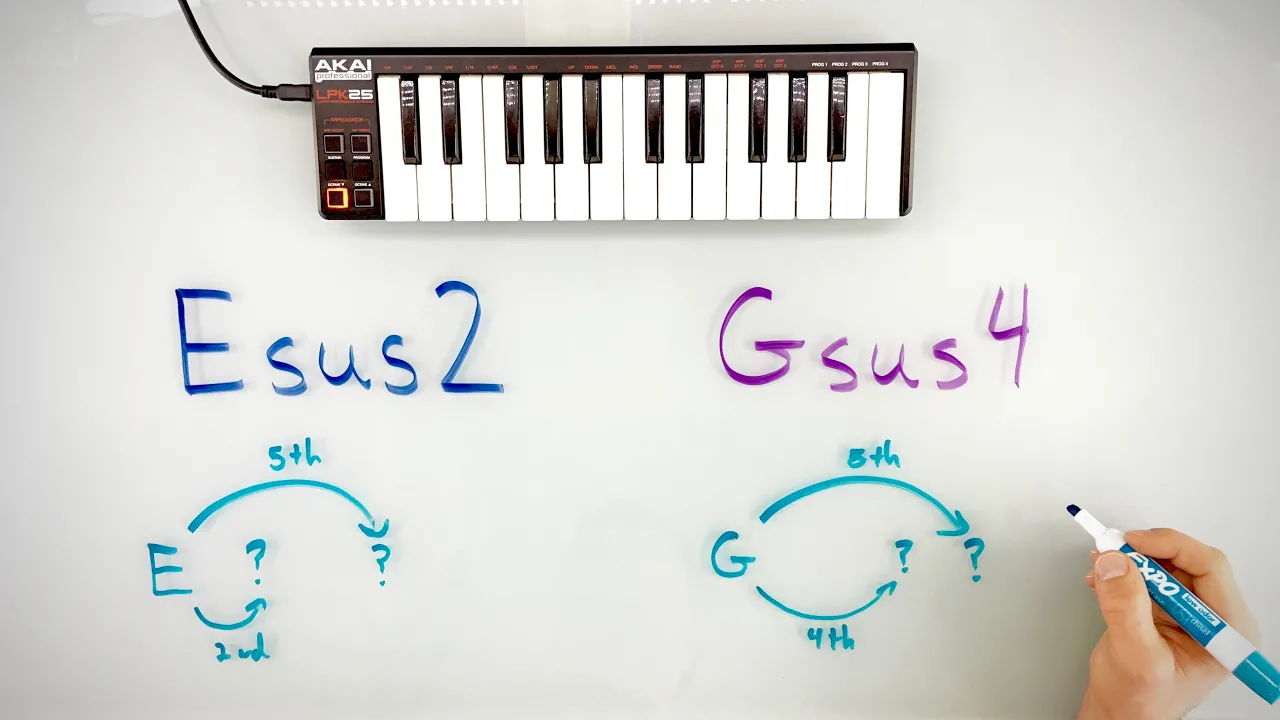
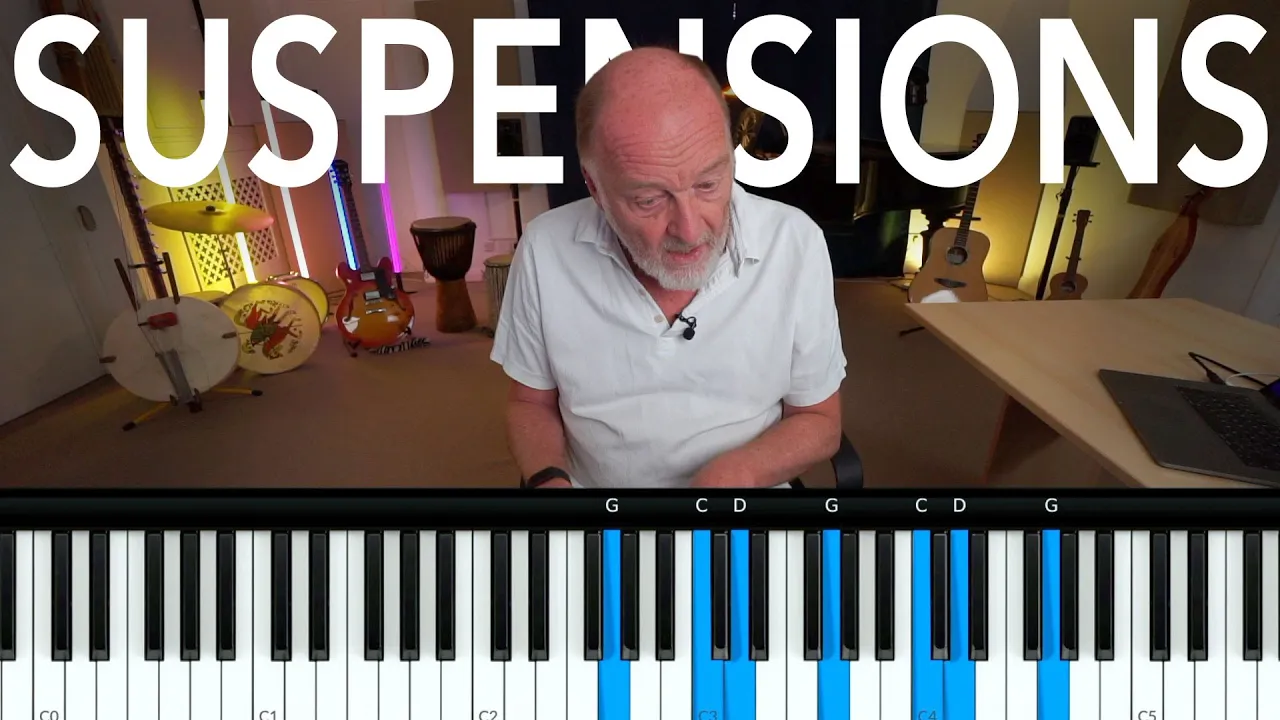
how many of you have seen sus 4 or sus 2 next to a cord and wondered what it was the sus stands for suspended cord or suspension a suspension is a means of creating tension by prolonging a consonant note of one chord while the underlying Harmony changes creating dissonance now the cord can actually stay suspended that happens all the time in contemporary music or the chord can resolve by stepwise motion to the nearest scale degree either up or down a sus4 chord if I have a g sus4 that c resolves back down to b or I could have a a sus two that resolves up to a major let's take a look at the different types of suspensions from a classical musician's point of view let's say we're in the key of C I take the four chord F major then G major and then there's your CS4 resolving to the third of C major the Cs for is the F okay so on the strong beat I have that suspension then the resolution happens on the weak be so that's called a 43 suspension because it's the fourth note of the c major scale or the fourth of the chord resolving to the third now there's all different types of suspensions you can have a 9/8 suspension you can have a 43 you can have a 2 three you can have a 65 a 98 suspension would be something like this if I have a G major chord going to a C major with that 9th then resolves down to the root that's why it's called a 98 you can also have a 9843 double suspension that would be this if I went okay so suspensions have been used since the beginning of time in music the Renaissance Era the bro era the classical era the Romantic Era the impressionistic era contemporary classical music and in pop music take the song Clarity by Zed first chord of the song is an A flat sus4 over B flat which is really B flat minor 11 the second chord is an E flat sus or an E flat 11 chord so 2 [Music] 3 I did a flat sus too there although I think they they play ad nine there or even Songs Like This [Music] Pinball Wizard is a real obvious one here's another real obvious [Music] [Applause] [Music] one so you have the D sus two D Major D sus 4 that gives you so much there's so much uh emotion in that guitar riff in Stairway to Heaven There the ending the suspended chords the suspended chords are really emotive they're ambiguous they're intense when you pass through and you're holding on [Applause] [Music] that and then he goes to the C add n actually the voicing if you listen to all the parts in there it's really so that c lydian you've got C to to that with and he adds a sharp four to it and the sharp four actually acts like a suspension lydian chords or sharp four chords are another type of Triad that acts like a suspension let me show you how let's say we take a C major Triad if I make it a c sus4 the notes become c f g now if I take this chord and I invert it meaning take the bottom note move it up the active it becomes F sus2 so C sus4 inverted becomes F sus 2 and if I invert it one more time I call this G qual because there's a perfect fourth there and perfect four there but if I move these down if I go down here a voicing like this could really if I add that note to it it's like a G7 sus4 so all these suspended chords act like suspensions now if I take C major and make it a sus sharp 4 it becomes a c linean Triad 1 sharp 4 [Music] five this is exactly what's going on stward to heaven so c add9 c lydian ad 9 or sharp 4 ad9 next I'd like to talk about how to use suspensions in modern composition like film scor now to use them in that way we could take something very simple we'll do I'll do something that would be called chain suspensions or just a succession of suspensions and I'll use a three voice texture to do this if I take uh an a suspended chord which would be a e d this is actually a spread Triad suspended right and then resolving a minor and then that goes to G sus for to G major to F lydian that's a suspended sharp for to F major to e sus4 to E minor to D sus4 to D Minor to CS4 the c major suspended cords are great to use when you want to have an emotional impact on the listener I'll give you a great example in the Jurassic Park theme that John Williams composed he's going back and forth between B flat major and E flat major and then he throws in an E flat suspended four let's take a [Music] listen when that E flat suspended for happens he doesn't even do the resolution doesn't even put in that g there so what's going on there is that the ear is hearing hearing those a Naturals each time because that's in the key of B flat major but the last time the third time around the theme and it goes F B flat up to up to a flat in the melody that's called the downward modulation because we're hearing right and then so you're hearing and then downward modulation with that suspended chord is really powerful listen to it [Music] again quick review modal modulation okay so the melody in Jurassic Parks going da da da B flat a B flat so we know that we're in B flat major there because we're going from the one chord to the four chord on the four chord you play the lydian scale or the lydian mode okay and that has a note a in it da da da now when the melody goes da da da da B flat a flat when you hit that note a flat we know that we are no longer in the key of B flat major because it does not have an A flat in it the closest key that has an A flat in it is a key of EF flat major which is one key away in a flat Direction that's why it's called a downward modulation so this E flat sus4 it has the notes E flat A flat B flat okay now John Williams doesn't even bother to resolve it down to E flat major he's using it for suspense for power for emotion another great example of the use of suspensions is from the soundtrack to in the heart of the sea by rooh BOS what's cool about this is that he uses the 9843 double suspension let's check it [Music] out so this starts on C minor with a spread Triad with a root on top so it's c g e flat C and then then he goes to E flat lydian with a major so it's E flat major and the sharp for goes up to the fifth there but you have EF flat major spread Triad there with a sharp for right then here's your double suspension 9843 the 98 is the G to F so it's the ninth to the root and then the fourth to the thir then he moves up to C minor up the active but this time he goes to a flat lydian so he's got a flat major spread Triad here with the sharp four on top same thing but then he goes to a double suspension on the um B flat so it's B flat uh 98 43 same thing so you've got 98 43 9 8 43 or if you think of of sha Shank Redemption which I've talked about many times on here Thomas Newman uses suspensions where they don't have the resolution following them so that would be so this is d flat major and then you go to e69 but then here's DS 4 which resultes down to a b sus 2 says D sus 4 though is not resolved if if it were resolved it would [Music] be not good right that mysteriousness of having the suspended cord uh retaining the suspense suspended cord in this case is really for suspense although the second time through he [Music] goes and he puts the sus4 with the major 7th in there on the D chord right instead of D sus4 he goes D sus4 with a major 7even so we've only actually touched upon Triads in this episode The sus 4 Triad the sus 2 Triad the lydian Triad a little bit on the cordal Triad but these Triads can also have sevenths on them you can have a major seven with a sus 4 you can have a major 7 with a sus two you can have a lydian Triad with with a major 7 you can also have these with flat sevens we'll talk about this in future episodes that's all for now please subscribe here to My Everything music YouTube channel if you're interested in the bat book where you can find out about all this stuff plus hundreds and hundreds of examples go to my website at www.bi.com and don't forget if you want to become a supporter of the channel through the Bato Club you can find that on my website at rick.com thanks for watching
Up Next
6:29
Major and Minor Scales Explained | Music Theory Intervals
@Montechait
2.3K views•2025-08-14

10:20
Mozart's Musical Dice Game Explained: History, Rules, & Fun
@webpianoacademy
5K views•2023-03-13
7:07
Unlocking Phrygian Dominant: Scales, Chords & Film Scoring
@RickBeato
360.6K views•2022-09-01
10:49
Understanding John Coltrane's Giant Steps: A Music Theory Analysis
@Vox
10.4M views•2018-11-12
Related Study Plans & Knowledge Roadmaps
Structured learning paths in Music Theory
music-theory
Composing Galant Music: Partimento & Schemata
01Foundations of Figured Bass and Keyboard Harmony
02The Rule of the Octave (Regola dell'Ottava)
03Galant Schemata: The Building Blocks of Form
+ 2 more learning modules
30h5 modules
Explore Roadmap
music-theory
Decoding Overtone Series: Tuning & Drone Music
01Acoustic Foundations: The Physics of the Overtone Series
02Tuning Systems: Equal Temperament vs. Just Intonation
03Microtonality and Spectralism: Beyond Standard Pitches
+ 2 more learning modules
24h5 modules
Explore Roadmap
music-theory
Impressionist Harmony: Scales, Planing & RPGs
01Foundational Music Theory: Keys, Intervals, and Seventh Chords
02Impressionist Color: Chord Planing and Parallel Harmony
03Whimsical Textures: Pentatonic Cascades and Whole-Tone Scales
+ 1 more learning modules
14h4 modules
Explore Roadmap
music-theory
Negative Harmony: Axis Reflection in Indie Pop
01Music Theory Foundations: Scales, Intervals, and Triads
02Functional Harmony and the Circle of Fifths
03Demystifying the Negative Harmony Axis Reflection
+ 2 more learning modules
16h5 modules
Explore Roadmap