




![Explaining Musical Intervals As CLEARLY As I Possibly Can [MUSIC THEORY FUNDAMENTALS]](https://i.ytimg.com/vi_webp/m9GlB8tanNE/maxresdefault.webp)





















Major and minor scales are the two fundamental diatonic scales in Western music, each containing seven notes; they differ primarily in their interval structure, where the minor scale has its third, sixth, and seventh notes each lowered by a semitone compared to the major scale, resulting in distinct emotional qualities—major keys sound bright and uplifting while minor keys sound darker and sadder. Both scales follow a pattern of five whole tones and two semitones per octave, with the major scale having semitones between the 3rd-4th and 7th-8th notes, while the minor scale has semitones between the 2nd-3rd and 5th-6th notes. To construct any major or minor scale, one can use the white keys on a piano, beginning on C for major scales and A for minor scales.
Major and Minor Scales Explained | Music Theory Intervals
Added:A scale is simply a specific sequence of notes. Of course, we can create a scale with all 12 notes we find in each octave.
That's called a chromatic scale. But usually we use scales with a smaller amount of notes. The two most important scales we use in western music, the major and minor scale, are so-called diatonic scales, which consist of seven notes.
This is why the piano has seven white keys in each octave. And it's also why our musical alphabet has seven letters.
Each letter appears exactly once in any major or minor scale.
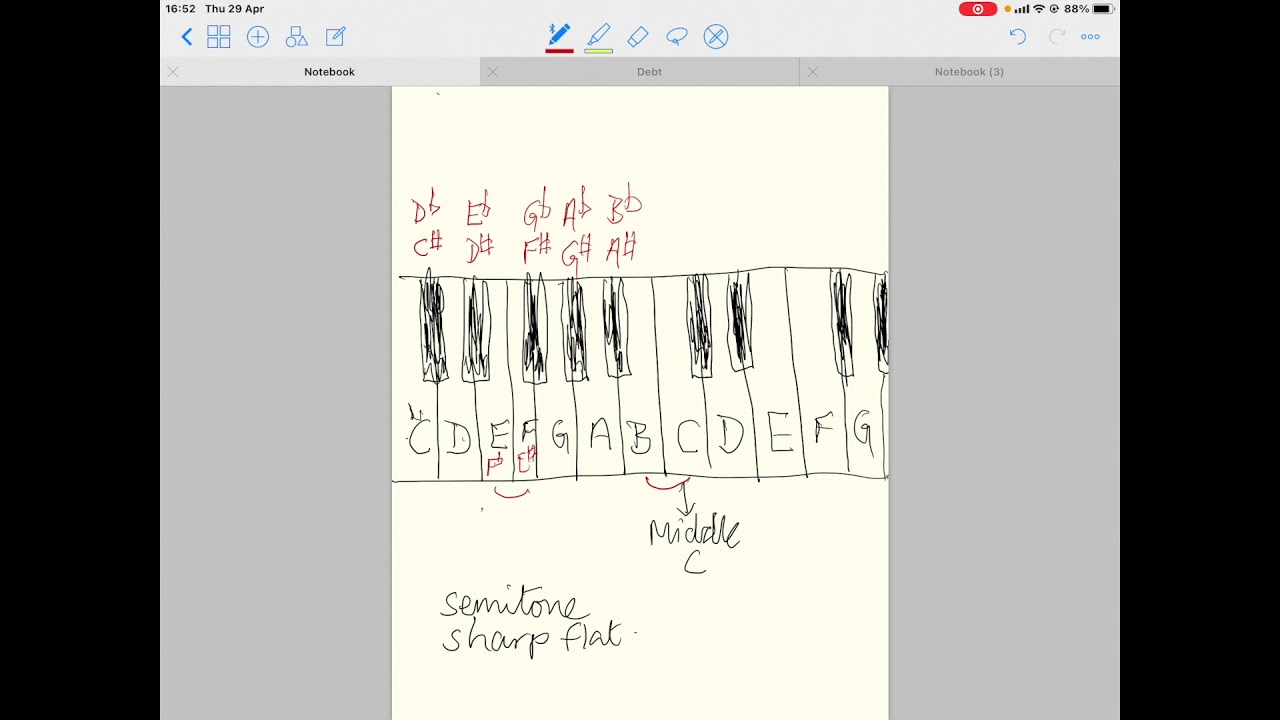
Using just the white keys on the piano, we can already play both a major and a minor scale. If we begin on C, that's a C major scale.
If we begin on A, we play an A minor scale.
It is often said that major and minor have different emotional qualities.
Major keys tend to sound bright and uplifting while minor keys sound a little darker and sadder.
In any case, the vast majority of western music from classical to pop is based on these scales. So when you hear that a song is in a specific key such as C major or A minor, it means that the first note of that scale is the tonal center and the song mostly uses notes and chords from that specific scale. But how do we know which keys to use in which scale? We can take a look at the structure of major and minor scales. The major scale contains three perfect intervals, fourth, fifth, and the octave, as well as four major intervals, the second, third, sixth, and seventh.
Now, let's compare that to our minor scale. The perfect intervals remain the same. We have a perfect fourth from A to D, a perfect fifth from A to E, and of course, an octave from A to A. The second note of our scale also remains the same. There are two semmit tones between A and B, a major second.
However, the third note of the scale is lower than the one in our major scale.
There's only a minor third between A and C.
The same is true for the sixth and seventh. Both of them are minor intervals.
So that's the whole difference between major and minor keys. In the minor scale, the third, sixth, and seventh note are each a semmit tone lower compared to the major scale. This means that if we want to turn our C major scale into a C minor scale, all we have to do is lower these three notes by a semmit tone.
So a C minor scale looks like this.
Likewise, we can transform our A minor scale into major by raising these three notes.
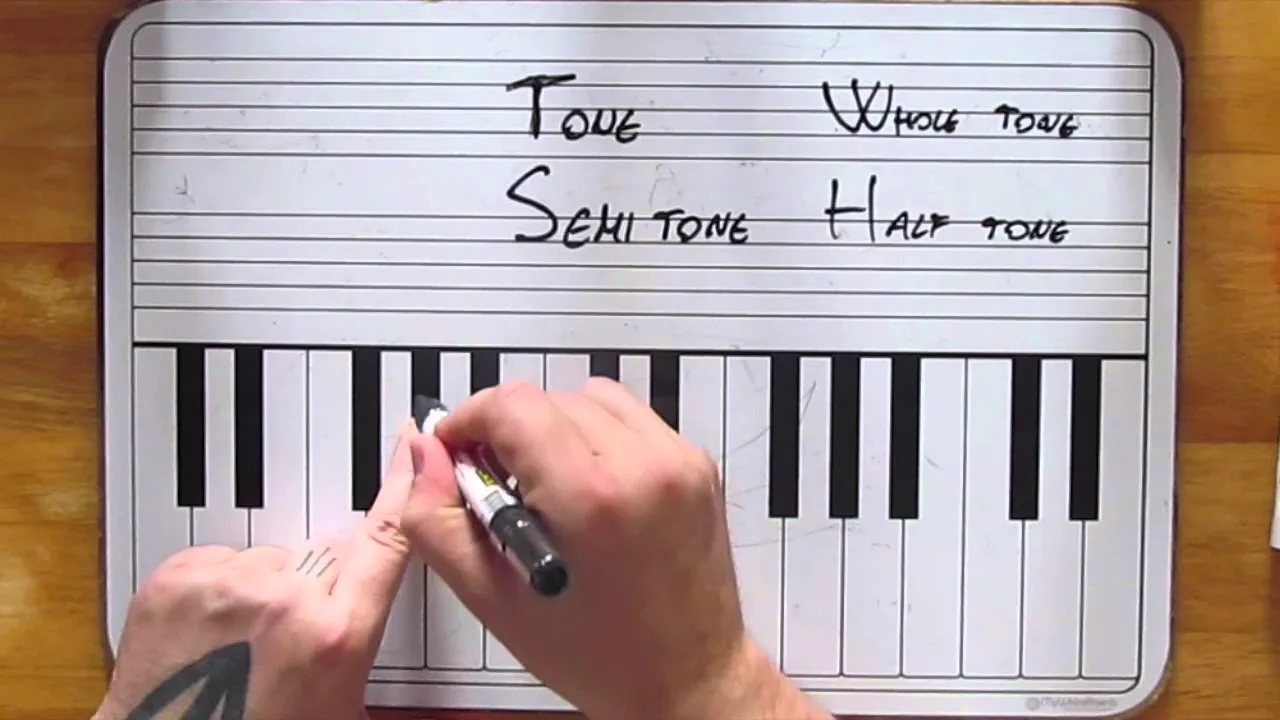
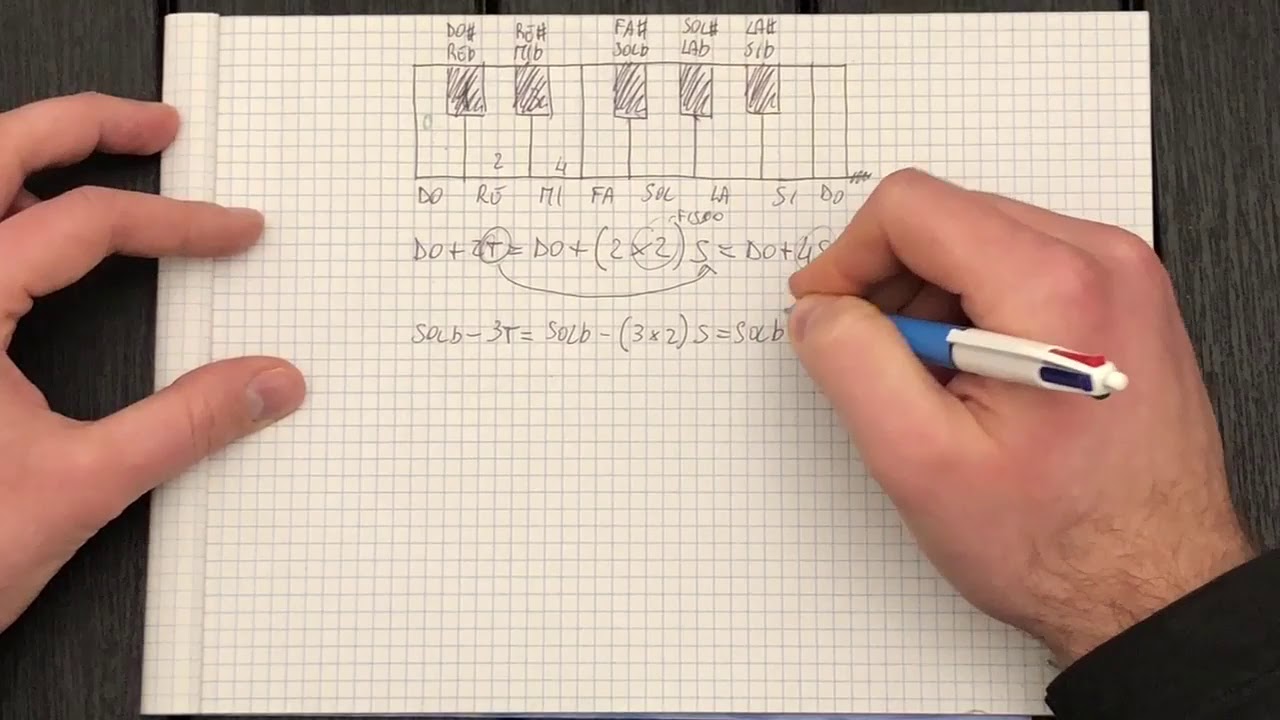
I want to show you one more way to think about this, and it's connected to the layout of the keys on the piano. We learned that there's always a semmit tone between neighboring keys. This means that although the white keys are identical in size, there are actually two different intervals between them.
Since there's no black key between E and F and between B and C, those notes are only a semmit tone apart. While we have two semmit tones, a whole tone between all the other white keys.
So when we play a scale using just the white keys, each octave consists of five whole tones and two semmit tones. And this is true for both our major and our minor scale. The only difference between them is the position of the two semmitones.
In our major scale, we have semmit tones between the notes three and four and seven and 8. In our minor scale, the semmit tones are between two and three and five and six.
The great thing is you don't have to memorize any of this because as soon as you're sitting at the piano, you have this structure right in front of you.
All you need to remember is that when you play a scale using the white keys, the major scale begins on C and the minor scale begins on A.
So with this formula we can now create any major or minor scale. Just to give an example let's build a D major scale.
The first step is a whole tone which takes us from D to E.
Now we need another whole tone. Since E and F are only a semmit tone apart. Our third note has to be F sharp.
The next step in our scale is a semmit tone. So we move from F sharp to G.
The following three steps are whole tones. So we go from G to A, from A to B, and from B to C sharp.
That leaves us with the final step of our scale, a semmit tone between C sharp and D.
[Music]
Up Next
How to Build Chords: Triads, 7th Chords & Extensions
@ZachAdkinsGuitar
910 views•2020-09-20

Mozart's Musical Dice Game Explained: History, Rules, & Fun
@webpianoacademy
5K views•2023-03-13

Understanding Diatonic 7th Chords in Major Keys | Music Theory Tutorial
@GracieTerzian
54.7K views•2022-03-02
Understanding John Coltrane's Giant Steps: A Music Theory Analysis
@Vox
10.4M views•2018-11-12
Related Study Plans & Knowledge Roadmaps
Structured learning paths in Music Theory