














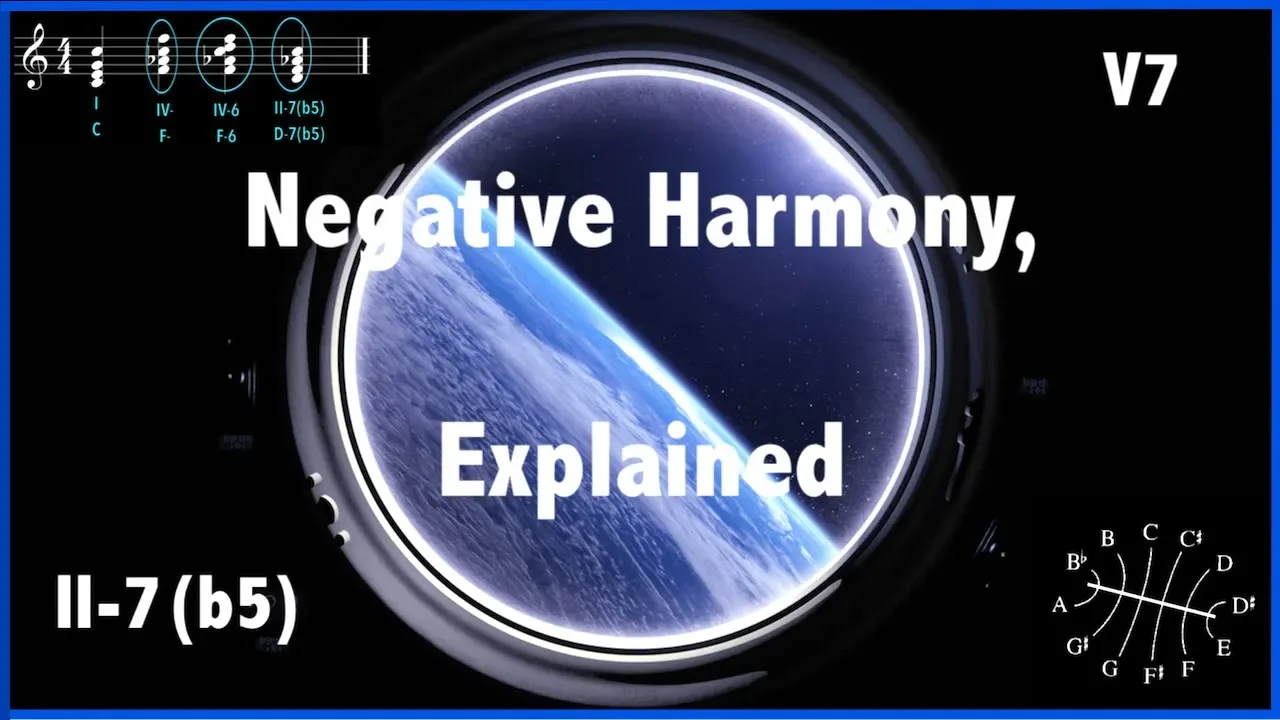


Negative harmony is a music theory concept where every note and chord in a key has a 'mirror' or 'negative' version obtained by reflecting it over an axis between the tonic and dominant notes on the circle of fifths, which reverses the direction of motion (ascending becomes descending) and inverts chord qualities (major becomes minor and vice versa); this technique was coined by Steve Coleman in the late 1970s/early 1980s, though it incorporates ideas from Ernst Levy's earlier work, and was later popularized by Jacob Collier.
Negative Harmony Explained: Music Theory Guide
Added:Understanding of major and minor diatonic scales, key signatures, and scale degrees.
Familiarity with chord construction, including triads, seventh chords, and Roman numeral analysis.
A solid grasp of interval theory, specifically how to identify and measure perfect, major, and minor intervals.
Knowledge of the Circle of Fifths and basic tonal functions, particularly the dominant-to-tonic relationship.
Applying negative harmony to jazz reharmonization, substituting standard dominant chords with their negative equivalents.
Studying Ernst Levy's 'Theory of Harmony' to understand the historical and mathematical origins of harmonic dualism.
Analyzing voice leading principles within negative progressions to ensure smooth chromatic resolution.
Integrating negative harmony with other advanced concepts such as modal interchange, tritone substitution, and Coltrane changes.
96.2K views5.6Klikes23:43Original Release: 2025-09-25
This video is sponsored by Hook Theory.
What the f is negative harmony? Well, let me show you an example. This is Live Forever by Oasis.
>> And this is the negative harmony version of Live Forever by Oasis.
[Applause] >> You got to fly.
Everything that was going up has gone down and vice versa. And everything that was major has gone minor and vice versa.
So later in this video, we'll give the negative harmony treatment to a few other famous songs. But first, let me explain to you what negative harmony actually is. Put shortly, negative harmony is the idea that every note in the key and therefore every chord in the key has a negative version of itself like a mirror version a note and a chord that kind of has the same character and function but from another way around from the other side. So for example in the key of C the negative version of the five chord G7 is F minor 6 this chord.
And we can kind of intuitit that that those two chords have a similar role to play within the key because for example when we're in C we could go C G7 C 1 5 1 and that's a perfect cadence right and that works because the five chord has that sense of tension that wants to resolve back to the tonic chord C.
But we get that same level of tension not just from the G7 chord, but from the F minor 6 chord. The F minor 6 chord also wants to pull us home to C, but in a different sort of approach, right? It's going around the other way.
So later in this video, I'm going to show you how you can use negative harmony, how you can find the negative version of each chord in the key, and how you can use negative harmony in a melodic way, because that's actually closer to the original purpose of this technique. But first, I want to get to the bottom of where this idea even came from. Who came up with the term negative harmony? Well, a lot of people now associate negative harmony with Jacob Collier. And that's because in this interview a few years ago, he was asked about negative harmony. And this is what he had to say.
>> Any chord in any key has like has a has a reflection, a polar opposite chord within that key center based on rotating every single note around the axis of the key center.
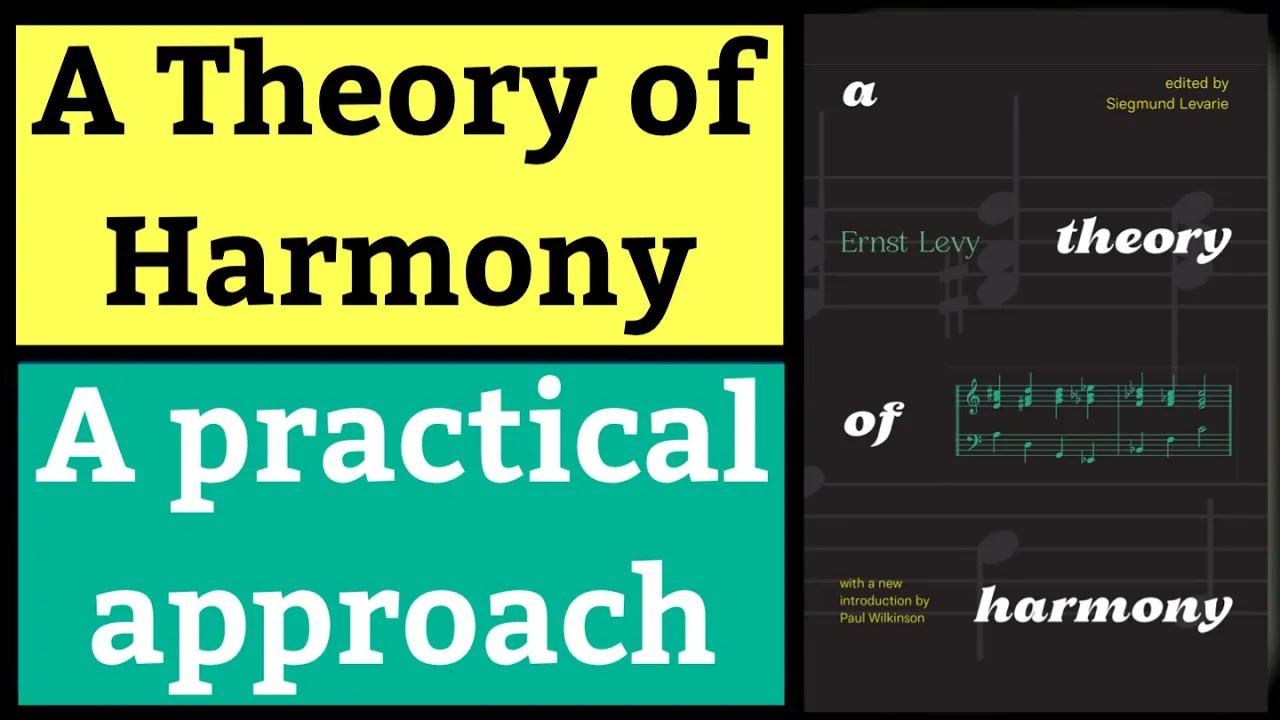
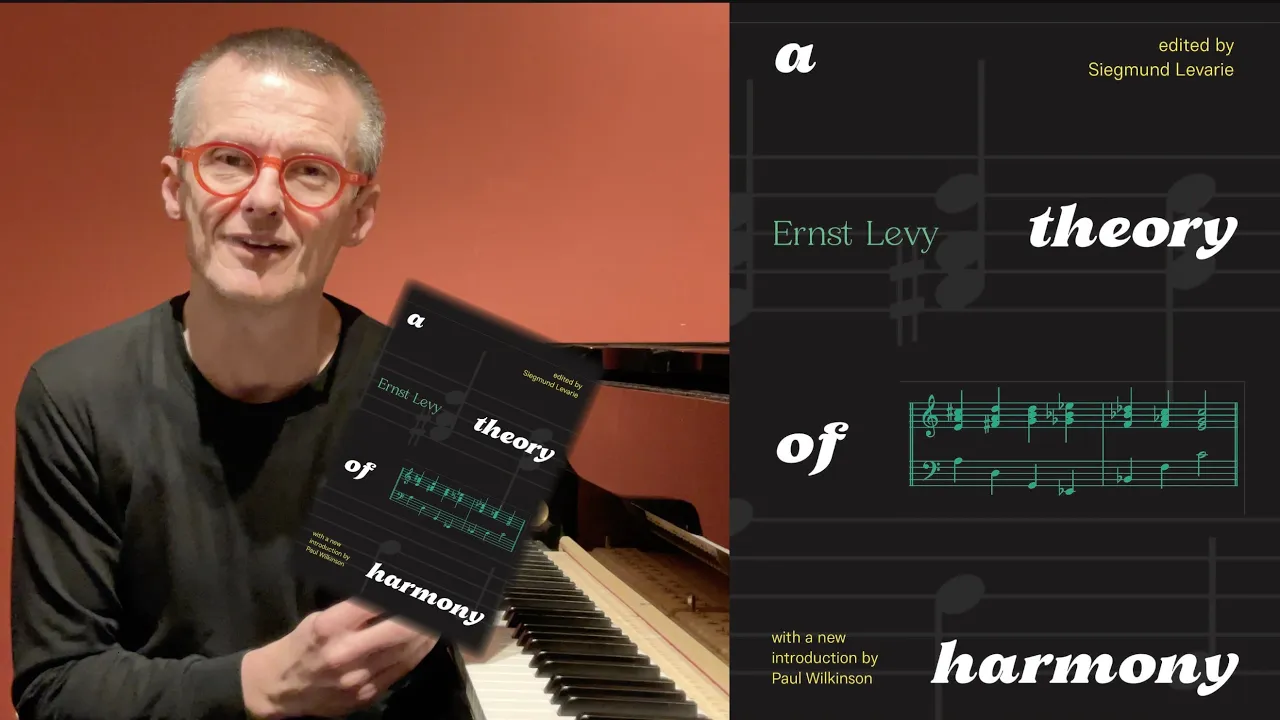
>> So in this interview with June Lee that went kind of viral in the music theory sphere, negative harmony was suddenly introduced to thousands of people and that's sort of how it's become popular again as an idea. But as Jacob mentions in the interview, he didn't come up with negative harmony. And he attributes it to this music theorist called Erns Levy who wrote a book called Theory of Harmony. And you'll see that book referenced a lot when people are teaching about negative harmony online.
But if you look at that book, if you actually read that book, the term negative harmony is never once said in that entire book. The word negative is not even in that book. So although that book does have similar ideas to negative harmony and we'll talk about that a bit more later, that book isn't where negative harmony came from as a concept.
So I did a bit of digging on the internet to try and get back to the original source of this idea. And eventually I arrived at one particular name, Steve Coleman. Steve Coleman is an American saxophagist and music educator.
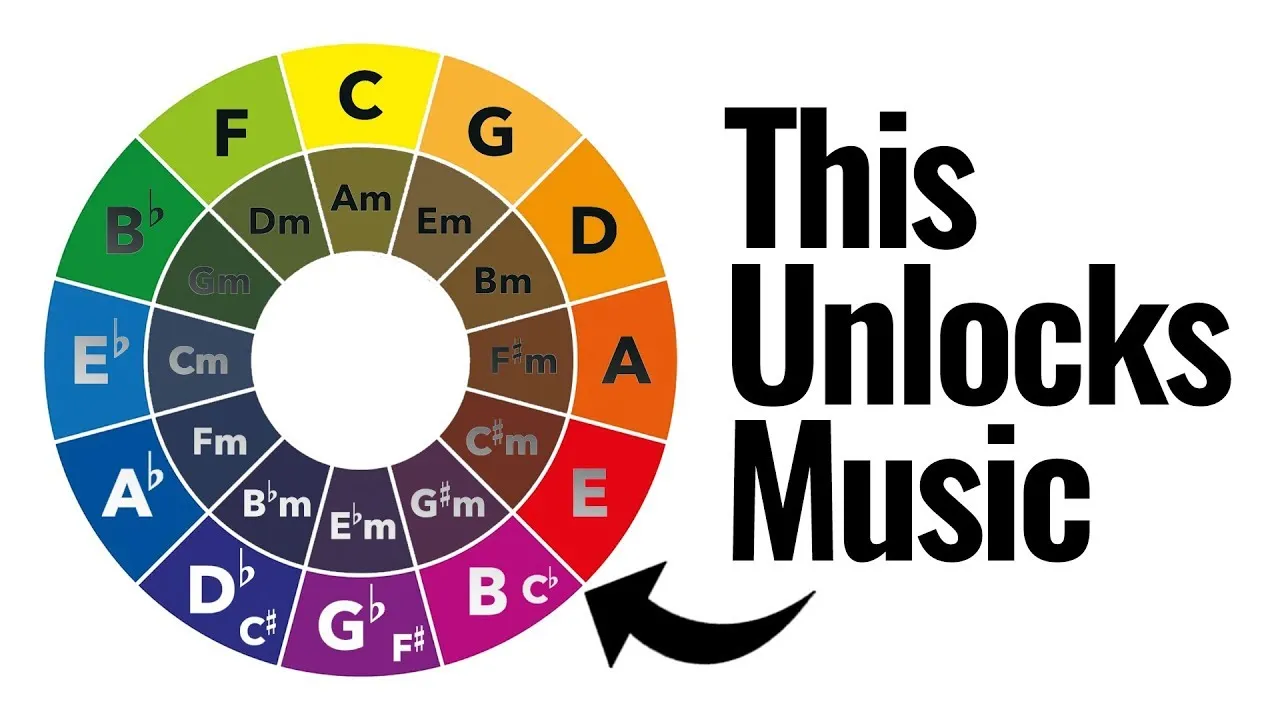
And it's Steve who came up with the term negative harmony. And I know that because I emailed him and he replied, "I created the terms negative harmony and negative tonality in the late 1970s, early8s. This is a phrase that I created to describe the tonal progressions that saxophonyist von Freeman was playing and later I applied it to what Charlie Parker, Art Tatum, John Cold Train, Sunny Rollins, etc. were doing. It's only in the late 1990s that I connected the phrase negative harmony which I'd been using for decades to the ideas of Erns Levy. So although Steve acknowledges there's a link to Erns Levy that he kind of incorporated Erns Levy's ideas into his idea of negative harmony, it's Steve Coleman who came up with negative harmony. Steve Coleman was super helpful in these emails and he even was able to shed light on how Jacob Collier came to know about negative harmony. Steve told me that he taught the ideas to a music educator called Barakimal and then Barrick taught Jacob Collier. So that's where negative harmony comes from. Now let's dive into how we can actually use these ideas. So the main idea with negative harmony is that you're reflecting the notes of the scale and therefore the chords of the scale over an axis. You get this sort of reflection of them and that axis is cut down the middle of the circle of fifths.
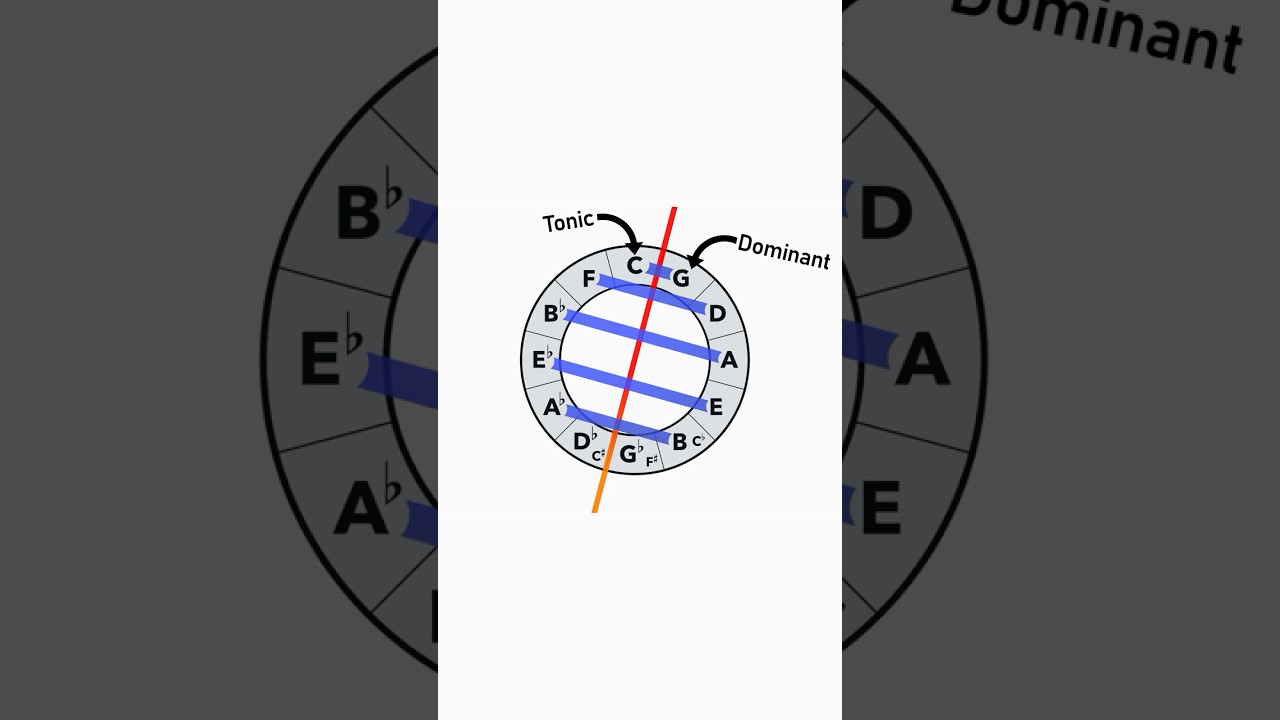
Basically, you take the circle of fifths and you cut a line down between the tonic note and the dominant note. So, if we're in the key of C, the tonic note is C. The dominant note, the fifth note of the key is G. So, we cut a line through the circle of fifths between those two notes. And now that is our mirror. So, the notes on either side of this circle of fifths are going to be the negative versions of each note. C reflects to G.
F reflects to D. B flat reflects to A. E flat reflects to E. A flat reflects to B. And D flat reflects to G flat. That's how we get the mirror version of the notes. The final step to make this negative harmony. You know harmony as in chords is to then take the notes of whatever chord we want to reflect and one by one reflect them over this axis.
So for example earlier we said that the reflection of the chord G major is F minor and we can see that by taking the three notes of G which are G, B and D and reflecting them over to get C, A flat and F, the notes of an F minor chord, right? That's how you get the negative version of any chord you like.
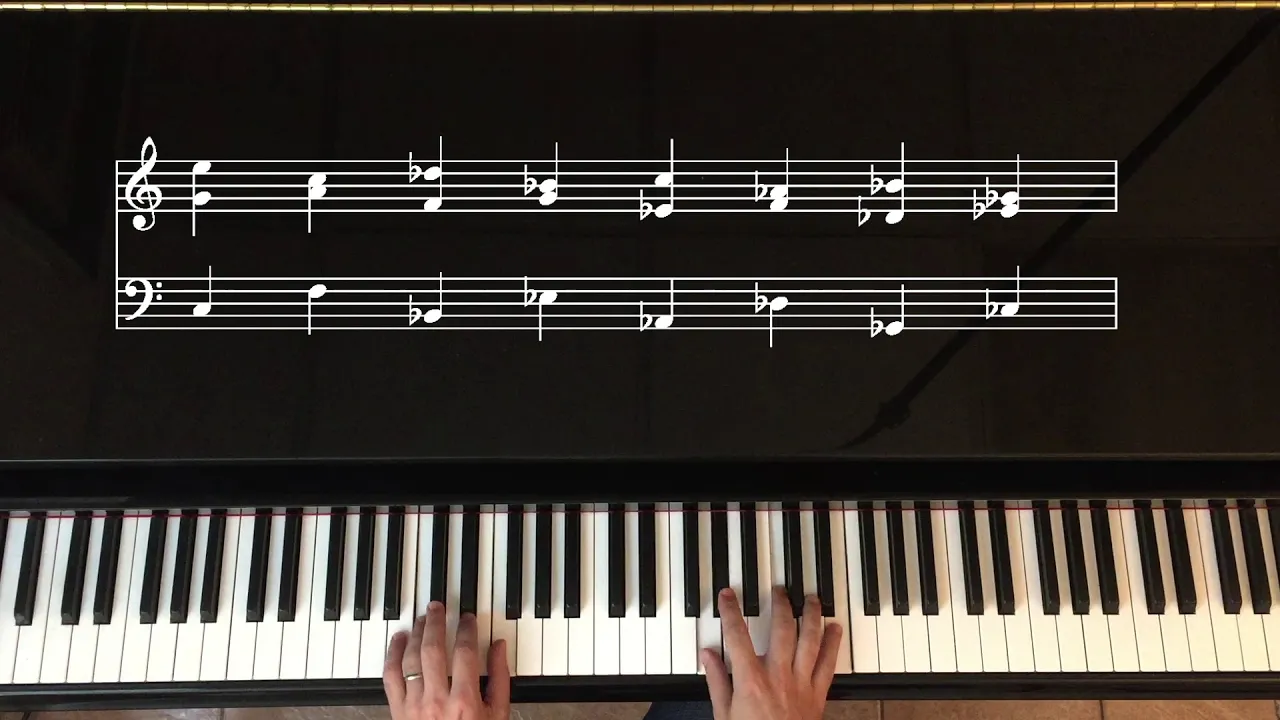
So for example, if we wanted to get the negative version of E minor, we reflect the E over to get E flat. We reflect the G over to get C. And we reflect the B over to get A flat. And we have an A flat major chord. So the negative version of E minor in the key of C is A flat. And what you'll find when you reflect chords into their negative versions is that everything that was major becomes minor and vice versa. And everything that was ascending becomes descending and vice versa. So, for example, if I took the chord progression in C major of C, D minor, E minor, and F, just climbing up the major scale.
Well, the negative version of that would be this.
[Music] We're now climbing down the minor scale.
So, we were climbing up the major, we're now climbing down the minor, and all of the chord qualities have flipped. So before we had major, minor, minor, major, and now we have the opposite. We have minor, major, major, minor.
So let's put this into action again and create another negative harmony version of a famous song. This time, let's do Creep by Radio Head.
[Music] >> This song's originally in the key of G.
So if we flip everything over the axis between the tonic note of G and the dominant note of D, we get this.
[Music] >> What the hell?
[Music] I don't belong here.
Now, what's interesting is because Creep, the original version of Creep uses chromatic chords, once you flip it into a negative version, you get quite interesting results. For example, in the original version of Creep, we have the move from major to minor. And in this negative version, it happens the other way around. We have minor, this D minor going to D major, which actually creates quite a conventional sounding perfect cadence at the end of this negative harmony version. Okay, we've done a radio head example. I guess we have to do a Beatles example, right? So, let's do Let It Be by the Beatles. This is the original version.
>> When I find myself in times of trouble, Mary >> and this is the negative version.
>> When I find myself in times of trouble, Mother Mary comes to me.
[Music] So, of course, we discussed earlier how to flip the chords into negative harmony versions by taking each note of the chord and putting it over the axis. But there is a shortcut you can do as well because each chord of the key, each scale degree will always flip to the same negative scale degree. So, you can sort of just memorize them. So, the major tonic chord always becomes the minor tonic chord. The major 5 chord always becomes the minor four chord. The major four chord always becomes the minor five chord. Sevenths become sixths and vice versa. And this makes sense, right? Because the whole point of negative harmony is we're saying that each chord has a sort of equal but opposite function in the negative side of the circle of fifths. So that's the chords. But how do you flip the melody?
Well, it's the same principle, right?
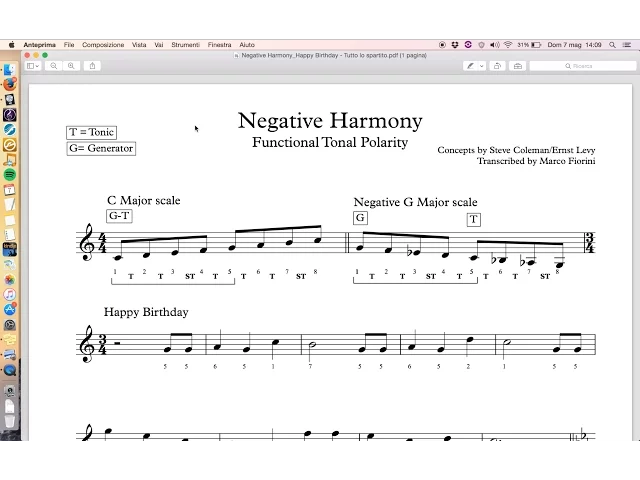
You take each note of the melody and one by one you flip them over this axis. And as I mentioned earlier, what you wind up with is a melody that is often sounding minor rather than major and will now go up instead of going down and down instead of going up. And as you can hear, the character of the melody really changes. In fact, I'm going to play you now another very famous melody, but I've already flipped it into a negative version. Let's see if you can guess what this melody is.
[Music] If you guessed happy birthday, then you're correct. Or maybe this would be better described as unhappy deaf day.
>> Happy birthday to you.
Happy birthday to you.
Happy birthday to Jacob. Happy birthday to you.
>> So, in just one moment, we'll look at a real song that actually uses negative harmony. But first, I want to tell you about a resource that I use on the daily when I make these videos. It's the way that I find so many examples for my videos. It's Hook Theory. You can search through Hook Theory's massive theory tab database of songs by what chord progression you're looking for. And you can even stipulate that that chord progression should happen at the beginning of a section, which is a feature they added for me recently after I asked for it. In addition to the theory tab database, Hook Theory also offers a suite of musical tools, including Hookpad, a songwriting sketch pad with music theory functionality built in. Chord Crush, which is a fun ear training game that helps you recognize chords in pop songs, and some music theory books that teach you the principles of music theory whilst using real songs. You can use the link below for a 20% discount on all of these great tools. So, are there actually any real world serious examples of an artist using negative harmony to create a negative version of a song? Well, one example I found is by Dan Teper and his jazz trio, and the song is called Back at You.
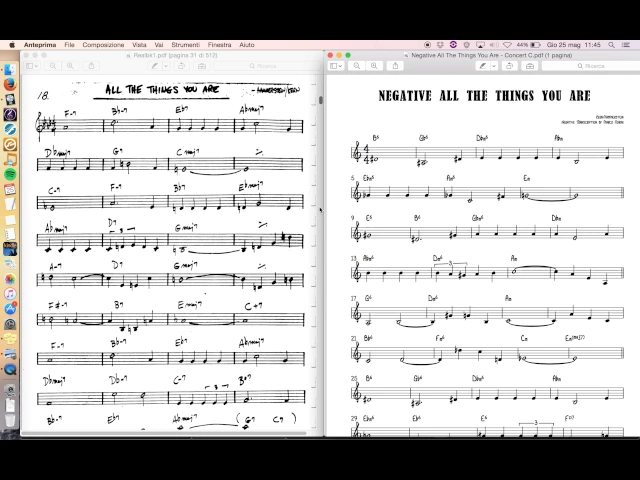
[Music] So this back at you is actually a negative harmony version of a very famous jazz standard. But even if you're intimately familiar with the jazz standard in question, I don't think you would recognize it just by listening because negative harmony really does utterly transform a piece of music. What this is, what back at is is a negative harmony version of all the things you are. Despite having a few modulations during its course, all of the things you are is ultimately in the key of a flat.
So Dan Teter has flipped everything over the axis of a flat. And I don't think it's a coincidence that he chose to flip this particular jazz standard because all the things you are is a great example of a circle of fifths chord progression. A chord progression that moves in fifths, moves around the circle of fifths effectively.
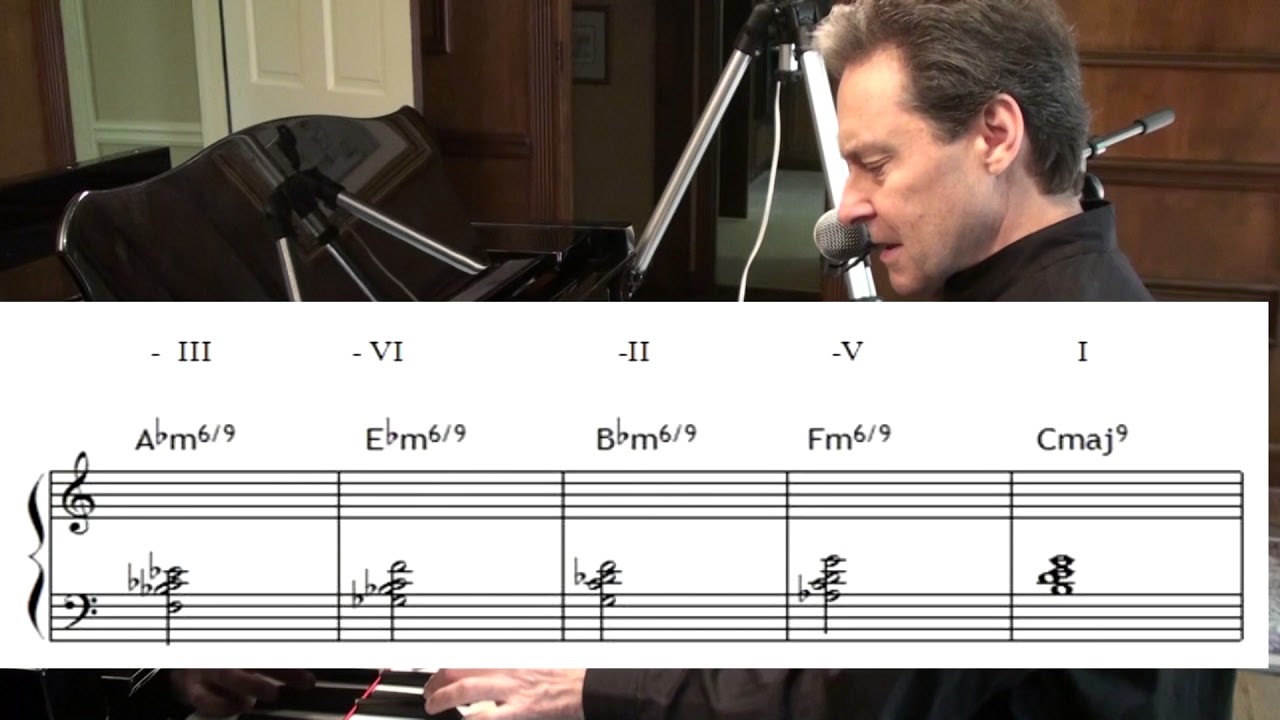
[Music] [Applause] [Music] So when you get this negative version of it, we're now moving the other way around the circle of fifths. So it has this really intriguing quality where we're still moving around the circular fifths. We still have that familiar motion, but turning the other way. Also, the eagle-eyed amongst you may have noticed that Dan did give us a little clue to what jazz standard he had made into a negative harmony version in the title here because of course at the initials of all the things you are. So, you can apply negative harmony however you wish, but I think it's most practically applied to individual chords in a progression rather than flipping the entire chord progression. So, like we showed at the beginning, you know, quite commonly if you had a chord progression, especially in jazz, it could end with a dominant chord G7 in the key of C. But you could use negative harmony to flip that G7 chord into an F minor 6 chord. So we wind up with [Music] now Steve Coleman refers to this chord the four minor 6 chord F minor 6 in the key of C as the negative dominant chord.
So G7 in the key of C is the positive dominant and F minor 6 is the negative version of that. both dominant chords, but resolving us back to C from a different perspective, going a different way around the circle of fifths. Now, how Steve describes this, which I think is great, is in the same way that the G becomes a sort of dynamic version of itself by adding the F. The F is the thing adding the potential energy that resolves it back to C.
The sixth that we add to the F minor chord here, the sixth that we add to the four minor chord is the same idea. It's adding that dynamicness. It's adding that energy. That note gives it that supreme power to resolve back. And in both cases, in the positive dominant and the negative dominant, the reason they're adding this note, either the seventh to the positive dominant or the sixth to the negative dominant is adding that dynamicness, that want to move forward, is because adding that note to the chord creates a trionee within its intervals. Tritones are inherently unstable and want to drive back to resolution.
[Music] Now, anyone who has studied counterpoint classical music, basically the work of JS Bark, will see a familiarity here, particularly in the way that negative harmony applies to melody. It's very, very similar to a much older idea called inversion, melodic inversion. A classic way to spin out a motif, a short fragment of melody into a longer melody is to transform it. And a very very typical transformation is what we call inversion, which is basically when you flip all of the intervals upside down.
So rather than it going up a second, it will go down a second. Rather than it going up a fifth, it will go down a fifth. And that gives you a new version of the motif that's upside down that you can then use to further develop your piece. And that's very similar, isn't it, to what we did with negative harmony. It's the same melody, but every time that the original version goes up, the negative version goes down by the same interval and vice versa. So negative harmony is definitely related to this earlier concept of inversion, melodic inversion. But negative harmony is a more precise version of this technique. There's two precise rules that have to apply for it to be negative harmony. One is that it is a pure or chromatic inversion rather than a diietonic inversion. Which means that whereas people like JS Spark would flip the intervals but keep it all within the same key often by opting for a minor third instead of a major 3rd or a minor 6th instead of a major 6th. In negative harmony we do a pure like forlike transformation. So if it goes up by four semmit tones, it will now go down by four semmitones even if that pushes it outside of the original key center. And the other important stipulation is that whereas in classical melodic inversion, we can transpose that inversion anywhere we like in the scale, we can have it start from different points, in negative harmony, it must be a fifth from the original version. That's how we're getting that negative reflection. That's the whole point of that axis thing we did. Basically, another way of thinking about negative harmony, a negative inversion, is that you're just flipping all of the intervals, so they go up rather than down or vice versa, and then taking that and transposing it all by a fifth. This transposition is really at the heart of how negative harmony works.
And a good way to see that is if we take a major scale, so the C major scale, and get the negative version of that. Well, that would be this. Now, as you can see, it's descending now rather than ascending. And what we actually have here, if we look at the notes, is a G friian scale. So the negative version of C major is G friian. But that is assuming that this note here is the tonic note. But that's not how it works in negative harmony. This note isn't considered the tonic note in negative harmony. And we can see that clearly if we harmonize the scale. So what do we mean by that? Well, if we harmonize a scale normally, so the C major scale for example, we are taking the notes from the scale and stacking them up and effectively playing one note, then skipping a note, playing one note, skipping a note, playing one note, stacking in thirds to give us the chords of that scale. These are the chords that are in the key of C major. If we do that same principle but with the negative version of the C major scale, this descending G frigian scale, well, you can see because now the chords grow downwards rather than upwards, we actually wind up with a C minor chord here on the root note. This is the C minor scale harmonized. Right? Even though it looked like G was the root note here, once we've harmonized it, we can see that this is a harmonized C minor scale. The negative version of the C major scale is a C minor scale. You just have to harmonize it first to see that. And that makes sense, right?
Because this concept is called negative harmony. Harmonization is at the core of it. And in fact, if you're a negative harmony purist, you wouldn't be labeling these chords as C minor and D diminished, etc. You'd be labeling the C minor, for example, as negative G major.
In negative harmony, right, we're thinking of everything from the top down rather than from the bottom up. So the note that we name the chord after isn't this bottom note, but the top note, which is G. And the intervals of this chord, if you're looking downwards rather than upwards, are a major third followed by a minor third, which in positive land, in a normal chord situation, would be a major chord going upwards. Right? So, a positive major chord is a major third up and then a minor third up. And a negative major chord is a major third down and a minor third down. But I've avoided labeling the chords like this throughout the video because at that point it becomes quite difficult to get your head around it. It's easier, I think, to continue naming the chords in a sort of positively minded approach in, you know, our normal approach to labeling chords rather than completely rewriting our entire understanding of music theory.
Unless, of course, you want to dive completely down the negative harmony rabbit hole, which you know, you can do.
So, as I mentioned back at the beginning, the idea, the concept of negative harmony has largely been popularized by Jacob Collier. But the thing is, Jacob Collier hasn't actually really used negative harmony in his music. As he discusses in this clip, rather than thinking consciously about negative harmony and, you know, flipping over an axis as he writes or improvises, the element of negative harmony that he is drawn to is that rather than moving everything forward through perfect cadences through fifths, moving anticlockwise around the circle of fifths. Negative harmony shows us that we can get the same level of resolution, but going the other way around the circle of fifths, moving through a series of plagal cadences rather than perfect cadences, giving us this sort of darker route to resolution than the more traditional perfect cadences. So, how do I use it? Well, in a very um basic way, it's it's plagalizing every perfect cadence. And when we see plagal cadence, it's like a 41 instead of a 51. So 51 is this. And 41 is this, right? It's almost like a more of a gospel sound. So rather than going, yeah, right. It's going like what James Taylor would do. Do I think about this when I'm improvising piano on stage? Consciously, no. But what I have done is familiarize myself with the materials of what that feels like in my own experimenting at home and practicing and understood that The feeling of that being different from this is like a brighter version. And then the negative version is darker.
Bright and dark. These that's a universal thing. You you won't meet a person or a creature or any living thing that does not understand bright and dark.
So hopefully there I've shed some light or maybe some darkness on negative harmony as a concept. Now I really have kind of just scratched the surface with this. It goes much deeper. The application specifically to jazz and Bbop, which is what Steve Coleman was originally using negative harmony for, goes even further. So I've linked down below loads of sources to learn more.
Thank you again to everyone who contributed to this video, including Steve Coleman. And let me know in the comments what you think about this concept. What do you think about negative harmony? Is it useful? Is it kind of just theory for theory's sake?
I'd love to hear what you think.
Up Next

12:57
Impressionism in Music: Key Characteristics and Composers
@PianotvNet
139.3K views•2016-09-27

10:20
Mozart's Musical Dice Game Explained: History, Rules, & Fun
@webpianoacademy
5K views•2023-03-13
2:38
Negative Harmony Explained: Music Theory in 3 Minutes | Axis System
@DavidBennettPiano
53K views•2025-12-07
10:49
Understanding John Coltrane's Giant Steps: A Music Theory Analysis
@Vox
10.4M views•2018-11-12
Related Study Plans & Knowledge Roadmaps
Structured learning paths in Music Theory
music-theory
Composing Galant Music: Partimento & Schemata
01Foundations of Figured Bass and Keyboard Harmony
02The Rule of the Octave (Regola dell'Ottava)
03Galant Schemata: The Building Blocks of Form
+ 2 more learning modules
30h5 modules
Explore Roadmap
music-theory
Decoding Overtone Series: Tuning & Drone Music
01Acoustic Foundations: The Physics of the Overtone Series
02Tuning Systems: Equal Temperament vs. Just Intonation
03Microtonality and Spectralism: Beyond Standard Pitches
+ 2 more learning modules
24h5 modules
Explore Roadmap
music-theory
Impressionist Harmony: Scales, Planing & RPGs
01Foundational Music Theory: Keys, Intervals, and Seventh Chords
02Impressionist Color: Chord Planing and Parallel Harmony
03Whimsical Textures: Pentatonic Cascades and Whole-Tone Scales
+ 1 more learning modules
14h4 modules
Explore Roadmap
music-theory
Negative Harmony: Axis Reflection in Indie Pop
01Music Theory Foundations: Scales, Intervals, and Triads
02Functional Harmony and the Circle of Fifths
03Demystifying the Negative Harmony Axis Reflection
+ 2 more learning modules
16h5 modules
Explore Roadmap