




















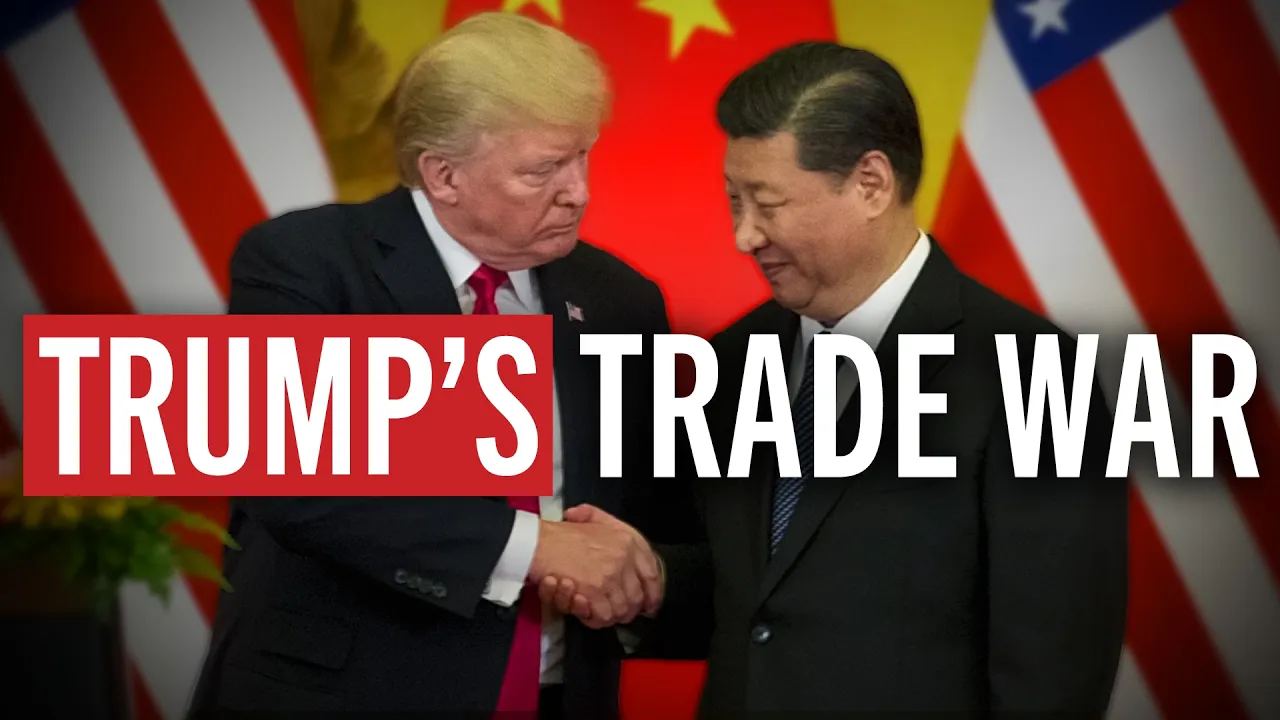


This video explores the debate over tariffs through the lens of Robert Lighthizer, former Trump trade chief, who argues that strategic tariffs (25-60%) are necessary to address China's trade dominance and protect American manufacturing jobs, while economists counter that tariffs ultimately burden consumers and can destroy more jobs than they create, as demonstrated by historical evidence showing that tariffs can deepen economic crises and that higher import prices reduce consumer purchasing power while potentially causing retaliatory trade wars.
Tariffs & Trade Wars: Economic Impact Explained by Ex-Trade Chief
Added:Basic Definition of Tariffs and Protectionism: Understanding what tariffs are, how they are levied, and their historical use as tools of economic policy.
The Balance of Trade and Trade Deficits: Comprehending how import and export dynamics function, specifically the nature of the trade imbalance between the US and China.
Fundamentals of Inflation and Consumer Prices: Knowing how taxes on imported goods can pass costs down to consumers, influencing overall price levels and domestic demand.
Global Supply Chain Dynamics: Realizing how modern manufacturing relies on components sourced from multiple nations, making single-country tariffs highly complex in practice.
Retaliatory Tariffs and Escalation Dynamics: Analyzing how target nations respond with their own trade barriers, creating a reciprocal 'trade war' cycle.
Currency Devaluation and Exchange Rates: Investigating how countries adjust their currency values (such as China's management of the Yuan) to offset the economic impact of foreign tariffs.
Bilateral vs. Multilateral Trade Agreements: Comparing targeted, nation-to-nation trade deals against international regulatory frameworks like the World Trade Organization (WTO).
Modern Industrial Policy and Decoupling: Studying how trade restrictions lead to domestic subsidies, reshoring efforts, and strategic economic decoupling in high-tech sectors.
1.9M views17.5Klikes13:32Original Release: 2025-02-03
you don't know Robert lighthiser but his influence with President Trump could change America's economy lighthiser was the top us trade negotiator in the first Trump Administration and he's an evangelist for tariffs taxes on imported goods yesterday the president declared an emergency and imposed unusually high 25% tariffs on Mexico and Canada and 10% on China to coer them to stop the flow of the deadly drug fenel that's unusual because tariffs are normally used to balance trade and in ligh heiser's opinion America has little Choice he says China's 3:1 dominance in trade is a threat to our way of life the story will continue in a moment China to me is a an existential threat to the United States it is a a very very competent adversary China views itself as number one in the world and wants to be that way they view us as in the way they have the biggest army in the world and they're growing it the biggest Navy in the world and they're growing it they're spying on us they're taking our technology they've been waging an economic war against the United States and winning that war for at least the last three decades so your tariff regime for China would be what I believe in strategic decoupling I'm not saying no economic relationship with China that's not my position at all I think you want balanced trade and how do you get balanced trade you're going to get balance Trad by having large tariffs on most of what they send to us what's large you know the president has floated numbers 50 60% but I think there are big numbers like that wait a minute you're talking about decoupling from China what would that look like so it is strategic decoupling so we would still have trade so I would say we sell you 150 billion we buy 150 billion from you no more we don't allow investments in China except in circumstances where we believe that's in the interest of the United States we don't allow inbound investment so we begin to disentangle we disentangle our technology you can ask yourself what is China's policy towards us it is exactly a mere image of what I just said said so what I'm suggesting we do to China is what they do to us Ronald Reagan gave the young trade lawyer his first White House job and 77-year-old Bob ligh Heiser has been advising Republicans since in Trump's first term liser was in charge of negotiating trade agreements in Trump 2.0 he's an unofficial advisor but a passionate one we noticed when he apologized for chewing up time just because I I talk too much so it is 60 minutes after all and we don't get all of it it's not 60 days is that what you're thinking it's not days but centuries that tariffs have been debated every US president has used them but in the 1930s tariffs deepened the Great Depression and after World War II America led a broken world to W free trade us manufacturing jobs were stable until around the year 2000 then in 10 years a third of manufacturing jobs were lost nearly 6 million there was a modest rebound under Obama Trump and Biden that dip is covid but fewer than one and a half million jobs are back you don't know how much you love going to work until you can't go there anymore Stacy dah Michelle Lopez and Matt Franson are among 12200 workers laid off in 2023 when the badier Illinois auto assembly plant shut down this is my home and when they told me that we were done it hurt it really did we've got a community of 24,000 people and uh there's probably not a street you can't you can go down that somebody's not tied to this plant um we've been here since 19 65 it's a good job provides a great living and uh we would just like to see it come back come back from Mexico in 2016 car maker stellantis moved one of Bader's Jeep models South of the Border in 2023 beler closed we've lost Electronics we've lost textiles we've lost chemicals in a large way we invented the semiconductor now we make 8% of semiconductors of the world and none of the really high tech ones more than half of the car sold in America are now Imports Mexico Canada and China are America's largest trading partners but China Bob ligh Heiser says has an enormous Advantage because of the trade imbalance and Chinese Espionage stealing us Trade Secrets you add it all up you can get to around a trillion dollars a year of of wealth from the United States being transferred to a geopolitical adversary it's insane and it's working and then you ask yourself as a national security issue how do you fight a war if God help us we ever have a war with China when they're now four times more likely to be able to to produce what is needed in a war but isn't trade one of the ways we avoid a hot War the way you prevent Wars is by having the strongest biggest best army biggest best Navy uh best economy in the world best technology you do those things the Allies come to you they see you as the future already China's manufacturing sector is bigger than that of the United States Germany and Japan combined isn't China too big to snub we should never have that attitude there are things we can do the genius of America combined with our allies we can turn this around but what do we need we need to change the relationship with them we need tariffs in my judgment we need subsidies in certain areas and we need an economic policy and a military strategic policy that rises up to the challenge everyone will prosper every family will thrive on the campaign Trump proposed historic tariffs 10 to 20% on All Imports 25% on Mexico and Canada 60% on China he said America would grow wealthy collecting taxes from overseas a tariff is a tax on a foreign country that's the way it is whether you like it or not a lot of people like to say oh it's a tax on us no no no it's a tax on a foreign country it's a tax on a country that's ripping us off and stealing our jobs but most any importer or Economist will tell you the president is mistaken tariffs are not a tax on a foreign country the tax is paid by the Importer in the United States for example Walmart imports goods from China and when those goods cross into the United States Walmart pays the Tariff if Walmart decides to pass the cost to Consumers then you paid the Tariff not China so if you go to Walmart if you go to Target you're going to see higher prices for imported goods and IST Mary lovelyy studied Trump's proposals for the Peterson Institute for international economics a leader in non-partisan research the argument is made that if tariffs are imposed American consumers will buy less of the foreign Goods more domestically produced goods and that's a great thing for consumers and for jobs well it's a great thing for consumers if you don't care about how much they are able to buy because the prices of everything they buy will go up will they substitute toward domestic Goods let's just take that to start yes to some extent they will but the prices of those domestic Goods will also rise because they no longer have to compete with imported goods lovely's research estimates the tariffs Trump talks about would cost an average household around $200 a month Footwear toys HomeGoods certain types of Machinery certain active ingredients in Pharmaceuticals certain types of chemicals we're still very dependent in certain categories but worse lovely says tariffs can kill jobs she points to Trump's first-term tariffs on imported steel as intended steel prices Rose us Mills were protected but the higher prices hurt steel buyers like car makers economists estimate that the tariffs created 1,000 jobs in steel but but cost 75,000 jobs Among Us companies overall this idea that it creates jobs yes in a few places for a few people but for the majority of us it's more pressure on employers it's more pressure on our wages it's more pressure on our jobs and obviously more pressure on our wallets when we go to the cash register the argument is made that when you increase the cost of parts and supplies coming into the country you're hurting Apple you're hurting Ford you're hurting American companies will these very highly paid CEOs have to figure out how to how to make a profit uh in a new environment one that helps workers and helps Innovation and and it's more American focused America first um the answer is yeah they're going to have to figure it out will they figure it out of course they'll figure it out they're going to learn how to make money one of the ways they figure it out is by laying people off well no you you see I don't believe that's true too I think to me the exact opposite will happen you will see more production in the United States you will see more jobs better jobs more pressure upward pressure on wages which is my objective the way you paint it it seems like tariffs are magic well I wouldn't say magic so so remember the tariffs are part of an economic policy the policy has tax cuts it has it has spending cuts it has energy production has regory reduction and it has tariffs the combination of that I think and tariffs are an important part of it has the potential to have this kind of Renaissance we saw some of that combination he talks about back in badier where turbocharge tariffs have been hitched to a big taxpayer investment when you were putting that t-shirt on Joe Biden did you think that's it the plant's opening again in 2023 Matt fransen president of the UAW Local welcomed President Biden to badier with a union shirt I thought we were well on our way you know baders always fought for themselves and in this scenario we needed we needed everybody to fight for us and they did Biden did he increased Trump's earlier 25% tariff on on Chinese cars to 100% for Chinese electric vehicles then Biden gave car maker stantis a $335 million Grant to convert badier to electric cars we don't know how much that helped but last month stellantis said it would reopen in 2027 they need to realize that whether you're Democrat Republican independent we need to work on the middle class if the middle class is strong that helps so many different areas so it's not just going to be the tariffs it's got to be policy that's set for the middle class but tariffs cut both ways Canada and Mexico now say they will retaliate against Trump's new tariffs with their own tariffs on us Goods the opening shots of a trade War the real fear that I have is that we have real problems and I'm afraid that tariffs have time and time again proven to not deliver so in the long run I'm afraid it will just increase sinicism among the American public about whether the government is able to deliver and make their lives better what are the chances that you're wrong well once again we tried it the other way Scott if we do this in 10 years it doesn't work we can go back and always fail again the way we have in the past
Up Next
14:13
Tariffs vs. Quotas: Trade Policy & Rent-Seeking Effects
@MarginalRevolutionUniversity
70.2K views•2015-09-16
5:07
Impact of Yuan in Indo-Russian Trade Amid Sanctions
@WION
261.9K views•2022-07-01
10:33
Behavioral Economics Explained: Rationality, Nudges, and Risk
@crashcourse
1.1M views•2016-03-12

113:18
The Age of Easy Money: Fed & Inflation | Full Documentary
@frontline
21.2M views•2023-03-15
Related Study Plans & Knowledge Roadmaps
Structured learning paths in Economics
economics
Sovereign Debt: Defaults, IMF & Restructuring
01Introduction to Sovereign Debt & Government Bonds
02Debt Sustainability & Credit Ratings
03Anatomy and History of Debt Crises
+ 2 more learning modules
12h5 modules
Explore Roadmap
economics
Market Design: Matching Theory & Gale-Shapley
01Introduction to Market Design and Price-Free Markets
02Two-Sided Matching & The Gale-Shapley Algorithm
03School Choice Systems and Mechanism Design
+ 2 more learning modules
10h5 modules
Explore Roadmap
economics
Impossible Trinity: Forex, Capital & Policy
01Introduction to Monetary Policy and Central Banking
02Exchange Rates and International Capital Flows
03The Mundell-Fleming Model
+ 2 more learning modules
8h5 modules
Explore Roadmap
economics
Healthcare Economics: Market Failures & Systems
01Introduction to Healthcare Markets and Market Failure
02Asymmetric Information and Adverse Selection
03Moral Hazard and Insurance Design
+ 2 more learning modules
12h5 modules
Explore Roadmap