








![[Phần 33] Cặp phạm trù nội dung và hình thức, tất nhiên và ngẫu nhiên. Cho ví dụ.](https://i.ytimg.com/vi/1BSyzudVMJw/hqdefault.jpg)










Russian Formalism emerged in the early 20th century as a pioneering movement that analyzed literary texts by focusing on form rather than authorial psychology or social context. Key figures like Viktor Shklovsky and Roman Jakobson developed the concept of the 'poetic function' of language, which distinguishes literary texts from ordinary communication through techniques of 'defamiliarization' (ostranenie)—aesthetic devices that make the familiar strange to reveal underlying structures. The formalists distinguished between 'fabula' (the chronological sequence of events) and 'sujet' (the narrative arrangement), emphasizing that plot serves to defamiliarize reality and make readers aware of literary artifice. This approach marked a fundamental shift toward treating literature as an autonomous domain characterized by specific formal properties rather than merely as reflection of social or psychological realities.
Russian Formalism & Early Narratology: Literary Theory Origins
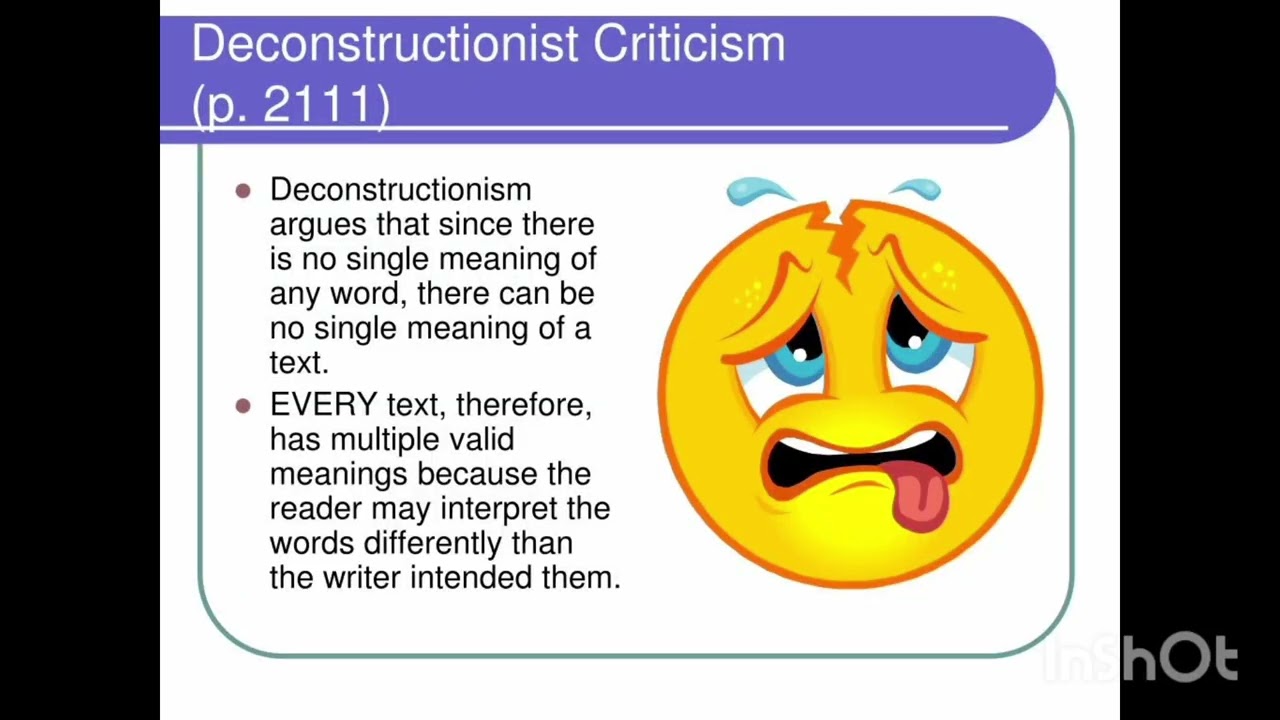
Added:welcome to your new lecture today we are going to look at the origins of criticism in Europe and the formalist movement Russian formalism and also explore some of the early theories of the novel so the early principles of narratology the term literature can refer to the body of oral and written records of a particular culture or community of people it could include any written material such as poetry novel essays etc especially works of imagination characterized by excellence of style and expression and by themes of general or enduring interest the Oxford English Dictionary refers all only to writings but before the expansion of print the printing press much literature was disseminated in the oral tradition that took the form of myths legends and also epic poetry in another one of our lectures you can take a look at the evolution of the oral tradition and myth criticism for centuries the theoretical discussion on literature was related to poetry the words literature and literature have been used in their current sense for barely two centuries it had a completely different meaning for example in dr. Johnson's early dictionary and it is often pointed out that the new term corresponds to a new kind of relationship between the author and the readers literature and literary criticism form a network of relationships that involve not just the authors and critics but also the publishing industry education and even adaptation to other media formats people employed in schools universities education institutions to teach literature not only examine different texts and invite commentary and critical analysis for from students some of these people particularly in the universities are also part of the critical establishment because their jobs also include research and publication which helps in given disability to authors as well as other critics from the late Middle Ages to the 18th century literature predominantly referred to the intellectual property of a person signaling his or her knowledge of letters books and languages this early usage of the term did not include imaginative creative or aesthetic aspects of literature the literate or literary persons where the privileged classes and the social and economic elites the aesthetic aspects of literature began to be emphasized during the Romantic period and a consequence of this was a greater position in of art and literature in terms of beliefs and values of a society in the Western world the teaching of literature and literary criticism is documented as far back as the Greek philosophers both Plato and Aristotle included reflections on the nature of art and literature as forms of representation of reality an awareness of the authors who controls a test and correct correlative Lee implied an inferior an inactive reader a passive receptor who was acted upon by the text and the author from the Aristotelian ideas on catharsis to the search for harmony and equilibrium after the Renaissance didactic our instructional trends to persuade readers in the 1700s or the rise of passionate feelings conveyed by the author in order to share aesthetic and sublime pleasures of imagination with the reader in the 80 in the early 1800s during the Romantic period the history of literary theory shows the changes imposed by all these social cultural shifts early criticism came from mostly philosophy for example Espinoza teleological political treatise from 70s 1670 raised relevant issues regarding the question of interpretive truth or whether literature provides any kind of political knowledge as distinct from its purely aesthetic and imaginative inclinations this inquiries brought Espinosa to be as communicated as a renegade you by the synagogue of Amsterdam in 1656 and his writings thereafter condemned for a saison for dayss suggested that religious truth was a matter of power relations since God's Word was revealed only to a privileged set of individuals who could interpret them and thus authorizing only clerics as interpreters and commentators a claim that was also raised in Christianity by Martin Luther a century before Spinoza so truth figures mainly as a kind of sacred preserve a repository of values inherently resistant to time and change and meaning on the other hand is that which denies all forms of canonical closure all attempts to identify the interpreters role with the faithful handling down of unquestioned self authorizing truths Espinoza's discussion was taken up again in the work of the so called new criticism at the end of the 18th century literature came to mean also the occupation of professional writers and the production of books this idea of professional activity is evident for example in the Godwin family who owned their own bookshop the juvenile library which opened in 1805 and specialized in children's literature and using this literature as means of Education during the Romantic period a time of nation-building the world literature also came to mean a body of writings produced in a particular culture and in a particular period and popular literature such folktales and local legends also began to be seen as part of the literary canon they undergoing a simultaneous nationalization anaesthetise ation during the second half of the 18th century and the beginning of the 19th century the development of a national literature was not free from cultural values since it encapsulated what the romantic term the spirit or Geist of the nation and the age it is during this period that literature became laden with socio-cultural aspects in a big way romantics like William Wordsworth or some more taylor coleridge focused particularly on metrical writings exploring novels and romances as candidates for poetic statues romanticism brought the subjectivity of the poi to the center of critical and theoretical attention personal expression became the goal not only for the spontaneous overflow of powerful feelings as worth worth put it but also for the personal voice of the authors whose influence went beyond their works and as Percy Bysshe Shelley claimed in his defense of poetry they became the acknowledged legislators of the world because of their impact on society through the teaching of literature however contrary to what many critics have signaled this idealist and metaphysical philosophy of art that locates the highest values of aesthetic experience in a real more organic form seeing the poem as a verbal icon a sort of concrete universal did not serve as a pretext for avoiding any question as to the social and material factors bound up with the work of literary production so please refer to the video on actresses and intermediate II and romanticism for a clearer explanation of all these aspects continuing on with this reflection on the evolution of critical theory in the second part of the 19th century the moral and civilizing imperialist strenght of colonial expansion epitomize in the figure of Matthew Arnold and his volume the function of the function of criticism at the present time from 1864 explains the movement of criticism to include prose fiction as part of literature and taking air a movement that took place much later in England than in France and Germany in those countries the spirit of nation-building struggled to construct a Canon that is a list of works which counted as literature and culture of the group earlier even than in England the 20th century however began to see trends which dissented from the so called author centered expressive theory and for example we can see this in the figure of TS Eliot who writing in tradition and the individual talent an essay from 1917 argued that the progress of an artist is a continual self-sacrifice an extension of personality do you have a couple of quotations there from Eliot no poet no artist of any art has it's his complete meaning alone his significance his appreciation is the appreciation of his relation to the dead poets and artists you cannot value him alone you must see him for contrast and comparison among the dead I mean this is a principle of aesthetic not merely historical criticism what happens when a new work of art is created is something that happens simultaneously to all the works of art which preceded it the poet who is aware of this will be aware of great difficulties and responsibilities and another quotation what happens is a continual surrender of himself as he is at the moment to something which is more valuable the progress of an artist is a continual self-sacrifice an extension of personality the remains to define this process of depersonalization and its relation to the sense of tradition it is in this depersonalization that art may set to approach the condition of science Eliot wrote and finally the poet's mind is in fact an acceptable for seizing and storing up numberless feelings phrases images which remain there until all the particles which can unite to form a new compound are present together the interwar modernist period saw the search of propaganda war that made everyone wary of the double meanings hidden in text messages so they were seeking simultaneously to give more autonomy to readers remained in remaining as James Joyce put it behind their work pairing their fingernails you have the quotation there from Joyce's a portrait of the artist as a young mind from 1916 the artists like the god of creation remains within and B or behind or beyond or above his handiwork invisible refined out of existence indifferent pairing his fingernails like Eliot who was close to vision a wolf's father unto her own Bloomsbury group Wolfe thought that you have the quotation there in your screen behind the cotton wool is hidden a partner a pattern that we I mean all human beings are connected with this that the whole work is a work of art that we are part of the work world Hamlet or Beethoven courted is the truth about this vast mass that we call the world but there is no Shakespeare there is no birth oven certainly and empathically there is no God with all the words we are the music we are the thing itself and this is from wolves moments of being so gradually all art forms including literature came to be treated as culture products their analysis approach from different schools and views that we shall explore in this series of webinars and lectures Teague theory can thus be classified according to three major trends a Center on the author the text or the reader in the first half of the century several approaches help understand the nature of discourse and how it functioned in representation disregarding the search of psychoanalysis which focus on the author's impact on his artwork so this lecture is going to explore formalism indeed 20 century literary theory begins with Russian formalism the formalist movement appeared as a pioneer in the analysis of the form of texts rejecting the author's psychological personal and biographical considerations it focus first on poetic language and among the so-called Moscow Sarko which operated between 1914 and 1915 and promoted linguistics and poetics it included a number of members the most important one was roman jakobson and their works were influenced by hustles phenomenology a couple of years later the Society of for the study of poetic language oh boy yes was founded in 1916 in San Petersburg which was then known as Petrograd and after 1924 Leningrad and the group included Boris - bound left Jacobean ski sergej Bank Stein Victor's lava ski jury Tinian off a no sip break they all met at - bounce house and they were also in relation with bloody mean propped who was born in San Petersburg and he was not a member of the group but influenced by their work formalism technical approach to textual processes derives from the discipline of linguistics and it can be linked to so Ciara's Fernan and associates ideas on language the group studied the formal structures that determine the context of literature that is the form and contact together for the formalist the terse the text is regarded as a crafted thing a work of art or artifact stressing the materiality of the literary text and and the significance of the medium and the context of communication formalist criticism was directed at the social level against the decadent bourgeois culture and at the artistic level against French symbolism whose subjective and philosophical conception of art went against the scientific and objective attitude of the formalists after 1924 the opposition to formalism gained strength in Russia in literature and revolution which is published in that year Leon Trotsky did not wholly dismiss the formalist approach but he insisted that the methods of formal analysis were necessary but insufficient because they neglected the social world with which the human beings writing and written literature were bound up so the leaders of for the formalist movement began to suffer some political persecution and Jacqueline Antonov wrote defenses of formalism in 1928 to summarize the fundamental positions and but eventually the group had to move to to Prague to the Czech now the Czech Republic so Jacobsen left Moscow in 1920 and he in 1926 he established the Prague linguistic circle and this group worked in Prague until 1939 when with the onset of World War two Jacobson had to relocate later himself and Nikolay true bits coy and as well as Rene wellick they all moved to the u.s. United States because of their Jewish background so Jacobsen escaped from Prague via Berlin and then Denmark where he became associated with the copenhagen linguistic circle including intellectuals such as louis homeless lev as the war advanced West Jacobsen was smuggled into Norway in a coffin with his wife when Swedish colleagues feared for a possible German occupation Jacobsen managed to leave on a private yacht to work together with parents Casilla former rector of Hamburg University and they landed in New York City became part of a wider community there of intellectual em egress in 1949 Jacobson moved to Harvard University where he remained until his retirement in this last decade he maintained an office at the Massachusetts integer of Institute of Technology as well where he was made honorary professor emeritus formalist conceived literature as an autonomous and specific domain characterized by what Jacobsen term they literary their main objective was to discover the features of the literary the only type of text capable of creating aesthetic effects Jacobsen pronounced the poetic function of language that is the property that makes literature literary consisting in a set of aspects relating objects and sign signs within the message for by message Jacobsen means the form of the language of the text phonological graph illogical cinta syntactic and semantic rather than the communicated aspects or content so the focus on textual form is achieved by a high level of structure ation and concentration on the rhetorical techniques which according to Slavs key increased the difficulty and length of perception Slavs key also offer that any new work does not arise to spread something new but to replace the previous one that has lost its aesthetic attitude this assertion open the way to perceiving works of art according to their interrelationships however for the formalists theory and history are linked together in a union where works attempt to replace previous productions so it was Mihiel bactine who would explain that it may not have been entirely a replacement but a dialogue among different voices giving rise to the concept of intertextuality later and we shall have lecture and webinar lecture dedicated specifically to Bakhtin's work which was very very influential in Slava's keys ese art as device from 1917 he could which is considered a manifesto of formalism he developed the notion of the literary work as a dynamic system of correlation correlations among elements one of which become became dominant among others all the others accompanied this dominant and intensified through harmony and heightening it through contrast with including a number of variations that play within the dominant so this notion was later developed by Jacobson in a lecture entitled the dominant in 1935 linked to the notion of party fees Slav ski also develops the idea that art refers to a form of deep automation literature he points out like language works by surprise by substituting a beetle autumn eyes perceptions shifting expectations and thus destroying the automatism of everyday perception according to him art has the unique capacity to bring to life or reanimate the everyday world made invisible by habit line quoting from his work art as device after being perceived several times objects acquire the status of recognition an object appears before us we know it is there because we do not see it and for that reason we can say nothing about it in this complex net of human memories recognition is the key word that with the right aesthetic devices allows us to see the world anew again to experience it perceptually so art is a device that touches us effectively and allows the stone become stony as the as Trotsky famously put it for the Russian formalist critic the purpose of art is to give a sensation of the object as vision and not as recognition the procedures of art are that of the singular ization of objects and that that from which consists in obscuring the form in increasing and increasing the difficulty and duration of perception slav ski asserts that art is thinking in images and that these images are relatively static crossing history without change he says he adds that images are almost like essences that belonged to no one I said perhaps to God and he says that the more you tried to explain a network the more you are convinced that these images you thought were created by a given poet where in reality passed on to him by others without hardly a change he says that images are basic units possibly invariant because of the physical limitations of human perception and cognition so this his Stan his it's very similar to metaphor conceptual metaphor studies nowadays and aesthetics for sloths ski is the use of identifiable techniques manipulations of language that cumulative Lee produced the work word and he calls this a device and and the device for making for creating these awareness it's called the familiarization in Russian astronomy which means to make a strange so the familiarization it's a is the crucial way in which literary language distinguish itself from ordinary communicative language and it's a feature of how art presents the world as a strange and new in order to allow us allow us to see things differently so his argument reveals Australia knee not just as a device but also possibly as a consequence of our device because he illustrates his theory with an example from Tolstoy that focuses on linguistic substitution of a verb with literal description of activity engine injecting a bizarre character into the narrative as we mentioned repetition that is the spirits within time is necessary for perception to become both a batoul and automatic automatic recognition for scoffs key is an algebraic method of thinking in which objects are grasp especially the delayed perception produced by art reverses this process and I'm quoting from art of as device the object is perceived not despite especially but as it were in a temporal continuity so through our the spatial becomes the temporal and recognition returns to vision he claims so the life of a poem and of an artistic artifact artifact proceeds from proceeds from vision to recognition from from poetry to prose from the concrete to the general his planes as the work of art dies it becomes broader he says so scoffs key description of the transformation of artistic devices from perception to recognition moves first linearly at the level of individual memory only to transcend to a broader interpretive nonlinear a scenario another level where using the cyma of poetry or music he claims and I quote we're dealing here not so much with a more complex rhythm as with a disruption of rhythm itself a violation we may add that never be predicted so this unexpected break takes the notion of the device from the linearity in linearity of perspective of vision to the oriole oral aural temporal dimension of simultaneously and the this the dimension of sound where the leap to another fractal level of representation its aids according to slots key possible so they clearly the notion of astronomy is related not just the conditions in which perception moves beyond automatic recognition but to the aesthetic devices that enabled the flight of the mind that is the possibility of transcendence they conduct a contingent by playing in nonlinear scales of simultaneously and this is precisely what the oven guards and modernism original of James Joyce and the pictorial oven guards in the 20th century were exploring so for Slav ski oscillation between astronomy has divided us as phenomenon it's similar to the use of metaphor and metonymy and signaling a powerful semiotic tool that seeks to trust and spacious despite special levels two temporal frameworks by assuming specific and even mutant instance Asians and we shall see later how Jacobsen also connects the question of metaphor and metonymy which is one of the crucial aspects in contemporary research of on conceptual metaphor for example the work of Laco Van Johnson from the 1980s well in the in the next slides I want to open an example of how she loves his account of the device enables to post questions about for example micro narratives on micro fiction and you can see on your screen a number of short fiction pieces and written by very well-known authors and I'm going to do a I'm not gonna read the pieces but I'm gonna do a sort of an analysis applying formalists theory to particularly the idea of strange man know to to the pieces so so in the case of short narratives the oral tradition can be considered like the primal seal is seen of these minimal forms of technologies of memory and this short narratives can be seen as devices designed to capture both attention and recollection as kernels of information and my argument is that short fiction is a node in which the oral and the visual remember that slavs key was focusing on this distinction that a temporal distinction between the aural and visual this cultural network of memory and language act as a strategic narrative both in its instability and in an in-between fact fictional function data tends to capture attention and reduce a to a mental image so sure micro fiction can be considered a device destined to be memorized and recollected in its spatial limitations know as Derrida would Jack Derrida would explain Micra fiction can claim a presence that actually masks and evokes a loss because a lot of it of the meaning is not income so encapsulated in what it is said but in what it is implied so the central task of short fiction fiction and would be to summon up a world and make it vivid to its audiences in a very synthetic form so micro fiction can be understood as a device that draws attention to the paradox of claiming presence out of a sign of absence on your screen another piece by ray bradbury another example of micro fiction and my reflection is that micro fiction frameworks and do away with temporal structures present in longer narrative forms and this reduction produces an articulated silence a gap at the heart of this story for example in these micro narratives conflict is minima minimalize and characters are also as if suspended in times and become signs of the unnamed and unnameable spectral presence which largely behaved young the spatial finitude of the readable text they are like cost no so in the internal time in a micro fiction and that is the links between the narrative situations presented and it's almost obliterated its external time and and this we will explore in another webinar Jeannette and REM Paul Rico theories on time and narrative so the sternal time forges links between the text and the cultural situation it represents and it's activated only on the surface of micro fiction so there is a temporal gap between these internal time and external times that enables a kind of poetic rhythm that deals and ghostly trace and behind the apparent simplicity and transparency of the economy of the micro structure this void opens to the reader in the form of spiritual interpretations to this paradoxically absence which in fact is saturated with plenitude so the birth of micro fiction and short fiction is really a ghost story so I wanted to include this little example to give you an idea of how formalist concepts can be applied to a very in this case a very short piece of criticism now regarding short fiction or micro fiction so all these temporal aspects that drop cloths case artists device presents and will be expanded in reception theory by German philosophers hans-georg gadamer Robert Giles and others in the school of Constanza as well as in Italy by Umberto Eco and also in the construction as I have mentioned Derrida but in the construction these temporal gaps and aesthetic distance are also a very important aspects and it's also they are also explore bipolar man's theories of irony and we will explore these in other webinars so continuing with the formalist school alongside clusky roman jakobson developed techniques for the analysis of sound systems in the different languages and inaugurated the discipline of phonology Jacobsen went on to apply these same techniques to the analysis of syntax and morphology and controversially proposed that they could be extended to semantics which is their study of meaning in language drawing on insights from semiotician Harvard Samuel Titian trusts under purse as well as from communication theory some proposed methods for the investigation of poetry music the visual arts and cinema and he also had decides very important influence on claude lévi-strauss and roland barthes among others no lévi-strauss and we have talked about him in the webinar lecture on myth criticism and roller Bart rollin Bart's it's also the topic of another lecture on semiotics okay so Jacobsen became a pivotal figure in the adaptation of a structural analysis to disciplines beyond linguistics for example he theorized their relationship between metaphor and metonymy and that would would be later expanded to Studies on concept or metaphor and this relationship between metaphor and metonymy was also present in Freudian theory linked in metaphor to [Music] Association and metonymy to displacement sorry so for Jacobsen metaphor is substitution of one with something similar and and metonymy is the replacement of one with something close and by no so in metal we have like our relation of similarity and in metonymy we have our relation of contiguity okay so these are very important concepts as I said in conceptual method for theories that we will try to explore also in other webinars and also in psychology as I said finally on your screen you have the community communicative functions that Jacobson established the referential function which allows contextual information the aesthetic function or poetic function which is Auto reflective the emotive function which functions as self-expression the conative function which is evocative or imperative addressing of the receiver the Phatak which is related to the channel and the metalingual which relates to the code at work in the communication process so the last figure to mention among the formalist is Rena valack in and he emigrated to the states teaching first at the University of Iowa and then later at Yale University and in 1942 with an American Austin Warren relic published a landmark volume which is entitled theory of legend literature and it's one of the first works that tried to synthesize a literary theory in the 1960s Valek became associated to the school of known as new criticism or the Chicago School and even though he always emphasized the importance of interpretation in literary criticism and he was not he was impatient with purely textual and empirical approaches to literary scholarship which is the trend that the new critics emphasize as we will see in another lecture so in what follows am I'm going to focus on and the impact of formalism and on the theories of narrative and first I'm going to explore a little bit about Russian formalism and later I'm going to concentrate on different authors coming from the anglo-saxon schools so theories of narrative feature prominently in Russian formalism specifically the distinction between story and plot this was not of course new in the theory of literature and the distinction goes back at least to Aristotle for whom the plot which he turned mythos was the arrangement of incidents and it was clearly different to this story on which it was based so that at the time of sequence of events in Greek tragedy for example is clearly different to that of the events it relates so usually tragedies start with a report of what happened before and then the audience is plunked into the middle of events and what it was called meteor rest and with occasional references back to earlier stages in the story so formalist Boris Tamar yes key develop further I am a concept that loved skiing had first formulated in in an essay on in which he studied English author Lawrence's turn and his novel tristram shandy so the basic material of the story was turned fabula and tamari s key contrasts this with Sue's yet the that is the story as it is actually taught so one fabula can provide material for many Suzette an ocean an ocean which was taken up by later formalist and was also to provide a link with structuralism Timaeus key also contributed with his study on motivation our relationship that allows the motives to be united and and these are minimal units of thematic material so this notion of motivation was able to link the concept of fabula as the result of considering the motives in chronological succession and maintaining a logical cause effect while Sujit it was the setting of the same motives but arranged respecting the order that they follow in the work in the way in the composition so the English author TM foster also saw the need to difference differentiate between plot which refers to the Kassel relationship between the facts to produce a desire static effect and the story the narration of the facts considers simply interpret in temporal sequence so the formalist distinctions are not essentially are a formulation of Aristotelian concepts because the formalists conceived the effects and purposes of suja differently to those of Aristotle's mythos so for example at is total plot had to be plausible it had to have a degree of inevitability and provide insight into the human condition however for Russian formalist on the other hand the function of plot was to D familiarize what we are observing to make us aware of the artificiality of the process of literary creation so the formalist also had an idiosyncratic notion of motivation using the concept not for with the meaning of intention or purpose but in relation to this structural concept of motive Timaeus ski was one of those to elucidate their distinction so the theme is the central meaning of the story and to give you an example in Frankenstein the theme is humanity's scientific and technological hubris leading to destruction a motif is a repeated narrative element that supports the theme of the story and it serves to support through recording aspects that enhance the narrative so the motive is a unit of construction it's the smallest unit of a plot so Tom I have Sookie distinguish between bound and free motives a bound motif is needed for the original story for example the dialogue between Walton and Victor Frankenstein at the beginning of Mauritius Mary Shelley's novel but a free motive is not necessary in the same way because it is part of the artifice of the work for example Mary's decision to set this scene as part of a diary and a series of letters at the beginning of her novel so Timaeus key argued that awareness of the distinction between bound and free motives was necessary because when an unfamiliar device or free motives is included it serves for a while to make us aware of the artificiality of the text but eventually it it too becomes familiar and therefore conventional so for example when playing with time sequences became the norm both in literature and in cinema in the 20th century then this device could no longer have the familiarizing effect so the link between formalism and modernism is worth exploring there are very many connection between Regina Wolf's fiction or James Joyce and Thomas Mann all of whom explore the question of time and temporality and their relationship as applied to narrative sequences I'm on the formalist is also important to mention Vladimir Propp he was not member of the formalist circus but he developed his critical theory in parallel with the formalists his morphology of the folktale from 1928 studies a corpus of 100 Russian stories to make a topology of the description of the events and the agents that carry out the actions and he looks for thematic units that are repeated in the works at the level of fabula not of sujet so propping him to use the same function when referring to the essential reasons those that had the same function and a distinction later used by a structuralist like Algirdas gray mass so prose a prop reduced to 31 functions all the possible alternatives of actions that the characters could perform considering that there are absences of functions in some stories and repetitions in other stories he discovered that it was possible to speak of certain constant constants and he called basic actions and an of certain variables which were usually the names of the characters the places were the action took place and so on so his final analysis proposes that it is possible to go back to a hypothetical primary narrative a tale from which all the other tales originated and this idea will inspire a also anthropologist Claude lévi-strauss psychologist Carl Jung and mythologist Joseph Campbell so in this regard please refer to the webinar lecture on myth criticism to expand knowledge on this topic so prop notices that the author is free to use certain aspects who does the action how does he do it but that authors are almost imposed by the logic of actions so that creative freedom depends to some extent on the initial situation that is taking place in the genesis of the story so prop offers in addition to the sink dogmatic perspective linking the functions paradigmatic one that attends to the distribution of functions among the characters in this way his thirty-one functions are divided into seven octants or agents he considers them as categories but without individuality so for example the aggressor or evildoer the donor or the one that gives a magical object to the main character or hero they axillary someone who helps the hero the princess the character that it's the hero's seeking to rescue the loop ruler who sends the hero the falls hero or imposter also opponent so prop concludes that the four tail is built from fixed schemes passed on down from generation to generation many of the tests by the Russian formalists were only disclosed in translation in the Cistus by Vuitton Todorov and julia kristeva the distinction between fable and plot is picked up by Todorov himself who speaks of history and discourse a term also proposed by a middle van Vista in his field of linguistics and as we will explore in another webinar lecture Roland Barthes distinguishes three levels of description in narrative work that of functions dead of actions and that of narration we will see about this also work by Jarrell Jeannette it's interesting in that speaks of history narrative and narration and it also refers to the producing narrative act and by extension to the whole of the real or fictitious situation in which it occurs so next we're going to talk about the English critical tradition and see the evaluation until the 60s from the early 20th century until the sixties in this webinar and there'll be another webinar specializing in otology which will focus on new theories coming after day 70s or so so the English critical tradition can be said to start with the romantics as well as with Matthew Arnold who was writing later in the 19th century in the early 20th century american-born writer Henry James who was following English writers Walter Scott Charles Dickens George Eliot and also a French and Russian artists like balisok choose to genève Hawthorne in the United States and developed some interesting alternatives to the formalist critical tradition so James was the second son of distinguished family an American family his elder brother was the philosopher and psychologist Henry William James and Henry James moved to Europe and settle in England and became a British subject in 1915 and he's considered one of the fourth forefathers of modernism he is heir to the pragma pragmatism prevalent in America in the early years of the 20th century for example work by semiotician choice under pers and he was also a passionate critic dedicated to the exploitation of the Dai Li of introducing technique without sacrificing subject matter Henry James the art of fiction which it was published in 1884 is a fundamental piece on narrative theory as well as a response to Walter Walter Besant the art of fiction which was published the same year James affirmed that a novel is in its broadest definition a personal a direct impression of life that to begin with constitute its value which is greater or less according to the intensity of the impression this is a quote from him his great technical contribution to the novel was the development of the point of view James directed the novel away from and the traditional emphasis on plot which derive from epic and Rama's antecedents and regarded character and not plot as central so the emphasis on point of view is very important and he modified the traditional omniscient narrator of Victorian fiction so for James the aim of the novel is to represent life but this process involves art and imagination and the producer and audience creating what he called the atmosphere and you have a quotation from James there the power to guess the unseen from the scene they trace the implication of things to judge the whole piece by the pattern the condition of feeling life in general so completely that you are well on your way to know in any particular corner of it this cluster of gifts may almost be said to constitute experience and they occur in country and in town and in the most deferring stages of Education so James emphasized three concepts the dramatized consciousness of the individual character his emotional and moral life a subject the author's great creative transformation of art into life and the importance of arising arousing and maintaining the readers interest in his text he creates an ideal reader with a double consciousness involving curiosity but also detachment and James achieves this through the manipulation of voices and point of view as well as by an imaginary that engages the reader while maintaining ideological control of his tests in which he exposes diverse forms of social domination which is his mayor theme amongst James most powerful devices are the silences and elisions suppressions also gesture or actions whose significance becomes clear in the context of slovsky's notion of defamiliarization so an example of this is for example his novella the turn of the screw which was published in 1898 and it shows an obsessive intensity of conveying through the conveyed through the first-person narration and by the events of the plot that multiply the supernatural and the psychological readings many of James works investigate knowledge and its limitations through the movement of the novel form and also celebrate life especially through through art now James technique is to introduce an economical way a condensed situation in the opening pages of his stories combining accuracy with brevity so every aspect of the network of relations then is made to work towards compression his scenes are very brilliantly compacted rather than an extended account of events James uses direct speech to create a theatrical tableau that includes various forms of varial verbal suppression he modulates point of view by using the description of the author wall as seen through the eyes of the characters thus introducing a sort of doubtful credibility and vivid but Confused inner consciousness so he's building streets and sometimes the claustrophobic cities of his texts are also heirs to Dickens's tradition he uses rhythm in his sentences concatenation of images disruption of sequences in order to convey what for his protagonist is inevitably an inexplicably vivid the wanderings and buffle Ness of the characters map out their inner worlds intrigues fears corruptions fatal illnesses there are secrets made known only to the reader building out building an anticipation of and knowledge of the protagonist but the characters are still seeking this knowledge there is an ambiguity of apprehension in the characters and this alerts the reader that then of the dangers beneath the apparent surface of the story so in particular James makes clear that knowledge is associated with fear so he balances moments of Revelation with hints that signal deeper truths inaccessible in in words of the of the novel and this ellipses of knowledge are left to the reader to be imaginatively constructed another writer who also reflects on aspects of Naruto Logie is Ian Foster and his volume aspects of the novel published in 1927 informed by his own experience he foster writes in two traditions the humanistic tradition which includes components of nominalism utilitarianism admiration for realism and the prophetic tradition which has its origin in mplet onic and also studies on the bible and since art as an alternative to to the world and to as a form of intensification of reality so in the first tradition we find Aris total Horrors my few are no Henry James in the second we find William Blake Shelley's Walter pattern Oscar Wilde WB Yeats D H Lawrence and foster himself so he tries to do justice to both traditions in this volume and in the first chapters he focuses and story people on plot voicing the first tradition and in the later chapters which begin with fantasy and they become the aspects of the second tradition become more pronounced also in another chapter called prophecy pattern and rhythm Foster's book and was a response to Henry James critical legacy which argued for the importance of importance of point of view as we have mentioned but Forster beliefs that point of view is over stressed and that one must pay attention to characterization in the district in the distinction between flat and wrong characters so he proposed that flat characters can be summarized in a single face phrase and and they are caricatures and that correct round characters are complex and and there is ample real people so you have a quotation there from foster the test of a round character is whether it's capable of surprising in a convincing way and it has the in calculability of life about it live with within the pages of a book so like other major modernist Konrad Lorenz Joyce wolf foster understood that human character is continuously changing it's a flux of experience rather than an essence depicted in traditional realistic novel of manners static no consequently in his novels he sought to dramatize states of mind as at crucial moments in the in the plot by stressing and the primacy of character over plot and rejecting at the same time Henry James emphasis on point of view Forster continued the movement away from traditional stress on plot fr leavis the great tradition from in 1948 is another landmark in the study of narratology between 1932 and 1953 livers had been an editor to the scholarly journal scrutiny and the journal sought to bring the Academy were the academic world closer to the social world by a certain and influence on education and the universities and like Matthew Arno levers believed that the study of English literature could play a mayor role in in social life and that the present of literary criticism not just in philosophy it should contribute to the development of public to critical consciousness so the great tradition starts with a chapter on Henry James and includes a reprint of some of leiva's essays published in the journal scrutiny Livas stresses that literature is not merely an extension of life but that its raw material it's taken from reality but then a fiction imposes a set of organizing principles upon life and he uses the terms essential organization organization of vital interest intensely a significant organization and so on he insists that great novelists are concerned with form an organization so like Henry James leavers prefers to prefer stuck on the concrete to the abstract dramatic movement moments dialogue dialogue two narrators telling and and he also prefers realism first and foremost he explains that the work must dramatize its values by means of concreteness and particularities of situations all responses to a situation so concreteness it's according to levers that derive from a dramatic moment and and Levy's was also unsympathetic to the feminist movement and attacked Virginia Woolf's polemic volume three guineas he was accused of narrowness by authors like George Orwell who compared him in his last review for the observer written in 1949 with our tyrannical schoolmaster because of his resistance to include avant-garde experimentation in the great cannon and Tolkien was also very critical with latest approach among the female critics we could mention Dorothy fan Gant they whose volume the English novel form and function from 1953 had a profound impact on the teaching of English novel in in Britain she understands the novel as a human experience and argues that each novel should be studied within its physical and cultural context as a specific time and place she was primarily concerned with moral values of art and how literature can affect the quality of one's moral life so for her literary form is the moral shape imposed upon characteristic events that make up narrative the quotation from her work you have on your screen the form of the book is the content the form is the book itself when she insisted we cannot dissociate the author s conception of life and its value and significant from the aesthetic structure of the literary work another important book on critical theory is any higher bar mimesis from 1953 and it focuses on the way imaginative literature imitates and reflects reality including the culture in which it was written so Oliver subject is as he puts it and I quote the history of the literary treatment of reality so for Oliver and art is about something other than art the writing of novels or the investigation into how long which means the German critics is interested not only in how people behave and in what people believe but in what historical forces in what historical forces shape behavior and belief so the artist for him should establish a compelling link between individual events or relationships in a specific social and economic media I as a response to historical forces so mimesis inquires into the style that the author uses to present his interpretation of reality like Mihiel bakhtin and Giambattista Vico before him Yaba assumes that language is the repository of cultural history Auerbach begins mimesis by differentiating between two major traditions of narrative presentation they Oh medic or classical which depends on earthly relations of place time and costs and the biblical one which depends on vertical connections are standing from all that happens converging into God so in the America literature details are scrupulously externalized visible and palpable in all their parts and completely fixed in their spatial and temporal relations by contrast the story of Abraham's sacrifice of isaq in the Old Testament focuses on inner experiences that allegorical re bodily signifies something else so or your back regards modern realism as the integration of these two impulses the classical one that Amita is reality by crystallizing a culture and the biblical one that seeks to render historical process into our teleology or organizing principle and you have on your screen several quotes from oil / mimesis which specifically refer to what i have just mentioned coming now to the 60s the rhetoric of fiction by weighing both differentiate between poetics the study of what the work is what it has been made to be and rhetoric but the work is made to do so both rights that the kind of actions authors perform on readers differ markedly those substantively from the kinds of imitation of objects that are seen as making in the poetic mode so his planes that autonomous texts derive from conscious and unconscious decisions made by the author to shape the readers response so booth insists that the an author affects the reader as the author intends and communicates human emotions and values to an audience so the reader in turn responds to the felt presence of a human voice within the text so although when booth was not a follower of the chicago school of criticism the new critics and he criticized the use of the term house of fiction which was borrowed by this school from Henry James he applied the concept to the idea of the self dramatized in narrator as the basis for inquiries into irony tension and ambiguity however unlike the new critics booth and was concerned with the art of communicating with readers not concentrating only on the text so he thought that it was possible to find out the rhetorical resources and available to the writer which could be used consciously honest or unconsciously in order to impose a fictional world upon the reader so in a way he returned to Aristotle's concept of Poisson sees as a dynamic non-static effect of the text like levers and others both believed that reading literature helps people achieve critical consciousness makes them better people by providing them with values by rhetoric the title that gives that appears in his rhetoric of fiction and by rhetoric both means both how books communicate with readers and specifically how books Arai arouse and interests in the readers about issues and the characters in the imagined imaginary words that affect us morally so one of his major legacies is the distinction between reliable and unreliable narrators and you have a quotation there I have called narrator reliable when he speaks for or acts in accordance with the norms of the work which is to say they implied author norms and unreliable when he does not so for both reliabilities in itself of value the art of construction reliable narrators is largely that of mastering all of oneself in order to project the persona the second self that really belongs in the book so the function of reliable commentary is to shape the beliefs of the reader and in part convince him or her that the material is morally significant so to finish this lecture I would like to mention very briefly franker modes the sense of an ending studies in the theory of fiction 1967 Kermode focuses on the role of the real reader in giving meaning to literary texts and criticizes formalism and new criticism for their only emphasis on the form of the text although he understands the novel as a self-enclosed effective universe with its own cosmology and energy ography he turns it a biblio cosmos her mood focuses on temporal aspects on how in modernism time is fundamental but it's converted into a space and he claims that this temporal present perception of represented space followed scientific advances at the time for example Einstein's theory of relativity is crucial in Finnegan's Wake the last novel written by James Joyce now on your screen a quotation from Kermode talking about Sartre where he says that Sartre himself explained it provides a more inclusive formula when he says that the final aim of art is to reclaim the world by revealing it as it is but as if it had its own source of human Liberty so this statement according to karma does two things first it links the fictions of art with those of living and choosing and secondly it means that the the humanizing of the worlds contingency can not be achieved without a representation of that contingency this representation must be such that it induces the proper sense of horror at the utter difference the utter shapelessness the utter inhumanity of what must be humanized so the term contingency here refers to a future event or circumstance which is possible but cannot be predicted with certainty so contingency refers to the relationship between the internal and the external environmental organizations and it's a crucial concept in dynamic Systems Theory also known as chaos theories which we shall explore in another webinar so thank you very much for your attention you
Up Next
Understanding Unreliable Narrators in Storytelling
@OverlySarcasticProductions
852K views•2023-07-28

Formalism in Literary Criticism: An Academic Lecture Overview
@mattalberhasky9952
39.1K views•2015-08-05

Point of View in Fiction: First Person vs. Third Person
@magicalthriftyteacher
153.8K views•2014-03-31

1984: Orwell's Dystopian World and the Mechanisms of Totalitarianism
@AlternateHistoryHub
7M views•2017-03-04
Related Study Plans & Knowledge Roadmaps
Structured learning paths in Literature