The Sidewinder rattlesnake's unique dual-wave body movement—where horizontal and vertical waves interact to determine which body segments advance while others remain anchored—allows it to ascend steep sandy slopes by increasing the proportion of its body in contact with the sand; this biological principle was applied to improve robotic snake locomotion on inclined surfaces.
Sidewinder Robot Mimics Snake Sand Climbing Technique
Added:Deep Dive
The fundamental principles of biomimicry, where engineering designs are directly inspired by biological systems.

Biomimicry: wat kunnen ontwerpers leren van de natuur?
1.1K
Key principles for biomimicry include: (1) looking for patterns across unrelated species and differences within closely related species, (2) isolating specific properties rather than copying overall form, (3) considering scaling effects since natural solutions work differently at different scales, and (4) recognizing that nature's solutions may not always be simpler than human-engineered alternatives.
Click to watch →
Developing Ecological Citizens
242
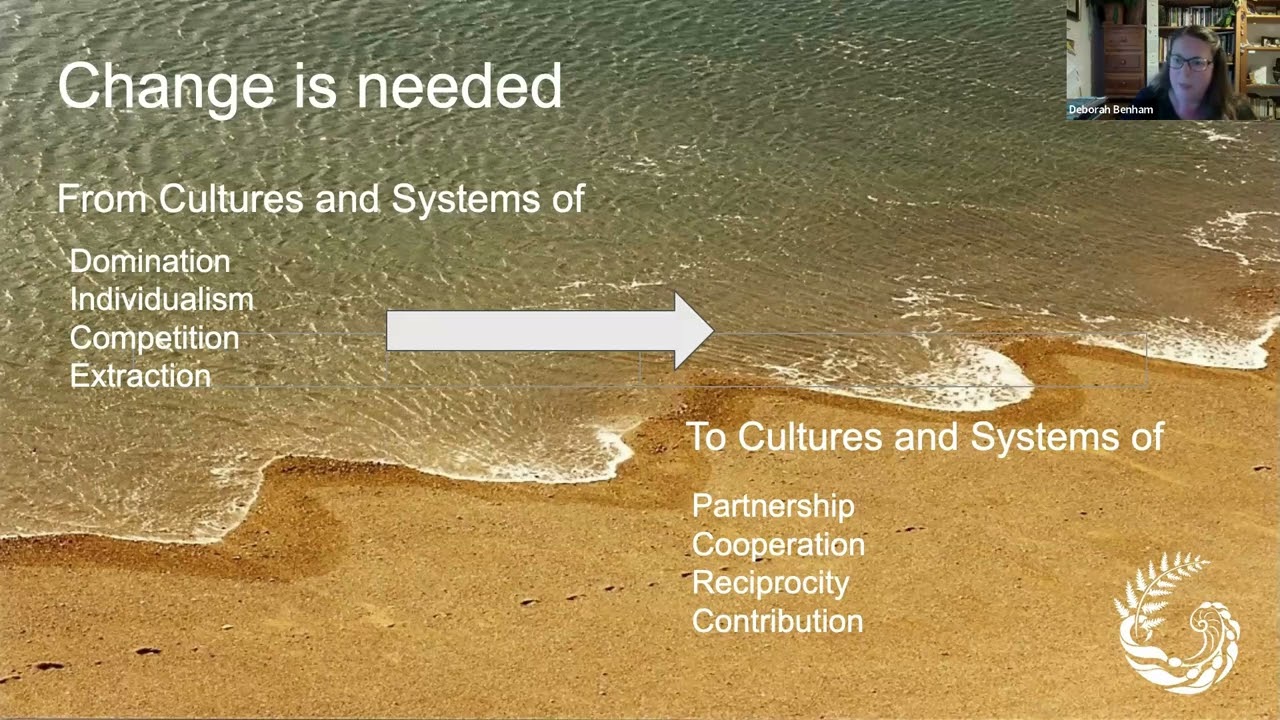
Over 20 years, biomimicry practitioners have developed 26 living systems principles derived from nature's problem-solving strategies. Key principles include: be locally tuned and responsive, leverage cyclic processes, use readily available materials and energy, cultivate cooperative relationships, be resource efficient, use low energy processes, recycle materials (nothing is waste), adapt to changing conditions, incorporate diversity, embody resilience through variation and decentralization, build from the bottom up, self-organize, and combine small modules into nested fractals. These principles provide a foundation for applying biomimicry in ways that support life to thrive, distinguishing it from mere biomimetics or copying without understanding.
Click to watch →

Грановская. Кишечник, БАДЫ, долголетие. Секреты организма от профессора молекулярной биологии.
450K
Biomimicry involves learning from nature to solve human problems. An architect designing a mall in Africa with extreme temperature variations studied termites, which maintain stable temperatures in their nests through sophisticated ventilation systems. The iridescent colors of butterfly wings are not due to pigments but to the physical structure of wing scales that manipulate light through refraction and interference. Microtubules, cellular structures that function as tracks for transporting molecules, create materials that are simultaneously ultra-thin, ultra-light, and ultra-strong when arranged in specific grid patterns.
Click to watch →

Asking Nature for Inspiration | Jacquelyn Nagel | TEDxCharleston
2.5K
Biomimicry is the practice of learning fundamental principles from nature and applying them to solve engineering problems, rather than simply copying surface-level features; this approach involves understanding both the physical aspects (forms, architectures, materials) and non-physical aspects (functions, processes, system interconnections) of biological systems, and connecting these insights across different domains of knowledge to create innovative solutions.
Click to watch →
Blaze and the Monster Machines | ⭕️ Você pode ajudar Blaze? Parte 2 ⭕️ | Nick Jr. em Português
3.1M
This segment teaches engineering design principles and biomimicry. Engineers are scientists who design solutions to problems. To create a more powerful bow and arrow, engineers design a larger, more flexible bow (limbo) with a strong cord and large suction cup arrow. Trajectory adjustment is demonstrated—when projectiles miss targets, aim should be adjusted higher or lower. Projecting solutions involves imagining ways to solve problems and building them. Nature-inspired designs solve engineering challenges: ankylosaurus tails (strong, effective for knocking down rocks) inspire a tail mechanism using a drag cable and heavy metal weight. T-Rex jaws inspire powerful mechanisms using hydraulic arms and demolition claws. The segment demonstrates counting objects (2, 3, 5 rocks) and testing designs through repeated attempts.
Click to watch →
Deep Dive
Basic concepts of terramechanics and granular materials, specifically how shifting media like sand behave under applied force.
The puzzling physics of sand
8.3K
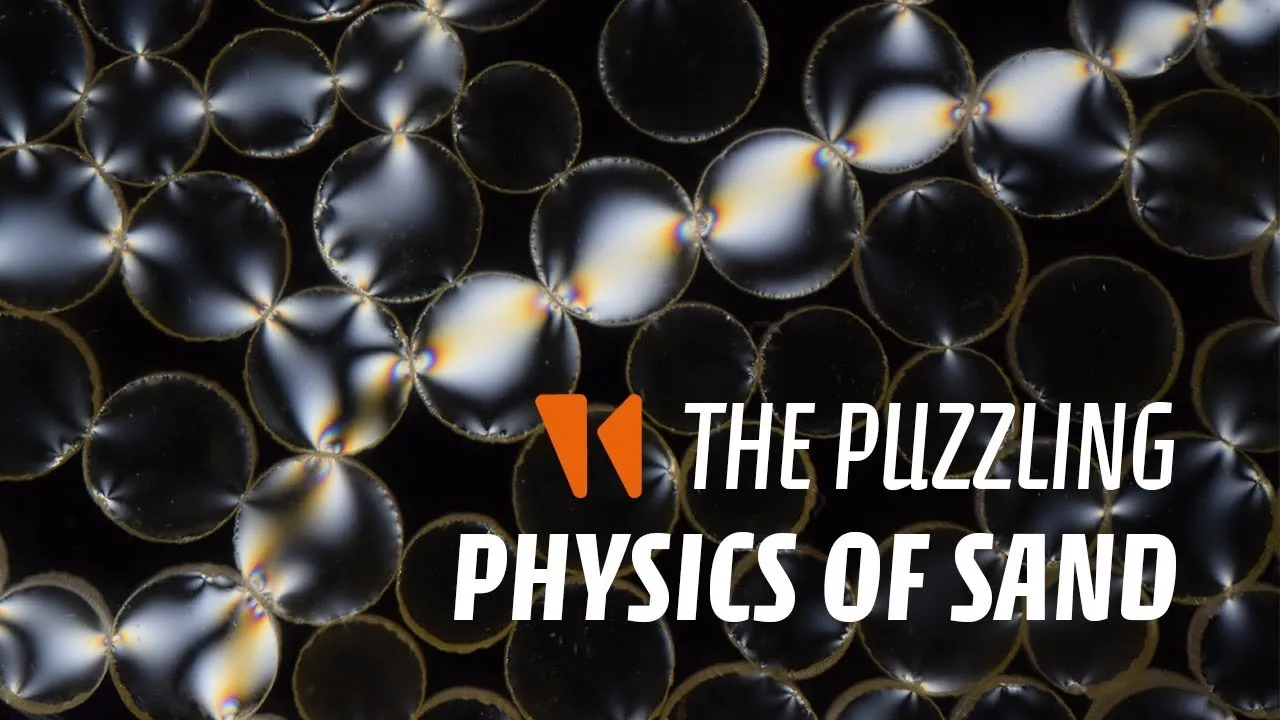
Sand exhibits paradoxical properties that defy simple classification as either solid or liquid; it flows like a liquid due to intermittent cluster movement and lacks surface tension, yet forms stable structures through force chains and arches that transmit forces through compression, and paradoxically expands (dilates) when compressed rather than contracting, making it a unique granular material where both grains and voids must be considered together to understand its complex physics.
Click to watch →

Este material se expande al presionarlo
745.4K
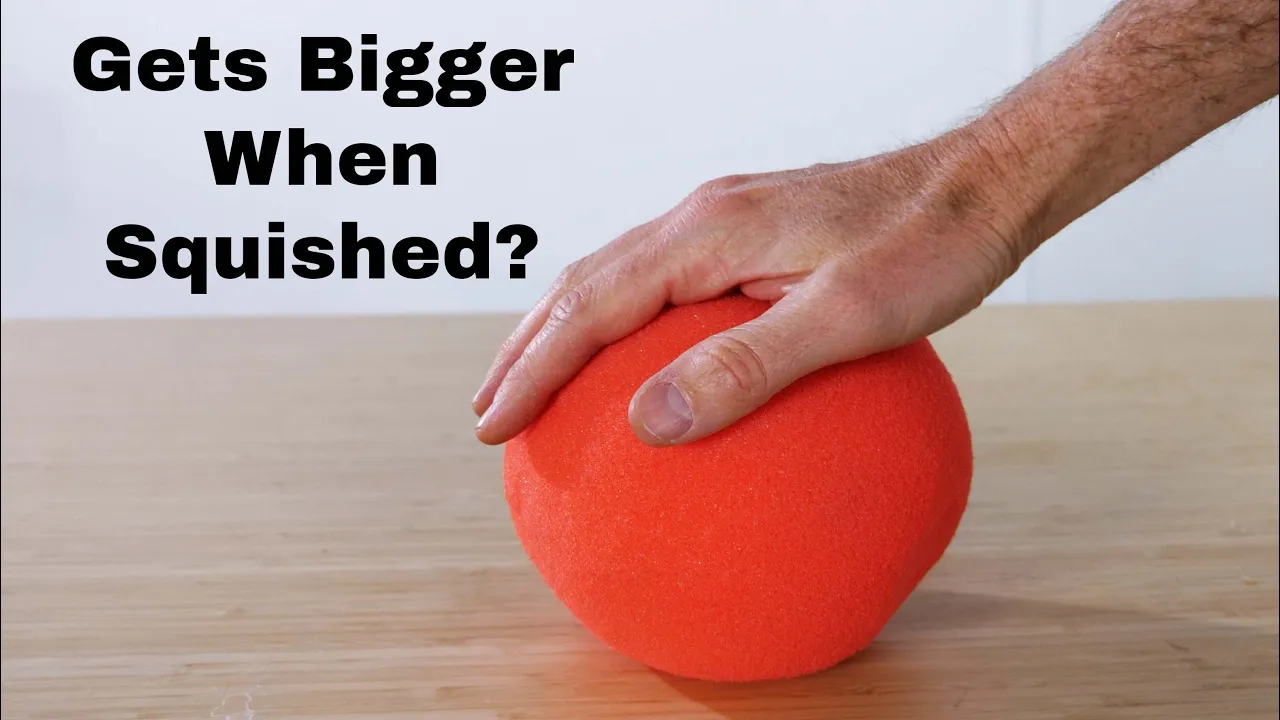
When granular materials like sand are compressed, their particles rearrange and create new voids, causing the overall volume to increase and drawing in surrounding fluids like water.
Click to watch →
This Material Gets Bigger When You Squish It
2.3M
This segment explores the scientific mechanisms behind dilatancy and its practical implications. When shear force is applied to wet sand, particles shift and create new gaps, increasing total volume. The relationship between applied force and sand volume follows a non-linear curve—light pressure may pack particles tighter while heavy pressure causes expansion. Engineers must account for these properties when designing infrastructure like tunnels, roads, and skyscrapers. In earthquake-prone areas, sandy ground can suddenly expand during shaking, pulling water into gaps and causing liquefaction when settling resumes, demonstrating how granular materials exhibit behaviors neither purely solid nor purely liquid.
Click to watch →

La friction granulaire ou comment bâtir sur le sable
1.1K
Granular materials like sand or grains can transition between solid and fluid states based on applied forces and internal friction; this transition is governed by the angle of repose (around 27-30° for typical granular materials) and the Mohr-Coulomb failure criterion, which predicts that materials will fail along specific planes when the ratio of tangential to normal stress exceeds their internal friction coefficient, explaining phenomena from sand pile formation to earthquake fault behavior.
Click to watch →

The Science of Magic: Tress of the Emerald Sea w/ @MarkRober
273.6K
Fluidization is a process where granular materials like sand behave like liquids when air is forced upward through them. The key principle is density: objects less dense than the sand-air mixture will float, while denser objects sink. This phenomenon scales from desktop demonstrations to larger applications like hot tubs. Aerated water similarly reduces density, which is why diving competitions use bubble-filled water for softer landings. For a fluidized ocean to support sailing, it must be in a 'Goldilocks zone' - not too much air (which would make it less dense than ships) and not too little (which would prevent proper fluidization). The sensory experience is surreal, feeling like being in a liquid, but turning off the air immediately traps people in solid sand.
Click to watch →
Deep Dive
Biological mechanics of snake locomotion, focusing on the differences between lateral undulation and sidewinding gaits.

The Most Relaxing Facts About Snakes to Fall Asleep To
315
The complete absence of limbs would seem at first consideration to be a severe handicap to locomotion and movement. How does an animal move effectively without legs to push against the ground, without arms to pull itself forward, without appendages to provide leverage? Yet snakes, through millions of years of evolutionary refinement and countless generations of natural selection, have not merely overcome this apparent limitation, but have transformed it into a strength and source of versatility. They are capable of moving through environments that would challenge many limbed animals, navigating spaces too narrow for creatures with protruding limbs. And they do so with an efficiency and grace that has inspired countless observers throughout human history. From ancient myths to modern robotics engineers, snakes employ at least four distinct modes of terrestrial locomotion. Each suited to different terrain and circumstances, each the product of specialized muscular control and body mechanics. Some snake species are capable of using all four methods, switching between them fluidly as conditions demand and the substrate changes. Others specialize in particular modes that best suit their anatomy and ecological niche and rarely use alternatives. This versatility is part of what makes snakes so successful as a group, allowing them to inhabit environments ranging from loose desert sands to forest canopies, from underground tunnels to water surfaces, from smooth rock faces to dense vegetation. The most familiar and recognizable mode of snake movement is called lateral undulation, sometimes referred to simply as serpentine locomotion due to its characteristic S-shaped curves that we associate with the very word serpent. This is the sinuous side-to-side motion that most people envision when they picture a snake moving across the ground. In lateral undulation, waves of muscular contraction travel sequentially down the length of the snake's body from head to tail, creating alternating curves that bend to the left and right in smooth continuous motion. The snake pushes these curves against any irregularities in the terrain, rocks or pebbles, clumps of vegetation, ridges in the soil, anything that provides resistance and a point to push against. Each push propels the snake forward smoothly. The body following the precise path traced by the head moments before. Like cars following the engine of a train along a winding track laid down by the locomotive. The key to successful lateral undulation is friction and resistance. The snake needs multiple points of resistance against which to push simultaneously along its body length. Which is why this method works beautifully on natural terrain with its inevitable irregularities, but fails completely on perfectly smooth surfaces like glass or highly polished metal or ice. A snake placed on such a perfectly smooth surface will thrash and writhe but make essentially no forward progress. The curves of its body finding nothing to push against, all force directed uselessly into the frictionless substrate. In nature, however, such perfectly smooth surfaces essentially don't exist outside of water, and lateral undulation serves as the default mode of locomotion for the majority of snake species in most typical situations they encounter. The mechanics of this movement are elegant in their complexity and coordination. Large muscles along the snake's back and sides, organized into distinct muscle groups on each side of the vertebral column, contract sequentially along the body in precisely coordinated patterns. In each bend, the muscles on the outside of the curve, the convex side, are active and contracting, pulling that section of the body inward and creating the wavelike motion. As the snake progresses forward, each point along its body follows precisely the same path through space, passing over the exact same points of contact with the ground. This requires extraordinary sensory-motor control, the ability to remember and precisely replicate the positions and movements of body sections that have already passed, integrating information from the entire body length spanning dozens or even hundreds of vertebrae depending on the species. Interestingly, when snakes swim through water, they use a form of lateral undulation very similar to their terrestrial version, though adapted to the different physics of aquatic environments. In water, the snake doesn't need fixed points to push against as it does on land. Instead, it pushes against the water itself, and the resistance of the fluid provides the necessary reaction force. According to Newton's third law of motion, the undulations of a swimming snake tend to have larger amplitude, bigger side-to-side waves than those used on land, as water offers less resistance than solid obstacles, and the snake can achieve greater speeds with more exaggerated curves. Many aquatic and semiaquatic species have laterally compressed bodies flattened from side to side like a ribbon which increases the surface area pushing against the water and improves swimming efficiency significantly. The second major mode of locomotion is called concertina movement, named for its resemblance to the opening and closing of an accordion or concertina musical instrument in a back-and-forth pattern. This method is typically used when the snake is moving through confined spaces such as burrows, narrow tunnels, crevices in rock faces, or dense vegetation where lateral undulation isn't feasible because there isn't room for the side-to-side curves. In concertina locomotion, the snake anchors the posterior part of its body, often by pressing outward against the walls of a tunnel or by gripping irregularities in the surface with its scales. With the rear portion firmly anchored in place, the snake extends the front portion of its body forward as far as possible, straightening out the interior curves. Once fully extended forward, the head and front body sections secure themselves against the substrate, and then the posterior portion is drawn forward in accordion-like folds, bringing it up to meet the anchored front section. The cycle then repeats with the rear anchoring again, the snake progressing in a series of reaching and gathering movements that look almost like an inchworm, but with much more body involved. Concertina movement requires tremendous muscular effort compared to other modes as the snake must support its body weight or resist gravity using static muscle contraction while either the front or back is moving and it is relatively slow compared to lateral undulation or the other modes. However, it excels in situations where lateral undulation cannot function due to space constraints or lack of lateral resistance points. A snake climbing a vertical cylinder such as a tree trunk or pipe uses a form of concertina movement, coiling around the trunk to maintain grip through friction and pressure while extending upward, then releasing the lower coils and drawing them up to the new position once the upper body is secured. The ability to switch to concertina movement is part of what allows snakes to be so versatile in navigating complex three-dimensional environments, enabling them to traverse vertical surfaces and narrow spaces that would be impossible using only lateral undulation. The third mode is called rectilinear locomotion or sometimes caterpillar locomotion due to its visual resemblance to how caterpillars move forward in a stra
Click to watch →

Secrets of Slithering Snakes | Science Nation
82.7K
Snakes move by pushing their overlapping belly scales into small ground irregularities rather than simply sliding; they lift parts of their bodies to increase speed and efficiency, and they have four distinct movement patterns (undulating, extending/contracting, side-winding, and straight-line motion) that they use automatically from birth, which has inspired engineers to design more versatile snake-like robots for applications like search and rescue and minimally invasive surgery.
Click to watch →

What if we Lived Inside Oceans? + more videos | #aumsum #kids #science #education #whatif
3.1M
Snakes display up to four different types of movements: (1) Serpentine locomotion involves moving in a sinusoidal wave pattern; (2) Concertina or accordion locomotion involves the body contracting and expanding successively like an accordion or spring; (3) Lateral displacement or sidewinding locomotion involves moving laterally by forming vertical waves, minimizing contact with the surface and is typical of desert snake species; (4) Rectilinear locomotion involves crawling in a straight line with the body stretched, commonly found among larger snakes as it allows them to access narrow burrows of their potential prey.
Click to watch →

Snake Locomotion Biomechanics: How Serpents Move
1.2M
Snakes employ multiple specialized locomotion strategies adapted to their limbless anatomy: rectilinear locomotion involves muscles pulling the body forward by stretching skin and using overlapping belly scales with directional friction; lateral undulation creates curved waves that push against anchor points on rough surfaces; sidewinding generates stationary contact points for movement on loose sand; concertina movement uses stop-and-go motions for climbing vertical surfaces; lasso locomotion wraps the tail around smooth objects; and some species like flying snakes can glide by flattening their bodies to generate aerodynamic lift during falls.
Click to watch →

How Snakes Move! (They don't just slither!)
687.5K
Snakes use four distinct methods of legless locomotion: serpentine (side-to-side undulation using anchor points), concertina (accordion-like movement with alternating anchoring), sidewinding (combined back-and-forth and vertical movement for hot/slippery environments), and rectilinear locomotion (straight-line movement using belly skin muscles, discovered in 2017); each method serves specific environmental needs and constraints.
Click to watch →
Deep Dive
Introduction to robotic kinematics, including multi-jointed systems, degrees of freedom, and actuator coordination.

4H Junk Drawer Robotics Level 1
537
This section explains how robots achieve movement and manipulation. A free body has six degrees of freedom: three translational (up/down, left/right, in/out) and three rotational (pitch, yaw, roll). Joints constrain these movements: revolute (pinned) joints allow rotation around one axis; prismatic joints enable linear sliding; spherical joints permit multi-directional movement; cylindrical joints combine rotation and linear motion; screw joints convert rotation to linear motion; planar joints allow sliding contact. Actuators convert power to motion: hydraulic cylinders provide linear force, pneumatic motors deliver rotational motion, and electric motors convert electricity to rotation. Simple actuators can be made from surgical syringes connected by hoses. End effectors (grippers) allow robots to pick up objects: linkage grippers, vacuum suction cups, linear grippers, and magnetic grippers each serve different purposes. Students design robotic arms with at least two axes of movement using these principles.
Click to watch →

Robótica Industrial (introducción, conceptos y nomenclatura)
41.3K
Robot kinematics involves two basic joint types: revolute joints (cylindrical representation, θ variable for angular displacement) and prismatic joints (linear displacement representation, d variable). Degrees of freedom equal the number of joint variables needed to describe the robot's state. Serial robots have equal joints and DOF, while parallel robots have active and passive joints creating different relationships. The workspace is the total volume swept by the end-effector during all possible movements. The dextrous workspace is a subset where the end-effector can reach points with specific orientation constraints.
Click to watch →

Introduction to Robotics: Coordinate Systems and Forward Kinematics
264
In robotics, objects in free space have six degrees of freedom (three translational movements along X, Y, Z axes and three rotational movements around these axes: pitch, roll, yaw), which can be fully characterized by providing an entire coordinate system rooted at the object's center; however, robots typically have fewer degrees of freedom in actuator space due to physical constraints, and forward kinematics mathematically derives the relationship between actuator motions and the robot's end-effector position and orientation.
Click to watch →
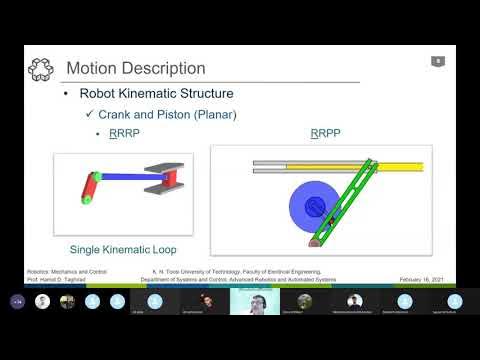
Robotics (Session 03) - Prof. Hamid D. Taghirad
660
Robots are mechanically designed using joints and links. Links provide workspace reachability, while joints enable relative motion. Primary joints include revolute (R) for rotation and prismatic (P) for translation, each providing one degree of freedom. Compound joints combine multiple motions: universal (U) provides two rotations, cylindrical provides one rotation plus one translation, and spherical provides three rotations. Kinematic structures define how joints and links connect and which are actuated. Single kinematic loops (closed chains) constrain motion with inherent relationships between joints, requiring only one actuator. Open kinematic chains (serial manipulators) have no loops, providing maximum flexibility. Common serial manipulators include RR (planar positioning), RRP, SCARA robots optimized for fast horizontal movements, and six-degree-of-freedom industrial manipulators using three joints for positioning and three for orientation. The actuator-DOF correspondence principle states that three actuators control three degrees of freedom. Poor design can lead to singular configurations where actuation fails to produce expected motion.
Click to watch →

5. Fundamentos de robótica. Grados de libertad de un sistema robótico
14.6K
Degrees of freedom (DOF) define the independent movements a mechanical system can perform. In three-dimensional space, any free object has six DOF: three linear movements along x, y, and z axes, and three rotational movements (yaw, pitch, roll). Linear movements include forward/backward, left/right, and up/down motions. Rotational movements are named from aviation: yaw (rotation about z-axis), pitch (rotation about x-axis), and roll (rotation about y-axis). Different joint types constrain motion differently: revolute joints allow rotation about one axis (1 DOF), prismatic joints permit linear movement along one axis (1 DOF), cylindrical joints combine rotation and translation along the same axis (2 DOF), spherical joints enable rotation about all three axes (3 DOF), and universal joints allow rotation about two perpendicular axes (2 DOF). Grubler's criterion calculates DOF using the formula: DOF = 6n - (j + 1) + Σf_i for 3D mechanisms, or DOF = 3n - (j + 1) + Σf_i for planar mechanisms, where n is the number of links, j is the number of joints, and Σf_i is the sum of DOF permitted by each joint.
Click to watch →
Prerequisite Knowledge
- Concept 01The fundamental principles of biomimicry, where engineering designs are directly inspired by biological systems.
- Concept 02Basic concepts of terramechanics and granular materials, specifically how shifting media like sand behave under applied force.
- Concept 03Biological mechanics of snake locomotion, focusing on the differences between lateral undulation and sidewinding gaits.
- Concept 04Introduction to robotic kinematics, including multi-jointed systems, degrees of freedom, and actuator coordination.
Subsequent Learning
- Step 01Applications of terramechanics in space exploration, such as designing planetary rovers capable of traversing sandy Martian slopes.
- Step 02Real-world search and rescue robotics, focusing on navigating collapsed buildings, rubble, and unstable natural disaster zones.
- Step 03Adaptive control systems and machine learning algorithms that allow robots to dynamically adjust their gait to changing terrains.
- Step 04The development of soft robotics and flexible materials to improve structural resilience and environmental adaptability.
Robotic Snakes
Failure Insights
Snake Mechanics
Sidewinder Waves
Slope Secret
Robot Upgrade
Robotic Snakes
0:06Playing Section
- 1
Limbless robots show promise for diverse terrain exploration.
- 2
A desert test exposed robot limitations on sandy slopes.
Limitations of Biomimicry and the Efficiency of Non-Biomimetic Propulsion
While biomimetic robots like the sidewinder snake-bot offer novel mobility, critics in robotics argue that mimicking biology often introduces unnecessary mechanical complexity and control overhead. Snake-like robots require dozens of high-precision joints and complex coordination algorithms, creating numerous potential points of failure in harsh, dusty environments like deserts or extraplanetary dunes. In contrast, non-biomimetic alternatives, such as screw-drive (rotary) propulsion or specialized high-traction tracked systems, provide far superior mechanical reliability, higher payload capacity, and energy efficiency. These traditional engineering solutions utilize continuous rotation—a mechanism unavailable in biology—allowing them to conquer loose sandy slopes with simpler control systems and greater durability.
Deep Dive
Applications of terramechanics in space exploration, such as designing planetary rovers capable of traversing sandy Martian slopes.

Dr Lutz Richter, ISTVS 1ST Vice President | ISTVS Terramechanics Bite
189
Terramechanics models are essential for designing planetary rovers, predicting motion resistance, drawbar pull, gradability, and required drive torque based on terrain properties and wheel design, enabling engineers to optimize rover performance while accounting for reduced gravity effects and ensuring adequate ground pressure (typically below 10 kPa) to prevent vehicle immobilization on unprepared extraterrestrial surfaces.
Click to watch →
CRADLE Talks - 05 Nov 2025 Webinar Series on Space Robotics Part 1 (Dr Chris Brunskill)
102
Terramechanics is a methodology for modeling and predicting net force that robotic rovers can develop on loose sand and regolith. This enables comparisons between mobility systems like tracks and wheels. While tracks can develop roughly twice the driving thrust of wheels, they require additional components like grousers, introducing multiple failure points. The 2008 Lunar Robotics Challenge tested rover concepts on Mount Teddy and Tenref, simulating lunar conditions. The challenge required traversing crater walls up to 40 degrees, collecting samples for analysis, and returning them to base stations. The development work formed the basis for subsequent PhD research in planetary robotics.
Click to watch →

FASTER: Explore space faster and safer
1.1K
Terramechanics is the science of vehicle-soil interaction applicable to both Earth and planetary exploration. For rover design, it determines wheel sizing, wheel count for adequate mobility, and predicts terrain safety and bearing strength (trafficability). The ideal sensor warns of hazardous conditions ahead, enabling faster missions. The Mars Yard facility replicates Martian terrain for testing, featuring rocks, sand, and appropriate lighting. Modern rovers use passive suspension systems without springs, relying on mechanical linkages for shock absorption. The FASTER project tests these principles using realistic platforms like BRIDGET with six wheels and passive suspension, representing approaches used in ExoMars and American Mars missions.
Click to watch →
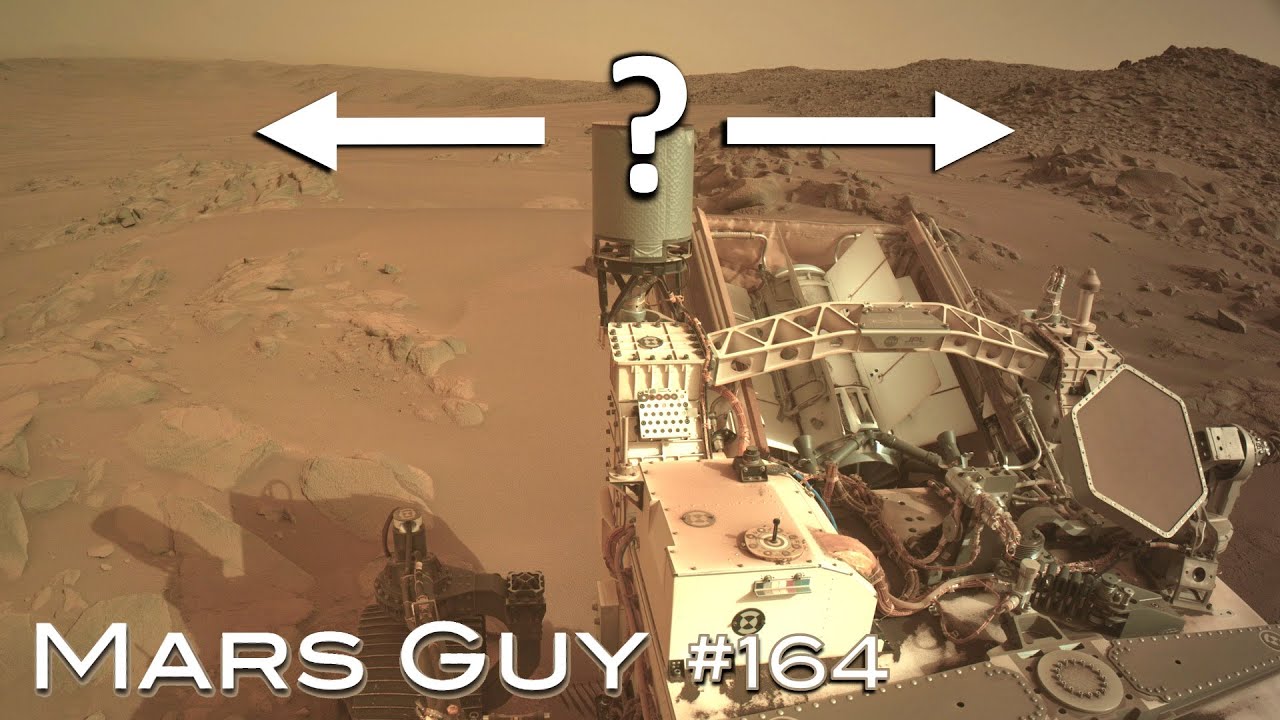
Between a rock and a soft place
20.7K
Mars rovers face significant terrain challenges when navigating rocky and sandy environments. Perseverance, which routinely completes autonomous drives of 2-300 meters, has been reduced to drives less than one-tenth of that distance due to the gnarly terrain. The combination of large sand ripples and treacherous rocks creates obstacles that require careful planning and significantly slow progress. This demonstrates how terrain complexity directly impacts mission efficiency and scientific exploration capabilities.
Click to watch →
Off-Road Mobility and Terramechanics: Theory into Practice - J. Y. Wong
1.8K
Terramechanics, pioneered by Dr. Bekker in 1960, provides physics-based frameworks for predicting vehicle mobility on deformable terrains. The discipline evolved from empirical methodologies to systematic analysis of vehicle-terrain interactions, encompassing pressure-sinkage relationships, shear stress-displacement characteristics, and standardized terrain parameters. Two primary models emerged: NTVPM for track vehicles treating tracks as flexible belts and NWVPN for wheeled vehicles distinguishing rigid from flexible operating modes. These models predict normal pressure distributions, shear stress patterns, and drawbar pull performance through comprehensive analysis of vehicle configurations and terrain properties. Industrial applications demonstrated successful integration into military vehicle development programs. For extraterrestrial mobility, the risk equation and gravity scaling laws enable prediction of lunar and Martian rover performance from Earth-based tests, with parabolic flight maneuvers and discrete element simulations providing experimental validation. This progression from theoretical foundations to practical implementation exemplifies how terramechanics transforms intuitive understanding into quantifiable predictions for both terrestrial and space exploration applications.
Click to watch →
Deep Dive
Real-world search and rescue robotics, focusing on navigating collapsed buildings, rubble, and unstable natural disaster zones.
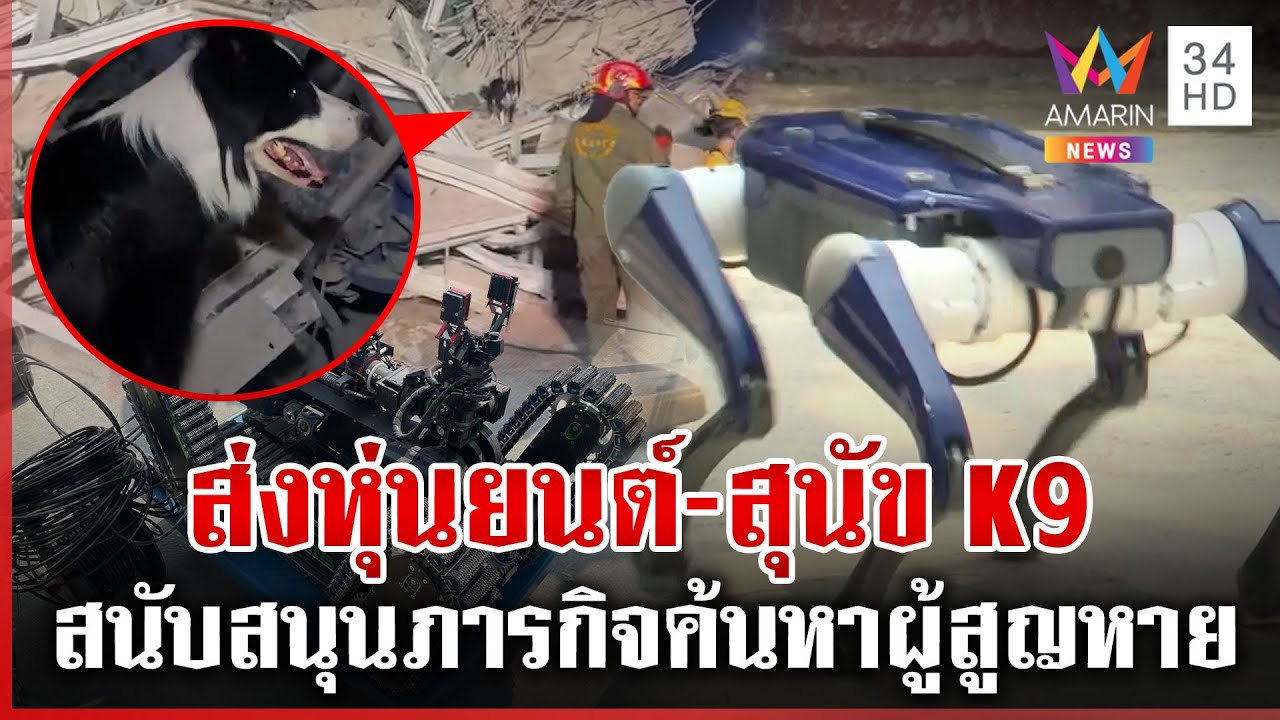
เข้าช่วยลำบาก ระดมหุ่นยนต์-สุนัข K9 ค้นหาผู้สูญหายใต้ซากตึก สตง.ถล่ม | ทุบโต๊ะข่าว | 29/03/68
56.9K
Rescue operations in collapsed buildings require coordinated use of multiple technologies and specialized teams. The pancake-style concrete collapse creates unstable structures where heavy equipment can trigger secondary collapses. Laser monitoring detects structural movement as small as 2 centimeters. K9 teams with international training and over 10 years of experience use trained dogs to locate survivors through barking signals. Small rescue robots developed by universities enable safe exploration of hazardous areas, handling objects weighing 3-7 kilograms and operating with sensors up to 2 kilometers away. Robots equipped with thermal imaging and grippers reduce risks to human rescuers while providing critical information for rescue planning. The 72-hour window for survival makes rapid, coordinated response essential.
Click to watch →

แผ่นดินไหวโกลาหล ตึก สตง.ถล่ม | 29 มี.ค. 68 | เช้านี้ขยี้ข่าวช่อง8
511.1K
The video demonstrates the use of small exploration robots equipped with cameras and sensors to map interior spaces of collapsed buildings. These robots can navigate through narrow openings that humans cannot access, creating 3D maps of affected areas and identifying potential survivor locations. This technology extends the reach of rescue operations into dangerous or inaccessible zones.
Click to watch →

Saving Los Santos from the BIGGEST TSUNAMI in GTA 5!
283K
Search and rescue operations in collapsed or damaged buildings require systematic approaches to locate and extract trapped individuals. The video shows Franklin searching for Chop (the dog) inside the Maze Bank tower, calling out and listening for responses. This demonstrates the fundamental technique of using auditory cues and methodical room-by-room searches to locate survivors in compromised structures. The emotional aspect of searching for a pet adds personal stakes to the rescue operation.
Click to watch →

UNTV: C-NEWS | June 01, 2026
178.9K
Rescue operations in the collapsed building in Angeles City, Pampanga continue with focus on identifying sleeping quarters including septic tanks converted into temporary shelters. Rescuers have recovered multiple bodies, with some victims not on the original missing list, including a father and son construction workers from Camarines Sur. Challenges include strong odors slowing operations, requiring disinfection protocols for rescuers entering and exiting ground zero. K9 working dogs assisted in identifying and recovering bodies, with the Philippine Coast Guard's K9 dogs playing a significant role in the search and retrieval operations.
Click to watch →

ধ্বংসস্তূপের নিচ থেকে যেভাবে উদ্ধার হলো দুই বোন || Jago News
990K
This video documents the rescue of two sisters from beneath a collapsed building, demonstrating emergency response procedures for extracting individuals from rubble during structural collapses.
Click to watch →
Deep Dive
Adaptive control systems and machine learning algorithms that allow robots to dynamically adjust their gait to changing terrains.

Has A.I. Made Robot Dogs Too Smart?
349.5K
Gait refers to the sequence of foot contacts during movement. Common gaits include trotting (diagonal alternation), bounding (front-back alternation), and prancing (simultaneous contact). Classical approaches fix gaits before optimization, while reinforcement learning discovers optimal patterns autonomously. Robot controllers use neural networks programmed with different policies—some prioritize precise foot placement for hallway navigation, others emphasize adaptability for challenging terrain. The trade-off between controllability and agility emerges clearly: precisely-tuned controllers feel natural but struggle with obstacles, while minimally-shaped policies offer greater adaptability despite occasional instability.
Click to watch →

Unitree Just Gave Its ROBOT a BRAIN and It’s Already Acting HUMAN + More AI & Robotics News
210.7K
Reinforcement learning combined with imitation learning enables robots to walk like humans by adapting stride, balance, and pace dynamically across uneven terrain. Atom, developed by PND Botics, uses Nvidia's Isaac Gym for deep reinforcement learning at scale, then applies motion capture data adapted to its specific body structure. The robot achieves blind locomotion (without vision modules) by learning through simulation-to-reality transfer. Key specifications include: Intel i7 chip with real-time controls; 25 force-controlled QDD actuators delivering up to 360 Newton meters of torque in legs; 5 degrees of freedom in arms; 3 degrees of freedom in waist; 1.66-meter height; 60 kg weight. This approach demonstrates full simulation-to-reality transition capability.
Click to watch →
![[Lab Meeting] Advancing RL based Humanoid Locomotion(AMP, Reward Based)](https://i.ytimg.com/vi_webp/6v7ckIPb7pw/maxresdefault.webp)
[Lab Meeting] Advancing RL based Humanoid Locomotion(AMP, Reward Based)
240
This research explores two approaches to enable humanoid robots to walk robustly on rough terrain using reinforcement learning: (1) Mixture of Experts (MoE) architecture, which trains multiple terrain-specific expert policies and uses a gating network to select appropriate policies based on terrain information, and (2) Denoising World Model (DWL) architecture, which separates observations and privileged information into actor-critic networks and uses encoder-decoder structures to reconstruct privileged information, enabling more robust motion learning with fewer observations. The research demonstrates that reward function design is critical, as improper reward balancing can cause the robot to lose walking motion, and RGBD sensor data can be integrated into observation history for terrain perception.
Click to watch →
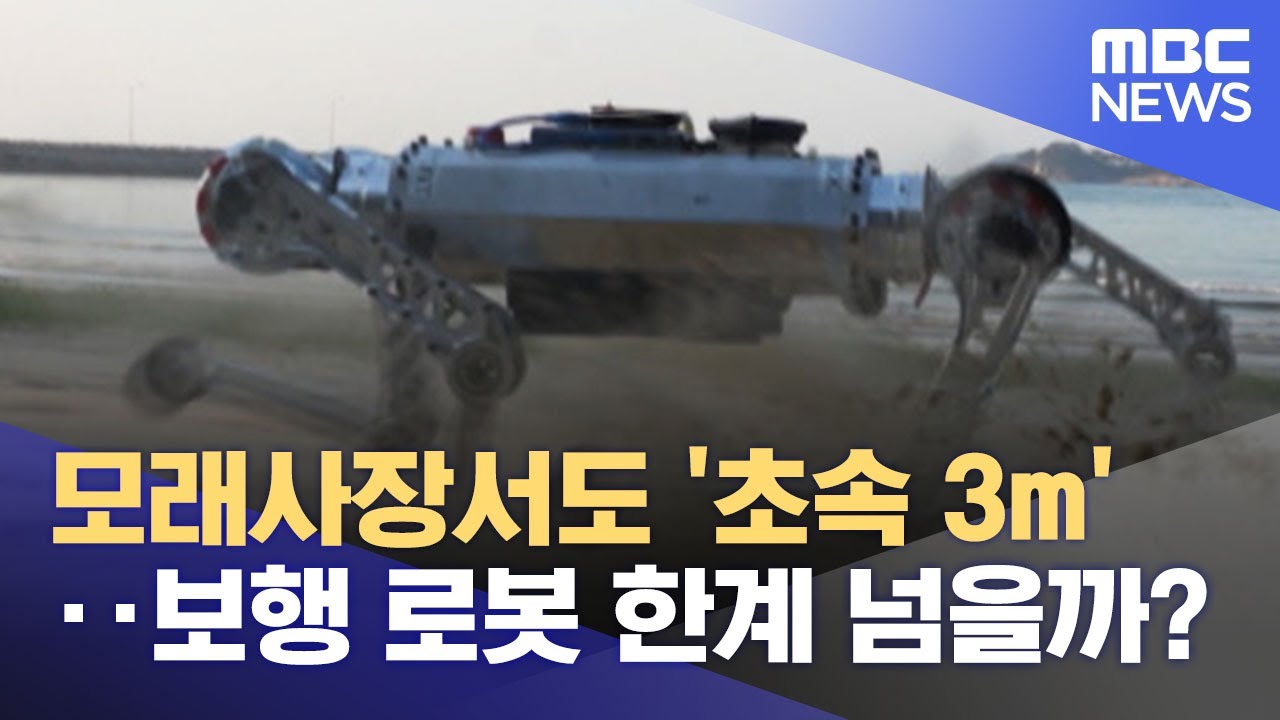
모래사장서도 '초속 3m'‥보행 로봇 한계 넘을까? (2023.01.27/뉴스투데이/MBC)
473.7K
A 4-legged walking robot developed by KAIST researchers uses reinforcement learning and artificial neural networks to achieve autonomous balance and locomotion across diverse terrains, including sandy beaches where it can run at 3 meters per second, demonstrating that self-learning algorithms can enable robots to adapt to environmental changes without prior information about the terrain.
Click to watch →

S3 E20 Jitendra Malik on Building AI from the ground up: Sensorimotor learning before language
6.1K
Rapid motor adaptation enables robots to adjust locomotion behavior within approximately one second to accommodate changing terrain conditions (hard ground, sand, stairs). This capability prevents falls and injuries, particularly important for elderly users. The approach detects discrepancies between commanded motor outputs and proprioceptive feedback—when identical commands produce different joint torques on different surfaces, the system infers terrain properties and adjusts behavior accordingly. Unlike classical control theory which relies on known differential equations, this learning-based approach identifies system dynamics and learns control policies simultaneously, leveraging computational power to handle complex systems previously considered intractable.
Click to watch →
Deep Dive
The development of soft robotics and flexible materials to improve structural resilience and environmental adaptability.

Soft Robotics: Bridging Materials, Design, and Versatility
1.2K
Soft robots can be extremely resilient to impact, maintaining functionality after significant drops. They adapt behavior based on environmental conditions without explicit control—for example, a hopping robot automatically develops a 180-degree phase difference when entering water. Functional materials enable additional capabilities: transparent actuators become invisible, and biodegradable robots can physically disappear in environments like water, providing solutions for waste management and environmental monitoring.
Click to watch →
inSPIREd - Dr Ryan Truby - Can soft materials revolutionize the meaning of robotics?
2.4K
Soft robots can exhibit complex bio-inspired locomotion, perform resiliently in harsh, complex, unstructured, or uncertain environments, withstand blunt force damage and repair themselves, and interact gently with humans and their environment. These capabilities are achieved through a simple change of building materials from rigid to soft matter.
Click to watch →

EML Webinar by Prof. Rob Shepherd, Cornell University on 16 Sept. 2020
2.9K
Nature designs with toughness in mind rather than strength, achieving equivalent or better toughness than metals and ceramics without reaching their strength levels. The majority of biological tissue is soft, making elastomers the best synthetic analog to biological tissues. This allows soft robots to achieve compliance and adaptability that rigid robots cannot, while still providing sufficient structural integrity for most applications. The trade-off is that soft materials may lack the high strength needed for certain tasks, which can be addressed through hybrid approaches.
Click to watch →

T2: 11AM Session Two
152
Soft robotics enables the creation of extremely resilient systems by combining soft materials with specific chemical, pH, and temperature tolerances. Materials can be engineered to withstand harsh conditions including fire, extreme temperatures, and corrosive environments. This resilience is particularly valuable for exploration robots, nuclear decommissioning equipment, and other applications in hostile environments. Additionally, flexible electronics using liquid metals or saltwater conductors can be integrated into soft robotic systems, allowing computation and sensing capabilities to survive the same environmental stresses that would destroy conventional rigid electronics.
Click to watch →

Lockheed Martin Robotics Seminar, May 6, 2022: Po-Yen Chen
161
Soft robots and soft machines are fabricated using soft materials like elastomers, hydrogels, polymers, or paper, enabling infinite degree of freedom deformations unlike rigid robots. This provides advantages including lightweight construction, lower costs, power efficiency, and accessibility. For environmental perception, soft robots require three sensor types: strain sensors for kinematic feedback control, pressure sensors for detecting object properties, and chemical/biological sensors for environmental understanding. However, adapting traditional rigid-sensor materials to flexible substrates remains a significant challenge for effective integration.
Click to watch →
Robotic Snakes
Failure Insights
Snake Mechanics
Sidewinder Waves
Slope Secret
Robot Upgrade
Robotic Snakes
0:06- 1
Limbless robots show promise for diverse terrain exploration.
- 2
A desert test exposed robot limitations on sandy slopes.
Limitations of Biomimicry and the Efficiency of Non-Biomimetic Propulsion
While biomimetic robots like the sidewinder snake-bot offer novel mobility, critics in robotics argue that mimicking biology often introduces unnecessary mechanical complexity and control overhead. Snake-like robots require dozens of high-precision joints and complex coordination algorithms, creating numerous potential points of failure in harsh, dusty environments like deserts or extraplanetary dunes. In contrast, non-biomimetic alternatives, such as screw-drive (rotary) propulsion or specialized high-traction tracked systems, provide far superior mechanical reliability, higher payload capacity, and energy efficiency. These traditional engineering solutions utilize continuous rotation—a mechanism unavailable in biology—allowing them to conquer loose sandy slopes with simpler control systems and greater durability.
The fundamental principles of biomimicry, where engineering designs are directly inspired by biological systems.
Basic concepts of terramechanics and granular materials, specifically how shifting media like sand behave under applied force.
Biological mechanics of snake locomotion, focusing on the differences between lateral undulation and sidewinding gaits.
Introduction to robotic kinematics, including multi-jointed systems, degrees of freedom, and actuator coordination.
Applications of terramechanics in space exploration, such as designing planetary rovers capable of traversing sandy Martian slopes.
Real-world search and rescue robotics, focusing on navigating collapsed buildings, rubble, and unstable natural disaster zones.
Adaptive control systems and machine learning algorithms that allow robots to dynamically adjust their gait to changing terrains.
The development of soft robotics and flexible materials to improve structural resilience and environmental adaptability.
94.9K views316likes2:00@ScienceMagazineOriginal Release: 2014-10-09
0 on Robotic snakes sound like the stuff of nightmares.
But their limbless movements make them good candidates for exploring land, sea and air.
On a recent expedition Egypt. a robotics team ran into trouble.
Their robo snake couldn't make its way up sandy inclines.
"We're often as is interested in failures of locomotive models as we are success because the failures help us understand some of the principles."
Meanwhile... a physics team in Georgia was working out the biomechanics of snakes on tilted sandy soils. "We thought to yourself what's a very cool animal that no one is looked at?" As it turned out robots aren't the only ones to have problems with the sand. But one snake had no issues ascending the steepest slopes the Sidewinder rattlesnake. When sidewinders sidewind they're actually sending two waves down their body: one in the horizontal plane and one in the vertical plane. Where these waves meet determines which part of their bodies move ahead in which stays stuck to the soil.
Their secret to tackling slopes? Increasing the proportion of their bodies in contact with the sand as the slope got steeper. It's harder than it sounds.
After teaming up, the researchers use what they learned from the Sidewinders to improve the robot snake.
Because the snakebot showed improvement it meant that their understanding of sidewinding mechanics was accurate and now it has the skills to slither up all the dunes in Egypt.
Up Next

18:24
Engineering a Rideable Snake Robot: Design, Build, and Testing
@jamesbruton
117.3K views•2022-08-09

58:25
MathWorks Virtual RoboSub Simulation Environment | Webinar 2026
@RoboNationInc
209 views•2026-03-10

11:04
How to Build a Self-Balancing Robot: Arduino Nano & MPU6050
@easytechzones
16.8K views•2022-03-09
25:22
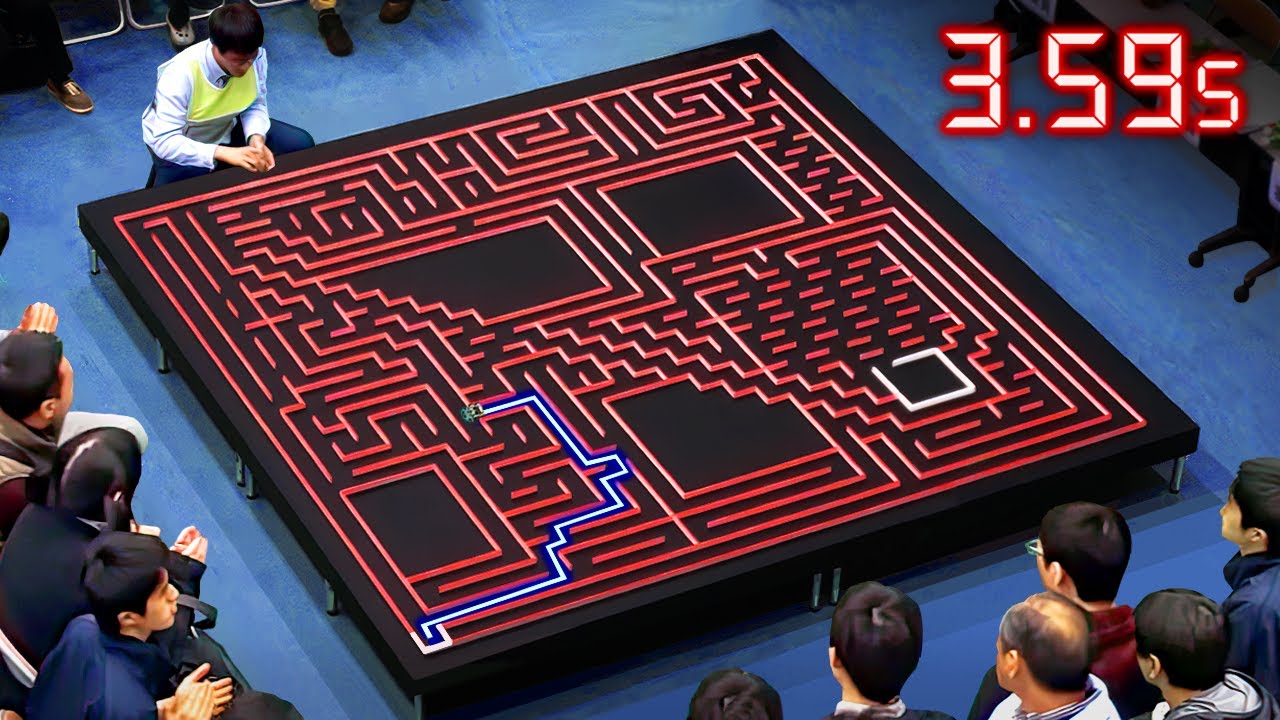
Micromouse: The Fastest Maze-Solving Robots on Earth
@veritasium
23.5M views•2023-05-24
Related Study Plans & Knowledge Roadmaps
Structured learning paths in Robotics
robotics
Building Delta Robots: Kinematics & Pico
01Foundations of Delta Robots & Mechanical Design
02Electronics and Microcontroller Setup with Pi Pico
03Delta Robot Kinematics and Coordinate Math
+ 3 more learning modules
65h6 modules
Explore Roadmap
robotics
Building Ballbots: Dynamics, Kalman & LQR
01Embedded Electronics & Omniwheel Actuation
02Ballbot Kinematics & Rigid Body Dynamics
03IMU Sensors & Kalman Filter State Estimation
+ 2 more learning modules
42h5 modules
Explore Roadmap
robotics
Micromouse: Hardware, PID Control & Flood-Fill
01Electronics & Teensy Microcontroller Basics
02Sensors and Actuators: Motors, Encoders & IR
03Precision Movement: Implementing PID Control
+ 2 more learning modules
35h5 modules
Explore Roadmap
robotics
CDPR: Kinematics, Arduino & Winch Control
01Foundations of Arduino & Basic Electronics
02Stepper Motors and Winch Mechanics
03Kinematics of 2D Cable-Driven Robots
+ 2 more learning modules
28h5 modules
Explore Roadmap