











![CHEMICAL EQUILIBRIUM [L-O3] Kc, Keq ,](https://i.ytimg.com/vi/IDOYSv8dG88/maxresdefault.jpg)









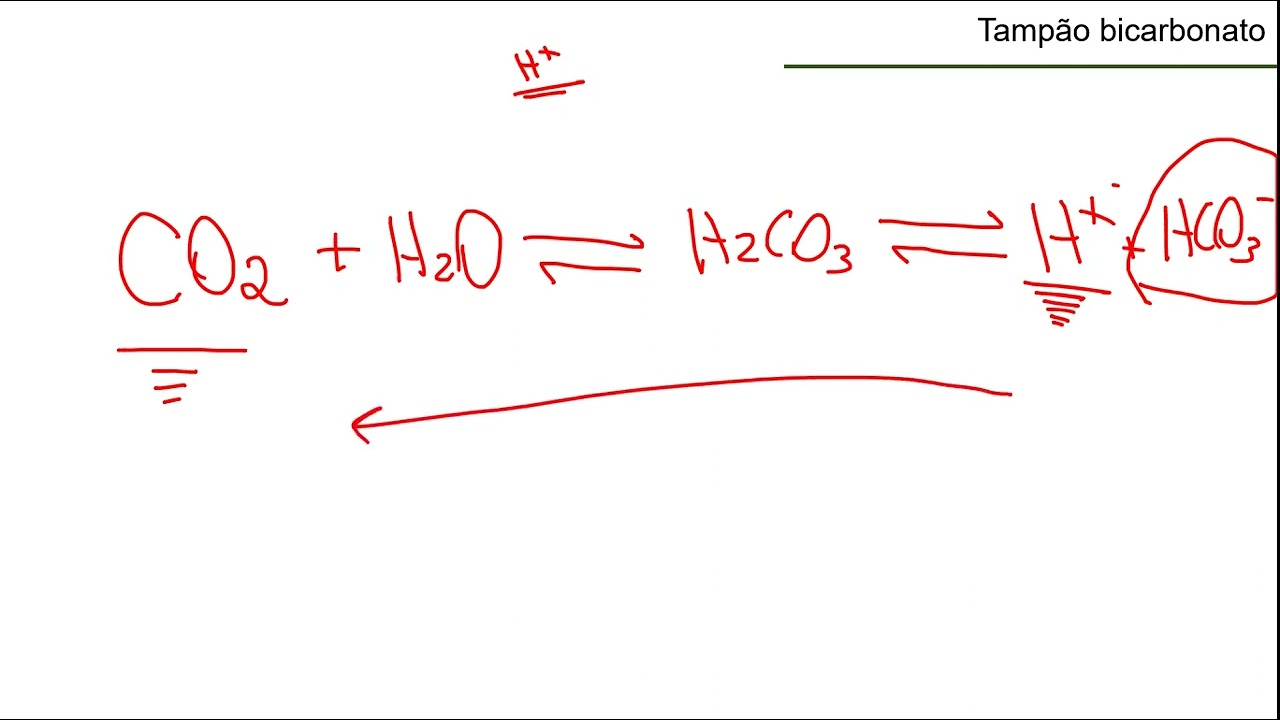

pH measures the power of hydrogen (H+) in a solution and is calculated as the negative base-10 logarithm of hydrogen ion concentration, while pOH measures hydroxide ion (OH-) concentration; in aqueous solutions, the product of [H+] and [OH-] equals the water dissociation constant Kw = 1.0 × 10^-14, meaning pH + pOH = 14, with neutral water having pH = pOH = 7, acidic solutions having pH < 7, and basic solutions having pH > 7.
Understanding pH and pOH: Acids, Bases, and Logarithms
Added:Basic mathematical properties of base-10 logarithms and scientific notation.
The fundamental definitions of acids and bases, specifically the Arrhenius and Brønsted-Lowry chemical theories.
The concept of chemical concentration, specifically molarity (moles per liter, M), and how to express solute concentrations.
An introductory understanding of chemical equilibrium and what an equilibrium constant (K) represents.
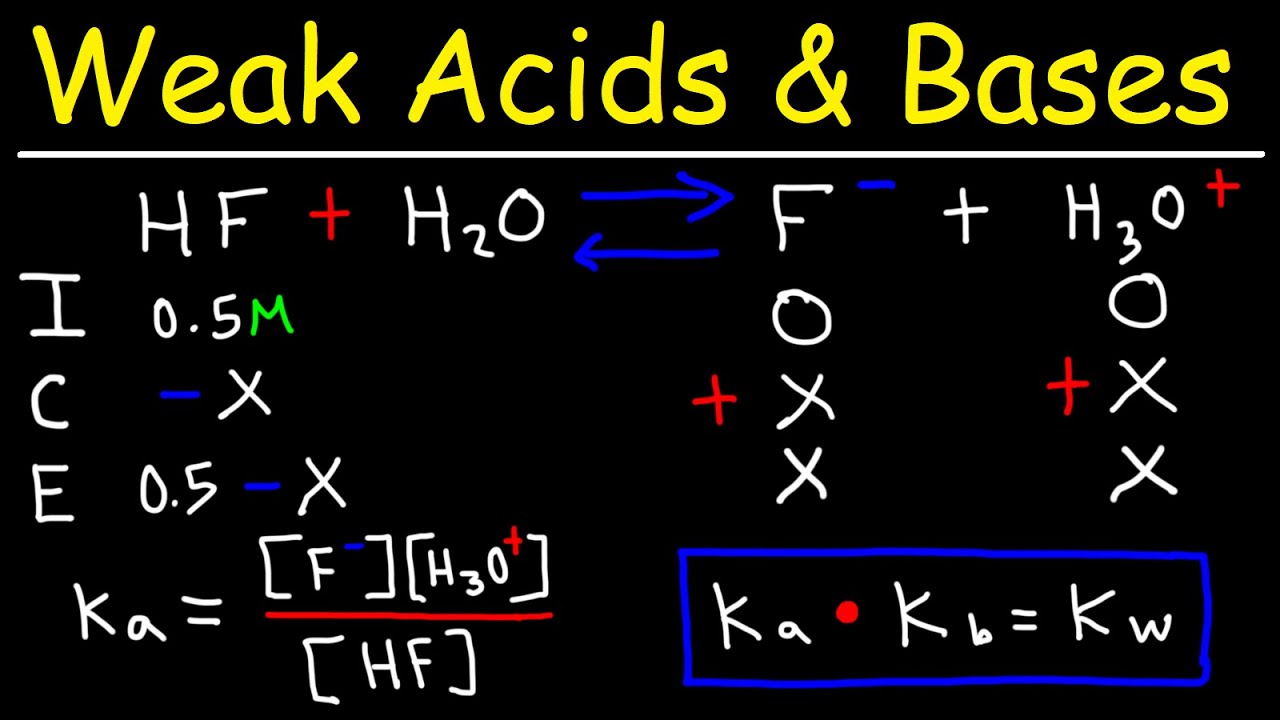
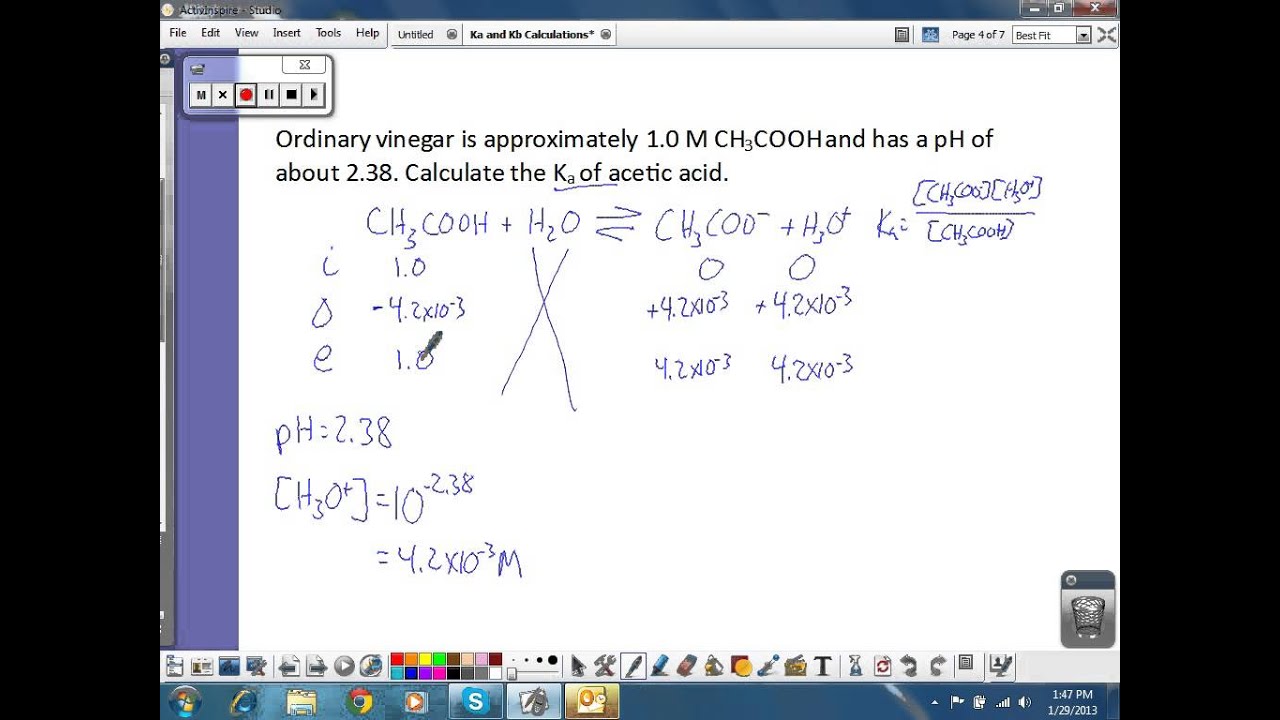
Calculating the pH of weak acids and weak bases using dissociation constants (Ka and Kb) via ICE (Initial, Change, Equilibrium) tables.
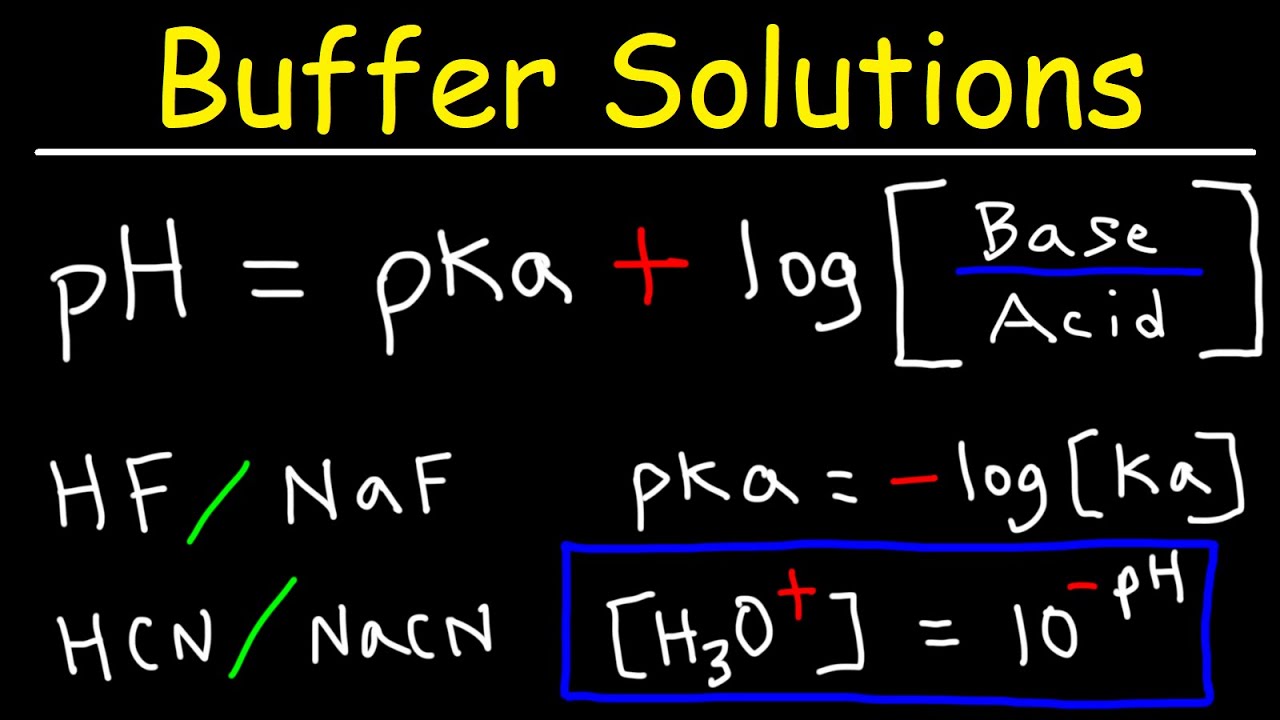
Understanding the chemistry of buffer solutions and how to apply the Henderson-Hasselbalch equation.
Analyzing acid-base titration curves, identifying equivalence points, and selecting appropriate pH indicators.
Exploring practical applications of pH dynamics, such as physiological buffering in human blood or the environmental chemistry of ocean acidification.
2.3M views24.9Klikes11:22Original Release: 2013-09-09
This may come as a bit of a shock to you, but I'm not super into personal grooming.
Like I understand soap and shampoo.
But there's all this other stuff now, and I keep seeing references to pH balance everywhere.
pH balanced soaps, and shampoos, and deodorant, and makeup abound in supermarkets and drugstores.
And I've even seen pH balanced water?!
We've talked a lot about balance over the last couple of weeks, and pH balance is related to the equilibrium state of a reversible reaction.
You're probably also familiar with the pH scale, and you know that it has to do with acids and bases.
But what is pH exactly?
And why is it weirdly written with a lowercase 'p' and a capital 'H'?
And also, what about pH's alter ego pOH?
The capitalization thing is probably the easiest to answer, 'cause there is no answer.
No one really knows what the 'p' means.
The Danish chemist who came up with the term, a guy with the absolutely amazing name, Søren Sørensen, never explained his reasoning.
Some people think that it comes from some form of the word power, whether it's puissance in French, or maybe Latin, pondus.
But it probably just came from a common habit chemist have of differentiating a test solution, labeled 'p', from a reference solution, called 'q'.
But thinking of the 'p' as standing for power, does help us remember the meaning more easily.
The 'H' part is even easier, it stands for hydrogen.
Because hydrogen ions, or protons, are pivotal to the behavior of acids and bases, which is what pH describes.
So you can think of pH as basically the power of hydrogen in a solution.
The strength of the acid or base character of a substance.
And it all revolves around one very important point of focus, our old friend water.
[Theme Music] If you've been watching Crash Course Chemistry from the beginning you've gotten the message that water is special in more ways than I can list, and pH is just one more of those ways.
We normally think of water as a perfectly neutral substance, neither acidic nor basic, and that's true.
But, as I've mentioned before, water can also function as an acid -- releasing hydrogen ions, also known as protons, and as a base -- consuming them.
How on Earth is that possible?
In order to explain, we first have to understand what the pH of a substance really tells us.
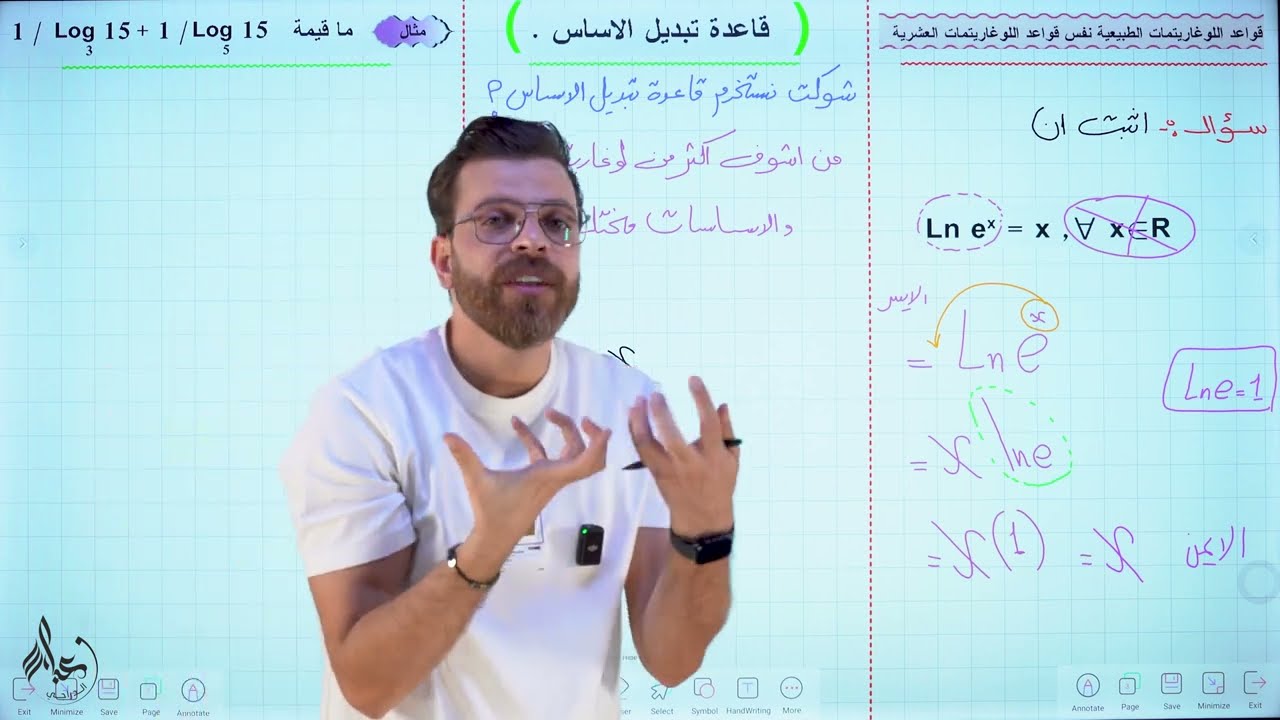
While chemically we say that pH represents the power of hydrogen in a solution, it's mathematically defined as: "the negative of the base 10 logarithm of the concentration of hydrogen ions in solution."
OK, so now that you're terrified, I'm here to help.
So, yeah, logarithms can seem a little bit scary at first, but the ones that we're using here are super easy.
And bonus, once you get familiar with them here, it'll be that much easier to understand them in math class.
So now that we got the scary mathematical definition, let's do the simplest mathematical definition.
At any given moment, there will be a certain number of hydrogen ions in solution -- a very small number -- the concentration will be a number like one times 10 to the negative fifty moles per liter.
That negative 5, is your base 10 logarithm.
Take the negative of that, and you get the pH. 5.
Now let's get a bit more in to the weeds.
The logarithm, or log, of a number is the exponent to which another number, called the base, must be raised to produce the target number.
So for base 10 logs, the base is 10.
They're what we use most in chemistry, and they're really easy to understand, and also what we base scientific notation on.
So as an example, the base 10 logarithm of one hundred is 2.
Because 10 raised to the power of 2, or 10 squared, equals one hundred.
Base 10 logs are so common that we often leave the subscript 10 off when we write it.
Like if your calculator has a 'log' button, that's just for base 10 logs.
So what in the name of Søren Sørensen does this have to do with face melting acids?
Well I'm getting to that, and it all starts with waters crazy potential to act as both an acid and a base.
Random changes in the tiny electrical fields around the atoms in water occasionally cause the molecules to break apart.
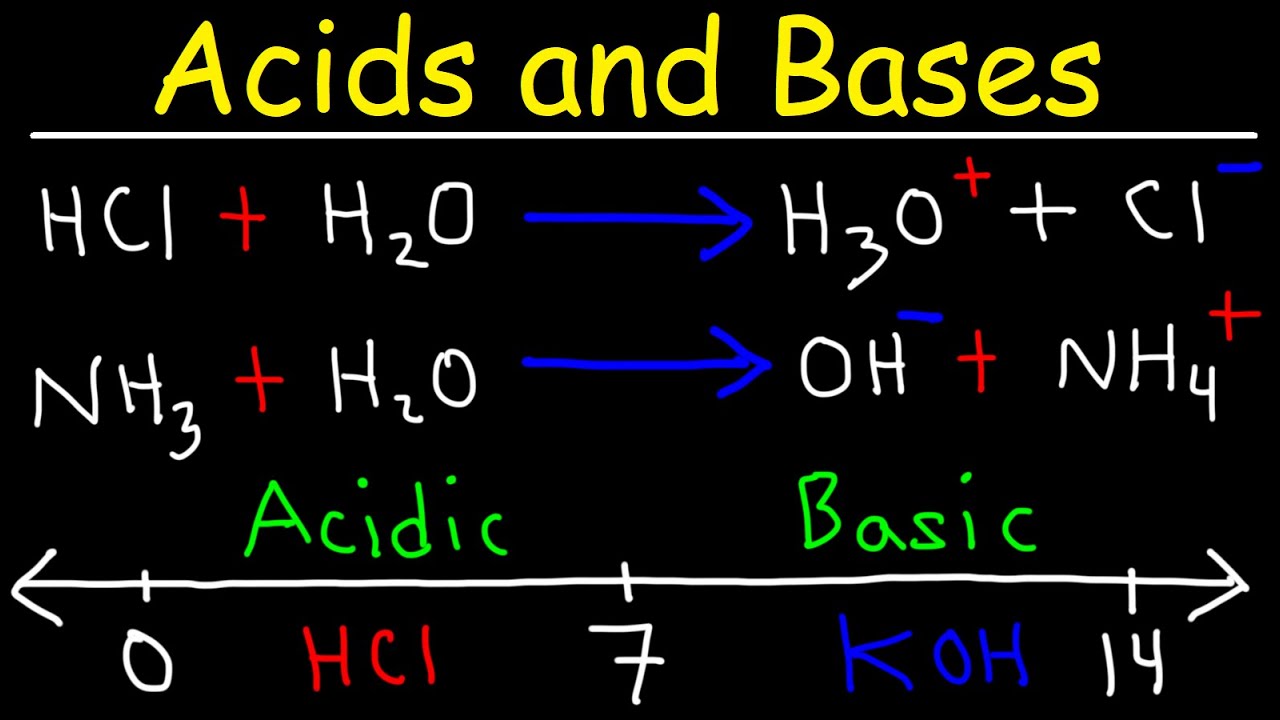
Specifically a hydrogen ion, or proton, will break off from one molecule and attach itself to another one, forming a hydronium ion, H3O+, and a hydroxide ion, OH-.
This is why water can act as both an acid and a base.
It's molecules can both release and accept protons.
In this case, it's only interacting with itself.
But water can interact in the same way with other acids and bases.
Some times you'll see the hydronium ion written as a simple hydrogen ion, H+, allowing the reaction to be written with only one water molecule.
It's not technically accurate, but it's close enough to reality that it can be used to simplify things.
So when we say that the pH is the negative log of the hydrogen ion concentration... yeah, we actually mean hydronium ion concentration.
Just another thing that early scientists got a little wrong and now we have to live with.
Anyway, this dissociation of water is a reversible reaction.
And in fact, the ions always reform in to water within a tiny fraction of a second.
But it's happening all the time constantly.
In your bottled water, in the water inside your cells, and in the ocean. Always.
However, at any given instant only a tiny number of molecules are dissociated ions.
In fact, the exact number of these molecules is well known to chemists.
It's the equilibrium constant for this reaction.
And because it's such a special reaction, it has it's own name -- the water dissociation constant, or Kw.
Kw is equal to one point zero times 10 to the negative fourteenth.
The formula for Kw is set up like any equilibrium constant, concentrations of products over concentrations of reactants, all raised to the exponents based on the coefficients of the balance reaction.
There is however one difference.
Because the ions represent such a tiny proportion of the total mass, the water itself is essentially pure.
And pure substances, because they don't have concentrations, aren't included in equilibrium calculations.
So the formula for Kw becomes simply the hydronium ion concentration times the hydroxide concentration.
According to the balanced equation for the dissociation of water, hydronium and hydroxide are formed at a 1:1 ratio, so their equilibrium concentrations must be equal.
That means if we call the concentration of H3O+, for example 'x', then the concentration of OH- must equal 'x' as well.
So the formula for the dissociation constant 1.0 x 10^-14 simplifies even further to x times x, or x squared.
Suddenly, it's crazy easy.
The equilibrium concentration of each ion is just the square root of 1.0 x 10^-14.
Touch one key on the 'ol calculator, and hello both concentrations equal 1.0 x 10^-7 moles per liter in equilibrium.
The pH then, is simply the negative log of that, which is 7.
This my friends, is the basis of the pH scale.
Water is neutral, so 7 is the center of the scale.
And I can prove it too.
This is a strip of paper that's been infused with a chemical called litmus.
Litmus is a pH indicator, a chemical that turns different colors at different pHs.
There are many different indicators, with many different colors, but we'll talk more about those next week.
For now, just know that litmus paper turns pink in acids, blue in bases, and a sorta light purple when it's neutral.
But one thing you need to remember about the pH scale, because pH is calculated from a negative logarithm, it turns everything backward.
When the hydrogen ion concentration goes up, the pH gets lower.
For instance, if a little acid, such as vinegar, were added to the water, the concentration of hydronium ion might rise to say, 1.0 x 10^-4 moles per liter.
Which is a thousand times more than before.
That concentration would push the pH down to 4.
On the other hand, a base, such as ammonia, would consume a lot of hydrogen ions if it were added to the water.
If the hydrogen ion concentration drops to 1.0 x 10^-11, a thousandth of the equilibrium concentration, the pH would be eleven.
As you can see, the logs turn out to be a mathematical shorthand, that saves us from dealing with very huge or very tiny numbers.
The pH scale then is normally written from 0 to 14.
With numbers below 7 representing acids, and numbers above 7 representing bases.
It could also below zero or above 14, but that only happens in super extreme cases, that you are very unlikely to encounter.
At least I hope.
As with like hydrochloric or nitric acid, which ionize strongly, sometimes even completely.
Thus releasing a lot of protons, are called strong acids.
Because they raise the hydrogen concentration a lot, they also generally have very low pHs.
Weak acids, like citric acid, dissociation incompletely, releasing much smaller amounts of hydrogen ions, and therefore they usually have higher pHs.
Generally considered in like the 4 to 6 range.
Strong bases meanwhile, like sodium hydroxide, consume large amounts of hydrogen ions leaving the concentration very low, so they 10d to have very high pHs.
Weak bases, like sodium bicarbonate (baking soda), consume much less, and generally have pHs in the 8-11 range.
Neutral pH is technically just 7.0, but in a more practical sense, it's usually considered to be between 6 and 8.
So if pH is based on the concentration of hydrogen, that is hydronium ions, what about the concentration of hydroxide ions?
Just as we can calculate the pH of a substance from it's hydrogen ion concentration, we can calculate the pOH.
The negative log of the hydroxide concentration.
This is easy because Kw never changes.
Although the concentrations of hydrogen and hydroxide are only equal in pure water, or perfectly neutral solutions, the product of the 2 concentrations always equals 1.0 x 10^-14 in any aqueous solution.
So like orange juice, which is really just an aqueous solution of sugar and citric acid and a few other things, say the hydrogen concentration in your OJ is 3.2 x 10^-4 moles per liter.
Just for the fun of it, let's go ahead and calculate what the pH is at that point, which turns out to be 3.5.
But we can also use the Kw and the hydronium ion concentration to do a very simple division problem and find the hydroxide concentration.
It works out to 3.1 x 10^-11 moles per liter.
Once we have the concentration we can take another step, we can find the pOH of the solution which is similar to the pH, simply the negative log of the OH concentration.
The pOH in this case is 10.5.
And now for a tip that's just more awesome and cooler than an ice cream corn dog, the sum of the pH and the pOH is always 14.
In the example we just did, the pH was 5.4 and the pOH was 8.6, and yeah you add those together: 14! Surprise!
OK, maybe that's only cool to me.
But that's never stopped me before, I love this stuff!
And next week, I hope to really bend your mind by showing you how to make the pH of a solution hold steady, even if you dump a strong acid or base in it.
In the meantime, thank you for watching this episode of Crash Course Chemistry.
If you paid attention, you learned how pure water ionizes to form hydronium and hydroxide ions in reversible reactions.
And you learned about the equilibrium constant for that reaction, which has a special name: the water dissociation constant.
You learned some examples of acids and bases and neutral substances, as well as why some acids and bases are called strong and others are called weak.
You learned about logarithms and how you can use them to calculate the pH of a substance.
And a little bit about pOH, which can be calculated with logarithms, also with subtraction.
And finally, you learned about some cool mathematical connections between pH and pOH.
This episode was written by Edi González and edited by Blake de Pastino.
The chemistry consultant was Dr. Heiko Langner.
It was filmed, edited, and directed by Nicholas Jenkins. The script supervisor was Katherine Green.
Michael Aranda is our sound designer, and our graphics team is Thought Café.
Up Next

97:40
Extreme Acid Mine Drainage at Iron Mountain, California | USGS Lecture
@USGSPresentations
2.7K views•2018-08-09
83:56
Biocatalysis and Catalysis in Islatravir Synthesis | Merck Webinar
@SCIwheresciencemeetsbusiness
675 views•2020-10-08
9:57
Nuclear Chemistry: Radioactive Decay & Half-Life Explained
@crashcourse
2.1M views•2013-11-11

17:31
Edible Water Bottles: A DIY Guide to Sodium Alginate Spherification
@ryan
10.5M views•2019-06-21
Related Study Plans & Knowledge Roadmaps
Structured learning paths in Chemistry
chemistry
Nuclear Chemistry: Decay, Meds & Fuel Cycle
01Introduction to Nuclear Structure and Radioactivity
02Decay Dynamics and Kinetics
03Radiation Interaction and Detection
+ 2 more learning modules
24h5 modules
Explore Roadmap
chemistry
Supramolecular Chemistry: Forces & Machines
01Foundations of Chemical Bonding and Intermolecular Forces
02Introduction to Host-Guest Chemistry
03Thermodynamics and Dynamics of Self-Assembly
+ 2 more learning modules
16h5 modules
Explore Roadmap
chemistry
Photochemistry: Excited States & Reactions
01Foundations of Light-Matter Interactions
02Molecular Orbitals and Electronic States
03Photophysical Processes and Jablonski Diagrams
+ 2 more learning modules
18h5 modules
Explore Roadmap
chemistry
Coordination Chemistry: Bonding & Properties
01Introduction to Transition Metals and Ligands
02Crystal Field Theory (CFT) and Geometry
03Magnetic Behavior and Spin States
+ 2 more learning modules
14h5 modules
Explore Roadmap