
















This documentary follows Jane Dudley's journey from being diagnosed with incurable bipolar disorder to achieving remission through fecal microbiota transplantation (FMT), a procedure that transfers gut bacteria from a healthy donor to a recipient. Jane's severe mental illness, which began after childhood trauma and was compounded by years of antibiotic use that disrupted her gut microbiome, showed remarkable improvement after receiving FMT from her partner Alex. The procedure helped restore her gut microbiome, which is connected to brain health through the gut-brain axis, enabling her to reduce and eventually discontinue psychiatric medications. This case has sparked significant interest in nutritional psychiatry and the role of gut health in treating biological mood disorders, though researchers emphasize the need for proper donor screening and clinical trials before FMT can be widely recommended.
How a DIY Fecal Microbiota Transplant Reshaped Mental Health Treatment
Added:[Music] As soon as I I met Jane, I knew that she was the one >> when I start uni.
>> But there was a little bit of, "Oh my god, what have I taken on?"
>> I felt like a huge burden. And every day for years, I would say, "Why are you with me? Why do you love me?" Because I didn't understand why he would take me on as a partner. When he became my carer, >> I was in hospital. We were desperate.
Jane was definitely broken.
She She didn't deserve that pain.
>> I don't know what's happening inside your head, but I know that your heart is undamaged and beautiful.
>> You decided to fix me. You wanted to help me. And it was just so out there. And I did.
>> I was like, "What? You want to do what?
That is gross. No, thank you." That was my initial response. No. But then I had a few months of thinking about it and realizing that I had to try something.
>> Jane was one of the most unwell people I've ever worked with. I'm a forensic psychiatrist.
>> There's something in the top of the mugger.
>> The change is bordering on miraculous.
If I hadn't seen this, I'm not sure I'd believe it.
We haven't really explored east of the divine together that much. No, >> this is a story that needs to be told.
The condition that has been positioned as incurable may potentially be curable.
>> I think we have a lot of hang-ups about poo, but I think my story proves that you shouldn't poo poo poo. In a very rare way, the number twos cured my blues.
I told Alex that I had bipolar within the first 20 minutes of our chatting online. So, I was very upfront about it.
>> Did you know what that meant?
>> No, I had no idea.
>> And you also didn't know what bipolar really meant until you lived >> That's true.
>> until you experienced it on a day-to-day basis. And I didn't I didn't run away. I I ran towards you.
>> It's really hard to put into words just how much mental illness stole from me.
I lost friends. I lost opportunities for a normal development. I lost the chance to have a higher education. I lost work opportunities.
I lost 18 years of life that I will never get back.
[Music] Jane was uh the last of four children and they all grew up in Cesnok.
Well, Jane was a great kid actually. She was terrific kid. Very adventurous.
I was okay at athletic but you know see I would have been I would have been disappointed cuz like I'm third dear >> you know I had to be the best >> super bright could do anything she put a hand or a mind to so much came to her so naturally >> do you remember when I first started kind of getting obsessed with soccer my whole childhood trajectory was skilling myself to a point where I would one day play for Australia that was my big dream and I was well on my way to achieving that. We went on to win the state championships.
>> Finally, the energy for that became hard work and um there was a shift going into puberty.
>> As a kid, I look pretty pretty well and happy. And then you get to teenage years and I think that's when you can start to see kind of >> Yeah.
>> the the deadness in my eyes. I'm just unwell. From about 14 onwards, I had a lot of anxiety issues, but I still felt like I was on this upward trajectory. I just took it for granted that I was going to finish high school with good marks and end up doing a university degree.
However, when I was 16, an uncle that I didn't grow up with moved to New South Wales, and that trajectory came crashing down very quickly.
He was the cool uncle that let me drink with him and let me smoke marijuana. And that was part of the grooming process to manipulate me and to lower my defenses so that he could finally turn our relationship into a sexual relationship.
The emotional fallout from the abuse was all pervading. It broke me on a fundamental level and was definitely the trigger for me developing serious mental illness.
like most victims do they took she took the blame on herself lowle depression was there but that that deepened it drastically >> this is when we moved to Newcastle as well so >> and that's and that's when the tonsillitis got worse and and the whole depression deepened >> following the abuse I developed chronic tonsillitis and glandular fever and as a result my GP was prescribing antibiotic after antibiotic after antibiotic It impacted her life drastically.
>> She was sick so often she couldn't go to school.
>> Yeah.
>> She couldn't couldn't complete the HSC at high school.
>> That man stole my youth and my future and I lost myself for the next 18 years.
It's a hard thing to talk about but important because this happens to so many people. It's not the abuse, it's the shame and guilt that's followed.
My depression fluctuated throughout my 20ies, but uh I did spend vast amounts of time being almost completely non-functional.
I was on suicide watch looking out for signs that Jane might be going to harm herself.
It's pretty scary.
You feel totally unequipped.
>> Mhm.
>> To to handle that sort of depression.
>> Yeah. And then the flip.
And the flip.
>> If I didn't take my medication for 3 days, I would very rapidly move into mania and psychosis and end up in a psych ward.
I would sometimes leave my body and travel the multiverse with my alien buddies.
[Music] >> Come in and uh have a sit down.
>> Dr. Russell Hinton became my psychiatrist and he diagnosed me with bipolar one >> causing those issues. Bipolar one, that's characterized by severe manic episodes. And then those episodes are usually relatively short in comparison to the much longer very severe depressions where, you know, not uncommonly people want to kill themselves. They're that depressed.
>> I started seeing you after this kind of 18 months to two year period where I was in and out of >> public sight wards >> for being suicidal or menic. It was kind of like up down up down.
>> It's probably one of the worst things that that that a human being could go through >> and no expectations.
>> He said, "Jane, it's incurable. You're going to have to be on medication for the rest of your life."
>> I went from being 61 kilos to 85 kilos in 4 weeks after taking an antiscychotic. So, it was like, "Oh, great. I'm mentally ill and obese.
I lost count the amount of times that I went into a psych ward. I think it's about 10 or 11 times.
For me, a bipolar diagnosis was like a death sentence because I felt like there was no hope.
[Music] spending time in nature and working in gardens helped my mental health. And I thought that living and working on a farm would be therapeutic.
One day I put on my raincoat and I put my arm in and pulled out a frog and I thought, "This is special. This is rare and endangered. I need to know about this frog."
My sister had a friend who was a reptile and frog expert. So, I sent him a photo of the frog and that was Alex.
>> The woman with a frog will always get my attention and um yeah, we chatted till like 3:00 in the morning.
>> My interest in the frog quickly turned into interest in the man.
>> I've always been really interested in animals.
Very early memories of chasing frogs and things in the garden.
I don't know what it is about about lizards in particular, but they're kind of like my spirit animal.
I've been able to turn my passion for wildlife and animals into a career doing wildlife surveys all over Australia and I've been lucky enough to work as a ranger.
I do a lot of wildlife photography.
Alex lived in this little village 7 hours away on the northwest slopes of New South Wales called Kulai where there's like 18 houses and 35 people.
And so that weekend I decided to drive the 7 hours through the storms and stepped out of the car and and and I was like, "Gosh, he's old." And you were like, >> "Gosh, she's tall. She she was wearing these cowboy boots with with big heels."
And um >> and then we hugged and it was just like uh I'm home. It just that's it just felt like I'm home.
>> I know that we will get through this. I know I will enjoy your love again. I love you, Jane. I'm so grateful for you.
>> And you Why hasn't he cried yet? What a let down. I love it when you cry.
>> Our relationship became the anchor, the reason to stay alive. Even though the suffering was still unlivable, >> effectively Alex became Jane's carer.
Alex saw the worst of it and he did it alone.
[Music] just watching the the difficulty that she had even just getting out of bed for a long time. If she got out of bed before 11:00 in the morning, that was like that was a big win.
>> Where are we?
>> In Burell District Hospital.
>> And why am I doing it?
>> You're manic.
>> Can I?
>> Yeah.
>> How many am I?
>> Yeah, pretty manic.
>> And it was only when she she went into psychosis that I realized how severe her mental illness was. I am a visionary and I have the ability to see through time past, present and future >> with my imagination.
>> I was on different planets and it felt as real as this.
>> I am that person who had been hospitalized because she met some alien guy called Ashtar who just appeared to her in consciousness.
>> She was not living.
She wasn't living in a way that was sustainable.
>> I never dreamed about being frightened off by this. I was like, "How can I help?"
>> He just happened to have a brain that was constantly looking for research.
I'd heard about the gut microbiome, the microorganisms involved in digesting and processing our food and also transferring all sorts of good feelings to us via the the gut brain axis.
A lot of the precursors for dopamine and serotonin are actually produced in the gut. And I knew that Jane's depression was caused by not having access to dopamine and serotonin.
And I was like, well, maybe if we fix up the gut, it'll it'll allow those things to reach your brain.
I came across the um transfer in the blue study out of Corks University.
They got the feces of a depressed human and put it in a rat and the rat developed depression.
So I thought if that can be reversed then that could actually work.
After reading that that study, I thought maybe a poo transplant could actually take the edge off Jane's depression.
>> It was gross. Poo transplants. Who wants to do that?
>> That's >> people in extreme circumstances. That's it.
>> Actually, it should be in the name.
>> It shows how desperate we were >> that we were willing to try this out there, unproven experimental procedure for my mental illness.
>> Ooh, actually that's what I want to see.
>> A fecal microbiota for transplant or an FMT.
>> FMT stands for fecal microbiota transplant or transfer.
Basically, a poo transplant.
>> Your poo. my poo in this case. Yes, I really should have got tested, but >> we didn't realize at the time how dangerous FMT could be. We do now.
>> There are genuine and very serious risks involved in in do-it-yourself uh vehicle transplants.
If I'd had any diseases, Jane was going to get those diseases.
Alex made the FMT as well. I wasn't going to touch his poo.
That was his job. Your poo. Your job.
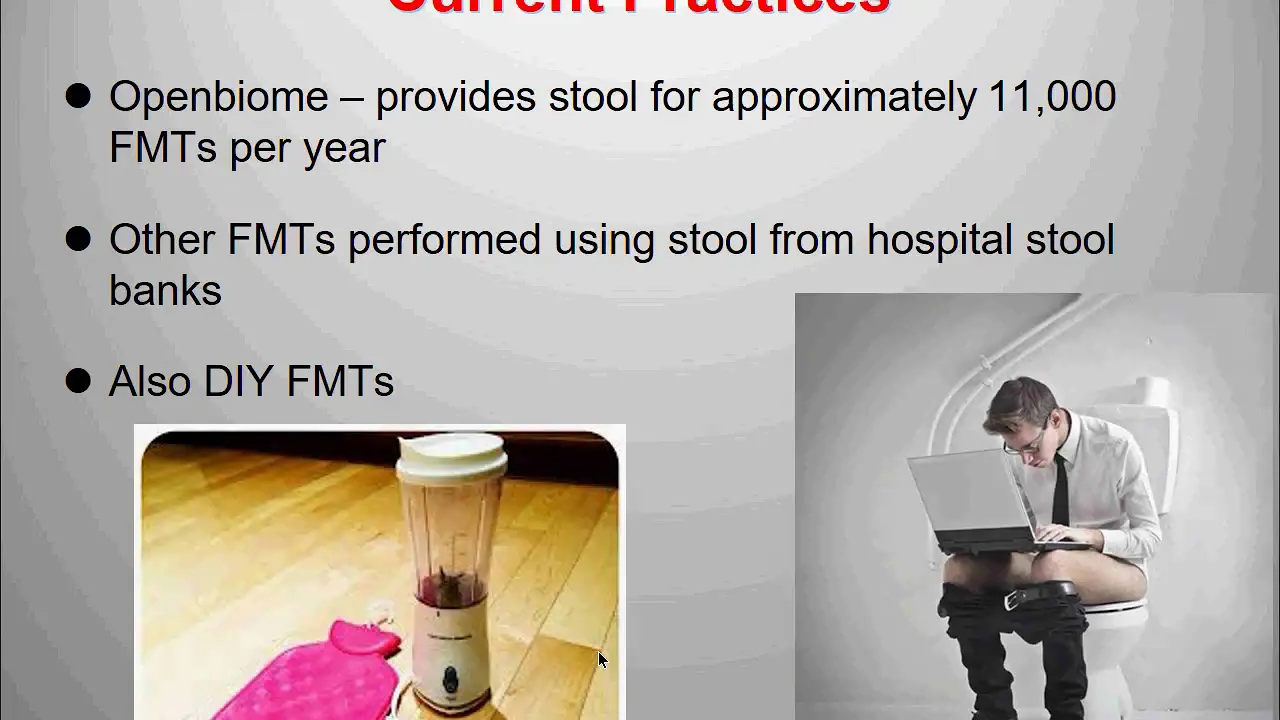
You take the poo. You put it in the blender. You mix in some saline solution. You whiz it up a little bit.
And then head down, bum up, up the bum.
Squeeze it in.
Initially, of course, I was really grossed out.
But once we did it, it was like, "Huh, is that it?" We didn't know if it was going to work. We didn't know the best way to do it. We didn't know how often to do it. We were just It was a shot in the dark.
I did agree to monitor Jane.
It was a a little bit of a dilemma because you're stepping outside of any protocol on treating bipolar disorder.
That's for sure. But I I I figured to myself I'd rather be in touch with and know if there are problems.
>> Many because I have bipolar.
>> Nothing happened for the first six FMTs in about 3 months. And then the magic started happening.
I started to get out of bed earlier and I noticed my depression just becoming less and less and less.
>> Jane just got, I guess, happier, happier. She was happy with who she was. She was more confident.
And then there was this one day that I'll never forget for the rest of my life where I woke up and confused because I was like, "What is this feeling? Do I feel good? Is this what feeling good feels like?"
I remember this one day we were on our friend's farm and I was like, "Alex, stop the car. I want to get out and run." I just had a motivation and urge to run. Like I used to run as a kid.
It felt simultaneously freeing and also like, "Oh you're out of you're out of shape, Jane.
You haven't run in 20 years."
>> And she ran down the driveway in front of me and it was it was really good.
>> You see in her demeanor >> that a cloud had lifted.
>> She became the person she was meant to be.
The depression was just gone and it's never come back.
>> Periodically, we'd spoken on the phone, hadn't we?
>> Yeah. Yeah.
>> And you you'd let me know how you how you going and every time I saw her or spoke to her on the phone, things were better mentally and physically.
>> Did you initially believe it or >> Oh, yeah. I believed it, Jane. But it it's always, how can I put it?
I'm not impressed at all by shortterm >> Yes.
>> improvements. The proof of the puddings.
How long will this last?
>> Yeah. Then she wanted to go off her meds.
>> You weaned me off my medications and he was against the idea. And he was right to be cautious because even under his guidance, I had a manic episode and it was a doozy. However, that was the last time that I was manic. That was in September 2017. So, I've been free of mania since then and free of all depression since about March 2017. So, that's going on eight years now.
>> It's kind of hard to over estimate how how incredible that is. I actually wouldn't believe it if I hadn't seen it with my own eyes.
I'm making this video because I thought it was about time that I started to share my pretty phenomenal story of uh curing, yes, I'm using the C word, curing my bipolar one disorder through a pretty out there experiment with poo.
>> When I got well, I wanted to shout from the rooftops. It's called a fecal transplant and it has worked beyond my wildest imagination.
So I joined every single bipolar community support community on Facebook and Reddit and I just shared my story on all of them.
>> Thanks for listening to my story.
>> The push back was fast, heated, and quite unpleasant.
>> Bipolar has nothing to do with the gut microbiome. this is ridiculous or you didn't have bipolar in the first place or your psychiatrist is a quack.
I was like, "Right, nobody's going to take my story seriously unless we can replicate this and confirm this in clinical trials."
One of the first people I reached out to was Professor Feliz Jaka at the Food and Mood Center, which is a part of Deacon University. Feliz coined the term nutritional psychiatry. She's a a legend.
>> Hi.
>> So good to see you.
>> Look, I think there's often these sort of miracle cures touted, but it made sense to me.
>> We have so many poo jokes. We're all quite um immune to it. You know, we'll have very deep conversations about poo over lunch.
>> Nice.
>> Yeah.
>> Understanding just how important the gut microbiome was in brain health and also in physical health more broadly. Um, it really made sense to me that gut focused therapies like FMT might have a really important therapeutic role in psychiatry.
>> Did you doubt that my story was true?
>> No. Jane's case was literally the inspiration for us conducting the moving moods pilot study that turned out to be the world first published results of a randomized control study of fecal transplants for depression.
>> Frozen vegetables.
>> Yes. you know, there were no terrible side effects. No one got sick or anything like that. So, that study is absolutely critical in allowing us to apply for funding to do a fully um scaled trial.
>> Thanks for inviting us to your beautiful home.
>> Jane reached out to me and told her story and I I was incredulous. It's a great opportunity to do a review.
Professor Gordon Parker. He is one of Australia's top psychiatrists. He was the head of psychiatry at the University of New South Wales. He's the founder of the Black Dog Institute and he's been researching bipolar for 40 years.
>> Jane's story um knocked my socks off. It was a story that caused me to say wow and keep on saying wow for quite a long time.
>> Your story challenges what I've been doing all these years.
It was important for me to check the story very carefully with Jane, with Alex, also with her managing psychiatrist.
>> I just remember at the age of 16 taking at least 10 courses of antibiotics over an 18-month period. And it was during that time that I developed really serious depression. And I now believe that the antibiotics played a huge role in just nap palming my gut microbiome and taking out whatever keystone species was necessary for my brain to produce dopamine and serotonin.
>> I've had three people in the last 6 months and they had late onset bipolar disorder following an antibiotic. The way we've been treating depressive disorders has essentially been by drugs up to now.
>> We're repeating those errors. This is such a paradigm change in terms of how to manage bipolar disorder that it is so unanticipated, so unexpected and that gives us the opportunity for a completely new approach focusing on the gut microbiome.
I thought that the best way of taking a story forward was to write a book.
I needed to investigate the science. So I reached out to Professor Immad Elmar.
He's a highly distinguished gastroenterenterologist. He edits the number one gastroenterology journal in the world. He understands the biome.
>> I heard the story and uh I have to say that I was not dismissive uh because I understand the gut brain access and the role of the microbiome in this. By doing this fecal microbiota transplant, they in essentially replace the ecosystem in Jane's gut by somebody else's. And uh in her case, it worked spectacularly.
A healthy gut microbiome that is the result of healthy living, healthy diet and so forth is fundamental to the way the the brain works because it regulates the brain.
[Music] When I got well, I was like, "Okay, well, how do I keep my gut bugs happy?
I basically fundamentally changed the way I ate. We cut out the majority of processed foods. I started growing a lot of our own food. I started cooking things from scratch, [Music] predominantly plant-based with a lot of different fibers, a little bit of meat, and some fermented foods.
You have to feed the microbes the food that they want.
What we know from about 15 years of research in nutritional psychiatry is that the people who have a diet that is more traditional whole foods, real foods, and lower in modern foods, ultrarocessed foods, tend to have a reduced risk of developing depression in particular.
Jane's story certainly persuaded me as a clinician to now encourage anyone who's got a significant biological mood disorder to focus on their diet.
[Music] The ethical dilemma I have about continuing to share my story is that I run the risk of promoting uh a therapy that is potentially extremely dangerous if the donors are not properly screened.
This is obviously really dangerous.
There's a lot of pathogens that can be introduced via stool. There's a lot of um antibiotic resistant genes that can be life-threatening.
>> There are stories about transferring for example obesity or you know anxiety and so forth. So selection of the donors has to be a scientific approach. It's not just a random one. It's not your you know your friend or your partner because you have no idea what they might be harboring in their gut. for doctors and psychiatrists to take it seriously.
That's why we need to do a fully um scaled trial to see whether it actually works or not.
>> I'm still contacted regularly from individuals asking me how they can be part of uh FMT research and I wish I could tell them that these studies are happening.
>> The food and mood center have a trial ready to go. It's been ready for four years. They've been trying to get funding unsuccessfully for four years.
>> Are they accepting the research? So we estimate that the fully powered uh randomized control trial of fecal transplants for depression would cost up to $10 million. Mental health and suicide cost the Australian economy $70 billion per year. So when you think about it that way um $10 million or less is really a drop in the ocean.
>> I'm absolutely signed up to the new paradigm and I encourage all of our colleagues in psychiatry to uh get interested in this and to drive it forward. Let us do it through clinical trials that are adequately controlled and then we can try and provide the answers so that it's once and for all established as a treatment.
[Music] >> I am now in a place that I could only have ever dreamed to be in when I was that severely mentally ill woman that I was only 8 years ago.
liking the lack.
>> Jane and I often work together on ecological surveys.
>> If you look at like scratch marks, if you can see evidence of >> she's doing university degree, she is doing really well. I'm incredibly proud of her.
>> Would you think there would be geckos in >> Well, this is to get the um the sun.
>> I feel like in a very real way that Alex loved me back to life. That's what it feels like.
>> You're pretty lucky that I like lizards as much as very lucky that you like this.
>> Alex has brought life back to our girl.
We'll be forever grateful for that.
[Music] >> Didn't think Jane would have a future like that.
>> So Jane and Alex's wedding was a a very special day.
>> No bouquet for Jane. She had a frog.
>> I know that everything that happened in my past was worth it. And I would do it all again if it meant I would be standing here makes me loud.
[Music] >> It's so delightful for us to witness the the love in her eyes.
>> It was a wonderful day.
It's just your your run-of-the-mill average fairy tale romance really. You know, woman meets frog, frog leads woman to man, man and woman fall in love.
>> And there was no kissing of frogs.
>> No kissing of frogs. Man cures woman's incurable mental illness with his magic coup, thus breaking the curse. Men and women live happily ever after. You know, it's cliche.
>> Yeah.
How I feel [Music] sitting at the bust of killing time. A smile on my face and I'm feeling fine.
The ghound bus comes into view. Now honey, I'm coming home to you. Though I have been so far away, your love sustained me every day.
My heart burns for you.
Up Next

Probiotic Strains for Disease Prevention: A Clinical Guide
@drrajsree
99.6K views•2024-11-30

Graphic Medicine: Comics for Collaborative Healthcare Communication
@nationalpatientadvocate
189 views•2023-12-04

Neuroanatomy: Central and Peripheral Nervous System Divisions Explained
@AKLECTURES
136.2K views•2014-09-20
Stages of Labor and Vaginal Birth | Childbirth Animation
@nucleusmedicalmedia
52.1M views•2017-08-18
Related Study Plans & Knowledge Roadmaps
Structured learning paths in Medicine