


















This lecture covers the fundamental equations of stellar structure, including hydrostatic equilibrium, energy conservation, and energy transport mechanisms (radiative diffusion and convection), demonstrating how these interconnected equations form a coupled system that can be used to constrain Beyond Standard Model physics by comparing theoretical stellar evolution predictions with observations.
Astrophysical Probes of Fundamental Physics Lecture 2
Added:Fundamental stellar structure equations, including hydrostatic equilibrium, mass conservation, radiative transport, and energy generation.
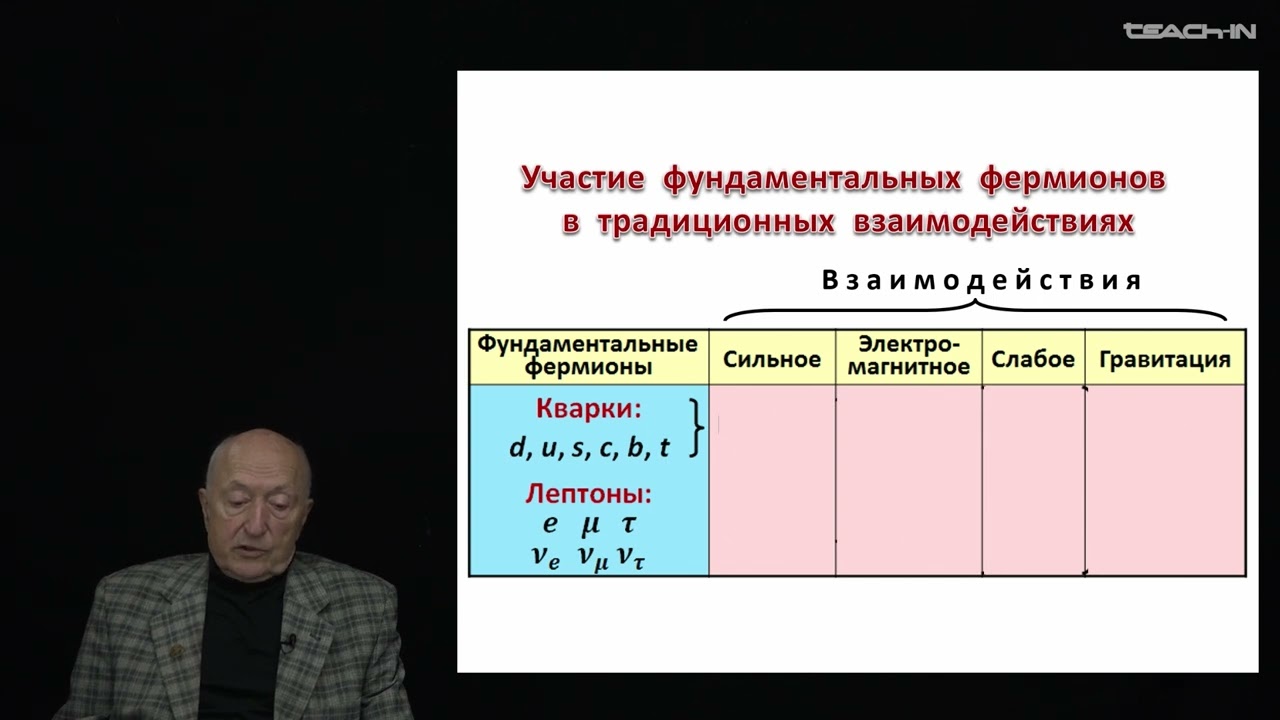
Basic tenets of the Standard Model of particle physics, specifically the classification of elementary particles and their fundamental interactions.
Concepts of quantum mechanics and statistical physics, particularly Fermi-Dirac degeneracy pressure in compact objects like white dwarfs.
The qualitative stages of stellar evolution, from the main sequence to stellar remnants.
Using observational cooling rates of white dwarfs and red giants to place quantitative constraints on light weakly interacting particles (such as axions or dark photons).
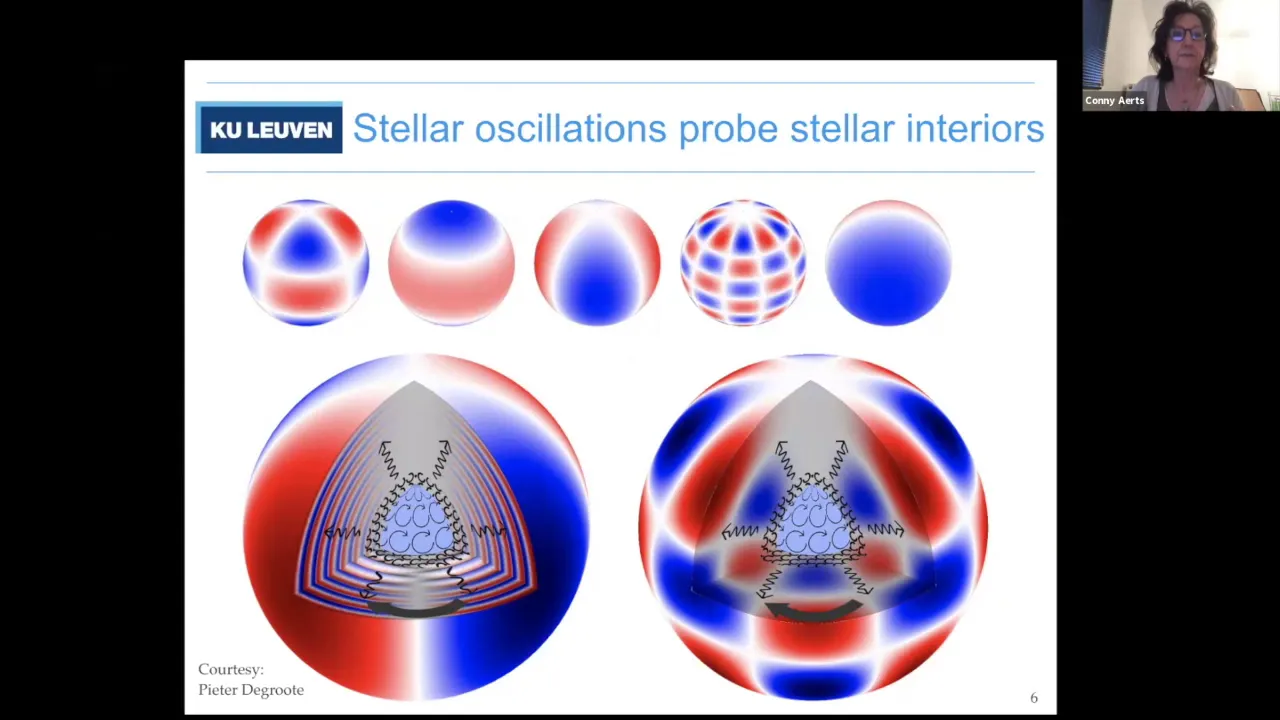
Advanced asteroseismology techniques using data from missions like Kepler and TESS to probe the deep interior profiles of stars.
The physics of core-collapse supernovae as extreme laboratories for neutrino physics and exotic particle production.
Applying stellar physics constraints to larger cosmological models of dark matter and the evolution of the early universe.
333 views6likes1:19:05Original Release: 2024-06-26
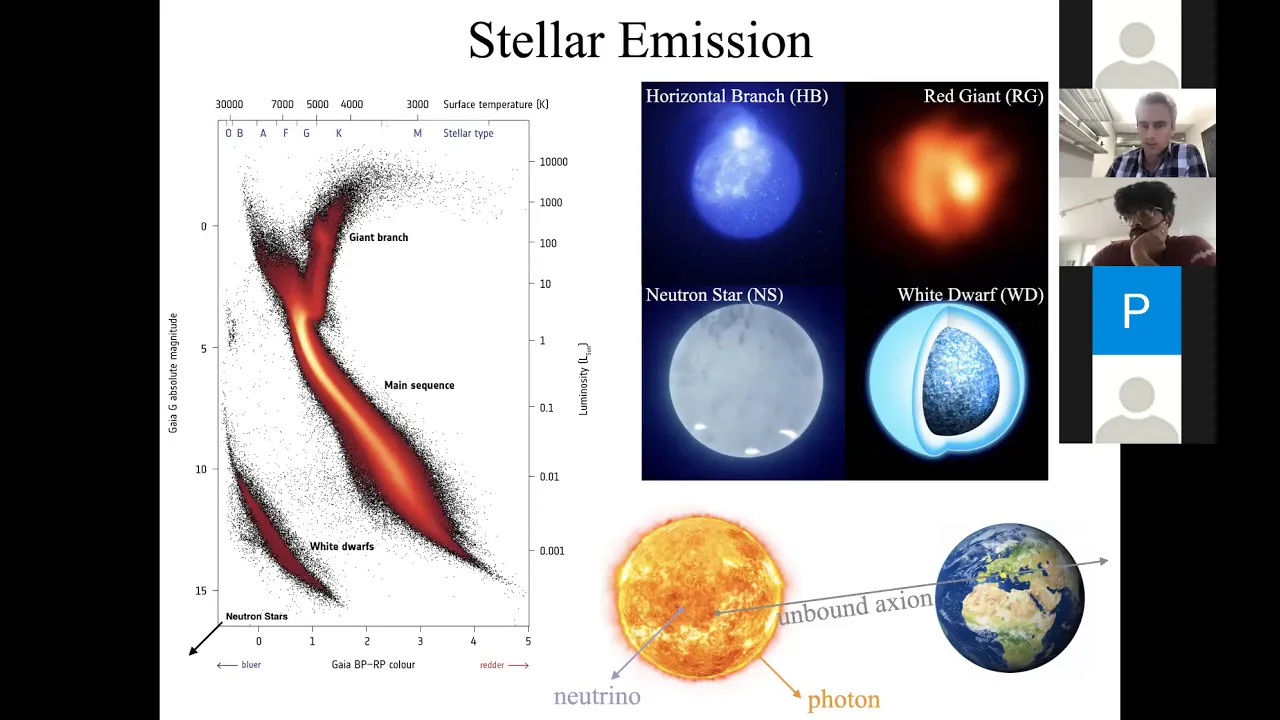
e e e e green light on yeah cool so you can get going whenever you're ready all right I'm gonna I think we have most of the stragglers yeah I usually clap but I didn't oh I can also do the like summer camp thing like yeah someone went to summer camp let's try that again sorry good you've trained them so rapidly well it's just it's like summer camp no all right hi guys welcome back um this is a a continuation of yesterday's lecture um so just as a quick reminder the kind of overview of the lectures um we're going to talk about astrophysical probes of BSM physics this is topic one we're going to make it and that's what we're going to continue to talking about today um and actually today we're also going to incorporate a little bit of uh break it and shake it as well um but just to give a really brief recap of what we talked about yesterday just to jog everyone's memory um photons are really really slow at coming out of the sun just because they are constantly scattering off of stuff uh I don't know if people are on the slack but um you know someone asked a really good question yesterday about um could there be some photons in some tail of the distribution that make it out without scattering and the answer is no because the odds of that happening are e to Theus 10 to the 11 okay so definitely not um so yeah photons are really really bad at uh transporting energy in stars um and uh you know if we think about BSM uh the stakes are pretty high we can set some of the strongest limits on axons um dark photons Mill charge okay so there's a lot to try to understand here in terms of how the emission of these particles might affect the interior of a star okay and so yesterday we started um getting into that a little bit so as a quick uh recap what we started talking about yesterday I mean actually this whole little subtopic goes by the name um the equations of Stellar structure okay and um I got also some really great questions after the lecture yesterday of like oh well you know how do we know that the star in the binary where we measure its mass has the same physics as the star you know of a solo uh star that doesn't live in a binary okay there's actually something it's called the uh V Russell conjecture okay and this is the same russle of hrung Russell like uh like this diagram over here and I just learned at the coffee break from Tom that I guess this russle guy was really prolific and he has a ton of other stuff named after him so that's really really fun um but these are the days basically where um this V Russell conjecture is like if you have n equations and N unknowns you can find a unique solution um and that's basically all this conjecture is so we're going to derive some of the equations of Stellar structure um and we're going to show that like you can actually uniquely specify what kind of star uh you have if you know its initial mass and its initial metallicity or its initial composition okay so that's how we know that you know the stars and binaries you know if you can measure certain things about it those are representative of stars and Singleton Okay cool so all right just as a recap um yesterday we showed that if you have some little parcel of plasma then it's position um no oops drdt squared its position or its radial location in the star is governed by this equation U minus one on row dpdr minus g m enclosed over R 2 okay and that's just um fals ma basically reexpressed in a slightly different way and we usually ignore this for main sequence stars because as we discussed yesterday stars in the main sequence are really really stable um if you didn't have pressure they would actually just collapse and about you can do the calculations it's about half an hour okay so because they're stable on tens of millions or tens of billions of years okay this is to good approximation negligible okay so this is um this is uh telling you that PR gradients have to play a really important role in stars um also we talked about what are the sources of pressure okay you can have you know um ideal gas okay you can have radiation [Music] pressure you can have degeneracy [Music] pressure okay you can have crazy neutron star stuff okay where we actually there's there's quite large uncertainties on the um neutron star uh what's called the equation of state so all of these things go by the name equation of State okay I'm actually not qualified to talk about this last point maybe some of you in the audience uh know more about this so maybe uh you can identify yourselves at a coffee break all right um so these are kind of two of the key equations of Stellar structure we talked about yesterday um now let's talk a little bit about the energetics okay so I'm going to do kind of like what I did yesterday just eyeballing it I think it was here all right so let's talk about the energetics okay or in other words the Luminosity okay the power okay um so conservation of energy just says that the change in the Luminosity that you generate over some radius um is equal to 4i R 2 okay and where that's coming from is if you just want to you know have your DL if you move this Dr to the other side then that's going to give you the volume of a thin spherical shell okay so we have a volume um we want to multiply it times something something that has units of one over volume so like a mass density or a number density would be suitable in this case we're going to multiply it times a mass density row of R okay so now we have something if we were to move this to the right hand side we would have something that has units of mass um but we want units of Luminosity which is units of power so we Define this quantity Epsilon it's a function of r and this is the energy production rate her unit Mass okay and it's a function of r just because depending on where you are inside of a star depending on what the ambient conditions are like in terms of the density and pressure um there may be uh you know differences in terms of how much energy you can produce okay so um some of the you know most obvious uh sources of this energy come from the nuclear reactions okay so I'm going to actually just put any of the like non-gravitational standard model interactions in here okay so I'm going to call this all my standard model stuff including neutrinos okay so that's one source of energy okay um but there's another really important source of energy um and that actually comes from the gravitational binding energy of the system okay um so uh basically the fact that you have this gravitationally bound object means that you kind of you know you kind of have money in the bank right you can uh either draw from that uh account or you can deposit into that account so this uh can have either a positive or A minus sign okay and um actually interestingly um some kinds of stars uh actually their uh energy production is dominated uh by this term for example you may have heard about uh Brown dwarfs uh you may have heard of them you know described as a failed star uh what's meant by that is just that they are failed in the sense that they are not hot and dense enough to generate any sort of nuclear energy Okay so because they don't have any uh energy coming from nuclear reactions you know they're luminous so we can actually still observe them and the source of their Luminosity is actually the gravitational contraction of the brown dwarf okay so in some systems this is a super super important term how how does the gravitational potential get converted into photons if there no AB yeah good question so um the energy so actually we're going to talk about this in a moment but you going repeat question oh my God yes the question was how does this energy get converted into photons if there's no nuclear reactions going on um actually as we're going to see in a moment the nuclear reactions are actually not really the most uh kind of necessary source of the photons um you can just make some energy and if you just assume something's in kind of thermal equilibrium uh you're going to just create photons from that thermal bath uh and then those photons are going to propagate out we're going to talk about that in just a moment but similarly yeah if you gravitationally contract uh as we'll talk about in like one minute you're going to heat everything up so you're going to make more photons okay okay so this is um this is basically a source or a sync depending on expansion or contraction okay so in the standard model this is these are all the terms okay but obviously we're here trying to understand physics beyond the standard model so now I'm going to add a term not going to really specify its form I'm just going to be a little bit General I'm going to call it ebsm and this is what we're trying to look for that's why we get paid the big bucks all right okay sorry that's right all right I think it was here roughly yes okay so more uh more following up on the comment I just said um so let's talk about this gravitational term a little bit more okay um this is this is a concept that's actually quite intimately linked um to the varial theorem okay so varial theorem you may recall from I don't know classical mechanics course or something like that um states that uh if you have you know something whose moment of inertia I is changing in time okay then that's equal to two * the kinetic energy plus the potential energy okay Square yes thank you yes all right normally actually when people derive the varial theorem they omit this term okay but actually it's it's there and because we're talking about um systems that can be expanding or Contracting uh this term can be important okay but in equilibrium this is just zero okay so because that's the easier case uh let me just uh hone in and just gain some intuition from from that case okay so in varial equilibrium just from that equation right there we have that the kinetic energy is equal to minus the potential energy over two okay and that means that I can express the total energy as the kinetic plus the gravitational potential energy and I can use that to express that as U over 2 uh or I can equivalently if I want to express that as minus the kinetic energy okay so kinetic energy always positive um gravitational potential energy for a bound system is negative okay so this is a quantity that's less uh than zero all right so what that means is that um if you lose energy from the system so if you have energy loss or in other words your total energy goes down then well okay so your energy it's already negative okay so it goes down so it becomes more negative all right so if it's becoming more negative then that means that the kinetic energy is becoming more positive right so if e total goes down that implies that the kinetic energy goes up and if the kinetic energy goes up the temperature also goes up okay so if you learn anything from today's lecture please please please uh for some of these bounds over here uh do not refer to these as Stellar cooling okay don't do it because actually the opposite is happening okay actually when you lose energy because of the varial theorem you're heating up okay but this bamboozles people all the time and actually oftentimes you'll hear these kinds of constraints referred to as Stellar cooling constraints when they are not okay so it's my pet peeve this is the hill I will die on so do not propagate this yes even if the temperature is going up if it's losing heat still be descrip as cooling what do you mean by losing heat though emitting energy so it's losing thermal energy energy is falling out while it's doing right but Second Law thermodynamics the volume is also changing so noodle that that's not what has nothing to do with heating compressing something isn't heating heating it it's doing work on it so this is so this e total is the DU of the this is in your second law all right all right moving on so um all right so this is how we're generating energy here's a comment so this is not not Stellar cooling so okay so we have these ways of making some energy have some rate of making energy so then um we make it at some little chunk in the plasma where does energy go so this is uh talking about local energy transport okay so there's kind of three main ways that you can um transport energy I think you like maybe learned this in middle school or something right you have conduction okay just from things touching right um actually in Stars conduction is usually not relevant with the exception being um neutron stars and white dwarfs okay so usually for regular stars on the main sequence we don't we don't really talk about conduction um but as you may remember from you know middle school or whenever you learned this uh we also have uh radiation and actually I'm gonna um use a slightly fancier term I'm going to call this a radiative diffusion all right and this is always active but as we've seen uh it's very inefficient okay okay and the third way uh is convective energy transport okay so um you know I'm a millennial so I love air fryers and right goes with the territory um and the reason why air fryers are so great is because they use a convective heating and convective heating is actually a lot uh more efficient okay so that's why you can have you know your chicken wings in like eight minutes or whatever um but uh unfortunately in a star the conditions are not always right so the conditions need to be right okay uh actually another thing I will note about convection um is that in addition to providing a means of energy transport it actually can also um create sort of uh smearing out effects in terms of the composition of the star just through kind of dredging up effects right you're mixing the contents of the star okay so um so for regular Stars okay so conduction is not really relevant radiative diffusion and convection are kind of the two main names in the game uh convection if it's allowed is going to be the dominant one okay and stars are very heterogeneous in terms of which one of those two dominates and in fact even within a given star you know depending on where you are in the star it can kind of be one or the other okay so for example the sun has kind of a radiative core okay where it's actually mainly radiative transport that's relevant uh but then it has a convective envelope okay so this is like a sunlike star um you know some stars have it kind of the opposite some stars are fully convective you know there's a there's a mix um and basically to determine the conditions for whether or not you can have convection um It's actually kind of based on Archimedes principle of like if you have some little chunk of plasma will it float or not yes or no if it will float then yes you can have convection if it will not float then it's radiation okay sink needs to sink right so so we're generally making energy in the core of the Star right and so then you want to ask how can we transport energy out um if the thing kind of goes out and it comes to some kind of equilibrium it can sink back down actually yeah so I'm not going to derive it but I will challenge okay so the question was is there a reason why this is more relevant in the core versus the envelope my challenge to you okay I'm not going to derive it but you can show that for um for a little chunk of plasma okay that is moving adiabatically okay so in other words if it's uh pressure obeys some kind of law like this where this is my adiabatic index okay um and if DT by Dr is less than or equal to gamma minus one over gamma T over P time DP Dr okay so to answer your question it really just depends so let's say you have uh you just want to treat this as a monoatomic ideal gas or something so um you may remember from like a thermal class that that has a adiabatic index of 5/3 so you plug in that number over here and you just look at kind of the local temperature pressure and pressure gradients and those are the conditions that allow you to have convection or to not have convection okay so I'm not going to derive this but um from everything I've said here plus Archimedes principle you can you can derive that if you if you're inclined you don't have to you can just take my word for it okay so that's how uh convection can occur but if it can't occur then this is really the the main uh person in town all right so uh otherwise for radiative transport okay I think it's uh helpful to again think about you know you have a a little maybe shell spherical shell of plasma and it's locally in thermal equilibri so you have some energy density u u * T 4th so this is the energy density okay and right now uh I'm being a little bit Photon Centric okay so um you know if you want to uh generalize this to something that's not a Photon um you're you know if it's not in thermal equilibrium then all bets are off but it is if it is in thermal equilibrium you just have to change the preactor here all right so um we're going to want to look at energy gradients so I can express du drr in terms of DT DT Dr just using the chain Rule and I'm going to get 4 pi^ 2 T Cubed on 15 * dtdr okay so that's just telling me uh what my temperature gradient what my energy density gradient is going to be but what I care about um is how that energy density is being transported so I'm going to imagine zooming in I have this shell okay again uh this is a radius R this is a radius R plus Dr okay and down here I have some local temperature which gives me a local energy density U and up here my local energy density is going to be U plus du oh sorry I know I have that flipped actually from how I have it in my notes I mean you can do it either way it's just a matter of how you want to Define it but because usually the Interiors of the star is hotter so it's going to have more local internal energy density and I want to ask how uh Luminosity is Flowing across this thin spherical shell and again this is radiative diffusion so you know I'm going to imagine that my photon is kind of doing some random walk through this thin spherical shell okay so all right if I want to compute my Luminosity at that radius R I'm going to do it as follows okay first of all there's going to be a 1/3 factor which is just going to be a fudge factor and that comes from the fact that you know it's not coming the light is not coming straight out necessarily it's coming out at some angle relative to our hat okay and so I'm putting a third as a fudge Factor here because this is the uh RMS of that angle okay so the average of cosine squ of theta is a thir okay then I'm going to multiply that times the volume of my show 4 Pi r^ 2 Dr this is the volume energy density okay all right so now I've got something it's got units of what so energy density so that there's a density that's going to cancel with the volume so this whole thing has units of energy but I'm trying to get something with units of power okay so I need to divide it by kind of a time scale and that time scale is going to be the amount of time it takes for my Photon to go from here to here okay and as we said yesterday you know if you're doing a random walk then the amount of time it takes it's going to go like the number of steps squared okay so going to divide by Dr over L mfp which as a reminder is the mean-free path I'm going to square it okay because this quantity right here is the number of steps and I'm almost done I still don't have something though that has units of uh Power so I need a time scale and the time scale I'm going to use is going to be the free time so the amount of time uh each one of my steps is taking okay so this is the time per step okay and I think there has to be a minus sign here in order to be con uh consistent with how with the conventions of how I drew this yes uh sorry I had some CLI oh yes there we go good you guys are paying attention okay so that's that's going to be one way of expressing my Luminosity oh question here you have differentials on we're gonna we're gonna move stuff around yeah yep that's right I'm being very Photon Centric right now so sorry ah why uh just cuz yeah I mean if you want Yeah well yeah if you want to take uh neutrinos into account yeah maybe I'll I'll decorate this with a photon here Photon those are the only two things or this is the only thing really that depends on photons so far in the discussion we're about to say some more stuff about the meanf free path that will be more Photon Centric um but you know if you have some species that's light and it's in thermal equilibrium then like I said all you're going to change is there's going to be some different preactor here okay yep good question the question was why aren't we thinking about neutrinos okay okay so yep continuing on this theme of being a little Photon Centric so this uh mean-free Path U maybe I'll decorate this with a little gamma to remind everyone that this is for photons um is going to be one over the photon number density times the Thompson cross-section all right right for neutrinos the mean-free path can be much longer or for BSM it can be much longer all right so rearranging things a little bit Yeah rearranging things a little bit bit what we find is that what this Luminosity gives us is a temperature gradient right so I can you know plug in my differential energy density that I got up there okay I can plug in my mean-free path I can rearrange this equation and I'm going to find that DT by Dr R is going to be equal to- 45 over 16 pi cubed times the Luminosity times the energy density times the Thompson cross-section over R 2 T cubed okay and again maybe I'll decorate this with some Photon symbols sorry this is actually the number density of electrons okay I'm just decorating it with these gamas to remind you that this is um the equation that's relevant for photons but from this discussion it should be quite straightforward to generalize it to other kinds of species okay and so um basically now we have come pretty far because now we have pretty much all the equations of Stellar structure that we need um I derived them for you in a very spherical cow way okay where we were neglecting a lot of really interesting physics for example we have been assuming okay that the star is spherical we know Stars aren't spherical we know they're actually oblate like an M&M okay uh we also know that stars are rotating so the sun is like rotating about once a month and uh We've completely neglected angular momentum anywhere in this discussion okay we've also ignored magnetic fields okay one number one way to uh you know scare away an astronomer at a coffee break is to say the words magnetic fields and watch them run away okay so we've totally ignored that um but it's actually super important in certain kinds of environments and for certain types of searches for beond and standard model particles Okay so we've ignored all of that because it's way too complicated but actually I hope that even at the spherical cow level you can kind of appreciate that um this is actually a really complicated uh kind of set of coupled differential equations so kind of just to give you the the whole kind of logic of how this whole system kind of flows all right so let's say you want to study BSM physics so you want to add some term like that okay so we're going to change my Epsilon okay and so the downstream effects of that is that it's going to change uh my DL drr okay over here and this is just this this is just conservation of energy okay but if I change my dldr okay so I'm changing my Luminosity profile in this star then that's going to feed into here right so I'm going to then change my dtdr okay but if I change my dtdr then it kind of depends on what your Stellar equation of state is but regardless these things tend to depend on the temperature so you change your DTD are and that has the downstream effect of changing your DP Dr but if you change your DP Dr then you're going to change your density row okay because now the amount of pressure support you have to support the star against collapse is changing and all of these changes are going to back react okay so for example um you know when you change uh dtdr okay you're actually also going to change Epsilon okay because a lot of the kinds of processes that are responsible for generating energy for you are highly temperature dependent yeah there's a question here oh I think it's just because of how I defined uh my du here to be higher in here so it's just because of the sign of the DU I think if I had put the DU over there it would have you know had the had the opposite sign just a convention yeah it just means that the energy is Flowing outwards basically so from regions of high temperature low temperature right so anyway if yeah if you changed gdr you're going to change Epsilon because you know these nuclear processes are quite sensitive to the temperature um gravity doesn't super care well maybe it cares because youve changed kinetic energy well okay I don't want to get into that but yeah a lot of BSM processes are also highly sensitive to the temperature for example um the plasmon production of neutrinos that we talked about yesterday I think it if I'm not mistaken I think it's like temperature to the 7th power okay so it's actually really sensitive uh to that okay uh or if you change the pressure then again depending on the equation of State you can change the temperature okay uh if you change the pressure you can actually also oh no do I have anything I have a whole flowchart here it looks like a serial killer or some kind of you know police procedural person you know with all the arrows and it's all interconnected really you know what I'm talking about you know those shows uh where they have the you know yeah uh then what you know okay you change row you're also going to change the pressure equation of State you can change the uh Luminosity because you're going to change the number density you can change Epsilon because again a lot of these things are depending on the density right it's all super super interconnected okay and this is a total headache okay we don't want to deal with this so in fact um you can't really generally solve this system of couple differential equations inclosed form with the exception of a few like very very unphysical toy models um so what we do is we just put this on a computer so there's some really nice code packages that people have done all of this um for example Mesa is one of them modules for evolution Stellar astrophysics um there's also garst which is the Garing Stellar Evolution code okay those are just two examples but there's there's other ones um and because you know we decide okay we're going to just put this on a computer anyway right then you can incorporate some of the effects that I talked about which we had ignored like you know not necessarily needing it to be spherical or you know maybe you want to talk about different nuclear processes and you want to add convection and dredge up and all these things so you can take that all into account when you put it on a computer but another thing whoops another thing I'm really trying to impress upon you um is that you know I think kind of the days of um you know in kind of the you know maybe the 80s or something before we had these really nice Stellar Evolution codes kind of the state-ofthe-art for constraining Beyond standard model physics was like I make a particle uh does it free stream out of the star yes or no if the answer is yes then I compare that uh total integrated emission to the integrated emission of neutrinos and if the total integrated emission is bigger than that of neutrinos then I say oh I'm going to draw line okay and that was what we were doing in the ' 80s but I think in the Advent of the Stellar Evolution codes um and given how um interconnected and complicated all these processes are uh it's really you know it's now the time to move kind of past that um and you know it's also true in the Advent of like new data that we have from Gaia from Astros seismology with Kepler um that you know some of the old arguments are not necessarily going to cut it um all right so yes question here do we know how much is the difference seriously um I think it's highly highly so the question was how much does this depend uh or sorry what's the difference of if we just uh were to treat this in terms of the full you know coupled system versus if we just did the naive thing how much does it depend or how much does it change the answer and I would say it really depends on the type of BSM model that you're considering just because of how the uh production of energy depends on the temperature uh and the density so actually I'll show you an example in a few slides which I can speak more to from my own work but that's going to be a very model dependent example so yeah yeah question here is it easy to introduce some BM effects where all of the changes cancel out leave observables the same or do you have to find really hard thoughts in prayer so the question was is it possible to introduce BSM effects where all of the effects cancel out um I don't know can a te Kettle be orbiting the Earth at the L2 lrange point I can't rule it out but okay so um oh question over here good I'm going to get to that in a the question was if we have an excess of energy production from BSM how can we detect that so I'm going to come to that in a moment all right but for now um let's just uh let's go into kind of maybe Story Time mode so um here I just pulled this off of YouTube there's like countless many examples of this so here's just one that I thought looked pretty um and this is um someone ran uh Mesa Stell Evolution code and I and they put in an initial mass of one Mass uh an initial radius um and it looks like so over here this is the composition okay so it looks like very close to primordial where they put roughly 25% of the mass in helium and the rest in hydrogen and very little other stuff okay so maybe this is a type two star or something like that and this are the kind of the initial inputs and you can run Mesa and you can kind of watch what's going to happen so you can kind of see up over here right you can see how this thing is going to evolve in something that looks like a Herz Bron ruell diagram so this T effective is the surface Photon temperature that we observe and Luminosity is what we observe okay um because of how they have the time unit scaled we've already left the main sequence by now um so now we're actually on one of the where are we we're on the probably the HB horizontal branch so just to oh I called it the helium block where they go back down yeah so usually it's HB which can either stand for horizontal Branch helium burning just don't call it late for dinner okay so um this plot over here is showing um just as a function or you know what like what is the relationship between temperature and density inside of the star and uh this is showing like these colors are showing like you know when the conditions are right to have certain processes like nuclear processes is um producing energy at a certain rate okay and these different Contours correspond to the known Contours when you can have nuclear uh reactions happening let's watch it again because that was really fast all right so okay so it's pre-main sequence it's on the main sequence and it's quickly going to leave the main sequence okay so now it's left the main sequence okay and eventually you cross this threshold where o now suddenly you can have helium burning so you get this helium flash which changes things and this changes the the relationships uh you get these oscillations going on okay uh you know eventually you keep you know heating up and having like more and more uh energy loss from nuclear processes eventually are you going to cross the carbon burning phase I don't think so because this is a low mass star okay but it's going to kind of flirt with that boundary for a while it's oscillating a bunch okay and then something crazy is going to happen uh any moment now yeah look at the upper left corner look at o that just went that way shot that way and then it looped back around so that's that point where it shoots to left that's called planetary nebula it's like a it has a bad name because it has nothing to do with planets uh we'll talk about that in a moment and then the end phase is a white dwarf okay so that's like the more quantitative version of what's Happening inside of the star um so now it's time for story time the core of a white dwarf really sorry is the core of a white dwarf uh sorry the white dwarf oh sorry this is a this is a Proto white dwarf down yet no well I don't want to watch this whole video again they later so this is just a plot showing like the temperature and density conditions uh in the star um but uh you also need to have the um so these these lines are like if you have an abundance of that material then you can do this kind of burning but actually in the core of a white dwarf you actually mainly have carbon yeah yeah so I just so there's no helium burning because there's no helium because it's because it's carbon I would have thought the core of a whitew would be cool because it's denser I guess better conducting heat or something we will talk about uh white dwarf Cooling in just a moment okay or not just a moment but like 10 minutes okay how am I doing on time what time do this lecture end no okay perfect we're doing great oh question here this kind of Gap so here we have like that intermediate density then we have close to like somehow when very to I don't know Nuclear Physics I don't know this is above my pay grade question back here sorry how good is what yeah absolutely so again um the question was if Epsilon BSM is a lot smaller than Epsilon nuclear which it absolutely is uh then how much do we trust these codes um that's a really great question and yeah like Theory air bars are always really really hard to determine um as far as I know um there's a lot of tests that people can do to kind of calibrate these codes um to observed stars on the standard model side um and then another thing you can if you want to be careful about it when you put BSM physics in is you can try to put it into different uh codes which all use different schemes and you can try to compare uh the kind of uncertainties that you get from that so that's that's kind of a way of estimating Yeah question here is it always reasonable to treat stars as being like a like do their environments ever matter for evolution great qu uh yeah we'll come to that in a moment okay um actually spoiler alert the part where it goes crazy and goes to the left on the HR diagram is actually an example where it's like the star is actually just shedding all of its mass into the environment yeah Okay cool so um that's kind of the quantitative version of what's going on so now it's now it's time for a little kind of sorry did I say that was quantitative that's the quanti version of what's going on now it's time for qualitative story about what you just saw okay all right okay so now it's time for the story hour with Caitlyn so um okay so we have the main sequence okay as I mentioned already it's a mass sequence so where you are are on the main sequence is uniquely determined by your initial mass and your initial composition okay but then I'll Hell Breaks Loose once you leave the main sequence because then things aren't in equilibrium anymore we saw things were kind of like pulsating and doing weird things so um here's kind of the qualitative picture so Stars leave the main sequence when they run out of hydrogen in the core of the star okay so they've taken all the hydrogen and they they fused it up all into helium okay so then what that means is that you have a loss of local Luminosity L okay and I've erased some of the equations now but uh if you just look at kind of that flow chart over there um if you lose local luminosity you then lose um your temperature and your local pressure support so so you lose Luminosity temperature and pressure support and so then what that triggers is it triggers gravitational contraction so now the star is no longer to good approximation and hydro static equilibrium it's lost pressure support so it starts to collapse but as we saw from the varial theorem uh when it starts to collapse the temperature goes up due to the varial theorem okay so the local temperature goes up and uh then if we kind of then Trace that through the other you know equations of Stellar structure what that means is that the outer layers oops outer layers surrounding the core which were previously too low in temperature to support uh nuclear processes um they're now hot enough to have Fusion so the heat up and fusion can occur so that leads to what's called a shell burning process where you have the core of helium primarily and it's Contracting which is heating up this kind of core or this shell that's sitting right on top of it um so now it's hot enough that it can actually burn hydrogen and make helium okay all right so Fusion can occur in a shell and by the way the shell can actually move progressively outwards because then you know you have let's say you have nuclear fusion happening in a shell eventually that Shell's going to run out of hydrogen so now you kind of the same thing happens you know you then progressively heat up the next outermost uh shell and then now that shell can support Fusion so the the helium shell can actually grow through kind of subsequent phases of shell burning okay um what this means is that the overall Luminosity of the star increases okay because first of all we're gravitationally Contracting and second of all we have the uh nuclear fusion happening in a shell and shells have more volume than cores okay because of the Jacobian Factor um so the overall Luminosity is going to increase in the star and at the same time because the shells are hotter and they also now have nuclear processes going on that can you know give you a new source of energy that causes the shell to puff up so shell Puffs due to higher temperature and nuclear processes which again if you trace through all the equations of Stellar structure itus cuses this puffing up effect okay so um your increased luminosity and your puffing effect they kind of have competing effects in terms of what they do to the temperature of the surface of the star okay it actually turns out that the surface of the star the temperature goes down decreases and it's because this temperature to the fourth power scales like the Luminosity over the Stars radius squared and this comes from the flux coming out of the surface of a black body and this is just another way of expressing that flux so the Luminosity has gone up but the radius has also gone up um this one wins so this is the dominant effect and that's why the surface temperature decreases and so combining all of these you know things that are happening again this is story time so you know you can look to the code um you get the red giant branch and it's called the red giant Branch uh right so uh actually maybe I'll go back to the HR diagram that I showed before oops so indeed this is the red giant Branch um if you look at its Luminosity right the Luminosity has gone up compared to the main sequence and also the surface temperature right stars that were born here on the main sequence end up moving that way on this branch and so their surface temperature goes down okay so that's kind of the the words that go with the you know more numerical thing of what's happening on the red giant Branch oh there's a question here ah really good question so um this is really just we're looking at kind of the local yes uh why is it a branch and not the end of the main sequence like why why is there stuff over here is is that the question so we're just looking at a snapshot in time at the local so this is from Gaia this is um mapping out the local Milky Way um if you had a sort of isolated set of stars like a globular cluster and if there's no Active Star formation going on then this will this will not be here basically okay because the lifetime of these guys is really really short so they actually leave the main sequence first so uh I'll show in a few slides actually like a bunch of snapshots in time of like if you have a an isolated globular cluster with no Active Star formation like how that looks over time but because we're looking in the local Milky Way where we have active star formation going on you can kind of keep repopulating this part of the diagram yeah uh was there another question okay maybe I imag oh question here what is the approximate time scale of this transition uh for how long it stays on the red giant Branch I would say it's on the order of 10% of the star's lifetime say how quickly this process happens like really quick like over uh I think good question I think it's like maybe tens of millions of years but I think it might depend on what type of star it is so what its initial mass is I'm not exactly I don't have like a precise answer for you exposion no no definitely not so yeah Stars tend to kind of last like 10 order 10% of their life on the red giant Branch so it's like 90% of their lifetime on the main sequence 10% red giant Branch everything else is like happening really fast and again it like depends a little little a little bit on what type of star Okay cool so that's the red giant Branch as we saw in the video though that's not uh the end of the video so um then what happens so again the um core it continues to contract okay and again because you have this shell burning but then the shell can run out of hydrogen and so the size of the helium core is actually growing both spatially and in terms of its mass so it's going to continue to contract and um basically at some point you eventually get to the temperature uh where you have the helium Flash okay and that is um basically that's this temperature there it corresponds actually very well to a mass just again through the varial theorem so the like the core Mass uh corresponds to a specific temperature and at that temperature you get this helium FR flash process where you can have three uh helium 4 nuclei making a carbon 12 okay so this is also sometimes called the triple Alpha process um and actually this is a this is a resonant process so normally three body processes are face space suppressed but actually there's a resonance I don't know the Nuclear Physics of it but uh if I'm not mistaken I think actually from kind of Stellar astrophysics considerations it was known that this was a resonance be like in terms of Astro astrophysical observations before it was known experimentally or from Nuclear Physics I believe that's a true statement anyone in the audience who knows more can correct me if I'm wrong okay that's the truth then I guess great that's how that works um so uh when this happens this is when we get to the tip of the red giant branch and you may have heard of the tip of the red giant Branch actually in terms of um maybe you've heard about the Hubble tension and people using the tip of the red giant Branch as a way to calibrate distances and the reason why we can do that is because we just understand the physics of it very very well you know in terms of like what the Luminosity of a star is going to be when it gets to this point um because that directly correlates to just like the veral theorem basically you have a varial mass of your core which gives you a varial temperature which gives you the ability to do this triple Alpha process okay so that's the tip of the red giant branch and then now okay so now we can burn helium so then that transitions to this HB which can either stand for horizontal Branch or helium burning okay so I'll just call it horizontal Branch we didn't see much of a horizontal Branch I'll play the video again we didn't see much of a horizontal Branch for this um particular star uh but I'll again just talk you through what's happening okay so the star is on the main sequence and now it's leaving the main sequence okay it's kind of moving up into the right on the Herz spurn Russell diagram and then it's going to eventually cross that threshold you get that helium flash it actually goes back down and it kind of is like oscillating up and down and it's imperceptibly moving to the left okay you kind of can't really see it but for other types of stars it's more pronounced okay and then basically what you see is it starts kind of looks like it goes back up uh the red giant Branch again and what that essentially corresponds to is that pretty much a repeat of what we saw for the red giant branch is actually going to happen with helium as well okay so um we have the same qualitative thing when we run out of helium in the core and so that is what leads to What's called the asymptotic giant Branch or also sometimes called the double shell burning so the picture in this pH is that now you have this core of carbons that you made from this triple Alpha process okay and you've exhausted all of your helium so now um again the same kind of thing happens it contracts it heats up the surrounding regions now those surrounding regions are now hot enough that they can sustain this triple Alpha process and then progressively As you move out the temperature goes down eventually you get into a region where you can have just regular uh four protons going into a helium type of nuclear processes um and so you have two shells where nuclear processes are active and this whole time again we have this kind of uh puffed up layers layers okay just from the temperature going up and the nuclear reactions so they puff up and so you have low surface gravity um which means that the outer layers are really susceptible to uh you know any Stellar winds or anything giving you Mass loss Yeah question here so the hydrogen only was finished in the core yeah only in the core that's you know in a typical main sequence star yeah in a typical main sequence star you have uh nuclear processes are happening in the core but the outer kind of envelope is not doing uh very much uh nuclear fusion so there's just a pristine kind of hydrogen kind of waiting there to be fused at a later time yep anyway as I was saying you get these puffed up layers like a croissant or something uh you get low surface gravity which means you're susceptible to Stellar winds and so you have mass loss so again I'll just refer back to this calculation so watch the mass okay so start off with one solar mass okay we're going to go the red giant phase okay going to get to the tip of the red giant right about now okay so now we're helium burning we' got the helium flash look already we're down to 75 okay and this gets more pronounced when we go back up to the ASM totic giant Branch okay so now we're going to start losing mass at an even quicker rate okay so we're losing mass and eventually when things start to go crazy and if you look at the upper left plot when things start to move to the left then your mass loss is going to start to go kind of Haywire any minute now come on you can do it all right so your mass is going haywire your radius of your star is getting smaller because you're just shedding these outer layers and so the radius goes down the radius of the star Goes Down And as per this uh over here that means that the surface temperature T star goes up all right and it's at fixed Luminosity so that's why it's moving to the left okay um this is called a planetary [Music] nebula and you get these really nice pictures of planetary nebula where you kind of get the kind of core that remains and you see all the material that was shed and it kind of looks like a ring around the remnant which is pretty interesting so um then what happens the Final Phase that we saw on this diagram is that if your star is less than a certain Mass it's around roughly eight solar masses then uh your core varial temperature uh does not get hot enough to ignite carbon so you're not hot enough to carbon and you are left with a white dwarf okay and so that's what you're getting uh down over here you have this white dwarf so it's primarily carbon you can have a little oxygen mixed in there too but it's primarily carbon um and now I want to talk about a few uh ways oh yeah where are the of yeah this is the log of the mass density and this is the log of the temperature if you only oh how does this give me a line just because in a given star it's got a profile of different temperatures and densities exactly so at different radi you have different um like yeah so maybe it's a little bit confusing but this is kind of like a parametric plot so there's some third like independent variable and then these are your two dependent variables sorry can you repeat that that's right yeah yeah the temperature gradient it always goes from hot in the middle to cool at the edge okay so now in the last five minutes or so I want to talk about some um so this is all standard model stuff I want to talk about some BS Sam effects on what we just watched on you know in terms of the post main sequence so um first of all so here's just two examples this column over here um is this work um by ilio lop lop group sorry I don't speak Portuguese so pronouncing that badly um here's kind of the plot that I promised um to Ethan earlier of this is what it looks like if you have a population of isolated Stars with no Active Star formation in a globular cluster whose initial masses are between 7 and 3.5 solar masses and here is what their color Luminosity diagram looks at different snapshots in time okay so um kind of here's like early phases of the main sequence and you can see that as time goes on um progressively the hotter stars like leave the main sequence first okay and uh you can see it kind of propagates down the main sequence as time goes on okay and um there's actually two versions shown so for the solid line that's just the standard model uh for the dash line that's what happens if you have wimps annihilating in Stars so that's one kind of model that you can actually expect to constrain now you have to assume something about the capture rate of wimps in stars um so I don't remember what cross-section that they assumed but once you have that uh presence there of Dark Matter that's been captured inside of a star then it can annihilate and so it can contribute I've erased it but it can contribute to Epsilon BSM and it can change uh the Stellar tracks question here oh like 100 GV scale Mass yeah so like really a wh like a true true wimp okay well here's another example um that I'm more familiar with because it's my own work so Shameless plug um this uh in this work we looked at what was happening uh at the tip of the red giant branch and what was happening if you could emit Mill charge particles so um someone asked me a question earlier about like what happens like if you just do the kind of spherical cow thing and you kind of ignore all the couplings um versus do they actually matter and the answer in this case is actually yes they definitely matter um so here this plot is a little bit small to read so sorry about that um but what's being shown here is the temperature profile and the density profile um and the emissivity of millicharged particles okay and this is for different the so the the solid line is the standard model and then the two textured lines are different millicharged particles with different effective charges they're super tiny um but as you can see the temperature profiles are pretty different and the density profiles are pretty different and what that actually does is over here this is a plot showing the energy loss rate from different types of processes and um you know this dash line here is the energy loss rate from the millit charges but we also have the energy loss rate from all of the different neutrinos so the different lines are corresponding to different processes that can make neutrinos and what we can see is that when we turn on the presence of these millit charges uh what that does is it rearranges the density and temperature profile of the star in such a way that it actually quenches the production of neutrinos okay so there's that really important back reaction there where some of these processes I mean look at this this is a log plot and it spans like I don't know like 20 orders of magnitude so the fact that you can actually see these differences is actually quite significant in this context um eventually at the end of the day doing a similar thing as what was done over there with the mill charges you can see that um if you have no Mill charges this is the tip of the red giant branch that you get if you add millit charges it's up here and again because Mill tip of the red giant branch is something that's really really well studied for a number of reasons um there's really good observational measurements of this and so we can actually constrain the presence of millit charges in kind of my remaining two minutes I want to talk about the end stage which we just discussed which is the white dwarfs so um here's I think probably the best way of thinking about the white dwarf uh population so this is at the population level where this y- AIS corresponds to uh it's a Luminosity function which is the number of stars of a given Luminosity per unit volume okay and uh this magnitude is just a funny astronomer way of you know telling you how bright the star is so the bright stars are over here and the dim ones are over here and basically um white dwarfs So within the actual white dwarf itself someone asked about this earlier um it comes to a fairly uniform temperature because uh conductivity you know is able to bring things to the same temperature really quickly but then in terms of how that whole bulk star is actually able to uh cool down it's it's actually very very inefficient okay so one way to read this plot is to think that these are the the young white dwarfs that just formed and then the ones over here that are cooler um they've just been cooling down slowly over time okay white dwarfs don't have any nuclear processes so it's kind of simple in that sense and for much of this uh magnitude space the predominant way of cooling down the white dwarf is actually just by emitting photons from off of the surface of the white dwarf which is really inefficient right because the surface represents a very very small fraction of the total volume of the white dwarf okay um as promised yesterday I told you I would show the evidence for this type of process and here it is so this um process right here where you have plasmons decaying to a pair of neutrinos is predicted in the standard model particle physics and we see evidence for it because if you just had surface Photon cooling that's cooling down a star then we would expect to see more stars that are hotter right because they they wouldn't have had enough time yet to like lose their energy through cooling but when you add this additional Channel then you're able to cool more quickly so you're able to move from the left hand side of the plot to the right more quickly and that creates a deficit over here okay and so um because this agrees super super well in this range of magnitudes this is I think very very good evidence for this process now one thing you might also notice about this plot is that over here in kind of these intermediate range of magnitudes kind of between eight and 10 um there's a few here that have points with really tiny looking error bars um that are actually below what's expected from Stellar Evolution codes so sometimes people refer to this as a cooling hint okay so um that's where I'm going to stop for today tomorrow we're going to finish this up and talk about the seg way into breaking it so we're going to finish making it and then we're going to start breaking it see you [Applause] [Applause] tomorrow you really cooling so they don't contract anymore yes good they are yes they really are cooling because they're supported by a degeneracy pressure and so they're not Contracting and so when they lose energy
Up Next

74:51
Journey to the Edge of the Universe | Space Documentary
@wondody
80.4K views•2023-04-09

12:53
21cm Hyperfine Transition in Neutral Hydrogen: Radio Astronomy Basics
@AaronRobertParsons
12.4K views•2011-10-13

32:32
NMR Spin Physics I: Zeeman Effect, Resonance Condition & Larmor Frequency
@nptel-indianinstituteofsci8064
2.3K views•2024-01-17

27:14
Entropy and the Second Law of Thermodynamics Explained
@veritasium
27.5M views•2023-07-01
Related Study Plans & Knowledge Roadmaps
Structured learning paths in Physics
physics
Nuclear Physics (Decay, Fission & Reactors)
01Atomic Structure and the Binding Force
02Radioactive Decay and Half-Life
03Nuclear Fission Mechanics and Chain Reactions
+ 2 more learning modules
12h5 modules
Explore Roadmap
physics
Soft Matter (Polymers, Colloids & Rheology)
01Foundations of Soft Matter & Thermal Forces
02Polymer Physics and Macromolecules
03Colloids, Surfactants, and Self-Assembly
+ 2 more learning modules
38h5 modules
Explore Roadmap
physics
Analytical Mechanics: Lagrangian & Hamiltonian
01Mathematical Foundations: Calculus of Variations
02From Newtonian Mechanics to Constraint Dynamics
03The Principle of Least Action & Lagrangian Mechanics
+ 3 more learning modules
28h6 modules
Explore Roadmap
physics
General Relativity (Spacetime & Cosmology)
01Foundations of Relativity: Special Relativity
02The Geometry of Spacetime: Equivalence Principle & Curvature
03Einstein's Field Equations: The Mathematics of Gravity
+ 2 more learning modules
55h5 modules
Explore Roadmap