



















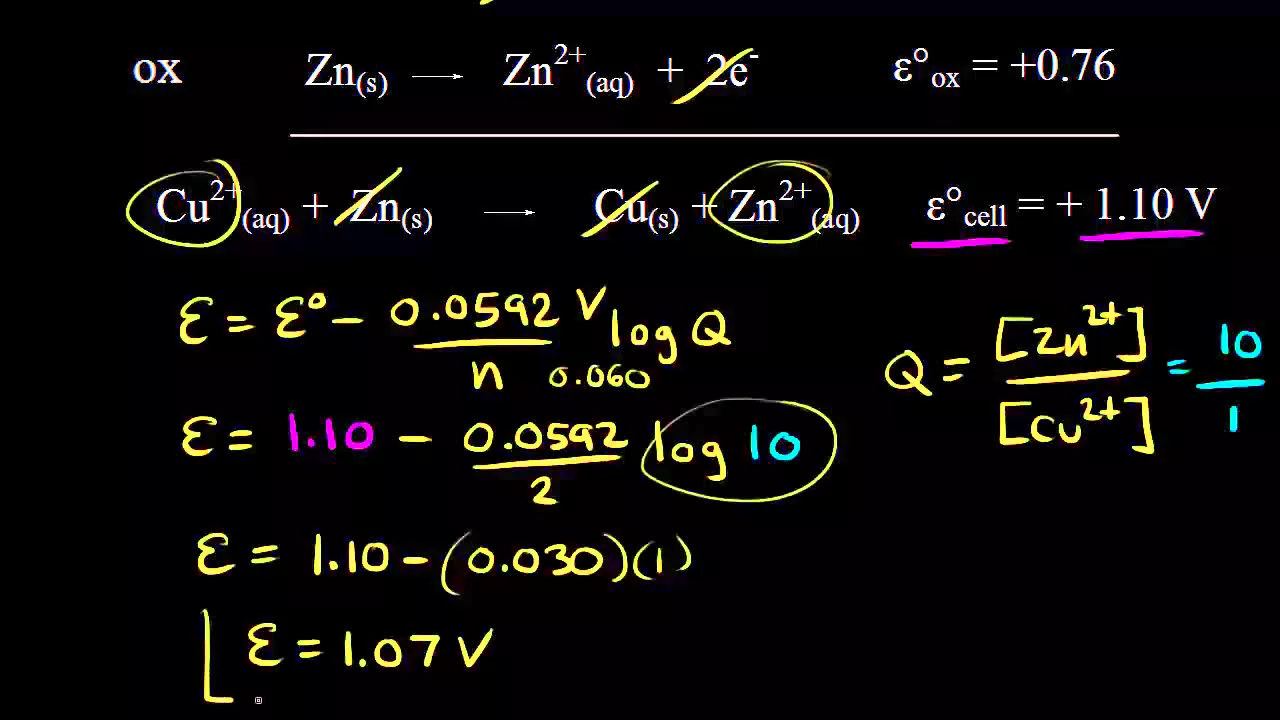







The Nernst equation (E = E° - (RT/nF)lnQ or E = E° - (0.0592/n)logQ at 298K) calculates cell potential under nonstandard conditions by incorporating the reaction quotient Q, where any stress that shifts the reaction toward products increases cell potential while stress shifting toward reactants decreases it, consistent with Le Chatelier's principle.
Nernst Equation Explained: Calculating Nonstandard Cell Potential
Added:Understanding of standard cell potential (E° cell) and how to calculate it using standard reduction potential tables.
Familiarity with galvanic (voltaic) cells, including the concepts of oxidation, reduction, anode, cathode, and electron flow.
The definition of the reaction quotient (Q) and its mathematical formulation based on chemical equilibrium principles.
The thermodynamic relationship between Gibbs Free Energy change and electrochemical cell potential (ΔG = -nFE).
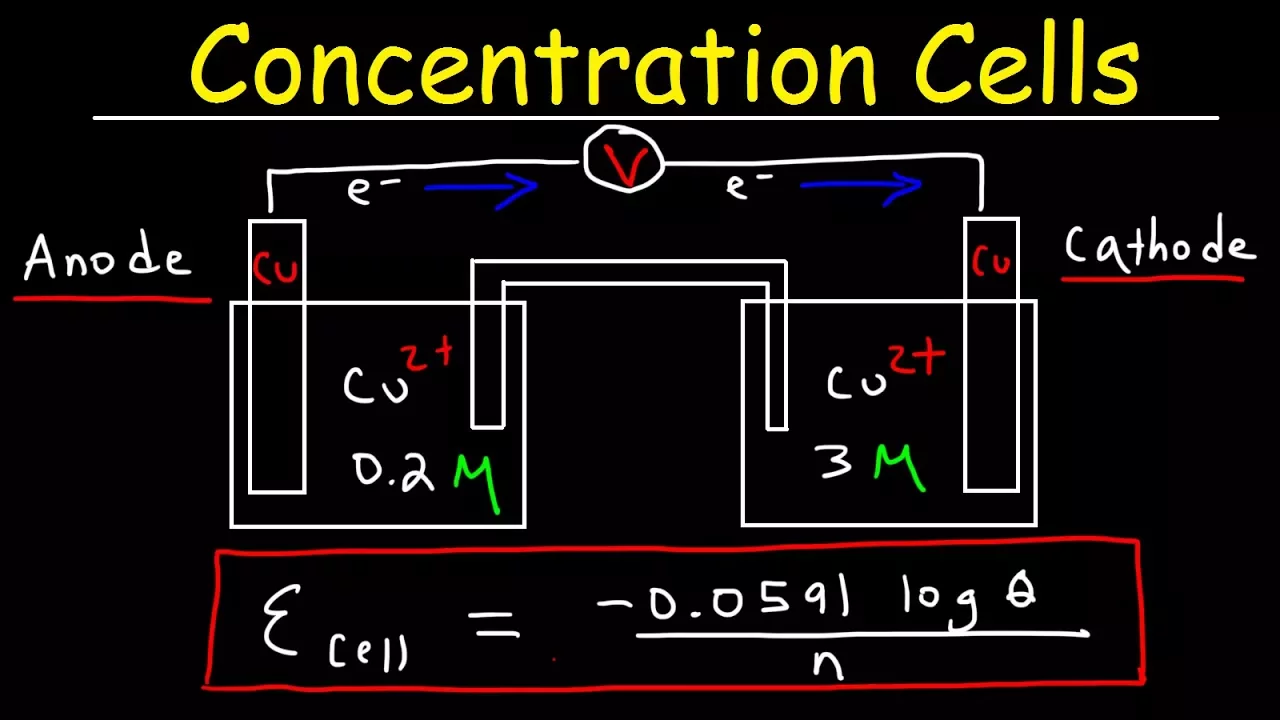
The study of concentration cells, where voltage is generated solely by a difference in concentration between identical half-cells.
Using the Nernst equation at equilibrium (where E = 0) to calculate the equilibrium constant (K) of redox reactions.
Real-world applications in analytical chemistry, such as the working principles of pH meters and ion-selective electrodes.
Biological applications of electrochemical gradients, specifically how membrane potentials are generated and maintained in nerve cells.
49.8K views1.1Klikes13:27Original Release: 2022-03-27
how to calculate non-standard cell potential using the nernst equation going to be the topic of this lesson my name is chad welcome to chad's prep where my goal is to take the stress out of learning science now in addition to high school and college science prep we also do mcat dat and oat prep as well i'll leave a link in the description for you can find those courses now this lesson's part of my new general chemistry playlist i'm releasing several lessons a week throughout the school year so if you want to be notified every time i post one subscribe to the channel click the bell notification all right so calculating non-standard cell potential and uh in the last lesson we learned how to calculate standard cell potentials and uh and this should be a little bit reminiscent of something we learned in thermodynamics in thermodynamics we spent a lesson learning how to calculate the standard value for delta g using some thermodynamic data in the back your textbook so and then in the next lesson we learned how to calculate the non-standard delta g and we had a similar looking equation to this one so this one says that your non-standard cell potential is equal to the standard value minus this fudge factor that involves the reaction quotient and you might recall that we had back in the last chapter a similar type equation for delta g delta g equals delta g standard plus rt ln q so and in fact this nernst equation actually comes from this equation truth be told so it turns out we're going to learn in the next lesson but i'll allude to it here that delta g equals negative nf e where e here is the e cell and maybe i'll just put that with the epsilon to kind of match things up here so and you could do it both under standard or non-standard conditions and so under non-standard conditions it's delta g that's related to e both under non-center conditions or delta g standards related to e standards so if we substitute both of these in for delta g and delta g standard right in this equation that's kind of where the nurse equation comes from so notice if we took negative n f e so that's in place of delta g and then in cell instead of delta g standard we'll substitute in negative nfe standard cool you'd factor out the negative nf so and then you'd find out you'd end up dividing that nf through over here which is where you get this negative rt over nf lnq terms that's where that comes from so i'm not going to go through the entire derivation here just want to kind of see where it's coming from so but that's the nurse equation it's the whole point is to calculate non-standard cell potentials now one thing you should know is commonly so r here is the universal gas constant 8.314 joules per mole kelvin so f here is faraday's constant often rounded to 96 500 coulombs per mole of electron or it's more specifically 96 485 coulombs per mole of electrons but usually rounded to 96 500. going to give you a pretty close answer either way and then finally most commonly they talk about this at 298 kelvin well if r and f are constants and if you're only ever talking about 298 kelvin then t becomes a constant so an n here it turns out is the number of moles of electrons transferred in the process or showing up in a balanced half reaction or reaction depending on the case so but if you know and that's variable depending on the reaction but the other three here there would be constants as long as we're talking about 298 kelvin and a constant times a constant divided by a constant is going to be another constant and it turns out if you take 8.314 joules per mole kelvin times 298 kelvin divided by 96 500 coulombs from all electrons you get 0.02 so and you can summarize it as a constant and so oftentimes the nernst equation is reported this way and again it only actually is applicable as long as you're talking about 298 kelvin but sometimes professors just say you know what this is a pain in the butt i'm only ever going to ask students about 298 kelvin i'm going to give them this equation instead well it turns out even earlier in time before calculators were prominent so it's been a minute so that natural logs are a pain in the butt and so often times instead of using natural logs they use log base tens because a lot of those calculations you can do in your head or you could use a slide rule or there were tables of them published and stuff and so often times they would turn natural logs into log base 10. you simply have to multiply by an extra factor of like 2.303 and so if you multiply this guy by 2.303 you get 0.0592 and then you can use the log base 10. so and even though it's you know been quite a while since we didn't have access to good calculators and stuff you'll find this version of the nernst equation often still reported as well now whether you've got the original actual nernst equation or whether you've got one of these two simplified versions uh at 298 kelvin either with the natural log or the log base 10 you've got to be prepared to use it but it's all used for the same thing to calculate non-standard cell potential so let's take a look at an example all right so the question we're going to take a look at is we're going to calculate the cell potential for this lovely reaction under these conditions at 298 kelvin and so in this case we can see that we're definitely not under standard conditions because these are not equal to one molar again standard conditions means aqueous species are all one molar concentration gaseous species all one atmosphere partial pressure so definitely not standard conditions and the moment you're asked to calculate cell potential under non-standard conditions that's what the nernst equation is for and again it could be presented to you in any one of these three forms use whichever one is being provided for you so i'm going to use the original here so and we're told to find this at 298 kelvin and that's how you'd also know that either one of these would be applicable as well and we'll legit exactly the same answer if you do the calculation correctly so but in this case to be able to calculate your non-standard cell potential you first have to actually calculate the standard cell potential and sometimes it'll just be given for you but sometimes they're going to provide you with the appropriate reduction potential so you can figure it out and and technically we actually figured out the standard cell potential of this exact reaction in the last one so and in this case your standard cell potential so we can see that zinc two plus to zinc is reduction and that's negative point seven six uh volts as a reduction but cobalt to cobalt two plus that is the reverse reaction and whether i change the sign and then add it to negative.76 or whether i do cathode minus anode where the minusing changes the sign for me either way it's going to be negative 0.76 plus 0.28 volts and so your e standard here is going to be negative 0.48 volts and so now we've got e standard now we can do the rest of the calculation adding in this fudge factor so and r again is 8.314 joules per mole kelvin temperature is given as 298 kelvin so and then nf here and if you look here n is the number of moles of electrons transferred in the reaction and it's the same n as uh what you're balancing an overall reaction to it so it turns out you can apply this equation to a half reaction or the entire reaction well if it's for a half reaction like one of these or something you just see oh if it's just for this half of the reaction well then it's two electrons and you can see it but if it's for the entire balanced reaction you're gonna have to figure it out and so in this case in going from one zinc two plus to one zinc that's a two electron process two electrons being gained two electron reduction and from cobalt to cobalt two plus that's two electrons being lost two electron oxidation and so two electrons lost two electrons gained this is two electrons being transferred and that's n so notice the number of electrons lost and gained should be the exact same number if it's been properly balanced all right so our n here is 2 and we'll write that as 2 moles of electrons and then finally faraday's constant f which is often rounded at 96 500 coulombs per mole of electrons so if they give you a more specific number like 96 485 coulombs per mole electrons by all means use whatever they give you and then finally we're going to have the ln of q now q here is just you know products over reactants raised to the power of their coefficients uh for whatever conditions you happen to be under doesn't have to be at equilibrium and so in this case let's solve q first and just plug it in but q is going to equal the concentration of cobalt two plus all over the concentration of zinc two plus a reminder that solids do not show up in reaction quotients or equilibrium constants and so in this case the cobalt 2 plus concentration is given as 0.10 molar and the zinc concentration is 0.0010 molar so dividing by.001 is the same thing as multiplying by a thousand which just moves that decimal over three places and this is gonna get us a hundred so q is a hundred and so natural log of q natural log of one hundred and now we're ready to do some plugging and chugging with our calculator now again truth be told so 8.314 times 298 divided by 96 500 is simply 0.0257 and then we'll have to divide by n the two and then take the natural log of q which in our case is a hundreds that's how you might have used this one so and how did you use this version instead the big key is that you'd have to use the log base 10 instead of the natural log but again whichever form the nernst equation is provided for you that'd be the one i recommend you use here so uh in this case we're gonna have negative point four eight so minus eight point three one four times two ninety eight divided by two and i'll put all the denominator here in parentheses divided by parentheses 2 times 96 500 and parenthesis times the natural log of 100 and we're going to get negative 0.54 volts oh i lost my negative side okay and so we can see that this reaction got a little more negative on its e cell than the standard value standard value is negative 0.48 volts and our non-standard value here is negative 0.54 volts it's not spontaneous under standard conditions it's definitely not spontaneous under these conditions either but it's even more non-spontaneous or even less spontaneous or how you want to look at that so being a more negative e cell here and we could have predicted this so in addition to people do calculations with the nernst equation for these non-standard cell potentials you also kind of want to get a qualitative look a big take home here so when a reaction reaches equilibrium that's when your e cell is going to reach zero so let's just say this reaction had reached equilibrium so if we measured e cell it would be zero now let's just say though that we added a bunch of zinc two plus at that exact instant it reached equilibrium and then we added a bunch of zinc two plus well it's not going to be equilibrium anymore le chatelier would call this a stress placed on the system at equilibrium and it's going to shift to the right to counteract the stress so adding zinc 2 plus increasing its concentration causes a shift to the right well if it's shifting to the right that means it's no longer at equilibrium if it's no longer at equilibrium then e cell's no longer going to be zero and what a shift right ultimately means is that the forward reaction is now spontaneous and if the forward reaction is spontaneous then e cell's got to be a positive number now and so the take home here is that anything that causes a shift to the right causes your e cell to go up get more positive or get less negative same diff so we might just sum that up by saying anything that causes a shift to the right increases the cell potential the voltage and therefore anything that causes a shift to the left making the reverse reaction spontaneous the forward reaction non-spontaneous that's going to cause e-cell to go down either less positive or more negative and that's a big take-home and so notice looking back at this here with the zinc 2 plus and the cobalt 2 plus we could have looked at this and said oh the zinc two plus concentration is lower than standard conditions and lowering a reactant leads to a shift to the left and then we look on the other side and say well the cobalt two plus though is also less than standard conditions less than one molar and that would cause a shift to the right and in this case though the question is which one is further away from standard conditions they both have the same coefficient of one in front so there's no difference there remind me just a reminder that coefficients show up as exponents but in this case this one's so much lower that the shift left being caused by the zinc two plus being lower is more significant than the shift right by cobalt two plus being lower than standard christians and so overall we probably should have said an overall this is shifted to the left relative to standard conditions which means that e cell should be even more negative or less positive than the standard value of negative 0.48 volts so something we might have qualitatively expected for this answer to come out even more negative than the standard value cool that is your nernst equation so there are some you know places where you can definitely make a mistake in the calculation so however if you're given one of these simplified versions i highly recommend you go there and again they only apply to 288 kelvin but oftentimes that's the only temperature many a professor will even ask you about now if you found this lesson helpful like and a comment letting me know are pretty much the best things you can do to support the channel and if you're looking for general chemistry practice or any preparation for your final exams including practice final exams and check out my general chemistry master course i'll leave a link in the description a free trial is available happy studying
Up Next
29:40
Chemical Reactions & Aqueous Solutions | Electrolytes Explained
@drsapnagupta5718
252 views•2015-10-03

83:56
Biocatalysis and Catalysis in Islatravir Synthesis | Merck Webinar
@SCIwheresciencemeetsbusiness
675 views•2020-10-08
19:50
Kinetics of Nuclear Decay: Half-Life & Radiocarbon Dating
@ChadsPrep
16.5K views•2022-04-13

17:31
Edible Water Bottles: A DIY Guide to Sodium Alginate Spherification
@ryan
10.5M views•2019-06-21
Related Study Plans & Knowledge Roadmaps
Structured learning paths in Chemistry
chemistry
Nuclear Chemistry: Decay, Meds & Fuel Cycle
01Introduction to Nuclear Structure and Radioactivity
02Decay Dynamics and Kinetics
03Radiation Interaction and Detection
+ 2 more learning modules
24h5 modules
Explore Roadmap
chemistry
Supramolecular Chemistry: Forces & Machines
01Foundations of Chemical Bonding and Intermolecular Forces
02Introduction to Host-Guest Chemistry
03Thermodynamics and Dynamics of Self-Assembly
+ 2 more learning modules
16h5 modules
Explore Roadmap
chemistry
Photochemistry: Excited States & Reactions
01Foundations of Light-Matter Interactions
02Molecular Orbitals and Electronic States
03Photophysical Processes and Jablonski Diagrams
+ 2 more learning modules
18h5 modules
Explore Roadmap
chemistry
Coordination Chemistry: Bonding & Properties
01Introduction to Transition Metals and Ligands
02Crystal Field Theory (CFT) and Geometry
03Magnetic Behavior and Spin States
+ 2 more learning modules
14h5 modules
Explore Roadmap