










![[난제] 리만가설 / [Eng sub] Riemann hypothesis](https://i.ytimg.com/vi/Xslgz1nNcTQ/hqdefault.jpg)





The Prime Number Theorem states that the number of primes less than x is approximately x/log(x); its proof involves showing the Riemann zeta function has no zeros on Re(s) = 1 using a clever inequality, applying Newman's Tauberian theorem to show the integral of ψ(x) - x converges, and deducing ψ(x) ~ x, which then implies π(x) ~ x/log(x) because ψ(x) ≈ log(x)·π(x) and log(x) is approximately constant for large x.
Prime Number Theorem Proof Sketch | Intro to Number Theory Lecture 48
Added:Basic Complex Analysis: Understanding of analytic functions, poles, contour integration, and analytic continuation.
The Riemann Zeta Function: Familiarity with its definition, the Euler product formula, and its basic properties.
Chebyshev Functions: Knowledge of the theta and psi functions and how they translate the distribution of primes into an analytically manageable form.
Asymptotic Notation: A solid grasp of Big-O notation and asymptotic equivalence to understand the behavior of prime distribution functions.
Rigorous Analytic Proof of the PNT: Studying the full, detailed proof of Hadamard and de la Vallee-Poussin, filling in all analytic details.
The Riemann Hypothesis: Exploring how the horizontal distribution of the non-trivial zeros of the zeta function determines the error term in the Prime Number Theorem.
Elementary Proofs of the PNT: Analyzing the complex-analysis-free proofs developed by Selberg and Erdos.
Dirichlet L-functions and Primes in Arithmetic Progressions: Extending the zeta function machinery to study primes in specific arithmetic sequences.
11.5K views225likes17:40Original Release: 2022-04-14
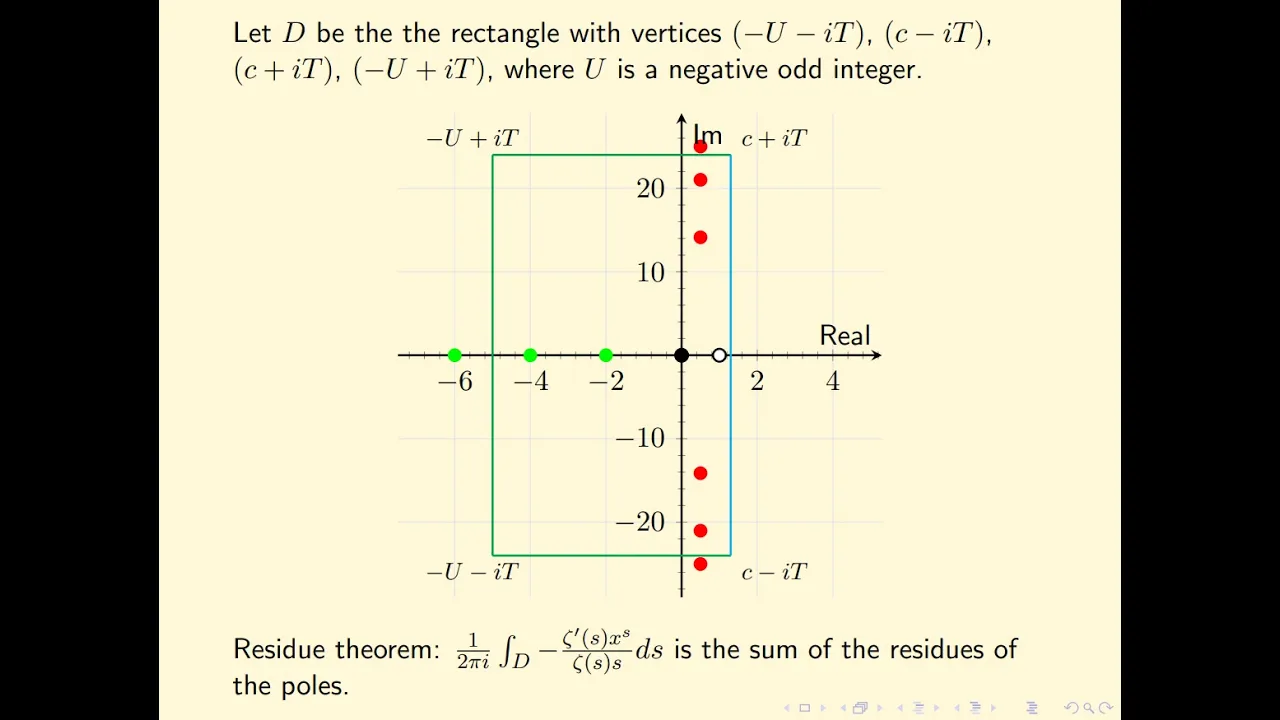
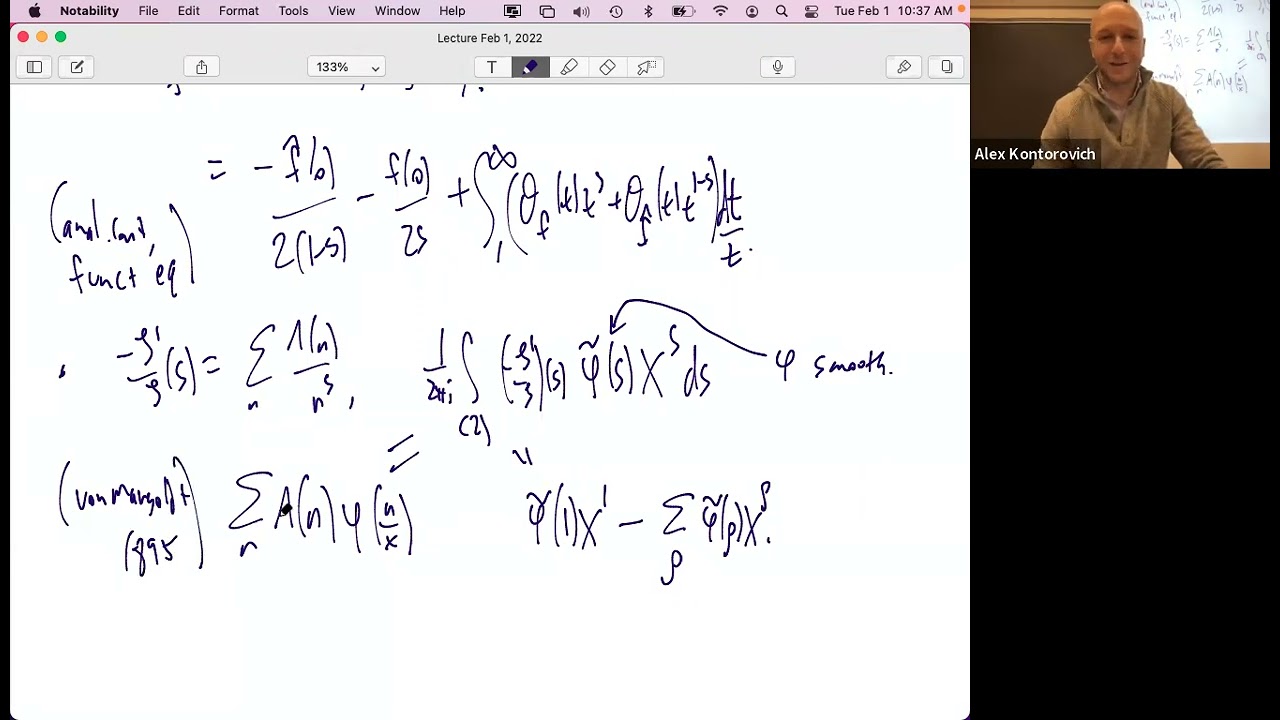
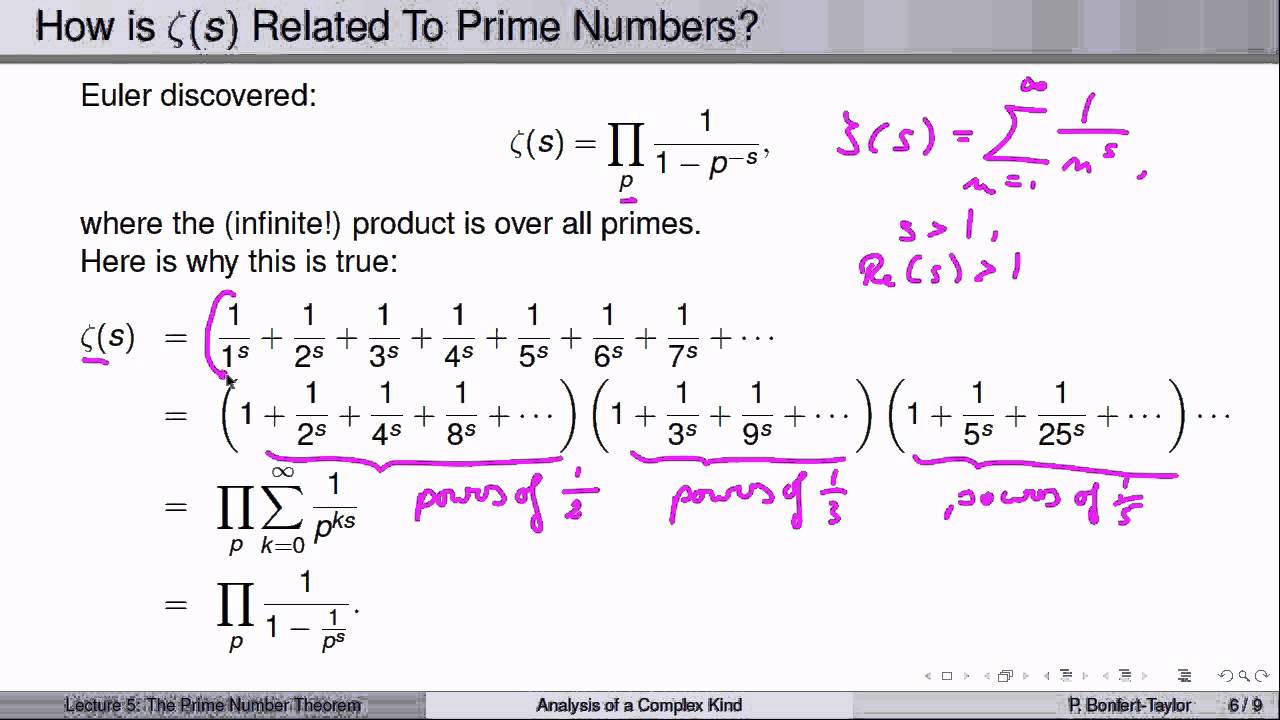
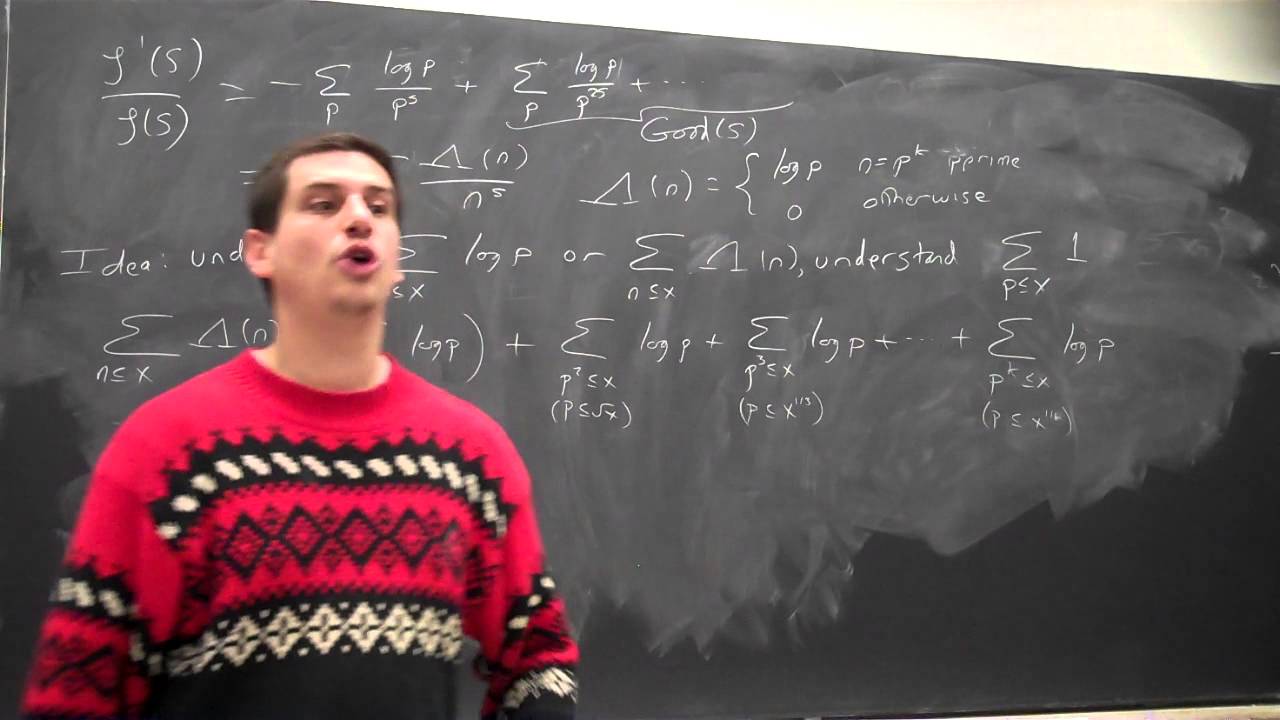
this lecture is part of berkeley math 115 an introductory undergraduate course on number theory and will be about a sketch of the proof of the prime number theorem so if we recall the prime number theorem says that the number of primes less than x is approximately x over log of x and the previous lecture i gave some background to this and gave a rough overview of the proof and what we're going to do is to go through the various steps of the proof mentioned in the previous lecture in a bit more detail so as i said the first main step is to show that zeta of s has no zeros if the real part of s is um greater than or equal to one so when the real part of s is greater than one this follows very easily from euler's um infinite product that this is the product overall primes of one over one minus p to the minus s as i discussed in the previous lecture so the problem is to show that it's got no zeros on the boundary of this region where where the product converges and proof of this is quite short but involves a rather clever idea which is not at all obvious and the clever idea is to look at this function you take zeta of s minus two i t times zeta of s minus i t to the four times zeta of s to the sixth times zeta of s plus i t to the 4 times zeta of s plus 2 i t and you may wonder where this does this funny looking function come from well um the exponents come from binomial coefficients so you recall that if we've got a number z then z plus c to the minus one to the four is equal to z to the four plus four z squared plus six plus four z to the minus two plus z to the minus four so we have these exponents these coefficients one four six four one which are appearing in the exponents one four six four one so how do you use this well we recall the infinite product for zeta of s and if you take the logarithm of that we find that the logarithm of zeta of s is sum over all n and all primes of p to the minus n s divided by n where we're just using the usual formula that the logarithm of one minus x is um x over x minus x over so plus x over squared over two plus x cubed over three and so on so if we if we apply that to the product formula for zeta we get this and this means if we take the logarithm of this funny product of zeta functions we get a sum over all p and n of p to minus n s times um p to the i n t over 2 plus p to the minus i n t over 2 all to the power of 4 divided by n here we're using the fact that this thing here is p to the 2i t plus 4 p to the i t plus 6 plus 4 p to the minus i t plus e to the minus two i t and um so all we're doing is substituting in the sum for zeta of s for each term of this product and this expression looks like a bit of a mess but it has one really nice property you notice this is always greater than or equal to naught 0 for t real because um this expression is a number plus its complex conjugate so it's real and the fourth power of that is real and so on um so this expression here is always greater than or equal to zero well if the logarithm of something is always greater than or equal to zero then that something is always greater than or equal to one so we've got this key inequality that this expression here is always at least one that that's that's um why we write it down well now let's look at it in a bit more detail so we've got zeta of s minus two i t times zeta of s minus i t times zeta of s four times h of s to the sixth times zeta of s plus i t to the four times zeta of s plus two i t um this is greater than or equal to one and here we need the um real part of s to be greater than zero so it's going to be greater than one so that everything converges um and now let's let's fix t and assume that zeta of one plus i t is equal to zero and this implies zeta of one minus i t is equal to zero because it's just the complex conjugate of zeta of one plus i t and now let's take a look at what happens at the point s equals one so all of these become meromorphic functions so at the point s equals one this thing has a pole of order six and zeta of s plus one plus i t has a zero order four and this also has a zero of order or well if we've got all together so this has a zero of order at least eight and a pole of order at most six so altogether this function has a zero of order at least two at s equals one well this contradicts the fact that it's greater than or equal to one or um s greater than one i mean if i if it's at least one for for s greater than one it can't suddenly become zero at s equals one so this is a contradiction so zeta of one plus i t cannot be equal to zero um so um so that that that's the first step of the proof of the prime number theorem um the next step is to prove newman's towbarian theorem but i'm not actually going to do that because it involves a slightly tricky bit of complex analysis so we're going on to step three which is to show the integral from one to infinity of psi of x minus x over x squared dx converges um here we just recall that psi of x is the sum over n less than of x of lambda of n where lambda has the property that lambda of a power of a prime is equal to the logarithm of the prime and is zero otherwise as i discussed in the in the previous lecture and what we do to prove this is to we observe that um the derivative of zeta of s over zeta of s which we recall was equal to sum over n of lambda n over n to the s um is can also be written as sum over n of lambda n times the integral from n to infinity of s over x to the s d x by elementary calculus which turns out to be s times the integral from one to infinity of psi of x over x to the s plus one dx um and um you you using that formula for psi um so we have zeta prime of s over zeta of s minus one over s minus one is equal to s times the integral from one to infinity of psi of x um um minus x over x to the s plus one d x okay and now we're going to apply neumann's towbarian theorem and neuron's taubering theorem says that if the integral from one to infinity of um f of x times x to the minus s dx converges for the real part of s greater than one and if you can extend this to a holomorphic function with no um to a holomorphic function for real with no poles for real part of s equal to one then it converges or s equals one well um so if if we take f of s to be psi of s minus x over x then we see from this that this function here has no poles for the real part of s equal to one because we showed that zeta of s has no zeros for real part of s equals to one so neumann's tarbearing thin works for this and implies that this function converges for s equals one which shows that this interval converges which is what we needed to show so now step four we want to show that psi of x is asymptotic to x and this follows easily because if psi is a increasing function so if psi of x is any increasing function and the improper integral integral from 0 to infinity of psi of u minus u over u squared d u is less than infinity then this automatically implies that the psi is asymptotic to x and the proof of this suppose that psi of x is greater than lambda x for some x with lambda greater than one then the integral from x to lambda x of psi of t minus t over t squared dt is going to be greater than or equal to the integral from x to lambda x of x lambda minus t over t squared dt which is greater than or equal to some constant k so if the integral converges um this can't happen for arbitrarily many values of x because then the integral will be bigger than k plus k plus k plus k plus k and so on so um so this condition here can't happen for arbitrarily large values of x so so psi of x um so the the the the limb soup of psi of x over x is less than or equal to one um a similar argument shows that the limb inf of psi of x over x is greater than or equal to 1 which shows that the limit of psi of x over x as x tends to infinity is actually equal to 1 which is what we're trying to show that psi of x is asymptotic to x so this is a slightly tricky but piece of analysis but really has nothing to do with number theory it's it's just a theorem about arbitrary increasing functions so now we've got psi of x is asymptotic to x and from this step 5 um deduces the prime number theorem which says that x over log of x is asymptotic to the number of primes less than x and this follows easily from the following kia key step which is that log of x is almost constant well you probably don't think log of x is almost constant because if you've seen graphs of log of x it kind of looks a bit like that and that is clearly not constant nowhere near being constant well that's because you haven't looked the graph of log of x for really large values of x so suppose i look at a really large scale so here's naught and here's 10 to the 10. here's norton here's 10 to the 10. so what does the graph of log of x look like well it looks like this it's indistinguishable from the x-axis then it's indistinguishable from the negative y-axis there's it's got a very sharp bend in it um well that said that log of x is approximately zero so i want to focus in a little bit more on it so let's um expand the scale of the y-axis a bit so what i'm going to do is i'm going to look at naught here's 10 to the 10 and here's naught and and here's let's just go up to a hundred and then the graph of log of x looks something like this um it's it's very nearly log of 10 to the 10 for all values until you get very very close to zero that that's because whenever you go um down by a factor of e log of x goes down by one well if we go down by you know two or three factors of e we're already down here but that means that log of this number has only gone down very slightly by about two or three or something so we hardly notice it and the the graph of log of x looks almost like something with a right angle in it if you look at something on a very big scale and you can see that um what this is saying is that log of x so if x is less than or equal to 10 to 10 then log of x is approximately log of 10 to the 10 unless x is very small so so so the logarithm of x is very close to being a constant when x is very large so now we've got psi x is asymptotic to x and what's psi of x well that's lambda of 2 plus lambda of 3 plus lambda of 4 and so on and what's lambda of n well lambda of p to the k is equal to log of p so we've got a sum over primes we've also got a sum over prime powers and now we notice that we can ignore prime powers and that's because prime powers are pretty rare so the number of what's the number of prime squares p you know 2 squared 3 squared 5 squared up to p squared less than x well it's going to be at most the square root of x because the the number of squares less than x whether or not they're prime squares is going to be at most the square root of x and similarly the number of prime cubes is going to be at most the cube root of x so the number of prime powers less than x is going to be at most the square root of x plus cube root of x plus 4th root of x and so on up to plus some k root of x where 2 to the k is equal to x because there's no need to go further than that so so k is going to be about log of x times some constant so the number of prime powers less than x that aren't primes is going to be at most you know about log of x times x and this will be very so log of x times root of x and this will be very much less than than x divided by log of x so we can ignore prime powers and if we ignore prime powers we see that psi of x is going to be about log of 2 plus log of 3 plus log of 5 and so on and um if since log of x um is approximately um so so log of p is going to be approximately log of x when x is large as long as p isn't too small so this is going to be approximately um log of x plus log of x and so on where the number of terms here is just the number of primes less than x so we see that psi of x if we ignore prime powers and pretend log of x is constant is going to be about log of x times pi of x so um since lot since psi of x is asymptotic to x this gives us that pi of x is going to be asymptotic to x over log of x um so that ends the sketch of the proof of the prime number theorem um if you want to see um the details i'm adding a link to a paper by don zagier which in particular gives a proof of newman's towbarian theorem and um gives a altogether his proof of the prime number theorem is only about four pages long okay next lecture will be about the the rich lay's theorem about prime numbers in arithmetic progression
Up Next
34:24
Ramanujan Summation: Decoding 1+2+3+... = -1/12
@Mathologer
3.5M views•2016-04-22
4:43
Elliptic Curve Cryptography Explained: ECC, ECDSA, ECDH
@PracticalNetworking
28.5K views•2024-10-21

27:53
Abel's Theorem: Unsolvable Quintic Equations Explained
@richarde.borcherds7998
11.7K views•2021-01-08

6:00
The Mathematical Impossibility of Accurate World Maps
@Vox
23.3M views•2016-12-02
Related Study Plans & Knowledge Roadmaps
Structured learning paths in Mathematics
mathematics
Tensor Calculus: Vectors to Riemann Curvature
01Mathematical Foundations: Linear Algebra & Calculus
02Covectors, Dual Spaces, and Tensor Basics
03The Metric Tensor and Index Gymnastics
+ 2 more learning modules
40h5 modules
Explore Roadmap
mathematics
Gödel's Incompleteness: Logic, Proofs & Limits
01Introduction to Formal Systems & Hilbert's Dream
02Set Theory, Cardinality, and Cantor's Diagonal Argument
03Arithmetization and Gödel Numbering
+ 2 more learning modules
14h5 modules
Explore Roadmap
mathematics
Galois Theory: Fields, Groups & Solvability
01Foundations of Abstract Algebra: Groups & Fields
02Polynomials & Field Extensions
03Splitting Fields & Symmetries
+ 2 more learning modules
24h5 modules
Explore Roadmap
mathematics
Non-Euclidean Geometry: Models & Geodesics
01Euclid's Fifth Postulate and the Birth of New Geometries
02Hyperbolic Space and the Poincaré Disk Model
03Geodesics: Defining Straight Lines in Curved Spaces
+ 2 more learning modules
15h5 modules
Explore Roadmap