











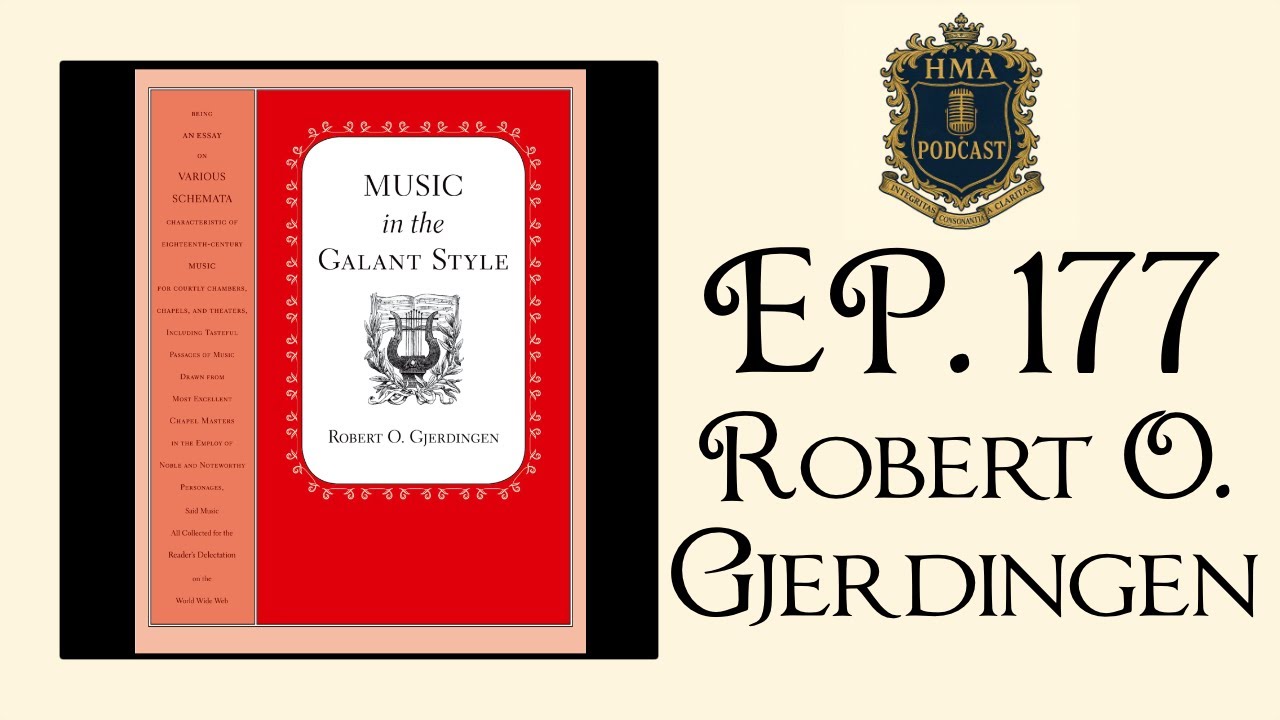







Joseph Riepel (1752) established that effective Galant melodies are constructed from even-numbered bar units (2, 4, or 8 bars) with hierarchical phrase endings: Cadence (strongest, for large phrases), Abzats (medium, ending 4-bar units), and Annit (weakest, ending 2-bar units); melodies should combine rhythmic activity types (every-beat, some-beats, and immobile notes) and employ four melodic characters (singer, runner, noiser, leaper); tonal relationships follow a hierarchical estate model where the tonic (Steward) is most important, followed by the dominant (Foreman), then the subdominant and mediant (Chief Mate and Assistant), with the least important being the supertonic and submediant (day laborer and handmaid); key modulation typically follows the sequence I-V-vi-iii-I; and composers can transform melodies through permutation (rearranging note sequences) to create endless variations while maintaining structural integrity.
Joseph Riepel's Secrets of Galant Melody | Early Music Sources
Added:hello and welcome to early music sources.com my name is Elam mm and today with the help of Sean Curtis hey we will present a fascinating 18th century Guide to the composition of Galant [Applause] music when we think of Music Theory nowadays we often think of complex Counterpoint and harmony in the mid 18th century however when Yosef rippel published a Trea aiming to describe the music of his time the most important feature to him was Melody for him the science of putting together a melody was the most important aspect of composition in this episode we will get a taste of his fascinating Treatise sharing the secrets of the Galant musical style let's start ysph repo was an Austrian born Capel Meister violinist composer and theorist who spent his professional life in Regensburg in 1752 he published the first chapter of a massive 10-part trece called the foundations of musical composition aiming to teach composition in a new way based on presenting many examples and not according to the old mathematical way only the first five chapters were published in his lifetime two were published after his death and three were left unpublished in manuscript the first two chapters about metric order and tonal order are especially fascinating and will be the focus of this episode Ripple lived in a time that saw exciting developments to musical style many composers were no longer interested in elaborate polyphony but rather preferred simple clear Melodies with light accompanimental textures this style is often referred to as the Galant Style explains for listeners as is well known do not like to tax their ears with many competing things but would rather pay attention only to a single outer main Melody which the other voices sometimes support sometimes reinforce but must in no way confuse this is what many of the outdated composers do not understand but rather they fill everything with cabbage and turnips okay so the focus should be on the melody but what about the Bas from time to time one could do something pleasing with the Bas but the listener cares little about that he only pays attention to the melody in fact rippel assures his imaginary student in the treaties that writing a baseline could be learned in a single day but before that I first want to know whether you have sufficient knowledge of the orderly division of the melody according to repel a Melody should be constructed of units with an even number of bars well this rule like many other rules given by reple is later amended with countless exceptions this is based on the conventions of dance music which plays an important role in the Galant style but also on nothing less than nature itself for four 8 16 and even 32 bars are those which are so ingrained in our nature that it seems difficult to us to listen with delight to any other structure and so most music should be made of distinct melodic units of two four and eight bars for example this is a melodic unit of two bars called ATV by Ripple and this is another one and this is a unit of four bars called a fer together they make a larger unit of eight bars that can be used as the first part of a simple Minette if we continue to the second part we can have another unit of two yet another one and finish off the piece with a four bar unit that includes a Cadence [Music] and so we end up with a perfect 16 Bar Minette it is not by chance that tripple starts his treaties by focusing on the composition of minets he explains indeed it is not a great honor to compose minettes but that a minuette in its execution is no different from a concerto an ARA or a symphony we want always to begin very small and inconsiderably in order later to achieve something greater and More praiseworthy in short he says that both the principles of composing a little minouette as well as its very building blocks are the same as in any other piece among these building blocks is a hierarchical system of phrase endings the strongest in his hierarchy is the Cadence award repel reserves only for the most conclusive endings of large phrases next in the hierarchy is what he calls an abzats often ending a four bar unit there are two types of abzats which are defined by their harmonic connotation in the first type the melody ends on one of the notes of the Triad of the tonic that is the first third or Fifth Scale degrees on c e or G if we are in C major this is called a gr abzats in the second type of abzats the melody ends on one of the notes of the dominant that is the fifth 7th or secondth scale degrees g b or d if we are in C major this is called a changing or endong absat repel notes that generally you should not use the same type of absat twice in a row finally the weakest type of phrase ending is called an annit which most often ends a two bar unit by the way it should be said that while most of riel's examples do not include a base The Melodies themselves often imply the harmonies and specific bass notes most commonly the main structural note of the melody in a grund absat will be the third scale degree in an enderun absat it will most often be either the second or seventh scale degree in this short example in C major the first four bar unit ends with a grun absat and the second four bar unit ends with an enderun absat [Music] the idea behind this terminology is to illustrate more clearly that rhetorically music is like spoken or written language with different types of punctuation of different strengths and qualities Johan Mattison had already touched on the same idea some years before Ripple every idea be it verbal or written consists then in certain word phrases or periods but every such a phrase also consists in smaller curas up to the close with the period matazon even Drew specific analogies between various types of musical punctuation and commas colons semicolons and periods looking back at our first example labeling it according to repel terminology we can imagine the annit units to be like commas the absat units like colons and the final Cadence like a period if you wish you could even introduce a semicolon but we should say that tripple isn't so concerned about creating a systematic analogy between Musical and textual punctuation okay repel showed us that Melodies are made of units of different sizes all having an even number of bars and that they have different types of endings according to their strength and rhetorical quality but this is not all Ripple goes deeper in describing further melodic characteristics let's see rippel distinguishes between bars that have more or less rhythmic activity bars with activity on every beat bars with activity on some of the beats and bars that have only one long note which reple calls dead or immobile according to reple a a good Melody should elegantly combine these rhythmic types in order to create variety and structural Clarity on top of that he defines four common melodic characters a singer with longer note values and a canab quality a runner with rapid mostly stepwise notes one who makes a lot of noise with quick repeated notes typical for orchestral string writing and a leaper with jumps and arpegios here is a little example demonstrating [Music] them before going on to reel's famous Monte fonte and Ponte which in recent years have become a much discussed Topic in 18th century music scholarship we first have to discuss reel's explanation of the relationships between Keys the tonal order earlier we were talking about phrases that end either on the harmony of the tonic or the dominant but this was all in the context of one key without modulating without making a strong Cadence in a key other than the main key of the piece modulating of course is an essential part of almost every piece and repel came up with a very interesting and colorful way of Pres presenting it rippel compares the relationships between keys to the hierarchical roles fulfilled by an imaginary staff serving at the household on the estate of an honorable Lord Baron like other authors from his time Riel saw major Keys as masculine and minor Keys as feminine and the characters he created reflect this in a piece written in a major key the most Central Key is of course that of the first degree called by repel the steward he is in charge of the whole operation he is always the first and the last at work and the most industrious among them all and he must be left neither out of sight nor out of hearing the second in command is the fifth degree is foran the steart and the foreman work outside in the field and speak to each other with constant questions and answers indeed almost every piece in a major key in 18th century musical genres will modulate to the fifth degree and make a strong Cadence and then later eventually return to the first degree next in the hierarchy are the sixth degree the chief mate and the third degree the assistant made both of which are minor and thus feminine we are left with the least important degrees according to Ripple of course which are typically used only in passing that is without making strong cadences these are the fourth degree and second degree the day laborer and aand girl respectively finally Ripple also assigns a character to the minor version of the first degree which is a colorful and special occurence a female neighbor who sometimes helps out on the estate called black Gradle Ripple uses this analogy to explain that in an Allegro of a symphony or a concerto beyond the stward we do not need more than the foran and possibly the chief made in such a scenario the piece would start on the first degree and modulates to the fifth degree then to the sixth degree and finally come back to the first degree rle demonstrates this common structure in a very condensed miniature notice that the second and fourth degrees also appear but only briefly without making strong cadences [Music] having explain the tonal order Ripple supplies us with common harmonic structures used in the different musical genres of his time it is clear from his text however that in long pieces one may modulate to any key in Ripple's model okay now we're ready to talk about the Monte fonte and Ponte the Monte fonte and Ponte are Musical models that Riel considered extremely important when introducing them he declared that you must remember these three examples as long as you are alive and healthy each with their own particular connotations melodic sequential harmonic Etc they are typically found in the middle of a piece for example a common way to begin the second half of a Minette can be with one of these the Monte the mountain is so named because it climbs upwards it is typically built from a pair of two bar units the first comes to a weak closure on the key of the fourth degree and the second often an exact transposition a step higher comes to a similar closure to the fifth degree in practice these closures are often achieved by using the dominant harmonies to the local degrees that is a dominance to the fourth degree and then a dominant to the fifth degree like in this mon taken from an imaginary piece in C [Music] [Applause] major however the second half can be varied even to such a degree that it no longer resembles the first half at all but nevertheless still retains the same structural [Music] closures the fonte the well is so named because you climb down into it it is also built from a pair of two bar units with weak closures this time transposed down a step first to the second degree which is minor and then to the first degree which is Major like in this Fon which again is taken from an imaginary piece in C [Music] major in some of people's examples it seems that the first half of the phrase is enough to determine whether it should qualify as a fonte or a Monte for example here Ripple begins a four bar phrase like a fonte with a closure to the second degree only to continue in the manner of a Monte with a closure to the fifth degree he nevertheless labels it as a fon [Music] finally the Ponte the bridge typically emphasizes the key or the harmony of the fifth degree the dominant and can end either with the harmony of the first degree or the fifth degree here are two examples again in C major let's listen to one of [Music] them by the way the Ponte may be constructed from a single four bar unit like this or from two two bar units like this with this information we can revisit the example from before now recognizing not only the general tonal order but also the Ponte fonte and Monte each touching on their respective keys if you want to get more acquainted with the Monte fonte and Ponte check out our footnote page with a PDF with many examples by the way while the Monte fonte and Ponte are the most famous of riel's models there are others he also introduces three named after Birds stiglets spats and fou Riel adds that if you want I have even more useless words reel seems to have had a rather playful approach to composition he constantly shows how according to your whims you can exchange elements switch around their order expand or compress them and much more here is a selection of some of his techniques one meter Ripple demonstrates how the same Melody can be transformed in order to fit another meter interestingly this example also shows us that in certain time signatures and Tempe Ripple's metrical unit may not be the same as one actual bar two expanding and compressing Ripple shows how a 24 bar example can be compressed into a 12 Bar one or even an8 bar one and then he shows how the same example can also be expended to 51 bars this is all based on his system of structural closures that divide the piece into segments that is if the piece includes for example a gr absat then an Ender's absat followed by a modulation to the fifth degree and a Cadence on it any expanded or compressed version of it will include those same elements only with more or less stuff in between Ripple's pretty ingenious analytical tools prove useful for understanding even much larger structures later theorists such as Heinrich Kristof K based their ideas on rippel system in order to describe the forms of complete Symphonies and sonatas three extending by repetition reple demonstrates how repetitions can be used to easily extend the melody for example repple presents this eight bar [Applause] [Music] melody in order to extend it he continues by taking a two bar unit from it which he repeats he continues further to the final phrase where he repeats the Cadence but with a slight evasion and connection between the two cadences repel explains that repetition does not impede good structuring but rather promotes it four other means of extending reple shows how a Monte or a fonte can be extended by means other than exact repetition they may be proportionally doubled tripled or even quadrupled while retaining their essential structure five odd-numbered phrases repel says that a three bar unit like this for example is awkward it strikes our hearing as completely improbable and extraordinary because of its odd number of bars it is like a man who has had too much to drink however if it is followed by another three bar unit the resulting six bar phrase restores the even numbered regularity [Music] according to reple a drunk man must always be accompanied by his friend in the same way he explains that other OD numbered units such as 5 S and N are also best used in pairs six well it's not always an even number of bars Ripple explains that in some situations a single bar might be cut even if this breaks the otherwise desired evenness he shows that for example in an ARA or a Concerto in the transition between the solo and Tutti sections it would create an awkward effect if the orchestra had to wait around for an entire bar after The Soloist finishes his or her [Music] Cadence Ripple says that he would prefer to fix this story structure by bringing the orchestra in a bar earlier so that the first bar of the new phrase overlaps with the final bar of the previous phrase in essence cutting one bar a technique today known as [Music] elision by the way riel's abbreviated score which only contains the principal Melodies is fascinating he chose again how for repel the melody is Central with the other parts playing a subordinate role in another example this time from a violin Concerto in common time the problem is slightly more nuanced because of the time signature the units are counted two per bar and so cutting out the fourth unit in order to bring the toti earlier would make the orchestra enter in the middle of a bar the student in the tretis explains a listener must of course be satisfied with it it does not please me however because according to the bar line not only the toti but also the following solo is brought into disorder repple then explains that in order to tackle this problem one may leave the toti where it is and extend the solo by adding a little repeat of the Cadence in this case with an evasion and a bit of ornamentation seven endless variations repeatedly throughout his treaties Ripple stresses that when composing an almost Limitless number of options are available to you and that you should never imagine that one must set it in exactly one way and in no other in order to spare himself from reminding the student of this idea over and over he invented this little sign to indicate that a certain principle or musical idea may be expressed also in many other ways sometimes he says literally a thousand ways Ripple used what he called The Art of permutation as a source of endless variations he explains that a series of three notes for example may be arranged in six different ways and that a series of four notes may be arranged in 24 ways he even supplied the table showing how quickly this mathematical principle reaches absurd Heights for example just 10 notes can be arranged in over 3.6 million ways the student in the tretis rightfully comments I see that many of the permutations yield Melody that is not of much use but rather too strange the teacher Ripple answers that doesn't matter one ought only to select the best of them moreover music lovers are constantly asking for ever stranger ideas Ripple's technique of constant variation and experimentation emphasize the artisanal aspect of composition and allow a composer to come up with a lot of music in this Spirit the student declares at one point at home I will at once compose several hundred more little pieces Ripple's approach stands in stark contrast to our romantic ized ideas of the genius composer who relies on Supernatural inspiration to inform him exactly how his piece must be composed finally let's quickly examine Ripple's influence on the theorists and composers that followed him not long after Ripple's first publication the Czech composer France kaver poorne a student of rippel offers a glimpse of the kind of influence rippel may have had on other composers of the day he reported that the composers holzbauer stamitz and D maintain the very same theory that I learned from Ripple indeed these composers wrote music that often closely resembles reel's examples one year later the theorist and composer Fred Vel marug highly praised R's work books of this kind deserve to be in the hands of every practical composer without exception and to be read day and night later musicians even after reel's death continued to praise his work also among reel's fans was Leopold Mozart who most probably used reel's books as teaching materials for his talented son Wulf gang this can be seen quite clearly in the young Mozart's earlier works for example in this minouette written when he was only 6 years old we can recognize Ripple style regular phrase structure closures repetition techniques and models like the monter even in Mozart's mature works for example in this Minette from one of his string quartets we can still see Echoes of reel's ideas and techniques executed in skillful and original ways for example it opens with an irregular three bar unit and instead of following this with another three bar unit as suggested by repel Mozart restores the balance with a larger irregular phrase of five bars this is an imaginative way to arrive at a standard eight bar structure [Music] as you can see the second part begins with a nice [Music] fonte this kind of playful experimentation with flexible modular building blocks which can be found throughout Mozart's U is very much in the spirit of Ripple this was our show about Ripple's fascinating approach to comp wait we still have to tell them about the sloth okay sure here is the bit about the sloth following the 17th century German theorist atanasio ker Ripple presents some fascinating facts about the American sloth he writes no one knows even at this time what kind of food it eats or even if it eats it cannot travel much farther than a rifle shot in 14 days it lets itself be heard nightly in the following way [Music] like kha Ripple claimed this scientific finding is proof that the six notes of the hex Accord are an intrinsic part of nature itself building on this idea Ripple also cited the sloth to explain why one would ordinarily only modulate Within These six degrees when the student asks why one cannot modulate to the key of the seventh degree Ripple repli eyes I can well answer because the American sloth with his song only goes up to the sixth and not to the seventh degree this was our show about Ripple we hope you enjoyed it huge thanks to Sea who wrote this episode with me sure thing thanks also to Eva Saladin and Carl valter for their beautiful playing don't forget to check the special page on our website with all the footnotes and other extra information if you enjoy early music sources consider supporting it on patreon comment share and like see you next time at early music sources.com [Applause] no I think it's better like this okay you stop no exent okay
Up Next

Improvising an Allemande over a Romanesca Bass: Baroque Practice
@RichardusCochlearius
2.6K views•2022-11-09

Mozart's Musical Dice Game Explained: History, Rules, & Fun
@webpianoacademy
5K views•2023-03-13

Understanding Diatonic 7th Chords in Major Keys | Music Theory Tutorial
@GracieTerzian
54.7K views•2022-03-02
Understanding John Coltrane's Giant Steps: A Music Theory Analysis
@Vox
10.4M views•2018-11-12
Related Study Plans & Knowledge Roadmaps
Structured learning paths in Music Theory