




![[Wikipedia] Ekphrasis](https://i.ytimg.com/vi/E_ROmWkAhKg/maxresdefault.jpg)

![Кипр. Церковь Богородицы Асину. [Памятники ЮНЕСКО на Кипре. Росписи церкви Богородицы Асину.]](https://i.ytimg.com/vi/wKRkxKXaW_8/maxresdefault.jpg)

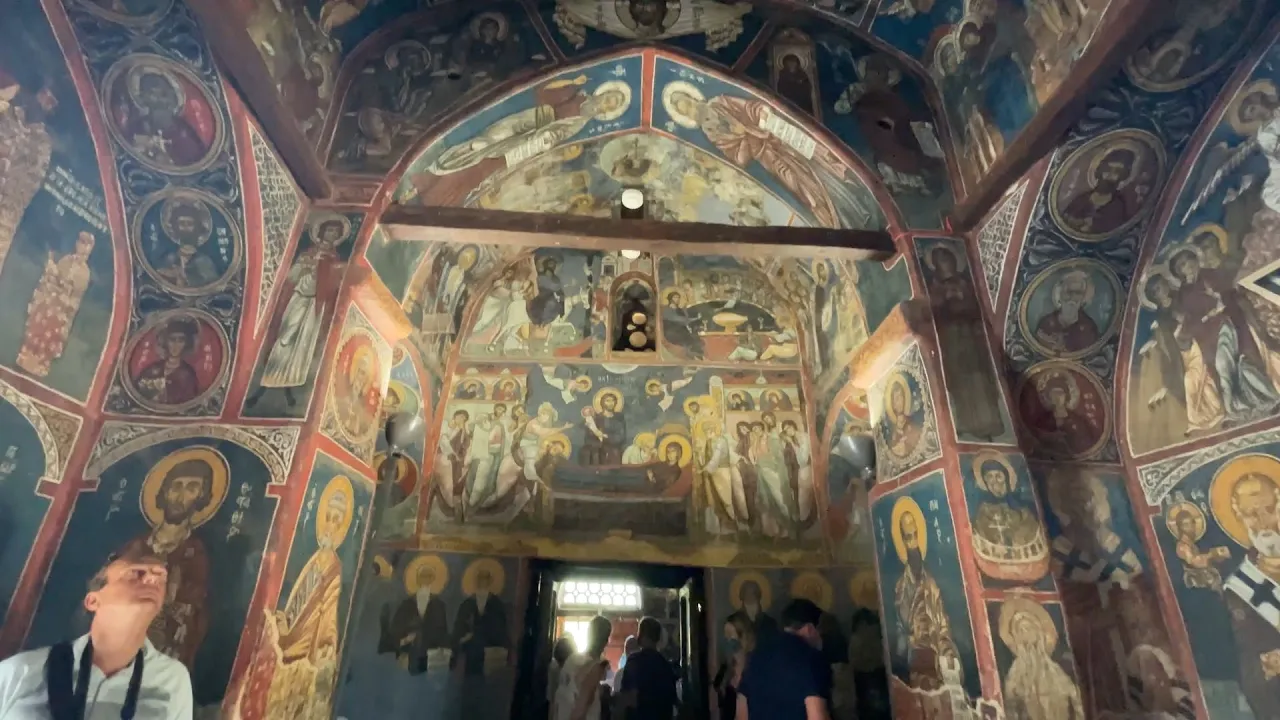






In Byzantine church decoration, inscribed texts serve multiple rhetorical functions—explanatory, narrative, prophetic, admonitory, and intercessory—that are systematically organized across the church's hierarchical spatial structure, transforming the building into an active space where visual and verbal discourse work together to instruct and console the faithful during worship.
Byzantine Cyprus: Painted Inscriptions at Panagia tou Arakos
Added:Basic principles of Byzantine iconography and the theological function of sacred images in the middle-to-late Byzantine period.
The historical context of late 12th-century Cyprus, particularly the transition from Byzantine rule to the Lusignan Kingdom around 1191-1192.
Fundamental concepts of Greek epigraphy and paleography, specifically how written text is integrated into monumental wall paintings.
An understanding of Byzantine rhetoric and literary devices, such as 'ekphrasis' (rhetorical description of art) and the use of poetic epigrams.
Comparative analysis of other UNESCO-listed Troodos churches in Cyprus (e.g., Panagia Phorbiotissa in Asinou) to trace stylistic and epigraphic developments.
Advanced study of Byzantine donor portraits and patron inscriptions to understand social status, piety, and political identity in the periphery of the empire.
In-depth exploration of the Byzantine epigram as a literary genre and its migration from manuscripts to monumental church walls.
Researching digital humanities applications in epigraphy, such as multispectral imaging and 3D modeling used to preserve and read faded historical inscriptions.
272 views8likes1:00:06Original Release: 2016-01-16
good evening and welcome american express and i'm delighted to see y'all and especially professional abydos our eminence speaker this evening and i gotta say capitals is professor of Byzantine literature at the university of cyprus he started as an and history and literature history personal art and my new psychology at the University of Munich and class 6 and visit and literature at half at the University where he again his separately in 1990 he has published many books some of them at the nunnery destruction the visitant binocular romances in ancillary one he started with evil click romance 92 theaters but the heat is on Greek philosophy adventure history in 1996 and the first edition a critical edition of the 13th century first romance leave istros and your domine I hope I'm under some pronounce it correctly again a volume with translations into mortal free of decent kind descriptions of works of art as well as he produce also has multiple unreadable erotic fiction around the Mediterranean I'm in a Mediterranean and that was published in 2008 some 70 obstacles in international journals and collected volumes cover subjects such as the history of manuscripts and the education in Kazan you pleasanton rhetoric and poetics your presentation a literal function 13 peasant and researcher as well as the image of Byzantium in modern Greek literature he his most recent publication in 2012 is an edited volume of the debug narrative stitching history in fiction from the center to the periphery of Europe are years 1100 to 1400 professional Abydos is currently preparing and in each translation with introduction and knowledge only distrust and Romany the 19th century those romance that i mentioned apart and this is the cannabis was translated text for the result lists and all circus prepare a booklet started on the historiography of piston phonology and the Imperial ization of his intent literature he has taught as visiting professor afraid universität Berlin they are called the odd attitude ASI sciences sociology sorry in Paris and Stanford University parallel to the scholarly activities he's a writer of historical crime fiction which I'm really looking forward to it in 2003 he publishes didn't I mr. you know that the a Bollywood said in 9th century surreal of cappadocia cappadocia and now in modern day Turkey and it was followed by the copper and enamel Medusa in 2009 at only the professor is marking another book now see if you tell us and let's welcome professor on Abydos so it is a great pleasure to be here tonight I'm delighted I am honored by the invitation for a particular reason that working and living in Cyprus for 23 years now it is a great pleasure to be invited by the Hellenic center and it's a very strong Cypriot present and presence in interests and so I decided to talk to you about something Cypriot and let me just say before I start my talk that what I'm going to talk to you about night is part of a research project that is coming out as a book pretty soon probably in march next year and it is a volume dedicated to the time dwarka in ladera as a building and a historical monument belonging to the unesco heritage and it will be the first volume fully dedicated to this church with a set of magnificent color photographs that are being sponsored by the leventis foundation in cyprus and under the direction of the archeological Department of Antiquities in Nicosia so what I'm going to talk to you tonight is part of the chapter that I am contributing to this volume and it is about the way in which inscribed texts function in the frescoes of the Church of the Virgin Mary lavera in Cyprus you know as a bit santini's I believe that these are demonic instruments you know you never know how this functions are so the strong presence of the written word in the visual arts of many older civilization can hardly go unnoticed the European Middle Ages are no exception the number of inscriptions incorporated into paintings of all types for example frescoes manuscripts mosaics portable icons is simply endless the visual presence of such inscriptions is in many cases remarkably dominant art historians biologists and historians have systematically studied the content of these inscribed texts the calligraphy of the letters used but also the purely visual form and typology of these inscriptions the study of all of these issues contributes to the dating of the work of art to the understanding of the depictions included in it even to the interpretation if we can say so of the meaning of a specific world of art in its historical context however however it is not this kind of issues that we concern us in my talk this evening since I shall focus on the inscriptions incorporated in the frescoes of a small church outside la madera a village in the rural area of pizza la situated on the north eastern slopes of the tallest mountain in cyprus right in the very center of the island the church as we find it today dedicated to the panel year or a courtesan or Virgin Mary of the wild veg as it is officially called but it's basically Eric as a form of larger p was built around 1175 to 1188 during the time of the Byzantine rule of the island but was renovated and fully decorated at the expense of Lord Leo to offend o in the year 1192 namely the very year in which richard the lionheart King of England and Duke of Aquitaine conquered the island and took it away from the Byzantine sphere of power my aim here is to approach this specific building as what I would call an active space by examining the presence character and function of the various inscriptions which are included in its painterly decoration I am interested in the aesthetic impression that these inscriptions evoke as painted discourse asking what is the purpose of this aesthetic impression in relation to the users of the building during the first years of its a renovated function that is at the end of the 12th and the very beginning of the 13th century now the building as we have it today has undergone two further stages of rebuilding the original structure is what is marked in green it is a building it's slightly less than 15 metres in length and that is the original church it was part of a small monastery that was surrounding it on its northern part then the building was redeveloped and expanded in the 14th century with an new developed set of entrances and a further part of the church and that is where you enter the church today this is its official entrance and then finally in the 18th century which you saw in the picture it got a fully covered wooden roof in the style of churches from the Balkans there is an influence there from Serbian Bulgarian in Russian architecture and they were built in order to protect primarily the churches of the tallest mountain from the strong snowfall in the mountain because the six the seventeenth and eighteenth century were two centuries very cold in Cyprus with a lot of snow so a lot of churches during that time got these covers with wood making the churches look very different than they did in their original fails I now will concentrate exclusively sorry I will concentrate exclusively on the interior of the original building of 1192 so let me first of all give you a very brief impression of this interior how does the church here is the view of the church when we stand at its original west wall and look towards the sanctuary in the east so it is this that we are looking at here and you can already see that all of the church is completely covered with frescoes when moving into the center of the church and looking upwards we gaze at the dome with its drum balancing on the four pendant eaves so here is the dome with its drum and here are the four pandent eaves when we lower our gaze to the left we see the north wall in its door so the dome is up here here are two pendant eaves and inner arcade and then the main wall and if then we look finally to the right we see the south wall with the equivalent here in fact we can also see a little bit the windows on the drum the fondant eaves the other arch and the walls below with the original flooring underneath as you can see the church is fully covered from top to bottom with paintings of the highest craftsmanship and artistic finesse by one artist and his probably his team and it is for good reasons that this small church is one of the most important ecclesiastical buildings of the chameleon era of the Holy 12th century for the whole of the Byzantine Empire because the artist was a constant in a poet and artist who had been invited to come to Cyprus and paint for Lord Leo and not only for Lord Leo he has painted also other churches the same persons lived about 10 to 12 years in Cyprus working but we don't know his name before examining the inscriptions of this Byzantine church it will be useful to bring mind what are the functions of the inscribed word within an image because these functions in contemporary art are quite different from those in Byzantium in a modern work of art words are incorporated as an inseparable part of the visual whole in other words should the words be removed from the image the work is completely destroyed and let me give you two examples for example in the very famous painting of Jack Reed the vide Mara murdered of 1793 the dead man still holds in his hand the letter sent to him by his murderous charlotte corday and the letter is actually written on the painting while the painter now himself has signed the painting as if his name was an engraving already existent on the wooden box serving as a provisional desk if you remove these words the painting is destroyed they're totally inside the painting similarly to just see a completely different image in one mirrors surrealist painting snail woman flower star of 1934 the title in French escargot from Fleur etoile constitutes a dynamic part of the work in its immediate connection with the depicted forms again if you take the words out the painting is completely destroyed the above remarks are not valid in the same manner for the presence of the written word in Byzantine art though written discourse certainly is part of an image it is not incorporated in this image on the basis of painterly criteria but rather of a rhetorical criteria that is to say the word performs a function of verbal display it is the word that is displayed and here I've taken the west wall of the central part of the Church of the panacea for VR design in asino also on the tallest mountain but painted about 80 years before the Church of at Livadia where you can see the inscriptions they the inscriptions either relate two pieces of information et misses the name of Christ is Christos here is another inscription indicating a scene it's Christ that in the temple or of course the the inscription makes a statement in this case for example it is a poem that is painted under the inscription under the painting describing the actual painting itself this elit oracle dimension of the word as image in byzantine art is strongly connected with its acoustical dimension and this is something that we tend as as historians and archaeologists to forget because the inscribed discourse is literally speaking through the work of art especially in the case of inscriptions within the painter a declaration of a church sound is very significant because the congregation perceives this sound as performed during Mass or other services the experience then of the word as active sound is very important for a society with a very high percentage of illiteracy people did not necessarily and disparate the inscriptions but they heard what the inscription said because they were reflected in the mass in the hymns and other parts of the services now the words of the inscriptions therefore are not only letters to be read but sounds to be heard the visual and acoustic nature of the word within the image obviously does not imply orality of discourse that is like for example with folksongs this is these are not texts that were perceived as oral the word is written because it is true and valid in other words it is always the same like for example here from la madera the grand nativity scene where three captions explain first of all who the characters are mie the scene itself if restore Genesis and then the Angels words to the Shepherd's I will come to the stakes a little bit shorter this the fact that the words are always the same is a basic characteristic of cultures of the book and one of the main differences between the ancient Greek and the medieval Greek world while ancient religion with its various literal practices was not defined by a recorded truth but rather by many oral traditions Christian religion and its own ritual practices are defined by books that codify the truth such as the Gospels or the text of the Divine Liturgy therefore this written discourse contributes to the truth of the image and to the complex functions of visual and verbal display for medieval society written discourse appears in the painted decoration of the era katisa in two forms firstly it takes the shape of a physical object whether it is a bound book or a loose scroll secondly it takes the shape of a suspended inscription that is suspended literally above the scene itself these two forms of eight and disposed express within the paintings what i would call five specific functions and these are very important functions for understanding how the active space of a church operates the first function is explanatory where the inscription explains what the faithful see depicted in the active space in which they have entered the term ition of the old Holy Mother of God ET missus TC / ideas Theo toko the preparation Yeti Messiah meaning the preparation of the throne of God at the Last Judgment jesus christ the holy man villain is Christos tae-hyun man villain this is the famous editor image of Christ and a very particular Byzantine version Jesus Christ the Holy tile is Zeus Christos to iron pyrimidine now these are all of course from the Panda hero Erika this this final this this particular now depiction of the image of Christ on a tile includes the data tecnica tori inscription which is also explanatory that is here this dedicatory inscription is explanatory because the donor points to his own contribution to the church which is the painter in the Cure declaration and this is the first text on your handout if you would like to take a look you have the text both in Greek and in an English translation i will read you the green a new story ste concept ohs NOS this y para ESA auto co2 eriko's via syndrome is Cape alupo fakir lalon toes to offend Oh mini vacay embryo invicta oh noes n de cartas to x axis y hasta el taco Co stop proto a tus note please that the word the first word UNMISS touristy means in Byzantine Greek fainted or to be more literal covered with visual stories the distance used the word astoria to mean a painting the second function of the world is narrative since the suspended inscriptions convey the true words of specific characters within these visual stories represented in a particular scene a fine example are the words of the angel addressing the startled shepherds in the nativity it's a famous passage from the second chapter of luke and i read it in the king's bible translation and of course you will recognize it immediately it appears in Handel's Messiah fear not for behold I bring you good tidings of great joy which shall be to all people the third function is prophetic when the painted word conveys the Saints of the prophets who spoke in the Old Testament about the coming of Christ thus the prophet Isaiah up in the Dome of the church holds in his left hand and open roll while he points with his right hand to Christ with exactly above him in the dome on the roll we see inscribed the famous birth proclaiming the birth of the Messiah from chapter 7 of Isaiah's poetry and this is also a passage with you know it also comes in Handel's Messiah behold a virgin shall conceive and bear a son and shall call his name Immanuel the fourth function is admonitory the inscription admonishes the faithful in an emphatic manner usually by addressing them directly st. Andronicus for example advises and that's a passage from the Maximus confessor and of the theologian of the seventh century he tells brethren he who is afraid of the Lord is afraid of hell and he who is afraid of Hell practices self-restraint the Apostle Peter for example holds a role saying and that is a passage from his own a pistol a pistol of heater dearly beloved I beseech you as strangers and pilgrims abstain from fleshly lusts which war against the soul in this way the st. speak in their own words which the faithful know from the respective readings during the ecclesiastical year the fifth and last and extremely important function of the inscriptions is intercessory that is when the person speaking and consequently the inscription he or she is holding addresses a specific recipient with a specific reset request on behalf of the third person such an intercessory function is performed for example by the Virgin Mary as the mercy giving Mother of God me ta feo y la russa which she is holding when addressing Christ and this is an inscription that we will look at more carefully towards the end of the talk these five functions and an inscription might perform two even three functions simultaneously within a building are subject to a very central principle of Christian art of religious art in general and that is instruction as image and sound in a church the written word teaches us in various ways about life in Christ especially so does the written word guide the ascetic exertions of the monks in there are Jews path towards God but how is the presence of this written word that we have now seen organized within the active space of the church to begin with the interior of the church and that the panagiotou erica in in ladera is it typically what we call church with a cross shape and the dome on top the interior of the church consists of three major structural levels architectural speaking the dome with the drum the fondant eaves the arches and the apse of the sanctuary and finally the vertical lines of the walls below the fondant eaves each of these structural levels conveys a different sense of space voted on the top and therefore pori dimensional in level a curved and thus three-dimensional in Level B and vertical and therefore two-dimensional in level see if we observe now the arrangement of the frescoes in the three structural levels we will realize that the painterly decoration of the church is also divided into three levels which I shall term hierarchy have a hierarchic structure d the heavenly world of the old testament e the world of Christ's incarnation and of the New Testament and finally if the earthly world of saints it is striking that the structural and hierarchical levels coincide with each other completely since D is found only a ye only in B and F only in c within these two overlapping sets of three levels the inscriptions find an appropriate structured place thus the roles and books appear in levels ad and C F why the suspended inscriptions are found only in levels b & e the function of the inscriptions are similarly structured the explanatory function appears in all three levels since all the holy persons and the major scenes are accompanied by inscriptions which identify them however in level ad we find only the prophetic function in PE again we find only the narrative function while in level c f here we find only the admonitory and the intercessory functions as modern viewers think of it for a moment as modern viewers we perceive the presence of written discourse when we step into such a church as marked because they are all over but as coincidental the reason is of course because we are tested in the paintings as art so we look at the paintings that other than at the paintings with the inscriptions in fact the written discourse is one single entity of texts and functions organized with great care in order to be consonant with the structural and hierarchical arrangement of the church enhancing in this manner the perception of the building as an active space in which we standing and in which we partake of the Divine Liturgy the person therefore who stands in the Church of the erekoi Pisa and looks eastwards towards the sanctuary and you can see it even in this photograph very well has the feeling that the space is broadened from above downwards as his gaze moves from the narrower and farthest top level of the dome towards the wider and nearest level in order to reach the floor thus the inscriptions move downwards sorry let's see that again thus the inscriptions move downwards as they descend from the eternal time of God to the past of Christ's presence on earth and finally to the present of the Saints and of the faithful themselves however in the central space of the church that is below the dome and at the level of the st. the faithful come upon two compositions where the voice of the inscriptions ascends towards Christ and these two compositions which we look now in the last section of my talk are particularly important for Leo as donor of the church but also for the faithful they also are of paramount importance for understanding for the understanding of the church's visual declaration as an essential component of its active space since the interior of the church accurately reflects the heavenly order the state of spiritual understanding and the mental activity with the Byzantines called an area which is directed towards God it is the theory of an area of dionysos the Areopagus and his famous treatise on the celestial hierarchy and in fact I was seeing the other day at the national gallery there is a very nice internal exhibition of booty cheenies ascension of the Virgin Mary where you have on this Florentine panel exactly the heavenly hierarchy it's a completely different understanding of dionysius the Areopagus but it's very much the same aesthetic and in theological principle that we have there so let us then for a moment imagine that we are entering the church along with the monks just before the beginning of the Divine Liturgy on a sunday morning around the Year 1200 since the cells of the monks were at the north side of the church the monks would use the north entrance of the building reaching the threshold of the open entrance the monks passed through two paintings depicting the cross of Christ martyrdom I have marked the entrance right here with blue arrow light Guardians the two crosses protect the monks during their entrance and this protective role is underlined by the one verse inscriptions placed under the horizontal beams of each cross and if you actually walk the the inscriptions are exactly on a normal average person's eye level so that you're walking you actually go right next to the inscriptions you don't necessarily see the cross but the inscriptions you see them once the monks would have passed the threshold of the north entrance and stepped on the cobalt floor they would see directly opposite them and add gas level the first of the two compositions which I referred to already this composition consists of two large paintings covering the wall on the lower part of the South Bay on the right stands Archangel Michael dressed in full formal Imperial attire while on the left stands the mother of god in front of the luxurious luxurious throne holding the infant Christ in her arms the size of the painting take a look at it the remember here's the floor and so height level is approximately about here I mean our heads somewhere here then the size of the painting depicting the Virgin is imposing and the quality of the depiction quite impressive yet at the level of the eyes of the monks and of the other faithful who are in the church an inscription has been suspended you can see the letters here and here the inscription the longest text found in the church is an epigram a point that is in 13 accentuated 12 syllable verses and this is the text number see on your handouts let's look at it more carefully it frames the Virgin from left to right while another inscription and that is a very famous inscription that gives to the church is official byzantine name characterizes the depicted holy person in its local manifestation that is me Tito is on the top er I katisa k k hurry too many the poem now is s application by Leo towards the mother of God requesting of her to protect him and his family while they are alive but also to provide for them the salvation of their souls when they die Lou's voice ascends as an entreaty to heaven and to the Virgin however even though the poem is personal the phrasing of the last three verses of the poem if you look at them are so generic is so generic that it allows the reader to consider the words of the poem as their own prayer to marry the inscriptions visual arrangement supports this feeling where the donors voice is identified with the voices of the faithful since the second and more general part of the poem thus application itself that is stands on its own to the right hand side of the erekoi pizza this is not a coincidence the poem itself belongs as we feel ologist stand to say to the category of dedicatory epigrams that accompany a two-dimensional painting or a three-dimensional object many poems such as this one survives from the Byzantine period and indeed as in the case of the era katisa they have been preserved painted or engraved on the objects themselves in particular the type of the error code is a poem that is the dedicatory epigram to an icon is particularly widespread the specific poem was obviously composed by the artist in agreement with the donor based on textual material that painters usually recorded in their notebooks and carried along with them when they went on an assignment the first two verses in this epigram where special emphasis is given to the icon if you read the lines are on Don Oh seen a more forces acorna Roma see firdous our nephew me bro these two lines are noteworthy since visually they are placed these are the first two lines they they are they they are placed just below the attribute er a courtesan the significance for the readers is crucial because the words point to a strange miracle the immaculate image and the adjectives are horrendous here suggests the immaterial essence of the holy persons true image of the panel year has taken for granted by the donor because the donor is the person who is described as all heck more forces the one who shapes the painting with the help of perishable materials namely the colors ramada so the use of an actually fully painterly vocabulary econ akmal for no drama transforms the dedicatory x into what is called a descriptive epigram in other words into a poem which implicitly describes the object which it accompanies thus the humble phrasing of the first two verses is in fact an indirect praise of the paintings creator and by implication of the donor of the church and so the one who has chosen the painter is praised because he has chosen this painter the painter is indirectly praised for having created an image that is a harm done as the monks take their place and turn their gaze eastwards to the sanctuary they see the second intercessory intercessory composition it is the vases as the byzantine calls it the supplication which is situated on the east reveal of the arch of the north and south bay's respectively but we we have here you you see this is the Iran Vemma with the ten blonde and the vases is this composition here originally if I might add originally the painter had also painted two exquisite paintings of Christ and the Virgin Mary they dated they are part of the 1192 project program but they were removed from the church and they are now they are preserved thankfully at the archbishop purse at our two bishops museum of byzantine icons in Nicosia so you can see them there but I would like you to keep in mind that what we would be seeing in 1200 would be a different type much more simpler form of a Templar with two immense paintings of Christ and the Virgin Mary in front of us and so we have a doubled version of the vases now let us look at this composition more in more detail on the North arch we find depicted the Virgin Mary she is the La Russa while on the south arch stands Jesus Christ the guarantor and you probably most of you have not heard this epithet he is one deformities it's a decent time illegal term meaning the person who gives guarantee to a petition that is why he and before me he speaks towards the one where dresses him so Christ the indefinite is on the Virgin's left from our perspective stands st. John the forerunner he is portrayed on the east end of the North Bay therefore and this is very important from a visual point of view the image of the era katisa with Leo's intercessory epigram is situated symmetrically opposite from John that is she is on the right of Christ the grantor thus the days is the Viet the basis is a composition that begins from the faithfuls left continues right and up down to the south wall and ends at the image of the era katisa the case of such an expanded depiction of the laces believe it or not is unique in all of Byzantine art there is no single other example in all of Byzantine art of the middle and late byzantine period that has this kind of form usually the basis is always simple and straightforward frontal obviously this is a particular choice made by the city of Lord and his highly accomplished painter let us then observe the three holy figures who are holding inscriptions the first thing to notice is that each of the three figures holds a different type of written object John the four runner holds tightly in his left hand and at the level of his waist and unfold the role with the following inscription and this is the first this is on your handout text be a you know this text also from Handel's Messiah says John behold the lamb of God which taketh away the sins of the world these are the words John occurs when he sees Christ coming to the River Jordan to be baptized in the first chapter of John's Gospel the forerunner prophesized that Christ as the LA of God will be slaughtered in order to redeem mankind from their sins now the intense gaze of John's ascetic figured and if you look at the photograph the eyes the pupils of his eyes have been placed by the artist completely to the right in a relation to his nose is turned towards Christ the grantor in this way our gaze is also directed towards Christ this is what we look at this is what John looks at so that the words spoken by the Prophet immediately identify the figure of Jesus as the Lamb of God the figure of the Virgin Mary is also turned towards Christ the mother does not look at her son directly since she has bent her head to the ground nevertheless her head her gaze like Jones is directed to the right and specifically towards Christ's feet from here down here which is of course a sign of respect towards her son and God Mary holds in her right and covered hand at the level of her shoulders or up high and unfolded document while her left hand rests on her chest the specific posture of the hands and her covered right hand reflect the manner in which a subject submits petitions to the Byzantine Emperor and this is described formally in the Byzantine manuals on court ceremony and we find that both in the 10th and in the 14th century the inscription now and that is your text b b is a 4 verse 12 syllable poem and let me read it to you would you like to hear the Greek while you look at the English so the pond brands like this T meter at ease Tim proton superion parody sonmez sympathy from em al ok pissed rifles in case ocean hiring excess in Leitrim f harris-dawson lawyer so two things are a remarkable on the one hand the home has the form of a dialogue since christ first addresses the virgin and she answers the dialogue is divided between the first and the second part of each verse on the other hand and you can see this very well in this photograph but a little bit on the other hand the dialogic form is visually emphasized through the use of a different color for each interlocutor ready for Christ I mean if you look carefully this is a different color than this here you can see it better the parody sonmez is lighter in color than the dark black of the other part of the text this division of color is a painterly contention for highlighting the importance of the text and let me just give you one example we find it in luxury manuscripts of the same age of the convenient period here very nice Luke gospel from the Beneke Museum in Athens of century in the point now Christ the grantor asks the mercy giving Mother of God what her request is and she mentions the salvation of mortals Christ despite his initial objection and for the sake of his mother guarantees that mankind will receive salvation the current II given by Christ is the result of the Virgin's intercession in her capacity as mediator of mankind to the king of heavens beyond the use of these two voices the dialogic poem is based on dialogic passages from the intercessory hymns of the Orthodox liturgical three which were read in monasteries after supper during the time of nocturnal prayer therefore the two voices of the intercessory epigram were constantly present for the monks when they were in the church looking towards the sanctuary we should also note that the visual impression of the poem with its two colors further emphasizes the characters of the dialogue if the first part of the first verse we find the salutation mother while in the second part of the last words we find the salutation word that is Christ the world laws the faithful once they have finished reading the inscribed poem turned their gaze towards the addressee Christ the guarantor who's reassuring voice they have just heard Christ holds an open book in his left hand and at the level of his elbow the text of the inscription spreading on both pages reads as follows and this is your passage b/c i am the light of the world he that followeth me shall not walk in darkness but shall have the light of Life the text of the inscription like that of John the foreigner comes from the Gospel of John in the eighth chapter wearing one of his teachings Christ talks to the gathered crown in a cloud in the sanctuary of the Temple of Solomon the specific saying a hoary me to foster Cosmo is often used as the words of Christ in the open book he is holding because he directly refers to a verse of the prophet Isaiah it's from Isaiah's ninth chapter and you know this I to you you know this passage because it also appears in Handel's Messiah the people that walketh in darkness have seen a great light invade that dwell in the land of the shadow of death upon them half the light shine and it is with this light that Christ's I Christ identifies himself in the Gospel as guarantor she confirms his promise to the Virgin Mary and interprets as I as light as the light of life that is of the new life in Christ the book that Jesus is holding in the laces is now and that is very interesting it is the only open book in the entire painterly decoration of the church high on the church's dome and above the faithful Christ the almighty holds a closed book while the book that symbolizes him in the allegorical depiction of the etta Messiah directly below the his defection as the almighty is also closed in both depictions the books have no voice Christ and that is very interesting speaks only in ladera when he is in the present time of the third structural and hierarchy level that is when he as son of God is standing among the faithful but why Christ has just conversed with the sampling and Virgin Mary on his left and he is now addressing all the faithful in front of him his serious gaze is turned to the right take a look at his eyes they are completely right oriented this day's is directed towards his triumphant mother viareggio teaser for the monks and for the rest of the faithful Christ guarantees with his gaze the salvation of Leo and of his family as expressed by the cypriot Lord in the prayer surrounding the ER a courtesan however because the generalized phrasing in the second part of the celica tory poem includes all those present in the church Christ guarantees the salvation of all in this way the artist has United the two intercessory compositions in the present time of the Divine Liturgy and by using word sound and image he has conveyed to the faithful the certainty that mankind will be saved in this manner the correct reception of this extensive silica Tory composition by the congregation finds its completion to a great extent this correct reception is based on the presence of the inscriptions which the holy persons are holding in their hands recalling the five functions of the inscribed these cores we realize that each of the three inscriptions performs a different function prophetic for the inscription of John the foreigner behold the lamb of God intercessory for the mercy giving mother of god and add monetary for Christ the grantor such is the consistency with which the artist expressed the didactic and consolatory purpose of the impressive vases as then the liturgy comes to an end the monks exit from the door from which they entered while Lord Leo with his family exit from the south entrance they pass from two other crosses flanking its interior also decorated with one verse inscriptions thus the visual declaration of the church did contribute decisively to the conviction of the faithful that in the world to come they will receive salvation of their souls in fact the presence and various functions of the inscriptions as animated images did play a very important role in shaping this conviction and this is a major achievement of Byzantine Christian art as manifested in the cypriot church of the panacea era katisa at la guerra and it's exquisite frescoes thank you very much
Up Next
14:40
Composition in Film: Golden Ratio vs Rule of Thirds Explained
@biscuitsalive
84.3K views•2017-02-07

114:18
Christian Iconography: History, Theology, and Meaning | Fr. Panayiotis Papageorgiou
@Trisagionfilms
58.8K views•2020-02-21
7:48
Ukiyo-e Art: History, Woodblock Printing & Influence
@japanathand
6.3K views•2023-06-08

16:34
Earliest Depictions of Jesus in Art: 10 Ancient Images Explained
@UsefulCharts
5.9M views•2022-06-03
Related Study Plans & Knowledge Roadmaps
Structured learning paths in Art History
art-history
Gothic Cathedrals: Engineering, Light & Society
01The Birth of the Gothic: Romanesque to Suger's Vision
02The Structural Triad: Pointed Arches, Ribbed Vaults, and Flying Buttresses
03Theology of Light: Lux Nova and Sacred Geometry
+ 2 more learning modules
14h5 modules
Explore Roadmap
art-history
Pre-Raphaelites: Realism, Symbolism & Critique
01The Victorian Art Establishment and Academic Formula
02The Founding of the PRB and Radical Realism
03Medieval Revivalism and Literary Symbolism
+ 1 more learning modules
8h4 modules
Explore Roadmap
art-history
Street Art: From Subways to Art Market
01Subcultural Origins in Philadelphia and New York (1970s)
02The Subway Era and Style Wars (Late 1970s - 1980s)
03The East Village Scene and Early Gallery Crossover
+ 2 more learning modules
10h5 modules
Explore Roadmap
art-history
Classic Maya Art: Iconography, Glyphs & Ritual
01Foundations of Classic Maya Visual Culture
02Deciphering Maya Hieroglyphs & Text-Image Integration
03Sacred Geography and Cosmological Architecture
+ 2 more learning modules
14h5 modules
Explore Roadmap