








![How to Analyze Present Estates and Future Interests on Real Property Questions [PART 1/3]](https://i.ytimg.com/vi_webp/L0tVSi1MGEI/maxresdefault.webp)








This video explains the four types of leasehold estates in landlord/tenant law: tenancy for years (fixed-term lease terminating automatically), periodic tenancy (renewing on successive periods like month-to-month), tenancy at will (continuing indefinitely until either party terminates), and tenancy at sufferance (holdover after lease expiration). The video covers tenant obligations including paying rent and avoiding waste, and landlord duties including delivering possession and making necessary repairs. Key concepts explained include the warranty of habitability (requiring landlords to maintain habitable premises in residential leases), the covenant of quiet enjoyment (guaranteeing tenants' right to peaceful possession), and constructive eviction (when landlord actions substantially interfere with tenant's use of the property).
Landlord-Tenant Law: Leasehold Estates Explained | Bar Exam Property Law Guide
Added:Lee Burgess: Hi, This is Lee from the Law School toolbox.
Welcome to Part 1 of our "Listen and Learn" series on leaseholds in real property.
In this video, we're diving deep into the world of landlord/tenant law.
Whether you're a law student preparing for the bar exam or just curious about real estate law, this video is for you.
Here's what we'll cover: the four types of leasehold estates; key obligations of tenants and landlords; important concepts, like the warranty of habitability and covenant of quiet enjoyment.
By the end of this video, you'll have a solid foundation in leasehold law.
So grab your note pad and let's get started.
Don't forget to stick around for Part 2, where we'll apply all this knowledge to real-world scenarios.
Now let's jump into the fascinating world of leaseholds.
Today we are going to be discussing landlord/tenant law, commonly known as leasehold estates.
The landlord/tenant relationship is governed by a lease agreement, which is a contract that contains certain covenants or promises made by the parties.
These promises are generally considered to be independent of one another, which means that each party typically must perform their obligations under the lease, regardless of whether the other party is fulfilling theirs.
In general, a lease agreement is a transfer of property interest for a limited period of time.
The landlord owns the property in fee simple absolute, and that interest is then divided into a present and future interest with the execution of the lease.
The tenant holds a present possessory interest called a leasehold estate.
This gives them the right to possess and use the property for the duration of the lease.
The landlord, in turn, retains a reversionary interest, or the right to future possession of the property.
At the end of the lease period, the property may or may not revert back to the landlord, depending on whether the landlord continues to lease the property or not.
There are four types of leaseholde estates that can be created with the execution of a lease: [1] term of years; [2] a periodic tenancy; [3] a tenancy at will and [4] a tenancy at sufferance.
We'll discuss each of these leaseholds in turn.
Let's start with a tenancy for years.
A tenancy for years is a type of leasehold that continues for a fixed period of time and terminates automatically at the end of the lease period, without notice from either party.
A tenancy for years may be created for any length of time - one week, six months, one year, 10 years.
The length of time does not matter.
The key is that the set term is fixed and ascertainable.
As we mentioned, the lease will automatically terminate at the end of the agreed upon period.
So if the parties wish to have a renewal option available, it will be explicitly set forth in the lease.
Otherwise, the default is automatic termination upon expiration of the lease term.
It is also important to note here that any tenancy for years that is set to last longer than one year is subject to the statute of frauds.
This means that the lease agreement must be in writing and signed by the party to be charged.
That writing must also identify, [1] the parties; [2] the leased premises; [3] the specific duration of the lease; and [4] the rent to be paid.
In most jurisdictions, any renewal option included in the lease will not count towards determining whether the lease is subject to the statute of frauds.
So, what you want to look for is whether that initial fixed term is longer than one year.
Okay, let's move on to discuss periodic tenancies.
If you've ever rented an apartment, chances are you've entered into a periodic tenancy.
This is the type of leasehold we generally think of when we think of lease agreements.
Periodic tenancies continue for a successive amount of time, such as month-to-month or year-to-year, until terminated by proper notice from one of the parties.
Periodic tenancies automatically renew at the end of each period until that proper notice is given.
All the terms and conditions of the lease will carry over to each renewal period, unless the lease provides otherwise.
Notice can typically be given by either party to terminate a periodic tenancy.
The lease will typically dictate how much advanced notice is required for termination, with the most common being 30 to 60 days notice.
At common law, oral notice was sufficient, but under most modern statutes, notice must be typically made in writing.
The third type of leasehold is a tenancy at will, and it is generally the most straightforward.
A tenancy at will is exactly as it sounds - the leasehold does not have a specific term.
It continues for as long as the landlord and tenant so desire.
A tenancy at will can be terminated by either party at any time.
At common law, this could be done without any advanced notice.
However, the modern approach typically requires at least some advanced notice for termination of a tenancy at will, often 30 days.
Our final leasehold is a tenancy at sufferance.
This leasehold is also sometimes referred to as a holdover tenancy, because it occurs when a tenant continues to occupy the property after their lease terminates.
A tenancy at sufferance is created when a tenant holds over and continues to exist for the period of time that tenant wrongfully remains in possession of the premises.
A tenancy at sufferance can be terminated in three ways.
First, the tenant can choose to vacate the premises.
If the tenant does not vacate the property, the landlord is left with two options.
The landlord may treat the holdover tenant as a trespasser and evict them, or the landlord can bind the tenant to a new lease.
If the tenant vacates the property or the landlord is forced to proceed with eviction, the tenant will be obligated to pay a reasonable amount for their use and occupancy of the property during the holdover period.
The tenant will also be liable for any reasonably foreseeable damages that occurred from the holdover, such as the cost of the eviction proceedings.
Now that we've established the four types of leasehold estates, let's look at the types of obligations tenants and landlords are bound to when they enter into a lease agreement.
We'll start with the duties of the tenant.
A tenant has two primary obligations when they agree to rent a property - the duty to pay rent and the duty to avoid waste.
While rent is not a requirement to create a leasehold estate, most landlords are unlikely to be so generous as to allow their tenants to occupy the premises for free.
So, the majority of tenants are required to pay rent in exchange for the possession of the leased property.
This duty to pay rent generally continues for the duration of the lease, but it's subject to two exceptions.
If the premises is destroyed and the tenant is not at fault, such as with a natural disaster, the lease terminates and the tenant is excused from their rental obligation.
A tenant may also be exempt from paying rent if their landlord materially breaches a covenant in the lease, which we will discuss later in the podcast.
So, we've established a tenant has an obligation to pay rent.
But what if that tenant fails to do so?
What remedies are available to the landlord in the event of such a breach?
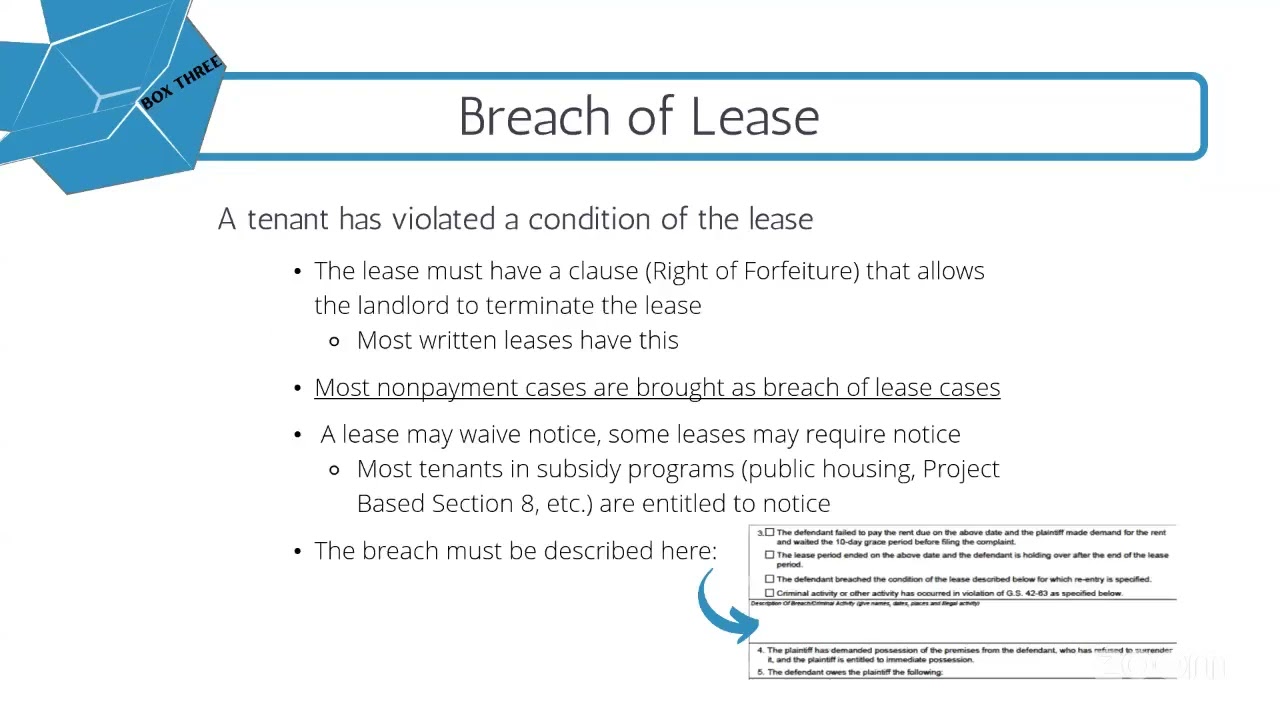
If a tenant fails to pay rent but remains in possession of the premises, the landlord can sue for damages resulting from the breach.
The landlord may also file to evict the tenant from the property.
In determining a landlord's damages for a tenant's failure to pay rent, the majority rule is that the landlord will only be entitled to rent that is past due.
The landlord is generally unable to sue to collect future rents that would have come due under the remainder of the lease term.
In addition to paying rent, tenants also have a duty to avoid committing waste.
This generally means that the tenant is required to return the property to the landlord in the same condition they received the property in.
Unless the tenant and landlord agree otherwise, however, normal wear and tear is considered permissible and will not violate the duty to avoid waste.
A landlord's ability to terminate or sue for breach of a covenant other than the payment of rent, such as violating the duty to avoid waste, is largely dependent on the specific terms of the lease.
So this will generally be determined on a case-by-case basis.
However, if the landlord is aware of the tenant's breach and continues to accept rent from them, the landlord is considered to have waived the breach and the right to terminate the lease on that basis.
Okay, now that we've established what the tenant's obligations are under a lease agreement, let's look at what the landlord's duties are.
The first duty a landlord has when entering a lease agreement is the duty to deliver possession of the leased premises to the tenant at the start of the lease term.
Seems simple enough, right?
It is.
Unfortunately, the rest of the landlord's duties are a little more complicated.
In the vast majority of states, the landlord has an implied duty to make necessary repairs to the property in all residential leases.
This is true even when the express language of the lease places the burden to repair on the tenant.
Failure to make necessary repairs to the premises may constitute a violation of the warranty of habitability or constructive eviction.
We'll talk about both of those in a minute.
Before we turn to those covenants, however, it is important to highlight that this duty to repair is only implied in residential leases, not commercial leases.
Commercial leases can lawfully place the burden of repairs on the tenant.
This is largely due to the fact that commercial leases do not have an implied warranty of habitability.
Now that we've teased it a few times through this podcast, let's finally look at the warranty of habitability.
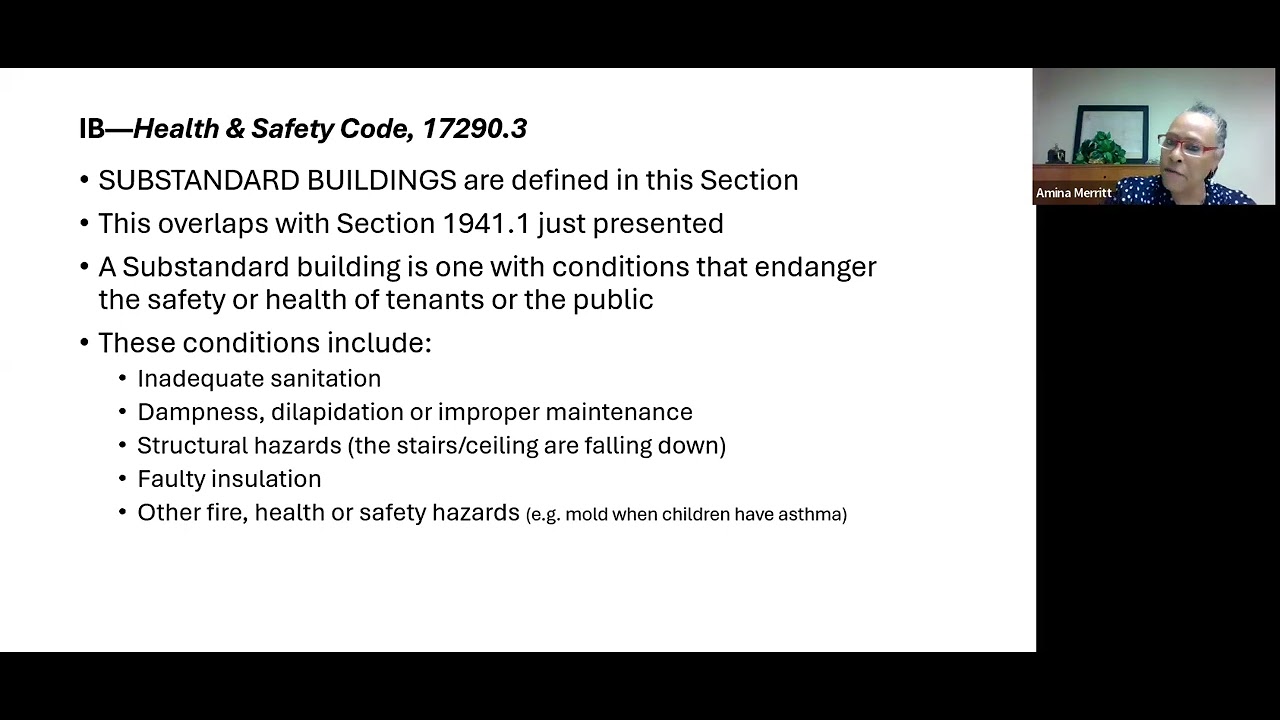
Residential leases include an implied warranty of habitability, which requires that the landlord keep the property habitable throughout the duration of the lease.
This generally means that the premises must comply with all housing codes and be free of any condition that substantially threatens a tenant's health or safety.
If the premises becomes uninhabitable during the lease period, the tenant has two options available.
The tenant may refuse to pay rent until the condition is repaired, or the tenant can pay to have the defect repaired themselves and offset the cost of those repairs against their next rental payment.
Before proceeding with either of these options, however, the tenant must first notify the landlord of the condition and give them a reasonable opportunity to correct the problem.
Unlike with constructive eviction, which we'll discuss in a moment, the tenant is not required to vacate the premises.
Every lease, both residential and commercial, includes an implied covenant of quiet enjoyment.
Under this covenant, the tenant has the right to possess and use the property in the manner that was originally intended at the time of the lease agreement, and to be free of any nuisances that would interfere with those rights.
The covenant of quiet enjoyment can be breached whenever a landlord's actions result in either actual or constructive eviction of the tenant.
Actual eviction occurs when the landlord physically excludes the tenant from the premises.
The most common example of actual eviction is when a landlord changes the locks to completely bar the tenant from entering the property.
When this happens, the lease terminates and the tenant is relieved from their obligation to pay rent.
If the tenant is only excluded from a portion of the property, however, they will not be free of their rental obligation in its entirety.
Rather, their rent will be proportionally reduced to offset the partial eviction.
A tenant may also be considered evicted from the premises even when the landlord does not physically oust them from the property.
This is called constructive eviction, which occurs whenever a landlord breaches a duty to the tenant that substantially interferes with the tenant's use and enjoyment of the property.
This could be something like a landlord's failure to make a necessary repair, a pest invasion, lack of heat or water at the premises, etcetera.
To succeed on a claim of constructive eviction, a tenant must meet three conditions.
First, the interference must be caused by the landlord.
Actions by neighbors or other third parties is not sufficient.
It must be the landlord's action, or failure to act, that is causing the condition resulting in the tenant's eviction.
Second, the condition must be so substantial that a court could reasonably conclude that the premises is uninhabitable or unusable.
So, this is not going to be a minor interference.
You want to look for a condition that is so disruptive that the tenant could not possibly use the property.
The final requirement that must be met is the tenant must move out of the property.
Unlike with the warranty of habitability, a tenant cannot remain at the property and argue constructive eviction.
If the tenant does not vacate within a reasonable time, they are waiving their right to a constructive eviction claim.
Still with me?
I know that was a lot of information to take in.
It's completely fine if everything we've covered thus far is still not entirely clear.
Sometimes it can be hard to fully grasp these rules until we see how they would play out in a hypothetical.
So stay tuned for Part 2, where we're going to talk about how to apply this law to a number of hypotheticals.
Thanks for watching!
Be sure to subscribe so you don't miss anything else.
Up Next

Can You Withhold Rent for Repairs? Legal Tenant Rights
@MikeRafiLawyer
2.5M views•2025-10-20

US Secondary Sanctions Impact on EU Businesses and Blocking Legislation
@Bureauvandijk
1.6K views•2019-03-20

Forensic Phonetics: Speaker Identification in Legal Cases
@nptel-nociitm9240
539 views•2025-03-19

Police Interrogation Tactics: False Confessions & Legal Reform
@LastWeekTonight
7M views•2022-04-18
Related Study Plans & Knowledge Roadmaps
Structured learning paths in Law