
![[ENG] 일본의 역사 30분만에 다보기 l Japanese History in 30 minutes](https://i.ytimg.com/vi/iiWOHiwF54g/maxresdefault.jpg)
























![Sarah Paine: “Russia and China Aren’t Allies” — America, Empires and the Future of War [INTERVIEW]](https://i.ytimg.com/vi/gyIIa8bUZbQ/maxresdefault.jpg)



Nationalism emerged as a powerful global force in the 19th century, driving the transformation of traditional feudal societies into modern nation-states; Japan exemplifies this process, where external pressures from Western powers like Matthew Perry's arrival prompted the Tokugawa Shogunate's collapse and the subsequent Meiji Restoration, which systematically modernized Japan through conscription, compulsory education, and bureaucratic reforms to create a unified national identity.
Nationalism and Japanese Modernization: Crash Course World History 34
Added:The structure of the Tokugawa Shogunate, including the feudal hierarchy of shogun, daimyo, and samurai, and the isolationist policy of Sakoku.
The basic concept of the Industrial Revolution and how industrialization shifted global economic and military power dynamics in the 19th century.
The definition of nationalism and how the concept of the 'nation-state' began to replace traditional kingdoms and empires in the West.
The rise of Western imperialism in Asia and the nature of 'gunboat diplomacy,' specifically Commodore Matthew Perry's forced opening of Japan in 1853.
The political structure of Meiji Japan, including the Meiji Constitution and the establishment of a centralized constitutional monarchy.
Japan's rapid transition from a defensive state to an imperialist power, highlighted by the First Sino-Japanese War and the Russo-Japanese War.
The societal and cultural conflicts of the Meiji period, particularly the tension between traditional Japanese values (Eastern ethics) and rapid Westernization (Western science).
A comparative analysis of 19th-century modernization, contrasting Japan's successful reforms with the failed or limited reforms of the Ottoman Empire or Qing Dynasty China.
The rise of ultra-nationalism and militarism in Japan during the early 20th century, which ultimately led to the Pacific conflict in World War II.
4.4M views56.2Klikes11:52Original Release: 2012-09-13
Hi, I'm John Green. This is Crash Course World History, and today we're going to talk about nationalism, the most important global phenomenon of the nineteenth century and also the phenomenon responsible for one of the most commented-upon aspects of Crash Course, my globes being out of date.
USS "R" not a country! [Explosion noise.] Rhodesia? [Explosion noise.]
South Vietnam? [Explosion noise.] Sudan with no South Sudan? [Explosion noise.]
Yugoslavia? [Explosion noise.]
Okay, no more inaccuracies with the globes. Ahhh, the little globes!
This one doesn't know about Slovakia [explosion noise], this one has East-frackin' Pakistan [explosion noise] and this one identifies Lithuania as part of Asia [explosion noise].
Okay, no more globe inaccuracies. Actually, bring back my globes. I feel naked without them.
[theme music] So if you're into European history, you're probably somewhat familiar with nationalism and the names and countries associated with it. Bismarck in Germany, Mazzini and Garibaldi in Italy and Mustafa Kemal, a.k.a. Ataturk, in Turkey.
But nationalism was a global phenomenon, and it included a lot of people you may not associate with it, like Muhammad Ali in Egypt and also this guy [Lincoln].
Nationalism was seen in the British dominions as Canada, Australia and New Zealand became federated states between 1860 and 1901. I would say "independent states" instead of federated states, but you guys still have a queen!
It was also seen in the Balkans, where Greece gained its independence in 1832 and Christian principalities fought a war against the Ottomans in 1878. In India, where a political party, the Indian National Congress, was founded in 1885, and even in China, where nationalism ran up against the dynastic system that had lasted more than two thousand years.
And then, of course, there are these guys [Hitler, Mussolini, Hirohito], who in many ways, represent the worst of nationalism, the nationalism that tries to deny or eliminate difference in the efforts to create a homogeneous, mythologized unitary polity. We'll get to them later, but it's helpful to bring them up now just so we don't get too excited about nationalism.
Okay, so before we launch into the history, let's define the modern nation-state. Definitions are slippery, but for our purposes, a nation-state involves a centralized government that can claim and exercise authority over a distinctive territory. That's the state part. It also involves a certain degree of linguistic and cultural homogeneity - that's the nation part.
Mr. Green, Mr. Green! By that definition, China was a nation-state by, like, probably the Han dynasty.
Dude, Me From the Past, you're getting smart! Yeah, it could be, and some historians argue that it was. Nationhood is really hard to define. Like in James Joyce's Ulysses, the character Bloom famously says that a nation is "the same people living in the same place," but then he remembers the Irish and Jewish Diasporas and adds, "or also living in different places." But let's ignore Diasporas for the moment and focus on territorially-bounded groups with a common heritage. Same people, same place.
So how do you become a nation? Well, some argue it's an organic process involving culturally-similar people wanting to formalize their connections; others argue that nationalism is constructed by governments, building a sense of patriotism through compulsory military service and statues of national heroes.
Public education is often seen as part of this nationalizing project. Schools and textbooks allow countries to share their nationalizing narratives, which is why the once and possibly-future independent nation of Texas issues textbooks literally whitewashing early American history.
Still, other historians argue that nationalism was an outgrowth of urbanization and industrialization, since new urbanites were the most likely people to want to see themselves as part of a nation.
For instance, Prague's population rose from 157,000 to 514,000 between 1850 and 1900, at the same time that the Czechs were beginning to see themselves as separate from the Austro-Hungarian Empire.
Which is a cool idea, but it doesn't explain why other less-industrialized places like India also saw a lot of nationalism.
The actual business of nationalization involves creating bureaucracies, new systems of education, building a large military, and often using that military to fight off other nation-states, since nations often construct themselves in opposition to an idea of otherness. A big part of being Irish, for instance, is not being English.
So emerging nations had a lot of conflicts, including the Napoleonic Wars, which helped the French become the French, the Indian Rebellion of 1857, which helped Indians to identify themselves as a homogeneous people, the American Civil War - I mean, before the Civil War, many Americans thought of themselves not as Americans, but as Virginians or New Yorkers or Pennsylvanians. I mean, our antebellum nation was usually called "THESE United States."
After, it became THE United States.
So in the U.S, nationalism pulled a nation together, but often, nationalism was a destabilizing force for multiethnic land-based empires. This was especially the case in the Ottoman Empire, which started falling apart in the nineteenth century as first the Greeks, then the Serbs, Romanians, and Bulgarians, all predominantly Christian people, began clamoring for and, in some cases winning, independence.
Egypt is another good example of nationalism serving both to create a new state and to weaken an empire. Muhammad Ali, who was actually Albanian and spoke Turkish, not Egyptian Arabic, and his ruling family encouraged the Egyptian people to imagine themselves as a separate nationality.
But okay, so nationalism was a global phenomenon in the nineteenth century, and we can't talk about it everywhere, so instead, we're going to focus on one case study: Japan. You thought I was going to say Germany, didn't you? Nope. You can bite me, Bismarck.
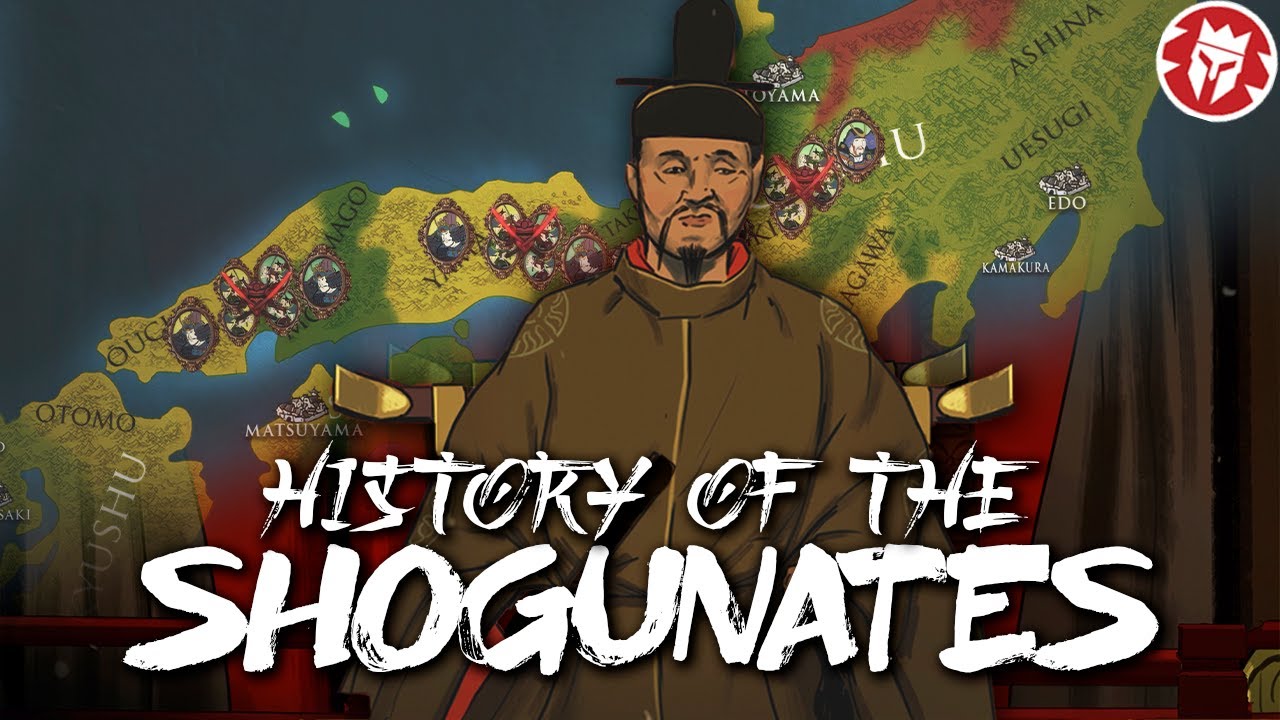
Japan had been fragmented and feudal until the late sixteenth century, when a series of warrior landowners managed to consolidate power. Eventually, power came to the Tokugawa family, who created a military government, or bakufu.
The first Tokugawa to take power was Ieyasu, who took over after the death of one of the main unifiers of Japan, Toyotomi Hideyoshi, sometimes known as "The Monkey," although his wife called him - and this is true - "The Bald Rat."
In 1603, Ieyasu convinced the emperor, who was something of a figurehead, to grant him the title of shogun. And for the next 260 years or so, the Tokugawa bakufu was the main government of Japan. The primary virtue of this government was not necessarily its efficiency or its forward-thinking policies, but its stability. Stability: the most underrated of governmental virtues. Let's go to the Thought Bubble.
The Tokugawa bakufu wasn't much for centralization, as power was mainly in the hands of local lords called daimyo. One odd feature of the Tokugawa era was the presence of a class of warriors who, by the nineteenth century, had become mostly bureaucrats. You may have heard of them: the samurai.
One of the things that made this hereditary class so interesting was that each samurai was entitled to an annual salary from the daimyo called a stipend. This privilege basically paid them off and assured that they didn't become restless warriors, plaguing the countryside - that is, bandits.
We tend to think of samurai as noble and honorable, but urban samurai, according to Andrew Gordon's book A Modern History of Japan, they were "a rough-and-tumble lot. Samurai gang wars - a West Side Story in the shadows of Edo Castle - were frequent in the early 1600s."
And you still say that history books are boring.
As with kings and lesser nobles anywhere, the central bakufu had trouble controlling the more powerful daimyo, who were able to build up their own strength because of their control over local resources. This poor control also made it really difficult to collect taxes, so the Tokugawa were already a bit on the ropes when two foreign events rocked Japan.
First was China's humiliating defeat in the Opium Wars, after which Western nations forced China to give Europeans special trade privileges. It was a wake-up call to see the dominant power in the region so humbled, but even worse for the Tokugawa was the arrival of Matthew Perry. No, Thought Bubble, Matthew Perry. Yes, that one.
The Tokugawa are somewhat famous for their not-so-friendly policy toward foreigners, especially Western Christian ones, for whom the penalty for stepping foot on Japanese soil was death.
The Tokugawa saw Christianity in much the same way as the Romans had, as an unsettling threat to stability. And in the case of Matthew Perry, they had reason to be worried.
Thanks, Thought Bubble. So the American naval commodore arrived in Japan in 1853 with a flotilla of ships and a determination to open Japan's markets.
Just the threat of American steam-powered warships was enough to convince the bakufu to sign some humiliating trade treaties that weren't unlike the ones that China had signed after losing the Opium Wars.
And this only further motivated the daimyo and samurai, who were ready to give the Tokugawa the boot. Within a few years, they would.
So what does this have to do with nationalism? Well, plenty. First off, even though the Americans and the Japanese didn't go to war... yet, the perceived threat provided an impetus for Japan to start thinking about itself differently.
It also resulted in the Japanese being convinced that if they wanted to maintain their independence, they would have to reconstitute their country as a modern nation-state.
This looks a lot like what was happening in Egypt or even Germany, with external pressures leading to calls for greater national consolidation.
So the Tokugawa didn't give up without a fight, but the civil war between the stronger daimyo and the bakufu eventually led to the end of the shogunate.
And in 1868, the rebels got the newly-enthroned Emperor Meiji to abolish the bakufu and proclaim a restoration of the imperial throne. Now the emperor didn't have much real power, but he became a symbolic figure, a representative of a mythical past around whom modernizers could build a sense of national pride. And in place of bakufu, Japan created one of the most modern nation-states in the world.
After some trial and error, the Meiji leaders created a European-style cabinet system of government with a prime minister, and in 1889, promulgated a constitution that even contained a deliberative assembly, the Diet, although the cabinet ministers weren't responsible to it.
Samurai were incorporated into this system as bureaucrats and their stipends were gradually taken away. And soon the Japanese government developed into, like, something of a meritocracy.
Japan also created a new conscript army. Beginning in 1873, all Japanese men were required to spend three years in the military. The program was initially very unpopular - there were more than a dozen riots in 1873 and 1874, in which crowds attacked military registration centers.
But eventually, serving in the army created a patriotic spirit and a loyalty to the Japanese emperor. The Meiji leaders also instituted compulsory education in 1872, requiring both boys and girls to attend four years of elementary school. Oh, it's time for the Open Letter?
An Open Letter to Public Education. But first, let's see what's in the Secret Compartment today.
Oh, it's a graduation hat. Thanks, Meredith the intern, for letting me borrow your graduation hat.
Dear Public Education, When you were introduced in Japan, you were very unpopular, because you were funded by a new property tax. In fact, you were so unpopular that at least two thousand schools were destroyed by rioters, primarily through arson.
Stan, it doesn't look good when you bring it in close like that. I look like a 90-year-old swimmer.
And even though public education has proved extremely successful, lots of people still complain about having to pay taxes for it, so let me explain something.
Public education does not exist for the benefit of students or for the benefit of their parents.
It exists for the benefit of the social order. We have discovered as a species that it is useful to have an educated population.
You do not need to be a student or have a child who is a student to benefit from public education. Every second of every day of your life, you benefit from public education!
So let me explain why I like to pay taxes for schools, even though I don't personally have a kid in school. It's because I don't like living in a country with a bunch of stupid people.
Best wishes, John Green.
In Japan, nationalism meant modernization, largely inspired by, and in competition with, the West. So the Meiji government established a functioning tax system, they built public infrastructure like harbors and telegraph lines, invested heavily in railroads and created a uniform national currency.
But the dark side of nationalism began to appear early on. In 1869, the Meiji rulers expanded Japan's borders to include the island of Hokkaido, and in 1879, they acquired Okinawa after forcing its king to abdicate.
In 1874, Japan even invaded Taiwan with an eye toward colonizing it, though they weren't successful. And in these early actions, we already see that nationalism has a habit of thriving on conflict. And often, the project of creating a nation-state goes hand-in-hand with preventing others from doing the same.
This failure to imagine the other complexly isn't new, but it's about to get a lot more problematic, as we'll see next week, when we discuss European imperialism. Thanks for watching.
Crash Course is produced and directed by Stan Muller. Our script supervisor is Danica Johnson.
We're ably interned by Meredith Danko and our graphics team is Thought Bubble.
Raoul Meyer: Also, the show was written by my high school history student, John Green, and myself, Raoul Meyer.
John: Last week's phrase of the week was "bearded Marxist." If you'd like to guess at this week's phrase of the week or suggest future ones, you can do so in comments, where you can also ask questions about today's video that will be answered by our team of historians. Thanks for watching Crash Course, and as we say in my hometown, don't forget to be awesome!
Up Next

17:35
Japanese Militarism Before WWII | Historical Analysis with Reactions
@VloggingThroughHistory
74.4K views•2022-12-08

33:02
The Great Schism of 1054: Causes and Consequences
@SacredCathedrals
113.5K views•2026-02-19

12:28
European Protests of the 1960s: Crash Course European History #45
@crashcourse
314.5K views•2020-06-20
17:05
Understanding the Cold War: Superpower Conflicts and the Road to Détente
@OverSimplified
46.1M views•2019-01-24
Related Study Plans & Knowledge Roadmaps
Structured learning paths in History
history
Byzantine Iconoclasm: Theology, Art & Politics
01Foundations of Byzantium and Early Christian Images
02The First Iconoclasm: Leo III and the Crisis of Images
03Empress Irene, Nicaea II, and the Second Iconoclasm
+ 2 more learning modules
9h5 modules
Explore Roadmap
history
Iranian Revolution (Causes, Events & Legacy)
01The Pahlavi Dynasty and the Roots of Discontent
02The Spark of Rebellion and the Rise of Khomeini
031979: The Fall of the Shah and the Climax of the Revolution
+ 2 more learning modules
8h5 modules
Explore Roadmap
history
Mali Empire: Mansa Musa, Trade & Timbuktu
01Foundations of the Mali Empire
02The Trans-Saharan Gold and Salt Trade
03The Reign and Pilgrimage of Mansa Musa
+ 1 more learning modules
6h4 modules
Explore Roadmap
history
1947 Partition: Politics, Borders & Legacies
01Foundations of British India and the Divide
02The Political Negotiations and the Mountbatten Plan
03Drawing the Boundary: The Radcliffe Line
+ 2 more learning modules
8h5 modules
Explore Roadmap