The critical Mach number (Mcrit) is the lowest speed at which airflow over an aircraft's wings reaches the speed of sound without exceeding it, marking the onset of shock wave formation; even when an aircraft flies at subsonic speeds overall (Mach < 1), localized airflow above the wing's upper surface can become supersonic due to acceleration, causing the first shock waves to appear at Mcrit before reaching the trailing edge.
Critical Mach Number Explained: Key Concepts for Aviation Enthusiasts
Added:Deep Dive
The definition of Mach number and how the local speed of sound varies with atmospheric temperature and altitude.

HOW WE FLEW | Airports in 1935. A dive back in time. Upscaled and colorized historical footage
626.6K
The Mach number is the ratio of an aircraft's true airspeed to the local speed of sound at its current altitude. It is named after physicist Ernst Mach. For example, if an aircraft flies 6/10 of a mile while a sound wave travels 10/10 of a mile in the same time, the aircraft is flying at Mach 0.6. Aircraft flying at the same true airspeed but at different altitudes will have different Mach numbers because the speed of sound varies with altitude and temperature.
Click to watch →
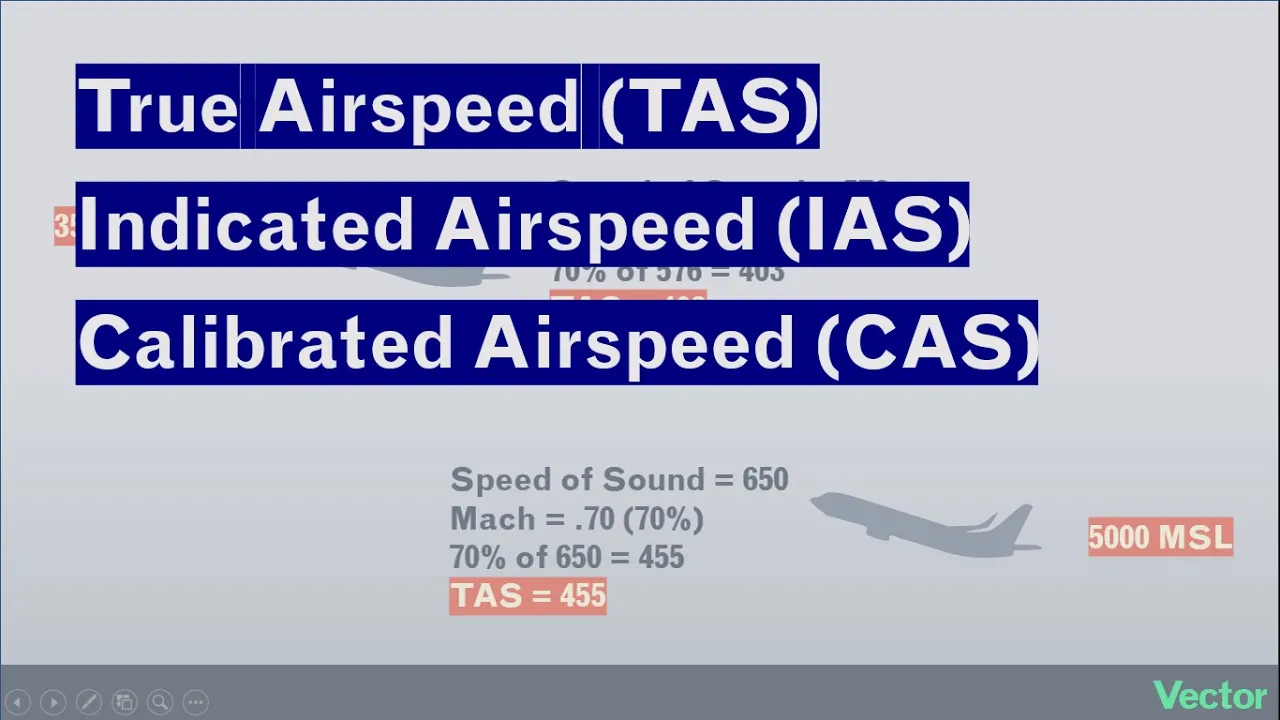
Types of Airspeed, Explained
210.9K
Mach number is the ratio of true airspeed to the speed of sound. At Mach 1, true airspeed equals the speed of sound; at Mach 0.7, true airspeed is 70% of the speed of sound. The speed of sound is a function of temperature and decreases as altitude increases (since temperature decreases with altitude). At constant true airspeed, Mach number increases with altitude because the speed of sound decreases. Conversely, at constant Mach number during climb, true airspeed decreases because the percentage of a decreasing speed of sound results in a lower actual true airspeed.
Click to watch →

ATPL Instrumentation - Class 5: Airspeed Indicators.
1.5K
Mach Number is true air speed divided by local speed of sound. At Mach 1, aircraft travel at sound speed. The local speed of sound formula is 38.94 × √(temperature in Kelvin). Temperature decreases with altitude, reducing the speed of sound. For example, at 37,000 ft where temperature is -57°C (216K), the local speed of sound is 572 knots versus 661 knots at 20°C. This means the same Mach number represents different true air speeds at different altitudes. A practical method to understand airspeed relationships is using four fingers or lines representing EAS, CAS, TAS, and MAC, rotating them to see how speeds change during maneuvers.
Click to watch →
![IAS, TAS, GS e MACH: le velocità aeronautiche [Lez.21]](https://i.ytimg.com/vi_webp/1dUn8KraNxw/maxresdefault.webp)
IAS, TAS, GS e MACH: le velocità aeronautiche [Lez.21]
73.4K
Ground Speed (GS) is the aircraft's speed relative to the ground, calculated by adding the wind component along the flight path to True Air Speed. If there is a tailwind, GS exceeds TAS; with a headwind, GS is less than TAS. GS is what passengers care about (arrival time), while pilots use TAS for navigation. Mach Number (M) is the ratio of TAS to the speed of sound at that altitude. Unlike GS, Mach number is not affected by wind. The speed of sound varies with temperature and pressure, which change with altitude. This is why maximum IAS decreases at high altitudes - because the Mach number limit becomes the governing constraint.
Click to watch →

CRP-5: Mach number & the speed of sound
13K
True airspeed is the aircraft's speed relative to the surrounding air parcel. The Mach number represents the ratio of true airspeed to the local speed of sound, where Mach 1 equals the speed of sound. The local speed of sound depends exclusively on air temperature, not altitude or pressure. This relationship is fundamental to high-speed flight and aerodynamics.
Click to watch →
Deep Dive
Basic aerodynamic principles of lift generation, specifically how airflow accelerates over the curved upper surface of an airfoil.
![What causes lift [Aerodynamics #13a]](https://i.ytimg.com/vi/J6h2UOlZQTI/maxresdefault.jpg)
What causes lift [Aerodynamics #13a]
9.9K
Lift is generated through the synergistic interaction of three conservation principles: conservation of mass causes flow acceleration over the airfoil's curved surface, conservation of energy (via Bernoulli's principle) relates this acceleration to pressure reduction, and conservation of momentum connects the circulation to the resulting lift force; the Coanda effect maintains flow attachment over the top surface while the Kutta condition ensures clean flow exit at the trailing edge, collectively creating the pressure difference that produces lift.
Click to watch →
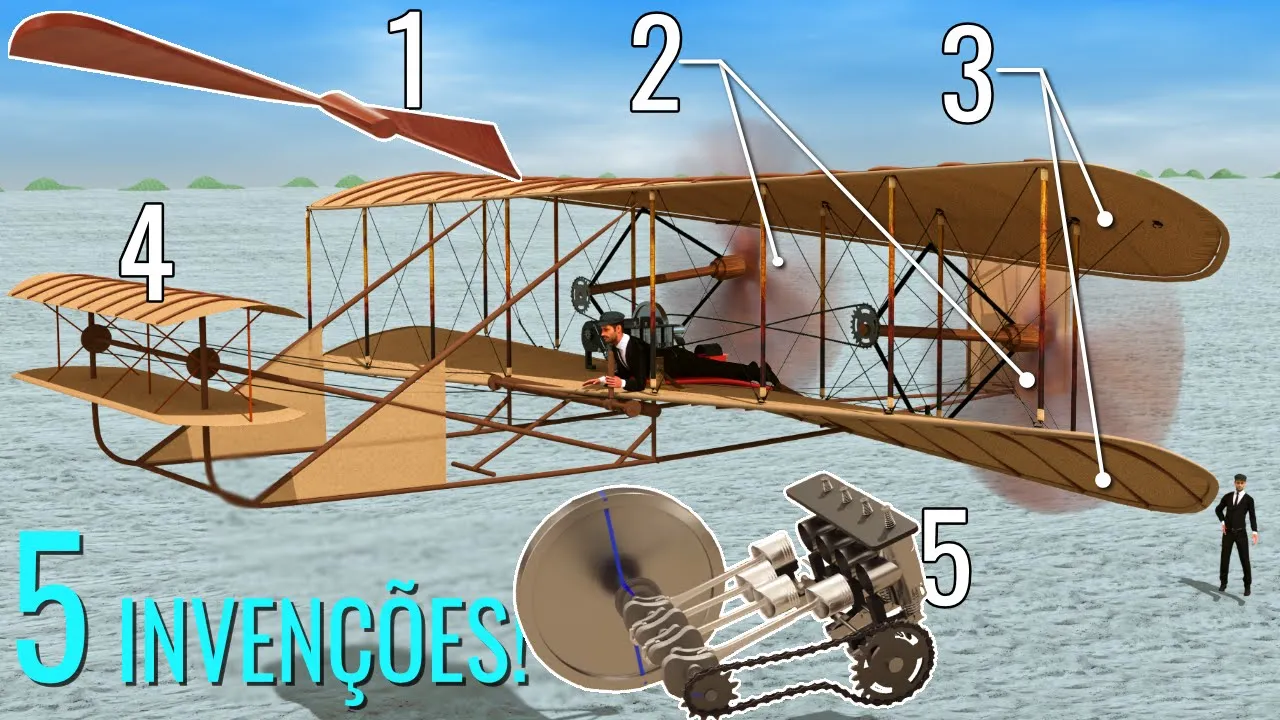
A Brilhante Engenharia do AVIADOR WRIGHT !
31.1K
Lift is generated when air flows over a curved surface (airfoil). The greater the velocity of air over the surface, the greater the lift force produced. Additionally, increasing the angle of attack also increases the lift force. These principles form the foundation of aerodynamic flight.
Click to watch →
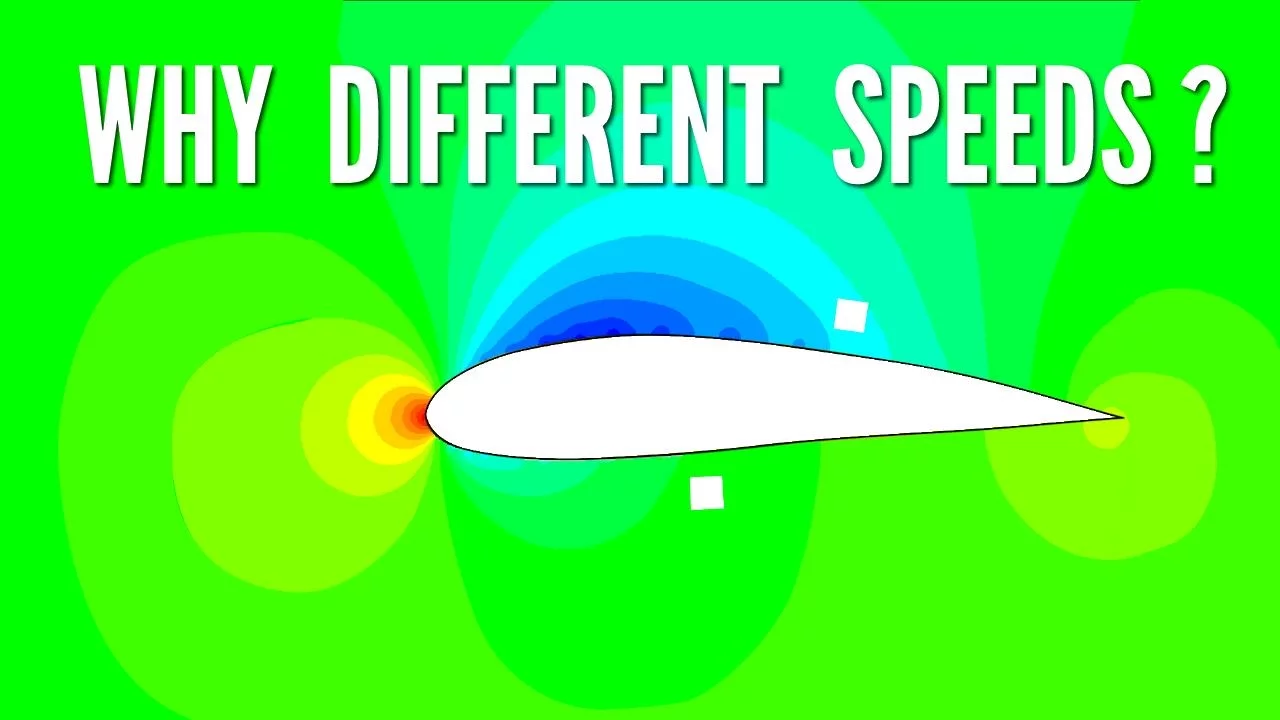
Why is the top flow faster over an Airfoil?
410.5K
The fundamental mechanism behind airfoil lift generation involves pressure gradients created by curved airflow. When air flows over an airfoil, the flow curves due to the airfoil's shape, creating regions of varying pressure. According to Bernoulli's principle, in curved flow, pressure is higher at the outside of the curve. The top surface of the airfoil has the largest curvature, causing pressure to decrease as air approaches the surface. The bottom surface has smaller curvatures—one downward-curving near the tail (increasing pressure) and a slight upward-curvature near the leading edge (minimal pressure decrease). At the leading edge, direct impact creates a high-pressure region. These pressure variations create forces that accelerate fluid particles on the upper surface while decelerating them on the lower surface, resulting in different flow speeds and generating lift.
Click to watch →

How Lift is Created
44.8K
An airfoil's camber or curvature causes airflow to accelerate over the upper surface, similar to how fluid accelerates through a narrowed tube. As air flows over the curved upper surface, it speeds up and creates lower pressure compared to the lower surface where airflow is slower and maintains higher pressure. This pressure differential generates lift. The entire effect is modulated by the angle of attack—the pitch angle of the blade—where increasing pitch angle amplifies this pressure difference.
Click to watch →
9 LIVES and the BIG WANG GANG but make it different?
25.8K
An airfoil generates lift when air travels a longer distance over its curved surface compared to the bottom surface. As air hits the front of the airfoil and travels to rejoin at the back, the increased distance creates a faster-moving air stream. This faster air creates a low-pressure zone above the airfoil, which generates lift. This principle is fundamental to both airplane wings and inverted applications like racing car wings.
Click to watch →
Deep Dive
The fundamental differences between subsonic and supersonic airflow regimes.

LA diferencia entre SUBsonico y SUPERsonico
23.3K
The fundamental difference between subsonic and supersonic flight lies in how air molecules respond to an approaching object: in subsonic flight (below Mach 1), the object moves slower than sound waves, so air molecules ahead are gradually displaced and the air 'knows' the object is coming; in supersonic flight (above Mach 1), the object moves faster than sound waves, so air molecules ahead cannot be warned and must be displaced abruptly, creating a shock wave.
Click to watch →
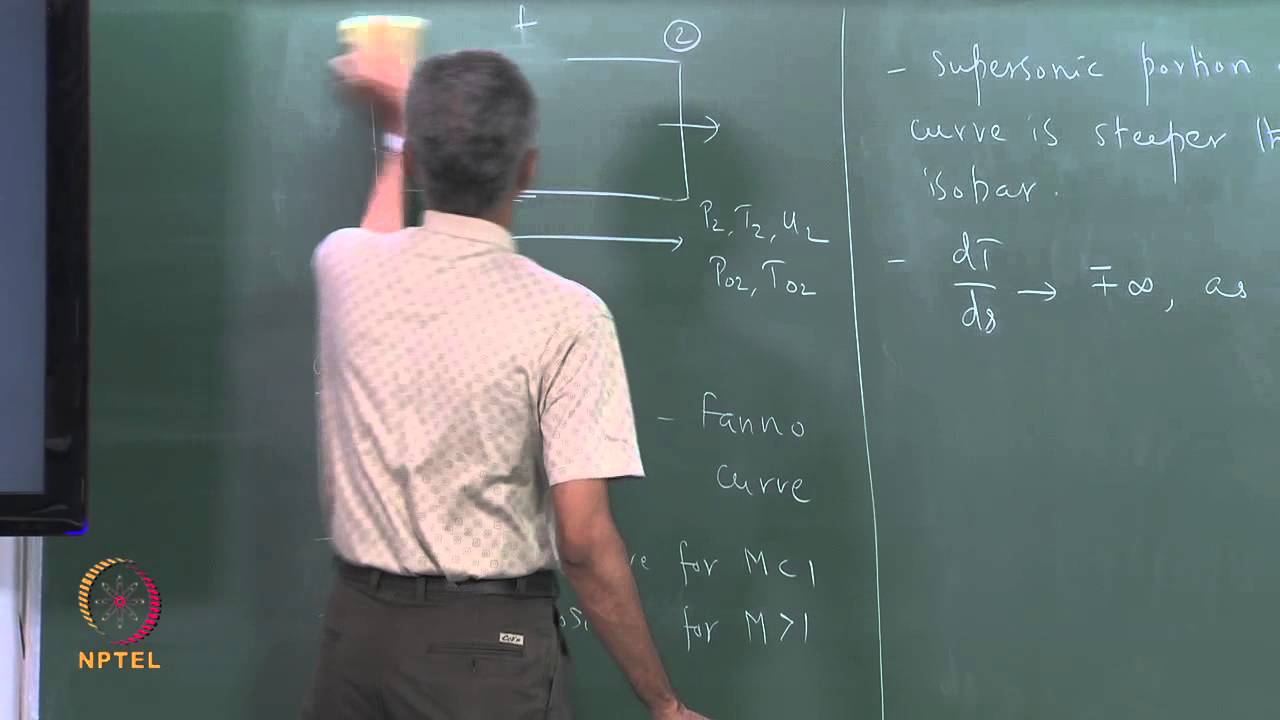
Mod-01 Lec-11 Fanno Flow
23.1K
In subsonic flow (M < 1), friction causes density, temperature, and pressure to decrease while velocity and Mach number increase. In supersonic flow (M > 1), friction causes density, temperature, and pressure to increase while velocity and Mach number decrease. Both cases show entropy always increases (ds > 0). This fundamental difference explains why subsonic and supersonic flows behave oppositely under friction effects.
Click to watch →
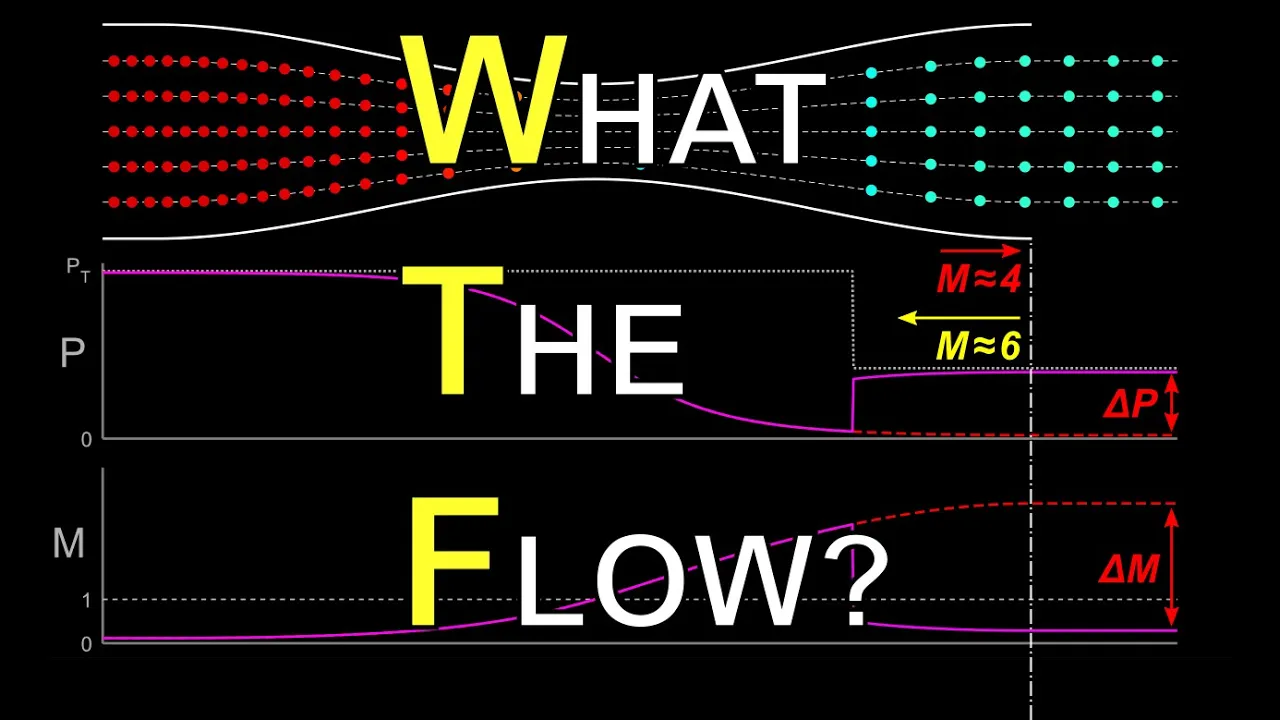
Supersonic Nozzles - What happens next will SHOCK you!
77.2K
This section explains how supersonic flow operates differently from subsonic flow. In supersonic regions, pressure information cannot travel upstream because particles move faster than sound speed. Instead, vertical particle interactions communicate flow behavior through the nozzle geometry. As flow expands through a diverging section, conservation of mass causes particles to spread out, reducing pressure and increasing velocity. The method of characteristics exploits these diagonal communication paths to solve supersonic flow problems. When neither supersonic nor subsonic expansion alone can match exit pressure, a normal shock forms—a perpendicular wave that transitions between regimes, always producing subsonic flow downstream with significant total pressure loss.
Click to watch →

Fluid Mechanics Lesson 15A: One-Dimensional Compressible Flow in Ducts
10.7K
In one-dimensional compressible flow in ducts, the relationship between area change and velocity depends critically on whether the flow is subsonic or supersonic: for subsonic flow (Mach number < 1), velocity decreases when area increases and vice versa, while for supersonic flow (Mach number > 1), velocity increases when area increases and decreases when area decreases; this fundamental difference arises because supersonic flow requires rapid density changes to maintain mass conservation, unlike subsonic flow where density changes are relatively small.
Click to watch →

Compressible Flow Lesson 13E: Design of Supersonic Airfoils
427
Subsonic airfoils feature rounded leading edges and generate lift through pressure differential (high-speed/low-pressure upper surface, low-speed/high-pressure lower surface). Supersonic airfoils are thin with sharp leading edges, known as diamond airfoils. At zero angle of attack, diamond airfoils experience oblique shocks followed by expansion fans, creating asymmetric pressure distributions (P2 > P3) that produce zero lift but significant wave drag. This contrasts with subsonic inviscid flow where drag equals zero despite non-zero lift (Kutta-Joukowski paradox).
Click to watch →
Deep Dive
The relationship between velocity, pressure, and density in compressible fluid dynamics.

Curso de Volumes Finitos - Prof. Maliska - 23. Acoplamento Pressão-Velocidade/Densidade II
1.3K
In compressible flow, pressure, velocity, and density are coupled through the conservation of mass equation. The pressure correction equation involves terms from both velocity and density corrections, creating an interdependent system. This coupling means changes in pressure affect velocity, and changes in velocity affect density. The system must be solved simultaneously to maintain mass conservation. The coupling is stronger in compressible flows than in incompressible flows where density is constant.
Click to watch →
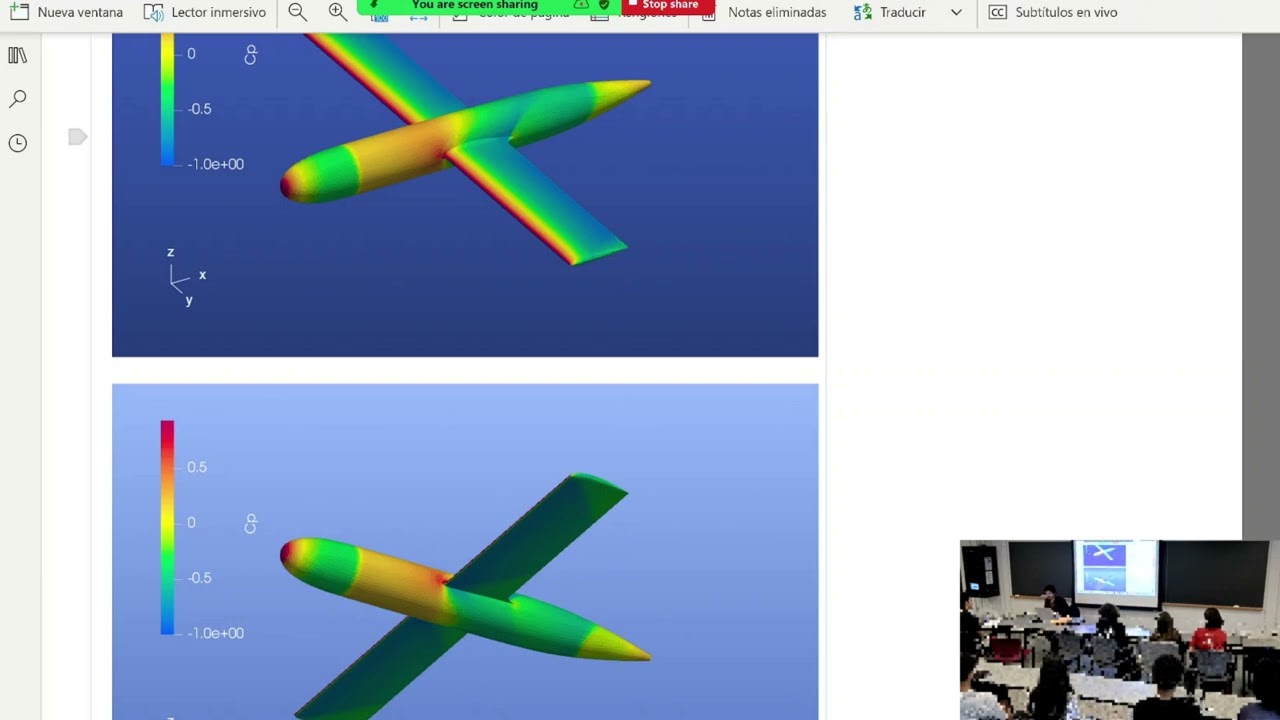
MIT 16.100 Aerodynamics 2024-11-01
477
This segment derives the fundamental relationships governing compressible flow behavior. Starting from Newton's second law for steady flow (-∂p/∂x = ρ∂u/∂x) and combining with ideal gas and isentropic relations, the instructor shows how density changes relate to velocity changes through the Mach number. The key result is Δρ/ρ = γ(Δp/p), demonstrating that density changes are amplified by the heat capacity ratio. This establishes that compressibility effects become significant only when Mach number approaches or exceeds unity. The instructor emphasizes that understanding these relationships is essential for predicting aerodynamic performance in compressible regimes.
Click to watch →
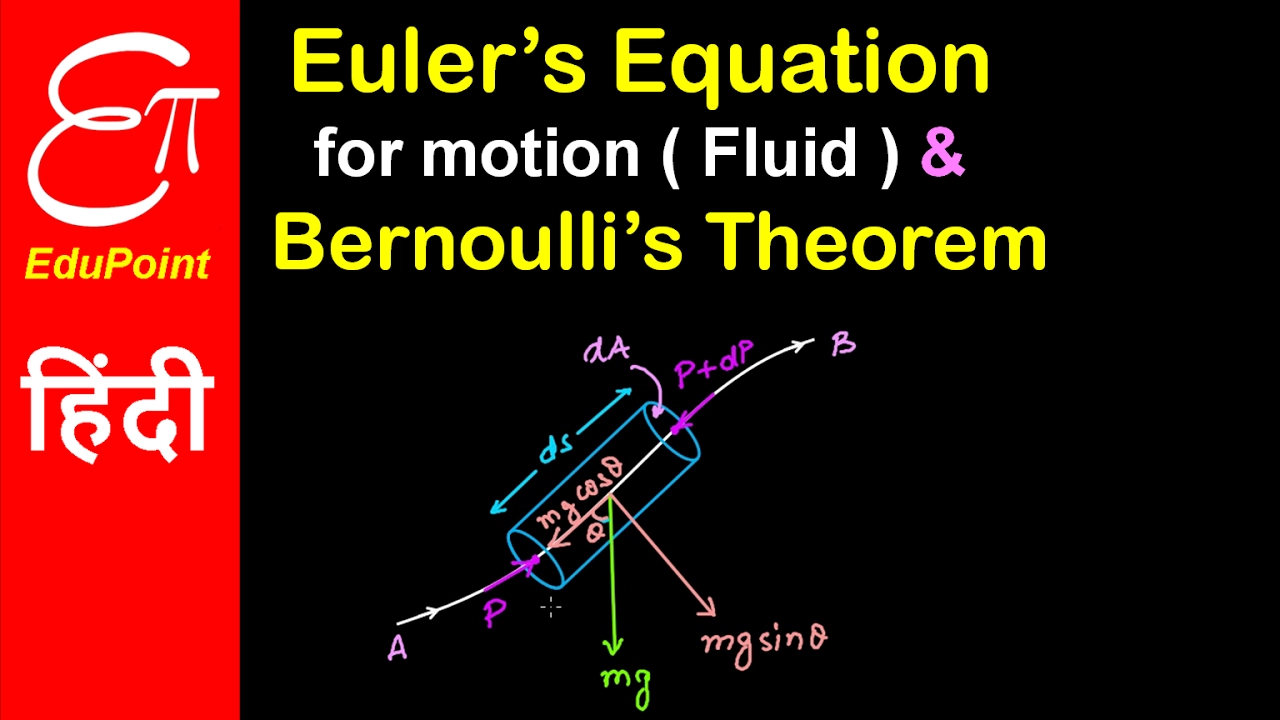
Euler's Equation for Motion and Bernoulli's Theorem | video in HINDI | EduPoint
294.5K
This video derives Euler's equation for motion in fluid mechanics for steady flow of an ideal fluid along a streamline, establishing a relationship between velocity, pressure, and density of the fluid based on Newton’s Second Law of Motion. From Euler’s equation, Bernoulli’s equation is obtained through integration, expressing energy per unit weight of the fluid. The derivation relies on five key assumptions: the fluid is non-viscous (zero frictional losses), homogeneous and incompressible (constant mass density), flow is continuous and steady along a streamline, velocity is uniform across the cross-section, and only gravity and pressure forces act on the fluid—no other energy or forces are involved. Bernoulli’s principle, derived from this, states that an increase in fluid speed occurs simultaneously with a decrease in pressure or a decrease in potential energy. The video presents these concepts in Hindi, focusing on the mathematical and physical foundations linking Euler’s and Bernoulli’s equations in fluid dynamics without introducing external forces or viscous effects.
Click to watch →
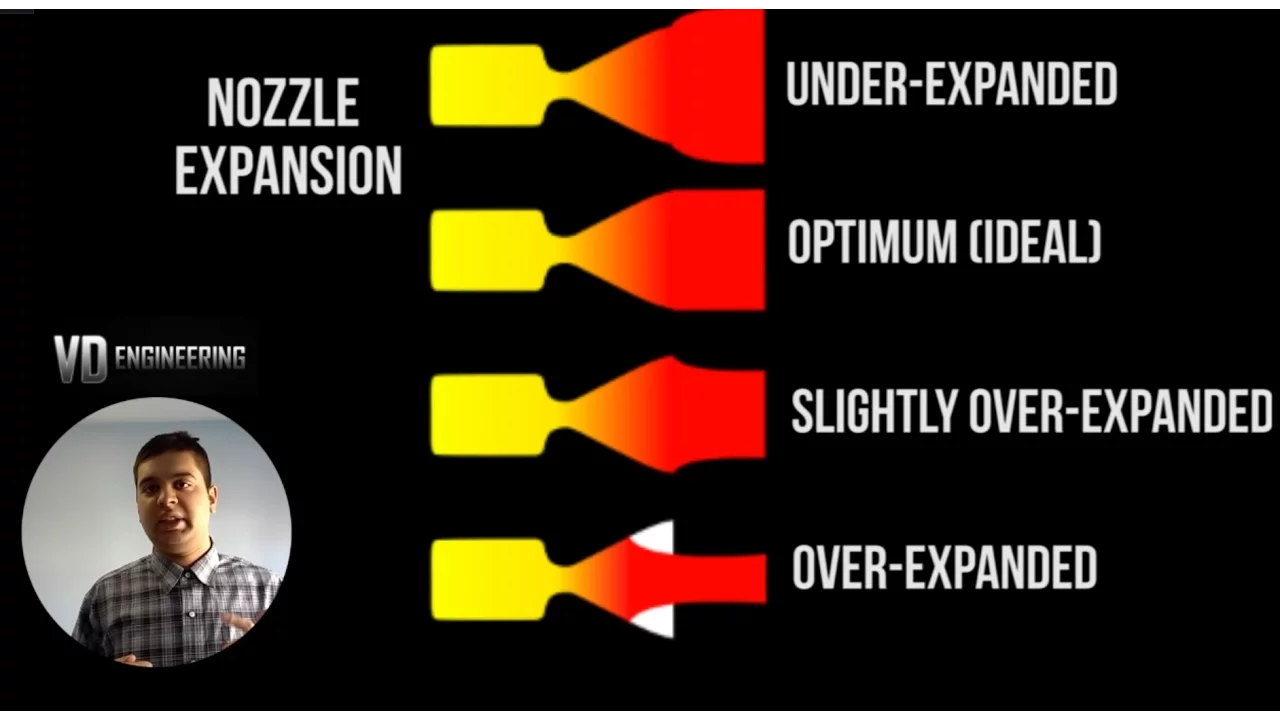
How does a Rocket Engine (and Nozzle) Work? - Compressible Flow Basics
128.4K
For incompressible fluids (density constant, speed below Mach 0.4), velocity increases when area decreases. However, for compressible fluids (speed above Mach 0.5 where density changes), this relationship reverses - velocity increases when area increases. Despite this reversal, the fundamental principle remains: when velocity increases, pressure always decreases regardless of whether the flow is subsonic or supersonic.
Click to watch →

Compressible flow basics and stagnation properties
493
In compressible flow, stagnation properties (temperature, pressure, and density) represent the conditions a fluid would reach if brought to rest isentropically; these are calculated using the Mach number (M = v/a, where v is fluid velocity and a is speed of sound = √(γRT)), with stagnation temperature given by T₀/T = 1 + [(γ-1)/2]M², stagnation pressure by P₀/P = [1 + ((γ-1)/2)M²]^(γ/(γ-1)), and stagnation density by ρ₀/ρ = [T₀/T]^(1/(γ-1)), where γ is the ratio of specific heats (cp/cv).
Click to watch →
Prerequisite Knowledge
- Concept 01The definition of Mach number and how the local speed of sound varies with atmospheric temperature and altitude.
- Concept 02Basic aerodynamic principles of lift generation, specifically how airflow accelerates over the curved upper surface of an airfoil.
- Concept 03The fundamental differences between subsonic and supersonic airflow regimes.
- Concept 04The relationship between velocity, pressure, and density in compressible fluid dynamics.
Subsequent Learning
- Step 01The formation of shock waves and the development of wave drag as flight speeds exceed the critical Mach number.
- Step 02Aerodynamic phenomena associated with transonic flight, such as 'Mach tuck' and shock-induced boundary layer separation (buffet).
- Step 03Engineering design methodologies utilized to increase critical Mach number, including wing sweep, supercritical airfoils, and the Whitcomb area rule.
- Step 04The operational concept of 'Coffin Corner' (aerodynamic ceiling) where minimum clean speed and maximum operating Mach number converge at high altitudes.
Mach Basics
Mach Basics
0:05Playing Section
- 1
Defines speed of sound and Mach number ratios.
- 2
Explains subsonic, supersonic, and critical Mach.
- 3
Describes shock wave formation over wing surface.
The Operational Relevance of Drag Divergence Mach Number (Mdd)
While the Critical Mach Number (Mcrit) is a fundamental aerodynamic concept indicating when local airflow first reaches supersonic speed, modern aerospace engineering often views it as an overly conservative metric for practical aircraft design. Instead, designers and operators focus on the Drag Divergence Mach Number (Mdd), the point at which aerodynamic drag actually begins to rise rapidly. Thanks to advancements like swept wings and supercritical airfoils, modern commercial aircraft routinely and efficiently fly at speeds above their theoretical Mcrit. Focusing solely on Mcrit overlooks how contemporary aircraft are engineered to control and exploit local supersonic flow, making Mdd a far more significant limit for real-world aviation performance and efficiency.
Deep Dive
The formation of shock waves and the development of wave drag as flight speeds exceed the critical Mach number.
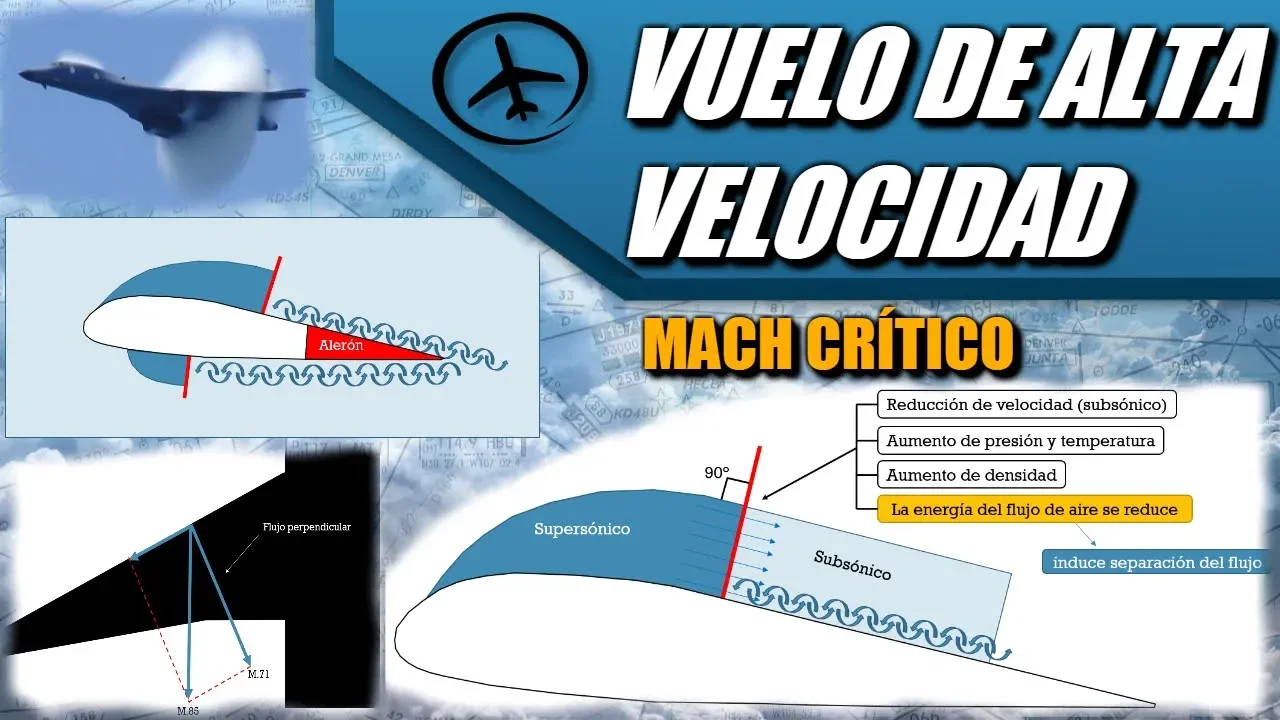
Vuelo de Alta Velocidad - Aerodinámica
30.7K
When airflow accelerates to supersonic speeds over airfoils and then decelerates, normal shock waves form perpendicular to the flow. These shock waves cause dramatic property changes: velocity decreases, pressure and temperature increase, and density rises. This reduces airflow energy and causes flow separation. Wave drag emerges as a sudden, dramatic increase in resistance when exceeding the critical Mach number, requiring significantly more thrust to maintain speed.
Click to watch →

High Speed Flight Part 1
90.5K
When an aircraft exceeds its critical Mach number, shock waves form on the wing—a sudden jump in air pressure across a very narrow region (about 1/10,000th of an inch thick) where supersonic air flow is violently reduced to subsonic speed. As the aircraft accelerates, the area of supersonic flow increases and the shock wave moves back along the wing, growing larger and stronger. Shock waves cause wave drag, a large proportion of total drag at transonic speeds, and shock-induced separation where airflow separates from the wing's surface, reducing lift and creating turbulence. Two chief design methods raise the critical Mach number: using thin wings (where maximum thickness is small compared to width or chord) and sweep back, which reduces the component of airflow that flows across the wing section. Sweep back to 35° can theoretically raise the critical Mach number from 0.8 to 0.98.
Click to watch →
HOW WE FLEW | Airports in 1935. A dive back in time. Upscaled and colorized historical footage
626.6K
When an aircraft exceeds its critical Mach number, shock waves form on the wing surface. These are extremely narrow regions (about 1/10,000th inch thick) where supersonic airflow suddenly decelerates to subsonic speed. The formation occurs because pressure waves emitted by wing points can no longer travel forward through supersonic airflow and instead pile up. Across the shock wave, there is a sudden rise in pressure and temperature, with significant kinetic energy dissipated as heat. This creates wave drag, a major component of total drag at transonic speeds. The energy loss must be continuously supplied by engines, and the resulting turbulence can cause violent buffeting and control difficulties.
Click to watch →
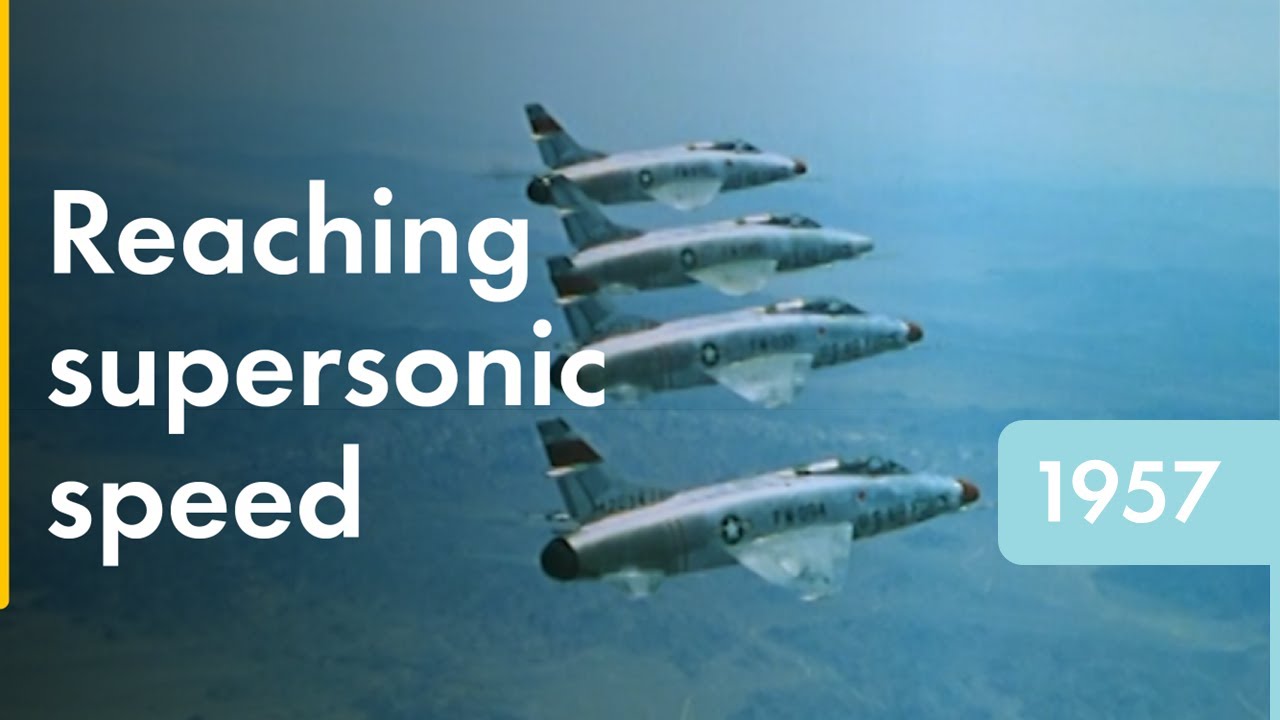
Transonic Flight | Shell Historical Film Archive
31.3K
Below Mcrit, drag is roughly proportional to the square of speed. However, when shock waves develop, drag rises much more steeply due to wave drag—the energy dissipated as heat by shock waves must be continuously supplied by engines. As shocks move back and grow stronger, wave drag increases. Once an aircraft passes Mcrit, drag rises much more steeply than before. Above Mach 1, wing shocks reach the trailing edge and grow more slowly, while bow wave drag changes gradually, causing the drag rise to become less steep toward the upper end of the transonic range.
Click to watch →
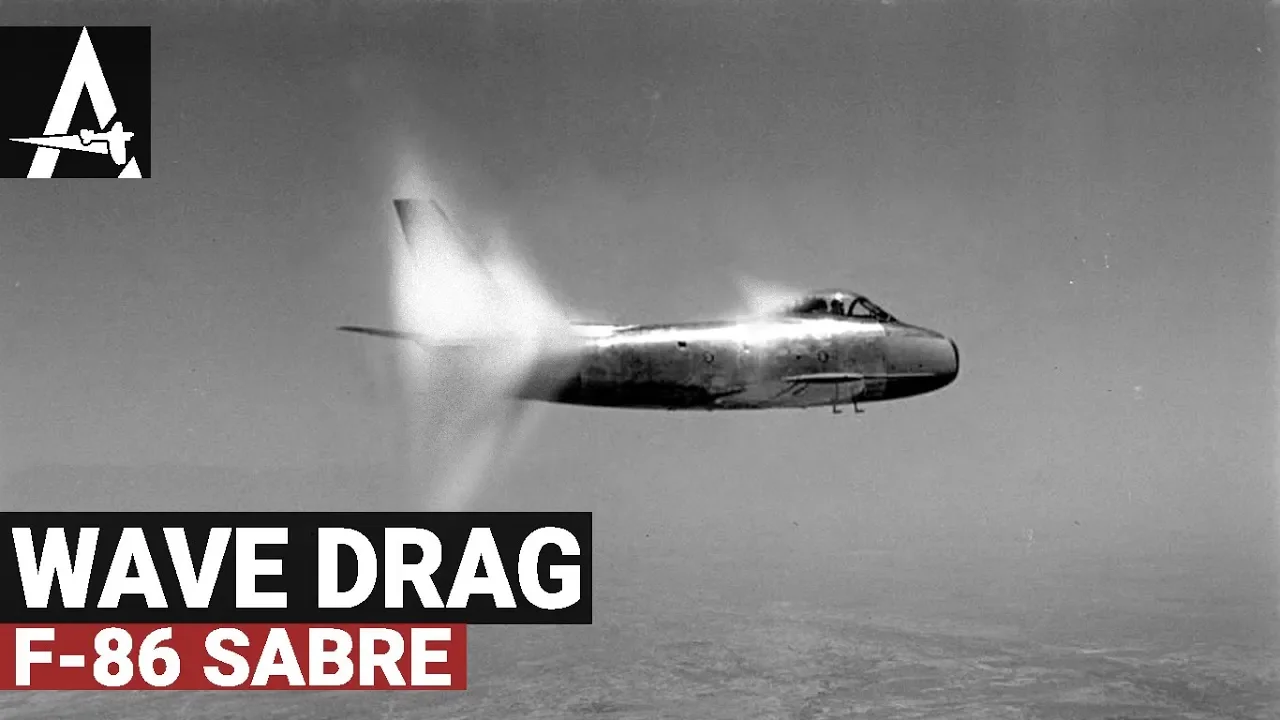
F-86 Sabre Wave Drag: Transonic Aerodynamics Explained
31.2K
Wave drag (also called transonic or compressibility drag) is the primary reason aircraft like the F-86 Sabre cannot efficiently fly supersonic at level flight; it occurs when shockwaves form on the aircraft's surfaces as it approaches the critical Mach number (around Mach 0.85 for the F-86), causing drag to increase dramatically—reaching approximately 75% of total drag at Mach 0.9—making level supersonic flight extremely inefficient and requiring aircraft to dive to achieve supersonic speeds.
Click to watch →
Deep Dive
Aerodynamic phenomena associated with transonic flight, such as 'Mach tuck' and shock-induced boundary layer separation (buffet).
CATS ATPL Principles of Flight - High Speed Flight
5.4K
As transonic speeds increase, center of pressure moves aft, causing tuck under (Mach tuck) where the aircraft becomes nose-heavy. The thickened boundary layer behind shock waves causes high-speed buffeting or Mach bucketing. Further acceleration may trigger shock stall at low angles of attack, caused by shock-induced flow separation. Critical Mach number (Mcr) is the free stream Mach where sonic flow first appears on the aircraft surface. At low transonic speeds, lift increases due to pressure differences; at higher speeds, shock waves reduce lift. In fully developed supersonic flow, lift increases again but remains lower than subsonic values due to bow waves.
Click to watch →
XB-1 Baby Boom Goes Supersonic - Jet Planes, Starlink & iPhones
461.3K
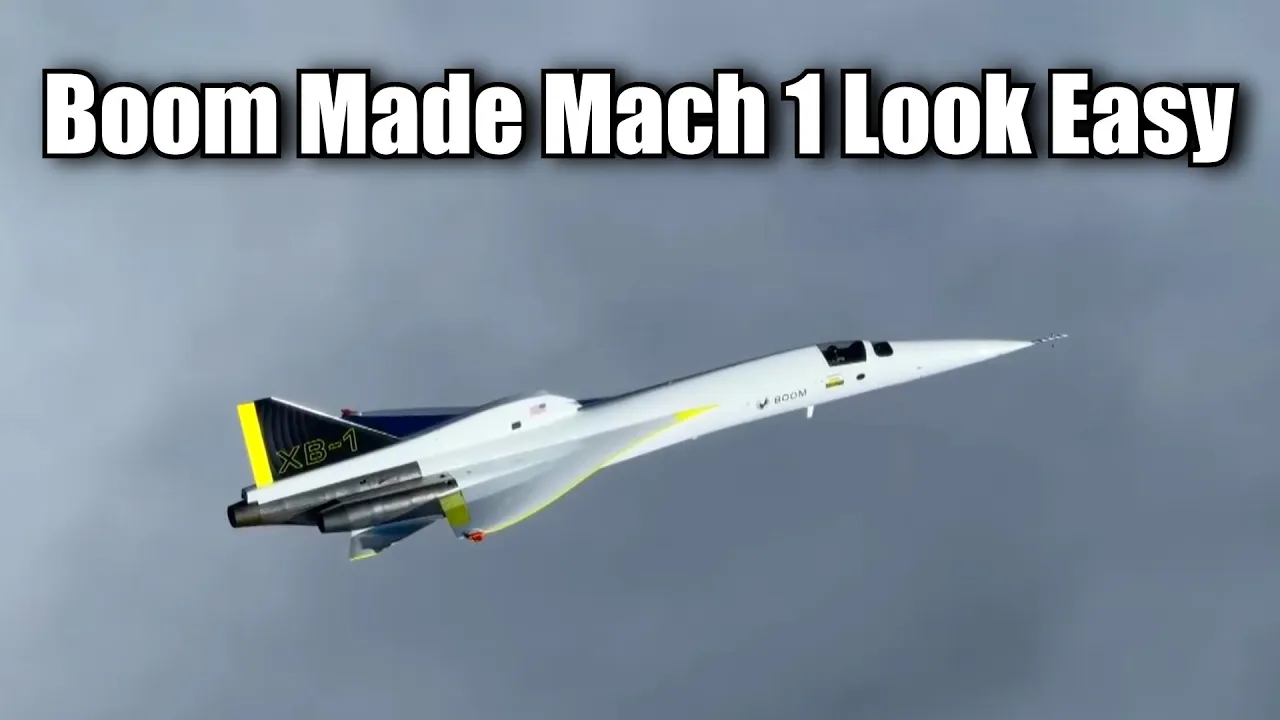
When aircraft operate near their maximum Mach number, they experience dangerous flight characteristics including M-buffet (severe buffeting from oscillating shock waves) and M-tuck (nose-down pitching tendency). These conditions result from the rapid movement of shock wave positions across the wing as aircraft speed and attitude change. Pilots must avoid prolonged operation in this regime due to poor handling qualities and potential loss of control.
Click to watch →
![[CURSO GRATUITO] Aerodinâmica - Aula 7](https://i.ytimg.com/vi_webp/B6Cp9wikILI/maxresdefault.webp)
[CURSO GRATUITO] Aerodinâmica - Aula 7
1.2K
Buffet occurs in both subsonic and transonic regimes. In subsonic flight, buffet is caused by flow separation from the wing, which can then impinge on the empennage (vertical or horizontal stabilizers), causing vibration. In transonic flight, buffet is associated with shock wave separation on the wing. The video uses the F-18 Hornet as a case study, explaining how vortex generators on the leading edge create vortices that delay separation but can impinge on the vertical stabilizer, causing buffet. NASA conducted extensive studies on this phenomenon, using smoke visualization in wind tunnels to observe the vibration patterns.
Click to watch →

Shell Oil Transonic Flight
2K
This comprehensive section covers the complete transonic flight phenomenon. When aircraft approach critical Mach number, shock waves form on wing surfaces, progressing from upper to lower shocks that eventually cause boundary layer separation. Beyond Mach 1, bow waves form ahead of wings, with oblique and normal shocks exhibiting distinct flow characteristics. Flying speeds divide into subsonic (all flow subsonic), transonic (mixed flow from M_crit to ~1.3), and supersonic (all flow supersonic) ranges. In transonic flight, flow separation causes violent shock movements and significant aerodynamic problems. Drag rises dramatically above M_crit as shock-induced wave drag converts kinetic energy to heat, creating the historical 'sound barrier.' Lift coefficient behavior mirrors drag—plunging suddenly at shock stall. The center of lift shifts rearward through the transonic range, producing persistent nose-down trim changes. Additional instabilities include wing drop, porpoising, sneaking, Dutch roll, and buffeting from turbulent separated airflow. Controls lose effectiveness because changes behind shocks cannot influence upstream flow, and separated air cannot generate aerodynamic forces.
Click to watch →

How HIGH CAN PLANES fly? What is the COFFIN CORNER? Explained by CAPTAIN JOE
327.2K
When air passes over the top of the wing and accelerates to or above the speed of sound, a shockwave forms above the wing, greatly reducing lift and increasing drag as the airflow detaches and becomes turbulent. This causes Mach tuck, where the aircraft's nose drops, increasing airspeed and worsening the problem. Control blanketing occurs when disturbed airflow acts like a blanket over control surfaces, making them ineffective or unusable, potentially preventing recovery from a Mach dive.
Click to watch →
Deep Dive
Engineering design methodologies utilized to increase critical Mach number, including wing sweep, supercritical airfoils, and the Whitcomb area rule.
HOW WE FLEW | Airports in 1935. A dive back in time. Upscaled and colorized historical footage
626.6K
Engineers employ specific design strategies to increase an aircraft's critical Mach number and delay shock wave formation. Thin wings reduce airflow acceleration over the wing surface, thereby raising the critical Mach number, though excessively thin wings increase landing speed requirements. Wing sweep back achieves similar effects by resolving airflow velocity into components parallel and perpendicular to the leading edge; only the perpendicular component affects critical Mach number. Greater sweep angles provide greater increases in critical Mach number. The delta wing configuration combines high sweep with structural strength and high-altitude performance. These design approaches represent compromises between high-speed efficiency and low-speed handling requirements, enabling modern aircraft to operate efficiently near the speed of sound.
Click to watch →
![Explained: Critical Mach Number [Airplanes]](https://i.ytimg.com/vi/e3BWJZIvXQ4/maxresdefault.jpg)
Explained: Critical Mach Number [Airplanes]
20.4K
The critical Mach number is the free stream Mach number at which the first local point on an aircraft reaches supersonic flow (Mach 1), marking the threshold where shock waves begin to form; exceeding this value causes flow separation, dramatically increasing drag and requiring additional power, which drives key aircraft design innovations such as supercritical airfoils, area rule fuselage shaping, and wing sweep to delay or mitigate these effects.
Click to watch →
High Speed Flight Part 1
90.5K
When an aircraft exceeds its critical Mach number, shock waves form on the wing—a sudden jump in air pressure across a very narrow region (about 1/10,000th of an inch thick) where supersonic air flow is violently reduced to subsonic speed. As the aircraft accelerates, the area of supersonic flow increases and the shock wave moves back along the wing, growing larger and stronger. Shock waves cause wave drag, a large proportion of total drag at transonic speeds, and shock-induced separation where airflow separates from the wing's surface, reducing lift and creating turbulence. Two chief design methods raise the critical Mach number: using thin wings (where maximum thickness is small compared to width or chord) and sweep back, which reduces the component of airflow that flows across the wing section. Sweep back to 35° can theoretically raise the critical Mach number from 0.8 to 0.98.
Click to watch →

The Insane Engineering of the F-117 Nighthawk
5.4M
Wing sweep angle is determined by an aircraft's speed requirements. Civilian aircraft like Cessnas have no sweep because they don't approach supersonic speeds. Airliners like the Boeing 787 have a 32-degree sweep angle to increase critical Mach number—the speed at which supersonic flow begins to appear over the wings. Jet fighters like the F-16 have a 40-degree sweep angle to prevent oblique shock waves from intersecting the wings, which would cause drag and lift loss. The SR-71 Blackbird had a 53-degree sweep angle. The Have Blue demonstrator had a 72.5-degree sweep angle, driven entirely by stealth requirements rather than aerodynamic efficiency.
Click to watch →
Swept Wings
151.4K
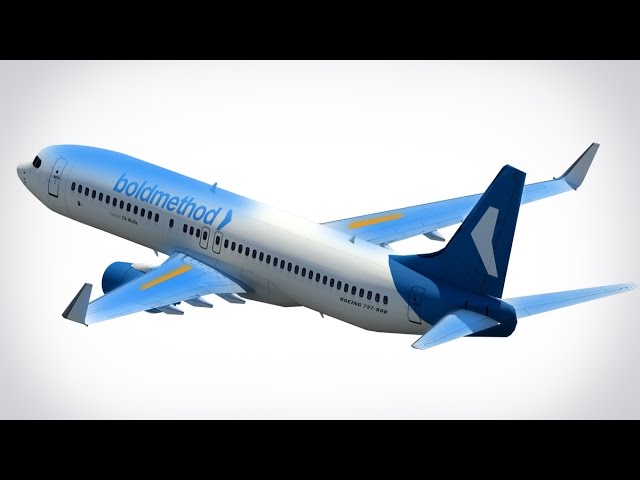
Wing sweep increases an aircraft's critical Mach number by dividing airflow into chordwise and spanwise components, where only the chordwise component accelerates while the spanwise component makes the wingtip feel like it's flying slower, thereby delaying supersonic flow and reducing shock wave formation.
Click to watch →
Deep Dive
The operational concept of 'Coffin Corner' (aerodynamic ceiling) where minimum clean speed and maximum operating Mach number converge at high altitudes.
Altitud Máxima de Operación - Performance
14K
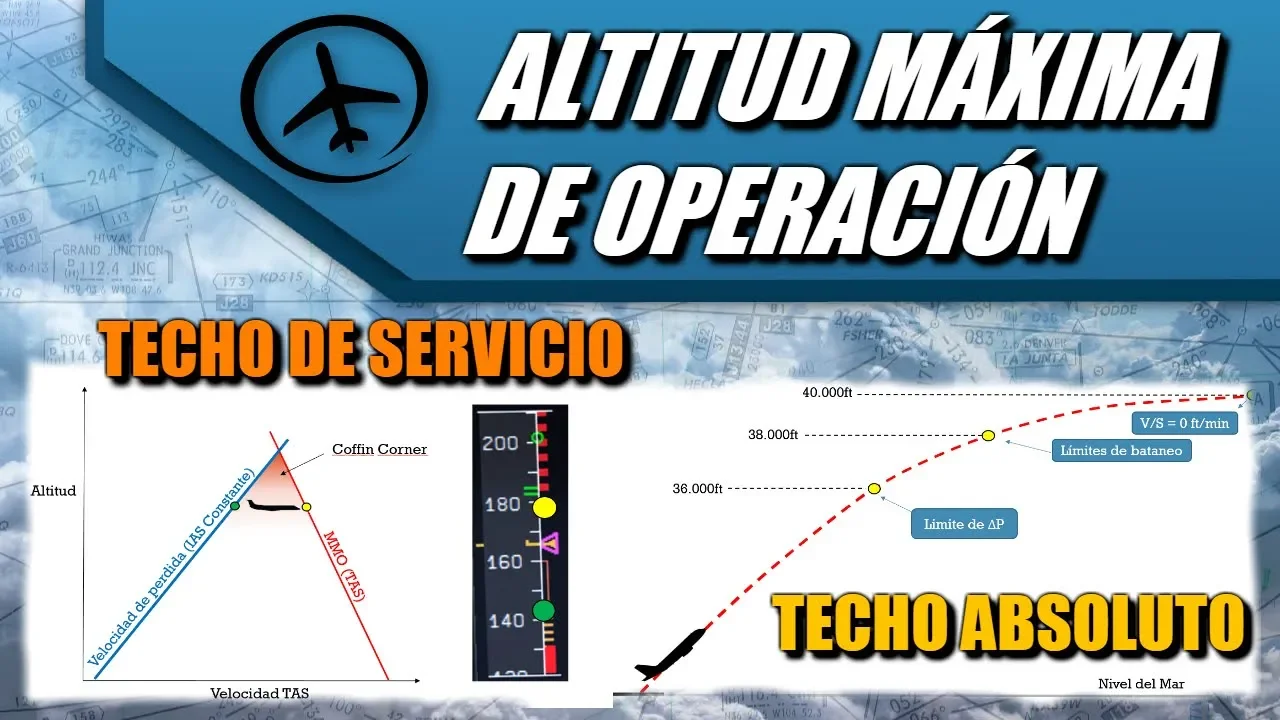
The Coffin Corner is an aerodynamic phenomenon where an aircraft cannot accelerate without exceeding maximum Mach number nor decelerate without stalling. This occurs because stall speed (constant indicated airspeed) increases with altitude while maximum operating speed (based on Mach number) decreases with altitude. There are two buffet types: high-speed buffet (exceeding critical Mach number) and low-speed buffet (boundary layer separation before stall). As altitude increases, the distance between these points narrows until they coincide at the aerodynamic ceiling. This altitude becomes the maximum operating altitude when it is the most restrictive among all limits.
Click to watch →

How Coffin Corner Can Endanger High-Altitude Flight
58.4K
Coffin corner is the narrow operating envelope at high altitudes where aircraft are constrained by two opposing limitations: maximum Mach number (upper limit) and minimum stall speed (lower limit). As aircraft climb higher, they cannot increase speed without exceeding critical Mach and cannot decrease speed without stalling. The coffin corner zone becomes progressively smaller with increasing altitude. On Airbus aircraft, this is visualized on the Primary Flight Display (PFD) as the area between the red Mach limit bars and the alpha protection bar.
Click to watch →

Coffin Corner, Explained: Boldmethod Live
74.2K
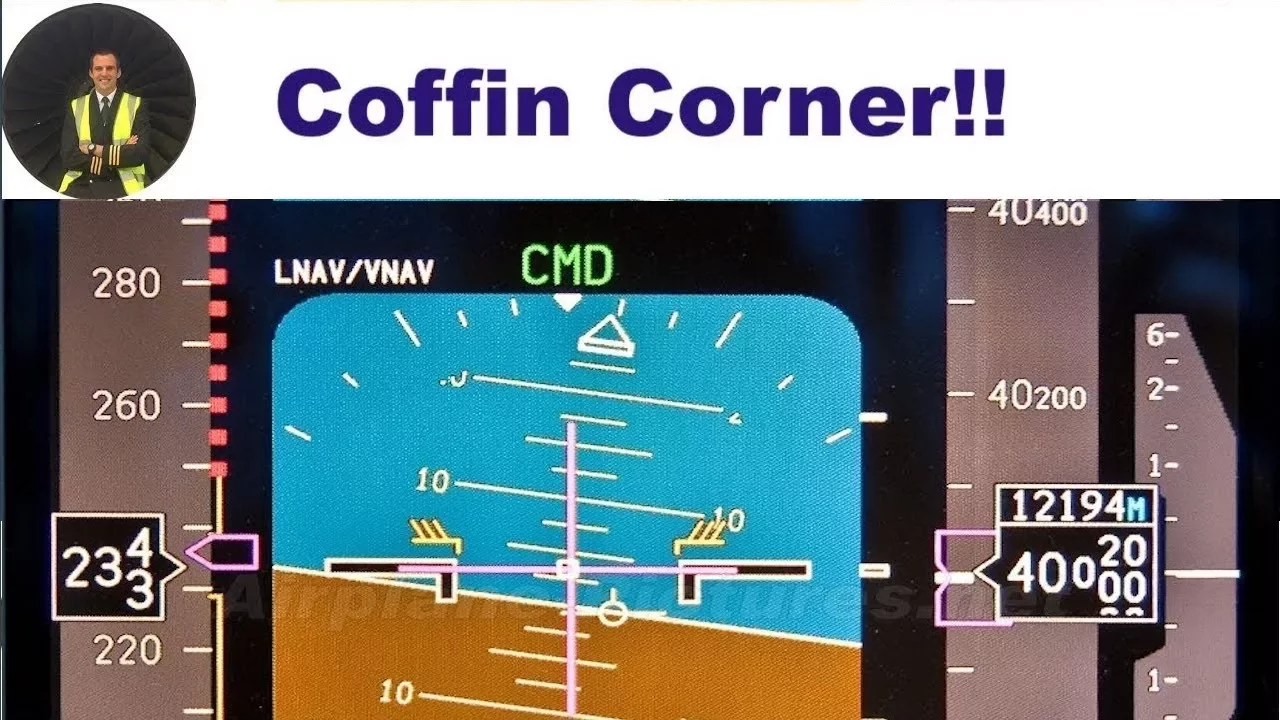
Coffin corner is the narrow operating envelope at high altitudes where an aircraft's minimum controllable speed (stall speed) equals its maximum safe speed (critical Mach number), creating a dangerous situation where any deviation from cruise speed risks either stalling or experiencing Mach tuck; this occurs because as altitude increases, the speed of sound decreases while stall speed increases due to reduced air density, eventually converging these two limits into a very tight operational window.
Click to watch →
Coffin Corner ✈
80.7K
Coffin corner is a critical area within an aircraft's flight envelope where the high-speed buffet line (Mach limit) and low-speed buffet line (stall boundary) converge, creating a narrow altitude-speed range where pilots have minimal control margin; at higher altitudes, decreasing air density increases true airspeed while decreasing temperature reduces the speed of sound, causing both stall speed and Mach limit to rise until they meet at coffin corner, where any attempt to accelerate risks entering high-speed buffet with shockwave-induced drag and Mach tuck, while any attempt to decelerate risks entering a low-speed stall, leaving the only escape option as descending to lower altitudes.
Click to watch →
Coffin Corner Explained With Easy Diagrams!
7.2K
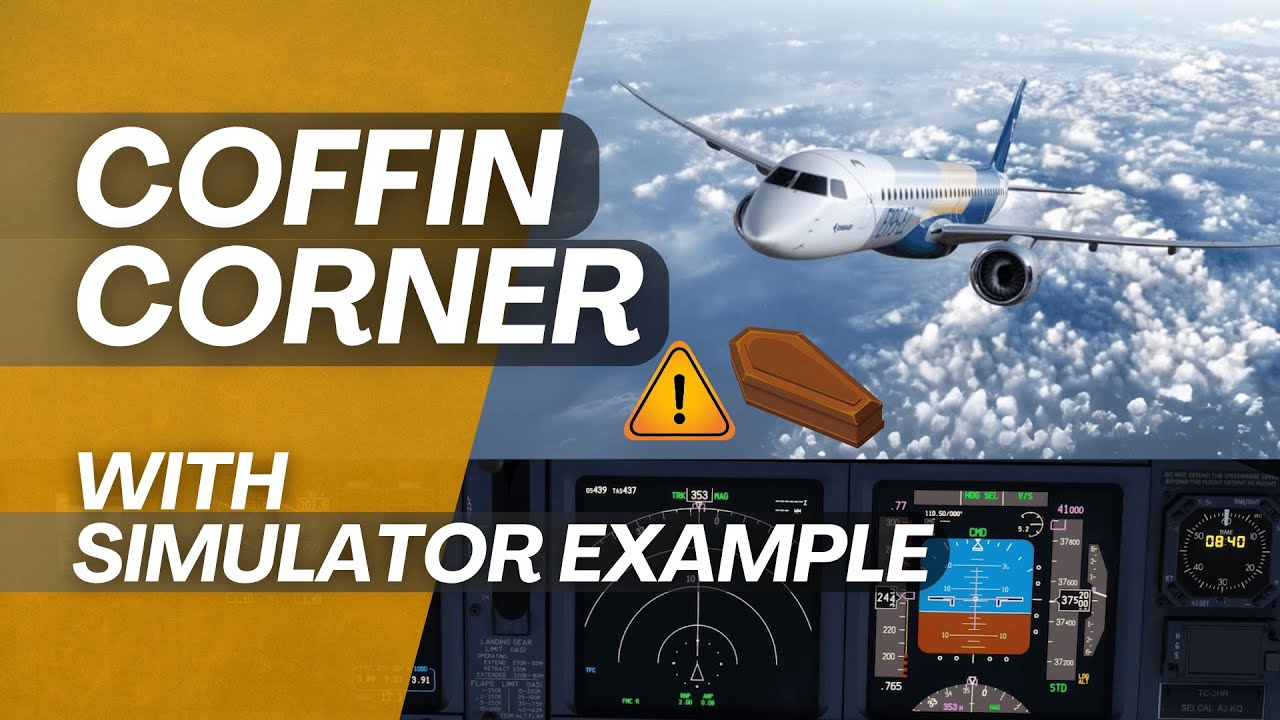
The coffin corner is the intersection point in an aircraft's flight envelope where low-speed stall and critical Mach number lines converge at high altitudes. This aerodynamic ceiling represents the upper operational limits where stall and overspeed conditions meet. Jet aircraft encounter this phenomenon due to the unique relationship between altitude, air density, and speed of sound. The narrow operating envelope exists at the peak of the flight envelope pyramid, bordered by stall limits on one side and Mach limits on the other. As altitude increases, the margin between safe and unsafe speeds progressively narrows, creating a dangerous situation where pilots must maintain extremely precise control within a very limited speed range.
Click to watch →
Mach Basics
Mach Basics
0:05- 1
Defines speed of sound and Mach number ratios.
- 2
Explains subsonic, supersonic, and critical Mach.
- 3
Describes shock wave formation over wing surface.
The Operational Relevance of Drag Divergence Mach Number (Mdd)
While the Critical Mach Number (Mcrit) is a fundamental aerodynamic concept indicating when local airflow first reaches supersonic speed, modern aerospace engineering often views it as an overly conservative metric for practical aircraft design. Instead, designers and operators focus on the Drag Divergence Mach Number (Mdd), the point at which aerodynamic drag actually begins to rise rapidly. Thanks to advancements like swept wings and supercritical airfoils, modern commercial aircraft routinely and efficiently fly at speeds above their theoretical Mcrit. Focusing solely on Mcrit overlooks how contemporary aircraft are engineered to control and exploit local supersonic flow, making Mdd a far more significant limit for real-world aviation performance and efficiency.
The definition of Mach number and how the local speed of sound varies with atmospheric temperature and altitude.
Basic aerodynamic principles of lift generation, specifically how airflow accelerates over the curved upper surface of an airfoil.
The fundamental differences between subsonic and supersonic airflow regimes.
The relationship between velocity, pressure, and density in compressible fluid dynamics.
The formation of shock waves and the development of wave drag as flight speeds exceed the critical Mach number.
Aerodynamic phenomena associated with transonic flight, such as 'Mach tuck' and shock-induced boundary layer separation (buffet).
Engineering design methodologies utilized to increase critical Mach number, including wing sweep, supercritical airfoils, and the Whitcomb area rule.
The operational concept of 'Coffin Corner' (aerodynamic ceiling) where minimum clean speed and maximum operating Mach number converge at high altitudes.
90.6K views1.8Klikes1:52@flightclubonlineOriginal Release: 2021-09-15
the speed of sound is the distance travelled by a sound wave per unit of time as it propagates through the air depending on the atmospheric conditions the speed of sound is about 667 knots the ratio of the speed of an airplane to the speed of sound is called the mach number so if an airplane flies as fast as the speed of sound its speed is mach one slower flight than the speed of sound is called subsonic the mach number is less than one faster flight than the speed of sound is called supersonic the mach number is more than one airflow around a cambered wing is accelerated above the upper surface so if for example the mach number of the airplane is 0.84 above the wing the flow may be supersonic that is higher than mach 1.
a critical mach number of an error plane is the lowest mach number at which the air flow over the wings reaches the speed of sound but does not exceed it the critical mach number is the airplane speed at which the first shock waves form in a normal shock the supersonic flow is abruptly slowed down to subsonic flow before it reaches the trailing edge
Up Next
112:54
Lithium-Ion Battery Basics Explained by Jack Rickard | EVCCON2013 Tech Talk
@NewelectricNl
6.6K views•2014-01-08

12:53
21cm Hyperfine Transition in Neutral Hydrogen: Radio Astronomy Basics
@AaronRobertParsons
12.4K views•2011-10-13

3:28
Lift vs Coefficient of Lift: Key Differences Explained
@flightclubonline
64.3K views•2021-08-04

27:14
Entropy and the Second Law of Thermodynamics Explained
@veritasium
27.5M views•2023-07-01
Related Study Plans & Knowledge Roadmaps
Structured learning paths in Physics
physics
Nuclear Physics (Decay, Fission & Reactors)
01Atomic Structure and the Binding Force
02Radioactive Decay and Half-Life
03Nuclear Fission Mechanics and Chain Reactions
+ 2 more learning modules
12h5 modules
Explore Roadmap
physics
Soft Matter (Polymers, Colloids & Rheology)
01Foundations of Soft Matter & Thermal Forces
02Polymer Physics and Macromolecules
03Colloids, Surfactants, and Self-Assembly
+ 2 more learning modules
38h5 modules
Explore Roadmap
physics
Analytical Mechanics: Lagrangian & Hamiltonian
01Mathematical Foundations: Calculus of Variations
02From Newtonian Mechanics to Constraint Dynamics
03The Principle of Least Action & Lagrangian Mechanics
+ 3 more learning modules
28h6 modules
Explore Roadmap
physics
General Relativity (Spacetime & Cosmology)
01Foundations of Relativity: Special Relativity
02The Geometry of Spacetime: Equivalence Principle & Curvature
03Einstein's Field Equations: The Mathematics of Gravity
+ 2 more learning modules
55h5 modules
Explore Roadmap