In this Art Institute Essentials Tour episode, curator Judith Barter explains how Chicago painter Archibald Motley Jr. captured the vibrant African American nightlife of Bronzeville in his 1943 painting 'Nightlife,' using bold hot pink hues and strong diagonal lines to depict a jazz club scene that challenges racial stereotypes by portraying diverse individuals with distinct characteristics rather than uniform representations, while also responding to Edward Hopper's 'Nighthawks' through his own interpretation of interior nighttime lighting.
Archibald Motley Jr. Nightlife: Art Institute Analysis
Added:Deep Dive
The history of the Great Migration and the development of the Chicago Black Renaissance in the Bronzeville neighborhood.
Chicago by 'L' with Geoffrey Baer
1.4M
Bronzeville's heyday in the early 20th century grew out of the Great Migration that brought more than half a million African Americans to Chicago from the South. That difficult journey is symbolized in Bronzeville's Monument to the Great Northern Migration by a figure clothed in worn shoe soles. One of the few areas where African Americans could find housing in Chicago was a narrow strip of the South Side known as the Black Belt because African Americans weren't welcome to shop in the Loop. They built their own downtown there at night. Bronzeville was alive with clubs where folks dressed to the nines to see some of the biggest names in blues and jazz—it was said that if you held a horn at the corner of 35th and State it would play itself.
Click to watch →

HE RECORDED THE SONG THAT CHANGED AMERICA. IT WAS RELEASED AFTER HE WAS GONE.
491
Between 1910 and 1970, 6 million black Americans moved from the rural South to northern cities, fleeing segregation, disenfranchisement, and violence. The Cooks settled in Bronzeville, Chicago, where restrictive covenants squeezed a quarter million people into a narrow strip. Inside these blocks, a parallel economy emerged: black-owned banks, newspapers (including the Chicago Defender), insurance companies, funeral parlors, barber shops, beauty salons, jazz clubs, and gospel churches. A kid in Bronzeville could hear Mahalia Jackson on Sunday morning and Nat King Cole on a jukebox by Sunday night, read newspapers written by people who looked like him, and dream out loud without being told to lower his voice.
Click to watch →

The Great Migration, Reconsidered
841
Bronzeville on Chicago's south side emerged as the epicenter of African-American life during the Great Migration. Key institutions like the Wabash Avenue YMCA, funded by philanthropist Julius Rosenwald, served as clearinghouses providing essential services including job assistance and relief during crises like the 1919 race riot. The area developed distinct cultural and intellectual life, hosting organizations like the Association for the Study of Negro Life and History and the Chicago Urban League. The George Cleveland Hall Library, opened in 1932 as one of the first libraries dedicated to African-Americans, became a hub for the Chicago Black Renaissance, featuring reading circles with prominent figures like Richard Wright and Gwendolyn Brooks. Simultaneously, the Great Migration transformed American Catholicism by creating entirely new religious communities, with black Catholics growing from a few hundred to 80,000 by 1970. The narrative must also be expanded to include Caribbean peoples facing similar racial oppression, exemplified by Jean Baptiste Point du Sable, a man of Haitian descent who arrived in Chicago around 1780, representing an early example of Caribbean migration to the United States.
Click to watch →

Bronzeville - History
13.4K
Bronzeville, located between Calumet and Washington Park along Lake Michigan, was first named by a Chicago beat editor who noted it reflected the skin tone of residents. Before the Great Migration (1910-1920), the area was known as Douglas, named after Illinois politician Stephen A. Douglas who donated the land to the federal government. Early establishments included St. James Parish (1855), the first Irish Church. After the 1871 Chicago Fire, the Southside attracted Irish Catholics and German Jews. Joseph F. Armor founded the Plymouth Mission in 1874, which became the foundation for the Armor Institute of Technology (1893). The Michael Reese Hospital opened in 1881, treating patients regardless of race or nationality. The Great Migration brought thousands of African-Americans to Chicago from the Southern States. White businessmen established restricted covenants and zoning restrictions prohibiting African-Americans from living among them, forcing black families into Bronzeville. Jesse Bing established Chicago's first black-owned bank in 1908, helping African-Americans invest in their community. The Jordan Building at State and 36th Street became profitable, inspiring ambitious African-American owned and financed projects. Open black churches acted as central clearing houses for southern migrants. The emergence of jazz in the 1920s became very important to Black culture, with musicians from New Orleans spreading to Chicago where they were considered urban elites. Famous venues included the Regal Theater (opened 1928, 3,000 seats) and the Sunset Cafe (opened 1929). Notable musicians who performed there included Miles Davis, Duke Ellington, Ella Fitzgerald, Charlie Parker, and Louis Armstrong. The Victory Monument was hoisted after a campaign led by the Chicago Defender, commemorating African-American soldiers who formed the 8th Regiment of the Illinois National Guard, which became the 370th Infantry of the 93rd Division and saw action in France during World War I.
Click to watch →

Biking the Boulevards with Geoffrey Baer
60.5K
Grand Boulevard (now Martin Luther King Drive) served as the hub where African Americans lived, worked, and shopped in the early 20th century. At a time when segregation kept them out of mainstream areas, they built their own downtown called Bronzeville. Black entrepreneurs opened restaurants, stores, banks, real estate firms, a film studio, and insurance companies. Liberty Life Insurance was the first black-owned and operated insurance firm in the North. Anthony Overton built one of the nation's largest cosmetic firms serving African Americans. The Chicago Defender newspaper championed civil rights and encouraged southern blacks to migrate north. Bronzeville was alive with entertainment, featuring jazz clubs where Louis Armstrong performed. Gospel music was born here at Ebenezer Baptist Church where Thomas A. Dorsey married religious lyrics with blues and jazz sounds. The neighborhood also housed the first armory in the nation built to serve an African-American military regiment, the Eighth Regiment, which sent over 2,000 men to France in WWI. In the 1920s, 63rd and Halstead was the second busiest shopping district in Chicago after the Loop. For 40 years, the city tried desperately to return this intersection to its former glory, eventually demolishing much of the shopping district to make room for Kennedy-King College, inspiring new residential and commercial development and raising hopes for Englewood's future.
Click to watch →
Deep Dive
Basic concepts of color theory, specifically how artists use unnatural palettes and artificial light to convey mood and atmosphere.

Analyze Art with Colour Theory
63.3K
Color temperature affects spatial perception: warmer colors advance toward viewers while cooler colors recede, creating depth illusions. Artists use warm foregrounds and cool backgrounds to simulate three-dimensionality. Additionally, color temperature conveys emotion—warmer palettes evoke joy/passion while cooler ones evoke calm/tranquility. Naturalistic colors mimic reality (green leaves, blue skies, accurate skin tones) making artwork accessible and believable. Unnaturalistic colors express subjective understanding, personal feelings, or symbolism. Harsh reds/oranges may symbolize anger, while blue might represent spirituality. Some artworks use nonsensical colors to represent dream states where logic doesn't apply.
Click to watch →

If you JUST downloaded Aseprite SKIP Color Theory and learn this instead | Pixel Art for beginners
2.4K
Colors convey specific moods and emotions beyond their basic hues. Pink, yellow, and blue combinations create feelings of love and energy, while white, orange, and beige evoke innocence and summer vibes. Darker palettes with black, purple, and red create mysterious or dangerous atmospheres. Artists can group colors by mood rather than just hue, making color selection more intuitive. Warm colors include yellow, orange, red, pink, and purple, while cool colors include green, blue, and some purples. Yellow and purple function as either warm or cool depending on their neighbors.
Click to watch →

KVS PRT Tier-2 Visual Arts One Shot 🔥 | Complete NCERT Theory + Questions + Notes | KVS 2026 #kvs
5.3K
Before modern materials, artists used natural sources for colors: turmeric for yellow, flowers, soil, stones, and mineral deposits. Color tints are created by adding white (lighter), while shades are created by adding black (darker). Colors change mood and atmosphere in artwork. Mixing different shades of leaves creates various color tones. Understanding color theory helps artists create depth, emotional impact, and visual harmony in their work.
Click to watch →

Comment DESSINER Des AMBIANCES LUMINEUSES (le mood)
5.1K
Ambiances lumineuses (lighting atmospheres) are the key technique artists use to create unique emotional responses in their illustrations. Artists like Samdazart and Velop create 'moods' through natural or synthetic color harmonies that evoke feelings in viewers. To extract the right palette, artists apply a strong blur filter (around 80%) to reference images to isolate dominant colors, then pipette these colors and their variants. The palette is applied using a soft brush with random strokes to avoid repetitive patterns. This technique allows artists to match the emotional tone of their references, whether depicting danger through red and blue tension, or melancholy through black tones.
Click to watch →

30 Tips To Create Mindblowing Videos With Google VEO 3 (Become a Pro)
166.6K
Lighting and color grading dramatically affect video mood. Soft sunlight creates warm, inviting atmospheres; harsh moonlight creates cold, dramatic effects. Firelight casting creates warm glows. Color palettes: cool blues create cold, dreary feelings; warm colors create softer, approachable vibes; desaturated colors give gritty, realistic tones; monochromatic schemes create unnatural, uneasy feelings; pastel colors create soft, gentle moods.
Click to watch →
Deep Dive
An understanding of visual rhythm and composition, showing how motion and sound (like jazz music) can be represented on a static canvas.
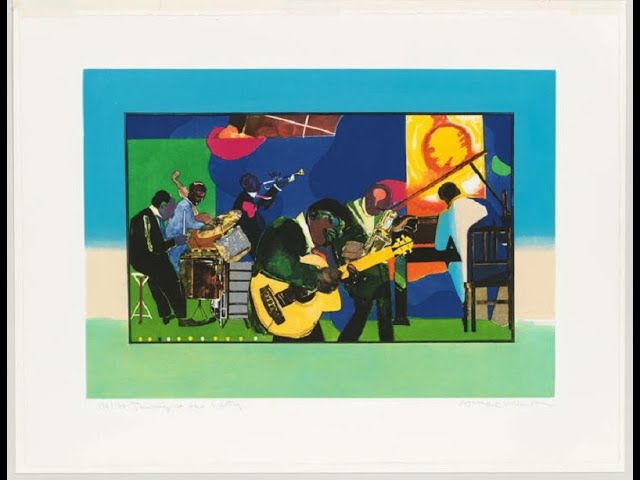
MUSIC TO MY EYES: ROMARE BEARDEN
243
Rhythm in visual art is when something is repeated over and over again, creating a pattern. In Bearden's artwork depicting musicians, the position of the bodies creates visual rhythm, as do the colors and the arrangement of figures. The diagonal lines of the guitar and piano create syncopation, with angles going in different directions against each other. This visual rhythm mimics the rhythmic patterns found in jazz music.
Click to watch →
![[미대입시23-기초디자인]화면구성수업 no.1 탁구공(점)과 율동감](https://i.ytimg.com/vi/D0FJFTV3vVc/maxresdefault.jpg)
[미대입시23-기초디자인]화면구성수업 no.1 탁구공(점)과 율동감
3.8K
In visual art, rhythm (율동감) is created through dynamic elements rather than static ones, where connecting points creates movement like lines, varying spacing between elements intensifies the rhythm, using curved lines enhances the sense of motion, and increasing curvature makes the rhythm more pronounced; artists can apply these principles by strategically placing elements with changing intervals and curves to convey movement in static compositions.
Click to watch →

WHO'S NEXT 2026 ver.01 結果発表&講評会 。より良い作品づくりに必要な視点をプロがレビュー!
3.2K
Composition can be understood through musical metaphors. Visual rhythm works like melody in music, where elements connect and flow. Background elements can establish tempo and rhythm, helping the main subject stand out. Strategic placement of contrasting elements creates visual interest and guides viewer attention through the composition.
Click to watch →

Ce e COMPOZIȚIA?🌈🎨 | fundamentele artelor vizuale
2.1K
Rhythm in visual composition refers to the direction of elements, how agglomerated or dispersed they are, and their positioning on the page. For example, the placement of points (one here, one there, one here) creates rhythm. When elements are clustered in one area with empty space elsewhere, this creates a different type of rhythm. With only one to three terms, it is easier to establish rhythm, give them direction and meaning, and create clear dialogue between them.
Click to watch →

composition in photography - rhythm and repetition
1.7K
Rhythm in visual arts is based on the same principles as musical rhythm. Musical rhythms create feelings of pleasure and comfort because our brains expect and receive the same notes in equal steps as predicted. This predictability is why we enjoy music. Similarly, visual rhythm creates aesthetic pleasure through predictable patterns. Without rhythm, there is no good music, and this principle applies equally to visual composition.
Click to watch →
Deep Dive
The historical context of early-to-mid 20th-century jazz culture and its social role as a space for African American community and expression.

sejarah awal mula musik jazz #root #jazz #jazzmusic #jazzinstrumental #jazzvibes
1.2K
Jazz served as a form of cultural and emotional expression for African American communities during the early 20th century. It became a way for people to communicate their experiences, struggles, and emotions about life through musical art, transforming personal and collective experiences into artistic expression.
Click to watch →
History of Jazz: Oxygen for the Ears | Music Documentary | Full Movie | Ravi Coltrane
29.5K
Jazz emerged from the collision of African rhythms and European harmonies in New Orleans Storyville during the 1890s-1900s. At Congo Square, enslaved Africans played handmade instruments while dancers performed tribal rhythms, creating a common language across racial lines. The word 'jazz' likely derives from Congolese 'jizz.' Early critics dismissed it as 'blatant noise,' but figures like James Reese Europe brought New Orleans rhythm to Europe during WWI, causing audiences to go 'crazy.' Meanwhile, U Street in Washington D.C. became the epicenter of African-American jazz culture after the Civil War, when escaped slaves established communities around Union Army bases. Before Harlem's Apollo Theatre (1932), the Howard Theatre (1910) was America's premier black entertainment venue. This area produced the Harlem Renaissance—Jean Toomer wrote 'Cane' here, and Langston Hughes composed 'Weary Blues' about 7th Street. Jazz provided oppressed African-Americans an opportunity to express their humanity, dignity, and individuality when they were segregated and discriminated against.
Click to watch →
A Jazzman's Blues - Flicks (2022)
914
In early 20th century America, juke joints like Hattie Mae's served as crucial community spaces where Black people could find freedom and relaxation. These establishments provided a rare environment where individuals could escape the constant fear and discrimination they faced in broader society, allowing them to simply be among each other without feeling the weight of racial prejudice.
Click to watch →

Joel Dinerstein in conversation with Melissa Weber
143
Jazz is fundamentally an emanation of African-American culture, not merely music created by African-American musicians. In Kansas City, there was a serious ragtime and blues scene supported by a black middle class before World War I, which directly influenced the jazz scene that emerged in the 1920s. Nearly every chapter of the book is about the African-American community out of which the music comes. While there are brilliant non-African-American jazz musicians, they typically learned the music's foundations from African-American musicians and communities.
Click to watch →
【20分で分かる】ジャズはこうして生まれた|1865-1917完全解説
143
Before the Civil War, New Orleans had a three-tier social structure: whites, Creoles (free people of color with French/Spanish heritage), and African Americans. Creoles received better rights and education than white Americans under French rule. After the Civil War, society collapsed into a two-tier system, with Creoles and African Americans both categorized as Black. The Tioke family—Spanish Catalans who immigrated in the 1780s—developed double-lip embouchure techniques and taught European classical methods to Creole and Black musicians. Early New Orleans bands were racially mixed, with Creoles, whites, and African Americans playing together. Jazz truly began with recording technology, with the 1917 recording of 'Livery Stable Blues' selling 1 million copies. While jazz is often called Black music because it provided African Americans with one of the few means to express their emotions and assert their identity, from a musical history perspective, jazz is the music of all Americans who shared ideas despite segregation.
Click to watch →
Prerequisite Knowledge
- Concept 01The history of the Great Migration and the development of the Chicago Black Renaissance in the Bronzeville neighborhood.
- Concept 02Basic concepts of color theory, specifically how artists use unnatural palettes and artificial light to convey mood and atmosphere.
- Concept 03An understanding of visual rhythm and composition, showing how motion and sound (like jazz music) can be represented on a static canvas.
- Concept 04The historical context of early-to-mid 20th-century jazz culture and its social role as a space for African American community and expression.
Subsequent Learning
- Step 01A comparative analysis of Archibald Motley Jr.'s style with other prominent artists of the Harlem and Chicago Black Renaissances, such as Jacob Lawrence and Romare Bearden.
- Step 02An exploration of Motley's broader body of work, specifically his focus on skin tone diversity and colorism within the African American community.
- Step 03The socioeconomic impact of the Great Depression and World War II eras on urban African American leisure, nightlife, and cultural production.
- Step 04Advanced studies in modernist art criticism, examining how Motley integrated European modernist techniques with uniquely American subject matter.
Vibrant Nightlife
Interior Light Study
Vibrant Nightlife
0:06Playing Section
- 1
Depicts 1940s Bronzeville jazz club with energy.
- 2
Hot pink palette and diagonals convey dynamic dance.
- 3
Challenges stereotypes through diverse individual portraits.
The Critique of Caricature and Class Distancing in Motley's Aesthetic
While Archibald Motley Jr.’s Nightlife is celebrated as a vibrant homage to Black urban culture, some art historians critique his stylistic choices through the lens of respectability politics and racial caricature. Critics argue that Motley's exaggerated physical features, saturated skin tones, and expressive poses borrow from the visual vocabulary of minstrelsy, potentially reinforcing white stereotypes of Black exoticism and hyper-sensuality. Furthermore, because Motley was a classically trained, middle-class artist who lived largely outside the Bronzeville neighborhood he depicted, scholars suggest his work represents a voyeuristic, class-distanced gaze. Rather than a straightforward insider celebration, Nightlife can be viewed as a stylized projection of working-class leisure that commodified Black nightlife for a broader, often white art market, contrasting sharply with the dignified, assimilationist portraiture favored by other artists of the New Negro Movement.
Deep Dive
A comparative analysis of Archibald Motley Jr.'s style with other prominent artists of the Harlem and Chicago Black Renaissances, such as Jacob Lawrence and Romare Bearden.
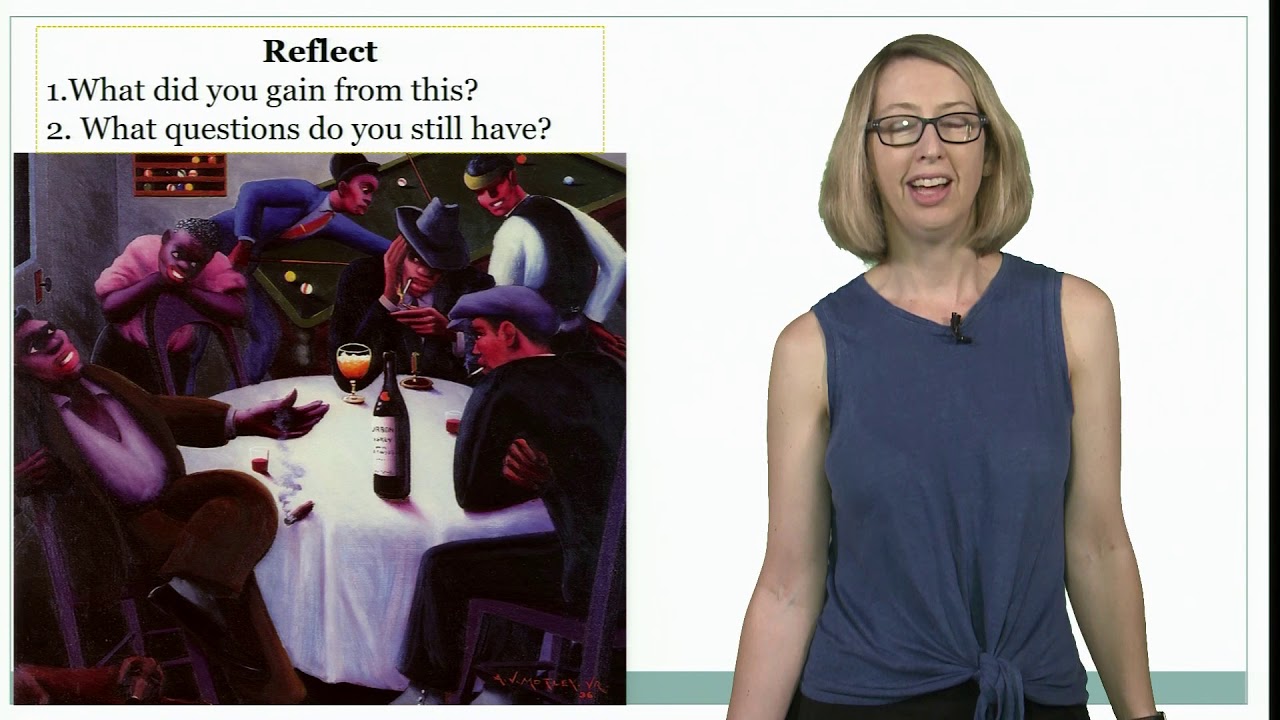
Visual Analysys BN Video Source
237
Archibald Motley Jr. was a Harlem Renaissance artist associated with the 'New Negro Renaissance' in Chicago. During this period, African American artists sought to create more complex, nuanced images of African Americans to counteract negative stereotypes and derogatory representations that had dominated previous artistic depictions.
Click to watch →

50-01 The Harlem Renaissance
832
Laura Wheeler Waring, a French-trained artist, painted portraits of prominent African-Americans including Alice Dunham Nelson, a poet and women's rights activist born in 1875 amongst the first generation of African-Americans born free after the Civil War. Waring studied in France again in 1924 and her paintings in Serr, Burgundy, were exhibited both sides of the Atlantic. Aaron Douglas, known as the father of African-American art, created a visual language combining African art with cubism and Art Deco. His 1934 mural 'Aspects of Negro Life from Slavery Through Reconstruction' for the New York Public Library takes viewers on a journey from cotton picking to the Emancipation Proclamation to jazz music. Archibald Motley, born in New Orleans and raised in Chicago, created the Chicago Black Renaissance, painting bustling street scenes and portraits of everyday people with dignity. Unlike other Harlem Renaissance artists, he never lived in Harlem. His work was inspired by the vibrant Jazz scene and Edward Hopper's 'Nighthawks' but conveyed activity and movement rather than stillness and loneliness.
Click to watch →
![[Part I] City of Others, City of Migrants: Art in Paris, 1920-1940s](https://i.ytimg.com/vi/xs-pcZXhtFQ/maxresdefault.jpg)
[Part I] City of Others, City of Migrants: Art in Paris, 1920-1940s
108
Many Harlem Renaissance artists produced extensive landscape work that deserves equal recognition alongside their famous portraiture. William H. Johnson spent much of his time in France, Paris, and Scandinavia painting landscapes and still lifes—easily 50% of his oeuvre. Archibald Motley visited rural Arkansas after becoming successful in Chicago and made moving portraits of relatives. This challenges the art historical tendency to overweight Black artists' representation of the Black figure. A balanced presentation of their work requires attention to their full range of subjects and styles, demonstrating that artistic excellence manifests in multiple forms beyond portraiture.
Click to watch →

Left of Black with Richard Powell
1.2K
Archibald Motley (1891-1981) was a pioneering African-American artist who revolutionized black art in the early 20th century by immersing himself in Chicago's black communities to document everyday life, jazz culture, and urban experiences, rather than adhering to the era's expectations of representing black respectability; his bold use of color and modernist techniques, combined with his authentic engagement with black communities, made him a forward-thinking artist whose work influenced later artists like Romare Bearden and established him as a major figure in American modern art.
Click to watch →

Figures of the Harlem Renaissance: Jacob Lawrence
140
Jacob Lawrence (1917-2000) was a pioneering African-American artist of the Harlem Renaissance who depicted the Great Migration and Harlem life through his distinctive flat, colorful style, becoming the first African-American artist featured in New York's Museum of Modern Art and later inspiring artists in Nigeria through the Mbari art movement.
Click to watch →
Deep Dive
An exploration of Motley's broader body of work, specifically his focus on skin tone diversity and colorism within the African American community.
![Lost Boundaries [1949]](https://i.ytimg.com/vi/z26VL_0EQks/maxresdefault.jpg)
Lost Boundaries [1949]
291.1K
Dr. Bracket, a white man, told Dr. Carter that no one in Keenum needed to know he was Black because 'no one there has to know.' This reflects how some members of the African American community viewed lighter-skinned individuals differently, with some believing that passing as white could provide better opportunities while others argued that Black people should stand up and be counted regardless of skin tone.
Click to watch →

Live with Don’t Call Me White Girl - Season 1 Kickoff Event
92.3K
Colorism refers to discrimination based on skin tone within racial groups. The speaker, as a light-skinned Black woman, explains she is called 'white girl' because of her skin tone, which she rejects because she 'really enjoy being black.' She describes how colorism affects Black women differently based on shade, with some experiencing more discrimination than others. The speaker emphasizes that despite these differences, all Black people should unite against racism and colorism.
Click to watch →
Darius Ranting about working
76.5K
Colorism exists within the African American community, where lighter-skinned black people are often privileged over darker-skinned black people. This hierarchy has been perpetuated by societal structures and has affected dating, employment, and social opportunities. The speaker notes that lighter-skinned black women are more frequently represented in media and entertainment, while darker-skinned black women face more challenges in finding relationships and achieving success. Children often explore their identity through experimentation, such as wearing colored contacts or trying different hairstyles. Lack of representation in media and society can affect how people develop their identity, with limited black representation potentially causing people to feel different from their peers. Self-discovery often requires introspection about one's identity and experiences, particularly for people who grow up in predominantly different environments.
Click to watch →
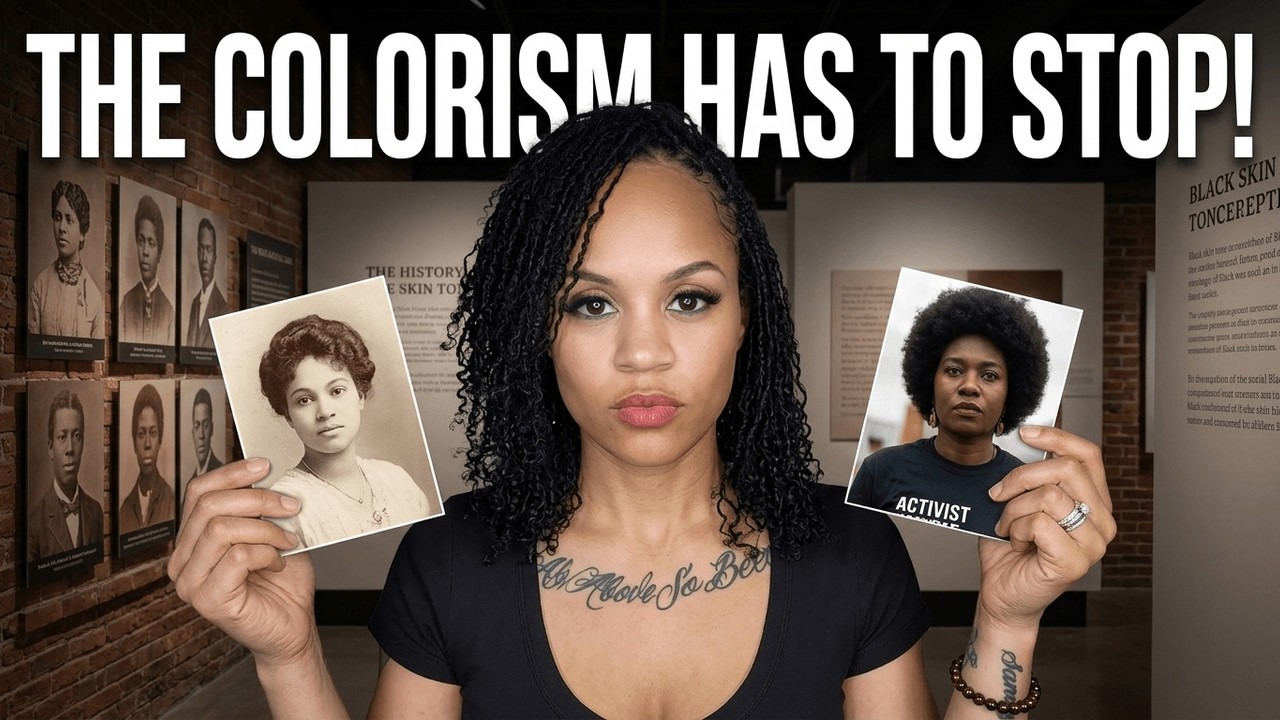
THE COLORISM HAS TO STOP!
869
Colorism is a harmful hierarchy within the African American community where lighter skin is often privileged over darker skin, affecting opportunities, treatment, and self-worth; this bias manifests in media representation, dating, workplaces, and social interactions, and can be challenged by recognizing personal biases, calling out harmful stereotypes, and celebrating Blackness in all its shades.
Click to watch →

Sibling Rivalry: The One About Colorism
46.8K
Colorism is discrimination based on skin color within racial groups, particularly affecting Black communities. The speakers discuss terminology like 'light-skinned,' 'dark-skinned,' 'paper sack brown,' and 'high yellow,' noting that light skin has more varied descriptors than dark skin. They explain that colorism in Southern Black communities stems from Jim Crow era status tied to skin color, where proximity to light-skinnedness meant higher social status. The speakers share personal experiences of being called 'Blackie' despite being dark-skinned, and discuss how colorism manifests differently in various regions, with St. Lucia having less prevalent colorism than American communities.
Click to watch →
Deep Dive
The socioeconomic impact of the Great Depression and World War II eras on urban African American leisure, nightlife, and cultural production.

Bumpy Johnson's Bodyguard PULLED THE TRIGGER at Point Blank Range | This Sound Changed Harlem Histo
110
The late 1940s in Harlem presented a paradox. The neighborhood had survived the Depression, contributed enormous numbers of men to World War II (the 369th Infantry Regiment, the Harlem Hellfighters), and was at a creative apex—bebop was being invented in after-hours clubs on 52nd Street and in Harlem basement sessions. However, economically, the postwar years brought new pressure. The same returning veterans who had fought fascism abroad came home to find that the color line in New York had not moved. Housing discrimination, employment discrimination, and police harassment operated as efficiently in 1948 as they had in 1928.
Click to watch →

Peter Thiel Flees America To Argentina To Avoid The Pitchforks
796
During the Great Depression, black America continued creating culture at an incredible level. Sister Rosetta Tharp was laying the groundwork for rock and roll with an electric guitar in church. Billie Holiday recorded 'Strange Fruit' in 1939. The Negro Motorist Greenbook launched in 1936, building survival infrastructure for black travelers. A. Philip Randolph organized the Brotherhood of Sleeping Car Porters into the first major successful black labor union. Bessie Stringfield rode a motorcycle across the country alone during Jim Crow. This period demonstrates black American resilience and cultural innovation during economic hardship.
Click to watch →

Free to Be: the African American presence in New York City 1900-1950
895
The Great Depression devastated Harlem's economy, with skilled Black workers' incomes dropping 43% and mortality rates doubling at Harlem Hospital. The 1935 Harlem Race Riots exposed persistent inequalities and catalyzed demands for economic justice. World War II brought unprecedented opportunities and contradictions: 700,000 Black Americans served, yet remained segregated. The Pittsburgh Courier launched the 'Double V' campaign (victory against fascism abroad and victory against segregation at home) in 1942. A. Philip Randolph organized the first March on Washington Movement, threatening mass protest until President Roosevelt signed Executive Order 8802 banning defense industry discrimination. This period demonstrates how economic crisis, military service, and organized protest converged to advance civil rights, establishing precedents for future movements.
Click to watch →
We weren’t struggling…
6.5K
While mainstream America experienced economic collapse during the Great Depression, black America simultaneously underwent a period of remarkable cultural and community building. The Harlem Renaissance adapted rather than ended, with artists founding independent institutions like the 306 Workshop and Harlem Community Art Center. Black artists sought refuge and recognition in Mexico, where they were treated as intellectual equals. This period saw transformative cultural production including jazz, blues, and literature, alongside essential infrastructure like the Negro Motorist Green Book and labor unions. Black Americans, already aware of systemic exclusion, continued creating and building while mainstream America mourned the loss of stability.
Click to watch →

The Old Settler (2001)-Directed by Debbie Allen, starring Phylicia Rashad, Bumper Robinson & Debbie.
334K
The Great Depression and World War II created severe economic challenges for African Americans in Harlem. Characters mention being unable to find jobs due to wartime labor shortages, increased rent costs, and the loss of income when white employers stopped hiring Black workers. The war also affected housing availability, making it difficult for families to maintain their living situations.
Click to watch →
Deep Dive
Advanced studies in modernist art criticism, examining how Motley integrated European modernist techniques with uniquely American subject matter.

The Black Dandy: Cultural and Historic Context
6.2K
This section analyzes Archibald Motley Jr.'s artistic practice and its relationship to the New Negro movement. An African-American artist in Chicago witnessing 1919 race riots, Motley engaged with all forms of representation, believing art could bring about better feeling between races. His undaunted engagement with self-presentation conveyed depth of interiority through exterior signs. During an era when prominent Black leaders countered racist imagery, Booker T. Washington worked with intellectuals to proclaim the arrival of the 'new negro'—a counter persona to the old imbued with self-dependency and agency. Many artists visualized this binary as rhetorical device to break with imagined past and create better future. Photographers and patrons used the same technology responsible for minstrel caricature to create counter-images. Waters photographic studio emerged as site where Black Chicagoans could see themselves at center of cultural production, collecting portraits in albums commercially published in 1927 and 1929. Motley realized the power of images to affect and unhinge viewers. His characters are extreme, precariously tipped into settings suspended between colliding planes. In an essay titled 'The Negro in Art,' Motley specified three criteria: personality (self-expression in original manner), intensity (discernment of the extraordinary and embodiment of energy), and sympathy (empathy connecting viewer with process and subject).
Click to watch →

AMWA After Hours--The Taos Society of Artists
880
European modernist influences transformed Taos art as artists like Victor Higgins and Walter Ufer brought new approaches to indigenous subjects. Higgins studied privately with Hans van Hight in Munich and at the Académie de la Grande Chaumière in Paris, feeling modernist works influenced him more than academic fundamentals. His painting 'Pueblo of Taos' simplified buildings and figures into basic shapes, emphasizing color and design over realistic detail—a hallmark of early 20th-century European modernism rejecting rigid academic training. Ufer, who studied engraving in Germany and painting in Chicago and Munich, painted Manuel de la Unes of Spanish descent. Taos paintings of Hispanic subjects sold less well than indigenous ones, as Hispanic traditions with European roots were seen as less exotic. Julius Roeschelman and Ernest Martin Hennings brought German Jugendstil (Art Nouveau) influences to Taos. Roeschelman's 'Indian Market' shows German expressionism's bold colors and elongated forms, rejecting traditional academy teachings for personal expression. Hennings' 'Taos Plaza Hitching Post' synthesized indigenous, Hispanic, and Anglo cultures in a single scene, demonstrating how European modernist styles merged with American Southwest subject matter.
Click to watch →

Art This Week-At The Amon Carter-Archibald Motley: Jazz Age Modernist-Maggie Adler Interview
1.7K
Archibald Motley's artistic development demonstrates how formal art education provides the foundation for innovative modernist expression; his training at the Art Institute of Chicago taught him to master traditional techniques before breaking them, and his Guggenheim Fellowship in Paris exposed him to jazz and blues culture, which he translated into vibrant, rhythmic paintings that captured urban nightlife through strategic color juxtaposition and syncopated visual patterns.
Click to watch →

Западная литература XX века (Джеймс Джойс, Сильвия Бич, Верджиния Вульф. Лекция - 09)
20.2K
American modernists like Eliot and Pound were critical of American values, particularly the pragmatic, success-oriented culture that they associated with American society. They criticized what they saw as the 'purer' American spirit of practicality and materialism, which they believed was incompatible with serious literary and intellectual pursuits. This critique reflected broader tensions between American and European cultural values and helped establish American modernism as a distinct literary movement that drew on European traditions while addressing uniquely American concerns. European modernism was characterized by a passionate rejection of cultural traditions, while American modernism was characterized by a deliberate embrace of European cultural traditions.
Click to watch →

Early 20th Century Art
77.3K
The 1913 International Exhibition of Modern Art (The Armory Show) exposed America to European Modernism for the first time on a grand scale, with 1,300 works seen by 300,000+ viewers. Critics called it 'pathological' and artists 'bomb throwers.' Alfred Stieglitz's 291 Gallery had previously introduced European masters to America. American modernists like Georgia O'Keeffe practiced pure abstraction. Frank Lloyd Wright revolutionized architecture by destroying the traditional box, creating open spaces inspired by Japanese tea houses with asymmetrical balance and flexible plans. This marked America's rapid transformation from artistic conservatism to engagement with radical European innovations.
Click to watch →
Vibrant Nightlife
Interior Light Study
Vibrant Nightlife
0:06- 1
Depicts 1940s Bronzeville jazz club with energy.
- 2
Hot pink palette and diagonals convey dynamic dance.
- 3
Challenges stereotypes through diverse individual portraits.
The Critique of Caricature and Class Distancing in Motley's Aesthetic
While Archibald Motley Jr.’s Nightlife is celebrated as a vibrant homage to Black urban culture, some art historians critique his stylistic choices through the lens of respectability politics and racial caricature. Critics argue that Motley's exaggerated physical features, saturated skin tones, and expressive poses borrow from the visual vocabulary of minstrelsy, potentially reinforcing white stereotypes of Black exoticism and hyper-sensuality. Furthermore, because Motley was a classically trained, middle-class artist who lived largely outside the Bronzeville neighborhood he depicted, scholars suggest his work represents a voyeuristic, class-distanced gaze. Rather than a straightforward insider celebration, Nightlife can be viewed as a stylized projection of working-class leisure that commodified Black nightlife for a broader, often white art market, contrasting sharply with the dignified, assimilationist portraiture favored by other artists of the New Negro Movement.
The history of the Great Migration and the development of the Chicago Black Renaissance in the Bronzeville neighborhood.
Basic concepts of color theory, specifically how artists use unnatural palettes and artificial light to convey mood and atmosphere.
An understanding of visual rhythm and composition, showing how motion and sound (like jazz music) can be represented on a static canvas.
The historical context of early-to-mid 20th-century jazz culture and its social role as a space for African American community and expression.
A comparative analysis of Archibald Motley Jr.'s style with other prominent artists of the Harlem and Chicago Black Renaissances, such as Jacob Lawrence and Romare Bearden.
An exploration of Motley's broader body of work, specifically his focus on skin tone diversity and colorism within the African American community.
The socioeconomic impact of the Great Depression and World War II eras on urban African American leisure, nightlife, and cultural production.
Advanced studies in modernist art criticism, examining how Motley integrated European modernist techniques with uniquely American subject matter.
17K views197likes3:01@artinstitutechiOriginal Release: 2020-04-23
"I think that every picture should tell a story.
And I think if a picture doesn't tell a story, then it's not a picture."
NARRATOR: "Nightlife" by Archibald Motley, depicts the vibrant scene of a jazz nightclub in Bronzeville, a neighborhood on Chicago’s South Side.
During the 1930s and 40s, this area was home to 90 percent of the city’s African American population who, like Motley’s family, moved to Chicago from southern states in search of economic opportunity and freedom from racism.
Here they faced discriminatory housing policies and a climate of violence.
But in "Nightlife," Motley depicts the pleasure and sense of community that many people found in the city’s urban nightlife.
Field-McCormick Chair and Curator of American Art, Judith Barter.
JUDITH BARTER: He was well known for his palette.
You can see the hot pinks that give this painting a lot of energy, and strong diagonals that define the motion of the figures.
NARRATOR: The strong angular lines enliven the painting, making the figures move and dance across its surface.
The man to the left gestures to a woman at the bar: maybe he’s asking her for a dance?
His arm carries our eyes toward the center of the dance floor, where a couple is frozen in mid-step.
The diagonal of their bodies draws us deeper into the crowd of expressive faces and personalities.
Motley complicated stereotypes about African Americans by painting compelling and diverse groups of people in his works.
In an interview in his later years he said: "And you'll notice in all my paintings, where you see a group of people, you'll notice that they're all a little different color.
They're not all black. They're not all brown.
And I try to get each one of them character, as individuals."
NARRATOR: The hot pink hue that covers the walls and the floor is an impression of the interior lighting you might find in the artificially lit bars of the day.
The portrayal of light in an interior scene is a reaction to other works Motley saw at this time.
JUDITH BARTER: This picture was painted in 1943.
In the next gallery you’ll see Edward Hopper’s “Nighthawks,” which is also a study of interior space and of lighting.
Motley actually saw Hopper’s work, including "Nighthawks," when it was on view here at the Art Institute here in 1942 and chose to do his own rendition of an interior space and nighttime lighting.
Up Next

16:30
Jacob Lawrence: Painting Black History and the Great Migration
@ArtHistorySchool
110.3K views•2021-01-20

114:18
Christian Iconography: History, Theology, and Meaning | Fr. Panayiotis Papageorgiou
@Trisagionfilms
58.8K views•2020-02-21
7:48
Ukiyo-e Art: History, Woodblock Printing & Influence
@japanathand
6.3K views•2023-06-08

16:34
Earliest Depictions of Jesus in Art: 10 Ancient Images Explained
@UsefulCharts
5.9M views•2022-06-03
Related Study Plans & Knowledge Roadmaps
Structured learning paths in Art History
art-history
Gothic Cathedrals: Engineering, Light & Society
01The Birth of the Gothic: Romanesque to Suger's Vision
02The Structural Triad: Pointed Arches, Ribbed Vaults, and Flying Buttresses
03Theology of Light: Lux Nova and Sacred Geometry
+ 2 more learning modules
14h5 modules
Explore Roadmap
art-history
Pre-Raphaelites: Realism, Symbolism & Critique
01The Victorian Art Establishment and Academic Formula
02The Founding of the PRB and Radical Realism
03Medieval Revivalism and Literary Symbolism
+ 1 more learning modules
8h4 modules
Explore Roadmap
art-history
Street Art: From Subways to Art Market
01Subcultural Origins in Philadelphia and New York (1970s)
02The Subway Era and Style Wars (Late 1970s - 1980s)
03The East Village Scene and Early Gallery Crossover
+ 2 more learning modules
10h5 modules
Explore Roadmap
art-history
Classic Maya Art: Iconography, Glyphs & Ritual
01Foundations of Classic Maya Visual Culture
02Deciphering Maya Hieroglyphs & Text-Image Integration
03Sacred Geography and Cosmological Architecture
+ 2 more learning modules
14h5 modules
Explore Roadmap