


















Modern society faces unprecedented risks from solar activity because our technology—relying on silicon-based semiconductors—is highly sensitive to high-energy particle flux from solar flares and coronal mass ejections, potentially causing aircraft failures, power grid collapses, and other technological disruptions; while the probability of catastrophic events is low (less than 1%), the asymmetric knowledge gap means millions remain unaware of these risks despite documented incidents like the 2025 Airbus grounding of 5,000+ planes.
Solar Flare 1.9 X-Class: Implications for Tech & Infrastructure Risks
Added:Understanding the classification system for solar flares (A, B, C, M, and X-class) and the logarithmic scale of their intensity.
Basic principles of electromagnetism, specifically Faraday's Law of Induction and how changing magnetic fields induce electrical currents.
The structure and function of Earth's magnetosphere and ionosphere in shielding the planet from solar radiation.
The distinction between different solar phenomena, such as solar flares, Coronal Mass Ejections (CMEs), and solar wind.
Analyzing historical space weather events, such as the 1859 Carrington Event, to model the economic and societal impact of a modern superstorm.
Engineering strategies for grid resilience, including the deployment of geomagnetically induced current (GIC) blockers and hardened transformers.
The study of space weather forecasting technologies, satellite monitoring systems (like SOHO and DSCOVR), and early warning protocols.
Investigating the specific vulnerabilities of global navigation satellite systems (GNSS/GPS) and high-frequency aviation communications to ionospheric disturbances.
443.1K views21.6Klikes1:40:14Original Release: 2025-12-01
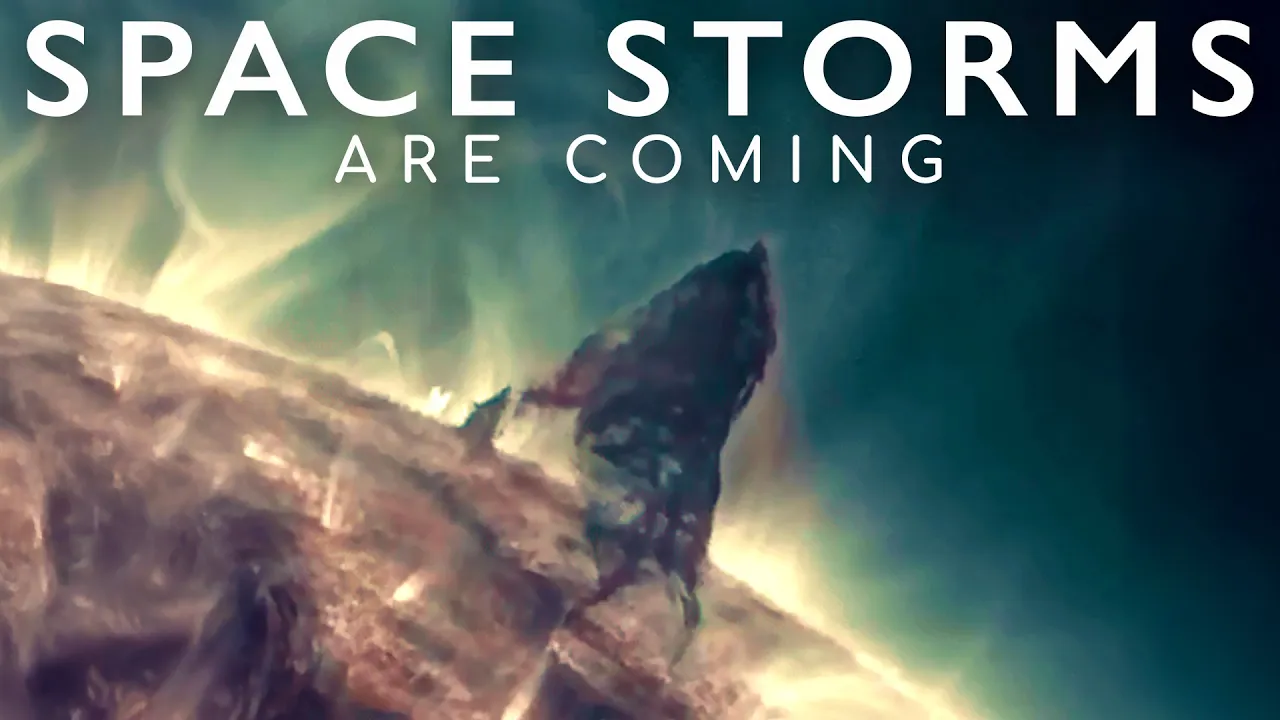
Boom boom boom shaka locka. What is up everybody? 1.9 x-class flare from the sun just moments ago. Here we see it with our 304 instrom view of the sun.
This was a big solar explosion. So hello and welcome to the live stream everyone.
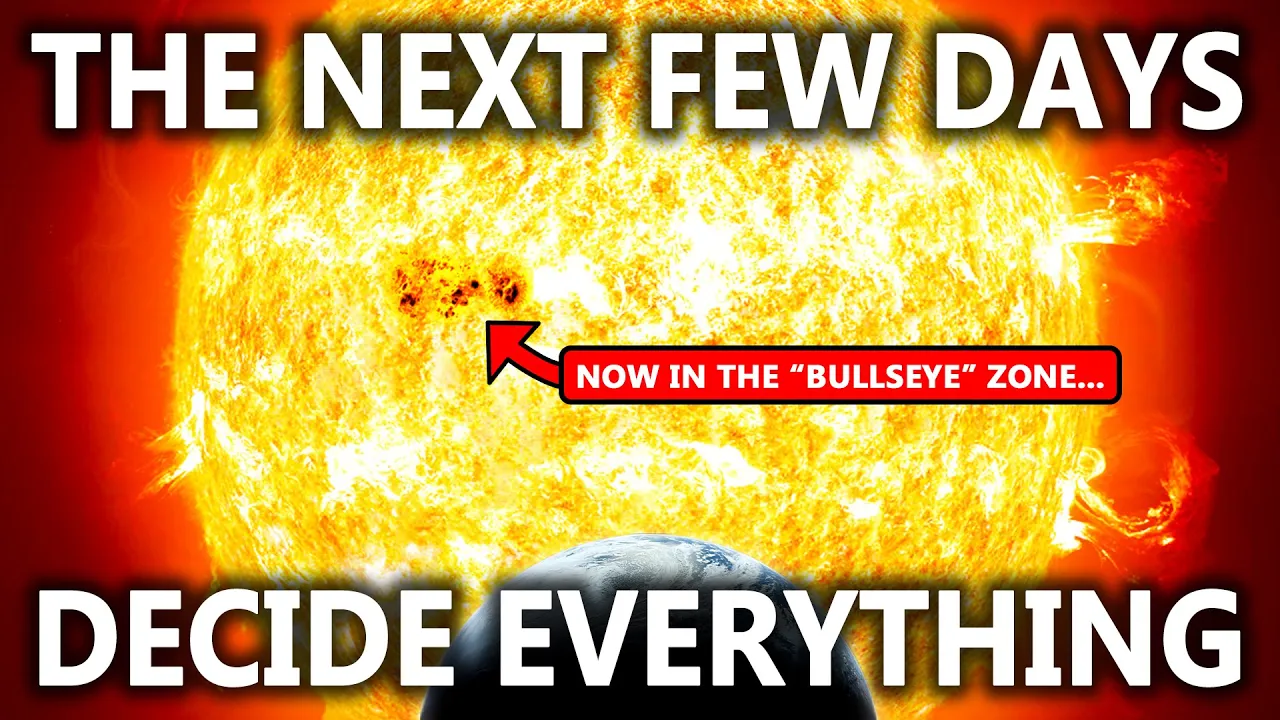
And I am your host Stefon Burns, geoysicist, geologist, space weather guy, cosmic bro, someone who's simply trying to understand what's happening with the cosmos and relay what I learned to you. Do your own research, but I find that um what I research into a lot of people are interested in. And so this is my way to share what I'm finding with you. I track solar activity, something that I started tracking years ago because I noticed that there was a very interesting connection between the space environment and our energetic environment here on Earth. So started with a background geology, expanded geohysics, then started looking into things like the Schuman resonances, which are Earth's natural resonant energy fields, and found out that there's a connection between the Schuman resonances and solar flares, geomagnetic storms, and more. So naturally, I had to start researching this stuff and well, we entered into a solar maximum cycle and it's been a strong solar maximum, stronger than expected. It was originally supposed to top out like 150 uh not even 150 sunspots, less than that. Uh it's actually been quite a bit stronger than expected. And this solar maximum is continuing though we are now getting close to descending phase. And we just had a 1.9 x-class solar flare from this sunspot group here. This is now its third time on the sun, earth facing because you have the far side of the sun which we don't see. Just like you have the side of the moon that's facing the earth. You have the dark side of the moon which is not facing the earth. So you have the side of the sun that's facing earth which we can see.
Takes 28 days to rotate. This guy's back for round three. Just blasted off another exclass flare. Early in November, we had a G5 minus geomagnetic storm from a series of coronal mass ejections that were launched from this sunspot group. Multiple X-class flares.
Now, we're back for round two. In fact, this is not the biggest sunspot group on the sun. That would be this bad boy right down there. 4294 4296.
one huge train of sunspots. So, a lot to talk about in this video. Hello and welcome everybody to the live stream.
I'm your host, Stefan Burns. We're going to go over what's happening right now in space. I'm going to talk about how this is unprecedented, like what the unprecedented thing is. It's the thousands of airplanes that were grounded due to quote unquote solar activity. So, we'll go into that story.
those soft those planes have been issued their software update but a lot of them are going to need to have an actual hardware swap and technically that's never going to solve the issue because if you have electronics they are able to be affected by high energy particle flux like from solar activity and or cosmic activity like galactic cosmic ray flux.
So the bigger picture here why millions are at risk is that we are now living in a modern technological age. So 200 years ago, we didn't have all this stuff. Now our society runs on ones and zeros and it's all siliconbased semiconductors which are very sensitive to disruptions.
And when you have a high energy particle hit a chip or piece of memory or something like that, it can cause a corruption, a critical failure. And well, at a technology standpoint, that can cause your laptop to freak out or like with these airplanes, it caused the airplane autoflight control to all of a sudden fail and the plane dropped in altitude suddenly and that injured like 10, 15, 20 people on the plane. Um, and there's really no way around that other than like shielding and even then it be it's a quantum probabilistic thing. So, that's one angle. You also have the angle of uh power grids potentially being affected from solar activity.
Again, 200 years ago, we're lighting candles, maybe kerosene lamps, whatever, right? Go back 500 years, it's just candles and campfires. You don't have this risk to power grids being overloaded by geomagnetically induced currents. and you get one city, one big city to go offline, that's a thousand, that's 10,000, that's a million people or more without power. So, this is a very real risk and it's only been a short duration in time since we've had technology. That's the thing. It's not like we have a 100,000 year track record. Oh, well, you know, the chance of this actually affecting us is pretty low. We had the Carrington event. We have multiple other events that were very large uh in recent history. It's just now in this modern era, the last big event that we can point to is 1989.
Since then, we have built out our capability of handling the solar activity, but if we get something big enough, we don't know what's going to happen.
And well, we have certainly some very active conditions on the sun right now.
So, it's worthwhile to talk about this from all these different angles because here's the thing. It's an asymmetric knowledge understanding gap that's currently uh at play. So, if for example um you thought that maybe Nvidia was going to do well uh because you saw their GPUs, their chips and how they were building out their performance stack. you bought Nvidia, let's say in 2015, right? You were ahead of the curve because 99% of the population had no clue what was happening and so you got the reward from that. Or like right now the price of precious metals is going crazy because people are realizing, hey, this fiat currency system we have is constantly being debased. Those that bought silver, gold, platinum, copper, whatever, you know, 10 years ago are doing very well. So there was an asymmetry in the understanding of what was going to play out. That is the case as it relates to solar activity and space weather. The general populace does not know the risk. There is a risk. Just because the general populace is not aware of the risk does not mean there's no risk. There is always that risk. It's just they are uninformed to the risk. So millions are at risk from this. Tens of millions, hundreds of millions. It's hard to say how many. And what is the probability that risk clicks in? Right?
In the airplane scenario, you have about a million people up in the air at any given moment, especially during like peak times. It can go up even higher.
Are you going to have all the planes in the sky fall out simultaneously from a solar flare? No, you're probably not going to have that. That'd be maybe a like a super flare, like a Miyaki event.
I don't know. Maybe that would be able to fry it and do it. But I don't think it's going to happen like that. But, uh, millions are at risk if they're flying in airplanes that are affected by these sort of solar flares. So, we'll get into all that, but let's look at our X-class flare, our 1.9 X-class flare that just blasted off from the sun and our sunspots. Here, we're looking at our chronograph view, and we see just how rapid this explosion is. And actually, this may have an Earth directed component to it because now that it's coming in, it looks like it's a partial halo. So, let's give this a watch. A little bit of a push there on the side.
I wouldn't be surprised if this hits us um maybe in about 48 to 72 hours with some with a little bit of energy mostly going off to the side. If we go again to our combined view here, 131 304, we see it blasting off like that. A huge ejection of plasma from the eastern limb of the sun. This is solar coordinate system. Um, but when you get these explosions big enough, some of that will even just blast towards the Earth even though it's not at a conducive angle.
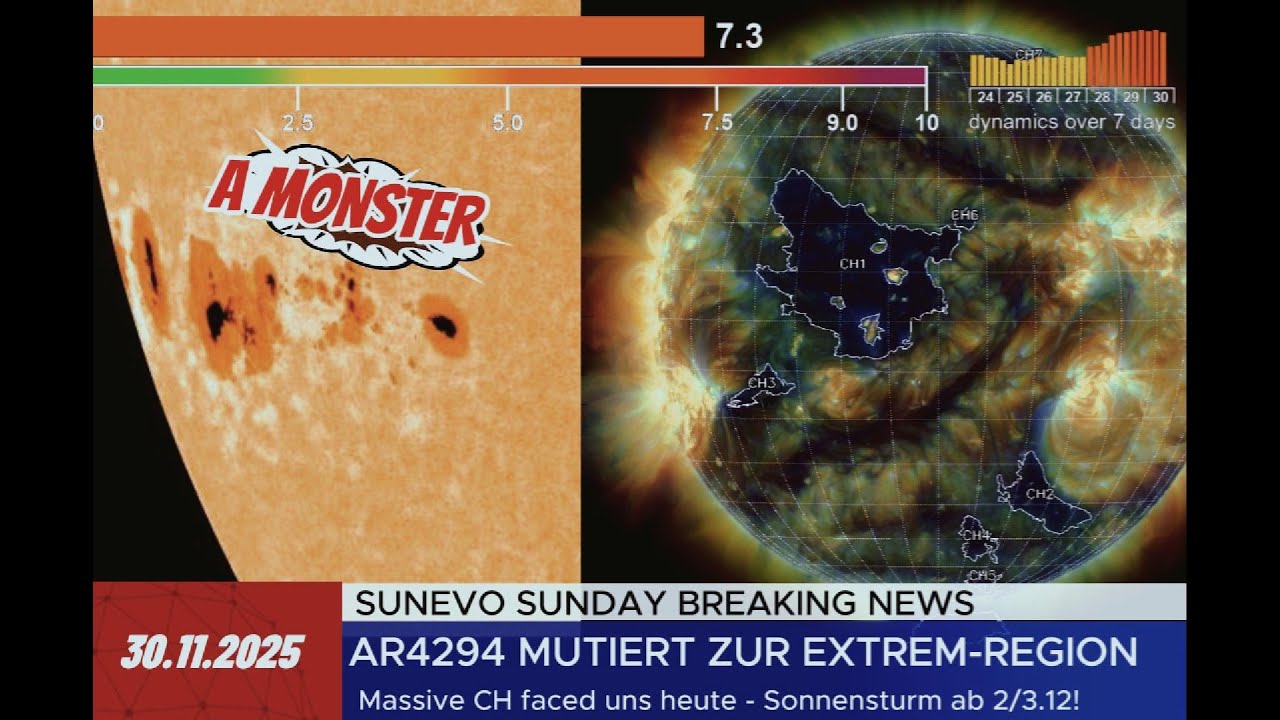
These sunspots though will be rotating towards Earth, right? Because this is Earth direct right here. takes seven days to go from limb to earth direct.
Seven days to go from Earth direct to limb. We have a two-eek journey now or maybe like uh two days into it right now. You can see that they're just rotating into view. So the next two weeks are going to be very dynamic. And then likely I wouldn't be surprised if uh the end of December and beginning of January is very dynamic because I don't think this guy is going away anytime soon. This looks like a sunspot that's here to stay. It's not going to just instantly disappear in two weeks time.
These really big sunspots, they have a staying power to them. Let's give this sunspot a look because it's really extraordinary.
As I mentioned earlier, if you stick around to the end, we'll do a question and answer. I'll take some questions from the audience and then I'll also answer every question that's attached to a super thanks. Unless it's totally out there crazy and yeah, but if you if you ask a question, super thanks. I'll do my best to answer it. Please stay on topic.
Um, here we have our magnetogram view of this sunspot group right here. This is really insane. So, this shows us the magnetic field. Okay. And here we see the magnetic field overall on the surface isn't that strong because we don't see these really strong colors, but we see some sunspots here and there.
Okay. Here we have our big Sunspot group 9294 and 9296. Thank you Una for the super thanks. That's awesome. Thank you so much. Namaste. God bless. Also a super thanks from um Donforce Gaming and Jen Fischer. We'll look at some of these others later as well. Uh but that's very generous of you. Thank you so much. So here we have our magnetogram view. Check out just how big and complex this sunspot group is. You have this uh opposing polarity right here. So, uh this is flip-flopped effectively, right? Which makes it more um unstable. Typically, you'll get like for example the orange, red colors, yellow colors, that's negative polarity. Green and blue is positive polarity. Okay? So you'll get this stacking of the polarities, right?
Where they're alternating dot dot dot dot dot dot. Look here how you have this sunspot group up against that sunspot group and that is of a similar polarity as the end of this one. So huge sunspot group of the magnetogram as we can see. I mean like really insane. Here we can look at our helio viewer and this allows us to see the latest imagery right here. So, we can actually move this up in time a little bit. Um, let me just set this.
That should be enough. And we'll see our latest sunspot imagery from the sun right here.
And they've actually labeled this as two different sunspot groups. But I think in general, it's it's all kind of just one big cluster. So, yeah, you can split into two. And there's a bit of a gap in between them as you can see, but really this is like one big baddy you could say. This guy's been bulking for sure.
And it just showed up on the sun not that long ago, so it hasn't been uh in like active for months now. It's fairly fairly new. And I think it's actually probably still growing.
So uh multiple cores the the sun or the earth rather for example is smaller than this core there that core this one. So it's really truly massive in scale. Um this is 4294 right here. This is 4296.
429 I think it's 429. Yeah 4294. 4296.
And then up top we have 4295.
And this is a sunspot group that just launched that 1.9 Xclass flare. We also have some other sunspots on the sun as you can see. But this for sure, I mean, look at that. This is one of the big sunspots, biggest sunspots of 20 uh of solar cycle 25 for sure. One of the absolute biggest sunspots of this solar cycle and definitely one of the largest just in general. So now uh the question I explained, I talked about this earlier. Now, is this going to affect millions of people? That's a good question. If it does a big enough flare and a power grid was to collapse for a big city or multiple big cities, it could do that. What is the probability of that is the question. So, to sit here and say it's a 100% guaranteed is a falsehood. To say it's a 0% chance is also a falsehood. So the question is by studying this can we get a good probability percentage like what's the forecast right this is not a Nostradamus thing of this is exactly what's going to happen I was given a vision by god it's we are going to analyze everything and what is the forecast the forecast of this solar activity right now and what we likely have coming up ahead okay so solar activity really getting big in the next uh next 10 days, right? Through the next 10 days, it being exceptionally crazy, uh, and then that affecting Earth, the chance of that doing something dramatic like big power grid failures or huge technological outages or something like that is less than 1%.
We had a G5 minus storm less than a month ago and we didn't get any reports of anything bad happening. Thank God.
1989 Quebec though is a good example of how things can go wrong where they had the entire city go out of power and people were affected for weeks. Believe that was February too of 1989. That's Canada February. Uh maybe check me on the the month, but I'm pretty sure that was February. So that's like pretty serious stuff. Um so the risk is low, but the thing is it's not like these storms are super infrequent and only once a decade. Like every solar cycle gets multiple G4 and G5 storms.
So you start to stack them up and we haven't had a Carrington event for a while. There's kind of a recurrence interval based off our historic data of us getting a Carrington event about every 50 years. You had one in 1859. You had a Carrington level event in 1872.
Another one in 1921. There was one that uh didn't have the right magnetic field configuration in 1972. If it did, that would have been a really big impact.
2012 was a Carrington level chronal mass ejection explosion. So, we've basically get one every 50 years. Um, and actually maybe even more frequently than that, it's just a question of it lining up, hitting us, and having all the the right characteristics, intense speed, um, also the magnetic field characteristics and and a few other things too. Let us look at the explosion itself that just occurred. So we'll go to our 131 extra view. This is J Helio Viewer. You can download this yourself if you wanted to and learn how to use this. But this allows us look in the sun in real time.
But you'll see just this crackling activity over the past um over the past few days here. So let's just give this a watch. Okay.
when you see this sort of crackling activity, you know that something's up.
And let's even switch this here to the 30th.
Um, to really hone in on the past 28 hours or so, we can expand that, synchronize, and turn that off.
And we'll switch this to a five minute view.
Here we go.
Bump that up a bit. Decrease that to make this show up a little better.
Okay. And while that loads, let us go to um our X-ray flux to see this solar flare in action. Okay. So, here is our past three days. Let me refresh this just to make sure we got it.
So, we're measuring the X-ray and extreme ultraviolet light flux coming off of these explosions that reaches the Earth in 8.3 minutes. All light photons reach the earth in 8.3 minutes because of our distance from the sun. We're quite close. So, uh it doesn't take long for the light to hit us. Now, the actual coronal mass ejection that plasma that shoots out it that is directed to Earth can take uh at a minimum about 14 hours. That's the fastest effectively that we've ever seen a chronal mass ejection reach earth is in 14 hours or so. uh a fast coronal mass ejection typically like a very fast one will be 24 hours or less. So the 14 hour figure is extraordinary. Typically it's two to four days with three days being an average. Two days if it's fast, four days maybe even more if it's slow because these speeds are like 400 kilometers per second, 800 km per second, 1,200 km per second. You know the really fast ones like 3,000 kilometers per second which is insane.
Uh but here we see uh let me just turn myself off. Here we see our past three days. You see that we have been building up in activity. Watch my cursor. Look here. We were down in the low Bclass zone with our X-ray flux. As the sunspot got closer, we've only been ramping up.
So here our value is 4 to the -7.
And then we went up here to about four to -6. That's a complete 10x increase in X-ray flux. And then you go to an X-class flare and you get another uh huge increase on top of that. So nearly a 1,000 increase going from here to here in X-ray flux. In general, this base load of energy, this whole section there moving up is something that we feel. And then when you get a big solar flare on top of that, that can be really, really powerful. And if we go here to our D-Rap model, we can see where that flare hit, where those light photons specifically hit. It's always going to be the sunlit side of the Earth. Um, because that's the side of the Earth that's facing the sun. And light photons move in straight lines. They aren't affected by magnetic fields. So here we can see this solar flare. We will see it pop off right over Australia and Southeast Asia. R3 radio blackout. That's a big one. So, that's what just happened. And it's a fairly long duration event. See how it's like maintaining R1 radio blackout levels for a while afterwards. This was a huge solar explosion. Okay. It's not like we've never had anything like this, but it's certainly uh very interesting how this occurred like two days after Airbus grounded 5,000 plus aircraft due to solar activity. That is what they said.
We'll talk about that a little bit more, but the timing is crazy, right? It's not during solar minimum, whatever. It's like we need to ground 5,000 aircraft to push out a software update. Effectively, they actually uh they reverted these planes back to an earlier software in order to mitigate temporarily this solar activity risk factor.
And then we get like 48 hours later a 1.9xclass flare. So, it's good that they did that, right? Being proactive. Uh, but it's really a clear, clean example of why we should be mindful of this stuff. And that's why I, uh, you know, I've said what I've said in this video, the title, thumbnail, everything, because we need to get the word out about like the real risk here. Just because people aren't aware of it doesn't mean that's not a real risk.
Okay?
If if you don't know that there's uh saltwater crocodiles in Australia and you go there, it doesn't mean that you may not get bit by one, right? Or if you don't know that there's sharks off the coast and you go swimming because you think there's no sharks, doesn't mean you're not going to get bit by one. It's not a high risk, but just because you're ignorant to something perhaps doesn't mean it doesn't exist and can't affect you. So that's the state of the world in many ways right now is that a lot of people are clueless as to the real risks that exist and actually what's happening on the planet. Uh and eventually they realize and they catch up and we all have this to some degree. We're all ignorant to some degree uh with certain things. So we just be mindful and we we hope that we're given the information when needed from the big guy up top.
Here we have that 1.9 x-class flare from the sun. This is the past 28 hours of imagery uh approximately. So, we're going to watch it really blast off there. You'll also notice this crackling activity. When you get a lot of that, that's a clear a clear sign that something's about to go. And here we get our X-class flare right there. Oh, big plasma burst at the end of that, too.
So, let me just use the cursor here to zoom forward. Watch that. That's our X-class flare. And look at that. Oh my god, this Oh, and this gu is also simultaneously going. So, we get a sympathetic flare at the same time triggered by this X-class flare. We even get like a little bit of right over here. Check that out. Just a massive explosion across the sun. That is insane. Let us look at our 304 anction view because honestly, I think it's even more insane with our 3004 angstrom view.
Um, and this shows lower temperature plasma. So when we're looking at that 1 to 31 view showing the really high uh temperature, highly vibrational plasma, if it's showing up on both of them, that tells you it's a big explosion because it's crossed the entire gamut, across the entire spectrum. Um, so this is this is serious stuff. This is really serious stuff. Now I want to talk more about this airplane issue. Uh, let me type in air bus and airplane grounding.
Um, and like just look at the BBC article. I think this will just be our our basic article, but let's just see uh let's just see what they say here. Okay. And we're going to do a little bit of investigative work, okay? Because what they've said in their story doesn't seem to actually be the case, but the overall message is correct. So that's important to point out. So, planes grounded after Airbus discovered solar radiation could impact systems.
Thousands of Airbus planes had to be grounded for a software update after it was discovered that intense solar radiation could interfere with onboard flight control computers. 6,000 planes A320 were thought to be affected. Half of the European firm's global fleet and Airbus is the biggest airplane provider now in the world, having surpassed Boeing.
Many were able to fly within hours after going undergoing the update. From what I read earlier, the update took about two hours and thankfully they pushed this news out at night uh right before Thanksgiving travel. Um so they were able to do a lot of updates in between like flights and also at night when there's a little bit more downtime. So there were some delays, uh cancel flights, etc. But the impact's not like what it could have been. It could have been a lot worse. Thankfully, they're really on top of this. Um, Airbus said it discovered the issue after an investigation into an incident in which a plane flying between the US and Mexico suddenly lost altitude in October.
Okay, that was October 30th, I believe.
So, that was a JetBlue flight and it was during the afternoon. Let's see if um let's see if we can type in and get exactly Exactly when that was JetBlue flight.
We should be able to get um here we go. JetBlue A320 plunges in flight control scare grounding emergency and hairy midair scare that aviation experts buzzing jet blue flight B61230 uh Airbus 8320. that platon that was affected flying from Cancun to Newark suddenly plunged from 35,000 ft to 10,000 ft in mere seconds on O I didn't realize it was 10,000 feet. Like that's actually insane. Imagine your plane going down 25,000 ft in mere seconds. Uh I hope this I mean I hope this is exaggerated but I don't know. I know it was a big deal because like people had lacerations on their face and head from hitting like it was this chaotic frenzy of screams. That's what I was saying. Uh yeah, it was like a big deal and that's why you would ground 6,000 planes, right? Imagine your plane dropping 25,000 feet and you know you have this issue that's affecting 6,000 plus planes. you're going to do a sudden dramatic global um uh recall to fix that because you get another one, two, or dozen of those happening. Like that's that's a bad bad deal. You don't want that. So, okay. Well, this is saying here the the flight data captured 100 feet in seven seconds causing immediate concerns about 8320's fly by wire system. So, I don't I don't know exactly what happened here, but it was a big deal. And if we go forward, let's see when the uh the date was. I think this was the 30th of October. Yes, October 30th. Okay. So let's look at the solar activity for October 30th because Airbus is saying that this is solar activity and it can be solar activity specifically for this instance whether it is or not. So we go to our real time solar wind here and we can go to October 30th using our cursor and just kind of zoom through there.
October 30th. And this was a I know that it was like a late morning, early afternoon going from Cancun to New York because I looked this stuff up yesterday. Okay, we did have some elevated geomagnetic activity, but it was nothing crazy.
So, here we see the 30th. It was nothing. It was nothing crazy.
And if we go specifically, this is like a G1 geometric storm. So, you know, it's something, but it's not so nutso. If we go to our X-ray flux, this is actual like solar flares, which we're now looking at. Let's see what it shows. Okay.
And we'll go forward all the way to October. right here you see October 19th 26 2nd November you actually see that our X-ray flux was going down leading up to the 30th of October. So here we have specifically the 30th of October. Let's turn off the sun here so you can see this a little better. And during this time frame right here here you see the 30th don't really have anything. You have this flare there at 12:31 universal time going up to C-class levels. This is nothing to scream about. All right, we just had an X-class flare. You actually see an X-class flare right there. These This was a solar storm sequence that gave us that G5 minus storm. So that followed just a few days afterwards. This is mainly from that sunspot which just launched that 1.9 xclass flare. Okay, today. But we see that on the 30th we didn't have any exceptional solar activity. Now it doesn't mean it couldn't have been from that but typically to create some sort of uh malfunction like that you need a very high energy particle and the sun wasn't really pumping them out at that moment in time.
Now if we go here we can see our neutron monitor and effectively what happens is when you have a lot of solar activity the magnetic field surrounding the sun of actually the entire solar system called the heliosphere goes out to 100 astronomical units the distance going from to from the sun to the earth is one astronomical units. So when you have a solar maximum cycle, the heliosphere strengthens and as a result you have less galactic cosmic ray flux coming in.
These are extremely high energy particles from space because our sun is actually pretty small in the cosmic scheme of things. All right? I mean there's red dwarves like it's in the intermediate zone but there are some behemoths out there and you have some energetic processes involving neutron stars and maybe black holes like I'm not convinced on black holes but all this stuff just going absolutely nutso. So they can produce these extremely energized particles. Hydrogen typically like a proton typically a proton traveling at speeds so close to the speed of light that's effectively at the speed of light. The closer you get the higher up the energy goes. So what can happen is these particles can actually pierce through the heliosphere. They can pierce through earth's magnetic field and then they can strike things and have interactions. And uh a good example of that is like the oh my god particle which you maybe you've heard about these extremely high energy particles that there's enough energy in one particle to be equivalent to like dropping a softball from waist height. Right?
That's like a real world impact. You put your hand on the ground, have someone drop a softball on it from waist height.
It's not going to break your hand, but it's not going to like be nothing. It's going to hurt, right? You can really feel the energy in that. There's some of these particles out there have that much energy or more just in a single particle. So, we didn't really have crazy solar activity on the 30th. We did have like G1 conditions. Maybe maybe it was from that. Uh I think it's more likely that a galactic cosmic ray uh ray hit the specific electronics in question for this uh Airbus 320 for the JetBlue flight. And that's probably what caused that issue. uh because a galactic ka ray or one of the cascades from that can be energized enough to actually then cause these memory corruptions and software failures and and more. So that's possible. Uh you can get that from glass cosmic rays for sure and actually probably everyone's experienced that to some degree. If you've ever been using your phone or your laptop and all of a sudden it's just like totally freaked out. I actually had this happen right before the live stream. My laptop just like totally froze like just unexpectedly.
Maybe a galactic cosmic ray hit it. We just had this exclass flare. Maybe a solar particle hit. It's possible. Um, everyone's probably had that happen to them before. Or actually in your body if you've ever just random be like, "What was that? That could have been like a oh my god particle hitting you." It's possible. So because they're everywhere.
They're just constantly zinging in. So we uh can track the co galactic cosmic ray flux using a neutron monitor as a proxy and we see that when it is decreased we are in a slower maximum and during solar minimum it's elevated because the solar magnetic field the heliosphere is weaker so let's have more of them. So right now we're here. This is where we are right now. Solar cycle 25. We are right here. Galactic cosmic ray flux is down as a result of this solar cycle.
But the point is is that while the highest energy particles typically from come from our space environment, the sun can also produce really energetic particles.
uh and you have what are known as GLE's or ground level enhancements which is when you get a solar uh flare so large that it actually causes particle flux at the surface of the earth to go up dramatically.
It's very rare. Typically all that particle flux gets absorbed in the upper atmosphere and we don't feel it down here directly. There's indirect energetic transfer mechanisms. But as it relates to a ground level enhancement, there's so much particle flux coming in, it overwhelms and saturates even down at the surface. So we have GLE's for example, 1956. This is GLE number five where the particle rate like the increase went up to even 5,000%. This was one of the biggest ground level enhancements on record, if not the the biggest one. This might be the biggest one ever. We get uh ground level enhancements typically every single solar cycle. Look at this. Here is our last one. We had a ground level enhancement on the 11th of November uh from a really big X-class flare from that sunspot which is facing us right now. We can go back to that sunspot right here. Here we can see our 3004 anction view and that blast of plasma out from this. Give this a watch. Check this out. Let's actually punch it on this bad boy. Okay, this is insane. This is literally insane. This is one of the biggest explosions we've had on the sun in this solar cycle for sure. Very high velocity. Check this out.
That's a big one. That is a big one actually. You know, I think it looks even bigger better in the 131 extra view. It just because we get this like sympathetic erupt eruption across the entire thing here. Let's check it out.
Let's actually bump up our frames per second, too. Oh, yeah.
So, this is what just occurred on the sun. Look at that.
And we can turn on our 3004 as well.
Doesn't have to be off. Let's see what the combo view looks like.
Yeah. So, that's what just occurred.
Huge explosion on the sun. These, if they're powerful enough, can actually trigger ground level enhancements.
and we just had one. This is exactly the sort of thing that could cause a failure with an airplane or critical technology from this uh quantum interaction of a high energy particle with a transistor.
Effectively, that's what it is. It's a quantum probabilistic interaction that the particles are going to connect together and that proton is going to transfer some of its energy to an electron which jumps up to a higher orbital uh energizes becomes a free electron. Now you have free energy flow in that system. You can get a short circuit. Boom. Now you get a memory failure or whatever and then you have problems. Okay, that's effectively the the sequence of events there. So, we just had a ground level enhancement on the 11th of November, 11-11, which was uh the 77th ground level enhancement ever observed. We we've been having these for millions of years from the sun. It's just now we have technology.
So, if we were still living uh in old times with candle light and moonlight and that's it, right? We wouldn't have this risk factor. We'd have the risk factor of many other things that we don't have now because of modern technology, but we wouldn't have that risk factor now. We have this risk factor and most people are unaware of it. That's simply just the facts.
Yeah. So, let us go back here and let's look um one more time at this Sunspot group because this is getting kind of insane. This is the big one that really we kind of have to worry about. Um, I mean, I'm not worried. That's the thing.
I I have faith and trust in in God. So, I'm I'm not worried, but I think it's good to be aware and educated. Uh, but it is possible that something big could happen. So, that is the update. We have these these sunspot groups rotating Earth direct over the next few days. Uh, the one other thing that's going to align with this is that we have a full moon coming up. So with the moon being full, that in general increases geomagnetic activity.
It's like a plus one modifier. So if we already have a lot of activity and then the moon moves into position in the magneto tail, which is where the Earth's plasma is, and shining more light into the Earth in general, expect a stronger energetic wave. So we got a big energy wave coming up over the next few days.
So if you are sensitive to this stuff, I really recommend you do some earthing and grounding. Make sure you eat good clean foods, drink good spring water like I have right here, and uh be just mindful of your health and wellness and rest as needed.
So now we are going to get into our question and answer and I'll do my best to answer any questions that you have.
So, let us let's move it to here because the other one has flashing lights and some people are sensitive to flashing lights. So, we'll just move it to our behemoth sunspot group right here and I'll take some questions from the audience first.
So, uh just type in at Stfan Burns. I'll take a few questions from the audience and then I'll take any questions that have uh come in to uh super thanks. So if you have a question that you want answer then just uh you can do a super thanks and attach your question to that and I will answer that as best as possible. Okay.
Thank you, Leonard, for the uh the kind words. I really appreciate that. That's what I'm here to do. You know, I really started researching this stuff just out of curiosity, and it's still very much a curiosity. I'm always researching different things. Right now, I'm reading a book on the solar system. Uh I'm researching a book on uh understanding variations of chaos. I'm reading uh and researching a lot right now to planetary alignments. We have a critical planetary alignment coming up January 9th of next year. Um, and so one of the things I spent a lot of time on was the sun saw activity and more. And uh, there's certainly some good information out there on it, but there was definitely also a deficit of uh, communication regarding this. So I figured, hey, may as well step up and do it because if if no one else is really doing it to the degree and consistency uh, needed and also from a complete perspective, well, it's my time to shine. So appreciate that. Thank you so much.
Okay. And question from psycho plant lady. Is this why I felt so so uneasy today? Something just felt off? Well, it could be because you're a psycho plant lady. Uh but if it's not that, it definitely could be from the solar activity. I mean, when you get a big X-class flare, that's a serious thing. That's a big push of energy coming in. Uh dayside or night side. I found that a lot of people comment on these things. doesn't really matter. You would think that'd be more dayside, it probably does have a stronger effect, but in general, when the center of our solar system, our sun, 98 99.86% of the mass of the solar system, the huge energy center starts having huge explosions. People begin feeling it. We are in resonance with the sun at all times. All the planets, the earth, ourselves, and more. So, it's it's very much possible that you could be feeling this. And yeah, this is this is a huge sunspot group. Like really, it's it's hard to look at that. I mean, there's more regions rotating in. It's really hard to uh over overstate just how big this sunspot group is. So, that's certainly possible.
A question from Bulis Mandy is uh iodine with solar activity, does that help?
Does it help prevent symptoms like headaches? Iodine is useful. It's something that you take for radiation.
So, it's good to have adequate levels of iodine. You don't want to take too much, but in general, if you get like uh an iodine dropper and just use that every now and then, that's a good thing to do.
I'm not religious with my iodine, but every now and then, I put some drops in my water and uh that seems to be good.
So, like all things, moderation, don't overkill it. But, uh if you're having symptoms from solar activity, that is something that you could try. Uh there's a lot of things that you can try. The first thing would be cleaning up your diet if that's not good. Second one would be moving your body, exercising, right? Sleeping well, uh all the basic lifestyle ones are going to clear up 90% of your problems if you're being affected by solar activity because effectively what solar activity can do is it can overstress your system, your autonomic nervous system specifically.
It can push you deeper into sympathetic activity, which is your fightor-flight response. So, if you already have a volatile autonomic nervous system that's not stable and it's more sympathetic than parasympathetic and you add a solar flare on top, yeah, it's not going to be a good thing. But why is it already perturbed in the first place? Well, maybe uh you need to examine lifestyle factors. Maybe you have an injury from the past, right? Maybe you have a disposition. I don't know. There's a lot of different factors. Do what you can.
Um but then there's other things that you can do like supplements and more that can help out with this stuff.
And yeah, it's really important. Uh, eating good food and walking. Honestly, like one of the biggest things I've implemented is just making sure I walk every day. And I've been doing that, but then sometimes I'm like, "Oh, well, you know, I'm I'm doing this every single day. You need to be walking. We We literally evolved to walk. So, 5,000 steps minimum. Um, if you can do it, 10,000's better. And then you add on extra activity like I go to the gym in addition to that or you ride your bike around in addition to that. But first thing in the morning is typically best is get it done over with. Watch the sunrise, get that good energy and mana in and then go about your day. You already have your blood pumping. Your heart's good to go. You're you're like you're energized and you carry that all the way forward. It's good for your cardiovascular system. There's a 24-hour effect after a walk. It's not going to be hard on your joints because it's low intensity and it boosts your metabolism.
Like walking is key. And then you start making better dietary decisions and watch everything change after that.
And Raymond Parker is asking, "I was wondering if increasing CO2 levels will increase our risk of solar radiation in the coming years. Thank you for all that you do. That's an interesting question.
So, uh, unfortunately with the internet and society and things in general, things are super polarized. So, people 100% believe in like 90 like I would say, well, hopefully there's more than this, but a lot of people are not in the middle. I'd say the majority of people are not independents in the middle uh with some of these key issues. Okay? So, it's like people are either 100% on CO2 is the only thing causing the plant to warm up or CO2 is uh a fake news story and it's just this or that or whatever.
Usually, like it's just the sun and normal cycles. It's actually both things. So, you have solar activity affecting things and like the sun and those rhythms, solar radiance, that certainly is the biggest influence on Earth's climate. Again, it's the biggest influence. It's not the only influence.
You also have things like ocean circulation which regulate the flow of temperature around the globe. You have the composition of the atmosphere. And just consider how for example, and I'll get to your question. We had millions of years of plants decay, sequester their carbon, right?
They're all photosynthesizing for millions of years. So they're absorbing solar energy for millions of years. So that's that solar energy coming right down that those life photons are being absorbed by these ferns and trees, you know, back millions of years ago for tens or hundreds of millions of years.
They then turn into oil, gas, coal, and then we take that sequester energy and light the match. What do you think that does? It causes an exothermic reaction.
So just in addition like ignore the greenhouse gas effect which does exist.
We are just simply liberating heat out of stable chemical bonds and that energy has to go somewhere. It's not a closed system. There is al uh infrared radiation that streams out of the earth but there's an imbalance. So we've been lighting up millions and millions and millions of years of sequestered solar energy in a very short time frame like 150 years, 170 years. So of course that's going to affect our climate. Now, you add on carbon dioxide, which does have a heat trapping capability, but it's not like they say it is. You know, some of the people say carbon dioxide is the only thing heating up our planet.
That's certainly not the case. It's the fact they just have these explosions ongoing. Every single car is internal combustion engine, right? You have power plants, you have all this stuff, and then you have the normal rhythms of the sun on top of that, which is the main driver. So, uh, will CO2 levels increase our risk of solar radiation? In terms of solar radiation, that's not going to change things. What it can do is if the sun becomes more active and we have a stronger greenhouse gas in effect because there's more CO2 in the atmosphere because again it's not negligible like some people think. It's not everything. It's also not negligible. That could accelerate things even further. So that's a real concern because we have been putting a lot of CO2 into the atmosphere and the sun is becoming more active after solar cycle 24 which was a minimum. So we hope that we don't actually get too active of a sun because if it really starts to ramp up like it did in the early in like the mid 1950s and 60s where we had really strong solar cycles that could really cause the climate to accelerate rapidly.
And then how that affects the earth we don't know. We're in interglacial right now. Are we about to have global cooling because we're going to go into glacial conditions again? It's really up in the air. But these are some of the factors at play as it relates to climate and so activity is the biggest driver like the sun is the biggest driver and impactor on the climate. Let's take one more question from the audience before we get to our super thanks.
Um Amy B369 saying we are punching holes in the ionosphere with rocket launches and our ionosphere is full of metallic debris from ablated satellites. That is correct. Our ozone layer is also being degraded by all these uh satellite rocket launches and that is a key protector of um of us here on the earth from ultraviolet radiation. So that's a serious issue that our ozone layer is again now diminishing once more from all these rocket launches and all the aluminum and metallic dust is also an issue. So yeah, there's a lot of factors with the Earth geophysical system that are being perturred by human activity.
Here's another one if you didn't know.
In the 1950s and60s we measure these things called radiation belts surrounding the planet. Um, and I can pull up a video of the radiation belts really quick so you can kind of get a sense of what they look like. All right, so let's pull up the radiation belts here.
And we have done a lot of research into the radiation belts, which has been pretty cool. Here we have our radiation belts.
All right, they're these high energy particle populations, basically plasma surrounding the Earth going from about the surface all the way out to 10 Earth radi out.
We first observed them in the 1950s.
Before that, we didn't know these radiation belts. They're also known as the Van Allen belts. Well, guess what?
We have power grids. And power grids have specific frequencies. 50 Hz in Europe, 60 Hz in the United States, etc. There's also other frequencies like train lines, whatever. Those specific frequencies resonate with the particles in the radiation belts. There's what's known as ion cyclron resonances. And that is in this like 30 to 60 Hz zone.
So when you have huge power grids around the planet, they generate this power line harmonic resonance even going out to space such that it can resonate with these particles and cause them to precipitate down into the earth. Whereas normally you wouldn't have that influence because the only thing producing that radiation would be lightning strikes effectively.
Now globally, we have a huge amount of power line harmonic resonance which is affecting the radiation belts. So we actually don't even know what the radiation belts were like in their normal natural state because we only started observing them after we had widespread power grids around the planet. So what the radiation belts looked like in the 1800s, we don't know.
They could be com they maybe they're similar to now. maybe they were uh way way way different than than now. So, some of these things also yet to take into account and very few people talk about this because they a don't know or b they don't want to address it or they think it's negligible, right? But we don't know. So things like that are also quite serious. Um, then you add in the rocket launches and the metallic dust and the ionosphere and the ozone and CO2 and all the explosions and heat radiation coming from that and solar activity and yeah, it gets it becomes a lot. But what we're interested here on the channel is just to go like build out the list as far as I know it. I'm sure there's things that aren't are on that list that I'm not aware of and that humanity overall is not aware of. Okay, but we're going to write out the list as clearly as we can and do our best to sort them by order of importance and also by how they synergize with each other either uh constructively or you know deconstructively. Does this help that? Does it hurt that? Whatever. So we can try to understand what's happening.
That's really my goal. I just am really interested in our planet. We have one planet. We have one home here in the universe. Let's treat her well with respect. Let's make the the the earth a beautiful place for not just us but for all life and to do that we need to understand earth uh scientifically and spiritually. So yeah there's a lot of things. So thanks for that. That's a that's an important thing to bring up and and very few people do unfortunately. I I I don't know why uh there's a reluctance from people to address things like power line harmonic resonance and the ionospheric dust and why there's reluctance from some people to acknowledge that CO2 is a thing and from CO2 people acknowledge that the sun is a thing. Like of course the sun affects the earth in a multitude of ways. It's like the biggest thing the biggest influence on our planet is sun by far. So I don't know people are crazy uh crazy crazy.
So we'll with that we will get to our super thanks questions. Uh Muhammad Atiq with a super thanks. Thank you so much.
3.3 magnitude earthquake in Bahrain just a few hours ago. Let us check out our latest earthquakes. Thank you for the uh the reminder there. We had a burst of earthquakes with the chronal hole highspeed stream impact which we've been tracking. That's quieted down. We have another chronal hole highspeed stream coming in as it relates to this earthquake in Bahrain.
I'm not seeing it here on the USGS map, but maybe if I turn on all magnitudes.
Um, well that's Qar Bahrain right here. Yeah, so that might be a local thing. So, thanks for the report on that earthquake. And Jen Fischer, thank you for the super thanks. Downforce Gaming, thank you for the super thanks. Why not publish in a scientific journal? The last couple videos, you seem to be very sure of things, so back it up with science. Uh, well, there's certain things I'm pretty sure of, but there's other things that I'm not so sure of. And, um, yeah, I could publish in a scientific journal.
Honestly, though, uh, I reach right now, we have,468 one. We have 14,690 people. We have 15,000 people basically in the live stream. I'm reaching a lot of people with the live stream. So, my role really is as a science communicator. I'm open-minded. I present different ideas and if I inspire someone else to do the deep research, that's a great thing. And I would like to do more scientific uh research and publish reports and stuff uh going forward as I find the time uh and the tools become more readily available to do that. and with the help of others. So this is a journey. It's a process. So yeah, it's definitely something that I I would like to do. Um but I also am like I I I see how the universe has slotted me into the communication position and there will be other brilliant people who can shine their light in other variety of ways doing research and more. And also scientific research like actual journals and everything are becoming less relevant day by day unfortunately because of plagiarism AI slop articles are being published uh fake scientific things and then there's retractions and you know it's such a huge problem uh higher education is becoming worthless I mean how many PhDs out there are just like totally bonkers and they're they're not honest good people right so there's more important things but these are all my thoughts and ideas thank Thank you four years super thanks. It's certainly something that uh it's it's important to do. So I agree it's it's all with due time. There are other things uh I have planned that are of higher importance that will then lead to the research papers. So I can say that the son of god will save us from the technocracy. Maybe it's possible. It's possible. Uh maybe that's what happens is that you get a a sun solar flare that wipes out technology that actually was going to enslave us.
possible. The the elites are are move they want to move us that direction, right? Digital IDs and uh robots that can knock on your door, say, "Hey, cough up." Right? So, we got some serious problems um looming unfortunately.
Margarita Diaz, thank you for the super thanks. Um I don't know really what you're referencing. Why have I been blocked so often? I don't know what that's referencing. Uh maybe it's moderator action. They shouldn't be blocking you though. But you're a longtime supporter, so happy to see you in the chat and with the super thanks.
Thank you so much. You're not blocked on my end by me. Let's just say that. I would never do that. Thank you, Knowledge Beyond the Stars, for the super sticker. Thank you so much. And from Aaron, thank you for the super thanks. Thanks for all they do. Could you explain how or why plasma waves can cause symptoms on our nervous system, i.e. tingles in the crown chakra or third eye area?
Uh well the very basic of it that's like a whole video okay it's actually multiple videos and I have some videos on this already okay so if you look through my video catalog specifically there's a playlist on the health effects of solar activity okay so go to my playlist tab on my channel YouTube and watch through those and I'll explain probably most of your questions okay as best as that I know okay that's all I can promise as best as I know with my research and it's not complete or anything like that I'm just one one guy out there on a mission. Um, but chakras have been shown scientifically, right, the seven chakras, there's more to be areas of higher conductivity on the body. Like they've actually measured the conductivity and seen that increases around the chakra points which have been known for thousands of years. And so when you have an increased electromagnetic field and the atmospheric gradient is increased from a stronger ionosphere from a solar flare and your conductive centers are embedded within that they're going to pull in more of that energy. So that could be why that's a simple uh explanation as to how that energy gets into your nervous system and you may feel it could cause sympathetic activity. But that energy coming in can also be used to help fuel your activity in terms of like I'm going to set a record in the gym or things of that nature, right? Like you're more active. You're more conscious and awake and aware. You're not just going by behavior actually doing what your higher spirit is calling for. So, there's a lot of good things to this little activity if you learn to channel it. And if you build out the system, the metabolism to use it, you can do great things. But if it's just going to short circuit your system, because you haven't built up the bandwidth, then that it's going to create some problems. Um, but as someone just speaking personally, as someone that exercises a lot, like powerlifting, the gym, walking, all this stuff, right?
Like this energy comes in. Very rarely do I have symptoms. Most often it's like I get creative bursts. I'm feeling charged up. I'm feeling good. I need less sleep. And that's not a bad thing.
Like like I'm on all firing all cylinders. So it really depends on how you've built up your health, your wellness, your body, and more. Your age, pre-existing conditions, right? Super complex, but that's health and wellness.
You got to figure out. You got to listen to yourself. The best doctor for you is you. Okay. Thank you, Cristiana, for becoming a member. And Lauren has a question. Thank you for the super thanks. Thoughts on our sun having a micronoval pole shift due to high density area on the galactic current sheet conditions on earth. Maybe pause with this theory. Yeah. So there is this idea of like a big uh solar flare from the sun. Uh we have to be careful with our terminology. Micronova is a process that has never been observed on our sun.
It's only been observed from stars with our limited astronomical data set. But these stars are quite a bit different than our sun.
So keep that in mind. Um because people paint stories that aren't really based in reality. So a star that's 10 times the size of our sun doing something may not be applicable to what our sun can do because it's a totally different star.
Whatever. in terms of a high density area of the galactic current sheet.
That's another thing that's not really like well proven or anything because we have very limited measurements of space.
We have Voyager 1 and two outside the heliosphere in terms of direct insitue measurements. That's all we got. Um we have other ways of kind of observing what's happening in the cosmic environment. uh for example uh ENAs coming in we can observe and we can look out with our telescopes and see the structures immediately around us but in general we're pretty blind so to be definitive on the structure of the galaxy around us is a step too far in my opinion like 10 steps too far so uh that's why I pause with these hypotheses they're not theories also theory has quite a bit of evidence to it hypothesis because it's extremely limited with the data suggest gesting that these things exist. Uh, but does the intergalactic environment and interstellar environment affect our sun? Yes. Can the sun do big explosions? Yes. Is there evidence of super flares? That's the the better term that we could use for big explosions on the sun, possibly. We don't know if these Miyaki events as they've been recorded on Earth are from super flares or from cosmic events or perhaps even from the Earth itself. We don't know.
Um, so we can't definitively say, but we know that it's probably possible for the sun to do super flares. So is all that coming together right now?
This is at the end of the day, this is all fairly routine in the in the in the bigger scale, geological scale, even like just the 50, 100 year scale, this is fairly routine. doesn't mean that we don't have a risk for society, technology, whatever, because we're now advanced in techn like um we have technology and everything, but this isn't anything to say, okay, we're having the end come. Okay, the end is as far as we know, the end of the world is not coming. Um, so be mindful of your sources that you listen to because a lot of people spin these tales um for for their own profit and they're not being honest with you. Thank you, Levvenia, for the very generous super thanks.
Thank you so much. That is really appreciated. God bless you. Namaste. Um, if you had a question, I would answer it. Uh, and then Lumpy K, thank you for the super thanks. How plasma energy that is emitted from celestials like 3i atlas relates to plasma energy radiated around the body re my podcast with eene and temple where he indicates plasma as intelligent and maybe conscious or god right so um yeah there's a lot of ways plasma can be different uh what's the vibration of the plasma the frequency of the plasma how big is this plasma or plasmoid right is it the sun is it a small little thing. So, uh it's a really pretty pretty deep question.
It's also what are the ions involved, right? Is it hydrogen? Is it helium? Is it heavier ions like iron or nitrogen or oxygen?
So, we know that threei atlas has a very bizarre makeup to it. It's heavily enhanced with elements that most solar system comets are not enhanced with, which would make the plasma surrounding it quite unique. and that would give it unique properties. Um, and the the the bioplasm of our body is very low density. It's very nebulous. It's very etheric. It's it's not uh well observed or studied. Like there are people studying this stuff, but it's not like uh we we really understand to that good of a degree. So, it's kind of hard to answer your question in the first place.
Uh but I'm researching into it more and more. And the bigger the bigger thing here is that yes, we do have a biofield that contains bioplasma. We have plasma within our bodies. Um, but how that relates to interstellar plasma, plasma of the sun, everything I I they're quite a bit different, but fundamentally they are still in that category of beam plasma. So that's what I can say. Uh, I hope that answers your questions.
Should we avoid getting on Boeing planes? It's the Airbus planes that have this solar activity problem. Though they have given them a software update. Some of the planes need a hardware update. If you're avoiding Boeing planes, it's because of the Max issue. So, um, should you avoid getting on a plane in general during solar activity? That's a different question. I know that if I have a flight coming up and unless it's absolutely critical, I know I can like postpone my flight and there's solar activity going crazy, I will do that.
So, for example, back uh early November, I was flying east coast to west and I had a flight on a Tuesday and it was going through Chicago and I was like, "Okay, well, there's this snow apocalypse that's coming to Chicago anyways. So, let's cancel that because I don't want to be stuck in the airport uh for three days or something because it was intense like tons of tons of snow, huge wind, ice, hail, whatever."
In addition to that, we had a lot of solar activity and these big sunspots on the sun right at that moment. In fact, that day we had a huge X-class flare.
So, I was right to basically pull off because I have been flying before in the air when there's an X-class flares. And when you're at elevation, you definitely feel it more. So, if you're just if you're ultra sensitive and you're flying, that may be a problem. If you're if you're not really sensitive to this stuff and you're flying, you may actually feel it up in the air because you're closer to all that relativistic particle flux. So, I personally uh do my best to avoid flying during intense slow activity. And this Airbus thing kind of confirms why that's a good idea. Um, but if you can't swing that, then I wouldn't freak out about it, but it's good to be mindful of. That's what I can say.
And right after that, thank you for the super thanks. flying home from New York City to West Coast Tuesday morning at risk. Uh, this thing's only going to be closer to Earth Direct. So, in terms of at risk with your plane crashing and like you dying, it's it's almost zilch.
Uh, in terms of your risk of the plane having some sudden issue or something like that, that's almost zero, too. Uh, in terms of your risk of maybe feeling like really faint or having like this energy hit your system, if there's a big ex-class flare while you're up in the air, if that happens, that's not negligible. It's it's definitely there.
I say it's moderate because I felt that before. Can really hit your autonomic nervous system strongly if you're in the air. So, it's really a question of how you want to manage that or if you want to change your flight, you can do that.
Um, but I mean, I'm just in general precautionary, so I personally wouldn't do it if I were you. uh if I was able to move it around, but everyone's different. So, I hope that helps you.
But I wouldn't freak out over this, okay? Like that's going to stress you out more than any solar flare or something like that. Our own internal response based off of our thoughts and perception, everything is the bigger thing here. So, don't freak out. Just be aware and in that serenity state and let let your decisions just naturally manifest forth, you know, trust in God, so on so forth. Downforce Gaming, thank you for another super thanks. What song would you put in the golden record if you could only choose one? Secondly, do you agree you've got some strange views on things overall? Yeah, I'm certainly uh out there in many ways. Everyone has strange views on a lot of things. A lot of what we consider normal in society is actually very strange. It depends on what society you go to. Have you heard about that African tribe? They do some wild stuff between the men and the boys.
Okay, totally normal for them. So, uh, we all have a little bit of crazy and strange within us. I don't think that's a problem so long as you're not hurting others. Um, now in terms of what song would you put in the golden record that I think you're referencing like Voyager?
Um, well, the first song that came to my mind right now, Shasakovich symphony number five, the entire thing that is an absolute masterpiece of classical music.
So that is what I put just that's the first thing I thought of probably my favorite symphony and song of all time one hour of pure awesome. So that is my answer to your question. Thank you so much. And what's the last day to put in a sizable order and receive by Christmas? Best estimate is okay. So you must be talking about earthevolution.com. I do have a website everyone with a variety of holistic wellness products uh and also merchandise. And we do have a sale right now going on. The code is thanks Stefan all one word. So t h ks s tfan.
That code's in the video description. Uh we are back in stock with spirituality.
We have everything in stock right now other than these guys and some of the artwork. But in general, if you want to get order in before Christmas, this is USA only, just order probably a week in advance. We ship out pretty quick, but definitely a week in advance because it depends on where you're from. We ship from the East Coast, so but everything 5% off right now. We have different merchandise, shirts, and these tea blends are all organic. They are herbal tea blends formulated by me, and it's just my dad and I that uh maintain Earth Evolution. And I brought my dad on to help out because originally I was doing this myself and it was a lot of work. So now he helps out in the back and it's great because he makes some cash and we're our father-son connection is improving day by day which is awesome.
So yeah, this stuff's all available. Put your order in fairly soon if you want to get that. Sooner is better than later.
Basically sooner is better than later.
Let's put our D region absorption model here to see that solar flare hit.
And uh Irv is saying, "What are you saying? Maybe not fly for the next couple weeks or just be cognizant of solar activity while traveling." Yeah, the second one. Now, if I had a flight that is like, "Okay, I need to go somewhere, let's say, back home." This is exactly what happened to me early November. I didn't need to leave immediately. So, it was easy enough for me to cancel my flight and just wait a few days. Um, but if that's not the case, and it depends on what you want, then, you know, I I wouldn't freak out about it. Just be cognizant. Um, but yeah, I mean, big solar flares hitting planes, and we had a new story just two days ago saying 6,000 plus planes grounded from solar activity makes you pause a little bit. So, it's good to be aware of this stuff. Hence why I'm making this video. So, I I can't It's a personal decision you're going to have to make. When those things pop off though, you definitely feel them from the air. At least you can. Um, do you know when the solar storms flares are going to trigger a volcanic eruptions in Yellowstone? I know it's been a while. Yellowstone hasn't erupted in a very long time. And uh, there is a connection, it seems, between solar activity, space weather, and volcanoes, earthquakes, and more. We're still elucidating exactly how that works. It's multiffactorial. Doesn't happen every single time. time. It's a very complex system, so it's going to be difficult to really put a pin down on exactly what it is. Uh, in terms of that triggering volcanic eruption, Yellowstone, I don't think anyone can say that with any certainty and and take themselves seriously. Okay. Um, so I don't know and no one knows. That's that's that's the answer. That's the answer. Uh, no one knows. Hopefully, it doesn't happen anytime soon. Let's just say that.
Where is threei Atlas during all this?
Is there an alignment? Threei Atlas is on the other side of the sun. We can check it out with the sky live. So, we'll go here and this should pop up immediately. Threei Atlas. We're checking out where our favorite interstellar visitor is in the solar system today, November 30th, December 1st, universal time already. So, here we are. threei atlas is on the other side of the sun. So let's actually flip this here.
Um because this Okay, so here's our sun. There's the earth. This is the side that these solar fl the sun sunspots are on in the solar flares and kernel mass ejections. Here we have three atlas. So it is actually on the earthf facing side. If you look at it from this angle here, um, see if I can move that. There we go.
If you look at it from this angle, it isn't on the other side anymore. So, I stand corrected there. It is, uh, on the Earth facing side if we look out here, but it's very close to the western limb solar coordinate system. So, that's where it is at this moment in time. And it's on its way to Jupiter. March mid-March, it's going to do its closest approach to Jupiter.
So, good question. Thank you so much, Tony. I hope you got that merch that I sent you.
Uh, hey there. I get tons of anxiety with anything related to space or the sun or the earth. Do you think we will be okay? Also, if you do so, please pray for us. So, yeah, I think we'll be fine.
Uh, a lot of people have these symptoms.
You're going to find a lot of community here because a lot of people come here to talk about that. U, so yeah, welcome uh if you're new. If you're not, welcome. Anyways, um so I think we'll be fine though. This is a big sunspot group. I don't think it's the end of the world. Uh doesn't mean there's no risk though. Okay. I think it's a very low risk. I think it's probably less than 1% that something crazy happens, but doesn't mean there's zero risk. So overall, I feel confident saying I think we'll be fine, but I could be wrong. But we're we're looking at this from as educated and open of a viewpoint as possible. So hopefully hopefully I'm right. Hopefully uh hopefully nothing happens crazy and we can go about our day. Unless we need that solar flare apocalypse to knock out the AI robots.
[laughter] Maybe that's what's better in the long run. Uh hard to say. And uh Perhistorian, thank you for the super thanks. What equipment can we use to detect these energies? ions, protons or electromagnetic fields options include EMF meters, PO electric sensors and static detectors for positive or negative ions. Uh yeah, so one piece of equipment that you could use uh one that means there's quite a few you know these neutron detectors is the the one that they use for a lot of things.
Um a lot of these telescopes and data feeds are from space right space. So, you don't have that option, but maybe a cause or ray flux detector or something that if you got the cash you could do. I don't know. Uh I think you're talking about like smaller scale things.
You could get a electric um field gradient sensor. They run like two, three, $4,000 which measures the electric field gradient. And when you get a strong ionization of the upper atmosphere, that increases the electric field gradient. But so does weather in your area. like you have clouds pass overhead, the electric potentials of those is very high. So that's going to cause that thing to go up. So you're gonna have to learn to differentiate between solar activity and atmospheric activity if you get one of those. So uh it's kind of a complex question. I don't really have an easy answer for you. In general, getting an EMF reader is useful. Like I have one. Um I think it's good to measure like the EMFs in your area, the voltage field gradient, things of that nature. But there it's it's a pretty complicated thing. There's no one simple easy tool that you can get to measure solar activity like we're talking about here. So, as far as I know, if someone else knows different, then you know, throw it in the chat or the comments of the video afterwards.
Um, hopefully that gets some traction.
You can see that. But, as far as I'm aware, there's there's really not much out there that's easy for people to be like to purchase themselves and crowdsource and more.
and Red Spirit, does the activity of the sun have anything to do with global warming? Thank you so much. Thank you for your super thanks. I answered that question earlier on. One of the first questions I answered. We went in depth on that. So, I'm not going to answer your question because I already did. So, when the video is over, you can rewatch that. I'll keep that section in. It'll be one of the first questions there. and uh listen to that. It'll answer your question exactly as you asked it. Thank you so much.
And life uh thank you for the super thanks. It's time to get close to Jesus, my friends. If that is your denomination belief, sure. Uh there are a lot of other beliefs out there. Um so yeah, thank you for your super thanks.
And Paris Historian, I asked because I do supernatural research and we can use and build various equipment. I was wondering how that may affect our research equipment.
um probably are not going to get much of an effect, but I mean like we saw this issue with airplanes, but they're up at al altitude and you know I mentioned the issue potentially with like your technology or whatever, but it's it's not common. It's very infrequent.
Doesn't mean it doesn't exist though. Um so it's a pretty niche thing for you. I would just keep going about your dayto-day and uh be aware of solar activity. You know, this is the ultimate instrument right here is our body. So, I would actually lean away from a technological and go more just internal and feeling and and use that as your gauge of what's happening because a lot of people feel these things as it happens and then they find my video or the data like, "Oh, okay. I felt the X flare when it happened. I saw the alert 20 minutes later." So, our body is the ultimate device, the ultimate instrument. That's that's that's all I can really say with uh that because uh what you're doing sounds super cool.
It's also really complex and kind of beyond the scope of what we're talking about here. So, I wish you the best at that. Sounds really awesome. Thanks for uh your super thanks and for sharing.
And Z Bear says, "Thanks. Um thanks Stephan. Sending love and light to everyone." Thank you so much, Zar, for bringing in the positive vibes u and that prayer of love and light. That's awesome. Thank you so much. And Danny Stonehouse, Earth's magnetic pole shift is overdue. Given all the increasing global activity, aren't they at the highest ever risk of the poles flipping right now? Um, I wouldn't say that. I have a whole video playlist on Earth's magnetic field. The poles are moving.
So, the north magnetic pole, the magnetic pole in the northern hemisphere has moved quite a bit. The magnetic pole in the southern hemisphere uh is off the coast of Antarctica. So there is and the the field is decreasing in strength. The South Atlantic anomaly is going up. So we could be at the beginning of a geomagnetic excursion. It's possible or a reversal. It's it's certainly possible, but we can't say that definitively because we don't have enough data and certain key criteria haven't been met which we see with all the other excursions and reversals which we have not yet satisfied. So to say definitively we're in an excursion or reversal is a disservice. But we could be just at the very preliminary stages and then those things could accelerate and then we would have that confirmation finally of oh the field strength did drop to this level. The poles did move to these zones. Okay, now things are really serious. But as of this moment in time, while there are lots of changes unfolding, there's always secular changes to Earth's magnetic field unfolding. We're not at critical levels.
So, let's be clear on that. Um, so it's possible, but it's um and at the highest risk ever, uh, no, because that would be when we're at the very very peak of an excursion, you would need that excursion to stay in place for a reversal. So, that's going to be your highest highest risk ever. If you have an excursion that then aborts, which is the LAP excursion, well then you didn't have the full reversal. And actually the effect is basically the same because whether the polarity flips or not, you still have the weakened field and everything and you're going to have the effects of that on the Earth.
So um but if the field gets if the field drops another 10% then that's going to be higher risk than right now. So uh yeah, it's a lot of nuance though. It's most people it's it's too much geoys knowledge for for them to wrap their brains around and I get it. So, but there's also people out there who just aren't reporting on this truthfully and accurately. So, yeah, that's what it is. Uh it's the internet folks. I'm fairly new to this and your channel. What's your point of view of grounding on earththing? I love grounding earthing. It's super good to do. Try to do that every single day. Uh at least ideally also dawn, noon, dusk, and at night.
So yeah, grounding earthing is one of the best things you can do for this and for your health and wellness in general.
Um I don't think it's a coincidence that some of the longest lived animals are the ones that are the most grounded day in day out. Whales, sea turtles, naked mole rats, right? A little bit of an oddball, but think about it. They don't have fur like regular rats. They live underground and so they're in direct contact with the earth all the time.
They live 10 times longer than normal rats. They have specific genetic alterations that are like anti-cancer and stuff. Same with whales. Turtles can live uh there's a stat that for each year that a turtle lives, it's less likely to die. So whereas humans, they age and all of a sudden the risk of mortality shoots up dramatically and basically guarantees death. Turtles are less likely to die each year that they get older. It's crazy. So the the animals that live the longest on this planet are the most grounded.
You know, coincidence or not, it's up for you to decide.
My friend asks if the activity in the sun is like having a short circuit. That is exactly what it is. Here we can look at that. And basically what's happening is that there's some flow of plasma which is arcing to a new zone creating a destabilization and then you get this explosion. So there's a few different models for this.
One's called the magnetic reconnection, but also you can have particle flux hitting the sun which can cause these explosions.
It's probably all the above. But yeah, this effectively is a short circuit because there's tons of circuits on the sun. And when you get a short circuit, boom, shakalaka, you get a solar flare.
So yeah, absolutely. Thank you, Margarita.
How do you differentiate correlation from causation? Uh well there's statistics that you can use for that. Uh statistics statistics can help you differentiate it. You also have to look at the system. I you know no one's an expert on this really but you have to look at the system. Uh people often do these comparisons between correlation causation and let me put on our uh sunspot view again because that one's pretty intense with the flashing.
Um, but they'll be like, "Oh, you know, there's a correlation between Will Smith and and Christmas or something, right?"
It's like, "Okay, well that's just like a nonsense correlation that you happen to find and now you're presenting."
Obviously, Will Smith isn't affecting the amount of gifts bought every uh Christmas unless he's coming out with a single that's Christmas related saying buy gifts, right? So there's these people will do this correlation verse causation thing and they want to make you believe that there's like no causation ever. The fallacy of correlation verse causation. They give you these ridiculous examples. And yeah, it's important to be mindful of this.
But when you're talking about things like the sun, which is this huge energy influence over not just Earth, but the entire solar system, if you find a correlation there, it's probably actually positive, right? The only thing that you would look at other than the sun would be the cosmic environment or the interstellar environment. But depend it depends on what you're looking at. So if you're looking at the sun or some big thing that's like the big gorilla in the room, the big chimp, it's probably it.
You just have to be mindful and really think these things out. So it's important to look at the statistics.
It's also important just to have a couple brain cells. But that's that's my own opinion there. Uh so thank you Dforce Gaming for another super thanks.
Very generous of you. Thank you so much.
Uh quick recap. Uh Tina is asking, "Did 3 Alice release the Epstein list? What is this video about? I'm late. Uh, I would just recommend you re-watch the video. Um, the beginning we get into the solar weather report. Now, we're in the question and answer. So, you can watch the Q&A if you want, but we cover what's happening uh pretty quickly in the main video. We talk about the the 1.9XClass flare, talk about the 6,000 planes that were grounded from Airbus due to solar activity. We explain what actually may have been the cause there, which is galactic cosmic grade flux. But irregardless how solar activity can affect technology and electronics and how that fundamental fact is placing millions at risk though the risk factor is not high. It does exist and was the potential of these things to occur quite low but not negligible. So there's the TLDDR.
Um yes I got the t-shirt. Thanks. Uh awesome. Thank you Tony. Uh you're quite welcome.
Is it possible that three Alice activated or enhanced these? So that's something that we were exploring a lot about a month and a half ago because these sunspots originally, not that one, but this sunspot up here originally, and I think actually this is part of that complex, but originally formed on the the earth facing side of the sun and then started to go crazy when they lined up at three atlas. So that's an undeniable fact.
They were they're growing on the earth facing side of the sun late octo um late like early October.
Yeah. Yeah. Early October. Then they rotated to face three eye atlas. They started going absolutely nutous solar nuts with solar activity on its uh superior conjunction with the sun as view from Earth.
Earth sun three atlas going through its perihelion October 29th. That's it closest approach to the sun. And then they swung around to Earth, blast us, blasted us with a ton of uh solar flares and radiation. That was the G5 minus storm that we had in November, early November. And uh yeah, so I I that's what I think, but you have to make up your own mind. I presented a lot of data and evidence of that on my YouTube channel, also on my Twitter X account. You can go check that out.
Is there a possible extinction in the near future? Well, sorry to break it break it to you, but we're already in what's known as the six uh mass extinction because of human activity.
So, the amount of animals and life that's been lost on this planet as a result of our activities over the past 200 years, 500 years or more is enough to qualify as a mass extinction. So, yeah, it's that serious. Now, will the sun cause a extinction in the near future? That is something that we don't really have evidence of. We don't see evidence of Miyaki events, which is these really high energy uh events on Earth that we have records of via tree rings and such. We don't see evidence of mass extinctions correlating with that.
But we do see evidence of some some weak, you know, maybe not weak, like moderate evidence of there being selective extinctions around geomagnetic uh variations like excursions, reversals. So it's not clear, but with the Lashamp excursion back about 42 44,000 years ago, we did have megapon extinctions in Australia and also that's when the Neanderls kick the bucket. So coincidence or not, it's for you to decide, but there is a connection there in time. And there's also causal mechanisms that could explain that. So um we would need, you know, it's more geomagnetic field related, less solar activity related as it relates to that if that's what you're asking. But we're already in the sixth mass extinction right now due to our activities on the earth, pollution, and more.
Um Cartardev Scale says we are a level one civilization. Uh, is it safe to say Stephan that we are still in the infasy of understanding universe? Absolutely.
In fact, we're a level zero. Level one is a harvesty the you're using the cumulative energy of like a planet.
Level two is of a star and level three is of a galaxy. Level zero is before that. So, we haven't, you know, our energy overall is not that of the Earth.
It's getting closer every year, but it's still pretty far off. So, we're level zero. So, yeah, we we basically know nothing. We're not even toddlers here.
We're we're I mean we're still just an idea in in the heads of a guy who doesn't have a girlfriend yet.
[laughter] So it's basically me, right? That's that's where we are right now in terms of our understanding of the universe. So it's good to approach this with a lot of uh uh humility and just to uh be very open-minded, not to really push anything away. you know, we do know some things.
Um, but and to look at things as honestly as possible, but be willing to revisit and revise our our ideas and thoughts and beliefs with new information that comes about, not to lock in on anything. That's what I believe. What happens to the defect in deep earth when volcanoes erupt, evacuating lava? So, that'd be magma.
Uh, well, you often see uh calderas collapse. So that's the typical thing with that eruption of Haley Gooby in Ethiopia, we saw some of the caldera actually collapse after that eruption.
So uh something like Yellowstone like a massive explosion will create a massive caldera. Now in terms of like some structure 50 kilometers deep imploding, that's probably not the case. These are shallow structures. But when you get a big enough volcanic eruption, it can turn a mountain, right? a strata volcano, a huge mountain, it can turn that into a caldera. So that's how big these things can be. So that's that's that's what can happen in the deep earth. Uh those sort of dynamics um don't exactly play out. You do get implosions and stuff and crazy things happen in the deep earth that's not exactly related to what you're asking.
So I hope it answers your question, Zia.
Thank you so much for the very generous super thanks. God bless. Namaste.
Um, thank you, Stefan. You're the only one we trust. I sincerely circle you in white light of love and divine protection. Blessings to you and your dad. Thank you, Red Spirit 76. That is very much appreciated. I do the same to you. Um, yeah, I I just do my best to be honest here. I'm not perfect by any means, but uh I I do my best, right?
Some people don't do their best. I do my best, right? It's important that we all try to do our best. So, I really appreciate that. Thank you so much.
And we're getting near the end here. Uh Giz Mu Cassell, thank you for the uh super thanks from Turkey. Hey Stefan, thank you for sharing all this awareness with us so openly. Your effort and generosity are really appreciated. Thank you so much. Um and I yeah, I love Turkey. I've been there a few times. I think that's where you're from with the uh the currency number it's showing. So yeah, really appreciate that and I'll keep doing the best that I can. That's that's really the goal. That's the whole thing. Lorraine, thank you for the super. Thanks. My friend needs to fly to New Zealand from London. Can can you tell me what he can do to be safe? Um, that's a long flight. I mean, just to uh have a lot of water on hand, right? To um I actually created a grounding blanket. So, that's something you can do. It's like a copper sheet with cotton on each side that you know I can actually bring that with me on a plane to help stop some of the radiation but they don't sell these products. Uh so just you know I would say take a dramamine and drink a lot of water and just sleep and you're you're in a safer state bioelectrically when you're sleeping than when you're active and awake. So that's that's about all you can do. Don't drink alcohol on the flight. That's not going to help, right?
Don't drink don't eat the food on the flight. uh be very mindful of your food that they're going to eat, right? Uh eat before the flight, but not something crazy just like good normal food like potatoes and eggs or something like that. These are good things you can do.
And Nancy B, thank you for the super thanks. The final one. So, we will call it there. Thank you so much everybody for joining today on the long live stream with this 1.9 XClass flare. Let us just make sure that nothing else has happened since uh we started this live stream because I wouldn't be surprised.
I haven't been in the live chat at all.
So, um I haven't been seeing that. But we're seeing right now our solar activity go down um from this X-class flare. But probably the first of quite a few over the next week and maybe 10 days, 12 days. I I'd say there's a 90% chance at least probably 90% chance that we have more X-class solar flares over the next 7 to 12 days. So that is my forecast for you and my question answer.
I hope that uh helped you guys out quite a lot. We will give this uh solar flare one more look here. Uh we'll update our imagery and then we will sign off. So let us do this. Looking at our 131 anstrom view of the sun right here thanks to J helio viewer. And watch this. This is our big big big solar flare that just occurred today. Huge explosion on the sun.
um and the first of very likely many to come and also probably we have some solar storms inbound in just a few days.
So it has begun. Um that is the deal.
It's good to be aware of this. It's good to be aware of the real risk involved and there are real things happening with our infrastructure. 6,000 plus planes grounded tells you that people are starting to wake up to the reality and the seriousness of the situation. So this is not fake news or anything. This is like just the reality that we we live in because of modern technology. So let's let's get the absolute latest imagery as this loads right here.
You know, one thing is with these live streams is that uh it's nice to drink water, but you're always talking. So that's better. So let's give this a watch and then we will sign off.
Get ready for the boom boom boom boom boom shakaaka boom shakaaka. That is wild. One more time right here. Look at that folks.
What the heck? Holy cow. That is insane.
What? Yeah. So, we got a lot more that is not Earth Direct. Actually, one last thing to check before we sign off is our chronograph because this is very fast.
Not that. And uh I think there's a partial halo to this barely. So, we may get an impact from this.
But this is a very fast chronal mass ejection launched off. Definitely uh one of the fastest of the solar cycle.
Oh, yeah. And there's definitely a component that's earth directed here.
So, we're gonna get something from this.
Um, but I don't think it'll be crazy.
And actually, because there's been a bit of time, let's look at our NASA space weather models because I bet they actually have a model up for this one already. So, let's give it a look. We'll see. If they do, we can do it live, but they may not have it yet. Here's the 1.9. It looks like they have the event.
It's not modeled yet. Okay. So, if you want to see this uh this space weather model that they'll release, then you can follow me on Twitter X and I will post this probably in just uh tonight because I'm sure this will be up tonight. Um so stay up to date there and stay up to date on my YouTube channel. Thank you all so much for watching. Again, I've been your host Stefan Burns and yeah, if you like to stay up to date with what is happening with the earth energetically, then I'm your guy. This is the places uh to watch to subscribe. We cover what's happening with the earth energetically, solar activity, space weather, planetary resonances. I've been doing a lot of research into planetary alignments recently. That's the big story coming up for January 9th. Um it's here I'll show you exactly what I'm talking about very quickly because this is a big thing coming up. So we can look at our planetary alignment on January 9th.
Right here we have this alignment with Mars, Venus, Mercury, Sun, Earth, and Jupiter. This is quite rare. I've been doing a lot of research into this. I can give you a better understanding of what may occur, like the type of effects of these really crazy planetary alignments.
So, I'll keep you up to date on that as well. So, wishing each and every single one of you well. Please take care of yourselves during this enhanced activity on Earth. Earththing, grounding is key.
Good, clean spring water. Don't drink tap. That stuff clouds you up. You don't want to drink taps, not good for your gut health or anything. Hundreds of chemicals in there. Good, clean, spring water. Uh, whole natural foods, organic if you can afford it. If not, just focus on whole and natural. Move your body, walk every day, do all the things.
Breathe good, clean, fresh air, be mindful of your microbiome environment, and yeah, there's a lot of things you could do. So if actually uh one last thing is if you like to uh learn more about my health and wellness philosophies and beliefs and some of my own personal journey there then you can watch that video. I did a podcast with Crystal Bell. We go into all the health stuff that I've been really focusing on over the past few months. In fact, I've been focusing more on my health and wellness than I have been on solar activity and all this stuff recently because it's been a bigger factor in my life. But I don't talk about off on the channel. So check out that video and the Earth Evolution store is right there.
You can use the code thanks Stefan all uh for 5% off the entire site going till the end of December. Thanks so much and have a great day.
Up Next

58:59
Solar Wind High-Speed Stream Impact on Earthquakes
@StefanBurns
153.2K views•2025-04-21

12:54
Triumph of Orthodoxy Icon: Byzantine Art & History Explained
@BenCallan
2.1K views•2024-08-06

9:49
FastAPI vs Flask vs Django: Choosing the Right Python Web Framework
@TechWithTim
302.5K views•2024-05-26

1:42
Game of Thrones Opening Credits: A Cinematic Analysis
@gameofthrones
46.3M views•2011-04-18
Related Study Plans & Knowledge Roadmaps
Structured learning paths in General & Interdisciplinary Studies
general-studies
Elevator Engineering: History, Physics & Cities
01From Hoists to Safety Brakes: The Dawn of Vertical Lift
02Hydraulic vs. Traction: The Engineering Physics of Elevators
03Modern Speed, Safety, and Algorithms
+ 2 more learning modules
12h5 modules
Explore Roadmap
general-studies
Rubber: Material Science, History & Geopolitics
01Origins of Natural Rubber & Mesoamerican History
02The Chemistry of Natural Rubber & Vulcanization
03The Geopolitics of the Rubber Boom & Colonization
+ 2 more learning modules
12h5 modules
Explore Roadmap
general-studies
Containerization: Evolution, Logistics & Trade
01Ancient Trade & Bulk Cargo: Amphorae to Barrels
02The Industrial Revolution & Cardboard Packaging
03The Containerization Revolution: Malcom McLean
+ 2 more learning modules
12h5 modules
Explore Roadmap
general-studies
Textile Tech: Evolution, Labor & Global Impact
01Pre-Industrial Textiles: Handloom & Cottage Industry
02Mechanization: The Spinning Jenny to the Power Loom
03The Factory System & Global Labor Transformation
+ 2 more learning modules
10h5 modules
Explore Roadmap