


![[HÓA 12] THẾ ĐIỆN CỰC VÀ NGUỒN ĐIỆN HÓA HỌC (Sách Cánh Diều, Sách Chân Trời, Sách Kết Nối Tri Thức)](https://i.ytimg.com/vi/xlBNFQkz3_E/maxresdefault.jpg)


















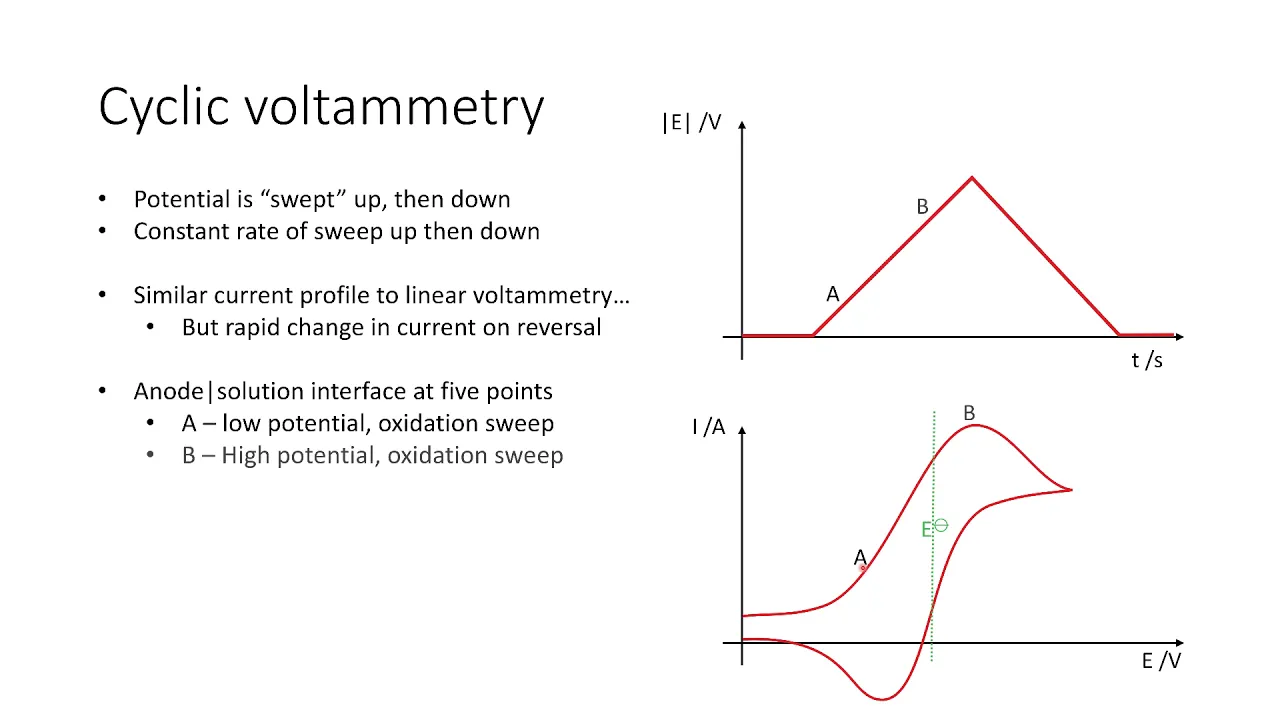




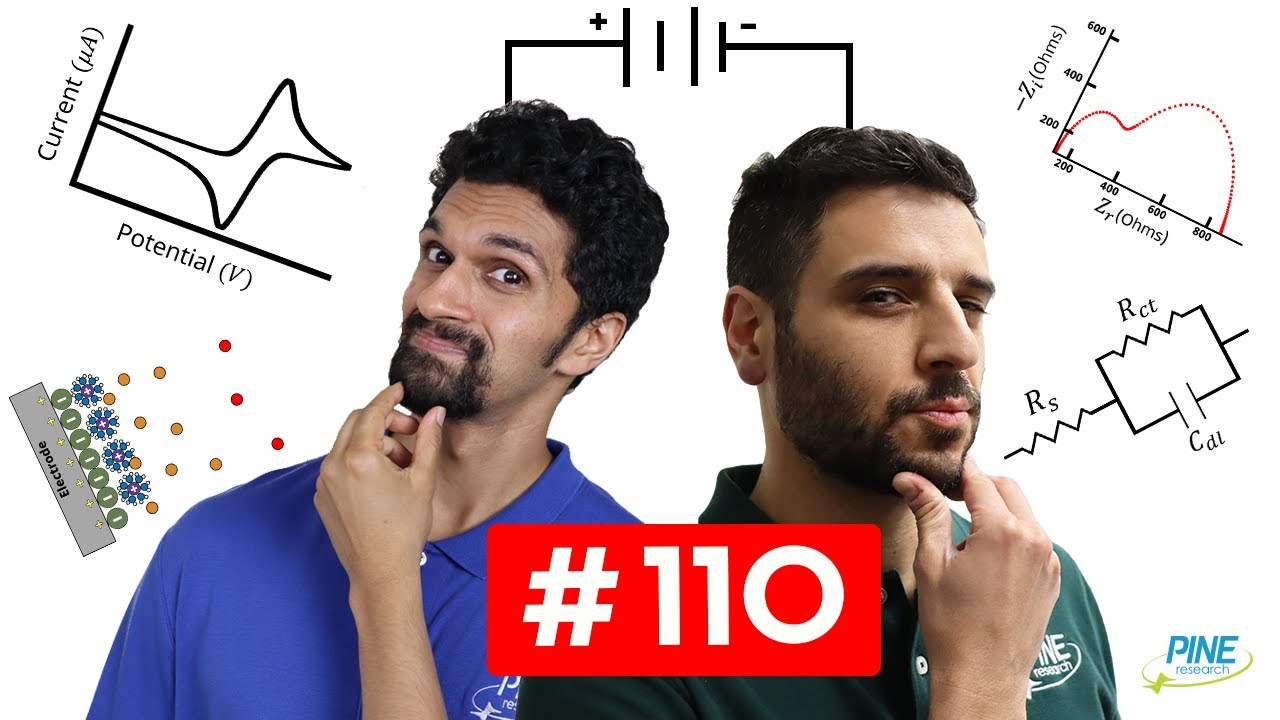






Cyclic voltammetry is an electrochemical technique that measures current as a function of applied potential, revealing key information about redox reactions including redox potentials, diffusion coefficients, and reaction kinetics. The technique involves a three-electrode system (working, reference, and counter electrodes) and produces characteristic duck-shaped curves where peak separation indicates reaction reversibility—smaller separations suggest reversible reactions while larger separations indicate quasi-reversible or irreversible behavior. The method relies on the interplay between thermodynamics (Nernst equation), electrode kinetics (Butler-Volmer equation), and mass transport (diffusion-controlled processes described by Fick's laws), making it essential for characterizing electrochemical systems in energy storage research such as flow batteries.
Cyclic Voltammetry Explained | Electrochemistry Basics (Emily Penn) - YouTube
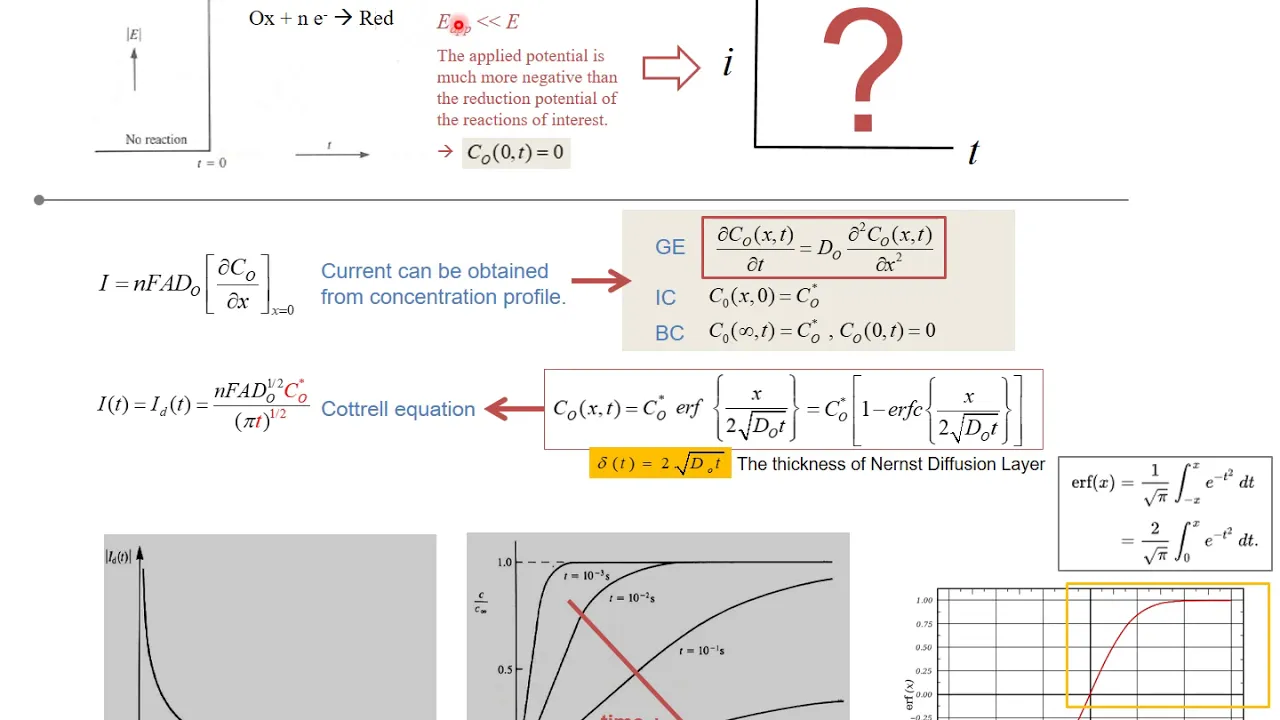
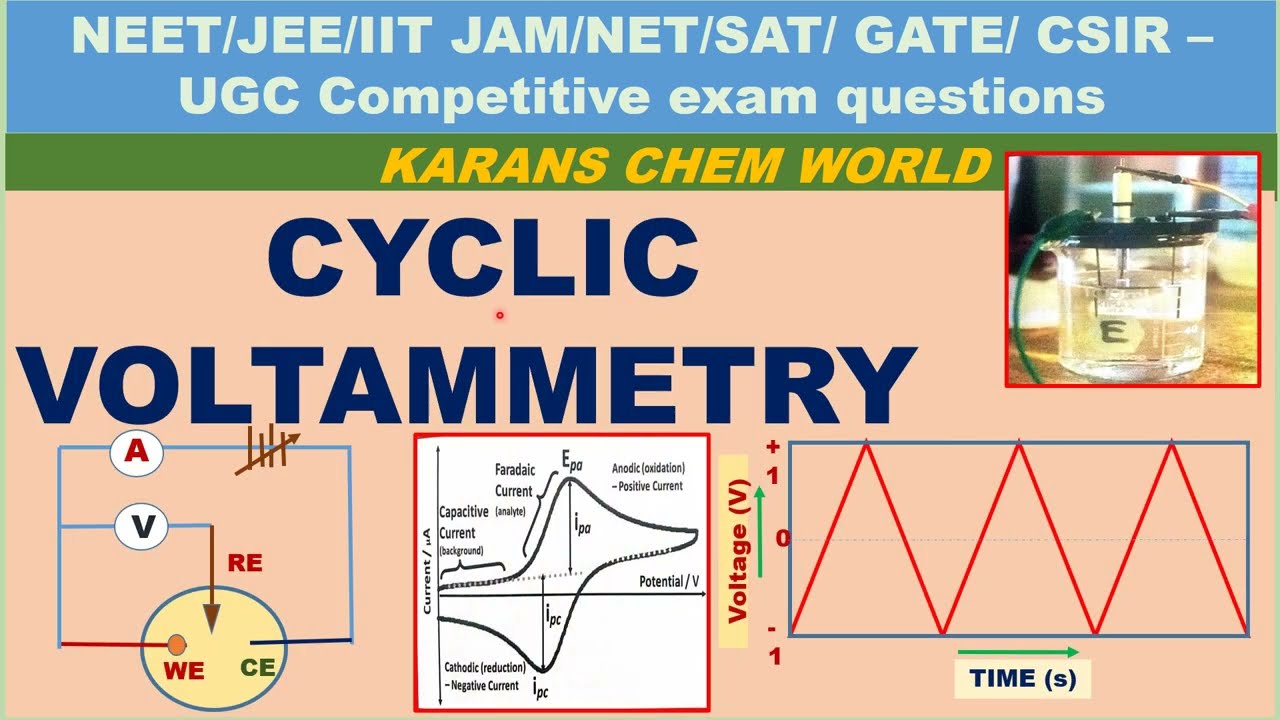
Added:recording is ready cool yeah so can everyone see my screen yes so straight before you you know you can't stand ready to start now okay cool yeah um hi everyone i'm emily and i'm giving a tutorial about cyclic voltammetry today so just for a bit of background i work on the flow battery team for some context about what we're doing is we're looking at using eutectic mixing of quinones to form high energy density redox flow battery electrolytes so on the left here on the left here i just have a schematic of a flow battery here on the left-hand side in blue we have a quinone hydroquinone electrode um in this schematic it's paired with hydrogen on the opposite electrode but what's happening is we have queen owns and we're forming hydroquinones as our discharge species and that's one side of the battery and then um we can pair it with something else on the other side in this case it's hydrogen but the flexibility of flow bodies allows us to have like multiple different options for what we could put on the opposite electrodes the main thing that we're focusing on though is the quinone electrode so here's work done by antonio davey and victoria who was a master student previously with our subgroup was to look at eutectic mixing of quinones so they found that when you mix different low melting low molecular weight queen owns you can depress the melting point and make mixtures of these quinones that are liquid at lower temperatures so ideally this would allow us to mix together low molecular weight quinones to form a high energy dense uh quinone liquid which you could use as a liquid electrode for redox flow batteries so we're ultimately trying to build a battery so one question might be why are we using cv maybe that's not a question at all but we use flow a flow battery setup and then we also use cv so in the top picture we have our flow cell setup that we use in the lab so this square part here is our flow cell so it's a compression cell um there's like two end plates and then there's two electrodes and then there's a membrane in the center separating both sides of the cell and we flow an electrolyte solution through each side of the cell we sometimes place this in an oven so you might have seen um this kind of weird looking setup in the 184 uh old vacuum oven where we've been working on some low temperature uh cycling experiment um and with this setup we can like test our queen on mixtures in a full battery configuration um but we also do experiments in the glove box with a three electrode setup so that's where we do cv and this has some advantages over the flow cell setup so this simplified experimental setup allows us to do like quicker screening of our system so this could be like what quinones are looking at um what like supporting electrolytes we're pairing it with and like different solvents that we might be using so we can more quickly understand the compatibility of these different materials and the reversibility of the electrochemical reactions in the presence of these different solvents or supporting electrolytes this three electric setup also has fewer components so in the flow cell we have contributions from the membrane interface transport through the porous electrodes we can also have crossover between the positive and negative side of the battery so testing in this like three electrodes setup allows us to exclude those contributions and look more closely at what's like going on with the electrochemistry of the quinones also we're able to do more like quantitative electrochemical characterization so using cv we can determine redox potentials for these different molecules we can also look at diffusion constants in different in different like scenarios and we can also determine rate constants and chemical reaction equilibria for like coupled chemical reactions a lot of people in our group are probably familiar with cyclic voltammetry so i apologize if this talk is slightly boring but i think it will be especially helpful for people that are newer to the group and are less familiaristic with water imagery so on the left here i mentioned that we're working with a three electrode cell so here's a quick diagram of what that is we have a working electrode um which in our case is normally a platinum or carbon like inlaid disk electrode so it's like a disk of platinum or carbon and then it's inside of like an insulating like cylinder you have a reference electrode um what reference you use is particular to what type of system you're working with so if you're working with an aqueous system you might use like silver silver chloride for non-aqueous systems we're working with a silver quasi-reference electrode right now there's also different options there and then for a counter electrode we normally use a platinum wire and then in your solution you have your redox active species of some concentration and it's dissolved in a solvent and then you have a higher concentration of a supporting salt which provides ionic conductivity to your solution for cv what we're doing is we are modulating the potential over a time period and we're recording the current so here we have on the x-axis time and on the y-axis the potential so you can see that as we increase the time we're first increasing the potential and then at some switching point we reverse the potential and decrease it back to the original value and then when we do this we measure the current so here's what a cv for some system where you have some species o and then you're forming some reduced species your current potential plot would look something like this where you see it peaks and then as you reverse the potential you get a peak in the opposite direction this this might look kind of weird um so this plot is from barden faulkner and they use a different convention for the current so for a quick aside i'll talk about two different plotting conventions that are used for cyclic voltammetry so the one that we can that we see here and that is used throughout barden faulkner which is a common reference material is the american convention so in this convention from left to right potential goes from high to low and reductive currents are on like the positive y-axis and oxidative currents are below the x-axis whereas for for most like current papers we use this iupac convention which makes more sense like intuitively so as you go from right to left the potential decreases and then we have reductive current below the x-axis and oxidative current above the x-axis so what i'm going to talk about is what dictates the current response to this applied potential um aka why do we get this duct shape so the current potential curves for cv have this like double peak shape that is often described as a duck which you can sort of see here um it comes from a lot of things but mainly kinetics thermodynamics and mass transport all play a part in this you might feel like spongebob like you've got kinetics and mass transport and you're trying to figure out like what's happening um you can also think about it like the food pyramid of cyclic voltammetry where we have thermodynamics which plays a big role and you also have to worry about kinetics mass transport and then if you have clean electrodes and good luck you might get some useful data from cyclical geometry so starting with thermodynamics i'll talk about this briefly but i'd also suggest you look at jeff's electrochemistry tutorial from a few weeks ago in which he discussed thermodynamics in a lot more detail than i plan to discuss here um but the main like thermodynamic equation that we want to consider when we're talking about cyclic voltammetry is the nernst equation so we have some formal potential for our redox reaction at standard reaction conditions and then knowing the conditions of our system so here we have the activity of the oxidized species over the activity of the reduced species for species dissolved in solution we normally use the concentration of the species but from this we can determine the equilibrium potential for the reaction and this e the potential is what we're modulating in cv so as we're scanning over the potential range we're modulating the free energy of the reaction and this has an effect on the activities or the concentrations of our oxidized and reduced species near the electrode secondly we need to consider electrode kinetics so yeah in this diagram this is also from barden faulkner we're looking at the reaction the reaction energy diagram for the oxidized species on the left and the reduced species on the right so to do this electron transfer reaction we're going through some like higher energy transition state and we can describe this using the butler balmer equation so if we consider the reaction rates um so we have two two possible reactions that are happening we have our forward reaction going from the oxidized species to the reduced species and then we also can consider the reverse reaction going from r to o so our net reaction is the rate of forward reaction minus the rate of the reverse reaction and we can relate this reaction rate to the current which we measure at the electrode using this like butler vulnera transition state like semi-empirical treatment we can determine the rate constants for the forward and reverse reaction um and then using our like net current which we described above we can know the current for the reaction this takes us to the butler-volmer equation which we'll use to describe the current at the at the electrode surface so from this equation we can see that the current is a function of the rate constants of the reaction also a function of the concentration of the species at the electrode surface and also a function of the applied potential so like we discussed before there's a lot of factors at play in determining what the concentration will be at a given potential the third thing that we need to consider is mass transport and the main equation that we'll use for this is the nernst planck equation so the nearest flank equation has three components to describe the three different modes of mass transport so we can relate the flux of some species i to the diffusion so that's related to the concentration gradient um and then we have the migration component which is related to the potential gradient and then we have the convection component if we happen to be like stirring our solution in any way um looking again at the the three electrode system which we described before normally cyclic voltammetry is done in a quiescent solution which is like just a jargon word that means it's an unstirred like still solution so this allows us to neglect the con the convection term in the next blank equation also you typically have a high concentration of supporting electrolytes so this allows us to neglect the migration term and as a result we're just left with this first term where our mass transport um and the flux of the species i is dominated by this diffusion term which yeah which comes from the concentration gradient in solution so from leonard's plank equation once we get rid of the migration and convection terms we're basically left with fixed first law which describes the flux related to the concentration gradient this equation like doesn't account for time at all it's like a steady state equation but then if we consider six second law which we get to by using fixed first law and considering conservation of mass then we can consider how the concentration change changes with time as a function of the concentration so here we'll first look at this picture in the top right so to understand the um to understand the coordinate system for this we have our electrode here and we're considering like just a unidirectional case so we have our electrode and at the electrode surface x equals zero and then far away from the electrode surface at x equals infinity we have some bulk concentration of our oxidized species which we start with and that's going to be co star so looking at our initial and boundary conditions first we have our initial condition so at time zero everywhere in the solution the concentration is co star then the second two equations are boundary conditions um so as x approaches infinity the concentration at all positions or sorry the concentration as x approaches infinity at all times is going to be co star and then our second boundary condition is that at the electrode surface at all times the concentration equals zero so that's the particular case that we're looking at here where you're using up all of your reactant at the electrode surface so the concentration is zero when we apply these initial boundary conditions to fix second law which is the diffusion equation we get the concentration of our species as a function of position and time um looking back at six first law we can say that the flux at the electrode surface is related to the current and this is a function of the concentration gradient again like we saw before and now that we have the concentration as a function of potential and time we can use this in fick's first law and we arrive at the control equation so this describes the current as a function of time this equation uh you've probably seen before for chronoamperometry so if we apply if we apply a potential step we can look at the concentration change over time and the current will follow a t to the minus one half um function it's important to note that the control equation only applies for unidirectional diffusion so in this example we were considering like just diffusion in the x direction um but this is valid for like a case where you have like a planar electrode um yeah and this equation is useful for chronoamperometry and it can also be used to look at cv after like the peak the final part of the cv pyramid is the experimental parameters so there's a lot of different experimental parameters that you can control in physical photometry but then also in like three electrode cells in general so one really important is the reference electrode i mentioned previously that there's different reference electrodes that you would want to use for different systems so that's important because you want your reference to be at a constant potential so that you have like a stable reference and it's not drifting during the experiment because that would affect your results you can also use working electrodes of different materials you can use different solvents different supporting salts and these will also have impacts on the voltammetry that you see you can also use different analyte concentrations the factors that you might want to change in a cv experiment would be scan rate so how fast we're sweeping the potential the potential sweep window so like the wind like the range that we're starting from and then reversing from and then you can also repeat like any number of cycles and you might want to do this for different reasons in your experiment so if we put all these together we can look at what the current potential like function looks like for a cv experiment so there's a few different things which i'd like to point out on this plot so first um we have the two different peaks so we have the cathodic peak which is at sea and then we also have the anodic peak so these peak heights um are one thing that you might want to measure we also have this e one half which is the half wave potential and that's going to be like the redox potential for your reaction and then another factor that you might want to look at for a cv is the distance between these two different peaks so like the delta e between the a notice peak and a cathodic peak um the delta e can tell you something about like the ohmic resistance you have in your system it could also tell you about like the kinetics of your system like if it's like narcian and like highly reversible or if like the peaks are further apart then you might have a quasi reversible or possibly irreversible electrode reaction so now that we went through the diffusion equation and looked at the concentration profile we can look at but like how the concentration profile aligns with this like current shape just to just like put it all together so at a at the start of your experiment um this blue line is the concentration of our reactant and you can see that everywhere the concentration of the reactant is one and we don't have any of our reduced species then at b as we reach this eu to the one-half potential our species are in equilibrium so we have an equal concentration of the oxidized and reduced species at the electrode surface then as we get to c um we're starting to deplete the reactant and this is where the cv peaks and then once we get to d we've fully depleted the concentration of the reduced the ferrocenium species at the surface and so this region is in like diffusional control like we just looked at with the catrel equation so then after we reverse the potential and we scan to e we're in a similar case as we were at b so we again have an equal concentration of the oxidized and reduced species at the electrode surface but our bulk concentration is is still that the oxidized species is at a concentration of one so that's why we have a different shape than we do in b but then as we continue we see sort of the same thing that we saw on like the forward scan where now we're depleting the concentration of this reactant species and then as we get back to the starting potential our concentration profile looks similar to how it looked um at a um so that's an example for that was an example for ferrocene so ferritin is a highly reversible like system is often used as a model but in practice the cvs that you may see in the lab don't always look as perfect as that one so first we have what you might see for like a reversible like narcian reaction so that would be something like ferritin um and then if we have a quasi-reversible reaction so in a quasi-reversible reaction the rate constants are slower so we do see some impact of the kinetic and the the delta e here is a lot larger for an irreversible system um here we see like a really irreversible system where we only have a peak in one direction so we're able to form the oxidized species but then we're not able to go back and reduce it so there's no like reverse peak on the like the reverse of this scan so that would indicate that you have a reaction that's irreversible there's some additional considerations that you might also want to consider so one other thing is the charging current so there's some like background current that is due to capacitance um you might want to take like a blank measurement of your solvent and salt without adding your redox active species to determine like the capacitive like background current um another thing to note is the solution resistance so when you add salt to the solution you have some ionic conductivity but if the ionic conductivity is low then you could still have a lot of a lot of solution resistance um in this figure here we can see that the working electrode is at some potential and then your auxiliary or counter electrode is at some other potential and this ir drop is due to the solution resistance but the potential that you're measuring at the working electrode is the potential between the working electrode and the reference electrode so this potential drop here is due to is an uncompensated resistance so if you are able to move your reference electrode closer to your working electrode then you're able to reduce this uncompensated resistance that would that might distort your voltammogram also we only considered a one electron reaction without any um coupled chemical reactions so you could also see different things with more complicated kinetic systems so for example if you have consecutive electron transfer reactions or if you have coupled chemical reactions then this will make your volta voltammograms look different for an example of this first we have on top an example of a reversible electrochemical reaction so that's er and then an irreversible chemical reaction so as we go from the red curve to the blue curve that's with increasing scan rate so at slow scan rates you're able to do your forward reaction but then some irreversible chemical reaction results in you not being able to do the reverse reaction of the electrochemical reaction if you scan really fast then you might be able to do the reverse reaction of your electrochemical reaction um faster than this irreversible chemical reaction can occur so it's important to do cvs at different scan rates so you can try to like tease off what is like what mechanism is at play um next is an example of a reversible chemical reaction followed by a reversible electrochemical reaction so here you're going from blue to red we're increasing the forward rate constant for the chemical reaction so if the chemical reaction is highly reversible or sorry if the chemical reaction has a faster rate constant then this first peak is higher again you can see that the peak changes with scan rate and then lastly we have an example of two consecutive electron transfers so then in this case the difference is we're changing the separation between the peaks so in the red line this is the case where the two electron transfer reactions have potentials that are pretty far away um but then as we go to this blue this blue curve this is still a plot for like two consecutive electron transfers but the potential of the second transfer is negative to the potential of the first transfer so it actually merges together to form like one peak um one other thing i just wanted to point out is that if we look at like the blue curve from this top plot and then the red curve from the center and then again look at like the blue curve from the bottom all three of those volcanograms look pretty similar um so you could get a volcanogram that could be representative of a bunch of different mechanisms so it's important to make sure that you do your experiments with different scanners um and like change other things in the experiment to make sure that you are attributing the correct mechanism to your um volumetry that you're seeing yeah so that's what that's what patrick's doing here he's like taking a close look at his cv results too to make sure that he's not like ascribing the wrong mechanism to um the cv another theoretical treatment that can be used is the randall's static analysis so i'm not going to walk through the derivation at all but this is an equation that is used to determine diffusion constants so this equation relates the peak current as a function of scan rate so if you do a cv at multiple scan rates you can plot the peak current versus the scan rate to the one half and by looking at the slope of that line um all the other things in this equation are constant so we have the number of electrons transferred faraday's constant area of your electrode uh your bulk concentration um the only other constant that we don't know is the diffusion constant so by doing this you're able to determine the diffusion constant for different molecules so another concept in cyclic voltammetry is systems that will give you steady state mass transport so alan talked about one of these last week when he discussed rde so one like what class of these methods is hydrodynamic methods so this includes the rotating disk electrode where you're spinning this electrode um and you're like hydrodynamically controlling the mass transport by modulating the the rotation rate another example is the flow channel electrode so here the electrode is this like band and you're modulating the mass transport here by flowing at different uh flow velocities a second case of a type of experiment to give you steady state mass transport is looking at ultra microelectrodes so we previously discussed the case of planar electrodes that have like semi-infinite linear diffusion so those are like larger electrodes ultramicroelectrodes are really small here in this paper you see that the dimensions of the like active surface of the electrode are like very small this one is like about 1 micron so when you have an electrode that's this small you get a different diffusion profile which allows us to obtain a steady state mass transport similar to what we see with a rotating disk electrode so in this plot on the left in the first column we see what we would see if we have a large planar electrode so this would be semi-infinite linear diffusion we get this like duct shaped curve like we've just walked through in the previous section as we decrease the size of the electrode um we're going from this planar this planar semi-infinite linear diffusion to a radially convergent diffusion once our electrode gets really small so instead of seeing these peaks we just see like a steady state like sigmoidal curve the main difference here between the planar electrode and the ultramicroelectrode is the relationship between the thickness of the diffusion layer and the electrode size so in an ultramicroelectrode we develop a really thick diffusion layer relative to the electrode size so this allows us to get into a steady state regime where the mass transport is completely controlled by this radially convergent diffusion a couple reasons too or like cases where you would want to use ultramicroelectrodes is first in cases where you might have low ionic conductivity you might have no support no supporting salt or you might not have a solvent and this is because ultra microelectrodes allow you to have a really low ir drop so since the current we're measuring add an ultra micro electrode is really small um the size of these electrodes is on the order of like microns so we get a very small current this allows the ohmic drop due to the uncompensated resistance to be quite small um also we're able to scan at fast scan rates that are not typically accessible with like larger like planar electrodes so how fast of a scan you can do in a cv is related to the cell time constant which is the uncompensated resistance times the capacitance so this is a function of the of the electrode radius so if our electrode radius is really small then this gives us a lower cell time constant so since our cell time constant is smaller then we're able to scan that faster scan rates so thinking about these like steady state mass transport methods we can again look at fixed first law which we talked about before where the flux of a species is related to the concentration gradient at the electrode surface at x equals zero so if we're talking about a mass transport limiting case we again want to say that the concentration is zero at the electrode surface so our concentration gradient will be the bulk concentration minus the concentration at the electrode surface over this delta where delta is our diffusion layer thickness so that's the that's like this region here where we're going from the bulk concentration to the electrode surface um the thickness of the diffusion layer is not super well known so it's often it's often described in terms of a mass transport coefficient which is the diffusion constant divided by the nurse boundary layer thickness if we input that this concentration is equal to zero at the electrode surface and then we plug in mo for this diffusion divided by the nice boundary layer and then we know that the flux is equal to the current divided by n times f times the area of the electrode we can get a steady state mass transport limiting current which is a function of the bulk concentration and the mass transport coefficient and the mass transport coefficient has different functional forms depending on what type of electrode you're using so for a disk ultra microelectrode it's a function of the diffusion constant and the electrode radius for the rotating disc electrode um this equation might look familiar from alan's talk last week this this functional form here is found in a leverage equation but for the mass transport at an rde it's a function of the diffusion constant and the rotation rate as well as the kinematic viscosity of your solution uh just like a quick aside i'll go through this really fast since we're close to the end of time um but it could be interesting to compare the mass transport coefficients for an ultra microelectrode versus a rotating disc electrode so if we consider a solution of ferrocene in a 0.1 molar salt solution in acetonitrile we know some diffusion constant for ferrocene on the order of 10 to the negative 9 meters squared per second and we have some kinematic viscosity for the acetonitrile salt solution for a 5 micron radius rde we can calculate the diffusion or sorry we can calculate the mass transport coefficient and we get this value here which is like about 6 times 10 to the negative 4 meters per second if we wanted to have the same mass transport coefficient at an rde it could be interesting to know how fast we would have to rotate to have that same mass transport coefficient so from the previous slide we know that the mass transport coefficient at an rde is again related to this kinematic viscosity the rotation rate and the diffusion constant so using the uh the values that we have for this system and then setting it equal to the mass transport coefficient for the ultra microelectrode we can then solve for the uh rotation rate that would give us like an equal mass transport coefficient uh interestingly it's super high so to achieve the same mass transport coefficient you would need a rotation rate of almost 23 000 rpm so that's like considerably higher than the normal rotation rates that people use for rde experiments just another quick aside all of the equations that we've considered here have been derived for dilute solutions so since we're looking at systems of like liquid quinones that are highly concentrated they're these like don't quite fit the equations and there are some other things that we need to consider so in this paper um this group looked at a redux active organic liquid for cyanopyridine and found some other like non-ideal scenarios that happen when you're doing voltammetry in a like extremely concentrated liquid so this liquid was almost 10 molar and they found that different things like the solution resistance and the fluid convection are dependent on the current and you can also have different factors which are normally considered constants that are then dependent on the concentration of your oxidized and reduced species in this talk i used a number of different references i included them here i think these are three really good resources to learn more about cyclic voltammetry especially if you're new to electrochemistry electrochemical methods by barden faulkner is like a classic and then this understanding voltammetry book is also really good and then um a practical beginner's guide to stick with photometry is like a pretty quick paper that goes through some like experimental considerations that you should make when doing cyclic voltammetry experiments so that's that's it thanks to everyone in the group and then thanks to old reliable aka barton falcon i'll take any questions great thank you emily for your talk on the cv um like emily said if you have any questions please feel free to admit yourself and ask you questions um i have a quick question about the mass transport part of this interpretation of the cv um i i've been thinking about this a lot since uh we've been fighting with reviewers arguing about like the fusion limitation and battery materials and um i often see like this argument uh where they do cv on like a porous electrode and then attribute the trailing tail to mass transport um uh phenomena i think um if you're in a reaction limited regime um then even without mass transport just the depletion of your reactants can result in a similar qualitatively similar feature and that made me think like um i mean the the main difference seems that like instead of having a uniform progression of of your reaction spatially instead if you have like a sort of like a particle by particle type of progression then many of these very basic equations might break down i feel so i wonder how how this is addressed in the more typical setup of electrochemistry yeah i'm not that was a lot so i'm not 100 sure what your question was but i agree with you that especially if you're considering a porous electrode um i think that's definitely where these equations would start to break down um because like we're just considering like semi-infinite linear diffusion in like the regular equations for cv and the diffusion through a porous electrode is going to be already pretty different than that i guess yeah another way to maybe ask the question is um let's say you have like a planner like thin film where you might initially assume that semi-infinite diffusion is like a valid valid setup but then experimentally how would you how would you confirm that you're in a mass transport limited regime where you can use all the standard equations if for example if part of the thin film reacts first and then completes the reaction before other parts of the film start reacting then i think um like the end of the cv where the trailing tail might look like the fusion mass transport limited but actually just come from the depletion of your total active area so i'm wondering if there's there's a way to experimentally distinguish these two scenarios yeah one thing that i've seen um to like look at differences between diffusion limited regime and like can like if your diffusion limit or kinetic limited one thing that i saw was doing like a potential step experiment um which i guess like ends up being similar to cv um but like you could separately analyze like what's happening at like each potential step um i don't have like a super like rigorous answer but i would think that if you did like a more controlled step experiment then you might be able to look at each of the individual steps and it might have like a different relationship if you have like a kinetically limited regime versus if you had like a purely diffusional regime so maybe you're looking at the temporal evolution there yeah or could you like could you do something to like control the mass transport um so then like you know how you're changing the mass transport and then um it's like that's known then you could more easily like look at the kinetics because you then like that would be something that's changing and you don't know how it's changing no maybe it can rotate inside the coin cell [Music] steven like the the way you were asking the question i'm not sure if i interpreted it correctly but it sounds like you know you're thinking of like the battery material where part of the surface can like stop reacting because it's full of lithium yeah like if some of the particles are um if you think of it as a particle ensemble then if some of the particles finish the reaction then you're decreasing the right right right but i guess like in a in like the standard cv if you just have like a platinum electrode that's not reacting um then it might be very different because i think in that case like if the current is going down i feel like it has to be some sort of mass transport basically like you're just not getting enough reactants to the surface essentially um like not like the platinum will stop being uh you know having the reaction happen at a certain point spatial right so it's it's a fairly different system in that sense also if you're i don't know if your system is like facially resolved at all like when you said some particles have completed the reaction but some particles haven't because there's also electrochemical techniques where like i think i think it's called scanning electrochemical cell microscopy um where you can like do it in like a do your electrochemistry in like a small volume and like one part of the sample and like like facially resolve the electrochemistry that way once there's um some way to get information about the spatial distribution i think it gets a lot easier i was just wondering because before you have that information we do these macro measurements first and then imagine what's going on without really seeing what's happening um yeah that's that's basic that was a question i was thinking about but definitely if there's microscopic information it helps emily i had a really quick question very opposite of stevens um when you connect the biologic potential stats to your electrochemical cell um which convention is the biologic using the american one or the um or the iupac one um the way that the like plotting software that the biologic uses is in the iupac convention okay yeah cool because i always forget when i'm connecting the the electrodes like which one needs to go to like which parts part so good to know are there any questions if not that will conclude our tutorial session for today and thank you emily and shin for internet for your talk uh i think um swati and peter
Up Next
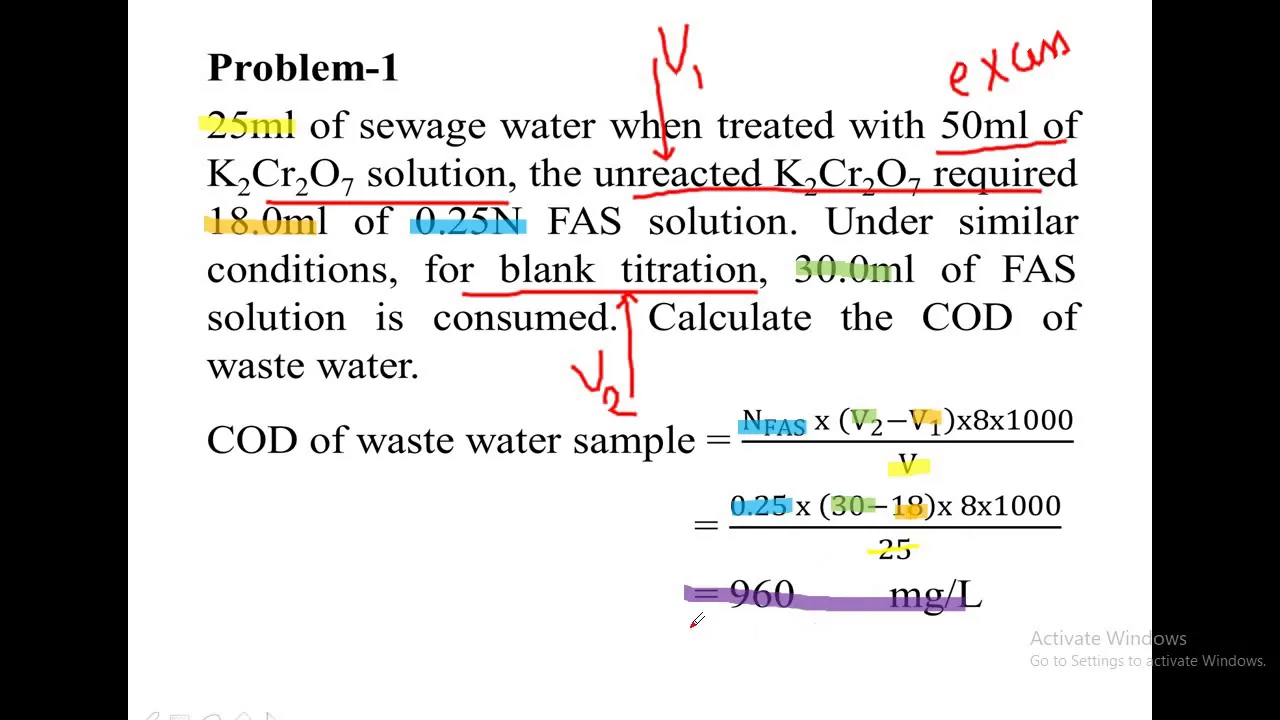
COD Problem Solving: Engineering Chemistry Wastewater Analysis
@vcetfy3844
20.6K views•2020-04-25

Biocatalysis and Catalysis in Islatravir Synthesis | Merck Webinar
@SCIwheresciencemeetsbusiness
675 views•2020-10-08
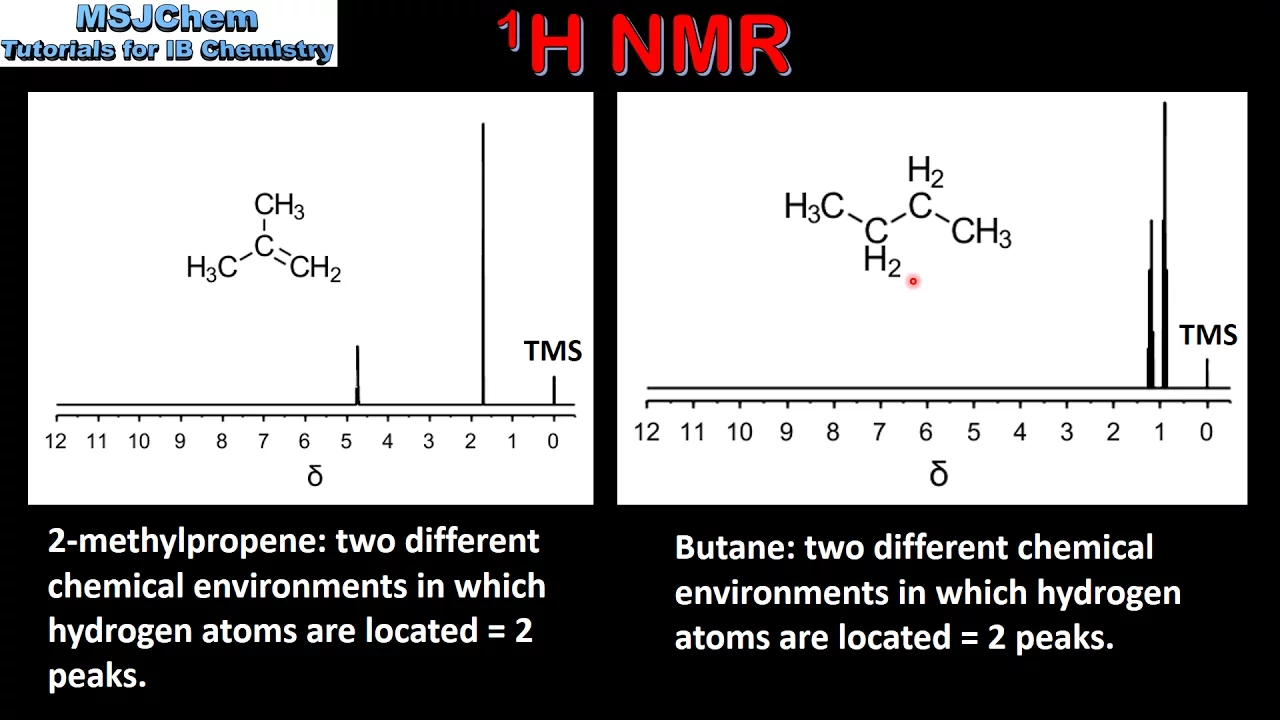
1H NMR: Determining Number of Peaks from Structure
@MSJChem
59.2K views•2017-04-06

Edible Water Bottles: A DIY Guide to Sodium Alginate Spherification
@ryan
10.5M views•2019-06-21
Related Study Plans & Knowledge Roadmaps
Structured learning paths in Chemistry