








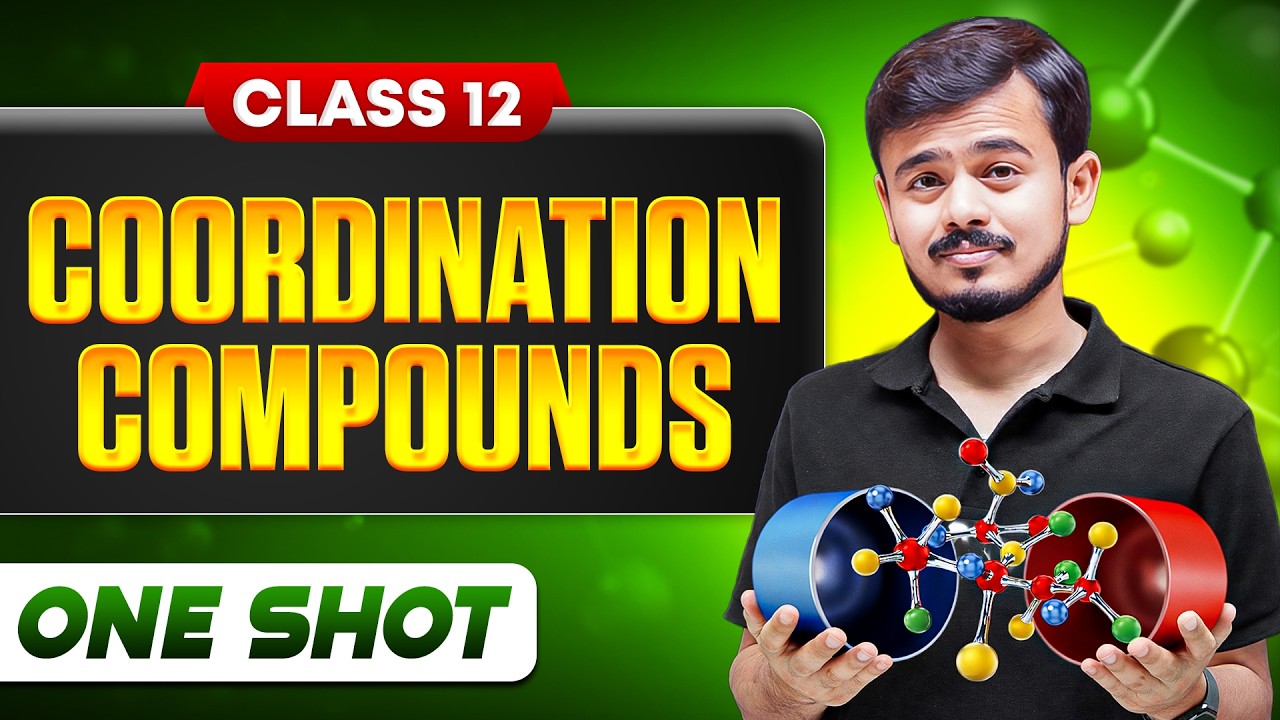








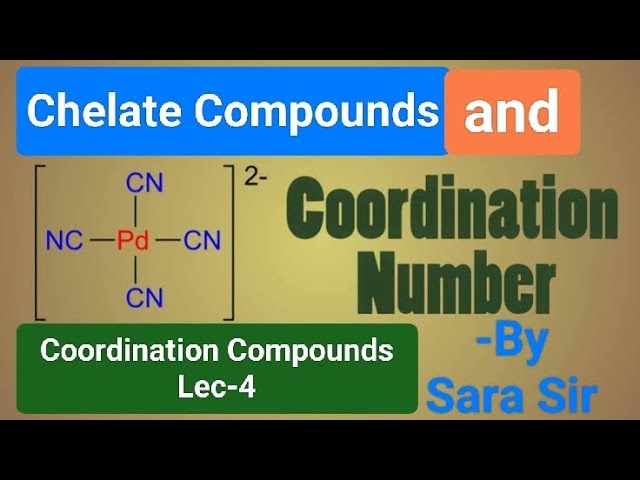
Coordination chemistry involves coordinate covalent bonds formed between a central metal ion (Lewis acid) and one or more ligands (Lewis bases with lone pairs); the coordination number (number of bonds to the central metal) determines the geometry: linear (CN=2), square planar or tetrahedral (CN=4), and octahedral (CN=6); polydentate ligands can form multiple bonds to a single metal ion and are called chelating agents, which are used in applications like treating heavy metal poisoning by sequestering metal ions.
Coordination Chemistry: Introduction & Complex Ions | Chem Basics
Added:Lewis Acid-Base Theory: Understanding electron pair donors (bases) and acceptors (acids) is essential for grasping how ligands bond to central metal ions.
Transition Metal Chemistry: Familiarity with d-block elements, including their electron configurations, d-orbitals, and variable oxidation states.
Chemical Bonding Principles: Mastery of covalent bonding, electronegativity, and molecular geometry (VSEPR theory) to contrast with coordinate covalent bonding.
Crystal Field Theory (CFT): Exploring how ligand fields cause d-orbital splitting, which explains the unique magnetic properties and vivid colors of coordination complexes.
Isomerism in Coordination Chemistry: Investigating structural isomers and stereoisomers (geometric and optical) in coordination compounds.
Systematic Nomenclature: Learning the IUPAC rules for properly naming coordination compounds and writing their chemical formulas.
Applications of Chelates and Complexes: Studying real-world uses in chelation therapy, water purification, and biological systems like hemoglobin and chlorophyll.
70.8K views1.6Klikes13:12Original Release: 2022-04-18
an introduction to coordination chemistry is going to be the topic in this first lesson on a whole chapter on the subject my name is chad and welcome to chad's prep where my goal is to take the stress out of learning science now in addition to high school and college science prep we also do mcat d80 and oat prep as well i'll leave a link in the description below for where you can find those courses this lesson is part of my new general chemistry playlist i'm still releasing for at least a couple more weeks several lessons a week and i'll start on a new playlist here soon so if you want to be notified every time i post a new lesson or when i get started on the new playlist then subscribe to the channel click the bell notification all right so coordination chemistry this all kind of is centered around what we call a coordinate covalent bond and we learned back in the day that a covalent bond is just the sharing of electrons and typically between two non-metals is the way we looked at it and one non-metal kicked in an unpaired electron and the other nonmetal kicked in an unpaired electron and then they shared those two electrons as a single covalent bond well gonna have a little bit different players here we're still going to have some sharing of electrons going on but where those electrons come from so and who shares what is going to be a little bit different so instead of having two different atoms each sharing one electron we're going to have one atom sharing both the electrons and the other atoms sharing nothing just saying thank you very much so we've got this unequal sharing of electrons like this we're dealing with what are called lewis acids and lewis bases which we got introduced to back in the acid and base chapters we got lewis acids lewis bases so you might recall that the hallmark of a lewis base is that it had to have a lone pair of electrons to share and it's going to share that lone pair as a bond with the lewis acid well in these coordination complex things get a little strange here so you're typically going to see a pattern kind of arise though in the center of it you're going to have a metal ion right there and so that is the lewis acid it turns out so we'll call him the central metal ion now technically everyone saw you might actually see a neutral metal in there but most of the time it's going to be a metal ion so and then it's going to be bonded to one or more molecules on the outside and i say molecules they could be neutral molecules they could be anions as well you'll find out that most of these are going to be anions but some of them will actually be neutral which is going to be a little unusual so but they're all going to have to have a lone pair of electrons to donate to make that bond that's what makes them the lewis base and we call them ligands or ligands depending on who you talk to i'm going to go with ligands that's how i've heard it so i'm going to run with that so what you're going to find is you have a single central metal ion bonded to multiple ligands is normally the way it's going to work so and we're going to deal with three different sets of numbers of bonds coming off that central metal ion we're going to deal with two bonds coming off in which case they'd be 180 degrees apart and we'd call it linear so the central metal ion can be making four bonds in which there are two different geometries associated with that square planar where they're all in a single plane 90 degrees apart or tetrahedral whether it's a three-dimensional structure where they're 109.5 degrees apart and then finally like this one here where the central metal ion is making six bonds so and that's going to be octahedrals same shape we've seen before where all the adjacent ones are 90 degrees apart or you know opposite ones are 180 degrees apart however you want to look at it but same octahedral shape we've dealt with back in molecular geometry so those the common drama she's going to deal with in this chapter that turns out there are you know coordination that well let's not get there there are geometries that are going to involve more than just six bonds around that central metal ion that we're just not going to discuss in this chapter these are the only ones we're going to talk about so linear square planar tetrahedral octahedral and these are going to correspond to what we call coordination numbers so of 2 4 4 and 6. and the coordination number again is just the number of bonds coming off that central metal ion now if we take a look at this guy right here so it turns out that your central metal ion and all the ligands it is bonded to is what we call the coordination sphere so and then everything outside the sphere is not part of the coordination sphere and it turns out in this case our this guy is a complex cation so it's a complex ion so and when your central metal ion bonded the ligands has an overall positive charge we call it a complex cation when it's overall got a negative charge we call it a complex anion and when it's neutral we'll just call it a neutral complex so in this case we've got a complex cation and then we've just got simple anions and those simple anons might be monatomic ions or polyatomic ions but they're not going to be a complex in this case so because they're just simple chloride ions now there's nothing that says you don't you can't have both a simple i'm sorry that you can't have both a complex cation and a complex anion it's not you know normally what you're going to run into but nothing says that you can't have both so but in this case we had a complex cation with just a simple counter ion a simple anion in response here all right so this is the coordination sphere the metal ion and everything in between and the reason it gets kind of singled out and gets a special name is it turns out what's in that coordination sphere may not be available to undergo normal chemical reactions so let's write this out real quick if we actually wrote this out the way we write the formula here is you start with the central metal ion then you list all the ligands it's bonded to and in this case they're all ammonia and there are six of them and then you put what's ever in the coordination sphere in brackets and you go cation first anna in second and so since the complex cation or the complex is the cation we put it first had it been the anion we put it second so but then the counter ions will come last and so it's always cation before anon just like with normal ionic compounds that don't involve complex ions so and there's our lovely formula now let's say we had something a little bit different here let's say we gave you the formula with water as a ligand so this is going to be a little unusual here and you might have seen it with ammonia here so so most ligands are going to have a negative charge it turns out but not all of them and the two most prominent ones that don't are uh the ammonia here and the water here we call this amine we call this aqua in this context and notice those are neutral molecules and a lot of students get a little you know confused here because we're used to ionic bonding we've got plus and minus cations and anions well in this case so you're definitely gonna have a cation at the central metal ion but the ligands around it oftentimes will be anions but they don't have to be so with water and ammonia those are neutral molecules and the hallmark again is to be a lewis base they just needed to have a lone pair of electrons and if you recall that ammonia's lewis structure shows that lone pair of electrons on the nitrogen it is that lone pair ammonia that was used to make this covalent bond here here here here here and here all right so if we take a look at this formula down here now you're supposed to realize that it's iron five waters and a chloride that form the coordination sphere and then there are two chloride counter ions and that's what you're supposed to get from this formula and so the question we're going to deal with here is if we react this with excess ag no3 and let's read that question verbatim so if excess agno3 is reacted with one mole of this lovely coordination compound how many moles of agcl will be produced and so the idea is the ag plus here is going to be reacting with some of the chlorides here and what you're supposed to realize is that the chloride that's within the coordination sphere is not available for this chemical reaction only these two chlorides out here and so with one mole of this lovely coordination compound even though it total has three moles of chloride ions one two three only these two are available for the chemical reaction so only has two moles of what we say free chloride ions to react with the ag plus and so we're only going to get two moles of agcl not three all right so what's inside the coordination sphere versus what's outside the coordination sphere very important all right it turns out we've also got some ligands that can make more than one bond and so in this case over here we've only actually got three ligands so this is ethylenediamine it's got two nitrogens separated in space and both of those nitrogens have a lone pair just like ammonia's nitrogen has a lone pair and so as a result one molecule can actually make two bonds to the iron so and when this is true we call this a polydentate ligand and if it's two it's specifically bidentated had it been three bonds to the central metal and it would have been tridentate tetradentate pentadentate hexadentate so on and so forth so but polydentate just generically here so but ethylenediamine is a well-known bidentate ligand it can make two bonds and it's not just enough to have two atoms that each have a lone pair they also have to be separated by enough space that they can bind like say 90 degrees apart in an octahedral complex like this so if we write the formula for this guy we've got fe and it turns out the abbreviation for ethylenediamine is en and we've got one here one here and one here for a total of three and then two plus and so in this case i don't have an entire coordination compound so cation and and i've just got the cation and so we can only write the formula of the cation i don't i never showed you what the counter ions were in this case so we'll just stick with just the cation but the big thing is a lot of students get tripped up here and if i ask you what's the coordination number of the iron in this compound a lot of students get tripped up and they would say three because they see three ligands but again the coordination number is not the number of ligands it's the number of bonds being made to the central metal ion and since each of these three ethylene diamines can make two bonds each well three times two is still one two three four five six bonds being made of that central metal ion it's still going to have a coordination number of six which is going to correspond to that octahedral geometry and so you're going to have to memorize you know which of these ligands are by dentate and there's only a handful most of the ligands are going to be monodentate and i put a on the next page of the handout here the study guide i put a big list of them i'll put it up on the board here as well and in this case you're supposed to know that ethylenediamine is biodentate so is o-phenanthroline and oxalate and carbon carbonate and then diethylene triamine is tridentate and then edta for short is mostly what we call it but ethylenediamine tetracetic acid can make up to six bonds to a central metal ion all right you should also know one other term here and that term is going to be called a chelating agent so and it turns out that any polydentate ligand can act as what we call a chelating agent so in these chelating agents when they're bonded to the the metal we call that a metal chelate so and these are kind of important they're important for a couple of reasons so but they they sequester metal ions by binding them and surrounding them so in this case this would be an example of a metal chelate right here so and again this is kind of important for a couple different reasons so one of them might be if you get heavy metal poisoning if you get heavy metal poisoning let's say lead poisoning or something like this well lead tends to bind very strongly to your proteins in an irreversible fashion and so once you get poisoned by lead usually you're probably going to just stay poisoned by lead and it's going to cause you some serious irreversible harm however if shortly thereafter getting that lead poisoning maybe they're going to give you some sort of chelating agent in your system and that's going to start binding to those lead ions before they have a chance to bind to your proteins and as a result because they're not going to be strongly bound to your body they might actually get passed through your system and so chelating agents can kind of help with say heavy metal poisoning and things of this sort uh also sometimes you know uh we run chemical reactions it's pretty common in biology like say some of these dna reactions we do we often have to add magnesium into the reaction to get these reactions to go turns out a lot of dna reactions uh in the biological sense are dependent on having mg2 plus round and so you might be running a biochemical reaction in this context and when you want it to stop well what we often do is just add in some sort of chelating agent to kind of sequester off all the magnesium ions and if there's no magnesium ions free you know to help out with these biochemical reactions with the dna well then the reaction stops and so it's a good way to kind of start and stop a reaction in this case with the presence or absence of a chelating agent so uh but big thing here is you should really just realize that any polydentate ligand could be called a chelating agent and when they're bound to that metal that's called a metal chelate all right on that same lovely table full of leggings you're gonna find out that it also lists their names so in a couple different names uh their actual name like h2o is water so but also how they're named when we name them as part of a complex ion or a coordination compound and so it turns out water is gonna be named as aqua ammonia is going to be named as amine with two m's and things of a sort and that's gonna be important because that's actually the focus of the very next lesson we're gonna learn how to name complex ions and coordination compounds in general now if you found this introduction to coordination chemistry helpful then a like and a comment let me know are pretty much the best things you can do to support the channel and if you're looking for practice and if you're looking for say final exam reviews this usually comes at the end of the semester or practice final exams then take a look at my general chemistry master course i'll be sure to leave a link in the description below a free trial is available happy studying
Up Next

21:31
Transition Metals: Electron Configurations, Properties & Reactions (OCR A-Level Chemistry)
@MrBioTom1
27.7K views•2014-04-21
83:56
Biocatalysis and Catalysis in Islatravir Synthesis | Merck Webinar
@SCIwheresciencemeetsbusiness
675 views•2020-10-08
19:50
Kinetics of Nuclear Decay: Half-Life & Radiocarbon Dating
@ChadsPrep
16.5K views•2022-04-13

17:31
Edible Water Bottles: A DIY Guide to Sodium Alginate Spherification
@ryan
10.5M views•2019-06-21
Related Study Plans & Knowledge Roadmaps
Structured learning paths in Chemistry
chemistry
Nuclear Chemistry: Decay, Meds & Fuel Cycle
01Introduction to Nuclear Structure and Radioactivity
02Decay Dynamics and Kinetics
03Radiation Interaction and Detection
+ 2 more learning modules
24h5 modules
Explore Roadmap
chemistry
Supramolecular Chemistry: Forces & Machines
01Foundations of Chemical Bonding and Intermolecular Forces
02Introduction to Host-Guest Chemistry
03Thermodynamics and Dynamics of Self-Assembly
+ 2 more learning modules
16h5 modules
Explore Roadmap
chemistry
Photochemistry: Excited States & Reactions
01Foundations of Light-Matter Interactions
02Molecular Orbitals and Electronic States
03Photophysical Processes and Jablonski Diagrams
+ 2 more learning modules
18h5 modules
Explore Roadmap
chemistry
Coordination Chemistry: Bonding & Properties
01Introduction to Transition Metals and Ligands
02Crystal Field Theory (CFT) and Geometry
03Magnetic Behavior and Spin States
+ 2 more learning modules
14h5 modules
Explore Roadmap