
























Gibbs free energy (ΔG) determines whether a chemical reaction will proceed spontaneously under constant temperature and pressure conditions; ΔG = ΔH - TΔS, where ΔH is the enthalpy change, T is the absolute temperature, and ΔS is the entropy change. A negative ΔG indicates a spontaneous reaction, while a positive ΔG indicates a non-spontaneous reaction, and ΔG = 0 indicates equilibrium. Entropy (ΔS) measures the disorder or randomness of a system, with solids having lower entropy than liquids and gases having higher entropy. Understanding both enthalpy and entropy changes is essential for predicting reaction spontaneity, as demonstrated by examples like ice melting (endothermic but spontaneous due to positive entropy change) and glucose oxidation (highly exothermic and spontaneous).
Gibbs Free Energy and Entropy: Predicting Spontaneous Reactions
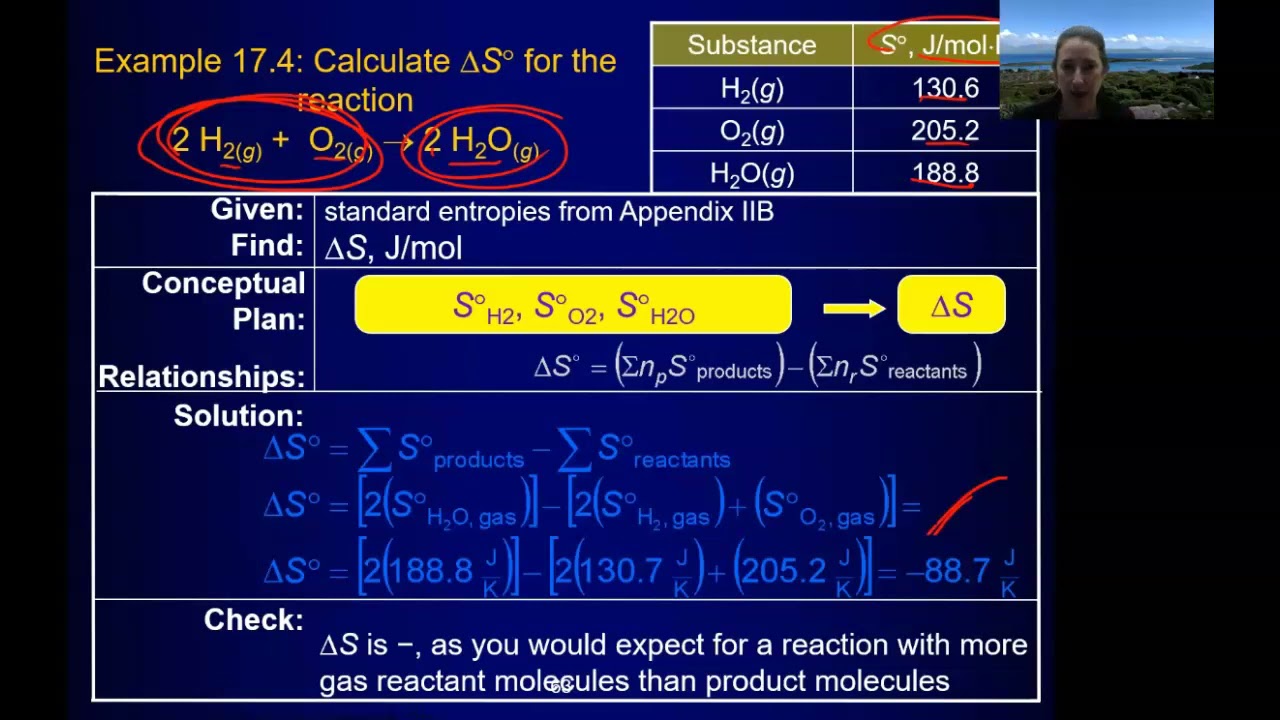
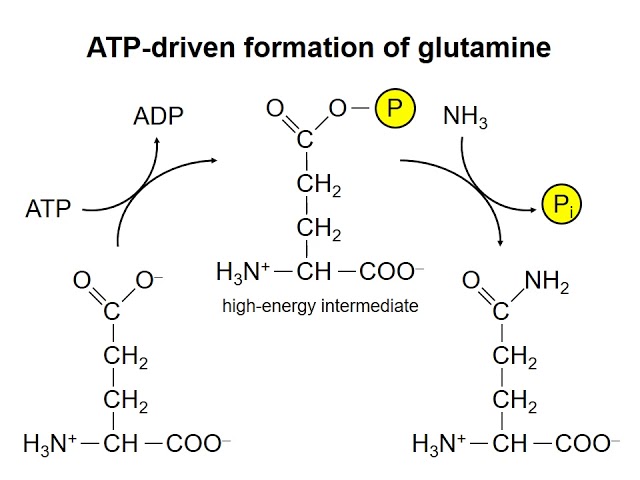
Added:the following content is provided under a Creative Commons license your support will help MIT open courseware continue to offer highquality educational resources for free to make a donation or to view additional materials from hundreds of MIT courses visit MIT open courseware at ocw.mit.edu all right so now we're going to move on to talk about um spontaneous change and so this is today's handout so spontaneous reaction is a reaction that proceeds in the forward Direction without any kind of outside intervention like heat being added for example it just it just goes in that in that in that Direction okay so um so we can talk about reactions following reactions are spontaneous at constant pressure and we'll see later that temperature can make a difference between whether something spontaneous or not but constant pressure here is an example iron plus oxygen and uh what is this in layman's term an example of rust yes and many of you are probably aware of this rust is a spontaneous process it's something that people try to do something about you don't want your car to rust if you're new to New England um and you're from a part of uh of the country that doesn't get so cold um you may not have you look at people's cars and you're like wow look at all that rust all over them yes rust happens especially in New England um and the Delta H here is negative is this endothermic or exothermic exothermic minus 824 okay here is another uh spontaneous process this is molecule is ATP and it will hydroly which means react with water forming ADP so ATP is triphosphate ADP is diphosphate so one of the phosphates and here's the other phosphate comes off it hydrolyzes off and uh this is a spontaneous process we have a h we also have a Delta H knot of minus 24 kog per mole and remember when we oxidize glucose in our body we store that energy in ATP and we want that ATP to uh to be around and then when we uh break ATP apart it releases the energy so this is a very important biological process and you have a negative value exothermic reaction but but there's a few other examples of spontaneous reactions one of them is this one and we've probably all experien this if you're from New England you've seen uh snow melt so you've seen or ice melt uh solid to liquid if you're from a hot part of the world you probably had ice cubes in your nice refreshing drink with maybe a little umbrella on the top anyway you everyone I think has seen ice melt um but here Delta H9 is a positive value it's endothermic also if you have ammonium nitrate this will just come apart in a spontaneous reaction Delta H here is plus 28 K per mole so is Delta H the key to spontaneity it is not plays into it but it is not the determining Factor so if Delta H KN is not the key to spontaneity what is it is free energy yes particularly gives free energy or Delta G and you know I I uh I'm really happy they decided to add the Gibbs free energy because another thing of energy would be a lot so uh so having this free energy have an abbreviation of g i I think is a good thing so Gibbs free energy so Gibbs free energy depends on Delta H but it also depends on another term which is T Delta s temperature and Delta s change in enthropy so Delta G is the predictor of whether a reaction will go forward in a spontaneous in the for direction in a spontaneous fashion or not so let's just think about the sign of Delta G and what it means so again at constant temperature and pressure here Delta G less than zero negative Delta G is that spontaneous or not spontaneous positive Delta G it's not spontaneous non-spontaneous and Delta g equals z is one of the other things that I am very fond of which is equilibrium so Delta G indicates whether something is spontaneous or not negative value spontaneous in the forward Direction positive value not spontaneous in the forward Direction and equilibrium the thing we all try to reach in our lives okay so let's look at an example and calculate what Delta G is going to be so we saw this this equation already we have a positive Delta H knot and now I'm telling you that Delta s knot is also a positive value so we can use this equation and this is really one of the most important equations um in chemistry um figuring out this equation was really a crowning achievement um and uh you'll be using it a lot not just in this unit but pretty much in every unit from now on um you will be using this equation all right so room temperature pretty much we're not doing occasionally we'll do something not at room temperature but we like room temperature um so and we like it in kelvin um so Delta G KN so we plug in our Delta H value so it's going to equal Delta H minus the temperature and if a temperature isn't given in a problem you can assume that it's 298 um and now we need to plug in Delta s but I left a blank here to make a point which is that Delta s's are almost always given in Jewels per Kelvin per mole but everything else is given in kles so you want to make sure you convert your units or you're going to come up with very funky answers at the end so from jewels to kilog so now plus 0.109 K per Kelvin per mole and we can do this out now so we have plus 28 Minus 32.482947 and why don't you tell me how many significant figures this answer has okay 10 more seconds okay so uh at least uh at least some people got it right we've identified once again a weakness um so rules of adding and subtracting so we have 28 here minus 32 there are no significant figures after the decimal point here so we're just left with four so when we're doing multiplication or division we consider the total number of significant figures but with addition and subtraction you got to pay attention to where the decimal point is and we get into the next unit there are logs and those have special rules of significant figures yes very exciting all right right so Delta G KN is negative here although Delta H is positive so this reaction is spontaneous it's not hugely it's a pretty small number but still it's spontaneous all right so let's consider our friend over here that we've been talking about glucose being oxidized to CO2 in water you practically should have the Delta H memorized for that at this point now I'm telling you what the Delta s knot is and it's positive 233 Jew per Kelvin per mole and we can plug this into our equation to calculate a Delta G KN again remembering to convert jewels to kilog uh to do this and so now we see that it is a very uh has a very negative Delta G KN here minus 2, uh minus 2885 K per mole um at room temperature so at room temperature this reaction is spontaneous but slow we saw that with the uh the the candies that had glucose in it we opened them up and no water or CO2 um were obviously being liberated in this um reaction because it is slow and now a clicker question I want you to tell me whether it would be spontaneous at different temperatures or not okay 10 more seconds yep so it is spontaneous at all temperatures not all reactions are but this one is so if we go back here the reaction spontaneous at all temperatures and that's because to be spontaneous you want a Delta G that's negative if Delta H is negative and Delta s is positive then you'll have a negative minus a negative so it doesn't matter what temperature is this will always yield a negative Delta G knot so other reactions that might not be the case but if you have negative Delta h and a positive um Delta s it will be spontaneous so negative Delta H again exothermic heat release and a positive entropy is a favorable thing entropy is always increasing so if this reaction has increase in entropy it'll be much more likely to be spontaneous all right so let's talk about entropy so entropy is a measure of disorder of a system Delta s is the change in entropy and Delta s again is a state function so one example of entropy in New England um are these uh stone walls that do not look absolutely beautiful um they often uh Stones falling everywhere and it doesn't matter if these the stone walls were probably built in 1600s or 1700s in New England were fell totally apart and we rebuilt now we just care about um how the wall is compared to the way it started so Delta s again is a state function it doesn't depend on path and so if you get out and walk around and go like on the Minuteman Trail and see some of the historical sites um where Paul Riv rode his horse along a lot of stone walls there's a New England poet who write who writes about this Robert Frost and he said something there is that doesn't love a wall and that something is entropy entropy does not love a wall entropy does not like order um another example those of you uh who are learning more about me as a person uh know that uh that I am a fan of dogs this is my dog Shep um Shep does not like going to the groomers does not like it and I think that this is because he's been at my office hours and he knows that increasing entropy is favorable decreasing entropy is not and he says you know really this violates the laws of thermodynamics what you're doing to me and you should cease and desist um but anyway he still gets haircuts all right so entropy again is this measure of disorder of a system you have a positive Delta s which is going to be an increase in disorder and a negative Delta s is going to be a decrease in disorder and it a disorder can be you can be thinking about this is internal degrees of freedom in your molecule it can be thinking about this as vibrations all sorts of different things can lead to lead to uh to increase or decrease in entropy um but we often think about changes in entropy depending on if the reaction is changing in Phase SO gas molecules have greater disorder than liquid and liquid has greater disorder than uh solids and so a solid has all its molecules lined up um and liquid can move around a little bit more but gas really can spread all out so in terms of entropy and changes in entropy we can think about the phase change that's happening and even predict if something's going to be an increase in entropy or not so let's just look at one example so without a calculation predict the sign of Delta s and this is a clicker question all right um let's just take 10 more seconds and can our demo Tas come down yep good so you predicted positive which is the correct answer and so here we're going from a liquid to a liquid and a gas um and so going to the gas that'll increase the disorder of the system so Delta s be positive so now we're actually going to do a demo of this particular reaction and so we have hydrogen peroxide um which can just be B bought at a CVS or local uh drugstore and it will uh go to liquid water and also oxygen gas and so how do you see a gas and you can see it by putting it in with soap bubbles so as bubbles of oxygen form the soap bubbles will uh bubble out and so you can see it and you can also add uh some kind of food color um and we have yeast as a catalyst to make it go a little bit faster so let's see if we can actually see disorder incase know want the mic if you want to just say if you want to talk at the same time here's a mic you're not gonna do that okay oh you do okay this on yes it is okay great so what we have going on here is we've got this container it's filled with water and what I did was I added about four teaspoons of yeast um the yeast as Kathy said is going to act as a catalyst um it's actually uh um a biological uh species it's actually going to it's a living species that's actually going to catalyze this reaction uh what Eric is doing is Eric is pouring some hydrogen peroxide he added some soap uh so as you see in the reaction the H2O2 is going to break down into water and gas uh the gas being oxygen and what we don't want to happen is we don't want just the gas to escape because then you guys can't see it so what Eric is doing right now is he's adding some soap the soap is actually going to catch if you will the uh escaping gas and turn it into a uh a foam and what we should be able to see is the foam uh kind of escape from this container you ready okay so hopefully this will work we should put on our goggles smells really bad okay ready all right and get out of there look at that hey y wow that worked a lot better than we thought it was going to work and so this is something called the elephant toothpaste uh demo because that is sort of what if you were an elephant what you would probably be brushing your teeth with I don't know um yes so uh so this is uh entropy increasing okay so let's just see if we can uh quickly talk about a little more about entropy and then we'll end so entropy of reactions can be calculated from absolute values and again we can use this um this equation here so we have the Delta s of for of um a Delta s for a particular reaction is this can be calculated from the Delta s's of the products minus reactants so again we have products minus reactants the absolute value or an absolute Delta s um s equals or S equals zero for a perfect Crystal at a temperature of zero Kelvin you never really talk about s by itself it's always really Delta s um um and S of zero this is like the saddest thing for a crystallographer because you know you're never going to have a perfect Crystal um even if you go to zero Kelvin I feel like um at least experimentally so s equals z to me that's kind of sad okay um so if we just um put in for this reaction that we just uh just did we can put in our values here and we can put in we're forming liquid uh liquid water and we're forming O2 gas and um we are using two molecules of hydrogen peroxide H2O2 here and so now we can calculate what that Delta s knot is um and it's a value of 125 jewles per Kelvin per mole so again products water and gas minus reactants pay attention to the stochiometry and you can get your Delta s value and why is it positive again we already talked about this it's from because it's going from liquid to a liquid plus a gas and then if we plug these values in again to see see if it's spontaneous we can use this equation and plug in our values making sure we change our units and we can see that in fact this is a spontaneous reaction because it's negative here but you already knew that because you watched it Go spontaneously so most of the time you can't do the demo so then you can use this awesome equation right here okay so that's where we're stopping for today um and we'll see you all on Friday all right so if you take out your uh lecture 16 notes um the bottom of page three we had an example about the melting of ice um at room temperature so we had did a little demo for you at the end of class last time and calculated um a that the reaction was spontaneous uh for hydrogen uh hydrogen peroxide is is pretty reactive and we watched uh the O2 bubbles go and we did that calculation so we're thinking about not just Delta H but we're thinking about Delta s and we're now thinking about Delta G as well and how they all play together so when we started last lecture we had talked about the fact of some reactions that were spontaneous where Delta H was negative where it was exothermic where heat was released but then we also gave some examples where Delta H was positive and said but these are also spontaneous reac reactions we all know that at room temperature ice will melt we know that that's a spontaneous reaction but the Delta H for that reaction is actually a positive value it's an endothermic reaction so when we're thinking about these reactions in spontaneity we have to be thinking about Delta G not just Delta H and Delta G has to do with Delta H and Delta s so sometimes Delta s is the driving force behind whether a reaction is going to be spontaneous whether the Delta G will be negative or positive Delta s is making that determination so we can calculate what a Delta s for a reaction is if we know um the entropy values for the products and it's the sum of the entropy values for the products minus the sum for the reactants so when we are doing um Heats of formation we also had products minus reactants but we have one exception to this products minus reactant rules and that's when we're using what what things are we going to do reactants minus products Bond enthalpies right okay but here we're products minus reactants so we can uh plug those numbers in our product is our liquid water um our reactant is our solid water or our ice and we can calculate what the Delta s not is for this reaction we can put in our values and we get a posit positive value positive 2859 jewles per Kelvin per mole and Delta s's tend to be in Jewels everything else is in kles so keep that in mind um and why why is why do you think this reaction it has a positive value why is Delta s greater than zero what would be your guess for that what's happening yeah so we're going from a solid to a liquid so we're increasing the internal degrees of freedom the molecules of water can move around more in a liquid than they can in a solid so this is increasing the disorder of the system increasing um it you're increasing entropy here because the water molecules can move around more there's more freedom of motion so Delta s is POS positive it's increasing and then we can use that to calculate Delta G KN gives free energy we can plug in our Delta H value minus t room temperature times Delta s which we just calculated making sure that we convert from jewels to kogs and then our um units will be kogs per mole and here Delta G is a negative value so it is spontaneous we all know it's spontaneous we've observed this happening um so even though Delta H KN is positive it's an endothermic reaction ice melts at room temperature because the Delta G is negative all right so let's talk a little more about Delta G so let's talk about free energy of formation and the last page of this handout so free energy of formation um Delta G subf and so this is analogous to Delta h of formation so the en change in enthalpy of formation so again when you have the little uh little value here the standard gives free energy of formation for the F here and that's the formation of one mole of a molecule from its elements in the most uh stable State and in their standard States so we can have tables in your book of these values so your book in the back if you haven't explored the back of your book is lots of tables of things um including uh um information about Delta G's and Delta H's and bond enthalpies and all sorts of other things Redux potentials we haven't talked about yet lots of tables so you can look this up um or if you have already say looked up your Delta h of formation you can use this handy equation Delta G equal Delta H minus t Delta Delta s but if we plug in our Delta H's of formation we can get our Delta G's of formation so how you're going to calculate Dental Delta G of formation depends on what information you are given so let's think a little bit about what it means for particular Delta G's of formation if they're positive or if they're negative so let's look at an example and we saw this before this is the formation of carbon dioxide from elements in its most stable state which is uh graphite carbon and O2 gas so these are the elements in their most stable State forming CO2 now I'm telling you that the Delta G KN is minus 39436 K per mole and we can think about why this what this information tells us that this is a fairly large negative number so if Delta um Delta G of form is less than zero What's going to be true thermodynamically and this is a clicker question all right let's just just take 10 more seconds interesting okay so let's think about why this is true this might be the deciding uh a deciding clicker question we'll see um so if it is negative value for Delta g a negative value for Delta g means that it's spontaneous in its forward Direction so here the formation from the elements in their most stable state if this is spontaneous in the forward Direction it also means that it's non-spontaneous in the reverse direction that means once CO2 forms it's going to be stable compared to the elements from which it came because it's non-spontaneous going in the reverse direction or at least that's the way that I like to think about it so relative to its elements it's stable spontaneous forward non-spontaneous in Reverse so this is kind of bad news for us because there's too much CO2 in our environment right now it's a greenhouse gas and wouldn't it be awesome if we could just uh encourage it all to uh go back to its elements for more oxygen which we could breathe how lovely make some nice graphite maybe compress it make some diamonds but no um it is uh quite stable compared to its elements so CO2 is in our environment causing global warming and uh it's going to be hard to solve that problem not easy to solve that problem so this is unfortunate news that thermodynamics gives us all right so then we can look at the other if you have a positive value for Delta um Delta G of formation then it's thermodynamic ially unstable compared to its elements so it's spontaneous going in the reverse Direction so it's unstable so thermodynamics tells us whether something is stable or unstable and kinetics tells us about whether things will react quickly or not so something can be kinetically inert it might take a long time to react but thermodynamics tell us us stable unstable so thermodynamics is great um but it doesn't tell us anything about the rates of reactions so nothing about the rates and that's kinetics so really thermodynamics and kinetics are very important for explaining reactions and we'll talk about more kinetics at the end so to calculate a Delta G for a reaction um it depends again what you're given you can sum up uh the Delta G um of formation of your products minus your reactants or you might use this you'll find yourself using this equation a lot this again is really uh was a crowning achievement of thermodynamics that Delta g equals Delta H minus t Delta s so again whatever information you're given you can use that to find these values okay so we're not done with this equation we're going to switch handouts but we're going to continue with that exact same equation
Up Next
Equilibrium JEE Advanced Questions | Physical Chemistry | IIT JEE
@Aakash_JEE
147K views•2019-03-18
Biocatalysis and Catalysis in Islatravir Synthesis | Merck Webinar
@SCIwheresciencemeetsbusiness
675 views•2020-10-08
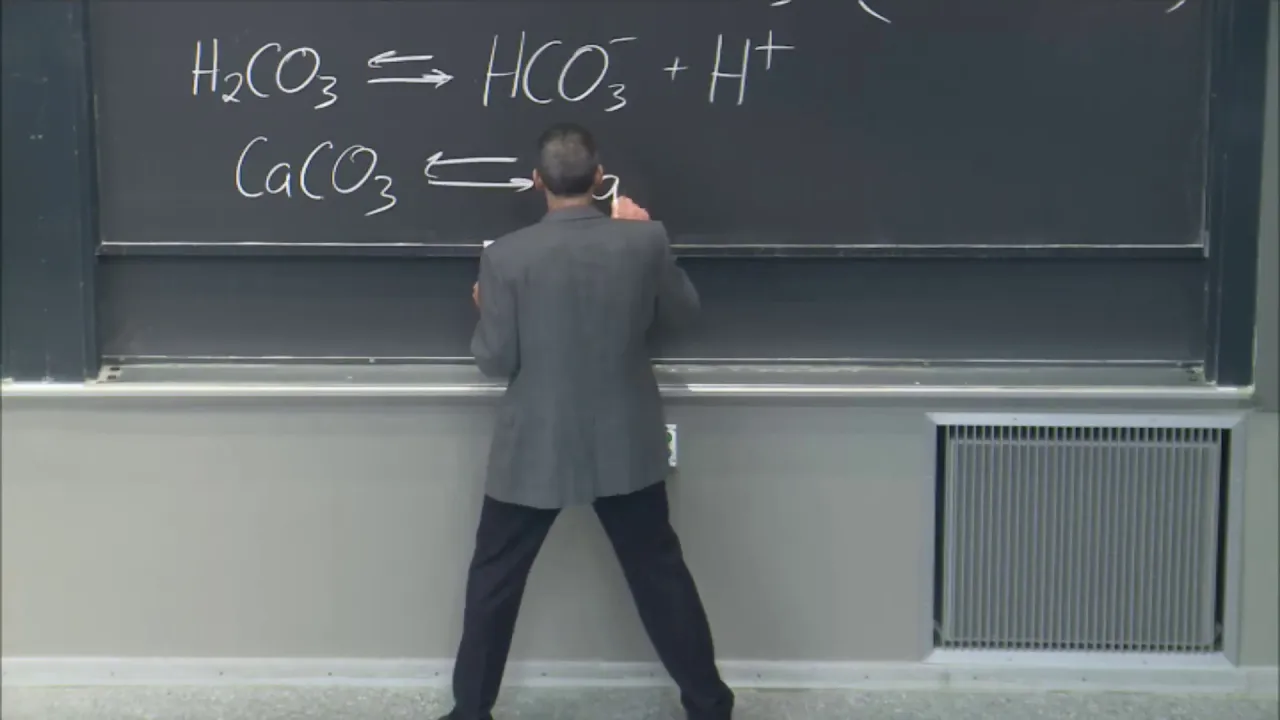
Ocean Acidification Chemistry | MIT Solid-State Chem
@mitocw
5.5K views•2020-12-07

Edible Water Bottles: A DIY Guide to Sodium Alginate Spherification
@ryan
10.5M views•2019-06-21
Related Study Plans & Knowledge Roadmaps
Structured learning paths in Chemistry