
















![SACANI RESPONDE [TUDO SOBRE COSMOLOGIA] - Ciência Sem Fim #273](https://i.ytimg.com/vi/CoDF65uzm88/maxresdefault.jpg)




Baryon Acoustic Oscillations (BAO) are fossilized sound waves from the early universe, imprinted in the distribution of galaxies, that serve as a precise cosmic standard ruler for measuring the universe's expansion history; these oscillations originated from acoustic waves traveling through the hot baryon-photon plasma before recombination at 380,000 years, when the sound horizon froze at approximately 500,000 light-years, creating a characteristic 150 megaparsec scale pattern that astronomers detect today through galaxy redshift surveys to confirm dark energy's existence and validate cosmological models.
Baryon Acoustic Oscillations: Cosmic Sound Echoes Explained
Added:The Big Bang Theory and the evolution of the early universe, specifically the state of the hot, dense plasma before recombination.
The Cosmic Microwave Background (CMB) radiation, including its origin and what it reveals about primordial temperature fluctuations.
The fundamental distinction between baryonic (normal) matter and dark matter, particularly how they interact with radiation.
Basic wave mechanics, specifically how competing forces like radiation pressure and gravitational pull create acoustic oscillations in a fluid.
The cosmological concept of a 'Standard Ruler' and how BAO is used to measure distances across cosmic time.
The properties of Dark Energy and how BAO constraints help physicists determine if it is a cosmological constant or a dynamic field.
The formation of Large-Scale Structure (LSS) in the universe, mapping how early sound waves influenced the distribution of galaxies.
The 'Hubble Tension,' which is the current discrepancy in physics regarding the rate of cosmic expansion measured by different observational methods.
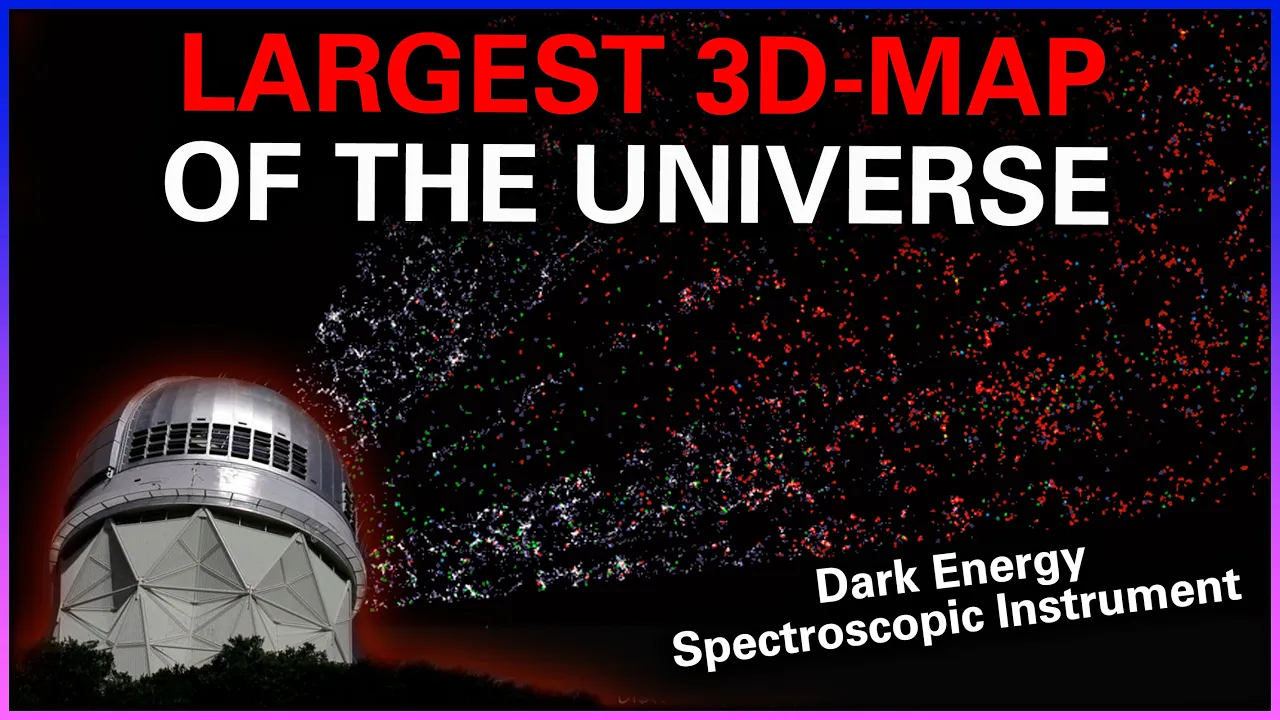
Key observational astrophysics projects, such as the Dark Energy Spectroscopic Instrument (DESI) and the Euclid space telescope, designed to map BAO.
724.2K views16.2Klikes17:32Original Release: 2019-02-07
We want to thank Google Science Journal app for supporting PBS Digital Studios.
Invisible to the naked eye, Our night sky is scattered with the hundreds of billions of galaxies that fill the known universe.
Like the stars, these galaxies form constellations, Hidden patterns that echo the reverberations of matter and light From an epoch long before galaxies ever formed.
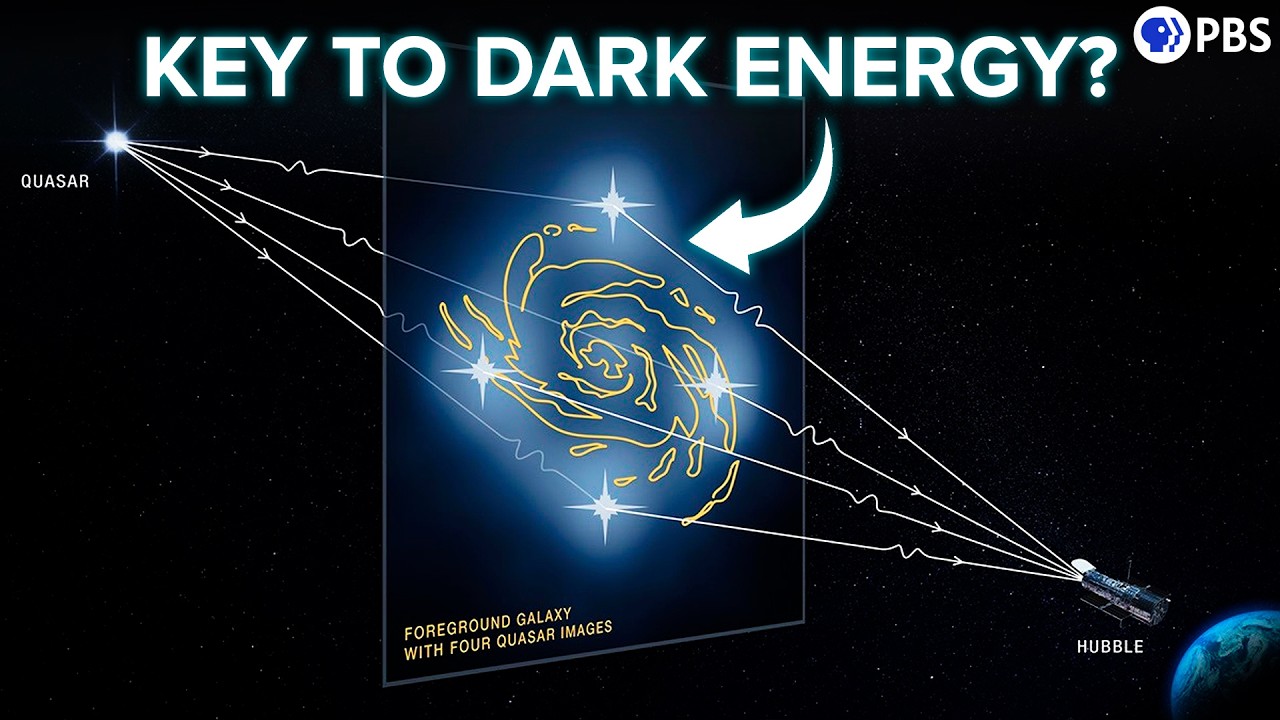
These are the Baryon Acoustic Oscillations (BAO), and they may hold the key to understanding the nature of dark energy.
[PBS Space Time intro] The field of cosmology and the study of the universe on its larger scales was once the least precise in all of astrophysics.
The impossibly vast distances made accurate measurements near impossible.
But as our telescopes and our techniques improved over the last few decades, Things are now very different.
We live in the era of precision cosmology, in which we know the stunning detail, the properties that govern the very birth, evolution, and the end of our universe.
We talked about one of those properties in a recent episode, The Hubble constant, and about a growing conflict in its measured value, which hints at strange new physics.
Today, we'll talk about another measurement that may help resolve this crisis: The baryon acoustic oscillations.
They are the fossils of the first sound waves in the universe, imprinted on the distribution of galaxies on the sky.
And in these patterns, we could read the expansion history of the universe.
Let's start at the beginning.
For the first few hundred thousand years in the life of our universe, All of the space was filled with hydrogen and helium in plasma form.
Protons and the lightest of nuclei forged in the first minutes after the Big Bang, and still so hot that no atoms could form, and electrons buzzed free of their nuclei.
These particles of matter are our baryons.
There's also light, in fact, around a billion photons for every electron.
but no photon is safe from a free electron.
Unbound electrons present a huge target to scatter any wavelength of light.
And scatter they did, constantly.
A photon could barely travel any distance before colliding with an electron.
The electrons in turn exerted their electromagnetic pool on the nuclei.
We say that in this state, light was coupled with matter, And baryons and photons formed a single strange fluid: A Baryon-Photon plasma.
There are three profound differences between the behaviour of matter in this state Compared to the gentle gas nebula of the modern universe.
First: The Baryon-Photon plasma was opaque.
There exists no lines of sight to anything during that time, and we'll come back to that later.
Second: Light was able to exert an enormous pressure on this plasma, as we'll see that it'd lead to the production of colossal sound waves.
And third: Those sound waves travelled fast.
Rapid interaction between the charged particles of the plasma via the trapped photons meant that ripples in the plasma travelled at over half the speed of light.
Mixed in this soup of baryons and photons was dark matter.
In fact, dark matter outweighs baryons by a factor of five, Which means it was, by far, the dominant gravitational influence in the early universe as it still is.
But unlike baryons, dark matter does not interact with light at all.
Light exerts no pressure on dark matter.
Okay, so, the universe is filled with this hot ocean of baryons, photons, and dark matter.
Now, in order for it to do anything interesting, We need one final ingredient: Density fluctuations.
A teensy bit more matter here, or a teensy bit less there, These fluctuations probably were the remnants of random quantum fluctuations From when the universe was subatomic in size.
And now that they've expanded enormously by cosmic inflation in the beginning instant of the Big Bang.
Immediately after that, two competing forces began to work.
Each over-dense region pulled gravitationally on its surroundings, gravitationally on its surroundings, drawing matter towards it.
In particular, the dark matter flowed inwards towards this density peak.
But also at that density peak, the imprisoned photons exerted an enormous outward pressure.
To equalise this pressure, radiation pushed outwards and carried the baryons with it.
This resulted in an acoustic wave, a true sound wave in the form of an expanding shell of increased density.
And remember, sound travelled at over half the speed of light back then, so the shell expanded fast.
But as it expanded, so did the universe.
As matter became more diffused, and the photons themselves were stretched, redshifted to ower energies, themselves were stretched, redshifted to ower energies, the universe cooled.
At 380,000 years, the plasma hit a critical temperature of 3000 Kelvin, around the surface temperature of the coolest red dwarf stars.
At this temperature, electrons could finally be captured by nuclei and the first true atoms formed.
The baryons transitioned in phase from a plasma to a gas.
We call this phase transition event: We call this phase transition event: Recombination.
While free electrons were able to interact with any frequency of light, electrons bound into atoms are restricted to only those specific frequencies corresponding to the energy level transitions of that atom.
As a result, light and matter were no longer coupled.
The universe went from opaque to transparent over a period of several thousand years.
As the wave of plasma and photons decoupled, light began to stream freely through the universe as the cosmic background radiation.
But the plasma, now hydrogen and helium gas, stalled.
The speed of sound dropped from half the speed of light to only hundreds of meters per second.
The wave of plasma-turned-gas essentially froze in its current state.
The radius of that shell became fixed to the rate of expansion of the universe.
And its size?
Well, the exact distance that sound could travel over the age of the universe at that time.
We call this the sound horizon. And at recombination, it was around five hundred thousand light years.
While all of this was happening, dark matter was doing its own thing.
Immune to the radiation pressure, the central dark matter overdensity had continued to grow It pulled on the expanding shell, and was pulled by it.
When the expanding wave froze, both dark matter and baryons flowed together and consolidated the new structure. Once more in the gravitational grip of dark matter, hydrogen and helium could begin the long work of collapsing into stars and galaxies work of collapsing into stars and galaxies as the universe continued to expand.
And now over thirteen and a half billion years later, the universe is expanded by a factor of 1,100.
So those rings should be 150 mega parsecs across, 500 million light years.
So how does this primordial history lesson help us understand the subsequent expansion of the universe?
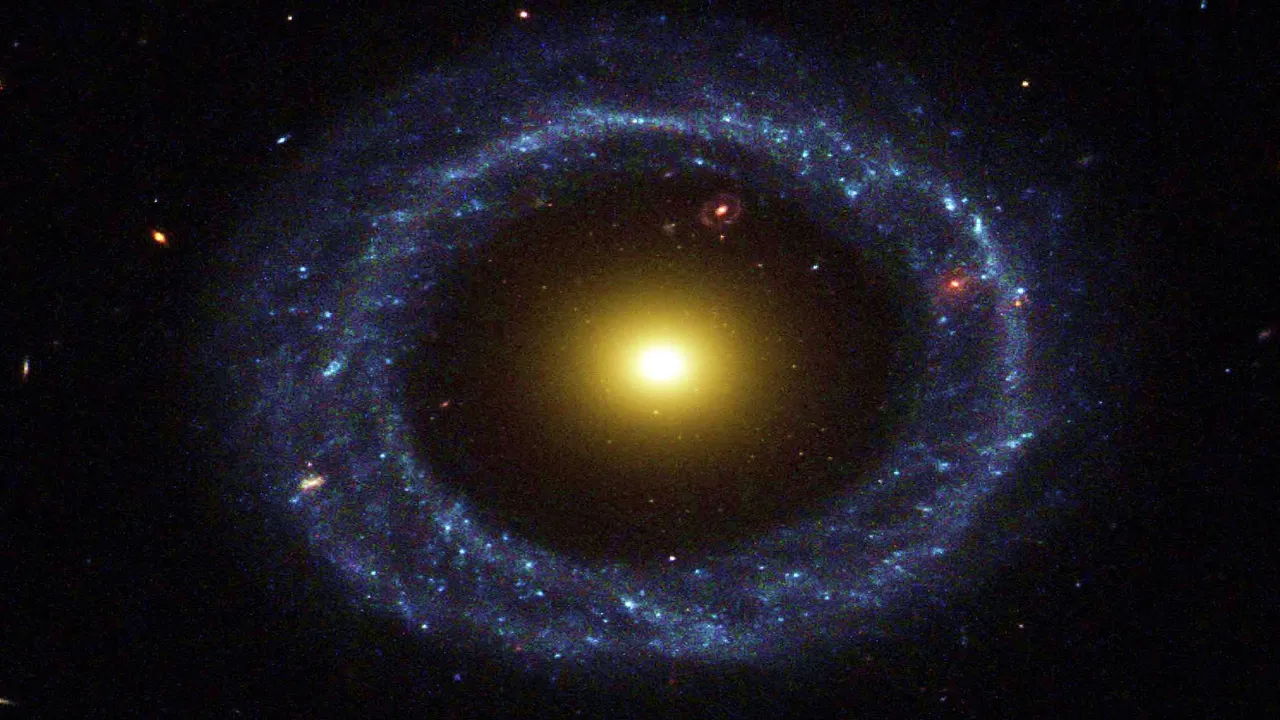
Well, crazily, we can still see those rings, not made of plasma or gas, but made of galaxies.
Before I show you what they look like, a note of caution: The story I just told you about the early development of these density fluctuations is far from the whole picture.
In reality, the density waves sloshed inwards and outwards.
Gravity pitted against radiation pressure.
Density everywhere oscillated with a rate of oscillation depending on the size of the initial fluctuation.
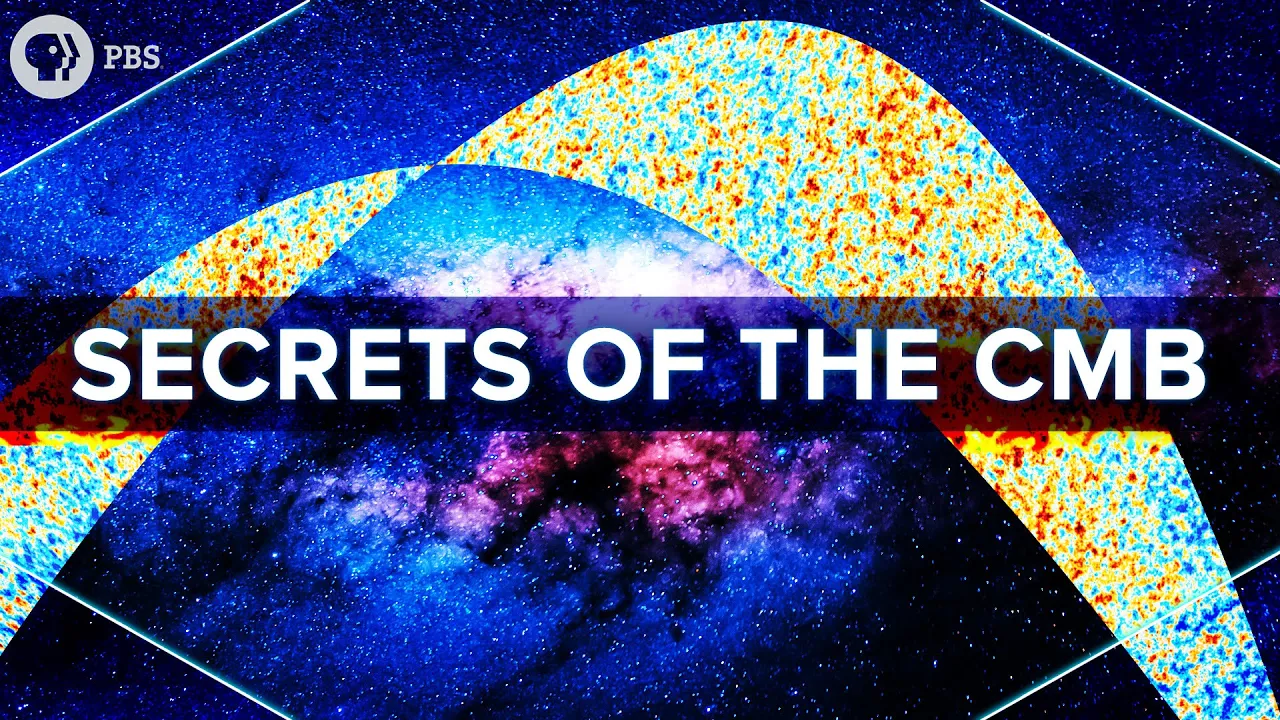
Those are the oscillations in the baryon acoustic oscillations, and the complex signature of that sloshing is imprinted in detail on the temperature map of the cosmic microwave background radiation.
That something will explore in a follow-up episode, because it is perhaps the most powerful tool we have in cosmology.
But today, we're gonna focus on this first outbound density pulse.
Then, what it looks like now in the arrangement of galaxies.
So, the acoustic shells at recombination overlapped in a complex web.
Those rings were further smeared out over the thousands of years it took for the universe to fully transition from plasma to gas.
Collapse that web into galaxies over the age of the universe, and at first glance, it looks like a random smattering of galaxies on the sky.
But the pattern is there.
Detecting it required the most detailed surveys of the heavens ever conducted: It required galaxy redshift surveys.
Redshift is just the amount by which a galaxy's light has been stretched as it travelled through the expanding universe.
The more stretching, the longer that light has travelled, and so the more distant that galaxy must be.
Redshift gives distance. And with careful measurements of galaxies' positions on the sky, a redshift survey can produce a three-dimensional atlas of the universe.
With a galaxy redshift survey in hand, how do you find patterns in what looks like a random splattering of tens to hundreds of thousands of galaxies?
Well, you expect that galaxies should mostly form in the centers of those primordial density fluctuations, where the dark matter was the most concentrated?
But you should also have a slight overabundance of galaxies at exactly 150 megaparsecs from those clusters.
Corresponding to the acoustic rings, everything is so hopelessly overlapping.
But here's what you do.
In your atlas of the universe, take slices of the universe, each slice a certain distance from us.
Within that slice, tally up the distances on the sky between every pair of galaxies.
You should see a lot of galaxies that are close together.
That's the clustering from the giant dark matter density peaks.
They should also see a slight excess of galaxy pairs with separations of 150 megaparsecs.
These are the galaxy pairs where one is at the center of the dark matter peak, and one is on the surrounding ring.
That bump seems small, but it's statistically very significant.
It's also exactly where we expected it to be.
This baryon acoustic oscillations signal was first spotted in 2005 by the Sloan Digital Sky Survey in the northern hemisphere galaxies, and the 2dF survey in the south.
Since then, the WiggleZ BAOs and 6dF surveys have improved the measurements/ Now, there was a powerful driving motivation to make this measurement and to improve it.
It was to confirm dark energy.
Dark energy was first discovered by using distant supernovae as distance measurements- to track the rate of expansion of the universe.
Those observations revealed that the expansion rate is accelerating due to an unknown influence what we call dark energy.
But such an incredible claim requires independent checking.
It requires an independent test of the expansion history. Enter the baryon acoustic oscillations.
See, we know exactly how big those acoustic rings should be.
Our understanding of the behaviour of the original baryon photon plasma is excellent.
So, we know how far the acoustic wave should have travelled before being frozen by recombination.
And we can confirm that prediction by looking at the patterns in the cosmic background radiation.
That means we know how big those rings were when they formed, and we can see how big they are at different points in the modern universe from our redshift surveys.
These rings give us a standard ruler on the sky, spanning all of cosmic time.
They allow us to track the expansion rate of the universe.
The baryon acoustic oscillations agree with and confirm what we measure using supernovae distances- The expansion of the universe is accelerating.
They confirm the existence of dark energy.
They also confirm the dark energy behaves just as is predicted by Einsteins cosmological constant.
It appears unchanging over time, just as we'd expect if dark energy is the energy of the vacuum itself.
Frankly, dark energy aside, just being able to see these patterns is cool enough for me.
I mean think about it. There are rings in the sky inscribed in galaxies, frozen echoes of the very first sound waves to reverberate across space-time.
Thanks to Google for supporting PBS Digital Studios.
Their mobile app 'Science Journal' lets you take notes and measure scientific phenomena, such as light, sound, and motion, using your phone, tablet, or chromebook.
You can find activity, ideas, and additional information on their website at G.CO/SCIENCEJOURNAL or check out the link in the description below.
Okay, so once again, we're covering comments from two episodes.
Today, it's the 'Crisis in cosmology' and 'Negative mass perpetual motion' episodes.
That Chess Guy has a fun one. To paraphrase: As the universe expands towards the infinite future, does that expansion outpace the probability of collapsing into a big crunch due to everything quantum tunneling towards a single point?
Well, the answer is- it depends on what size you consider. For the entire observable universe?
Almost certainly, there could be no quantum tunneling big crunch, but there is some smaller size that can eventually collapse that way.
Now, you need to wait 10^(10^25) years for the first quantum tunneling to turn iron stars into black holes, and way, way longer than that for anything larger.
Netist comments that, "It can't be real because it would break our current understanding of physics"...is hardly a good argument. Now, while I agree that this isn't a hard rule, it's a good guiding principle to be dubious of new theories that contradict extremely well tested old theories.
Remember that things like general relativity and much of quantum field theory are verified to stunning precision.
If a new theory says, "Nuh-uh, that all wrong", it better be able to also explain how those theories appear to be so right while being wrong.
Luis Aldamiz recalls the appropriate quote, "Extraordinary claims require extraordinary evidence."
Again, this is a guiding principle, and it helps scientists sort through the overwhelming flood of poorly thought-out "theories" that they get bombarded with all the time.
Seriously, I should show you guys my inbox one of these days.
Mr. Miller advises us to remember that the number zero didn't exist for thousands of years.
Ergo, time will prove negative mass' existence.
Well, first I'd say that the number zero existed, at least in a sense before we discovered it.
It's a common fallacy to draw analogies between revolutionary ideas that took a long time to prove or discover and fringe ideas that may or may not ever be proved.
Why? Because for every revolutionary idea that was proved, right?
There are countless of fringe ideas that were wrong.
You've never heard of those ones.
Not everything that we can imagine exists.
In fact, we can imagine infinitely more things than a real.
Still, it's worth looking into the wacky ideas for the tiny fraction that do spark revolutions.
But don't get too attached to any one of them.
flux_capacitor notes an alternate model for how negative mass might behave.
In so-called bimetric gravity, you can have positive and negative masses, but each is described by its own set of Einstein field equations.
That's kind of like having parallel spacetimes, one with positive and one with negative masses, which can still interact gravitationally.
In these models, like masses attract and opposite masses repel, but you don't get the crazy runaway motion that occurs if you put both positive and negative masses in the same spacetime.
So, no perpetual motion machines.
It can also be used to explain dark energy and dark matter.
An example is the Janus model of Jean-Pierre Petit.
This is a much more sophisticated model than the one by Jamie Farnes.
It is, however, just as speculative.
Okay, this is my favorite comment ever.
Adam Houlett asks whether these explanations might be any more understandable if the "actor" was actually knowledgeable, something-something, translation lost because the actor is more a pretty face than an expert.
Adam, you made me blush!
Normally, it's "He looks like a regular-sized Tyrion Lannister".
Seriously, every astrophysicists, like me, craves being mistaken for an actor and I feel like I've finally made it.
[PBS Space Time outro]
Up Next

121:10
Cosmology Lecture: Baryogenesis & Early Universe
@stanford
84.1K views•2013-03-17
61:17
First Billion Years of the Universe with the Square Kilometre Array
@iaaudc
121 views•2022-05-26
13:37
Starstuff: The Cosmic Origins of Elements and Supernova Chemistry
@pbsspacetime
480.3K views•2016-04-06
6:10
Gamma-Ray Bursts: Cosmic Snipers Explained | Astronomy
@kurzgesagt
15M views•2016-07-31
Related Study Plans & Knowledge Roadmaps
Structured learning paths in Astronomy
astronomy
Reionization: Pop III Stars, IGM & 21cm Line
01Foundations of Cosmology & the Early Universe
02Population III Stars & Cosmic Dawn
03Physical Mechanisms of Reionization
+ 2 more learning modules
17h5 modules
Explore Roadmap
astronomy
Planetary Rings: Dynamics, Roche & Resonances
01Foundations of Gravity and Orbital Mechanics
02Tidal Forces and the Roche Limit
03Structure, Composition, and Collisions
+ 2 more learning modules
10h5 modules
Explore Roadmap
astronomy
Asteroseismology: Stellar Waves, Ages & Cores
01Foundations of Stellar Astrophysics & Wave Mechanics
02Stellar Oscillation Modes: P-modes and G-modes
03Mathematical Framework of Asteroseismology
+ 2 more learning modules
35h5 modules
Explore Roadmap
astronomy
Adaptive Optics: Physics, Engineering & Control
01Foundations of Wave Optics and Wavefronts
02Atmospheric Turbulence & Optical Distortion
03Wavefront Sensing Technologies
+ 3 more learning modules
35h6 modules
Explore Roadmap