























All atoms in our bodies were created through stellar nucleosynthesis: hydrogen and helium formed in the first 20 minutes after the Big Bang, while heavier elements like carbon, oxygen, gold, and uranium were forged in the cores of massive stars and dispersed through supernovae explosions or neutron star collisions, making us literally 'starstuff' composed of material from ancient stellar furnaces.
Starstuff: The Cosmic Origins of Elements and Supernova Chemistry
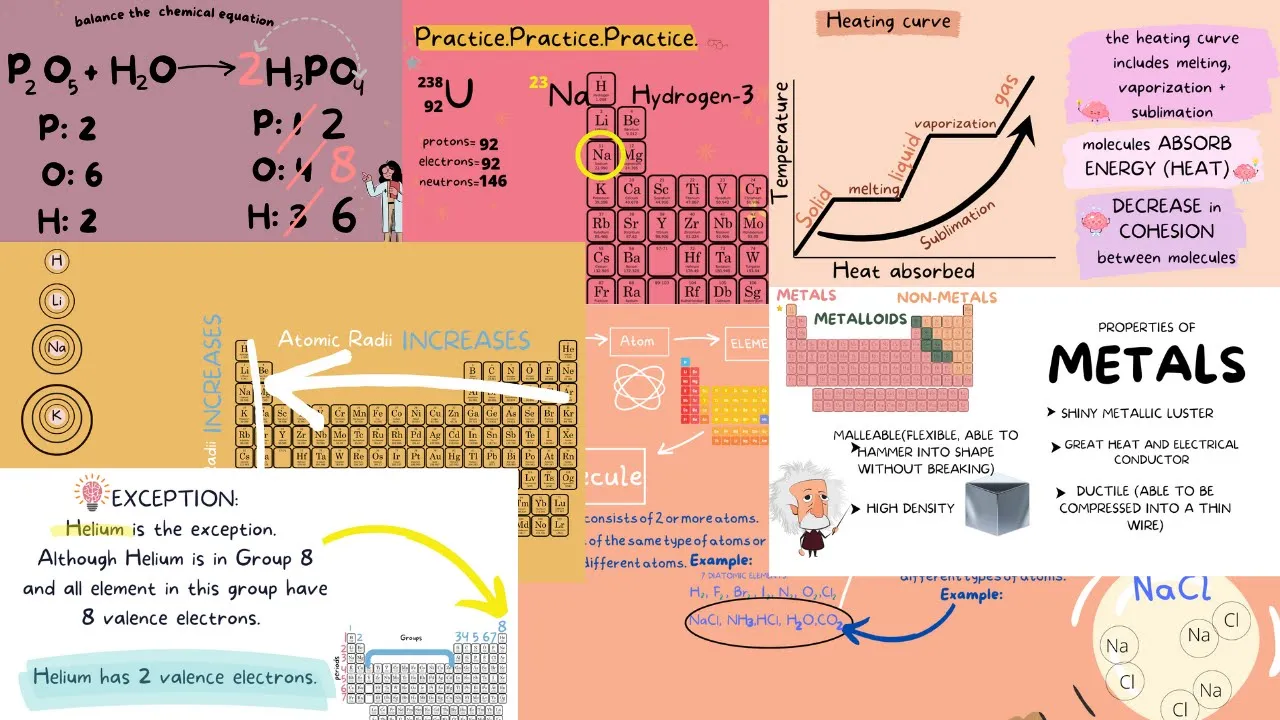
Added:Basic atomic structure, including protons, neutrons, isotopes, and how the periodic table is organized by atomic number.
The concept of nuclear fusion, specifically how high temperature and pressure overcome electrostatic repulsion to merge atomic nuclei.
The lifecycle of stars, including stages like the main sequence, red giant phase, and the basic mechanism of a supernova.
The foundational difference between Big Bang nucleosynthesis (creation of light elements) and stellar nucleosynthesis (creation of heavier elements).
The distinction between rapid (r-process) and slow (s-process) neutron capture pathways in synthesizing elements heavier than iron.
Astrochemistry and stellar spectroscopy, examining how scientists analyze light spectra to identify the chemical composition of distant stars and nebulae.
The concept of stellar metallicity and how it defines Population I, II, and III stars to trace galactic history.
Galactic chemical evolution models, which map how the abundance of heavy elements increases in the universe over successive generations of stars.
480.3K views11.6Klikes13:37Original Release: 2016-04-06
[MUSIC PLAYING] Carl Sagan said that we are "starstuff."
Most of the atoms in our body were forged in violent stellar alchemy and spread through the galaxy in past supernovae.
But the details of cosmic nucleosynthesis are even more mind blowing than you imagine.
[MUSIC PLAYING] We live in a complex universe.
Its raw gradients may seem simple.
Space, time, energy, mass.
These can all be described with chalkboard math.
Even the building blocks of matter, the elementary fields that fill our universe, and the particles that they manifest through their vibrations, these all lend themselves to mathematical representations that even our own limited minds can grasp.
Perhaps not fully comprehend, but at least deduce and manipulate with startling precision and predictive power.
But when those elementary particles start interacting to form nuclei, atoms, and molecules-- chemistry-- they result in levels of complexity that are soon beyond our capacity to model perfectly.
Of course, this capacity for complexity is what makes it possible for a universe to have things like planets, life, and minds to try to comprehend it all in the first place.
So the tapestry of our universe is woven across the dimensions of space and time and complexity.
What makes it possible for this universe to have such a depth of complexity?
Atoms and their interplay.
So, chemistry.
Every element on the periodic table is formed from nuclei of a defining number of protons.
Along with a similar number of neutrons, and beyond the nucleus, electrons swarm in their quantized shells.
Those shells are unique to each element, and they tell each element how it may bind to every other.
Perfect little Lego bricks.
The resulting vast array of permutations and combinations of these bricks is chemistry.
Respect the chemistry.
But how did this incredible and diverse selection of Lego bricks come into being?
Every single one of them, the actual physical stuff of your body, of the Earth, of everything you can see, was at one point forged in one of the most cataclysmic events in the universe.
Let's start with the simplest, hydrogen. Your body is up to 60% water, H2O, which makes you around 40% hydrogen by number of atoms, but only around 6% by weight.
The vast majority of that hydrogen has a lonely proton nucleus, a trio of quarks that found each other about a millionth of a second after the Big Bang and have been together ever since.
Aw, a romantic.
In fact, those protons will outlast almost every other nonelementary particle in the universe.
The secret of the success of this relationship is that it takes a lot more energy for those quarks to be apart than to be together.
A few seconds after it became possible for protons to exist, new heavier elements started to form.
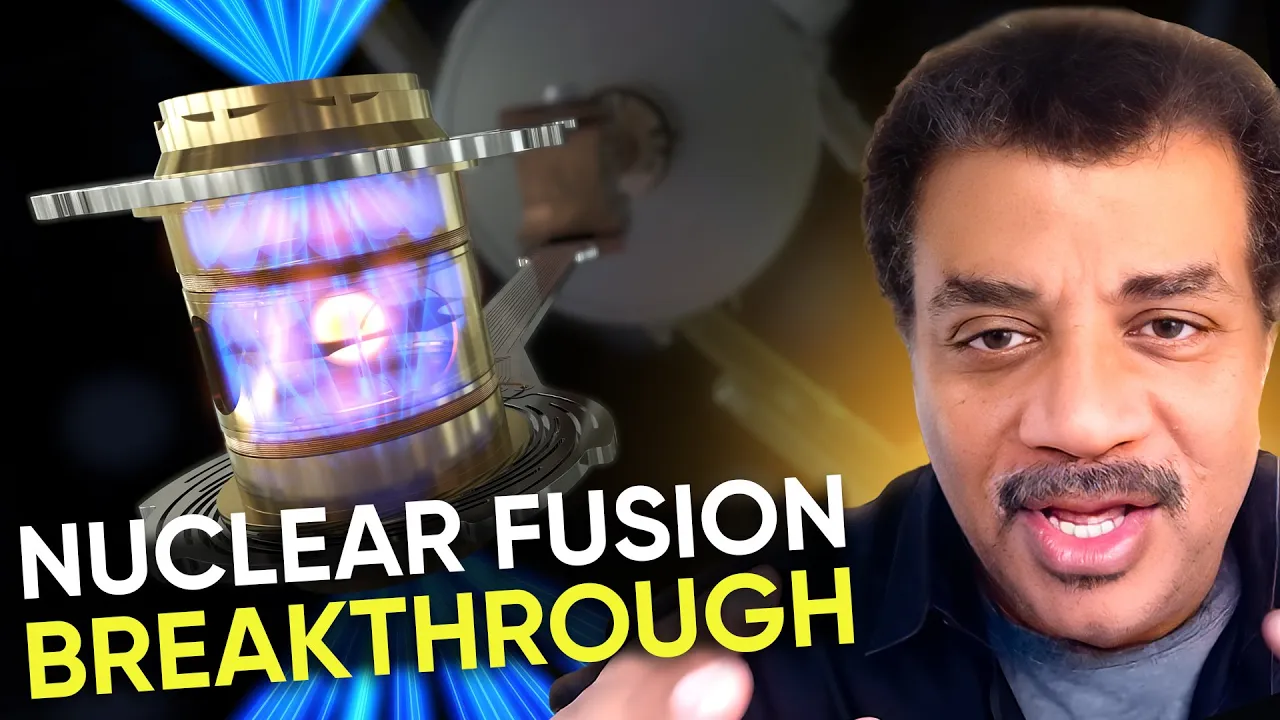
For about 20 minutes after the Big Bang, the entire universe was hot and dense enough for nuclear fusion, for protons to slam together hard enough to overcome the electrostatic repulsion between them, fusing them into helium-4 nuclei.
Two protons, two neutrons, 12 quarks, a complicated but very stable marriage of particles.
See, once these nucleon are close enough, the binding energy of the strong nuclear force is stronger than the repulsion of the electrostatic or cooling force.
The components are in a lower energy state together compared to when they're apart.
In fact, that helium-4 nucleus weighs less than the sum of the protons that went into it, and the difference is released in the form of light and neutrinos.
In those 20 minutes, 25% of the original protons were forged into helium with a touch of deuterium, lithium and beryllium.
This was the epoch of primordial nucleosynthesis.
And all of that hydrogen and helium would later become the fuel for the later formation of stars.
And stars are important.
As well as providing us with all of their glorious entropy-resisting energy, stars are element factories, stellar alchemists.
While the early universe had around 20 minutes to forge its nuclei, stars have millions to billions of years.
Our sun, and in fact every star in the prime of its life on what we call the main sequence, shines by forging hydrogen into helium.
In the case of the sun, when that process is finished, it'll puff out to become a red giant while its core shrinks and heats up to convert its helium into carbon and oxygen.
But that won't help the universe.
All that carbon never gets hot enough to fuse into heavier elements.
And in most cases, remains locked forever inside the final white dwarf.
In order to liberate the products of stellar nucleosynthesis, we need to explode that star.
When the largest stars, any bigger than around eight times the sun's mass, reach the ends of their lives, they become super giants, and their cores become hot enough to continue where smaller stars leave off.
Carbon is fused into oxygen, oxygen to neon, neon to magnesium, and so on up the chain to iron.
At the last moment of a super giant's life, it has onion shells of burning elements.
And each inner shell rages through its available fuel quicker than the previous.
Although the star took millions of years to burn through its original hydrogen core, when that core is entirely silicon, it burns through that fuel in only a day, leaving a core of iron.
At this point, we have a huge problem.
See, every single reaction previous had liberated energy, and kept the core hot and puffed up, outflowing radiation pressure, resisting gravitational crush.
But iron is the most stable of all nuclei.
You gain energy by fusing nuclei into it, but you also gain energy by breaking up larger nuclei to get iron by fission.
In order to go in either direction from iron, either increasing or decreasing the number of protons, you actually have to put energy in.
That means that as soon as iron starts to fuse, it sucks energy out of the star rather than adding to it.
So that iron core, once formed, can do nothing to prevent its own gravitational collapse.
And collapse it does, taking about a tenth of a second to collapse from around the size of planet Earth to the size of a city.
And the process makes it a neutron star.
And the surrounding onion shells of lighter elements collapse also, but they hit the brick wall of the newly born neutron star and ricochet back in the largest explosion in the universe, a supernova.
In this explosion, all those elements are spread into interstellar space, providing fuel for later stars to form.
And with them, planetary systems and life.
All of the main ingredients of your own body were fusion shells in past supernovae.
For more info on the elemental ingredients of life, you have to check out "It's OK to be Smart's" brilliant video.
But what about elements heavier than iron?
Until recently, it was thought that most naturally occurring elements heavier than iron were produced in that supernova explosion itself.
As the shockwave of the explosion rips through those infalling shells, neutrons are rammed into nuclei, producing lead, gold, uranium, all of the heavier elements of the periodic table.
The gold in your ring, the nickel in your nickel, and, in fact, a lot of the iron in your blood, was forged at the instant a star exploded, or are decay products from unstable elements formed in the explosion.
But was that explosion necessarily a typical supernova?
Actually, no.
When a white dwarf, a remnant of a low mass star like the sun, has a binary partner star and manages to accrete, to steal from it enough material, a runaway fusion reaction starts inside the white dwarf that completely obliterates it.
This is also seen as a supernova, and it also laces the galaxy with heavy elements.
Recent research actually points to a new possibility that's even more spectacular.
It may be that many heavy elements, including a lot of the gold in the universe, were formed not in a supernova, but in the collision of two neutron stars.
When two very massive stars in binary orbit leave behind neutron star corpses, those remnants will eventually spiral in as they radiate away their orbital energy in gravitational waves.
When they collide, most of their mass gets sucked into a newly born black hole.
But some also bursts out as gamma rays, as gravitational radiation, but also as a blast of newly formed heavy matter, including something like 10% of the Earth's mass in gold.
In conclusion, you're complicated, in a good way.
Our universe is an element factory, producing building blocks capable of becoming you in all your stunning complexity.
We are "starstuff."
But more, we our universe stuff, the most complex component that has risen from a beautiful and chaotic spacetime.
[MUSIC- KIM BOEKBINDER, "STELLAR ALCHEMIST"] In a recent episode, we talked about cosmic inflation, and you guys had some big questions in the comments.
A lot of you asked about what I meant by a flat universe.
And actually, this is something that I could have explained better in a few ways.
Let me clarify a few things about space geometry first, and I'll get to what flat means in a minute.
When I talk about the geometry of the universe and describe it as flat positive or negatively curved, I should say that the curvature of space at a single, constant moment in time has to be one of these three.
So constant time spatial curvature, which is different to the curvature of spacetime.
The time part is certainly curved, which leads to the expansion of space, even if the space part itself can be flat.
So what does flat space mean?
It does not refer to a universe that's pancake-like.
Space is still three dimensional, and perhaps infinite in all three dimensions.
Flat spatial curvature refers to the fact of the geometry of space on the largest scales in the universe works just like the geometry on a nice, flat 2D sheet of paper.
Parallel lines remain parallel, and the three angles in triangles add to 180 degrees, et cetera.
That stuff isn't necessarily true on a curved 2D surface like a ball, nor in curved 3D space, like within a gravitational field.
A few of you asked about my statement that the universe expanded faster than the speed of light.
How is this possible?
Well, the speed of light is an absolute speed limit for a thing in the universe traveling through space.
The limit doesn't apply to space itself.
General relativity allows that two patches of space can move apart faster than the speed of light.
And this didn't just happen during inflation.
It's happening right now in regions of the universe beyond what we call the Hubble Horizon, which is 13.7 billion light years away.
It's happening below the event horizon of black holes.
And if we haven't managed to build an alcubierre warp drive, well, it'll happen there too.
How much faster than the speed of light did the universe blow up during inflation?
Well, we can sort of answer that for two particles at opposite sides of the currently observable part of the universe.
They traveled about a millimeter or so in 10 to the power of minus 32 seconds.
So that's something like 10 to the power of 20 times faster than light.
mukul gupta asks whether the expansion of the universe will stop at some point.
Well, I'm glad you asked.
Guess what we're talking about next week on "Space Time?"
The end of the universe.
[MUSIC- KIM BOEKBINDER, "STELLAR ALCHEMIST"]
Up Next

43:21
Low-Mass Star Evolution: From Helium Flash to White Dwarfs | Astronomy Lecture
@philipsphenomenalphysics2948
383 views•2021-11-03
61:17
First Billion Years of the Universe with the Square Kilometre Array
@iaaudc
121 views•2022-05-26
18:10
Breaking the Eddington Limit: Early Universe Black Holes
@pbsspacetime
669.9K views•2024-12-05

6:10
Gamma-Ray Bursts: Cosmic Snipers Explained | Astronomy
@kurzgesagt
15M views•2016-07-31
Related Study Plans & Knowledge Roadmaps
Structured learning paths in Astronomy
astronomy
Reionization: Pop III Stars, IGM & 21cm Line
01Foundations of Cosmology & the Early Universe
02Population III Stars & Cosmic Dawn
03Physical Mechanisms of Reionization
+ 2 more learning modules
17h5 modules
Explore Roadmap
astronomy
Planetary Rings: Dynamics, Roche & Resonances
01Foundations of Gravity and Orbital Mechanics
02Tidal Forces and the Roche Limit
03Structure, Composition, and Collisions
+ 2 more learning modules
10h5 modules
Explore Roadmap
astronomy
Asteroseismology: Stellar Waves, Ages & Cores
01Foundations of Stellar Astrophysics & Wave Mechanics
02Stellar Oscillation Modes: P-modes and G-modes
03Mathematical Framework of Asteroseismology
+ 2 more learning modules
35h5 modules
Explore Roadmap
astronomy
Adaptive Optics: Physics, Engineering & Control
01Foundations of Wave Optics and Wavefronts
02Atmospheric Turbulence & Optical Distortion
03Wavefront Sensing Technologies
+ 3 more learning modules
35h6 modules
Explore Roadmap